
An issue of the Society’s newsletter, transcribed from the original. Download as PDF.
(11 pages, 872 KB)
Page 1
Canadian Society for Creative Leathercraft CANADIAN LEATHERCRAFT
Volume LIII No. 4 Summer 2005 0045-5121
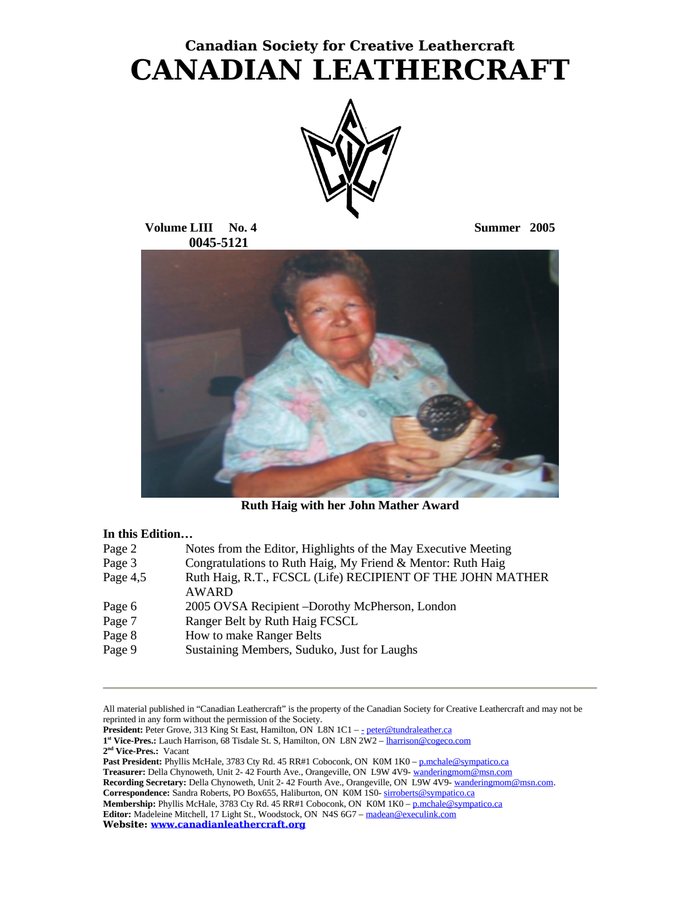
Ruth Haig with her John Mather Award
In this Edition…
Page 2 Notes from the Editor, Highlights of the May Executive Meeting
Page 3 Congratulations to Ruth Haig, My Friend & Mentor: Ruth Haig
Page 4,5 Ruth Haig, R.T., FCSCL (Life) RECIPIENT OF THE JOHN MATHER AWARD
Page 6 2005 OVSA Recipient –Dorothy McPherson, London
Page 7 Ranger Belt by Ruth Haig FCSCL
Page 8 How to make Ranger Belts
Page 9 Sustaining Members, Suduko, Just for Laughs
President: Peter Grove, 313 King St East, Hamilton, ON L8N 1C1 – - [email protected]
1st Vice-Pres.: Lauch Harrison, 68 Tisdale St. S, Hamilton, ON L8N 2W2 – [email protected]
2nd Vice-Pres.: Vacant
Past President: Phyllis McHale, 3783 Cty Rd. 45 RR#1 Coboconk, ON K0M 1K0 – [email protected]
Treasurer: Della Chynoweth, Unit 2- 42 Fourth Ave., Orangeville, ON L9W 4V9- [email protected]
Recording Secretary: Della Chynoweth, Unit 2- 42 Fourth Ave., Orangeville, ON L9W 4V9- [email protected].
Correspondence: Sandra Roberts, PO Box655, Haliburton, ON K0M 1S0- [email protected]
Membership: Phyllis McHale, 3783 Cty Rd. 45 RR#1 Coboconk, ON K0M 1K0 – [email protected]
Editor: Madeleine Mitchell, 17 Light St., Woodstock, ON N4S 6G7 – [email protected]
Website: www.canadianleathercraft.org

Page 2
Notes from the Editor…
With the temperatures this summer soaring into the thirties, CSCL members seemed to have taken the summer “off” for rest and relaxation – although a notable event for one of our Fellow members kept CSCL in the news. You’ll read more about Ruth Haig and her John Mather Award later.
Here’s what some of us did during our summer vacation…
Phyllis McHale sent an email announcing that we have a new member from Oshawa, and a renewal from Toronto. Her sister Della Chynoweth sent out the May CSCL Executive Council minutes in July – that’s OK Della, I didn’t get around to reading them until August.
Here at the Woodstock Branch, we did get our program organized (to start in September) after our annual
Potluck/Picnic at the beautiful home of Jean and George
Pickering.
New Fellow, Nancy Durham and I participated in a Museum “Camp” in Woodstock – we had 14 children 5 to 10 years of age learning how to make leather bracelets.
I honed my skills at a night school course on Web Site Design and hope to improve on CSCL’s web page…as soon as I find some time!
Summers always seem to escape much too quickly.
CSCL will be taking on new challenges starting with the
September Executive Meeting to be held September 23rd.
Canadian Society for Creative
Leathercraft
Highlights of the May CSCL Executive Meeting at the Tandy, the Leather Factory
Friday, May 27, 2005
CSCL projects in progress:
-Revision of the CSCL Constititution –any one having suggestions/comments can contact President Peter Grove
- Review of the Teaching Standards by Ruth Haig and Lauch Harrison -Lamour Library Boxes are now stored at The Leather Factory until they can be inspected and reorganized. (Anyone having library books in their possession – please return to any Executive member- NO
QUESTIONS, NO FINES!)
-Suggestion that an information card be attached to items that are being judged for an Annual to be pursued. Al Foss and Peter Grove looking at samples from other organizations.
CSCL Business:
-the 2005 Annual hosted by Woodstock turned a profit!
-Phyllis McHale has revised the Membership List and provided new lists to Executive members.
-the editor of the Bulletin to publicize our Sustaining members in the Summer Canadian Leathercraft.
Page 3
-Hamilton Branch already busy planning for the 2006 Annual:
-to consider recognition ribbons for all that submit an article for judging.
-to consider having judges available to critique an individual’s articles, privately.
-Phyllis Mchale suggested CSCL members check out web site of the International Federation of Leather Guilds at www.ifolg.org.
Congratulations to Ruth Haig!
Tuesday, June 21, 2005 was a memorable day for CSCL Fellow Ruth Haig along with her friends and colleagues who gathered together at the Wentworth Room of the Hamilton General
Library. Ruth received one of three medals sponsored by the family of John Mather, founding member and former Treasurer of the Ontario Crafts Council. Recipients are selected by OCC for long standing service to Crafts in Ontario.
Lauch Harrison, President of the Hamilton Branch of CSCL presided over the evening and introduced David McPherson
FCSCL who presented an overview of Ruth’s many contributions to the Craft world and particularly as an inspiration and mentor to CSCL and its members. (David’s presentation follows).
Rosalyn Morrison, Executive Director of Ontario Crafts Council, presented Ruth with the John Mather Award. Sarah Mulholland, Communications Director from OCC was also on hand to congratulate Ruth.
Ruth was eloquent in her acceptance speech. Many friends, co-workers, and CSCL members visited with Ruth following the ceremony and admired the display of Ruth’s leather articles and numerous ribbons, awards, and photos. Thanks to the Hamilton Branch for the organization, display, and refreshments at this memorable event!
Sarah Mulholland and Rosalyn The Hamilton Spectator
Morrison from OCC captured the event in the July 2/05 edition.
My Friend and Mentor: Ruth Haig FCSCL
I remember meeting Ruth back in the seventies and that began an adventure in excellent leather craft, rocky health, and always great humour. Executive meeting were livened up considerably with the banter of jokes between Ruth and Jack Meharg.
Ruth’s leathercraft workshops were amazing! She taught me techniques and skills I never knew existed. Always encouraging and patient.
Page 4
In the eighties, while I was CSCL President I planned to visit all the Branches. Ruth agreed to accompany me to the Norland Branch. We headed North on a lovely Friday afternoon and arrived about 6-ish at Hilda Chynoweth’s and were greeted by some Norland Members – by the time we had a meal and Ruth did some demonstrations and I talked with the group –it was nearly midnight.
Emma Windatt (Aunt Em) invited us to stay the night at her place in Fenelon Falls. Aunt Em said “Follow me” and took off like a bat out of Hell! We could barely see her tail lights in the dust clouds as we twisted and turned on those lonely country roads. Somehow, we arrived at Emma’s and settled in for the night. After breakfast the next morning, we set off back to Hamilton, bidding a fond farewell to the most northern Branch of CSCL. It was, for me, a trip I’ll never forget …
I remember visiting “Textures” and being overwhelmed with Ruth’s many superbly crafted articles. Each box or wallet had a personal touch, making each item a little treasure.
Ruth, you have always been generous with your gifts of teaching, problem solving, and laughter. I can’t think of anyone more deserving of the Mather Award. May you keep on doing wonderful leather…and laughing!
Your friend in CSCL, Madeleine Mitchell
RUTH M. HAIG, R.T., FCSCL (Life)
RECIPIENT OF THE JOHN MATHER AWARD
At the award presentation David McPherson expressed his warm thanks to Ruth for her encouragement to leathercrafters. He cited examples of how Ruth has played a front and centre leadership role. He then went on to read Ruth’s MATHER AWARD nomination statement as follows.
This year, the Canadian Society for Creative Leathercraft (CSCL) will celebrate its 55th anniversary – due in large part to the untiring efforts of Ruth Haig, Hamilton leathercrafter.
Leathercraft in Canada reached its zenith in the late 1950s with 276 CSCL members distributed among seven branches throughout Ontario. The charm and beauty of leathercrafting caught Ruth Haig’s attention and, in 1962, she joined the Hamilton
Leather Guild, Hamilton Handicraft Guild (now the Artisans Guild of Hamilton) and CSCL (all of which she later went on to serve in an executive capacity). Then, for 8 years, she studied leathercrafting at Adult Education classes taught by Hamilton’s renowned Irva Ford. CSCL interacted with the International Assembly of Leather Craft (IALC), situated in Buffalo, New York. The IALC disbanded in the 1980s, but prior to that, Ruth participated in these cross-border competitions and taught a workshop there.
This was during the Al Stohlman era when western style designs were in vogue, appearing on saddles, purses, belts and home décor items. They required intricate carving, manual strength, skill, tools, and heavy cowhide that retailed for 50 cents per square foot.
CSCL’s membership had begun to decrease dramatically as its membership aged. The western look had gradually faded from favour except in saddlery resulting in fewer people practicing traditional skills.
Meanwhile, Ruth assumed executive roles with CSCL (including that of president) and now serves as Chair of Teaching Standards thus helping to maintain a high level of excellence: Carve crisp clear lines! Dye evenly! Burnish edges!
Whereas Ontario leathercrafters had used soft leather to create vests, gloves and wearing apparel the new availability of synthetic leather-look fabrics allowed anyone with a home sewing machine to quickly create the leather-look. As well, inexpensive leathergoods began to flood the market. The market for traditional leatherwork dwindled further and CSCL’s annual booth at the Canadian National Exhibition, where Ruth volunteered committee time, was disbanded.
There were, however, several events that had a positive influence on leathercrafting in the province. One was the establishment of the Ontario Crafts Council (OCC) in 1976 and the opening of its retail location, THE GUILD SHOP, in Toronto. This focus on fine
Page 5
crafts helped shape the consumer’s appreciation of fine arts. That led to leatherworkers being defined as “artists”: a boost to the ego. Heavy leather sculpture, containers and masks came into vogue. These non-apparel items had a cleaner and streamlined contemporary appearance. Ruth adopted this new look in her work that retailed at
TEXTURES, Hamilton, craft co-op. This international artist’s involvement with
TEXTURES began, by invitation, in 1983 when she became a charter member of the combined-effort craft gallery in Hess Village. Because of Ruth’s support of fledgling crafters at TEXTURES many have successfully retailed their work there such as leathercrafter Lauchlin Harrison, Hamilton. He went on to receive a 2003 OCC Design Award and is now commonly known as THE MITT MAN.
Another positive factor influencing leatherwork in the province was the presence of the Haliburton School of Fine Arts. The establishment of HSFA provided an avenue for leather instruction and Ruth enrolled in several leather courses. There she studied wet and dry form boxes, her favourite technique, and went on to teach boxes at a Woodstock workshop.
Other influencing factors included the proliferation of medieval and historical re-enactment societies with their call for leather bustierres, gunpowder cases and mess kits.
The commissioning by museums of historic reproduction pieces such as leather firefighting pails also spurred an interest in leather. The helpful instruction given to would-be leatherworkers at friendly TANDY LEATHER stores, such as TUNDRA LEATHER, Hamilton, has brought in new members.
However, this craft has, in recent years, been declining in numbers while the price of cowhide has been rising to $8.00 or more per square foot. The public always expresses pleasure and surprise at exhibitions such as CSCL’s 2004 Biennial, Hamilton Public
Library, as evidenced in the GUEST BOOK comments: “Beautiful. Amazing, I didn’t know you could bake, laminate, hammer, nail, and saw leather!” In spite of physical limitations that now prevent Ruth from doing leatherwork, she continues as an honoured judge at CSCL competitions such as the 2004 Biennial and the annual conventions.
Ruth’s fine handwork has been recognized with numerous prizes and awards including: 20 CNE ribbons, Michigan Leather Award (1980), Irva Ford Memorial Award (Best molded leather, 1984), Robert Muma Memorial Award (Best tooled article, 1995), and numerous CSCL ribbons and prizes for excellence.
Throughout Ontario and also in Buffalo and Rochester, NY, Ruth conducted workshops – all the while enrolling in yet more leather courses under skilled crafters. She has long held the opinion that leatherwork should be a full-time course taught in community colleges and art schools.
Ruth has been a member of Ontario Crafts Council and Canadian Craft Council. She attended: the World Craft Conference, Vienna (1980); the Maritime Canadian Craft
Conference (1982); the World Craft Conference, Vancouver, 1986. Ruth was delighted to have her first woven belt selected for inclusion in an OCC travelling exhibition in the 1960s.
In 1986 the Canadian Society for Creative Leathercraft honoured Ruth with an
Honorary Lifetime Member Award and, in 2000, with an Ontario Volunteer Service
Award recognizing “OVER 35 YEARS SERVICE”. She has served faithfully and competently on craft guild executives and, as a strong advocate of crafting, her dedication continues, especially to the medium of leather. This Canadian heritage craft continues into the 2000s due, in large part, to the efforts of visionary people like Ruth.
For 43 years she has supported crafting on a local, provincial, national, and international level. Born in Mildmay, Ontario, in Bruce County in the early 1930s, Ruth
Page 6
became an x-ray technician and her work led her to Hamilton in 1960. In 1993 she retired as Director of Medical Radiography Services at DOFASCO Inc., Hamilton, after 23 years of employment. Ruth Haig’s lifetime dedication to, and exemplary support of, the arts makes her a most worthy candidate for THE JOHN MATHER AWARD.
(Written by Dorothy McPherson, Director CSCL)
Have You Renewed Your CSCL Membership?
Phyllis McHale, Membership Chair reminds CSCL members that the Annual fees were due April 1, 2005. If your membership expires you won’t receive the Canadian Leathercrafter or important CSCL information.
either contact your Branch Treasurer or send your $25 Annual fee (cheques payable to CSCL) to
Phyllis McHale,
3783 County Rd 45
RR#1 Coboconk, ON K0M 1K0
2005 OVSA Recipient…
Dorothy McPherson, London
Dorothy, a graduate of Alma College, began competing and retailing fine hand art when she taught fine arts for Niagara South Board of Education, Continuing Education. She later incorporated many of those design techniques into her leatherwork after joining the Canadian Society for Creative Leathercraft in 1990. Her work has garnered national and international acclaim.
In 1986 she began writing professionally and now continues more than 40 years of volunteer writing for organizations including CSCL. Besides writing leather feature articles she has successfully compiled 44 leathercrafters’ resumes for provincial and national awards. For two years she served as Canadian Leathercraft editor. Recently she received a CCAC (London) Certificate of Recognition for her volunteer community writing efforts with her healthcare newsletter MOBILITY NEWS.
Last year she added fine hand arts commentary to her newsletter and, to focus attention on Canadian fine hand art, she established TRC GALLERY, London. At the gallery, the work of 8 CSCL members was on display April through May: Madeleine Mitchell,
Marion Kehoe, Roselle Wallace, Allan Foss, Ray Clements, Lauchlan Harrison, and
David and Dorothy McPherson. The June/July/August exhibition, CANADA’s SPECIAL PLACES, showcases the Cascapedia River (salmon) Museum including metal art and Dorothy’s unique sea leather bracelets that have as their design element the natural contours of the fish.
She has served as Hamilton Membership and Woodstock Secretary. On the Executive Council she served as Corresponding Secretary and Director.
Her work, which has appeared in Ontario Crafts, has been recognized for excellence in design and presentation in group and solo exhibitions. At CSCL Annuals, Dorothy has shared her expertise through demonstrations and workshops on mache decoys and jewellery, and this fall will begin demonstrating leather dolls and masks. Dorothy, already a recipient of a 10-year Ontario Volunteer Service Award (Niagara Guild of Crafts), will receive an OVSA this year for 15 years service with CSCL.
Page 7
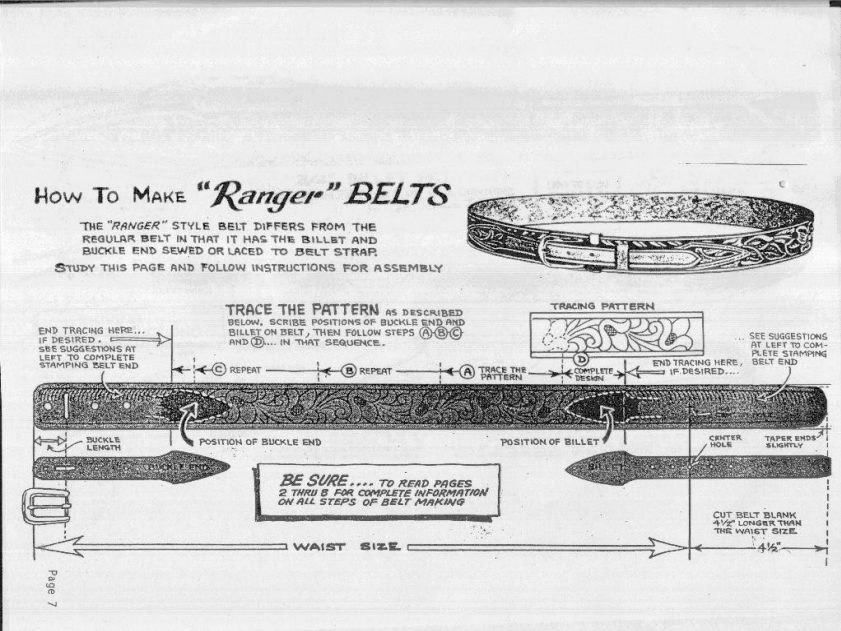
Ranger Belt by Ruth Haig FCSCL (Taken from the 1993 Canadian Leathercraft)
The History of the Ranger Belt
The ranger belt design came out of necessity. Range riders found that when they fastened their canteens, knives, ropes, etc. to their regular belts, the area where the tine of the buckle entered the billet end was appoint of stress. The destruction from wear at this point left an otherwise good belt body useless, except as a smaller size belt.
By adjusting the length of the body of a belt and stitching on the buckle and billet ends (both removable for replacements) this problem was solved and the new belt became known as the Ranger Belt.
Al Stohlman’s book, “Belts Galore” best describes the appearance and assembly of the Ranger Belt, with or without design. Our thanks to Al.
Tips before construction:
Before cutting the waist size, allow 6” extra as casing the leather causes shrinkage – more so in the latter years, with new tanning techniques. Casing the leather is a must. This is done by soaking the leather in tepid water with a mild detergent added, for 3-5 minutes. Do not rinse, wrap it in a towel, and place it in a cool area until the leather returns to a natural colour (barely damp), then proceed.
When putting a border line on the border, do it before a slight bevel is put on the edges.
Put a finish on the back before dyeing the front and edges.
Cutting Procedure:
From 8oz leather, cut a belt blank 1-1/4” x waist measurement + 6”. (1-1/2” may also be used)
From 6oz leather cut, cut the buckle strap 7” long by ¾” for a straight strap (allow 1 end taper as above, if you wish)
Using 6oz leather, make a keeper for the billet, 5/8” long, enough to fasten and slot the billet through. Use 6oz leather skived to half thickness, for the underside keeper, ½” x long enough for 1-1/2” coverage when finished.
Construction:
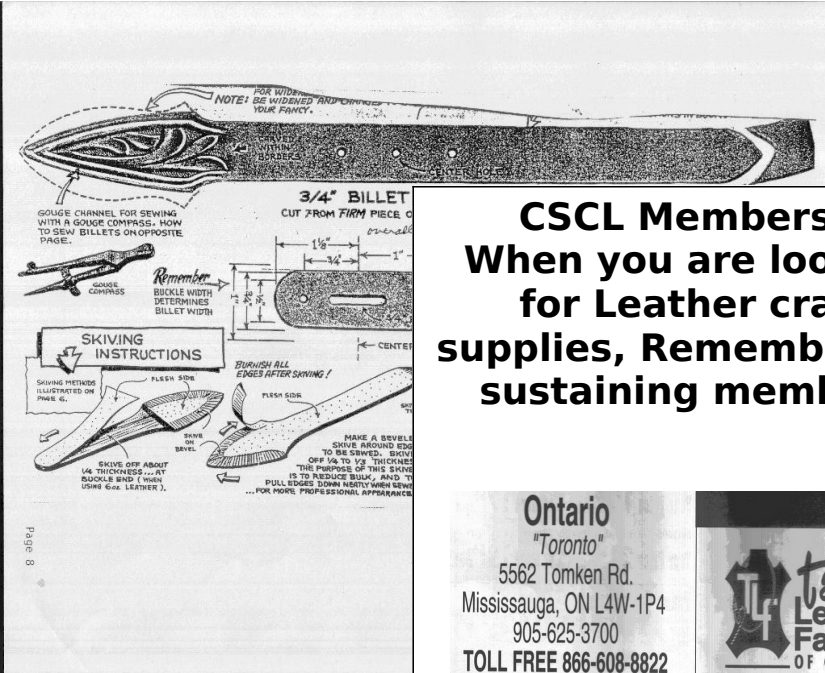
Skive as shown on the diagram. Mark grooving lines for saddle stitching. Groove the lines and using a diamond awl, punch the holes of the #7 stitching wheel. Using a rotary punch,
punch the holes on the buckle and billet ends as indicated on the instructions.
Page 8
The slot punch on the buckle end is along the length of the strap. The slot on the waist of the belt is across the length of the belt. Very important: This slot placement is determined by the length of the buckle, e.g. 1” long – 1” in from the end.
When all the holes and skiving and pattern have been carried out, slick the back of all pieces, except when glue is to be applied, then finish dyeing the edges and body of the parts. The billet end placement is now established, with the end of the strap at the end of the belt. (Any adjustment to waist size can be made at the buckle end with the slot.) When this is established, groove, mark stitch holes and proceed to stitch. For the buckle end, have both keepers ready to place between the rivets, the5/8” on top and the 1-1/4” on the bottom -. (see diagram). I usually assemble le this end by inserting the strap, with the buckle in place, into the slot, and set the first rivet at the end. Just under and behind the buckle is the1-1/4” keeper, stitching, or cemented end up, then a rivet. The 5/8” keeper on top of the strap, then another rivet. The innermost part of the strap, can then be cemented down and stitched.
These instructions are written in order of procedure. Study these and the assembly sheet carefully. If you take one step at a time, there should be no problem.
Taken from Al Stohlman’s “Belts Galore”
Page 9
CSCL Members… When you are looking for Leather craft supplies, Remember our sustaining members see: Antony Wohlgemuth
PS – Tandy, the above the game Leather is the very Factory easy level.
In Manitoba:
Have you tried Suduko? 104 King Edward St., E.
It’s the new internet numbers game Winnipeg, MB R3H 0N8 where numbers horizontal number all boxes 1 you and to 9 have without vertical, in all to the do repeating and lines, is put in the in a the 9 digit 204-775-4995 or Fax: Toll Just 204-775-8658 Free: Inside person, for 800-561-4995 Laughs every is a younger older in any line or box. Try it, using a pencil! person wondering what happened
Why do psychics 3 4 5 7 have to ask for your 5 8 3 2 6 name?
7 1 6 4 3 8 5 If you think nobody 9 4 7 1 cares, try missing a 7 8 6 couple of payments 5 7 2 4
2 7 5 6 1 9 3 3 7 5 1 8 1 4 6 7
If this game has caught your fancy, find more Suduko games at varying levels of difficulty at www.sudukogame.com

Page 10
Tundra Leather 313 king St., East Hamilton, On L8n 1c1 905-527-7745 Attention: peter grove [email protected]