
An issue of the Society’s newsletter, transcribed from the original. Download as PDF.
(11 pages, 519 KB)
Page 1
1
Canadian Society for Creative Leathercraft CANADIAN LEATHERCRAFT
Volume LV No. 4 Summer –2007 0045-5121
Peter Grove FCSCL, Hamilton Branch, demonstrating at the 2007 Annual
From the Left: Emma Windatt, Hilda Chynoweth, Della Chynoweth, Sandra Roberts, and Peter
In this Edition…
Page 2 Notes from the Editor, Notice of 2008 Exhibition & Workshop, TRC Gallery Page 3 Get Creative…and possibly win an award
Page 4 Annual General Meeting Highlights, Workshops Cancelled
Page 5Helping Out: some facts and figures – Dorothy McPherson, Leather Tips
Page 6,7,8,9 Splitting and Skiving Machines by Lauch Harrison, ACSCL
©2007 Canadian Society for Creative Leathercraft All rights reserved. Reproduction in whole or in part without permission of the copyright holder is prohibited.
President: Lauch Harrison, 68 Tisdale St. S, Hamilton, ON L8N 2W2 – [email protected]
1st Vice-Pres.: Phyllis McHale, 3783 Cty Rd. 45 RR#1 Coboconk, ON K0M 1K0 – [email protected]
2nd Vice-Pres.: Barbara Chynoweth,701-45 Balliol St., Toronto, ON M4S 1C3 –[email protected]
Past President: Peter Grove, 313 King St East, Hamilton, ON L8N 1C1 – - [email protected]
Treasurer: Della Chynoweth, Po Box 98, Brecken ON L9W 4V9- [email protected]
Recording Secretary: Della Chynoweth, PO Box 98., Breckon, ON L0K 1B0- [email protected].
Correspondence: Darlene Fry, 1296 Seaforth Cres., RR#3 Lakefield, ON K0L 2H0 – [email protected]
Membership: Phyllis McHale, 3783 Cty Rd. 45 RR#1 Coboconk, ON K0M 1K0 – [email protected]
Editor: Madeleine Mitchell, 17 Light St., Woodstock, ON N4S 6G7 – [email protected]
Website: www.canadianleathercraft.org Notes from the Editor…
Page 2
2
Have you noticed how fashionable Leather has become –again? Leather furniture has been around for years now, at somewhat more affordable prices, but now there seems to be a resurgence of leather clothing and accessories – desk sets, picture frames, office pieces, ottomans, storage boxes, and more CSCL’s main focus, in the years, I’ve been a member, has been both decorative and functional.
CSCL’ers have explored leather clothing (how about Sean Dalgetty’s Bustier) and accessories, footwear, book coverings, objets d’art, and household articles (I recall, a leather covered waste paper basket at one Annual). Things may not have changed all that much but the “Green” movement has made me think of leather in a different light.
Recently, I’ve been thinking about how leather is a great example of recycling and reusing. I still have a hard time tossing away a leather handbag, when there are changes in fashion. I still can see years of use in the old bag. Same thing with leather shoes. In many cases, I can’t bear to really toss leather away, so I take the pieces to the local Thrift Store. I put a bag of leather scraps out at a Garage Sale and was amazed how quickly those craft room scraps got picked up by the early morning bargain hunters. I’ve got enough scraps for another two or three bags –unless I find a project to make. CSCL is thinking of having an award for “Recycled” Leather. Give a few minutes thought of how you might recycle or reuse a leather article in a new, creative way – you could win an award! Examples of possible award articles are in this edition.
While at the Burlington Arts Centre attending the 2007 CSCL Annual, a good number of CSCL members had a chance to visit and view the Burlington Rug Hookers site. With springtime sun streaming through the windows, the hooked rugs and wall hangings took on a jewel-like essence, look for some pictures in this issue. Many Thanks to the members of the Hooker’s Guild.
Your input is always welcomed! The CSCL Newsletter will always find room for contributions of news, tips, questions –just contact me at [email protected] or write to Madeleine Mitchell, 17 Light St., Woodstock, ON N4S 6G7
Mark Your Calendars and start your Project for the 2008 CSCL Exhibition To be held at the Lindsay Art Gallery -April 2008. Details will follow in future issues of “Canadian Leathercraft”
Thanks to Lauch Harrison for the Hamilton Branch contributions to this Newsletter!
Contributions to the Autumn Newsletter will be from Mississauga Branch Deadline for submissions –November 1st, 2007
Visit The Reading Corner Gallery
Page 3
3
566 Newbold St. London For further information, contact Dorothy McPherson, TRC Gallery curator, 574 Cayley Drive, London, ON N6H 3G8. Open 9:00am to 5:00pm (519)473-6450 or email: [email protected] Featuring Fine Handart by Canadian Crafters
…possibly win an award for your efforts.
CSCL Executive Council has discussed adding some new awards for CSCL members.
Awards would be given out at the Annuals. Below are some of the new award suggestions.
All pictures from the 2007 CSCL Annual.
1.Jewelry:
Try bracelets, necklaces, ear rings, broaches, lapel pins, rings –use your imagination
1.Recycled leather: Include a before and after picture when possible.
Reuse,
Recycle,
Redo
Renew
Shoes
Sandals
Mocassins
Slippers
Boots
1.Footwear:
Can you come up with some innovative items for these categories?
You could be an award winner in 2008.
1.Miniature Doll House furnishings
Page 4
4
Furniture
Accessories
Floor Covering Book cases
Tables
Highlights from the 2007Annual General
Meeting
May 5, 2007
CSCL’s Constitution revisions have been approved by the General M e m be rs hi p!
If any CSCL member would like a copy of the revised Constitution contact any Executive Council member or Membership chair Phyllis McHale –Address are on the first page of this newsletter.
Pr e sid e n t' s Me ssag e – La uch lan Harr iso n ACSCL We lc om e a ll t o t he Can a dia n S o ciet y f or C re at iv e L e at h er Cr af t An nu al G e ne ra l me et in g, h ot e d b y M is siss a ug a. I wou ld l ik e t o ext en d g re et in g s t o ne w me mbe rs, v isit o rs f ro m ou t o f t o wn, corp o rat e pa rt ne rs a nd ou r me mb er ship. I am exc it e d t o h ea r th e wo rks h op s an d t h e d inn e r will b e w ell p op u lat e d a nd at t en da n c e is hi gh er th an la st y e ar.
As I be ga n r ev ie win g t h e ye ar a nd as se mb lin g my t h ou gh t s, I ha d t he f ee lin g o ur c r af t an d t he CS CL a re on t h e p at h to ren e wal a nd gr ow th. T h e w ind s of c ha n ge t h is wa y co me. W ha t give s me t h is ho pe an d l en ds c re d en c e t o t h is th es i s? Le t me sta rt by c h oo s in g so me sig n s cl os e to my ho me, w e h av e
Page 5
5 incr ea sed th e w or k ing me mbe rs in Ha milt o n, by o ne hu nd re d pe rce nt in t h e la st t wo yea rs. The re are re tu rn in g & ne w mem be rs in T or on to, an d No rla n d. Mis siss a ug a r un s wee k ly mee t in gs an d W oo d s to ck ho st ed a s u cces sf ul l ast e d b ox wor k sho p b rin gi ng int e re ste d n ew com ers t o o u r do or ste p. L ast bu t n ot le as t, th e vi sit or s f ro m O t ta wa ma y b rin g a ne w cha p te r to ou r soc i et y ou r so c iet y in bo t h f ig ura t ive a nd sub st an t ive way.
The We sto n Tr op hy Co mp et it io n h a d e nt rie s f rom eve ry cha p te r it h as b ee n a lon g w hil e s in ce o ur F ell ows h ave ha d t o lo o k a t so ma ny a rt icle s. W e a re t o ol u s er s, we ne e d t o u se o ur h an d s an d we ne ed cre at iv e ou tl et s t ha t co mp ut e rs can n ot sup pl y.
Wh en o u r cra ft u nit e s i ma gin a ti on a n d skill t o pro d uce art icl es of be au t y an d f un ct io n we are el eva te d i n sp irit. T ho se p iec e s are he re to d ay f or u s t o en jo y.
This A nn u al wi ll br ing ab o ut t he cu lm ina t io n of mo re th a n t hr ee yea rs wo rk on th e C on sti tu t io n a nd Byla ws, re s ult in g i n a n ef f ect ive an d mo re de mo cra ti c s o cie t y.
Let’s make our new members feel at home, by showing them our craft, our care and our respect for the medium.
Norland Branch Three Workshops-September 22 At the Old School Hall
3448 County Road 45
Norland Ontario
Hamilton Branch table at the 2007 CSCL Annual
HELPING OUT: some facts and figures by Dorothy McPherson
This is the8th year that leather crafters willbe among 9,000 Ontarians honouredin45 Volunteer Service Award ceremonies across the province for continuous years ofservice witha community group suchas the Canadian Society for Creative Leathercraft. There are 45,000 incorporated, non-profit groups in Ontario activein health, recreation, the arts, social services, newcomer settlement, education, religion, the environment and other fields.
Statistics Canada shows that86 percent of Ontarians volunteer while the national averageis only 83%. Statistics Canada values Ontario volunteer time atover $10 billion annually. Yes, Over 5million Ontarians volunteer yearly contributing over 800 million annual volunteer hours— equivalentto more than 400,000 full-time jobs. The Ontario Volunteer Service Awards area way for the government torecognize volunteers for their undeniable contributions. The awards are alsoa wayto thank volunteers for their continuous yearsof commitment and dedicated service toa group. Youth volunteers (under the ageof 24) are recognized for twoor more years ofcontinuous service. Adults are recognized for5, 10, 15, 20, 25, 30,40 (newin 2004) and50 yearsof continuous service.
Page 6
6
Membership aloneis not aqualification for recognition. It is necessary tohave held officein the organizationat the localor national levelor have performed some active, on-going, unique or outstanding serviceto the group.
Non-profit groups that have beenin existence fora minimumof five years may completea nomination form. Until this year, 2007, each group was allowedto nominateupto six volunteers each year. However, beginning this year,to encourage more youth nominees, organizations may nominateupto seven volunteers (at least oneof the nominees mustbea youth). Organizations nominating only adults are still limited tosix nominees. Also new this year, the first June Callwood Outstanding Achievement Award for Voluntarism willbe presentedat select ceremonies.
Each CSCL branch may nominate6 adult volunteers each yearif they sowish. However, noneof the CSCL branches electedtodo the required work of contacting their members who are potential nominees, collecting biographies, and submitting the necessary paperwork.As a CSCL Director,I prepared nomination biographies for 43members. Some people who were eligible declined the nomination for various reasons.
How are the awards presented?A recipient is presented witha stylized trillium pin and personalized certificateata government ceremony. Usually the local MMPison the platform tocongratulate recipients and present the awards. Pin and certificate correspondto the lengthof service being recognized: The fifty-year pin has turquoise and diamond stones;40is ruby; 30is diamond;25is amethyst. The5, 10, 15, and 20-year pins just have the numbers onthem, nostones. Usually, recipients receivean invitationto attend the ceremony with one guest. Each organization makinga nominationis also invitedto have two representatives attend the ceremony. If anominee cannot attend the ceremony the government will mail the certificate and pin after the last provincial ceremony has taken place.
So,ifa member has never servedon any CSCL executive, either locally oron the Executive Council nowis the timeto begin. Branch presidents should check with their members and offer apositionon the local executiveto anyone who hasn't yet served. Byrotating the jobs, everyone whois willing toserve has anopportunity todo so. Members-at-large whodo not havea local branch can join, and support, any nearby branch. They can also serve onthe Executive Council.
Although volunteeringis rewardingitis always niceto receive recognition for your efforts and have someone say "Thank you." The names of this year's nominees, Paul Kitchener and Miles Roberts, have been addedto CSCL's list of OVSA recipients: Robert Dengler/Ruth Haig/Dorothy
Muma/Sadie Roebuck/Nora Huyck/Jessie Little/Marion Kehoe/Gladys Riddell/May Corbett/Betty Heacock/Mildred Kemp/Hilda Chynoweth/Loreen Manuel/Carol McLean/Dorothy Stanton/Muriel Strongman/Irene Girling/Beula Reynolds/Laura Bush/Betsy Rennie/Jack Meharg/Della
Chynoweth/Madeleine Mitchell/Emma Windatt/Harry Wendland/Don MacLeod/Kevin Armstong/Phyllis McHale/Carol Broumley/Nancy Durham/David McPherson/Dorothy McPherson/Allan Foss/Cindy Magura/Keven Magura/Marian Sim/Lauchlan Harrison/Heather Atkinson/Sandra Roberts/Marilyn Harry/Barbara Chynoweth/Paul Kitchener/Miles Roberts.
Leather crafting Tips…
From Robert Muma FCSCL & Charter Member CSCL “When Morocco has been rubbed down until surface is smooth and shiny, moisten surface and stiple, using a stiff-bristled brush to strike the texture back into the morocco. You have to have a staccato movement – the brush has to bounce. This is best done while the leather is still moist”
From Gladys Riddell FCSCL “When you have chosen a piece of leather for a pattern, check the piece thoroughly for blemishes, holes and other flaws. Mark these on the flesh side with a pencil or pen dot. On the top side, stick a straight pin into the blemished area to give yourself a guide to work around.
There are always some marks that do not show well, and another system can be used to find them.
Take some very diluted Antique Golden Tan dye, and wash it over your leather and let dry. The flaws will appear clearly and the diluted dye won’t affect the eventual colour of the article.”
Splitting and Skiving Machines by Lauch Harrison ACSCL
The splitter is used to reduce the thickness of leather. The skiver is used like a splitter but it can also taper the split to a fine edge. The leather is pulled over a roller past a stationary blade, The blade is then able to cut across the work piece in a very controlled manner.
The earliest American production models were made in New Jersey by a number of Makers and Inventors in the middle of the 19th century. There have been many different configurations of blades
Page 7
7 and frames but the Osborne/Randall style seems to have had the right stuff as the machines made today follow the same principles and look very similar.
The Blade
The blade must be sufficiently thick that it will not distort when it is under heavy stress. The blade can be made in several different ways, laminated or all tool steel.
Laminated steel blades – the cutting edge is fine tool steel and the back of the blade is a milder steel. The tool steel would have a higher carbon (0.7% and 1.4%) content making the steel much harder, but rendering it more likely to chip and shatter if it was misused or dropped. The high carbon steel is required to hold the edge.
The blades can be hollow ground, this allows the user much more ease when sharping, as just the cutting edge and the back edge touch the stone. I’ve seen hollow grinding on both sides of the blade (HF Osborne #615). This speeds the process allowing just the cutting edge to be worked. Flat ground blades are great until a large nick has to be removed, if the blade is tool steel, the job is labouriuos.
Look for unpitted steel and blades that are wide enough to permit the resharping. Laminated blades must be more than 1 1/4” wide otherwise the edge has been consumed and the blade can not be sharpened. The blades made with tool steel can be sharpened all the way through the width of the blade.
The Frame can be cast iron, cast steel or welded mild steel, each has advantages. In the case of the cast iron, the least expensive, frames can be made lighter and more open, cast iron is very stiff and has many impurities, making the frame prone to shattering. Cast steel has the strength and the malleability to allow open lighter casting and resistance to breakage. The Welded frame is generally very tough, but it is heavier. Look for the absence of cracks, welds or broken pins or rivets. A highly pigmented lacquer -Japan that was put on in layers and polished was used to prevent rusting. Pitting, rusting and loss of Japanning will not affect the usability of the machine. Make sure all the parts and screws are present.
The Roller should be smooth and even, pitting is not a critical concern to the operation of the machine. More important is the gap between the blade and the roller, if the skiver is used mostly for strap widths less than 1 1/2” the gap can be larger on one side than the other. When splitting wider material, the gap must be very regular across the machine to prevent the strap from casting over towards the side with largest gap.
The Wishbone is spring steel, slightly higher carbon content than mild steel, tempered to hold it’s shape. The spring allows the roller to be opened to insert the strap, the tension pushes the roller towards the frame holding the strap in the same place for repeated splits. Look for the absence of cracks, and make sure the spring is still able to close the roller. Some makers marks are under the wishbone spring (CSO #86)
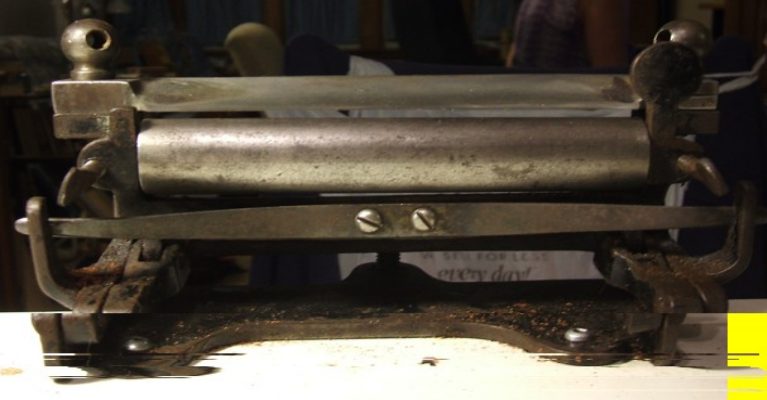
HF Osborne 6” Splitter
In 1874, Patent No. 179948, for a leather splitting machine was awarded to HF Osborne
Page 8
8
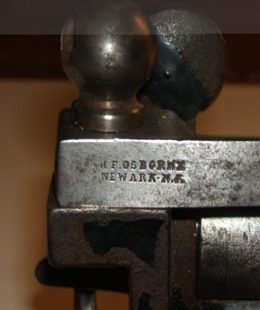
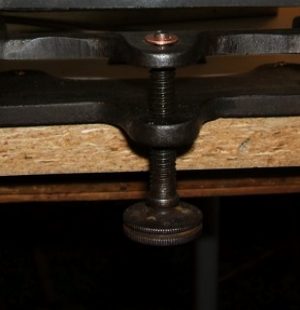
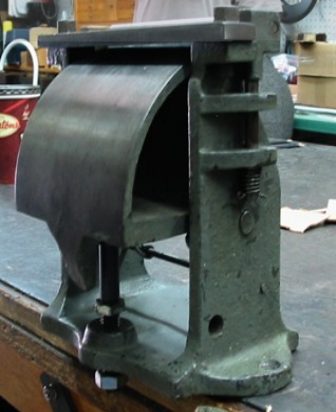
An 1891 H.F. Osborne catalogue, lists this tool as a "615 -- Knives, New Pat'n, Iron Frame". It also was available in sizes from 5", 6", 7", 8", 9" and 10" sizes. The distinguishing features are the castings are shaper than CSO #86 and the bump outs that hold the wishbone are cast pieces riveted on to the sides of the frame. This splitter has pad screws for the blade hold down. Most harness makers would have pad screw pliers in their kit. The thickness adjustment is made with a large knurled disc that protrudes down from the back of the splitter. This blade is clearly marked "H. F. OSBORNE NEWARK N.J." and "TRADE OPT MARK" (OPT is Osborne Patent Tools). Cost is $175 - $275 usd
Collection of Lauch Harrison
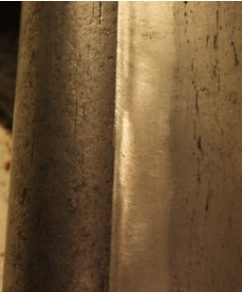
The differing steel colour and texture can be seen in the photo on the left, as the edge fades back to the milder steel, the roller is on the left. the frames were coated in Black Japan a highly pigmented lacquer, some frames may have 80% or more of the original finish.
CS Osborne 8 inch Keystone #84
In 1883, CS Osborne is Listed as assignor of Patent No. 274921, Lap Shaving and Splitting Machine, by David Dixon.
This is the most popular style of Splitter/skiver, the handle moves the blade, this allows the worker to pull the strap thru as the gap is closing, giving a taper skived edge. The #84 has a spring loaded stop screw that sets the machine up for repeated skives or splits. Pad screws are used for the blade hold down. This machine was made in Newark New Jersey before the turn of the Twentieth Century.
collection of Lauch Harrison. Cost $250 - $450
Page 9
9
Heritage #84 Skiver/splitter (modern)
Heritage #84 (a work horse) on the bench at Tundra Leather. Collection of Peter Grove
Modern #84 Lap skivers are made by Randall-Bosworth Keystone #84 ($565 usd) and Craftool Professional Leather Splitter (Tandy $575 cdn)
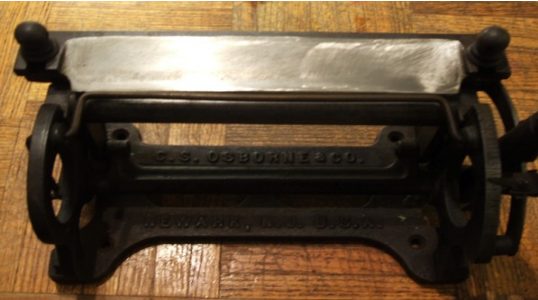
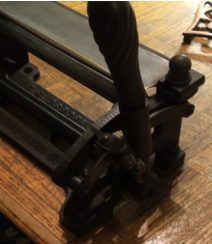
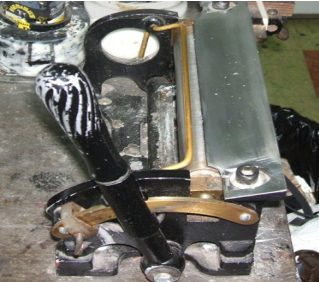
CS Osborne 6 inch #86
The #86 splitter is the most common splitter s still made today. The 2001, C.S. Osborne & Co. catalog #59 illustrates an almost identical 6 inch splitter design, with modern hardware.
Page 10
10
The blade is stamped "EST'D 1826" inside a rectangle and "C.S. OSBORNE & CO."
A late 1880's vintage C.S. Osborne catalogue lists this tool as a, No. 86. Iron Frame Splitting Machine, made in sizes 5, 6, 7, 8, 10, 12 inches.
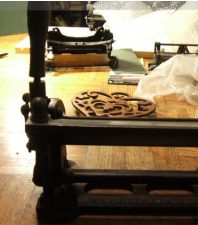
Note the pins that hold the Wishbone, and the thumb screw.
Collection of the saddle tool dudehttp://home.att.net/~saddle_tool_dude/ Cost $150 -$300 US
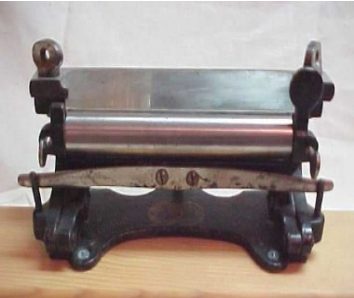
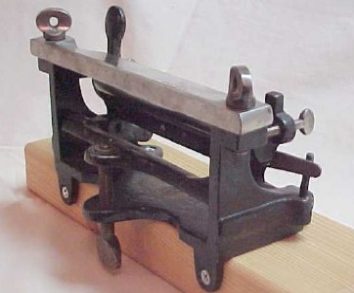
Randall 6” Lap Skiver
In 1888, the Patent No. 391190, was issued for a Leather-Skiving Machine, by Silas H. Randall, of Wyoming, Ohio. James D. Randall, listed as 1/2 assignor. The Randall lap skiver uses a concentric cam to close as the leather is pulled through the skiver, the gap closes up in a very controlled manner allowing the repeated skive. Saddle Skirt weight leather strap can easily be given a 4” - 6” long taper. This machine sells for $250 $500 usd
There are many types and maker of splitter/skivers, each has advantages. Look for solid castings and good blades. When you decide to get one you will find that you will use more of the old leather down in the workroom because now you can split it down to a more useful thickness. With this kind of thinking you can convince yourself that you are saving money (sic).
Please call if you have questions about old machines and tools.
Page 11
11
Yours sincerely, Lauch Harrison