
An issue of the Society’s newsletter, transcribed from the original. Download as PDF.
(9 pages, 860 KB)
Page 1
1
Canadian Society for Creative Leathercraft CANADIAN LEATHERCRAFT
Volume LVII No. 1 Autumn 2008 0045-5121
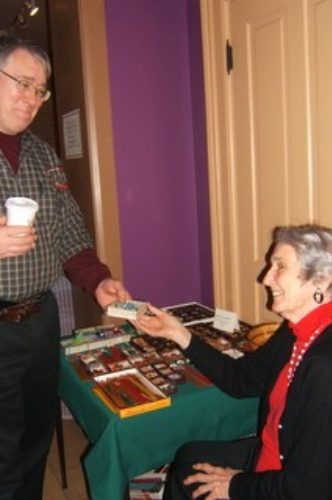
Lauch Harrison and Marion Kehoe at Woodstock Museum Sale
In this Edition…
Page 2 Notes from the Editor, Highlights from the Executive Council Meetings…
Page 3 Tributes to Dorothy Muma FCSCL
Page 4 Lasting Lasts by Lauren McPherson
Page 5 Woodstock Museum Host Annual Christmas Craft Sale, Jewelry Workshop –Part 2 Page 6 Christmas Crafts from Tandy Leather
©2008 Canadian Society for Creative Leathercraft All rights reserved. Reproduction in whole or in part without permission of the copyright holder is prohibited.
President: Phyllis McHale, 3783 Cty Rd. 45 RR#1 Coboconk, ON K0M 1K0 –[email protected]
1st Vice-Pres.: Barbara Chynoweth, 701-45 Balliol St., Toronto, ON M4S 1C3 –[email protected]
2nd Vice-Pres.: Paul Kitchener, 885 Rangeview Rd., Mississauga, ON L5E 1H1 –[email protected]
Past President: Lauch Harrison, 68 Tisdale St. S, Hamilton, ON L8N 2W2 – [email protected]
Treasurer: Della Chynoweth, Po Box 98, Brecken ON L9W 4V9- [email protected]
Recording Secretary: Della Chynoweth, PO Box 98., Breckon, ON L0K 1B0- [email protected].
Correspondence: Darlene Fry, 1296 Seaforth Cres., RR#3 Lakefield, ON K0L 2H0 – [email protected]
Membership: Tracey Howard, RR#1 2316 Conc Rd. A, Brecken, ON L0K 1B0 – [email protected]
Editor: Madeleine Mitchell, 17 Light St., Woodstock, ON N4S 6G7 – [email protected]
Website: www.canadianleathercraft.org
Page 2
2
Notes from the Editor…
As I write this, the snow is gently falling…what! It’s only mid-November! It’s still Autumn; there are still leaves on the ground that never got racked – I haven’t started my Christmas shopping yet. What’s happening? Well it’s a symptom of getting older I think, everything seems to take longer.
If you are thinking of Christmas, have a look at the creative ideas in this issue, contributed by our friends at the Norland Branch. Thanks, Phyllis!
Newer member of the Woodstock Branch, Lauren McPherson, provided an article about “Lasting Lasts” –be sure to have a read. The “lasting” machine revolutionized the shoe industry.
Other Woodstock Branch members contributed parts of this newsletter as well.
Read about the Woodstock Museum Craft Sale with connections with Hamilton and Norland.
Your CSCL Executive Council has met in September and October and started planning the new season for CSCL activities. See the highlights from these meetings on Page 2.
Watch for the notice for the Winter Workshop with Paul Kitchener, Leather Jewelry Part 2.
With sadness, CSCL learned of the passing of Charter Member, Dorothy Muma
FCSCL. You’ll find tributes to Dorothy in this edition. Walter Muma, son of Dorothy and Robert has a wonderful website for Robert at www.mumart.ca
CSCL is planning a second Jewelry Workshop for March 21, 2009 –circle the date on your 2009 calendar.
Contributions to the Winter Newsletter will be from Hamilton Branch Deadline for submissions –February 15, 2009
Highlights from Executive Council Meetings…
September and October 2008 highlights--CSCL would like to have a Workshop Co-coordinator to plan and organize future workshops.
Madeleine Mitchell to take the position as of January 2009. She will start by writing some guidelines and present to the Executive
-much discussion about “Junior Members” – a change will be required to the constitution and that can take up to 2 years. In the meantime, we will follow the current constitution statement that “A General Member who is a registered full-time student shall pay one-half of the annual fees”
Currently, $12.50 is half fees.
The Membership pamphlet will include a “Student Member” fee. Also CSCL will look into charging only $5.00 per student and having CSCL provide a $7.50 bursary, from a donation.
-as mentioned above, CSCL received a generous donation from a member, who prefers to remain anonymous. Paul Kitchener, Peter Grove, and Jim Wilkes have volunteered to look at how this donation can best to be used. They will report back at future meetings.
-Toronto Branch President, Barbara Chynoweth is already working on plans for the 2009, details will be presented as available.
Lauch Harrison, Sean Dalgetty and Peter Grove have demonstrated “Belt Making” at the
Burlington Arts Centre.
Page 3
3 -CSCL continues to explore how to attract new members, including high tech avenues such as through the Website and the Internet. Suggestions from all members welcome –contact your Branch President or any Executive Member or email to [email protected]
Dorothy Muma FCSCL passes away in Toronto
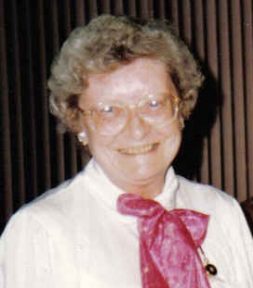
Dorothy Muma, a well-known leathercrafter and Charter Member of CSCL passed away November 15, 2008 in Toronto after a brief illness and a long and full life. Dorothy and her late husband Robert were among the organizing members of CSCL in the early 1950’s. Being very active in CSCL, Dorothy held many offices including President, Treasurer, Chair of the Council of Fellows, and Director. She was instrumental in the writing of the CSCL Constitution and later the amendments and revisions. Dorothy Muma will be remembered and missed by many CSCL members and forever connected to CSCL.
From Carol McLean FCSCL:
“C.S.C.L. was very near and dear to Dorothy’s heart, having been in at the inception of the Society. She knew the aims and criteria of the Guild like the back of her hand. She had a sharp, business-like mind and could relate dates and events with seemingly little effort. She could quote from Executive Minutes from previous years with total accuracy. She loved “order and organization” in everything she did. That made her a tremendous treasurer, chairman, president, mathematician and statistician. For most of her years on the Council of Fellows, she served as the person who did the tabulating of the judging numbers which involved the “weighting” of the figures to the specific category being judged. She also served as secretary on the Council. She loved protocol and procedure and kept us “on track” at our Fellow Meetings. She could remember when specific prizes were to be awarded and who each donor was and who the recipients had been in years past.
Most of the meetings of the Council of Fellows were held at the Muma home until Dorothy’s health became such that we felt it was too hard on her, although she never complained.
We were always welcomed into Bob and Dorothy’s home with a friendly greeting and a hug. After the early morning drive from Woodstock, plus the stress of the morning Toronto traffic rush, it was a place of calm and warmth,…a haven. Judging was always a formal affair and taken very seriously. It was always a time of learning for everyone. A business meeting was held before the actual judging and then the articles for the different categories were set out on tables. Judging followed, using the marking sheets set out for us. She always had clip boards and sharp pencils, with erasers, ready for each of us. These sheets (signed by each judge after marking took place) were then handed to Dorothy so that she could do the tabulating of the marks.
We always took our lunch along and broke for it at noon time. Dorothy provided the tea and coffee. We would then join our hands around the table in a Circle of Friendship while a short prayer was said before we ate and visited over our lunch. Judging was resumed after lunch and we tried to have it completed before the afternoon traffic rush began for our trip home.
She was so proud of Bob’s work and displayed it on the fireplace mantle with great pride. We were able to enjoy it each time we went there. [Editor’s Note: See Robert Muma’s work at www.mumart.ca set up by son, Walter
Muma]
One of Dorothy’s spheres of interest was tooling and modeling leather. She showed us handbags and wallet/key case sets that she had made. The work was so beautifully done and very precise; as one would expect.
She was so good at organizing conferences of the Society. Some were held at the Park Plaza in downtown
Toronto for the IALC. But she did it all with such ease and excellence.
Page 4
4
We will miss her guiding hand on so many aspects of C.S.C.L. She cared for the Society with a deep and abiding passion. Thank you Dorothy, for all that you have contributed to the Society for so very many years. We owe you so much. Your friendship meant a great deal to so many of us.” Respectfully submitted,Carol McLean FCSCL From David Windeyer:
“I am glad to add my comments about Dorothy. She certainly was a character… when judging the leather items.
But, she gave me a 90 on a small box many years ago and so I was happy with that.
I did deal with her in a business matter when she was on the board of a foundation set up many years ago by a Quaker. She was a stickler for detail and very knowledgeable in this area”.
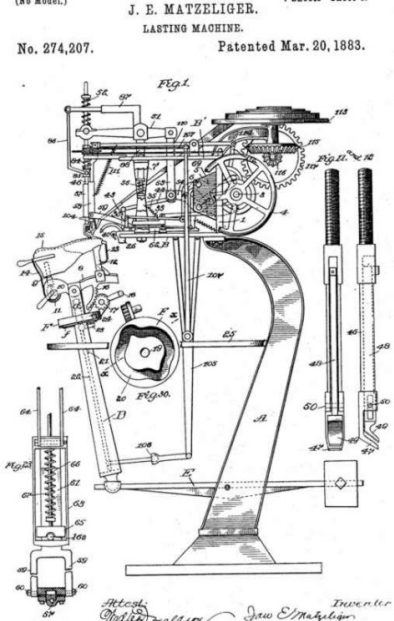
LASTING LASTS excerpts taken from inventors.about.com “Jan Matzeliger developed a shoe lasting machine that would attach the sole to the shoe in one minute.
This invention is the heart and sole of shoe making. This invention blew the lid off the shoe industry.”
Born in 1852 in Paramaribo, Surinam (Dutch Guinea) the son of a Surinamese homemaker and a Dutch engineer, Jan Ernst Matzeliger learned a great deal about machinery while working in the machine shops his father supervised from the age of 10. At the age of 19, he took to the seas and traveled around the world before immigrating to the United States two years later. He faced harsh discrimination for his race but quickly learned English and landed a series of odd jobs before settling in Lynn, Pennsylvania home to most of the country’s shoe manufacturing at the time. He worked in a shoe factory and found friendship and support through the North Congregational Church in Lynn where he later taught Sunday School.
By the 1870’s, the shoe industry was somewhat automated with machines that were able to assemble all of the pieces of the shoe, however, the final step of attaching of the top of the shoe to the sole was still managed by expert “hand-lasters”.
Naturally, the lasters formed a union of sorts and threatened work slowdowns in the name of high wages. These salaries combined with low production meant that shoes were too expensive for the average person. Other inventors attempted to design a lasting machine with no success and it was commonly thought that the development of a lasting machine was not possible. Matzeliger worked on his invention patiently and tirelessly over the course of ten years. And, when word leaked out about his secret project many people scoffed at the idea while others tried unsuccessfully to buy the machine from Matzeliger for large sums of money.
When Matzeliger introduced his automatic shoe lasting machine, the contraption, made out of wire, wood and cigar boxes, was so complex that scientists from the U.S. Patent Office in Washington were sent to inspect the invention before patent number 274,207 was granted on March 20, 1883. Soon after the Union Lasting Machine Company was developed to meet the high demand for the invention. Up until this time, professional shoe lasters were able to sew forty to fifty pair of shoes a day. Matzeliger’s machine generated 150-700 pair of shoes daily thereby driving the cost down and the availability up. Shoes were now available to more Americans than ever before.
Matzeliger worked on other inventions but was ill with tuberculosis. His long hours of work took their toll and he died on August 25, 1889 at the age of 37. He left what money he had to his church and to the Union Lasting Company, which owned his patent. The company was said to be worth over a billion dollars just sixty-five years after his death.
Researched and written by Lauren McPherson, Woodstock Branch CSCL
Page 5
5
OTHER WEBSITES: www.uh.edu/engines/epi1785.htm or google shoe lasting machine or Jan Matzeliger or Patents #274,207
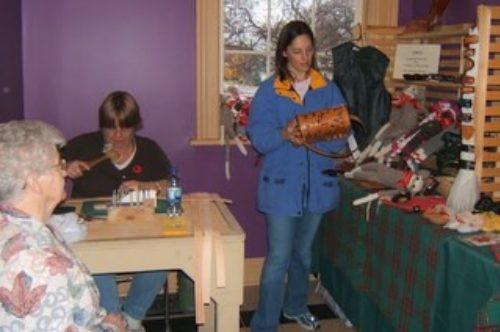
Woodstock Museum Hosts Annual Christmas Craft Sale Woodstock Branch CSCL has participated in this annual craft sale since its inception.
This year’s sales items were from Woodstock Branch Members (Lauren McPherson, Jan Malec, Joanna and Julia Malec, Marion Kehoe, Nancy Durham, David & Dorothy
McPherson, Madeleine Mitchell) as well as Norland’s Phyllis McHale, and Peter Grove and Lauch Harrison of the Hamilton Branch. The sale was held only on the main floor of the Museum making it more convenient for shoppers. Lauch served as official “Greeter” to the sale
Loreen Manuel, Nancy Durham, and a customer
Page 6
6 What do You want to learn at a CSCL Workshop?
Do you want Membership information for someone who might want to join CSCL?
How can CSCL serve you better?
Email: [email protected] and your questions will be taken to the next Executive Council meeting.
CSCL presents
Mark your calendar now! 10:00am until 4:00pm Saturday, March 21, 2009 At the Etonia Church Hall (near Princeton ON) Pre-registration required More details in the Winter Newsletter
Page 7
Stock No. 0915-00
Christmas Crafts from Candp Leather
Angel Barrette
You will need:
2 to 5 oz. Tooling Leather
Leather Weld #2015
White & Medium Flesh Cova Colors #2041
Silver Starlight Acrylic Paint #2039
Gold Starlight Acrylic Paint #2038
2%” Barrette Clip #1137
Craft Knife #1583
Super Glue Gel #2030
Step 1: Cut angel body and wings out of tooling leather with a craft knife.
Step 2: Dampen wings with water. Shape as shown, then let dry.
Step 3: Paint body and wings with Cova Color and Starlight Acrylic Paint.
Step 4; Adhere body to wings with Leather Weld, then adhere barrette clip. to completed ange! with glue. Note: 1" Pinback #1143 may be used in place of barrette clip.
Christmas Tree Pin
You will need: 2 to 5 oz. Tooling Leather
1° Pinback #1143
Red Seed Beads #1440 Beading Thread #1220 Needle
Green Cova Color® #2041 Silver Starlight Acrylic Paint
#2039 Leather Weld #2015
Super Glue Gel #2030
Step 1: Cut 3 tree parts out of 2 to 5 oz. leather.
Step 2: Dampen each pant with water and mold as shown. Let dry completely.
Step 3: Paint each tree part green. After Cova Color has dried, glue tree parts together with Leather Weld. Dab dots of silver Starlight Acrylic Paint on the front side of the tree to represent lights or ornaments.
Step 4: String 3 strands of red Seed Beads on Beading Thread, one for each part of tree, Each strand should be a little longer than widest portion of each tree part.
Step 5: Attach 3 strands of beads " to assembled tree by using Super ~
Glue Gel to glue strand ends on back of tree (see ill.).
Step 6: Glue pinback to back of completed tree (see ill.) with Super Glue Gel.
io” “s. %4" Round
Holly Earrings
You will need:
2 to 5 oz. Tooling Leather
2 Fishhook Earwires #1140
2 Red 4mm Glass Beads #1450 %" Round Drive Punch #2436 Kally Green Cova Color® #2041 Size 0 Mini Punch (%.") #1766 Needle Nose Pliers
Step 1: Cut 2 holly leaves out of leather using 4" Round Drive Punch. Punch small hole in top of each leaf with Size 0 Mini Punch
Step 2: Dampen leaves with water, then carve veins with a swivel knife or prass in with the pointed end of modeling tool. Twist each leaf and let dry. After leaves have dried, paint with kelly green Cova Color.
Step 3: Bend bottom loop of one earwire open with pliers. Slide off metal bead and replace with one red glass bead. Slide on holly leaf, then bend loop closed. Repeat with other earwire.
Metal bead — Drive Punch
Size 0 Mini Punch Bottom toop
>, Swivel knife or modeling
Cutting pattern
Cutting pattern
Cutting pattern
Pinback f eS Glue bead Q strand Ss ends to ial back Super Glue Gel ie fe Leather S Weld
Page 8
8
Page 9
9