An issue of the Society’s newsletter, transcribed from the original. Download as PDF.
(6 pages, 1063 KB)
Page 1
Canadian Society for Creative Leathercraft CANADIAN LEATHERCRAFT
Volume LXII No. 1
0045-5121 Autumn – 2013
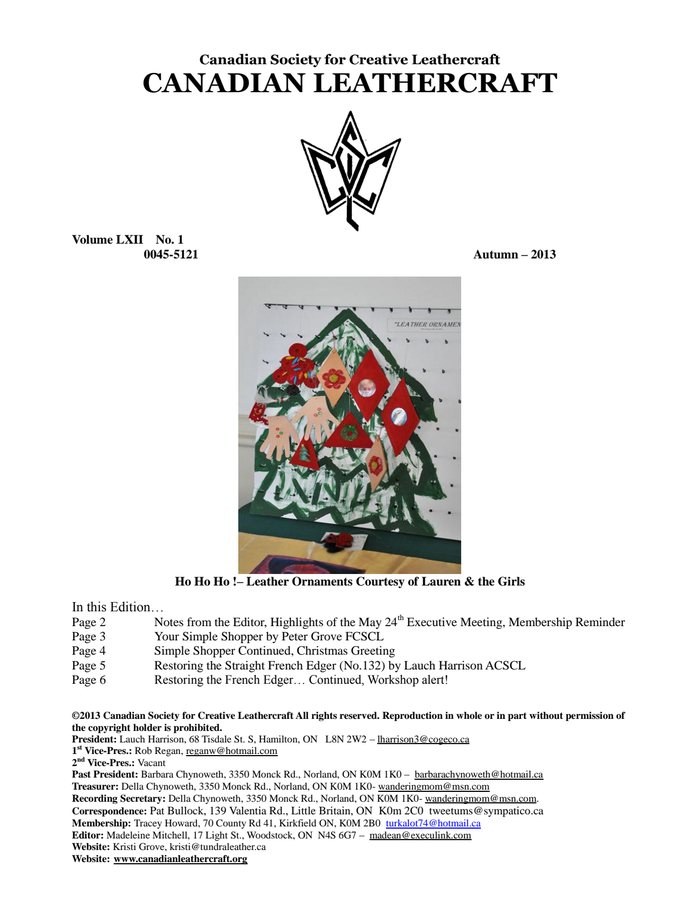
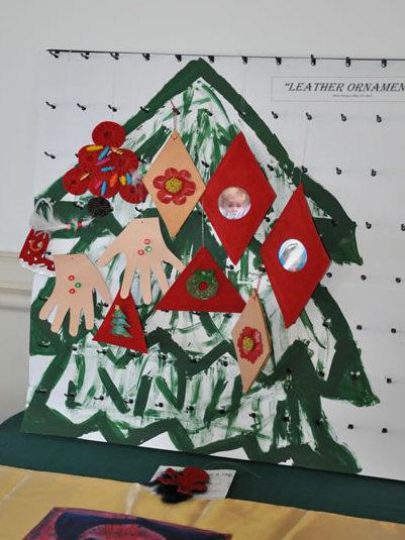
Ho Ho Ho !– Leather Ornaments Courtesy of Lauren & the Girls
In this Edition…
Page 2 Notes from the Editor, Highlights of the May 24th Executive Meeting, Membership Reminder Page 3 Your Simple Shopper by Peter Grove FCSCL
Page 4 Simple Shopper Continued, Christmas Greeting
Page 5 Restoring the Straight French Edger (No.132) by Lauch Harrison ACSCL
Page 6 Restoring the French Edger… Continued, Workshop alert!
President: Lauch Harrison, 68 Tisdale St. S, Hamilton, ON L8N 2W2 – [email protected]
1st Vice-Pres.: Rob Regan, [email protected]
2nd Vice-Pres.: Vacant
Past President: Barbara Chynoweth, 3350 Monck Rd., Norland, ON K0M 1K0 – [email protected]
Treasurer: Della Chynoweth, 3350 Monck Rd., Norland, ON K0M 1K0- [email protected]
Recording Secretary: Della Chynoweth, 3350 Monck Rd., Norland, ON K0M 1K0- [email protected].
Correspondence: Pat Bullock, 139 Valentia Rd., Little Britain, ON K0m 2C0 [email protected]
Membership: Tracey Howard, 70 County Rd 41, Kirkfield ON, K0M 2B0 [email protected]
Editor: Madeleine Mitchell, 17 Light St., Woodstock, ON N4S 6G7 – [email protected]
Website: Kristi Grove, [email protected]
Website: www.canadianleathercraft.org
Page 2
2 Notes from the Editor…
Unlike last November, we have had only a few flurries, in my part of the world, since I started this 62nd Volume Newsletter. We have had a few mild days interspersed with flurries, heralding the beginning of the winter…again!
It seems no sooner have we had Thanksgiving and Halloween, the Christmas and Holiday season is upon us. For some CSCL members it’s time to get out the tools and leather to make that belt for a favourite uncle, or try that leather Christmas tree ornament that was in a past CSCL newsletter or inspired by the London members as seen on the cover of this issue.
Perhaps you want to get that new tool from the mail order flyer, or make a stop at Tundra Leather in Hamilton for a gift for yourself. As the days become shorter and the nights longer it’s comforting to sit at your worktable and carve, or colour, or mold, a new leather project.
Before we know it, Hamilton Branch will be telling us about the 2014 Annual that they are hosting, along with the deadlines for the Weston Trophy and Associate and Fellow applications. Your Executive Council is busily working on a revised Awards List that will provide opportunities for all members to enter their work.
Thanks to the Hamilton bunch for their contributions to this newsletter. Peter has a wond erful project “Your Simple Shopper”, just in time to make, as you embark on your
Holiday shopping. Lauch Harrison provided a comprehensive article on “Restoring a French Edger”.
“Canadian Leathercraft” is your source of information about CSCL and its memb ers.
Check out the CSCL website at www.canadianleathercraft.org
As always, if you have questions, comments, or even a future article for this newsletter, contact your Editor, Madeleine Mitchell at [email protected]
Highlights from Executive Council Meetings…November 22, 2013 o Kristi Grove provided the name of a lawyer to look over our Risk Management Policy.
Peter Grove to investigate further.
o Barbara Chynoweth has streamlined the Awards Lists for CSCL Annuals and Biennials.
A draft was presented; further revisions to be made and discussed at the next meeting.
CSCL encourages all members to participate in our events and be eligible to take home awards.
o Kristi Grove is looking for articles, questions, comments, or a calendar of coming leather crafting events for the website and our Facebook page. She’s at [email protected] o Second Vice President position on the Executive Council will remain Vacant until the 2014 Annual Meeting.
o Executive members postponed sifting through Lamour Library resources until January 25, 2014 o Next Meeting and Library Review – January 25, 2014 starting at 10:00am at Paul’s Warehouse
It’s Never Too Late for a CSCL Membership!
To sign up or renew,
Tracey Howard
Note: Tracey’s NEW Membership Chairman, CSCL
Address 70 County Road 41
Kirkfield, Ontario K0M 2B0
T: 705-454-9941 [email protected]
Page 3
3 Your Simple Shopper by Peter Grove FCSCL – Construction notes: From the bench of Peter Grove
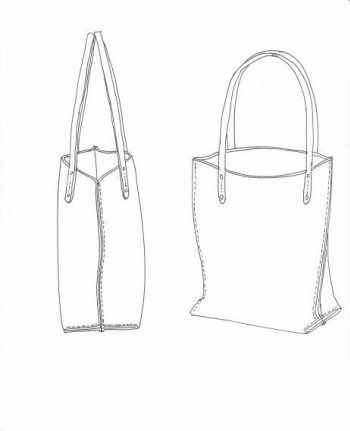
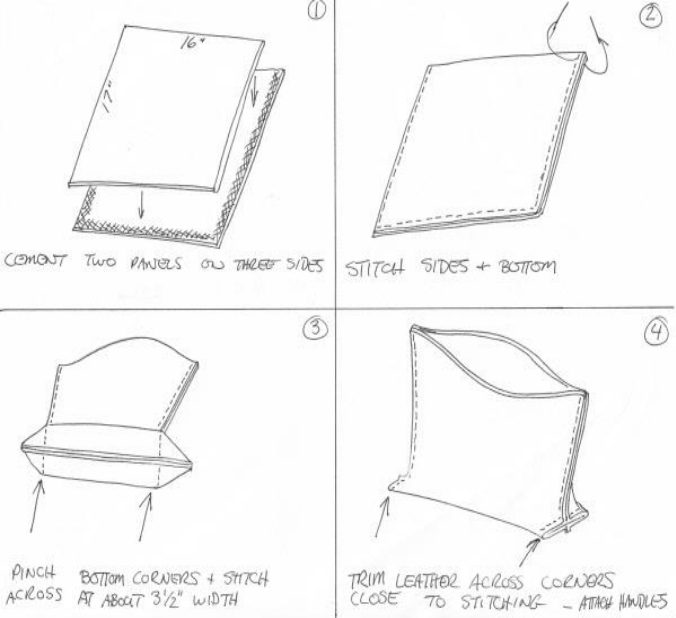
The bag body was cut from 5-6 oz. top grain oil lull-up chrome tanned cowhide. The panels are 16” wide and 17” tall. A wide variety of leathers could be used. The leather only need be tough enough that the rivet on handles don’t rip out under stress. I have made this bag using a heavy moosehide and it turned out well.
The straps were cut from 9-10 oz. bridle leather. Measurements are ¾” wide and 35 or 36 inches long. These measurements can be adjusted to your taste. In my bag, the bottom round end of the straps were set 4 ¼” from the top edge of the bag. They were set approx. 4” from the vertical side of the bag. I used two rivets and a bit of handsewing at each strap end. No particular edge finish was used on the straps or bag at all. Raw and rustic was the desired look.
This simple design and construction lends itself to all sorts of personalizing and customizing. Here’s a couple I came up with.
1. Add a band, either straight or shaped, around the top edge. Carve it, tool it or otherwise de-sign or embellish it. Maybe use an exotic or printed leather as an accent.
2. Us a ‘mystery braid’ for the handle. Or get adventurous and do a round braid over a core.
3. Assemble the bag with the flesh side out and then turn the bag inside out. This will put the grain side of the leather on the outside but all the seams to the inside. You’ll achieve a cleaner more refined look. Use a bit softer leather for this. It makes turning it easier.
4. As in idea 3 but also make a similar bag out of fabric or canvas. Try about 3/8” narrower and 1” shorter than the leather bag. Slide the liner into the finished bag to a point about 1” below the bag top. Fold the top of the leather bag to the inside so as to capture the liner and then stitch all around.
5. Make each of the two main leather panels out of 2 or more pieces each. This allows you to use smaller pieces of leather. The stitching of these panels together adds a certain design el-ement. You might even do a flat leather braid to affix the smaller panels together. Lots of choices here.
I think you get the idea. This “Simple Shopper” is very fashionable at the moment. Use your
Page 4
4 imagination with this very simple pattern. Have some fun. Your friends, relatives and customers will be glad you did. Photos of this bag will be posted shortly on Tundra Leathers facebook page.
Look for it and share it.
Merry Christmas to all our CSCL members and Friends! With Wishes for Happiness in the New Year
From your CSCL Executive Council:
Lauch, Sean, Rob, Peter & Kristi
Lauren, Nancy & Madeleine
Phyllis, Della, Barbara, Pat & Tracey
Jim, Paul & Joyce
Page 5
5
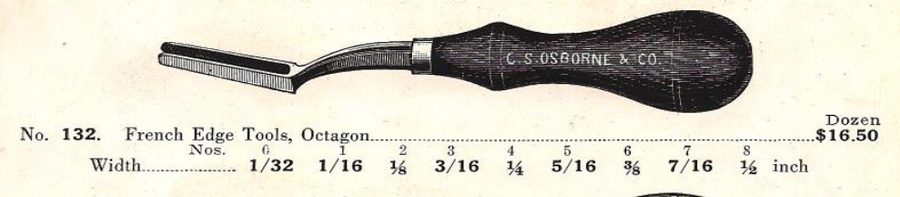
Restoring the Straight French Edger (No. 132) by Lauch Harrison ACSCL
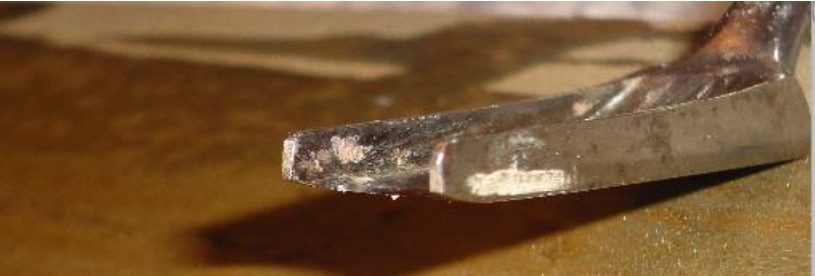
The French Edger is designed to cut thin shavings of leather in a controlled fashion. The French Edger is made to take leather off the high spots, not to gouge out low spots, it is not a carving tool! It has a thin sharpened blade that is protected by two side guards, the side guards protect and stiffen the blade. They also protect the user, it is quite difficult to cut or puncture yourself with a properly tuned French Edger.
The edger is used to reduce the thickness of leather, the flat sole allows the edger to make smooth flat bevels. If used in the middle of the leather a channel must be created with a gouge or craving tool. This tool can be indispensible for skiving, box making, miter stitching.
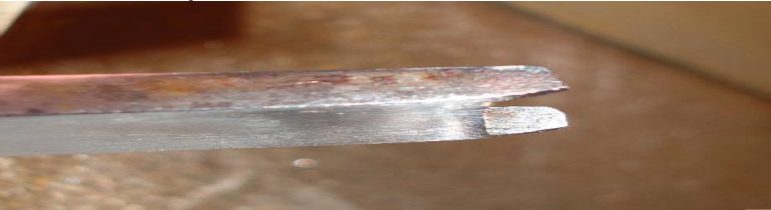
The back of the tool is meant to be flat. The sole should extend to the cutting edge with out curling up.
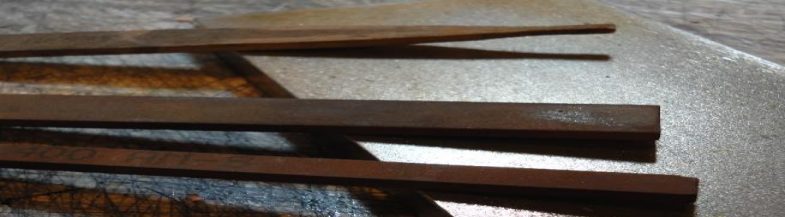
This allows the blade to have exposure to the leather without having to lean on the tool, pushing down can distort the front edge and even crack the steel between the guards. Some abrasive tools are required to sharpen the French Edger: slips or shaped stones to grind the inside of the tool.
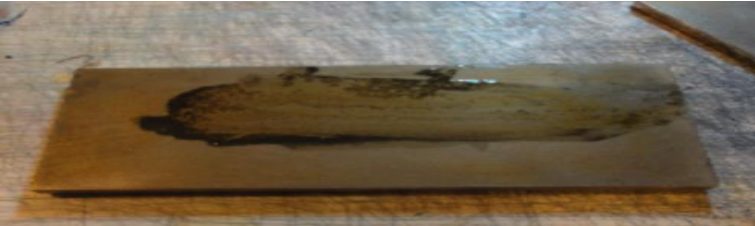
A lapping plate or large stone for flattening the sole (below)
Page 6
6
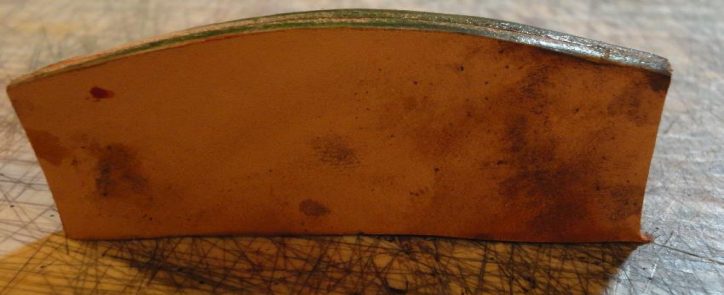
A curved buffing pad made from leather coated in abrasive compound.
I like to start with the inside edge, I will use a file, or coarse abrasive slip (x220) to shape the inside getting a long taper back toward the handle a angle of about 20º. Try not to cut into the side guards and try to keep the edge even and flat from side to side. Then graduate to x400 stone to get the grind marks out.
Now flatten the sole plate, the ears of the guards can have a small amount of upturn. This will expose more blade and make the edger more aggressive. The Lapping Plate or large flat stone is ideal for this, try to get close to the edge with the coarse stone but graduate to a finer stone to finish the edge. Quite a few of the old French Edgers were sharpened only on the sole, this can be seen by having very pointed ears on the guard blade and a sole that curves up to the edge when it is not supposed to. Some French Edgers are made with a curved sole plate, this allows the operator to tilt the tool to get deeper/shallower cuts as needed.
The sole plate can be buffed to a shine, if the inside edge is straight across between the ears you know the ramp of the edge is very even and the sole is the same thickness across the tool. Now the curved buffing pad is used on the inside ramp to bring the polishing compound to the cutting edge. The cutting edge will normally have a “wire” or bur, the bur is removed by gently buffing the edge on both sides. Resist the urge to knock the wire off by cutting some leather to test your edger, if the wire breaks off the cutting edge will be jagged and more buffing will be required to make the tool skive well.
There is an excellent resource for all your tool maintenance, “Leathercraft Tools how to use them how to sharpen them” by Al Stohlman
When the edger is properly sharpened the tools usually only require buffing for most uses, on occasionally some veg tanned or alum tanned leather will have a core of rawhide or some impurities engrained in the hide that will notch or turn the edge. When it happens you will be well prepared to fix your tools up so they work without the extra effort that causes slips, gouges and blood stains.
All the best
Lauch Harrison A.C.S.C.L.
Workshop Alert!
Paul Kitchener will be holding a Workshop in Norland in the Spring.
Details in the next Newsletter and on the Website (www.canadianleathercraft.org) and on our Facebook page.