
An issue of the Society’s newsletter, transcribed from the original. Download as PDF.
(8 pages, 1180 KB)
Page 1
Canadian Society for Creative Leathercraft CANADIAN LEATHERCRAFT
Volume LXI No. 4
0045-5121 Summer – 2013
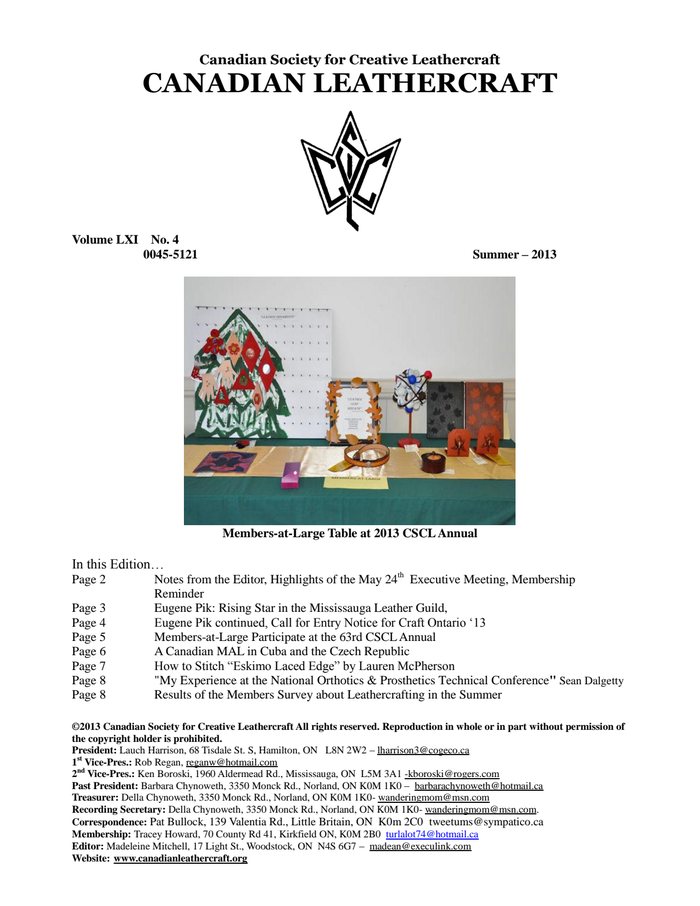
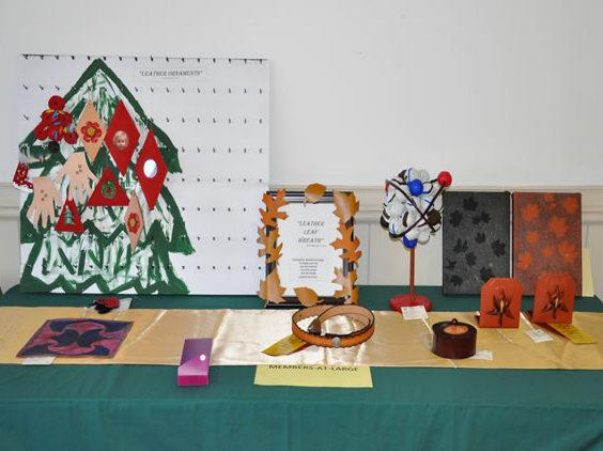
Members-at-Large Table at 2013 CSCL Annual
In this Edition…
Page 2 Notes from the Editor, Highlights of the May 24th Executive Meeting, Membership
Reminder
Page 3 Eugene Pik: Rising Star in the Mississauga Leather Guild,
Page 4 Eugene Pik continued, Call for Entry Notice for Craft Ontario ‘13
Page 5 Members-at-Large Participate at the 63rd CSCL Annual
Page 6 A Canadian MAL in Cuba and the Czech Republic
Page 7 How to Stitch “Eskimo Laced Edge” by Lauren McPherson
Page 8 "My Experience at the National Orthotics & Prosthetics Technical Conference" Sean Dalgetty Page 8 Results of the Members Survey about Leathercrafting in the Summer
President: Lauch Harrison, 68 Tisdale St. S, Hamilton, ON L8N 2W2 – [email protected]
1st Vice-Pres.: Rob Regan, [email protected]
2nd Vice-Pres.: Ken Boroski, 1960 Aldermead Rd., Mississauga, ON L5M 3A1 [email protected]
Past President: Barbara Chynoweth, 3350 Monck Rd., Norland, ON K0M 1K0 – [email protected]
Treasurer: Della Chynoweth, 3350 Monck Rd., Norland, ON K0M 1K0- [email protected]
Recording Secretary: Della Chynoweth, 3350 Monck Rd., Norland, ON K0M 1K0- [email protected].
Correspondence: Pat Bullock, 139 Valentia Rd., Little Britain, ON K0m 2C0 [email protected]
Membership: Tracey Howard, 70 County Rd 41, Kirkfield ON, K0M 2B0 [email protected]
Editor: Madeleine Mitchell, 17 Light St., Woodstock, ON N4S 6G7 – [email protected]
Website: www.canadianleathercraft.org
Page 2
2 Notes from the Editor…
The Summer months always seem to be filled with everything, but leathercraft! I don’t know for sure that all CSCL members slack off during the warm months, but this one does!
I checked around with my fellow crafters, see what I found out…page 8.
Thanks to Lauren McPherson who represents Members-at-Large, those members who don’t belong to a CSCL Branch. Lauren keeps in contact with us MALers, and provided several excellent articles for this edition.
One of Lauren pieces is an interesting technical article about Eskimo Laced Edge while another, explores leather at home and abroad. Thank you Lauren for your input.
Back in June, Paul Kitchener and Linda hosted a BBQ for the Mississauga Branch at his home. He kindly invited your Editor and Nancy Durham to attend. I met one of CSCL’s newer members who is with the Mississauga Branch. Eugene Pik won two Special Awards plus Ribbons at this year’s Annual in Lindsay and is definitely a rising star in CSCL. Read more about Eugene in this issue on pages 3 and 4.
Sean Dalgetty wrote the article about his well received presentation to the National
Orthotics and Prosthetics Technical Conference held in Hamilton. Lauch Harrison and Sean explored leathercrafting “outside the box”.
“Canadian Leathercraft” is your source of information about CSCL and its members.
Check out the CSCL website at www.canadianleathercraft.org
As always, if you have questions, comments, or even a future article for this newsletter, contact your Editor, Madeleine Mitchell at [email protected]
Highlights from Executive Council Meetings…May 24, 2013
- This last meeting of the year allowed the Executive Council to finish business pertaining to the last Annual and start the discussion for next year’s event.
- Areas of future interest – streamlining of Council of Fellows, improved criteria of Awards, graduated levels of Associate standing
- Welcome to new Directors – Kristi Grove and Phyllis McHale, Goodbye and Thank You to David and Dorothy McPherson
- Next Meeting – September 27, 2013
It’s Never Too Late for a CSCL Membership!
Don’t miss any CSCL events!
To sign up or renew,
Tracey Howard
Membership Chairman, CSCL
Note: Tracey’s NEW 70 County Road 41
Address Kirkfield, Ontario K0M 2B0
T: 705-454-9941 [email protected]
Page 3
3 Eugene Pik, Rising Star in the Mississauga Leather Guild
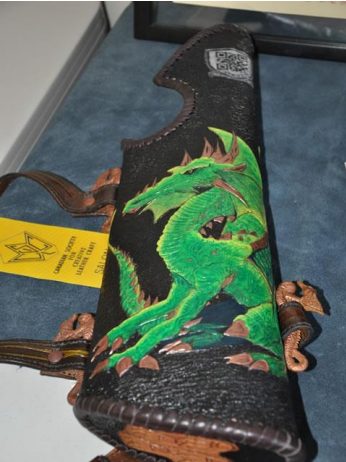
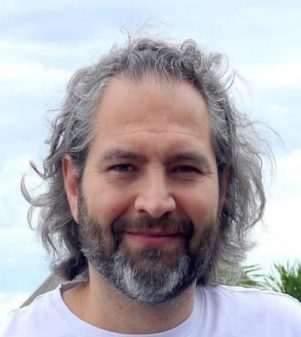
At the 2013 Annual, the Quiver by Eugene Pik, won the Robert Muma Award for Best Colour and the Betty Heacock Award for Best Novice Article. He also took home both a 2013 CSCL Salon Ribbon and a Craftsman Ribbon. Since meeting Eugene in June, we have emailed and I have learned more about one of CSCL’s enthusiastic new members.
The prize winning Quiver by Eugene Pik
[Madeleine Mitchell] I’m just starting the Summer Newsletter for CSCL and wondered if I could use your video link?
[Eugene Pik] Of course you can use the link to my videos for the newsletter: http://goo.gl/IFU21
[MM] Also I would like to present you as a new member of CSCL, what do you think? Could you give me a short biography and picture?
[EP] Absolutely. That would be a honor for me. A very short biography would be:
Born in USSR, moved to Israel at the 'Perestroika' time, then immigrated to Canada just before the Y2K [2000]. Studied Robotics in USSR, then computer programming in Israel. Worked in IT since 1992 as computer technician, network specialist, and then taught Novell courses in a college. For the last 14 years I have worked for BMO, currently as a project assessor.
I'm married, and have 2 daughters. For many years it was too busy to have a hobby. Since my school time I have tried to do different things - it all started with building car models, (still in USSR) –for which I received many awards at competitions. Later, in Canada I started a 180 gallon aquarium, followed by deck building, planting a vegetable garden, and then archery training. The leathercraft came naturally with archery.
[MM] How and why did you get interested in leathercraft?
[EP] Last summer I became interested in archery, took few classes, started shooting. At the same time I was researching different models of archery equipment and found an interesting article about making a back quiver (a tube that holds arrows). Though most of the quivers used at the archery range are the belt ones, there are also hip, bow and back quivers that are used in different situations.
To build a quiver I needed leather. Naturally, Tandy Leather Factory popped up in Google search. Its website mentioned Saturday's leathercraft classes. In October 2012 I attended my 1st class, and started my 1st leathercraft project - the back quiver.
Page 4
4 Eugene Pik continued…
[MM] I already know you have won CSCL Ribbons and Prizes for your Back Quiver – what else are you working on?
If you watch Eugene’s videos at http://goo.gl/IFU21 you’ll see as he does round lacing on one of his newest projects –carved and laced chair seats.
About the quiver:
Following photos explain the process of a quiver building. I needed to learn leather tooling, carving and painting, copper electroplating, how to make a silicone mold and cast pewter, and more. Straps are made from 2 layers of 3-4 oz. vegetable tanned leather. Both parts are glued together to create a strap with a grain side of the leather on both sides. This way a dye or finish could be applied to the bottom side of the strap. Once glued, the holes are punched and the design is carved. The carved design is colored (dyed), then protected by leather finish. An antique gel is applied. A linen waxed thread is sewn around the strap using the strongest of the stitches - the saddle stitch. For the strap holder I created a polymer clay model, then used it to make a silicone mold to cast pewter. The pewter object was copper electroplated and then aged using boiling copper sulphate patina. Liquitex paint was used to paint the dragon. This acrylic paint is recommended for the leather work. It is very elastic and no cracks appeared after the flat image was bent into a relatively small diameter tube.
Due to my mistakes I had to start the painting process from the beginning 4 times - every time the experience raised, and I guess, that made the final product look so nice
Photos of the quiver building process: http://goo.gl/0UI8nN
My projects: the quiver, and now the chairs, that's all for now. The chairs are not finished yet - its summer, need to get my portion of the sun radiation and spend more time with my family:)
Regards, Eugene
The CRAFT ONTARIO '13 call for entry is open!
Deadline for entry: Thursday, September 19, 2013
Taking place at the OCC Gallery, October 17 - December 21, 2013
Since 1975 the Ontario Crafts Council has supported the development of contemporary craft through a biennial juried exhibition showcasing the best of member work. Submitted entries are also considered for recognition by three cash awards that celebrate outstanding achievement: Award of Excellence, $750;
Best in Show, $500; and Honorable Mention, $250.
To find more information about the conditions of entry, and to download the call for entry form, please visit the Ontario Crafts Council website at:
http://www.craft.on.ca/Exhibitions/Upcoming_Exhibitions For more information please contact [email protected]
CSCL Members Note: - Della Chynoweth at [email protected] has entry forms
Computer Rule #222: Every twenty minutes look twenty feet away for twenty seconds.
Page 5
5 MEMBERS-A T -LARGE P ARTICIPATE A T THE 63RD CSCL ANNUAL
Although we couldn’t all make it to the Annual Convention in May of this year we MAL collectively supported the Annual by donating leather to the DRAW TABLE and thanks to everyone who contributed to this popular draw.The London Leather Guild’s last meeting was at the home of
David and Dorothy McPherson to make and package a project, LEATHER
ORNAMENTS, for the Annual MAL
Christmas Display in Lindsay. The decorations were based on ‘seasonal red suede’ and included everything from miniature picture frames to beautiful flowers by
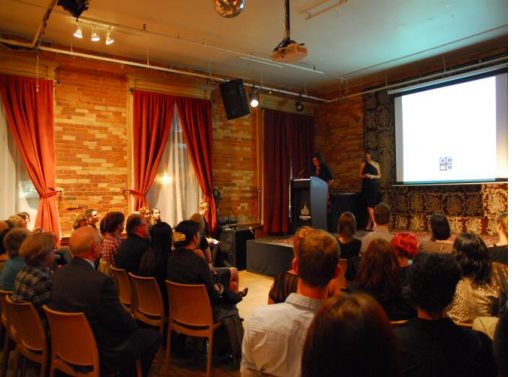
Marion Kehoe, London, and David and Dorothy McPherson, Members-At-Large jewellery-studded ornaments by from London, attended the Ontario Crafts Council and Roselle Wallace, Toronto. London Awards Presentation Ceremony, Gladstone Hotel,
Toronto, October 2012. (They are seated on the centre Leather Guild helped me cut out aisle and Dorothy is in the plaid jacket.)
supplies and prepare a two-part kit that was mailed December 2012 to each CSCL Member-At-Large. Indeed, some members completed the kit and mailed them back to me. I thank you for your support and participation.
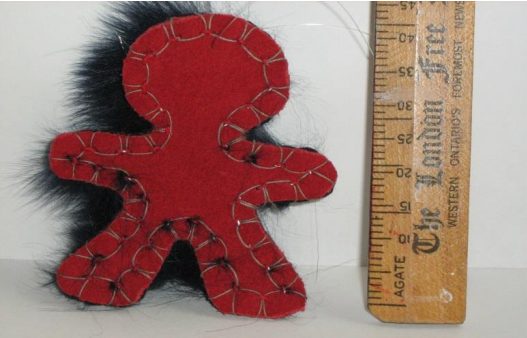
I am happy to introduce a new stitch, Eskimo Laced Edge,to CSCL via my Christmas Ornament (red suede,rabbit,linen thread, cotton twine), a fun challenge for any Ontario stitcher and part of our Canadian heritage.
Save your leftovers as you will see in this issue that tiny scraps make tiny souvenirs.
Lauren McPherson MAL Representative
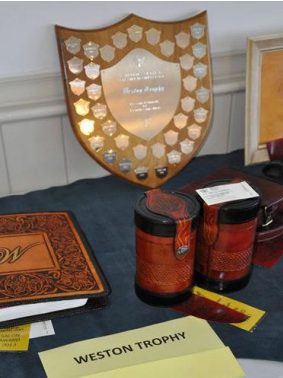
2013 Weston Trophy Goes to Hamilton Branch
Page 6
6 A Canadian MAL in Cuba and Czech Republic
By Lauren McPherson MAL Representative
What surprises and interests are there for tourists outside of Canada? How does one bring home a traveller’s tale, an exotic landscape or a new language? Leather.
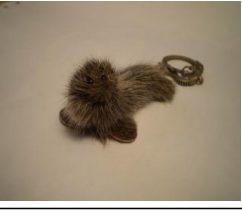
Leather Sea Otter Leathercraft continues to be a memorable find especially when I travel. Canada2009 Pictured below are leather pieces unique to three countries. A leather Sea Otter purchased in a sporting goods store east of Huntsville, Ontario in 2009 is a cute replica of one of Canada’s wildlife. This whelp (3x1.5x1 inches) was possibly hand sewn, the suede tab feet resembling my ‘on-growing’ inventory of bags of small leather leftovers at home in London, Ontario.
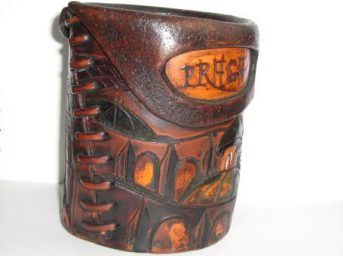
“Who made this leather mug?” I asked one local street vendor in 2010 as we crossed the artisan filled Charles Bridge, Prague, Czech Republic. Artist unknown not tter, working Canada, that 2009 hot summer day. ‘Kolik to stoji?’ is easier to write than say, and it was $10. This Leather Jack – basically a wide based mug (3x6 inches) with no handle – depicts the Prague Castle, tooled and coloured. No pine pitch or bees wax lining but I imagined the 9th century and the early craftsmen that eventually opened shop along the winding streets of the small town that grew to circle this towering architecture.
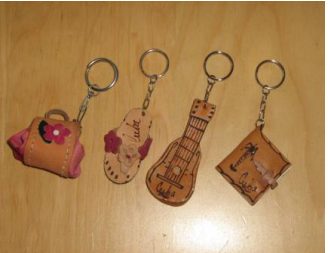
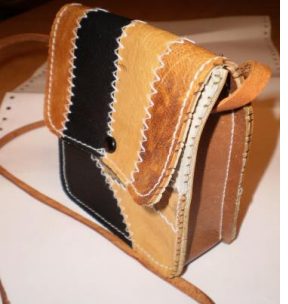
Vacationing in 2013 at a Leather Mug, Czech Republic, 2010 white sand tourist resort at Veradero, Cuba souvenir huts lined both sides of the main road. “Cuanto cuesta?” I asked each vendor. Leather keychains were a dollar store equivalent. These were not the Black Bear Figurine, Wooden Lobster Trap and Racoon Tail of Canada but rather Leather Sandal, Velcro-snap Gusset Purse, Engraved Guitar and Miniature Notebook (1.5x1.5 inch, 8 pages).
Leather Gusset Purse, Sandal, Guitar, Notebook Keychains, 2013Cuba
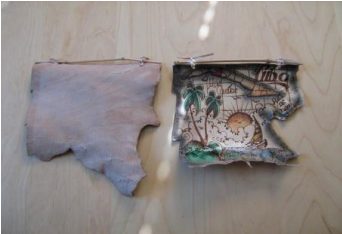
In addition, carved Leather Banners (8x8 inches) depicted our location, a treasure map to the Atlantic Ocean with its coral and shells. Also, a Junior Leather Purse was just the right size to bring home (6x6x2 inches, lightweight leather).
How nice to find leather being used around the world to create attractive keepsakes.
Leather Treasure Map, Cuba, 2013
Junior Lightweight Leather Purse, Cuba, 2013
Page 7
7 How To Stitch ‘Eskimo Laced Edge’ by Lauren McPherson
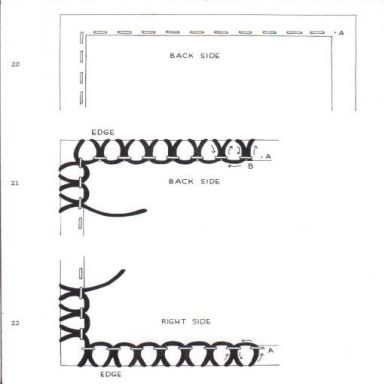
This simple and effective edging is based on the Running Stitch. It was devised by the Eskimos and the Aleuts to bind together the many seams of their seal gut parkas, making them waterproof. There is a real thrill in adapting this utilitarian stitch originally worked with caribou or walrus sinew to new beautiful edges with a contemporary feeling. It can look very different according to the texture of the material and the weight of the thread used. Linen thread and non-waxed thread work. Start by basting all around the edge you want to decorate with Running Stitches worked quite near the inner edge. Work from right to left on the back side (Figure 20). Place the beginning knot at A, between the material layers. Come out at the right side for the first stitch. This is important; if you come out on the back side, the pattern will not work out. If your hem is between ¼ and 3/8 inch deep, make your stitches and the spaces between them about 3/16 inch long. They should be worked one at a time, in a stabbing, rather than a sewing motion, all the same size and without pulling to make lacing easier. Always end and start a new length of thread from inside the material layers so that it won’t show. When the Running Stitches are completed, using a tapestry needle and heavier thread, lace over and under, working from the back side to the front (right side), and from right to left (Figures 21 and 22).
To do this hold the material with the back side up and the outside edge away from you.
- Start the beginning knot inside the material layers at B and come out just below the first Running
- Lace under the first Running Stitch without picking up the material.
- Turn the edge over so that the right side edge is toward you, and again lace under the first stitch (which should be a little to the right), this time lacing from the edge in.
- Then lace through the second stitch toward the edge.
- Lace over the edge to the back again under the first stitch from the edge inward.
- Continue along the base of the hem under the second stitch toward the edge.
- Continue over the edge of the hem to the second stitch on the right side of the material, and so on.
Page 8
8
"My Experience at the National Orthotics and Prosthetics Technical Conference" June, 2013
by Sean Dalgetty FCSCL, Chairman of the Council of Fellows
In May, 2013, I was asked to be a guest speaker at the National Orthotics and Prosthetics Technical Conference by Greg Hamaoka and Tim Manning of the Chedoke-McMaster Orthotics Prosthetics Department. Greg and Tim are regular customers at Tundra Leather, buying leather for many different orthotics and prosthetics. They got to know what we could do and thought that I could provide useful information at the conference. The conference was held at Sunnybrook Campus in Toronto on June 16th, 2013. It was organized by the Graduating Orthotics and Prosthetics Class from George Brown College.
Lauchlan [Harrison] and I drove in on Sunday morning, unsure of what to expect. There were booths set up for companies who manufactured artificial limbs and joints, and companies who offered custom orthotics and prosthetics. Really, it was everything you could imagine that had anything to do with prosthetics and orthotics.
I gave a talk for about an hour and half on general leather work, leather, and tools. Following that, I answered questions for about 15-20 minutes as well. Our demonstration tables were surrounded three deep with people asking questions and watching us demonstrate. This just goes to show how up and coming the field of orthotics and prosthetics is, especially where leatherwork is involved. We learned that these students and professionals were expected to know how to use leather when it came to prosthetics, but there was no one to teach them.
Due to the excitement over our booth and our demonstrations, Lauchlan and I were asked to stay for the coffee break and through lunch to further demonstrate how to use our tools with the leather.
We made a point of advertising the CSCL, as many of these students and professionals were very interested in leatherwork. We have received great feedback from this conference and would be glad to participate in any such events in the future.
Leather isn’t just belts, bags, cases, etc. – it’s used in things we sometimes don’t even consider.
Results of the Members Survey about Leathercrafting in the Summer - Only 6 Respondents (I guess the others were too busy working on their next project to open their emails)
Are you doing any leathercraft during the Summer?
4 are working on articles, 2 are taking the Summer off
Have you bought or acquired any supplies for a project?
1 acquired supplies, 5 did not
What is your most productive time of year in leathercraft?
2 before the Annual, 2 Fall and/or Winter, 1 Summer, 1 All Year
What can CSCL help you with? Workshops and information about …
Sandals, Vests (Clothing), Dyeing, Colouring, Carving, Skiving, help with Organization of tools, materials, notes, work surfaces – maybe -Fung Shui for leathercrafting.
Take Note: Workshop Organizers for the Executive Council