An issue of the Society’s newsletter, transcribed from the original. Download as PDF.
(6 pages, 831 KB)
Page 1
Canadian Society for Creative Leathercraft CANADIAN LEATHERCRAFT
Volume LXII No. 4
0045-5121 Summer – 2014
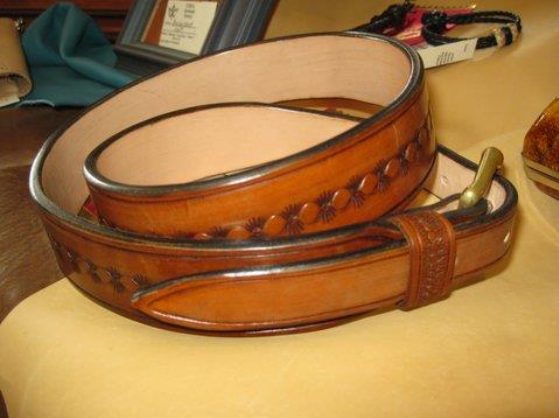
Woodstock Heritage Award 2014 CSCL Annual Belt by Paul Kitchener FCSCL
In this Edition…
Page 2 Notes from the Editor, Highlights of the past Executive Meetings, Membership Reminder Page 3 A Canadian Site to Visit by Lauren McPherson, On the Cover: Woodstock Heritage Award Page 4 It’s All About Health: Can Toxic Adhesive Fumes be Avoided? By Dr. Rainer M. Buchholz Page 5 Buchholz article continued... Some Internet Leather Crafting Resources
Page 6 More Images from the 2014 Annual Weekend
President: Rob Regan, [email protected]
1st Vice-Pres.: Jim Wilkes, 11 Flynn Ave., Cambridge, ON N3C 2T8 – [email protected]
2nd Vice-Pres.: Vacant
Past President: Lauch Harrison, 68 Tisdale St. S, Hamilton, ON L8N 2W2 – [email protected]
Treasurer: Della Chynoweth, 3350 Monck Rd., Norland, ON K0M 2L0- [email protected]
Recording Secretary: Della Chynoweth, 3350 Monck Rd., Norland, ON K0M 2L0- [email protected].
Correspondence: Pat Bullock, 139 Valentia Rd., Little Britain, ON K0M 2C0 [email protected]
Membership: Barbara Chynoweth, 3350 Monck Rd., Norland, ON K0M 2L0 – [email protected]
Editor: Madeleine Mitchell, 17 Light St., Woodstock, ON N4S 6G7 – [email protected]
Website: Kristi Grove, [email protected]
Privacy Officer: Tracey Howard, 70 County Rd 41, Kirkfield ON, K0M 2B0 [email protected]
Website: www.canadianleathercraft.org
Page 2
2 Notes from the Editor…
First a miserable frigid Winter, a changeable coolish Spring, and now a questionable rainy Sum mer! As I have always said, “if you can live in Southwestern Ontario, you can live anywhere in the world.” Of course, since the weather isn’t always co-operating with your outdoor plans, you could focus on indoor projects such as leather crafting. I think of sandal making, tote bags, passport wallets, possibly a case for your favourite electronic device.
Summer projects can translate into articles all ready for next Spring’s Annual Weekend.
CSCL members are always a great resource if questions about finishes, findings, and tools to use arise. Page 6 has has some inspirational pictures from the 2014 CSCL Annual.
Branch meetings are held in Hamilton, Mississauga, and Norland, Ontario. Guests are always welcome at meetings with opportunities for newcomers to meet members and pick up some of the valuable leather crafting tips. CSCL also has a website and a
Facebook page that can help with resources and finding people with the answers.
One of those helpful people is Eugene Pik, a CSCL member with his own website and amazing instructional videos. Search for Eugene Pik online and you will find projects you will want to try.
It’s funny how one thing can lead you to another, the power of the internet becomes evident when you search for Leather Crafting. On Facebook there is a group called “LEATHER- for the love of it”. Members from all over the world post pictures of their leather craft and share ideas, tips, and support. See Page 5 for more sites.
Whether you are a newbie or a seasoned leather worker, safety in leather crafting is critical. We handle sharp knives, pointy tools and some dangerous chemicals. Read the article in this issue addressing Toxic Fumes resulting from use of leather working adhesives, reprinted, with permission from the Leather Crafters & Saddlers Journal (Jul/Aug 2014) and the author.
Thanks to Lauren McPherson for contributing another fascinating article in her search for Leather craft during her travels: see page 3.
“Canadian Leathercraft” is your source of information about CSCL and its members. Check out the CSCL website at www.canadianleathercraft.org
As always, if you have questions, comments, or even a future article for this newsletter, contact your Editor, Madeleine Mitchell at [email protected]
Highlights from Executive Council Meetings…
May 23, 2014
-just a short meeting to round up the year and say goodbye before the Summer recess. We did work out a few details about the August 9th Purse Workshop in Norland.
Back to work at the end of September!
It’s a New Membership Year! To sign up or renew your CSCL Membership Contact our new Membership Chair: Barbara Chynoweth, Membership Chairman, CSCL 3350 Monck Rd., Norland, Ontario K0M 2L0 T: 705-454-9941 [email protected]
Page 3
3 A Canadian Site To Visit
By Lauren McPherson
PORT LORING, Ontario: Discover the Loring & Restoule Region, a distance of 266 km north of Norland, Ontario or 6 hours from London, Ontario. This year-round vacation area of the Almaguin Highlands boasts some of the most beautiful scenery in Northern Ontario. Around Port Loring is a string of small and enchanting communities. Together they share with the visitor a warm sense of community and an image of true country charm.
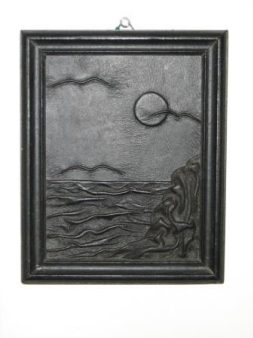
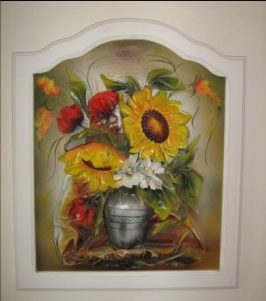
Nestled midway on Highway #522 between Highways #69 and #11, a local Port Loring antique/collectibles/motorboat mercantile attracts the treasure hunters. The owner, a Canadian WWII Veteran, retired tractortrailer driver and snowmobile/motorboat/motorcycle shop retiree was surprised at our find also. Leather folkart found: one black pictureframed molded leather landscape, (6.5x8 inches), tagged “From Poland ($15.00)”. Framed leatherwork are fascinating objects and even more rare. A solid black colour of this landscape contrasts the vibrant background and flowers of the second photo shown below: framed molded leather flowers and vase, (24x29 inches), coincidentally made in Poland by way of Winnipeg, Manitoba.
(courtesy of Dorothy McPherson, MAL London, ON, 2001).
Travel another hour north of Port Loring to Sudbury, Ontario to see the Big Nickel, a nine-metre replica of a 1951 Canadian nickel, located at the grounds of Dynamic Earth.
This 1964 landmark symbolizes Sudbury’s prominent mining industry; Happy 50th Birthday! Canadian souvenirs, unfortunately Not-Made-In-Canada, of tumbled precious stones are available in the Big Nickel Boutique, 122 Big Nickel Mine Road. Stock up on Petrified Wood Slices, Onyx Stone and Jasper Red for beautiful treasured supplies for future projects such as leather box lids, leather book covers or jewellery.
On the Cover: Woodstock Heritage Award
Paul Kitchener FCSCL was awarded the 2nd Woodstock Heritage Award at 2014’s Annual Weekend. The criteria for the award suggests the article highlight the beauty of leather while employing traditional leather crafting techniques. Paul captured the essence perfectly.
Page 4
4
It’s All About Health: Can Toxic Adhesive Fumes be Avoided? By Dr. Rainer M. Buchholz, Renia Adhesives, Cologne, Germany (Reprinted with the permission of the Author and the Leather Crafters & Saddlers Journal)
In leatherworking and many other fields, bonding is a very versatile and easy technique to join two pieces of material. No matter if for a permanent bond or just for holding the parts in place for sewing, there are many adhesives available that do the job. But still, there are substantial differences between products that have been around for ages, and modern, up-to-date adhesives actually developed for the application you have in mind.
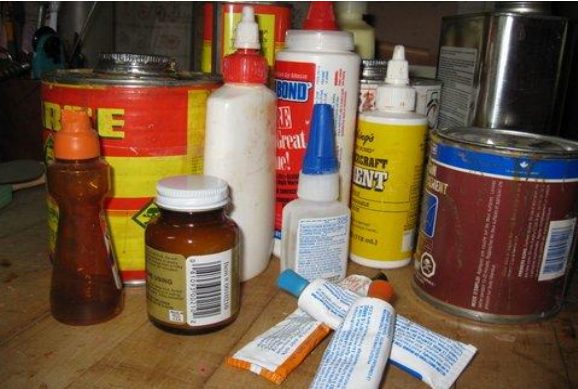
Toluene – avoid if possible! Toluene has been recognized as the main hazard in a lot of products still on the market. Chemically, it is really a great solvent: very strong, not too much odor, and it even helps the bond along a little by eating into many surfaces it is applied to. But at the same time, inhaling such a strong chemical cannot be very healthy – not only does it make you dizzy and can cause headaches, but imagine what happens in your lungs and your liver on top of that. Toluene is known to cause several severe health problems, and exposure to it is very dangerous during pregnancy: it is classified as “harmful to the unborn”, which means it can cause birth defects or even a miscarriage.
MEK – not much better This chemical is often used in “Toluene-free” adhesives, and it does indeed not have the same adverse health effects as the substance it replaced – instead, it can cause other health problems just as severe. MEK (Meth- yl-Ethyl-Ketone) can damage nerve cells, and in com-bination with many other solvents that are commonly used, it also carries a risk of permanent brain damage – very long term, of course, but still a risk that you might not want to take.
Both Toluene and MEK won’t cause all this from a one-time exposure – but many people who have been working with any of them for a long time have experienced the effects, not to their pleasure.
Are there alternatives? Even if you are not using much adhesive – you might, unlike a professional, be using it in your own kitchen or living room. Do you want your family exposed to dangerous solvent vapors? If you are looking for an alternative, always make sure that the product you choose is at least free of Toluene and MEK. This way, you avoid the two largest risks.
Page 5
5 Where do these solvents occur? Most old-fashioned contact cements still have them, as well as the very useful Rubber Cement (Rubber Solution – that is basically Natural Rubber dissolved in Toluene!).
“VOC-free” adhesives often contain MEK, so these are maybe not the best idea.
If you go for a modern product, you usually have the additional advantage of avoiding the ugly brown glue line – there are products on the market now that dry almost completely clear, and while they still contain solvents, these are at least the less toxic kind.
The safest way – go water-based! If you really want to go “all the way” in regard to health and safety, and especially if you are working at home or in a small and enclosed space, you might really want to try the newly available water-based adhesives, developed for leatherworking. There are several types available: water-based contact cements, as well as water-based replacements for the old Rubber Solution. But also here, there are differences: if you open the can and jump a few feet backwards from the smell alone, you just encountered the latex-based variant. Recognizable by the pungent Ammonia smell and the poor bonding strength ... so try to go for a Neo-prene-based adhesive (replacement for contact cement or rubber solution), or a PVA-based product (non-per-manent, e.g. for sewing) – they are both easier on the nose and also yield much better bonding results. Some adjustment required If you decide to change the adhesive you are working with, you should remember that this is just like switching to a new and different tool: you can’t just keep working exactly like you did before, but you need to adjust a little to what the new tool can or cannot do. Same thing with adhesives: they are often quite minor, but there are differences in application, e.g. a different drying or open time. Especially when switching to a water-based product, you should take care to follow the usage instructions – these products can yield excel- lent results, but only if used correctly.
For a long time, using the old-fashioned products with toxic solvents was the only option, but fortunately, that has changed in the past years. Now, there are products available that yield the same or even much better results, at a greatly reduced risk to your health! They might be a little more expensive – but how expensive is your health?
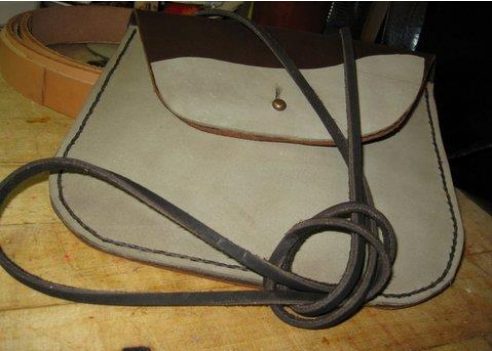
[Finally I finished my little purse from the Annual Workshop – using non-toxic, water-based adhesive. Editor]
Thanks to Dr. Buchholz and the Leather Crafters and Saddlers Journal for permission to use this article.
Some Internet Leather Crafting Resources:
-Go to You Tube and Search “Eugene Pik” – leather crafting videos from a CSCL member
- Go to Facebook and Search “LEATHER – for the love of it” Sharing from around the world -Search IILG International Internet Leathercrafters’ Guild- check the Scrapbook section
Page 6
6
More images from the 2014 CSCL Annual Weekend
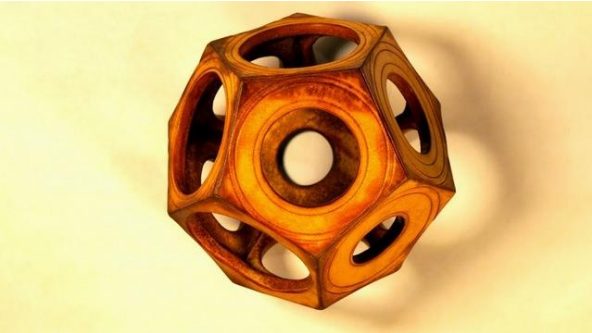
Best Non-Traditional Article –Eugene Pik – Dodecahedron
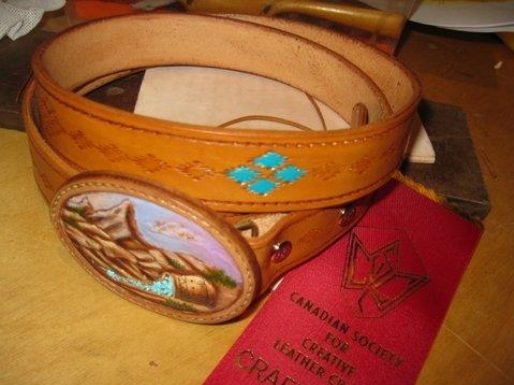
Don MacLeod’s Best Buckle Award – Nancy Durham FCSCL– Belt&Buckle
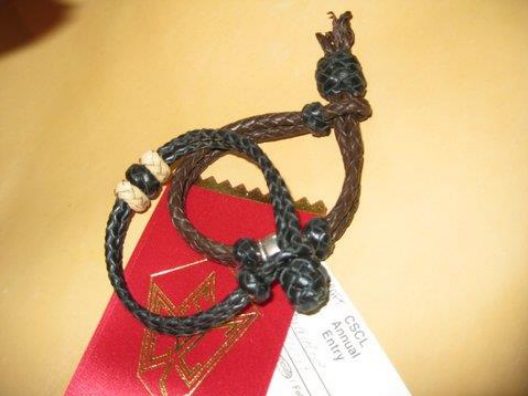
London Jewellery Award – Karen Weber ACSCL - Bracelets