
An issue of the Society’s newsletter, transcribed from the original. Download as PDF.
(16 pages, 998 KB)
Page 1
Canadian Society for Creative Leathercraft CANADIAN LEATHERCRAFT
Volume LIV No. 2 Winter 2005 –2006 0045-5121
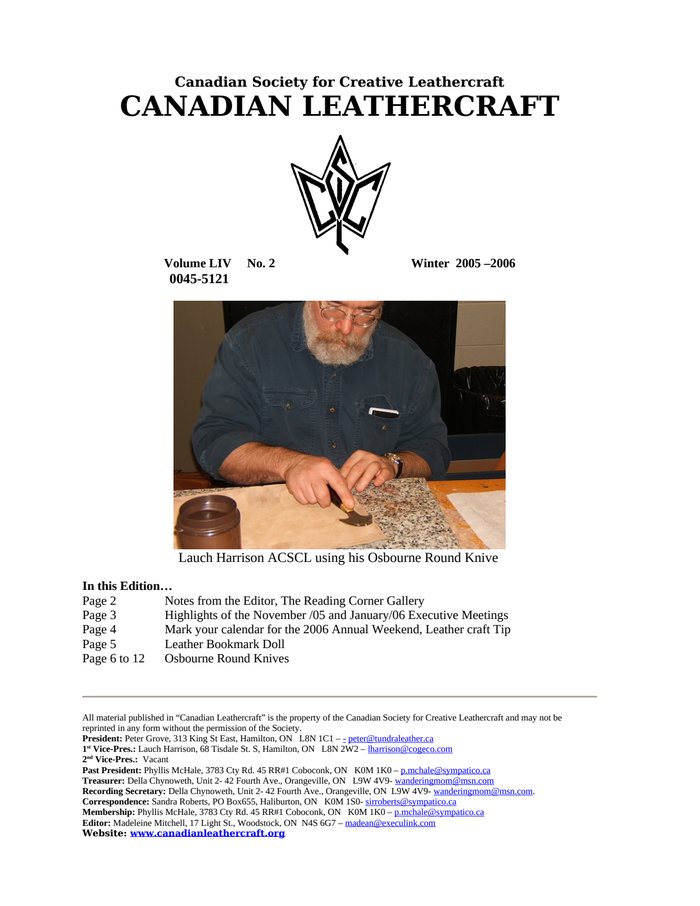
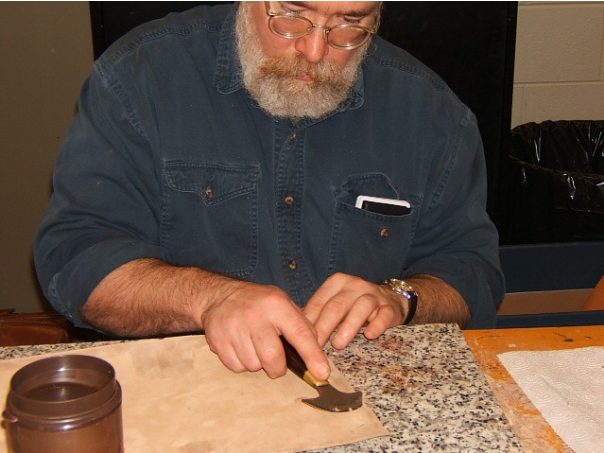
Lauch Harrison ACSCL using his Osbourne Round Knive
In this Edition…
Page 2 Notes from the Editor, The Reading Corner Gallery
Page 3 Highlights of the November /05 and January/06 Executive Meetings Page 4 Mark your calendar for the 2006 Annual Weekend, Leather craft Tip Page 5 Leather Bookmark Doll
Page 6 to 12 Osbourne Round Knives
President: Peter Grove, 313 King St East, Hamilton, ON L8N 1C1 – - [email protected]
1st Vice-Pres.: Lauch Harrison, 68 Tisdale St. S, Hamilton, ON L8N 2W2 – [email protected]
2nd Vice-Pres.: Vacant
Past President: Phyllis McHale, 3783 Cty Rd. 45 RR#1 Coboconk, ON K0M 1K0 – [email protected]
Treasurer: Della Chynoweth, Unit 2- 42 Fourth Ave., Orangeville, ON L9W 4V9- [email protected]
Recording Secretary: Della Chynoweth, Unit 2- 42 Fourth Ave., Orangeville, ON L9W 4V9- [email protected].
Correspondence: Sandra Roberts, PO Box655, Haliburton, ON K0M 1S0- [email protected]
Membership: Phyllis McHale, 3783 Cty Rd. 45 RR#1 Coboconk, ON K0M 1K0 – [email protected]
Editor: Madeleine Mitchell, 17 Light St., Woodstock, ON N4S 6G7 – [email protected]
Website: www.canadianleathercraft.org
Page 2
- 2 -Notes from the Editor…
The winter months do not often inspire leather craft projects in me. I seem to need the seasons with light and colour to really get down to crafting. Although I do remember a winter that I suffered through a nasty cold with laryngitis, that kept me home from work, and I created my first CSCL prize-winning article. With the time at home, when I couldn’t, or didn’t want to do anything else, the leather project was a diversion as well as a chance to explore a new crafting technique. I remember using Q-tips and playing with Garnett Dyes, the smoothness and flexibility of the skiver I used molded easily to the curves of the London Sherry bottle and stopper. That Spring, at the Annual, my bottle, was nicknamed “the Flame Bottle” and picked up a Craftsman and a Salon ribbon. I was flattered by the attention I received from legendary CSCL members: Fred Brown, Helen Wheaton, Clara Cavanaugh, Anne Hook, and Irva Ford As a novice, at my first Annual, I was thrilled to receive a Leather craft book from Clarice Packham
FCSCL, who was a superb Glove Maker. My friend and leather craft teacher, Carol McLean, got her Fellow that year and a book too, and, we were invited to afternoon tea at Miss Packham’s following the Annual of 1975. I still treasure that book and the memories of my first Annual.
Well back to reality, and the Winter of 2005-06. Dorothy
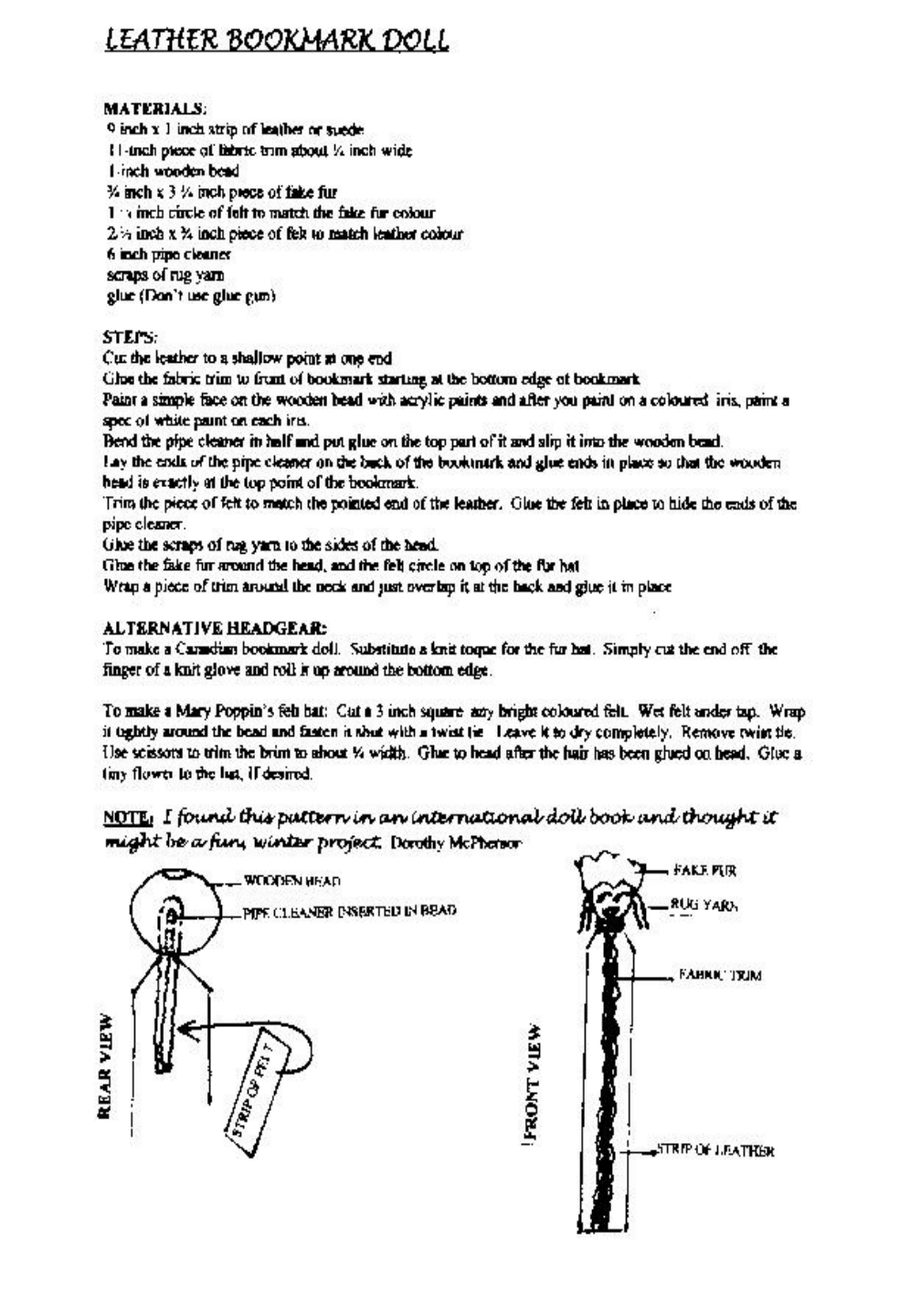
McPherson kindly wrote an article about her charming Leather Bookmark Dolls for this issue, and an announcement of an upcoming TRC Gallery show.
We’ve started our new newsletter schedule with contributions from Hamilton Branch in this issue. Lauch Harrison and the
Hamilton Branch are busily planning for the 2006 Annual, you’ll find some of the details inside. Lauch also contributed a comprehensive technical article about Osbourne Round Knives starting on page.
The Reading Corner Gallery 566 Newbold Street, London, will present
MASKS/MASKS/MASKS September 5 – October 31
featuring leather masks by Canadian leather artists.
For further information, contact Dorothy McPherson, TRC Gallery curator, 574
Cayley Drive, London, ON N6H 3G8. (519)473-6450 or email [email protected].
Page 3
- 3 -Thanks to Lauch Harrison for Hamilton’s contributions to this Newsletter! Contributions to the next Newsletter will be from Mississauga Branch Read about Paul and the gang, in the May issue of Canadian Leathercraft. Deadline for submissions –May 1st, 2006
Canadian Society for Creative Leathercraft Highlights of the November 2005 & January 2006 CSCL Executive Meetings November - at the Tandy Leather Factory January – at Paul Kitchener’s Warehouse
CSCL projects in progress:
-Revision of the CSCL Constitution –on hold until February Meeting.
-Lamour Library Boxes are being inspected and reorganized by
Lauchlan Harrison and will be circulating soon.
(Anyone having library books in their possession – please return to any Executive member- NO QUESTIONS, NO FINES!)
CSCL Business:
- a new membership list has been provided to Executive Council Members by Phyllis McHale – Branch Presidents advised to check lists and make any corrections and send to Phyllis. Any CSCL member may contact Phyllis when changing address or email address at the following:
Phyllis McHale
RR#1, 3783 County Rd 45 Reminder:
Coboconk, ON K0M 1K0 Memberships due April 1 2006 [email protected]
- the January 14th Workshop on Carving had to be postponed until Spring. Watch the web site for details and datewww.canadianleathercraft.org
- The January Meeting found Executive Council members sorting through the boxes of CSCL Archival Materials retrieved from the late Kevin Armstrong’s estate and boxes of Lamour Library books that had been at the former meeting place. A number of books, patterns and bulletins will turn up at the 2006 Annual for offering to CSCL members. Some items, mainly duplicates, had to be disposed of.
- CSCL’s history in slides, some dating back to the 1950’s, found a temporary home at Madeleine Mitchell’s, where they can be reviewed and possibly transferred to CD or DVD.
Page 4
- 4 -- The Executive Council thanked Paul Kitchener for his generosity in storing the CSCL memorabilia to date, and for a while to come, as the future home of the archives and library is decided.
The 2006 Annual Weekend at the Travel Lodge in Burlington, Ontario.
Planning continues and Lauch
Harrison needs your requests and ideas for demonstrations and workshops.
Contact Lauch at (905)525-4092 or [email protected]
If you’re in Hamilton, drop by Tundra Leather at 313 King St., East and pass on your thoughts for the Annual to Peter Grove, CSCL President
Page 5
- 5 -Leather Craft Tip:
If you run out of Brown dye for a project, try mixing instant coffee to your desired colour and consistency. It’s water soluble and cleans easily.
From “Ask Pinky” – Columbine Leather guild, Inc January 2004
Page 6
- 6 -
Page 7
Osborne Round Knives
The round knife “Symbol of the Leathercraft Trade!™'
The Osborne Company has been making tools since 1826, however the CS Osborne marks were not put on the tools until after 1861. The factory was in Newark, New Jersey and there it remained until (t was moved In 1906 to Harrison, hew Jersey,
The round knife and the head knife can look very similar, but the head knife is usually smaller and has narrower points that are better for cutting curves, The following illustration ls taken from Leathercraft Tools by Al Stohlmean.
I alee fee ome ord
BORLIPa) cpr Sepeibesl cf ifas
HEAD brabe in acm perlecrad omens peraciing! for cil or
"Far Dr hon gd PA, aero and eae" uel é hehe reoenee + Ae us ch icra ee ey Chee pte Re mcrae Pale yet coke bee Pie? on son Pp eoee FP aes hee beret one Be 4
+ lpn a00S%- Bek Hosd fej, an ana
The blade with a single point is a head knife and a knife with both points is sometimes called a double head knife. The Stohlman book Leathercraft Tools is a greal starting point for sharpening, usage and safery. Required reading for a new user! I use the head knife for all manner of work and it is the first tool to come out on the table. Pattern cutting, skiving this is the best tool for most jobs.
ge Leatnercran Toots by Al Stohiman 1954
Page 8
Rather than paraphrase the article, I'm going to show some Maker Marks that can be used to date and value your round knife. I have very few definitive dates to work with, please use this guide knowing it I s a best guess work when dating the tools.
The knives can come in many sizes and Makers, my favorite is a HF Osborne head knife that was likely made around the turn of the 19th century. HF Osborne, the brother of CS Osborne, ran his own tool company from 1877 'til 1905 when CSO bought the business.
HF Osborne
Saddiers' Round Knife. - “An 1891 H.F. Osborne catalogue, lists this tool as a #616 -- Small, Oval Rosewood Handles, 5 inch from point to point’.” Purchased on ebay for $38 usd Has the Trade mark OPT (Osborne Patent Tools)
The knife Is about 4- 1/2” across now, as It has been sharpened over the years, but there is sul! lots of life left in the blade, The smaller knives are able to do the same jobs as the big knives but if the leather is heavy saddle skirting, the big blades, made from thicker stock have the stiffness required to really lean on the cut.
CSO marked the blade with X’s for size. The handles tncrease as the blade gets larger, A late 1880's vintage C.S. Osborne catalogue lists these tools as No. 70. Round Knives, Oval Rosewood Handle. Made in the following sizes. '
Small, Oval Handles, 5 inch. Usual, Oval Handles, 6 Inch. X, Oval Handles, 6 1/2 inch. XxX, Oval Handles, 6 3/4 inch. XXX, Oval Handles, 7 inch. The No. 70 round knife still has the same name to this today.
* Taken fom http: //home.att.net!~taddle_tool_dude/tool_pages ‘round _knife.htm "Takan fom http: / (home att.net! —saddie_tom_dude/tool_pages /round_knife.hem
Page 9
Half Round Stamp (Newark)
The different sizes can be seen in this group of knives, the stamp on these blades are a half round €. 5. OSBORNE & CO with NEWARK NJ. on the flat underneath, These knives predate the late 1880's. Most of the knives have EST'D 1826 stamped on the reverse side of the blade surrounded by a wavy edged box.
(from left) CSO X, CSO Usual, and a CSO Small (circa 1870 -1880's) Nove the difference in size of the rosewood and walnut handles. The CSO XK blade, now 5 3/4" and It's as big a knife as I can safely use.
The small round knife is shown below in greater detall
The round Knife has a characteristic shape of a No. 70. The Small size is mow only 3 3/4" across. Purchased on ebay for $42 usd.
Page 10
-10-Oval Stamp (Newark) with Est’d 1826 in centre
This style was noted ina 1911 catalogue* Probably made in 1890's to turn of the century, I don't have a knife with this particular marking and have not seen it represented very often. It appears as the large round knife shown In book Leathercraft Tools by Al Stohiman.
Oval Stamp (Newark) with Est'd 1826 In centre
Round Stamp (Newark) Est'd in centre The round stamp was probably in use from 1900 'til 1905 and even after the move to Harrison NJ had been made, These knives go higher in §
Two different knives are shown both are round stamped CSO star, a round knife on the left, and the head knife on the right with a round handle, the knife is 4 - 5/8 inch across.
The star was used to denote the finest quality steel was used on this knife. Purchased on ebay -$32 usd, When sharpened and honed the round knife will glide through the heaviest of leather. The sharper the tool less the strain your hand is under. You can make the cut or skive without tiring your hands. Sharping these tools takes some practice and an investment in the proper stones. Once they have an edge they require very little malntenance.
“Csborne, €. §. & Co. (1911) Catalog: Established L826: C. §. Osborne & Co., Inc.: Standard tools. C. 5-Osborne 4 Co., lc, Newark, MN), Reprinted In LOT6 as a jalnt project by the Early American Industries Association, the Early Trades and Crafts Society and the Mid Weat Tool Collectors. (2)
Page 11
-11-Round Stamp (Newark) Made in USA This round stamp is located close to the handle and doesn’t have the EST'D 1826 on the blade. This looks like the last mark that was used in Newark and possibly after the move to Harrison. circa 1903 - 1911 Pianist i ye en Pte
1 Pe a
Round Stamp (Newark) Mace in USA
Round Stamp (Harrison) Est’d in centre This is the stamp used for most of the 20th century on the #70 round knife “ee
Round Stamp (Harrison) Est'd in centre
Page 12
-12-Half Round (Harrison USA)
The depiction in the catalogues can lag behind the actual blade markings by many years. The Round (Harrison) Stamp above and the Half Round (Harrison) No. 71 are seen in the same ne #59 (2000).
i eee ST
The No, 71 ls not on the blade ' Half Round (Harrison USA)
Half Round (Harrison USA) Forged The present stamp being used on both knives is a Half Round (Harrison) USA, with a oval Forged stamp fi nae , Half Round (Harrison USA) Forged
Conclusions
I believe that there is more value in a used knife, you can expect to pay $25 - $105 us$ for a used CS Osborne knife with the median being around $35 us$, remember to add the cost of shipping, $5 - $10 us$. If Customs get it’s plece of the action It will cost GST & PST on the Value plus $5 ca$ for brokerage fees, All in, expect to pay $50 -360 cag, A brand new round knife will cost $69 uss,
Page 13
-13-The handle should look firm and solid with no gaps between the brass ferrule and the wood, and no cracks, Blade may be chipped, blackened, pitted, stained etc. not to worry here, the steel will clean up better than most of the knives made today. Even though the modern steel will hone and hold an excellent edge. My modern head knife (circa 1980) was ground down to a smal! size before I bought it at auction (15$ us$) and it has worked like a charm, and holds an edge beautifully.
The Round Knife is a daunting tool, the Head Knife less so, in fact I have one that is small in size and crooked, a charming little guy that will take the fear out of everyone, This presents a problem, the very keen edge doesn't develop the respect 1t deserves until someone gets cuL
CSO Slanted Head Enife reverse shown EST’D 1826 within a wavey box {circa 18701880's) overall length 5 1/8 inch the head is 2 3’4 inches across. the obverse has the Half Round (Newark) Stamp
Round knives have been found in pre Dark Age sites and in Roman Sites. After you have used a Head knife the utility of this design will impress you. You will understand why this style of knife is unchanged by the passing centuries and why it is the symbol of the Leathercraft Trade.
Submitted by Lauch Harrison ACSCL
Page 14
- 14 -
Page 15
- 15 -
Page 16
- 16 -