An issue of the Society’s newsletter, transcribed from the original. Download as PDF.
(11 pages, 1209 KB)
Page 1
Canadian Society for Creative Leathercraft CANADIAN LEATHERCRAFT
Volume LVIV No. 1 Autumn 2010 0045-5121
At the Opening of LEATHER 2010: CONTAINMENT
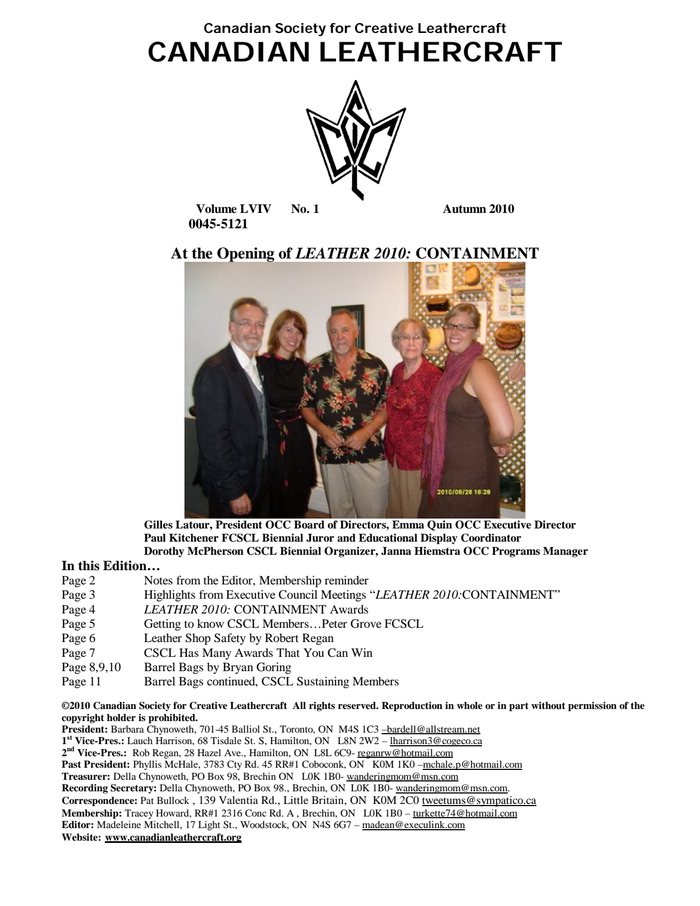
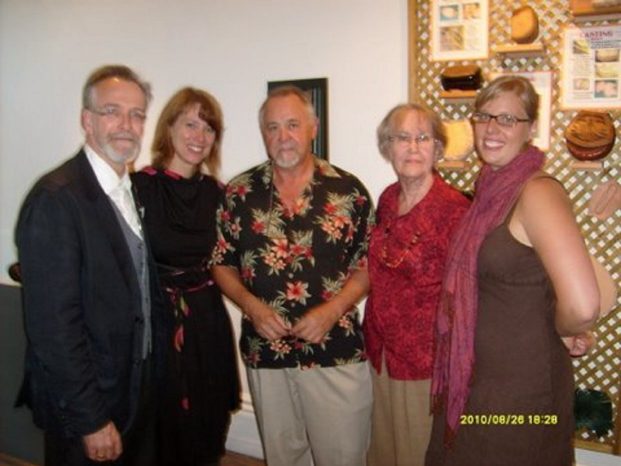
Gilles Latour, President OCC Board of Directors, Emma Quin OCC Executive Director Paul Kitchener FCSCL Biennial Juror and Educational Display Coordinator
Dorothy McPherson CSCL Biennial Organizer, Janna Hiemstra OCC Programs Manager In this Edition…
Page 2 Notes from the Editor, Membership reminder
Page 3 Highlights from Executive Council Meetings “LEATHER 2010: CONTAINMENT” Page 4 LEATHER 2010: CONTAINMENT Awards
Page 5 Getting to know CSCL Members…Peter Grove FCSCL
Page 6 Leather Shop Safety by Robert Regan
Page 7 CSCL Has Many Awards That You Can Win
Page 8,9,10 Barrel Bags by Bryan Goring
Page 11 Barrel Bags continued, CSCL Sustaining Members
President: Barbara Chynoweth, 701-45 Balliol St., Toronto, ON M4S 1C3 –[email protected]
1st Vice-Pres.: Lauch Harrison, 68 Tisdale St. S, Hamilton, ON L8N 2W2 – [email protected]
2nd Vice-Pres.: Rob Regan, 28 Hazel Ave., Hamilton, ON L8L 6C9- [email protected]
Past President: Phyllis McHale, 3783 Cty Rd. 45 RR#1 Coboconk, ON K0M 1K0 –[email protected]
Treasurer: Della Chynoweth, PO Box 98, Brechin ON L0K 1B0- [email protected]
Recording Secretary: Della Chynoweth, PO Box 98., Brechin, ON L0K 1B0- [email protected].
Correspondence: Pat Bullock, 139 Valentia Rd., Little Britain, ON K0M 2C0 [email protected]
Membership: Tracey Howard, RR#1 2316 Conc Rd. A, Brechin, ON L0K 1B0 – [email protected]
Editor: Madeleine Mitchell, 17 Light St., Woodstock, ON N4S 6G7 – [email protected]
Website: www.canadianleathercraft.org

Page 2
2 Notes from the Editor…
An era ended on Saturday, September 18th, 2010. At this meeting attended by Loreen Manuel, Janice Sloat, Nancy Durham, Nancy Wilson, and Branch President, Madeleine Mitchell, the Woodstock Branch CSCL decided not to continue. It was not a decision easily made since several of the members had been with the Branch for decades, but like all things the time had come to say goodbye. The last year was busy and a tribute to the members of the Branch as we hosted the successful 60th Anniversary of CSCL.
Here are some of my memories of the Woodstock Branch - please pardon any inaccuracies in the dates.
The Woodstock Branch formed in the mid-1960's, Beula Reynolds, Loreen Manuel, were early members. By the 1970's Carol McLean had joined, and acquired her Associate and Fellow status, and then Madeleine Mitchell in 1974. I believe Nancy joined in the 80's and then through the last 10 to 15 years we have had David and Dorothy McPherson and Marion Kehoe from London come to Woodstock. We expanded in the new millennium with the addition of Lauren McPherson, Nancy Wilson, Jan Malec and his two daughters who became our Junior Members.
Janice Sloat was our last "new" member.
Woodstock Branch has been fortunate to have existed for so long and had so many wonderful crafters as members.
Through the years our Woodstock Members have frequently picked up awards at Annuals and Biennial Exhibitions, even the Weston Trophy on occasion. We have hosted Annuals, often the "big" ones the 40th, 50th and 60th and Biennials as recently as 2010.
During the last meeting, members present all decided to continue as CSCL Members-at-Large.
The Treasurer's report provided by Lauren McPherson prior to the meeting was discussed and a Motion by Nancy Wilson and Seconded by Nancy Durham decided that "the bank balance and cash on hand will be passed on to CSCL as the fund for a "Woodstock Heritage Award" to be presented at both the future Annuals ($50 per year) and Biennials ($100 per Exhibit) for about 10 years or until the fund is exhausted”. Details of the Award will be provided to the Executive Council and the Council of Fellows. The Motion was Carried unanimously.
Our hostess for the last meeting was Loreen Manuel, and after we enjoyed coffee and treats, she generously asked us to help clear out some of her leather supplies.
What was not picked up, will go to the Executive Meeting for further distribution.
Finally, thanks to all the CSCL friends who emailed and called during my husband, Dean’s recent illness. He’s getting stronger everyday. We’re both appreciative of your caring.
“Canadian Leathercraft” is your source of information about CSCL and it’s members. Check out the CSCL website at www.canadianleathercraft.org
As always, if you have questions, comments, or even a future article for this newsletter, contact your Editor, Madeleine Mitchell at [email protected]
CSCL Memberships
Half price Special from October 1 to March 31st Contact Tracey Howard at 705-426-4663
Email to [email protected] or see your Branch Treasurer
Page 3
3 Highlights from Executive Council Meetings…
-Tracey Howard and Rob Regan mounting a Membership Drive for new members. Watch for their ideas -Sean Dalgetty and the Hamilton Branch are already planning the 2011 Annual Weekend
-Executive Council members asked to look for sites for the Biennial 2012
-David McPherson is looking missing lists of Salon Ribbons winners from 1974 to 1978, and from 1988 onward. If you can help contact David at [email protected].
-Madeleine Mitchell asked to include lists of CSCL Awards in the next newsletter (–see the list in this issue)
-_Lauch Harrison ACSCL has done a couple of Workshops in Norland – very enthusiastic group! He might be going back again.
“LEATHER 2010: CONTAINMENT”
Celebrating 60 years of Leatherwork at the Ontario Crafts Council Gallery, Toronto
With 40 people cheering the Award winners and admiring the stunning collection of CSCL
Leather, CSCL’s biennial exhibition -LEATHER 2010: CONTAINMENT showcased the versatility and ageless beauty of leather.
From the functional “Dragon Mug” to the iconic “Buttermilk”, this CSCL Biennial Exhibition presented CSCL’s talented crafters to the largest city in Canada.
Janna Hiemstra, OCC Program Manager was captured with the exhibition pieces and the “story boards” created by Paul Kitchener depicting the many steps in carving, tooling, embossing and other leather craft secrets.
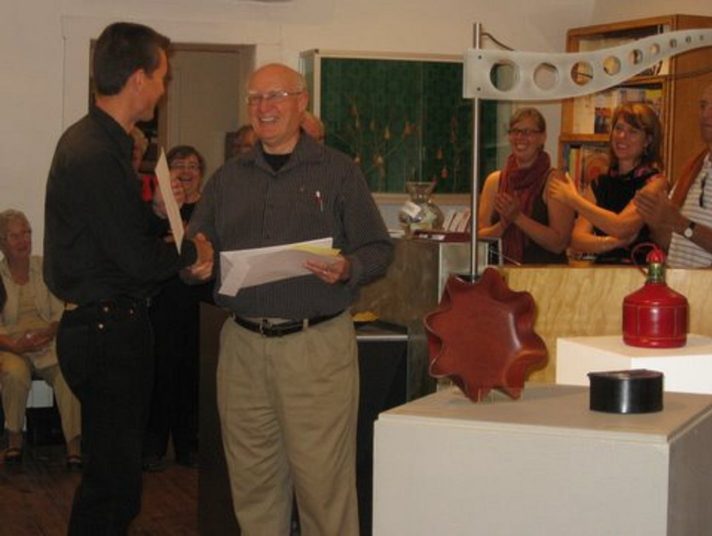
Sean Dalgetty receiving award from Council of Fellows Chair, David McPherson, for CSCL Special Judges Award for his Red Bottle ( at right)
Page 4
4 LEATHER 2010: CONTAINMENT AWARDS
- CSCL Executive Award for most functional article: Lauchlan Harrison, DRAGON MUG
- CSCL Special Judges Award for originality: Sean Dalgetty, RED COVERED BOTTLE
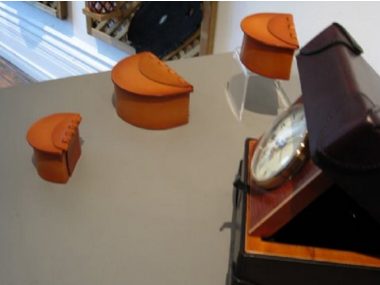
- Michigan Leather Award for best colour: David McPherson, DIMINISHING (set of 3 boxes)
- Irva Ford Award for best moulded piece: Madeleine Mitchell, LEATHER AS A BOWL
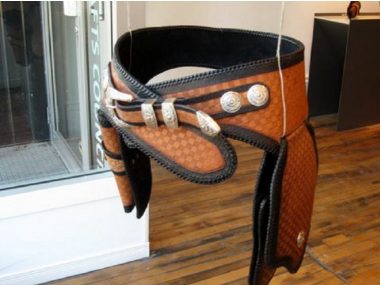
- Best Belt: Nancy Durham, CHESTNUT BROWN BELT
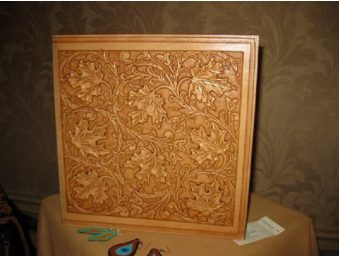
- Best Carving: Peter Grove, CARVED RING BINDER
- Honourable mention: Sean Dalgetty, CLOCK BOX
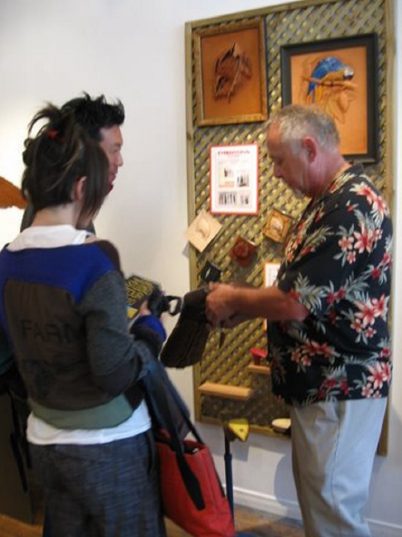
Paul Kitchener, at right with guests at the Biennial Opening
“Diminishing” set of 3 boxes by David Holsters by Brian Holohan McPherson and “Clock Box” by Sean
Dalgetty
Page 5
5
Getting to know CSCL Members…Peter Grove FCSCL
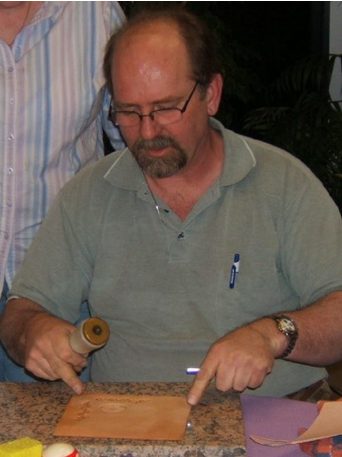
Highly regarded as a generous and skilled teacher, Peter Grove FCSCL of Hamilton, is well known in the leather craft community. He holds many CSCL ribbons and awards for his innovative and creative use of leather. He recently won the 2010 OCC Design Award and the Best Carving Award for his elegant Carved Ring Binder.
PETER GROVE FCSCL
As a 10-year-old boy, Peter was introduced to leatherwork in the public school system. It was the beginning of a life-long passion. At the age of 21, Peter went to work for the Tandy Leather Company, where he continued to work for the next 14 years. In 1991, he left Tandy Leather Company and started his own venture, Tundra Leather.
Peter’s use of carving, as a leather decoration, has been formed by countless hours at the bench, and exposure to some of the best carvers in North America. When he returned from the Rocky Mountain Leather Show, in 2000, he resolved to design his own Canadian style Sheridan carvings.
Peter is generous with his time, leading workshops and teaching private classes. He is a mentor to the members of the Hamilton Leather Guild and the Canadian Society for Creative Leathercraft (CSCL). Peter is a Fellow of the CSCL and has held office as Director and President of their Executive Council.
Peter’s work is available for viewing and sale at his shop, Tundra Leather, in Hamilton, Ontario or at www.tundraleather.ca.
Page 6
6
Leather Shop Safety By: Robert Regan CHSO, P.GSC, CRSP
In my career as a Health, Safety and Environmental Professional I have dedicated a great deal of my working life to the research and development of policies and procedures directed at protecting workers from injury. As a Leather crafter I have come to recognize that there are some significant hazards in what we do, it is from this perspective that I would like to share a few thoughts on protecting ourselves. I am sure you are aware that some of the tools we use in creating our projects are designed to cut, puncture, skive and mark leather efficiently, which is significantly tougher than human skin. Our own skin although resilient, can be easily injured and as with most accidents they can happen in the blink of an eye.
Being careful is more often than not an ineffective approach to the control of workshop incidents in comparison to pro-active planning based on a realistic assessment of hazard potentials. Lets take a second to consider the act of cutting a piece of heavy gauge vegetable tanned hide, the effort required is reduced when we employ an extremely sharp cutting tool such as an exacto knife. The specific hazard associated with this task is the drawing of the blade towards the body with the non-dominant hand holding the material from shifting around on the work surface.
Should the blade encounter a spot where the resistance changes the blade could jump up and cut the stabilizing hand. A sharp heavy duty blade is capable of doing serious damage that often results in stitches in some more serious cases nerve and tendon damage are also possible. In many cases hand injuries could be avoided by using alternative cutting tools such as a rotary cutter or a round knife that is pushed away from the body and the stabilizing hand is safely behind the sharp blade. Guides and gloves are also options that could be employed in an effort to control the risk of hand injuries
Chemical safety is one hazard that seldom gets the attention it deserves. Everyday in Ontario there are numerous people that end up in hospital emergency rooms due to unintentional household poisonings some health care professionals have estimated that up to 40% of all visits can be attributed to the improper use of household chemicals. Within the average home there are enough chemicals, cleaners, pesticides and solvents to kill or seriously injure family members simply though misuse or accidental combinations. In leathercraft we use adhesives, solvents, sealers and finishes to name a few. If we were discussing a workplace then there are several laws and regulations that provide a framework to develop a safe environment through mandatory training such as WHMIS {Workplace Hazardous Materials Information System) for anyone that comes into contact with chemicals or hazardous substances. Within our own homes we need to take a more proactive role where chemicals are concerned, fortunately there are sources of information available such as manufacturer websites. One other source of useful information is Cornell University, which has a free database of over 300,000 MSDS that you can search and print.
There are numerous other small injuries that could take place in a workshop and one possible control measure to consider is proper lighting and workstation design. I am sure everyone has experienced stiffness from being hunched over a project while tooling or stitching. This is definitely an ergonomic design problem. Ergonomics is the study of the mechanics of body postures and movement. When we hear the term “ergonomically designed” what this means is that posture, height and reach were carefully considered throughout the planning and construction of the object or device. When you experience discomfort from the performance of a specific task try to make small adjustments in how your body is positioned in relation to the work you may find that by fine-tuning your work area the discomfort may become less and less.
Workshop safety does not have to cost a lot, however through hazard recognition and planning, discomfort, injuries and illness can be avoided which provides for a more safe and healthy work environment. When we are more comfortable in our workspace there is more opportunity to create those beautiful items to bring to next year’s annual in Hamilton.

Page 7
7
CSCL Has Many Awards That You Can Win
At a recent Executive Meeting I was asked to publish the list of CSCL Awards that Members are eligible for at our various CSCL events. Upon researching for this publication, I realized that CSCL promotes healthy competition for prizes at all levels of skill and technical abilities. Be sure to participate at the next Annual and Exhibition.
You could win one or more of the following awards.
Annual Awards include:
-Craftsman and Salon Ribbons
-Robert Muma Memorial Award ($50) for best tooling or colouring
-Betty Heacock Memorial Award ($50) for new or novice member
-Ontario Crafts Council Design Award (1 year OCC membership)
-Best in Show ($50)
-Best Fellow member piece ($50) (minimum 5 entries)
-Best Associate member piece ($50) (minimum 5 entries)
-Best General member piece ($50) (minimum 5 entries)
-Workshop Award ($50) (minimum 5 entries, only for General members)
Plus several New Awards including:
Best Jewellery ($20) sponsored by Dorothy McPherson and Marion Kehoe
Best Non-Traditional piece ($20) sponsored by the Norland Leather Group Best Wearable item ($20) sponsored by the Toronto Branch
Woodstock Heritage Award ($50) from funds of the former Woodstock Branch
Biennial Awards include:
CSCL Executive Award for most functional article ($100) CSCL Special Judges Award for originality ($100)
Michigan Leather Award for best colour ($75)
Irva Ford Award for best moulded piece ($50)
Best Belt (award to be determined)
Best Carving (award to be determined)
Miscellaneous Award
Best Buckle in Memory of Don MacLeod, sponsored by the Mississauga Leather Guild
Page 8
8 Barrel Bags by Bryan Goring
From Mississauga Branch CSCL
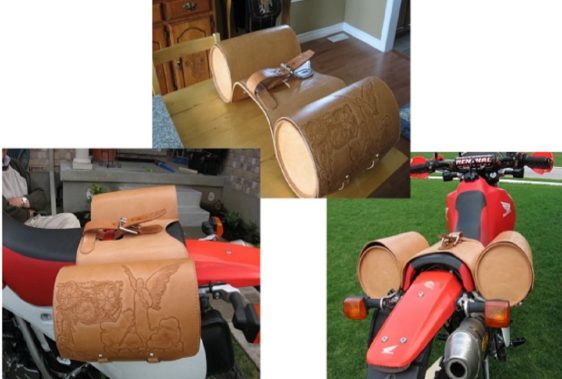
My Honda XR650 is a great bike, stingy on gas, and fun to ride; can go virtually anywhere, as it did during my summer vacation in Newfoundland, and once you get your leg over it, actually quite comfortable. It only lacks for a little storage.
So it was for some time I had been thinking a set of saddlebags was in order.
But how to fit the conventional flat backed saddlebag to this motorcycle?
The inspiration came when I realized that Ill the flared contours of the rear side panels ustration 1: Barrel Bags were designed and fitted to my would perfectly accept a round bag, and XR650 provide a little support of the bag into the bargain. Thus the basic idea was realized.
With this concept in mind, the additional design parameters/constraints were as follows:
the bags would straddle the saddle. With me sitting in front, this would limit the length of the bag to about 12”
To perfectly conform to the flare of the side panel, the diameter of the end should be about 7” The “front” and “back” were to be made of one continuous length with a reasonable opening size, perhaps a little less than half the circumference, and a flap to make the bag close completely It should have some means of being strapped to the seat of the bike, so it couldn't fall off, and, Finally, the entire project would be lined.
With those basic goals in mind, construction commenced.
Making the Ends
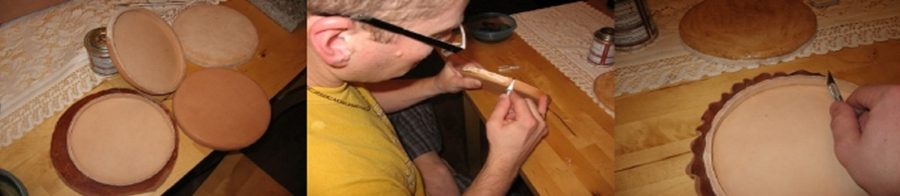
Each of the four ends was stretched over a circular last made of plywood. I wanted to create an inset end with the sewn lip projecting out of the bag rather than inside. To achieve this, the grain side was stretched face down over the last.
After drying, an Exacto blade was used to trim off the excess.
This was done Illustration 2: Ends were made over a plywood last, lined, trimmed and sewn manually by holding the blade firmly on another strip of plywood (same thickness), and rotating the end against the blade. With a few careful rotations, the fresh blade cut cleanly through.
Page 9
9 Next up, the ends were backed with a fine grain leather, and carefully coaxed around the lip edges. To smooth out some of the stubborn “puckers” I resorted to wetting the lining down a little with water. It didn't seem to impair the glue at all.
Since the flap would not be sewn for at least one third of the circumference of the end, to allow an opening of the bag, the lining on this portion of the end was maintained. Elsewhere along the edge, where the sides were to be sewn to the end, the excess was carefully trimmed back with the Exacto knife.
Following holing and sewing of the lined section of the ends, the four ends were set aside to deal with the sides.
The Sides
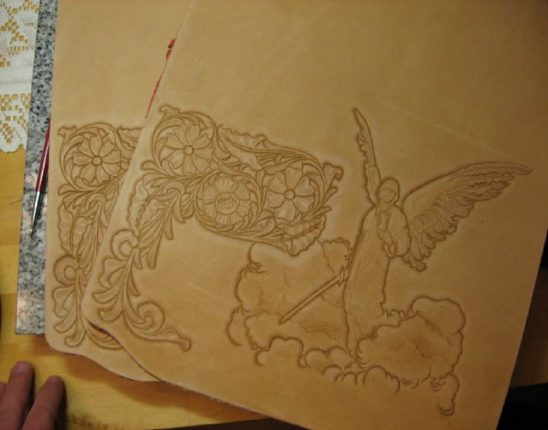
The two sides were cut from one length of rawhide. The length was determined as the circumference of the ends, and allowing for the thickness of the side, plus a small measure for the flap. An ornamental bend was cut along the front of the flap. The edges of sides where then skived down where they were to meet the sides, and the flap and front lip of the side (the opposite ends) were also skived down so that when the flap is closed, would appear to have a uniform thickness. At least that was the idea. A little carving was done, using a Tandy template, which I quite liked. The nature scene inside the frame I cut off, and inserted some other artwork.
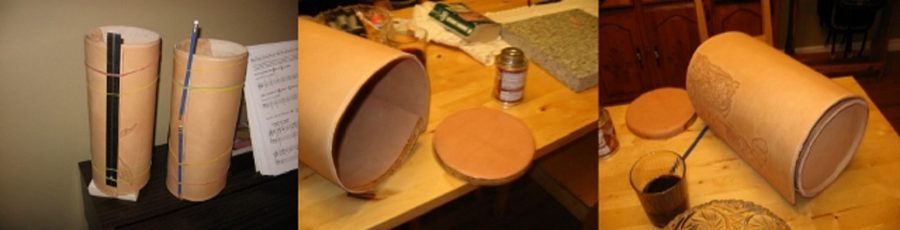
Following completion of all the carving, the sides were ready to be lined. Before lining, I wet both the sides and rolled them up, leaving them to dry with some elastic bands in place. My hope was that having some curvature would ease the job of lining.
After drying the lining was cut with a modest amount of oversize, and the sides were lined working the glue in sections and keeping the side rolled up. I kept the ends handy to make sure the roll was about the right size to avoid any creasing or stretching of the lining later. The only real
Illustration 3: Temptation to carve is irresistible challenge here was to bring the lining back from the edge about 1/4” where the side would be sewn to the end, but make it flush for the flap.
With the sides now tooled and lined, I set about with the overstitcher to mark the eventual holes. The holes would not actually be made until the sides were glued to the ends.
Assembling the Bags
Now came the fun part of assembling the sides to the ends. Contact cement was used to fix the very edges of the sides to the ends. This was a fussy process but the glue was strong enough to hold the bags together as I was making the holes. Using the hand awl, I holed around the glued edge starting from the front lip of the bag all the way around to the back. This comprised about 2/3 of the edge, which was the non-opening section. These were then sewn together. Next up the opening section of the side and the flap were holed following the oversitcher markings and sewn. The end result was that from the outside of the bag the stitching appears to be one continuous length between the opening and non-opening section.
Page 10
10
Illustration 4: Rolled sides drying to shape, the lined & trimmed parts ready for assembly, and the final assembled bag
The last sewing job was that of doing the front inside lip (behind the flap) of each bag. Looking closely at figure 5, left hand corner, you will see that the stitching of the front lip starts at the edge seam and runs across the entire front lip in one length. Since the edge seam is actually outside the bag, it was necessary to do some creative routing of the line to achieve this effect.
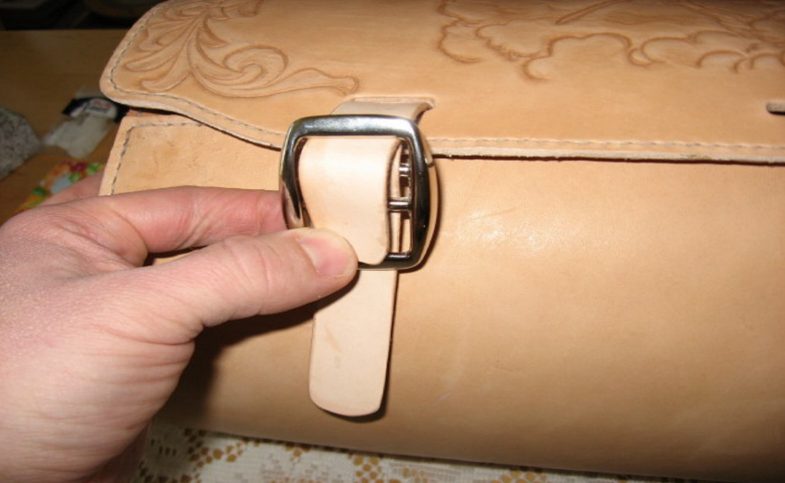
Illustration 5: Fitting the straps.
Finally, a set of straps were cut, fitted to the buckles, backed, holed, sewn and fastened to the bags. Since the straps run from the inside of the bag out, I found myself faced with having to make holes with the bag assembled. In hindsight this would have been easier with the sides lying flat on the table.
Holding it all together
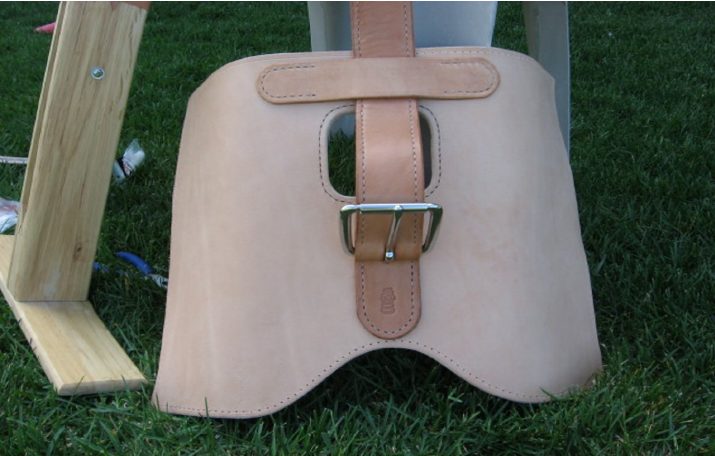
The last part of the project was to create a back to straddle the seat and attach the bags. Using the same gauge leather as was used throughout the project, I wet and stretched the cut shape over my saddle and allowed it to dry. After this piece had taken the shape I wanted, a tapered form of the seat with ample edge to sew the bags onto, it was backed to stiffen and retain its shape.
I then prepared a belt that doubled back on itself and could be threaded under the seat strap. The cutting of an aperture into which the belt goes, was cut to allow access to the strap. Finally all the edges were holed and sewn.
Page 11
11
I llustration 6: The back finished and waiting to be sewn to the bags.
After the back was completed, the last task was to sew the bags onto the it. For this each bag was first affixed using 4 ornamental Chicago screws. Mississauga club members one Saturday morning were aghast at the sight of me using power tools to make the holes on the finished bags, a task that I imagined would otherwise be impossible now that the project was assembled. Following that two parallel rows of stitching were done on each bag to make it fast. The whole project was finally subjected to the obligatory burnishing and application of sheen.
In the end this turned out to be a very challenging and interesting project for me. The barrel bags so far have proven resilient and practical addition to my bike. Looking forward and dreaming of the next project...
Support CSCL’s Sustaining Members:
Buy your leather and crafting supplies from our friends at the following businesses:
Tundra Leather
313 King St., East
Hamilton ON L8N 1C1 CSCL Wants your ideas for a future 905 527-7745 [email protected] Workshop
What do you want to Learn?
Moore-Pearsall Leather Company How can we help you make a project?
#7 – 100 Wingold Ave
Toronto, ON You tell us what you would like to do 416 789-3123 www.moorepearsallleathers.com And we’ll try to make it happen Send your suggestions to
Tandy Leather Factory [email protected]
5562 Tomken Rd
Mississauga, ON
905 625-3700 [email protected]