
An issue of the Society’s newsletter, transcribed from the original. Download as PDF.
(7 pages, 2562 KB)
Page 1
The Canadian Society for Creative Leathercraft CANADIAN LEATHERCRAFT
Volume LXV No. 2
Winter 2016/2017 0045-5121
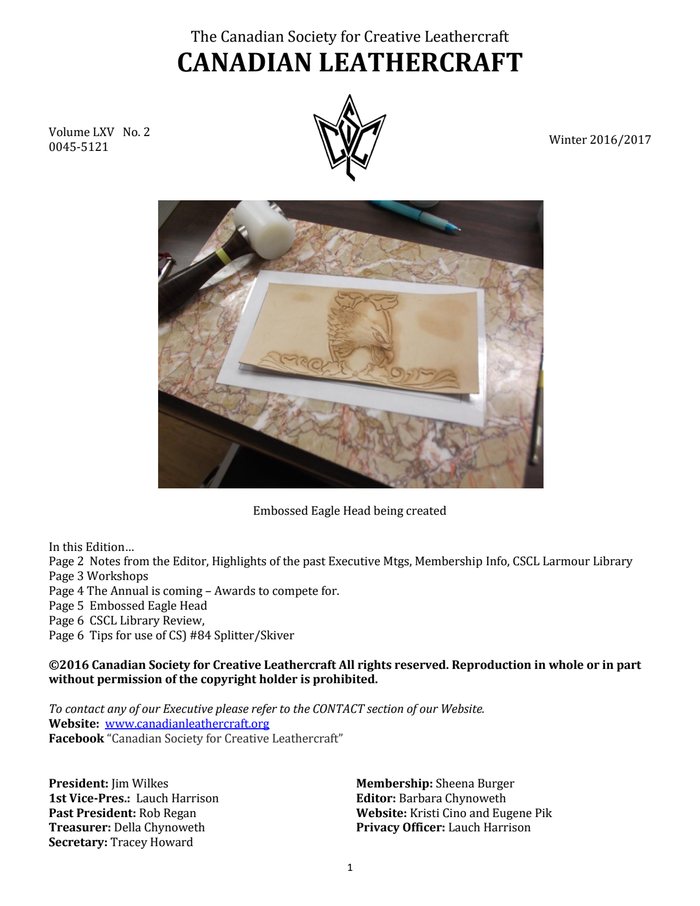
Embossed Eagle Head being created
In this Edition…
Page 2 Notes from the Editor, Highlights of the past Executive Mtgs, Membership Info, CSCL Larmour Library
Page 3 Workshops
Page 4 The Annual is coming – Awards to compete for.
Page 5 Embossed Eagle Head
Page 6 CSCL Library Review,
Page 6 Tips for use of CS) #84 Splitter/Skiver
©2016 Canadian Society for Creative Leathercraft All rights reserved. Reproduction in whole or in part without permission of the copyright holder is prohibited.
To contact any of our Executive please refer to the CONTACT section of our Website.
Website: www.canadianleathercraft.org
Facebook “Canadian Society for Creative Leathercraft”
President: Jim Wilkes
Membership: Sheena Burger
1st Vice-Pres.: Lauch Harrison
Editor: Barbara Chynoweth
Past President: Rob Regan
Website: Kristi Cino and Eugene Pik
Treasurer: Della Chynoweth
Privacy Officer: Lauch Harrison
Secretary: Tracey Howard
Page 2
Note from the Editor….
Please check out our new website.
The Annual is coming up the first weekend in May, have you got your registration sent in.
Membership renewals are due by March 31st.
The Quarterly Newsletter “Canadian Leathercraft” is your source of information about CSCL and its members. Also check out the CSCL website at www.canadianleathercraft.org and CSCL’s Facebook page.
Highlights from the Past Executive Council Meetings….
This winter the Executive tried their hand at Skyping for the meetings that they did not want the executive to drive in. After some trial and errors people were getting the hang of it and we are looking at doing it again when weather makes travelling difficult. More workshops are being planned and if you have any suggestions please let use know.
CSCL Membership
Have you paid your membership? It’s a new Membership Year (April 1 to March 31).
Send your membership along with your cheque made out to “The Canadian Society for Creative Leathercraft” to our Membership Chair:
Sheena Burger, 1085 Zion Rd, Little Britain, ON [postal code removed]
T: [telephone number removed] - [email address removed]
| General Member | General Member – Student* | Member-at-Large | Sustaining Member |
|---|---|---|---|
| Individuals interested in leathercraft who belong to one of the CSCL Branches. (Need not be a leathercraft person.) $40.00 | A registered full-time student shall pay $5.00 | Individual interested in leathercraft who does not belong to one of the CSCL Branches. (Need not be a leathercraft person.) $40.00 | Commercial Organizations interested in supporting the Society. $100.00 or material equivalent to $100.00. |
CSCL Larmour Lending Library
The CSCL lending Library of Books and Patterns can be referenced on our web site www.canadianleathercraft.org. Head to Gallery and click on CSCL Library of Books and Patterns. Under the Patter option there is 80 pages of patterns that may give you ideas of things to make. Under the Book section there is 13 pages of titles of Books and DVD’s about Leather crafting, design and colour. Remember these patterns and books are there for you to borrow from the library. Select item(s) you would like to borrow and send your list to Paul Kitchener at [email address removed]
Branch Presidents will assist in pickup and delivery of the orders from branch members.
Members-at-large may order directly from Paul and arrange shipping or printing options, fees may apply.
Memberships are due by March 31st.
Page 3
Workshops
CSCL Workshops presents Leather Waxcoated Mug
Blackjacks & Leather Bottells
Saturday, April 8, 2017 10:00 am to 4:00 pm
Norland School Hall Community Centre, 3448 Monck Road, Norland, Ontario
Registration - $30 members $50 non-members Materials - $30
Registration deadline April 1, 2017 To Register: Contact Lauch Harrison [email address removed] [telephone number removed] or Barbara Chynoweth [email address removed]
Potluck Lunch
Bring something for the Pot Luck Lunch Beverages and water will be provided.
Outline
The workshop will introduce the participants to leather drinking vessels, with a look into the history of the Blackjack and Leather Bottells. Particpants use 10 oz or heavier veg leather to make a handled mug or a cylinder.
Cutting Patterns in heavy leather, Carving decoration, Harness Stitching using a diamond awl and linen thread, Using a large sewing machine, and Half Round Punching in heavy leather.
The mugs will then be coated in beeswax to make a waterproof drinking vessel.
There is an opportunity to decorate the Blackjack, please bring a simple carving less than 3” tall and 2” wide. The carving must be finished in one hour or your mug may not be completed during the workshop.
Tools
Please bring your tools, there will be loaners and some tools to purchase.
Head Knife, Diamond Awls. Carving tools.
Supplied material - Needles, Thread, Contact Cement, Bees Wax and Leather.
Supplied loaner tools - head knife, diamond awls, stitch clamps, round and half round punches, spoke shaves, french edgers, rawhide mauls.
Participants will be able to use a harness stitching sewing machine, The mugs bottom seam has to be hand sewn.
The Hamilton Leather Guild invites you to the 67th Annual Convention Weekend for The Canadian Society for Creative Leathercraft May 5th, 6th & 7th 2017
The weekend Theme is Trucks, Truckers and CB Radio Talk 10-4.
Page 4
CSCL Annual Awards (PART 2)
pleasing in London Jewellery Award Piece must be pleasing in appearance. If colour is added it must be well appearance sponsored by London applied (Not clumpy. Appropriate to the article.) Findings (metal fasteners) Members-at-large must have no, or almost no, glue visible around the finding. A piece of leather (circular disc or neatly-cut square) should be glued over the back of (this will be awarded 5 the finding. Edges must be neatly finished in a manner appropriate to the times and then is finished) piece. It must present a pleasing finish coat or be properly buffed. The piece may be temporarily affixed to a piece of cloth or leather for display purposes. This will be Judged by representatives from London and/or former winners. Award is $20.00 unusual or non- Best Non -Traditional Piece Pieces considered for this award must be accompanied by an ARTIST traditional sponsored by the late STATEMENT. The ARTIST STATEMENT must state what unusual and non-techniques Hilda Chynoweth traditional approach was used to achieve what result and also state how (this will be awarded 5 successful the attempt was. This award recognizes unusual or non-times and then is finished) traditional techniques. This award may, but not always, exhibit an unusual or non-traditional use of leather. Award is $20.00 an item of apparel Best Wearable Item Must be an item of apparel such as gloves, vest, hat, scarf, mitts, footwear, sponsored by the former excludes jewellery. Award is $20.00
Toronto Branch.
(this will be awarded 5 times and then is finished) attractive, Best Hard Sculpture Item Hard sculpture is an attractive, handmade article that is rigid, non-pliable.
handmade article sponsored by the Examples of hard sculpture:
that is rigid, non- Mississauga Branch. Artistic adaptation of person, animal or thing such as the human figure pliable (adult, ornamental, often displayed on a base and assembled freehand, (this will be awarded 5 signed and dated, and usually one-of-a-kind about 2-36 inches tall times and then is finished) ornamental, not a cute, cuddly toy.) Adaptations are often realistic looking.
- Mask
- Container (Box, CD case etc.)
- May be either fully functional or ornamental.
- May be realistic, whimsical or abstract
Piece must be pleasing in appearance. If colour is added it must be well applied (not clumpy) and appropriate to the article. Must be well finished and traditional leather techniques must have been followed in its creation.
This will be Judged by representatives from Mississauga Branch and/or former winners. Award is $20.00 “Article that Woodstock Heritage This award is given for the “Article that stress’ the beauty of leather, less is stress’ the beauty Award from funds of the more, using Traditional leather crafting techniques, is eye catching” at the of leather, less is former Woodstock Branch. Annual if there is not a Biennial that year. The amount given for this award more, using is $50.00 at the Annual or $100.00 at the Biennial. Woodstock
Traditional leather representatives will compile some examples ie. Robert Muma’s work. This will be Judged by representatives from Woodstock and/or former winners.
crafting techniques, is eye catching”
New Associate This award is given to the New Associate with the highest overall with the highest percentage on their successful Associate Status Exam. This consists of four overall percentage Zelaitis Pin pieces judges by the Fellows and having an average of 79% or higher.
Best Buckle Miscellaneous Award In Memory of Don MacLeod, sponsored by the Mississauga Leather Guild.
No monetary award just your name on the trophy and you can show the trophy until the following year. This will be Judged by Mississauga Branch representatives selected by the Mississauga Branch.
Page 5
Page 6
CSCL Library Review By Lauren
#8 – Snaps and Fasteners, Karla Van Horne, 15 pages, duotang
An authentic leathercrafter’s bright yellow covered report moderately describes scenarios to set knobbies, split rivets, tube rivets, burr or washer rivets, eyelets, the Chicago screw, conchos, zippers, buckles, grommets, clasps,
Velcro, the Sam Browne, and ring assemblies.
Snaps come in a number of different cap sizes which are determined by a system of 40 lines to the inch. Photos and illustrations are not included; the author’s empirical view of fastener selection and installation succinctly compares and offers advice for each application. With only a few faintly reproduced paragraphs the electric typewriter font is a nicety for this genuine discourse from a home-grown button to a lock clasp to the author’s favourite: tuck locks as they offer a great deal of security for cases, which, due to their function, may be put under stresses which make snaps open too easily and which make buckles too clumsy or inefficient to use.
Tips for Use of CSO #84 Splitter/Skiver
Page 7
Blade set up
To make the blade cut well the bottom of the blade must be flat, no micro bevel, this includes beveling due to excess stropping. The blade has a set angle so when you sharpen the blade sharpen only the top side.
The blade should be hollow ground as it wears and get sharpened it gets flatter as the hollow is reduced.
This makes the blade harder to sharpen due to the increased contact of the steel and the stone. A quick fix is to elevate the stone on a penny, this will create a micro bevel and allow you to sharpen the edge and not grind down the whole blade. The micro bevel increases the strength of the edge with a very slight sacrifice in cutting ease.
The blade should be set just back from top dead centre above the roller. You can move the blade by loosening the screws and sliding the blade back and forth. Experiment on some scrap before you use the splitter on your good projects.
I use diamond hones for sharping the blades, depending on how much grinding I have to do, I'll use 400 grit then 600 grit then 15 micron then 1200 grit then finishing film or the strop. The diamond stones remain very flat and are a good investment.
Starting a cut
You place your leather Grain side to the roller in the splitter by pushing the handle forward, as the roller closes, wiggle the leather and pull it slightly to set the split then pull. First put about 10” into the splitter from the back of the splitter, wiggle it then pull it thru. Check the weight and adjust as needed. By using the thumbscrew and the setting the handle stop the same weight can be reproduced many times over. Reverse the strap and put the 10” split end in the front, use it as the handle to pull the entire strap thru the blade. It is best not to take off too much if it is very stiff leather, go at it bit by bit.
The skiving feature is used by pushing the handle forward as the leather is being pulled thru the blade, this makes a skive, The slower the handle is pushed forward the longer the skive will be.
Make a strop
Take some 8 oz leather 3” x 18” and pull it thru the splitter, to about 6 oz. punch a hole in one end as a thumb notch. Put some polishing compound on the flesh side and use it as a strop to polish the bottom of the blade. I use green aluminum oxide and white paste that comes in small bars or blocks.
Expect to pay $450 - $600 for a used splitter so make sure you have lots of heavy leather to pull dow to make it worth while, that being said they last for hundreds of years and they retain their value very well so it can be a good investment in your tool chest.
Good luck
Lauch Harrison, ACSCL