
An issue of the Society’s newsletter, transcribed from the original. Download as PDF.
(12 pages, 4906 KB)
Page 1
The Canadian Society for Creative Leathercraft CANADIAN LEATHERCRAFT
Volume LXVIIII No. 3
May, June, July, August - 2021 0045-5121
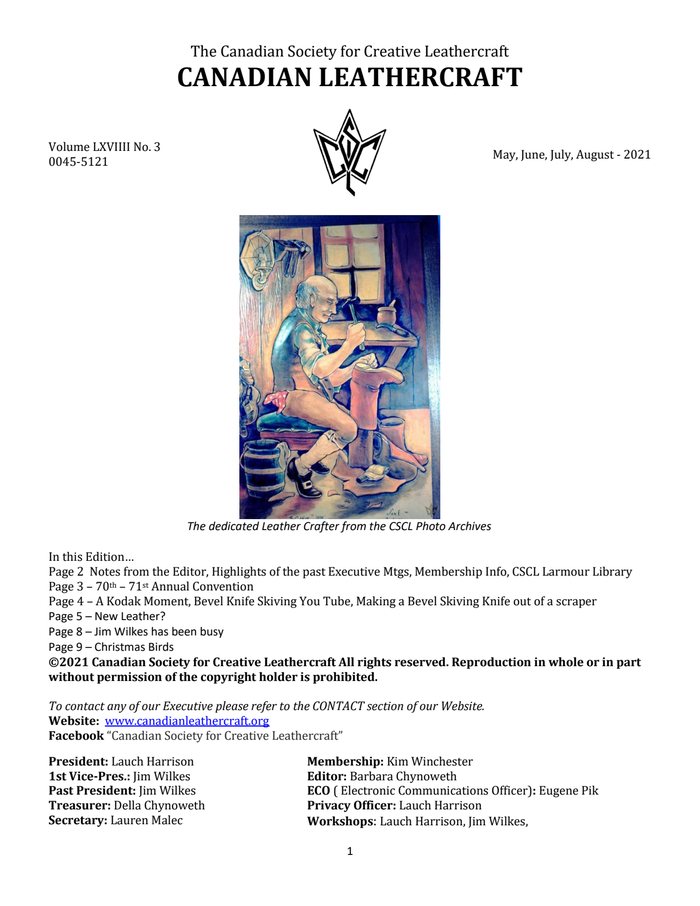
The dedicated Leather Crafter from the CSCL Photo Archives
In this Edition…
Page 2 Notes from the Editor, Highlights of the past Executive Mtgs, Membership Info, CSCL Larmour Library
Page 3 – 70th – 71st Annual Convention
Page 4 – A Kodak Moment, Bevel Knife Skiving You Tube, Making a Bevel Skiving Knife out of a scraper
Page 5 – New Leather?
Page 8 – Jim Wilkes has been busy
Page 9 – Christmas Birds ©2021 Canadian Society for Creative Leathercraft All rights reserved. Reproduction in whole or in part without permission of the copyright holder is prohibited.
To contact any of our Executive please refer to the CONTACT section of our Website.
Website: www.canadianleathercraft.org
Facebook “Canadian Society for Creative Leathercraft”
President: Lauch Harrison
Membership: Kim Winchester
1st Vice-Pres.: Jim Wilkes
Editor: Barbara Chynoweth
Past President: Jim Wilkes
ECO ( Electronic Communications Officer): Eugene Pik
Treasurer: Della Chynoweth
Privacy Officer: Lauch Harrison
Secretary: Lauren Malec
Workshops: Lauch Harrison, Jim Wilkes,
Page 2
Note from the Editor….
The Newsletter “Canadian Leathercraft” is your source of information about CSCL and its members. Also check out the CSCL website at www.canadianleathercraft.org and CSCL’s Facebook page.
I am always looking for articles for the Newsletter, do you have a project that you have done that you think everyone would be interested in seeing, we are looking for articles?
Highlights from the Past Executive Council Meetings….
The Executive was busy finalizing the 70th - 71st Annual that was being held on Zoom on May 8th. This Zoom Annual went very well and we were able to stay within the planed time of two hours. We would like to thank Stanley Major from Sea Leather Wear for his demonstration on the use of Fish Skin Leather and the various ideas that Fish Skin Leather can be used for. Visit him on the internet at Sea Leather Wear.
Please see the last page of the Newsletter for links to pictures of the items that were judge for this Annual.
We held an Executive meeting the end of May to wrap up any outstanding business before we broke for June, July and August. Our next Executive meeting will be held in September.
CSCL Membership
Have you paid your membership? It’s a new Membership Year (April 1 to March 31).
- If you are joining trough a branch pay your CSCL membership to the Branch Treasurer along with your branch membership fee.
- if you are joining as a Member-at-Large or Sustaining Member send your membership payment to the CSCL Treasurer: Della Chynoweth, 3350 Monck Road, Norland, Ontario K0M 2L0 or you can e-transfer to [email address removed] Please be sure to include your contact information.
| General Member | General Member – Student* | Member-at-Large | Sustaining Member |
|---|---|---|---|
| Individuals interested in leathercraft who belong to one of the CSCL Branches. (Need not be a leathercraft person.) $40.00 | A registered full-time student shall pay $5.00 | Individual interested in leathercraft who does not belong to one of the CSCL Branches. (Need not be a leathercraft person.) $40.00 | Commercial Organizations interested in supporting the Society. $100.00 or material equivalent to $100.00. |
CSCL Larmour Lending Library
The CSCL lending Library of Books and Patterns can be referenced on our web site www.canadianleathercraft.org. Head to Gallery and click on CSCL Library of Books and Patterns. Under the Patter option there is 80 pages of patterns that may give you ideas of things to make. Under the Book section there is 13 pages of titles of Books and DVD’s about Leather crafting, design and colour. Remember these patterns and books are there for you to borrow from the library. Select item(s) you would like to borrow and send your list to Paul Kitchener at [email address removed]
Branch Presidents will assist in pickup and delivery of the orders from branch members.
Members-at-large may order directly from Paul and arrange shipping or printing options, fees may apply.
Memberships are due by March 31st
Page 3
70th – 71st Annual Convention
Meet your Executive for 2021 - 2023 Executive
Past President Jim Wilkes President Lauch Harrison 1st Vice President Jim Wilkes Secretary Lauren Malec Treasurer Della Chynoweth
Branch Presidents
Hamilton Sean Dalgetty Mississauga Jim Wilkes
Norland Tracey Howard MAL Appointee Lauren Malec
Ex-Officio
Chairman – Council of Fellows Sean Dalgetty
Teaching Standards Lauch Harrison Editor – Canadian Leathercraft Barbara Chynoweth Membership Kim Winchester
Librarian Paul Kitchener
Privacy Officer Lauch Harrison
Electronic Communications Officer Eugene Pik
Special Committees
Workshops Lauch Harrison, Jim Wilkes
President’s Message from the Annual - Lauch Harrison FCSCL Welcome to the Virtual Annual General Meeting. What great changes the last year and a half has brought to our Leather Working Society and Canadian Society. The time has gone by alternating from very quickly to a dead stop.
Without our normal milestones it seems so little time has past since we met last in Norland. The extended period of inactivity has not served us well and if I use my own experience, I did not spend much time with leatherwork.
The Society continues to shrink, but we will continue for our members until our funds are gone. Our ability to pass along the craft to a new generation has been usurped by the internet and the myriad sites with information, patterns, videos and chat rooms that are free and easy to use. Our challenge is finding ways to remain vital, offering workshops is one avenue. Two years have past and one workshops was developed or given. We can't sustain interest in the Society unless we can draw outside interest for two reasons; income and introducing the Society to potential members.
The Fellows of the Society judged the First Virtual Annual Competition from photographs and I congratulate them on the effort and thank them for the time spent.
I hope this is not the only way to present our craft for others to see. I hope we will gather, do workshops, demonstrations and have some real Annuals in the coming years.
Page 4
A Kodak Moment
“...a rare, one time, moment thatis capturedbya picture or should have been captured by a picture.”
The 2020 Tokyo Olympics brought many Kodak moments and during this year’s CSCL summer break one MAL captured her camera too, and in leather.
Looking ahead to the 2021-23 term, our newly elected Secretary shares this week’s photo of her scratch pad sketch of her childhood Instamatic X-15. This sketch, including that fiddly flash cube, was transferred to a 4 oz piece of recycled cowhide leather which was last summer’s custom leather mouse pad project. All of these steps afforded her the fun opportunity to practise the use of a swivel knife at little cost.
What was your Summer ’21 Kodak momentin leathercraft?
Bevel Knife Skiving
Check out this You Tube video of Lauch Harrison talking about Bevel Knife Skiving.
https://www.youtube.com/watch?v=cqFU1uxroKo
Making a Bevel Skiving Knife out of a scraper
Making a Bevel Skiving Knife out of a Richard stiff scraper. this video shows the steps of annealing, profiling, hardening, tempering, grinding, honing and stropping the scraper into a knife for skiving leather. thanks for watching https://www.youtube.com/watch?v=zXN5k6UKx5g
Page 5
New Leather? The following is compiled from various articles I found on the Internet about New Leather, but I did not see any New Leather that could be carved.
Creating a leather alternative that could replace animal leather has been a goal for research labs and companies all across the world.
Over centuries, leather has become a crucial part of our society. Thanks to its abundance and properties, it is a perfect material to be used in various fields, from fashion to automotive industry.
Unfortunately, leather is as unsustainable as useful…
With the growing environmental crisis and the shift of the population towards more plant-based lifestyle, finding a sustainable replacement for animal leather is crucial.
What Is Vegan Leather, Anyway?
Vegan leather may sound like an oxymoron because, well, it is an oxymoron. So what even is vegan leather — besides being an ethical, sustainable, and cruelty-free alternative to traditional leather!?
Well, as you probably already suspected: It isn’t leather at all!
Vegan leather has a couple of different names — you may have heard of “artificial leather” or “synthetic leather” — all of which describe more or less what it is: An alternative to leather that looks like traditional leather, but doesn’t use any animal products.
Most vegan leather is made using polyvinyl chloride or polyurethane, both of which are plastic-based materials (hence the popular, albeit maybe dated, portmanteau “pleather,” which originally stood for “plastic leather”). And while we’re well aware of our planet’s plastic problem, “pleather” is still the more sustainable and ethical option when it comes to handbags, belts, wallets, shoes, and anything else you’d typically find using leather.
As Green Matters has reported countless times, experts agree that eliminating or cutting back on one’s consumption of animal products — yes, leather and hides included — is the single best thing an individual could do to help the planet. As researcher Joseph Poore put it, “A vegan diet is probably the single biggest way to reduce your impact on planet Earth, not just greenhouse gases, but global acidification, eutrophication, land use, and water use. It is far bigger than cutting down on your flights or buying an electric car.”
And switching to vegan leather is a change that the world has thankfully embraced. According to a recent report by consulting group Grand View Research, the world market for vegan leather is estimated to be worth $85 billion by 2025, LiveKindly reported.
Cactus Leather Is the Newest Eco-Friendly Fabric a new brand out of Mexico called Desserto is shaking things up by turning nopal cactus leaves into organic, all-natural, cruelty-free leather. Desserto is the first cactus-based leather on the market, and the material has the potential to make the vegan leather industry much more sustainable.
As reported by Fashion United, Desserto's cactus leather is organic, partially biodegradable, soft, durable, and high enough quality that it can be used to make clothing, accessories, furniture, and even car interiors. “After two years of research and development, we managed to produce a suitable
Page 6
material that complies with the features and technical/mechanical specifications required by those industries that use animal or synthetic leather,” co-founder and vice president Adrián López Velarde told Fashion United in an interview.
Cereal Crop Leather by Will's Vegan Store
Will's Vegan Store is an online store that makes luxurious vegan leather shoes from cereal crops.
As Will Green, founder of Will's Vegan Store tells Green Matters in an email, the company's vegan leather is made from a mix of polyurethane and bio oil. The bio oil is sourced from cereal crops that were organically grown in northern Europe in a carbon neutral process.
The company is trying to move away from using polyurethane to make its vegan leather, and recently rolled out a new product using viscose made from eucalyptus bark.
"I am working closely with the Italian producer of this material and hope to push the percentage of bio oil we are using even higher through further development," Green tells Green Matters.
Pineapple Leather by Piñatex
Dr. Carmen Hijosa was once a leather expert — but in the 1990s, she discovered the high environmental impact of the leather industry, and set out to find a better solution than PVC. After years of research, she invented Piñatex, a natural vegan leather made from pineapple leaves. The leaves are a byproduct of existing pineapple harvest, keeping the environmental impact of the material lower than both PVC and leather.
Hijosa founded the company Ananas Anam to sell Piñatex, and fashion brands, designers, and students can order sheets of Piñatex fabric through Ananas Anam's website. The company does not directly sell any goods made from pineapple leather, but you can buy shoes, purses, and other items made from Piñatex from companies including Nae Vegan Shoes, Hozen, HFS Collective, and Hugo Boss.
According to the company's FAQ page, Piñatex is made of natural fibres and polylactic acid fibres (PLA), which are biodegradable. However, Piñatex is coated with a petroleum-based resin, meaning the material not biodegradable — yet. Ananas Anam is working on a bio-based coating that will hopefully make Piñatex biodegradable in the future.
Cactus Leather by Desserto
New company Desserto debuted its vegan cactus leather at the International Leather Fair Lineapelle 2019 in Milan last year, followed by the RawAssembly sustainable materials show in Australia, where it was the most-buzzed about product at the entire event, according to Vogue Australia.
Desserto vegan leather is made from nopal cactus leaves, and it is organic, "partially biodegradable," soft, and durable — so durable that it can be used to make furniture and car interiors in addition to fashion items like wallets, purses, and shoes.
The nopal cactus grows in abundance across Mexico without requiring any water, making it a low-impact crop.
Corn Leather by Veja
French footwear brand Veja is known for its sustainability efforts and for offering a variety of vegan sneaker styles. In early 2019, Veja kicked things up a notch by unveiling a vegan leather material derived from corn, which the brand used to make a new line of shoes called Campo,
Page 7
as LiveKindly reported. The corn leather material is a waxed canvas, coated with resin from the corn waste industry that looks and feels similar to leather.
One year after launching corn leather, it looks like the Campo line is now made from animal-based leather — but several of the sneakers in Veja's vegan line are still made with corn leather, as well as organic cotton, recycled polyester, and natural rubber.
Flower Leather by Fleather
India-based company Kanpur Flower Cycling makes three innovative products out of leftover temple flowers. The company started out by making Phool, incense sticks from leftover temple flowers;
then, Florafoam, a biodegradable alternative to Styrofoam; and now, Fleather, a plant-based leather.
According to the company's website, the founders came up with the idea to repurpose temple flowers when they noticed the dyes, chemicals, and pesticides seeping from the flowers and into the river after people set them to float away on the water.
As reported by Verve, after a few years of making the incense sticks, founder Ankit Agarwal and research scientist Saumya Srivastava discovered a a "thick fibrous" leather-like material growing on the flower fibers. After some research and development, they were able to turn it into Fleather.
To make Fleather, the company first collects flowers from temples. The petals are then sorted (and any plastic wrappings etc. are removed), and after a little magic (the process is a trade secret, Agarwal told The Times of India) and three weeks of waiting, Fleather is formed, according to Verve.
Even though it's not on the market yet, Fleather has already won a UN Sustainability Award and a PETA India award for Best Innovation in Fashion. The team hopes to start manufacturing Fleather in April — and they are already in touch with three global luxury fashion brands who are interested in using the material to create vegan handbags.
Apple Peel Leather by Veerah In 2017, high-end vegan shoe company Veerah took its footwear to the next level by rolling out leather made from 50 percent apple peels leftover from the apple juice industry, and 50 percent polyurethane.
As explained on Veerah's website, the apple peels, which would have otherwise been waste, are harvested from an orchard in Northern Italy. The peels are dried and ground into a fine powder, which is then mixed with non-toxic pigment and polyurethane to become leather-like fabric. The company also uses other low-impact materials to make its shoes, including algae and recycled plastic.
The three pairs of heels in the company's Veerah Appeel collection are all made with the apple peel leather. The company is also known for selling matching attachable accessories that can jazz up its heels, such as tassels, brooches, and bows.
Page 8
Bible Cover - by Jim Wilkes
The first two pictures is of the original I made about 20 years ago and he is still using. This was when he was a Canon in the Anglican Church.
The other two photos are of the cover I have just finished as he is now a Bishop in Manitoba.
Online Workshop This is the cardholder/change purse that Jim made from Eleana Workshop. She is on FaceBook and has video’s on You Tube that you can watch. This is from /How to Make a Pocket Size LEATHER Wallet.
Page 9
From the October-November 1974 “Make It With Leather” Magazine
The “Twelve Days of Christmas” is an early Christian church festival held from the 24th of December to January 6th. Much time was spent in preparation for these once prevelant method of celebrating Christmas. Weeks were de-voted to creating ornaments, making candles, gathering holly, ivy, mistletoe, and baking bread and cake before the dawn of Christmas eve. The celebration of Christmas then began with song and dance mingled with the spirit of giving and sharing. “Feast Day” (the first of the Twelve Days), originally celebrated the martyrdom of Saint Stephen, was replaced by the title “Boxing-Day.” Although the custom is dying out, on this day Christmas boxes containing money or presents were given to servants, waifs, and others. During “Boxing-Day”’ and the following days the affluent populace (particularly of England) celebrated Christmas by viewing masques, folk plays, pantomines, circuses, and theatre.
Before dinner on the Twelfth Night party, hosts and guests listened as a leader recited the Twelve Nights of Christmas and all were requested to repeat. Again the leader recited all the verses, but if anyone faltered, that person had to surrender a forfeit. Each day of the twelve was celebrated in its own way with feasts, story-telling, bellringing, and various. religious observations.
The song “The Twelve Days of Christmas” seems to at this time have been an irreligious parody. Today, however, it is accepted as a delightful Christmas carol symbolizing the spirit of giving, and is even sung in churches. Many versions of the song have been devised by substituting various gifts for the familiar ones. Traditionally most familiar are the gifts including a partridge in a pear tree, turtle doves, and so forth. Today we think of the partridge and the turtle dove
Can be made as Christmas Tree Ornaments for your tree.
(Christmas Birds as Christmas birds. The partridge is a plump-bodied Old World game bird somewhat similar to a ruffed grouse or bobwhite. The turtle dove is a European bird possessing a white-edged tail and a soft purring voice. The dove, refered to several times in the Bible, symbolizes a messenger of peace or deliverance from care. Constructed as Christmas decorations, these birds will add a touch of traditional beauty to your Christmas finery.
INSTRUCTIONS: The first step in making the Christmas Birds is to transfer the cutting patterns onto a piece of 2-3 ounce tooling leather. Be sure to cut a right and left for each piece. If the birds are to be used as tree ornaments, wire hangers will be required. Use a small gauge, cotton covered craft wire and glue in place as illustrated in Fig. 1. Note that the hanger for the Dove is glued to the bottom. Omit wires if the birds are to be table decorations. Now glue the right and left body piece of each bird together as shown in Fig. 2. Next apply glue to areas. indicated on the cutting patterns and attach the wings. Once the glue is dry, dampen the Dove wings*and shape as illustrated in Fig. 4. The Partridge wings require no shaping. The last step in making these Christmas Birds is to carefully color them as shown in the color guides. Use Cova Dyes or Acrylic paints. Be sure all edges are colored. Once completely dry, a light gloss may be had by spraying lightly with a clear lacquer. If the birds are to be used as table decorations, make the simple cone shaped base as shown. Curl the piece into a cone and glue together at the joint as indicated. Color as described and glue the bird on the base. If larger birds are desired for use as a center piece on the holiday table, simply enlarge the patterns with a pantograph. ——e—
Page 10
CUT ALL PIECES FROM 272-3 OUNCE TOOLING COLOR LEATHER. GUIDES
"PARTRIDGE"
DO NOT COLOR a GLUE AREAS.
Dr Pare ING I PATTERNS
CUT A RIGHT AND LEFT FOR EACH PATTERN.
FIG. 2
IF BIROS ARE TO BE TREE WITH THE WIRES /N POSITION, GLUE
ORNAMENTS, GLUE WIRE /N THE RIGHT BND LEFT PIECES PLACE AS SHOWN, OF B/RDS TOGETHER.
WIRE »
10
Page 11
FIG. 3
WITH THE BODY PIECES GLUED TOGETHER, APPLY GLUE TO THE AREAS INDICATED ON CUTTING PATTERNS AND GLUE BOTH WINGS IN PLACE.
FIG=
ONCE GLUE /S DRY, DAMPEN W/NGS OF DOVE AND SHAPE AS SHOWN.
WINGS
FRONT V/E W OF DOVE
ALLOW GLUE TO DRY COMPLETELY BEFORE SHAPING OR COLORING. COLOR BIRDS W/TH COVA DYES OR ACRYLIC PAINTS.
/F SOL! WOULD PREFER USING THE BIRDS HS COLORFUL TABLE DECORATIONS, MAKE THE S/MPLE BHSE SHOWN
BELOW.
Gus BASE FROM 2-272 OUNCE LEATHER.
GLUE
CURL PIECE INTO A CONE SHAPE AND GLUE TOGETHER.
CHRISTMAS BIRDS GLUED ON BASES.
« COLOR BASE BLUE
11
Page 12
Results from the Annual Convention
Entries for the Annual Convention