
An issue of the Society’s newsletter, transcribed from the original. Download as PDF.
(10 pages, 660 KB)
Page 1
[Transcribed from the original ten-page issue. Paragraphs are reflowed from the original setting; spelling, punctuation and wording follow the original, including its own inconsistencies. Editorial notes appear in [square brackets]. The masthead volume is struck "XLi11" for XLIII. The first four articles in this issue are reprinted from the Spring 1956 issue, submitted by Ruth Haig, F.C.S.C.L. They set out the Society's early governance and standards and are among the oldest CSCL texts in the archive.]
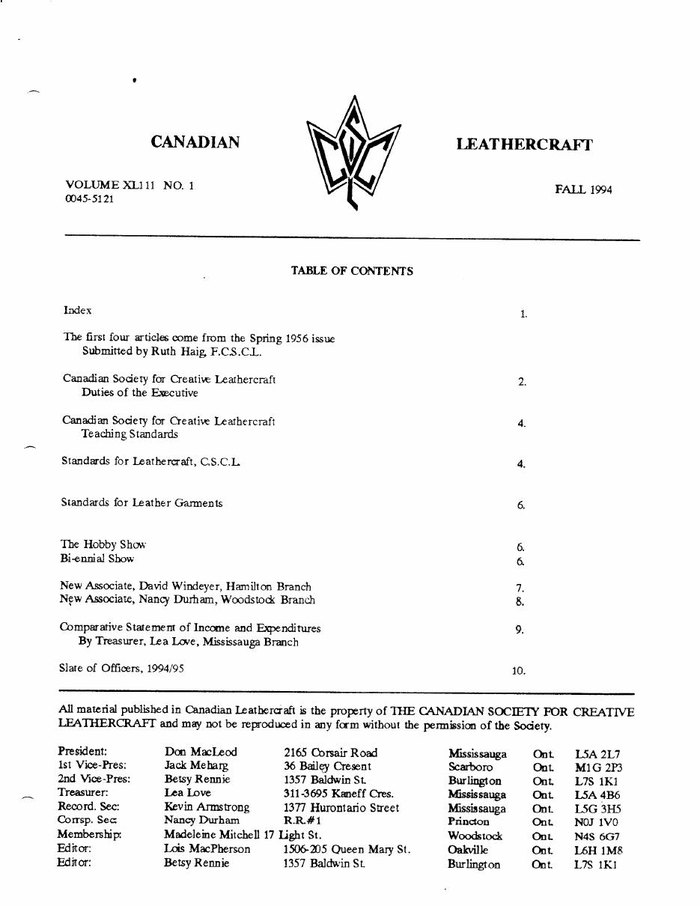
CANADIAN LEATHERCRAFT
VOLUME XLIII NO. 1                  FALL 1994                       0045-5121
TABLE OF CONTENTS
Index 1
[The first four articles come from the Spring 1956 issue. Submitted by Ruth Haig, F.C.S.C.L.]
Canadian Society for Creative Leathercraft — Duties of the Executive       2
Canadian Society for Creative Leathercraft — Teaching Standards            4
Standards for Leathercraft, C.S.C.L                                        4
Standards for Leather Garments                                             6
The Hobby Show · Bi-ennial Show                                            6
New Associate, David Windeyer, Hamilton Branch                             7
New Associate, Nancy Durham, Woodstock Branch                              8
Comparative Statement of Income and Expenditures                           9
By Treasurer, Lea Love, Mississauga Branch
Slate of Officers, 1994/95                                                10
All material published in Canadian Leathercraft is the property of THE CANADIAN SOCIETY FOR CREATIVE LEATHERCRAFT and may not be reproduced in any form without the permission of the Society.
EXECUTIVE
President:       Don MacLeod        2165 Corsair Road       Mississauga  Ont.  L5A 2L7
1st Vice-Pres:   Jack Meharg        36 Bailey Cresent       Scarboro     Ont.  M1G 2P3
2nd Vice-Pres:   Betsy Rennie       1357 Baldwin St.        Burlington   Ont.  L7S 1K1
Treasurer:       Lea Love           311-3695 Kaneff Cres.   Mississauga  Ont.  L5A 4B6
Record. Sec:     Kevin Armstrong    1377 Hurontario Street  Mississauga  Ont.  L5G 3H5
Corrsp. Sec:     Nancy Durham       RR#1                    Princeton    Ont.  N0J 1V0
Membership:      Madeleine Mitchell 17 Light St.            Woodstock    Ont.  N4S 6G7
Editor:          Lois MacPherson    1506-205 Queen Mary St. Oakville     Ont.  L6H 1M8
Editor:          Betsy Rennie       1357 Baldwin St.        Burlington   Ont.  L7S 1K1
Page 2
CANADIAN SOCIETY FOR CREATIVE LEATHERCRAFT
DUTIES OF THE EXECUTIVE
President · Compile agenda for meetings.
· Chair meetings.
· Attend all sub-committee meetings, except those of the nominating committee.
· If unable to attend personally, the First Vice-President can be appointed to attend, or a member of the Table Executive.
· Oversee all Guild activities.
· Arrange a timetable for the executive meetings for the year.
· represent the Guild, when necessary.
First Vice-President · Chair a meeting when the president is unable to attend. · Should be Chairman of a com mittee.
Second Vice-President · Should be chairman of a committee.
Recording Secretary · The recording secretary records the minutes and makes a copy for all members and completed 15 days before a general meeting. This should be done at a convenient place, but with a view to price. (This varies from place to place.) · The recording secretary sends out monthly meeting notices no later than 12 days before a general meeting.
Corresponding Secretary · Shall take care of all general correspondence.
· Compiles a concise annual report to be dispersed at annual meetings and sent to non-attending members.
Treasurer ® Keeps a record of the finances of the Guild.
· Prepare and report monthly statement to the Guild.
· To have a small committee to assist in dealing with all publicity meetings, sales, exhibitions, workshops, library displays.
· To draw up an annual budget and submit it to the executive. An average taken of the costs of the last two years would be an aid in this.
· Any convenor needing publicity should make sure of getting it to the publicity convenor in ample time.
Social Convenor · To look after meetings where there is food served.
· Keep a file of where, when and duration of library which asks for a display.
· Should have a supply of props, e.g., plate stands, etc.
Programs Co-ordinator · Should meet with all craft convenors, as soon as possible.
· Each craft convenor and his/her committee to be responsible for all arrangements for their meetings.
· Responsible for booking room, obtaining speakers fee from Treasurer, and booking projector and other requirements such as tables, screen, etc.
· Should contact the publicity convenor regarding publicity for each meeting.
· To see if fee or gift is needed for speaker and to remind convenor about introduction and vote of thanks.
Page 3
Workshop Co-ordinator
Responsible for obtaining a volunteer to run each workshop and to work in close consultation with that convenor to avoid duplication of work.
Make yearly budget and plan workshops for the year. Workshops should be arranged in a schedule to cover February to prevent a loss of time due to election.
Out-of-Town Exhibitions Committee
Each member is responsible to the committee for getting his/her own articles to the appointed place by the deadline set.
The committee cannot be responsible for breakage, loss or theft during transit.
An estimated budget should be given to the executive.
Area Exhibitions and Sales Committee
The convenor and committee are responsible for filling all props, etc. Record should be kept of outgoings and incomings of all articles loaned, where and when. This committee also works closely with the sales convenor.
All Committees
An estimated budget should be given to the executive.
Nominating Committee
This consists of the past president plus two others.
List replacements. Bear in mind, any member who has been particularly good in any area or who has volunteered. Avoid duplication of duties of Table Executive.
Standards Committee
To consist of six members, plus the Society President.
Each year, the standards may need reviewing so that changes and innovations can be dealt with.
Two people from the committee are necessary, from time to time, to adjudicate articles submitted to places for sale. This need not be an onerous task as the members should be used alternately.
Craft Convenor
Attend executive meetings when asked, or send a substitute, if necessary.
Inform members of the craft group about special exhibits and displays, and other relevant news items, when a newsletter is impossible. Let the social convenors know how many will attend the general meeting.
Be fully responsible for all arrangements for the general meeting assigned to his/her group. To work in cooperation with the program coordinator for this meeting.
At an exhibition or sale, be responsible for the timetable for personnel.
Check with the Treasurer re sales, books or sheets and instruct his/her workers upon their use.
Anybody who finds it necessary to resign from committee must do so in writing.
The chairman may substitute by appointing a replacement, after submitting the name to the Executive Committee.
The proposed budget should be presented to the executive by February, for approval.
Page 4
CANADIAN SOCIETY FOR CREATIVE LEATHERCRAFT
TEACHING STANDARDS
STANDARDS FOR LEATHERCRAFT, C.S.C.L.
At the 1956 Annual Meeting, a set of standards for the grading of leathercraft teachers was approved, as follows:
Knowledge and Craftsmanship:
Grade "C" (Elementary)
One who is proficient in basic construction and finishing methods and has some knowledge of tooling or carving.
Grade "B" (Intermediate)
One with (1) a certain minimum knowledge of leathers, tools and handling of such and (2) a certain minimum knowledge of and ability in construction and finishing and either tooling or carving, or both. Associate membership standing will automatically establish a Grade "B" rating. Credentials should specify "Teacher of Leathercraft, Grade B Tooling and/or Carving".
Grade "A" (Specialist)
One with (1) a wide general knowledge of leathers, tools and handling of such and (2) a wide general knowledge and skill in tooling, carving, colour and construction techniques. Fellowship rating automatically establishes applicant in Grade A category. Credentials should read, "Teacher of Leathercraft, Grade A". Outstanding skills may be indicated for Specialist’s rating.
DESIGN: Original design is encouraged. No commercial kits or patterns. FUNCTION: The project must fit the purpose for which it has been designed.
PROPORTION AND SHAPE: Proportion means the height in relation to the width, and each shape in relation to all other shapes of the design.
Teaching Ability:
The C.S.C.L shall not be responsible for guaranteeing any individual’s teaching ability. This shall be vouched for by his/her own record of experience listed on his/her credentials, with references which can be imvestigated personally by any mterested party.
The applicant’s rating will be established by the Board of Selection of the C.S.C.L, from representative samples of work submitted by the applicant, to demonstrate the degree of excellence and range of his/her leathercraft skills. Associate and Fellow members, whose work has already been appraised by this Committee, need only submit the application form for their rating and credentials, as above.
This rating is subject to review and change at request of the applicant on the basis of new experience or training, or information not supplied on the original form, or demonstrated in his/her submitted work.
On the reverse side of this Set of Standards will be the Teacher’s Credentials giving information as to experience both im leathercraft and teaching generally.
MATERIALS AND FINDINGS: Materials must be suitable for the purpose of the article being made and the findings must be in keeping and in good taste.
COLOUR AND DECORATION: The colour and decoration should be a complimentary part of the whole design.
Page 5
HARMONIOUS
APPEARANCE: This is the result of the relationship of the forms or parts, bringing them into unity.
WORKMANSHIP:
CUTTING: Accurate cuttmg to ensure correct fit and appearance.
DECORATION: Tooling: Clear, clean lines, any modelling must be smooth, back-grounder or stippling should be flat and put down solidly.
Carving: Lines should not be cut deeper than half the thickness of the leather. Except in certain places, lines should not cross each other, or go beyond the outline being cut. In open places, the endings should taper out.
Beveller: Must follow the cut line smoothly with no exact tool impressions standing out.
Pear Shader: Rarely is the exact tool impression on it’s own correct. The tool should be moved around in the area concemed, tapering off the pressure toward the edges. Rarely should it touch the lines.
Background: However the background is treated, it must not detract from the design.
When used, should look neat in appearance and not be overdone.
Seeder: This is mainly used in flower centres, and how it is used depends on which flower centre is being done and the effect that is desired. Decorative cuts:
When used, they generally follow the contour of the leaf or petal. They start heavy and taper out to nothing.
Embossing: The part to be embossed must be carefully raised. The raised portions must be well and smoothly supported. Generally, the surrounding area should be treated so that the embossing is well defined.
Stamping: The whole effect should create a related design.
Inlay: To fit accurately and show no tool marks.
Onlay: Prepared so that the edges are neat and firmly adhered.
Colouring: Must show that there is a knowledge of how to handle colour and to get the desired effect. Other forms of applied decoration, not specifically mentioned, need the same care and attention to details as of those above.
SKIVING: Skive sufficiently to make all parts fit well, but not enough to weaken the leather where strength is needed. Reduce the edges to an even thickness before stitching or lacing. For tumed edges, the leather must be skived enough to make a smooth, neat turnover.
FITTING
AND
ASSEMBLY: Edges to be flush. Gussets and fasteners to be properly placed.
MOULDING: Whatever method is used, the leather must be of a suitable weight for the article. If there is more than one moulded part to the article, the moulding of various parts must form a harmonious whole.
FINISHING:
Lacing am : be even and uniform, suitable to the article and inconspicuously jomed and finished off.
Cut edges: Whether laced or unlaced, should present a well finished appearance. Turned edges; The edges must be skived enough to make a smooth, neat turnover. Gluing: Glue should be spread so that no lumps are formed. Any excess glue should be removed from the visible parts of the article.
Linings: Should be a suitable weight for the article, neatly inserted and accurately fitted with the excess cut off.
Stacked leather; Must be accurately glued and sufficiently sanded to make a smooth edge.
Backs: To be finished suitably for the article, whether laced, dyed, polished or left untouched.
Page 6
Hand stitch: practical. COMBINATIONS: If leather is combined with any other material, the leather must be a dominant part ot the article and the material must be compatible with the leather.
STANDARDS FOR LEATHER GARMENTS
CONSTRUCTION: The leather must be pliable. Uniformity in weight and colour is desirable. Weak spots and holes in the leather are not acceptable. Matching skins must be used, unless it is an integral part of the design. Garments must be cut with the grain. Nap must run in the same direction, unless used as part of the design. Seams are to be strong, smooth, flat (not bulky), and neatly executed. Closings are to be neatly fmished and should function correctly; eg., buttonholes must be the correct size for the button, zippers must operate without catching. FINISHING: Proper and suitable finishing of the garment is desired. Machine stitching is allowed in the underside of the garment. Hand stitching should be used wherever possible, such as top stitching on lapels, collars, pockets or the stitching within a design. Edges, such as seams and hems, must be finished on the leather garment. Hems should not have a wavy effect. If there is an unsewn edge in the design and visible they must be dyed to match. Lining, if used, should be of a suitable quality and properly fitted. Could be detachable for washing. The best available quality of findings, suitable for the garment, should be used. Glue, where used, must not show. Outdoor garment leather should be weatherproofed by the crafts person, eg., smooth surfaces to be waxed, suede to be siliconed. Instructions for the proper care of the leather must be included with the garment.
These are general requirements. There will be exceptions in the case of articles with a newly identified need, mgenious application of material or technology, or an original aesthetic design.
THE HOBBY SHOW
The Hobby Show will be at the International Centre on Airport Rd. on November 4 to 6th, 1994. The Guild will have a booth at this show to display their work and have demonstrations. We hope you can come and help out. Phone Bruce White at (416) 755 - 4464 if you can help out. BI-ENNIAL SHOW
BI-ENNIAL SHOW
The set-up date for the Bi-ennial Show is on Monday, November 28, 1994 at the Etobicoke City Hall Art Gallery in Toronto. 399 The West Mall, Etobicoke, Ontario. M9C 2Y2.
December 1. 1994, at 8:00 p.m. We would like to see as many Guild members and family as possible. It is a special occasion to honour of Fred Brown, a long time Fellow and Guild member. There is an Etobicoke Art Committee Award given in his Honour.
The Oxford Quilters Guild will share the show with us this year as they did four years ago. We enjoyed their quilts along with our leather.
Take Hwy 427 to Burnhamthorpe Rd. exit. Turn left at West Mall Rd. Turn left again at the City Hall.
Page 7
DAVID WINDEYER, ASSOCIATE
Receiving my "Associate" was a special thrill for me. To have one’s work accepted at a high level by accomplished creative leathercrafters, gives one a sense that the learning and work has been worthwhile. I found it also means that from this point on there is a responsibility to maintain a high degree of craftsmanship. Also, I am now more aware of creating and executing pieces that require a broader range of skills. The possibilities for all sorts of projects seem endless.
I have been doing leatherwork for just over 10 years now, and it has been one of my longest involved hobbies. One of the main reason has been it’s versatility somewhere between working with wood, fabric, sometimes clay, and painting. This should be a strong draw for people wanting a challengmg and rewarding hobby. As well, it could turn into a business at times.
Once again, I’m just thrilled that my work was accepted by the judges, and am proud to be working with such a great group. My Congratulations to Nancy Durham who also got her Associate at the same time, and also to have been awarded the Zalitis pin.
I’m sure others have felt that once you have received your "Associate", one must logically, and with hope, go on to attain the "Fellowship". Hopefully, those "Fellows" will be among us for many more years to assist, guide, and teach the rest of Us,
[Line drawings of the submitted work accompany the text, hand-lettered: "Brown Beaver", "Deer Skin", "Magnifying Case", "Gloves".]
Page 8
NANCY DURHAM, WOODSTOCK BRANCH
[The page is given over to line drawings of the work submitted for her Associate standing, with hand-lettered captions. Legible labels include "Tan Carved Purse", "Wild Rose and Bound Book" [?], "Brown Maple Leaf Belt" [?]. The lettering is decorative and only partly legible in the scan; no body text accompanies the drawings.]
Page 9
CANADIAN SOCIETY FOR CREATIVE LEATHERCRAFT
COMPARATIVE STATEMENT OF INCOME & EXPENDITURES
ANNUAL MEETING 1994
                                  1994                    1993
April 22-24             April 23-25
Amount    Per Reg.      Amount    Per Reg.
(47)                    (44)
INCOME
Registration Fees      $ 3525.00     75.00     $  660.00     15.00
Draw Table                640.00     13.61        158.00      3.81
Banquet Income                                   1133.00     25.75
Donations                                          60.00
Total Income           $ 4165.00     81.61     $ 2021.00     45.93
EXPENSES
Meals & Hotel Costs    $ 2200.80     45.85     $ 1242.34     28.23
Refunds                   260.00
Demonstrator               80.00
Speaker                                            50.00
Bank Charges etc.                                  26.06
Printing & Postage                                 60.34
Office Supplies                                     8.77
$ 2540.80     54.06     $ 1387.51     31.53
Net profit on Annual as a result
of efforts of Host Guild $ 1624.20     34.58     $  633.49     14.40
Expenses paid by C.S.C.L. Applying to Annual
Prize — Bob Muma Award $   50.00               $   50.00
Annual Report Printing     40.25                    69.53
Presidents Room Cost      100.00                   100.00
Mailing of Notices         50.00
Judging Facilities        100.00                   100.00
Ribbons, Weston Trophy
Plaque & Keeper Trophy  154.07                   125.00
$  494.32     10.51     $  444.53     10.11
C.S.C.L. Net Income from
Annual                   $ 1129.88     24.04     $  188.96      4.29
Registration rose from 44 to 47, and the fee from $15.00 to $75.00 — the 1994 Annual returned $1129.88 to the Society against $188.96 the year before.]
Page 10
CANADIAN SOCIETY FOR CREATIVE LEATHERCRAFT
SLATE OF OFFICERS 1994/95
OFFICERS:
President                 Don MacLeod         905-277-2058
Past President            Ruth Haig           905-525-0780
1st Vice-President        Jack Meharg         416-439-5873
2nd Vice-President        Betsy Rennie        905-639-0771
Recording Secretary       Kevin Armstrong     905-278-4666
Corresponding Secretary   Nancy Durham        519-458-4533
Treasurer                 Lea Love            905-276-7340
DIRECTORS:
1.  Bea Austin           905-522-8282
2.  Laura Bush           613-392-1475
3.  Harold Brister       905-279-0333
4.  Jim Edwards          416-699-8214
5.  Richard Fielding     416-486-8109
6.  Muriel McKnight      905-529-9149
7.  Madeleine Mitchell   519-537-7821
8.  Hilda Newitt         519-756-3848
9.  Gladys Riddell       416-762-7466
10.  Dave Windeyer        905-634-5402
BRANCH PRESIDENTS:
Hamilton      Ruth Haig            905-525-0780
Mississauga   Bill Whittingham     416-239-3743
Norland       Art Cousins          705-454-1013
Toronto       Cal Lucas            416-755-8781
Woodstock     Nancy Durham         519-458-4533
EX-OFFICIO:
Chairman Council of Fellows   Dorothy Muma         416-654-5635
Teaching Standards            Ruth Haig            905-525-0780
Archivist                     Kevin Armstrong      905-278-4666
Membership Chairman           Madeleine Mitchell   519-537-7821
Editor                        Lois MacPherson      905-842-1383
Editor                        Betsy Rennie         905-639-0771
[This slate repeats the one printed in the Spring/Summer issue. Where that printing was struck unevenly, the numbers here are clearer and are used.]