
An issue of the Society’s newsletter, transcribed from the original. Download as PDF.
(8 pages, 13883 KB)
Page 1
[Transcribed from the original 8-page issue. Paragraphs are reflowed from the original setting; spelling, punctuation and wording follow the original, including its own inconsistencies. Editorial notes appear in [square brackets].]
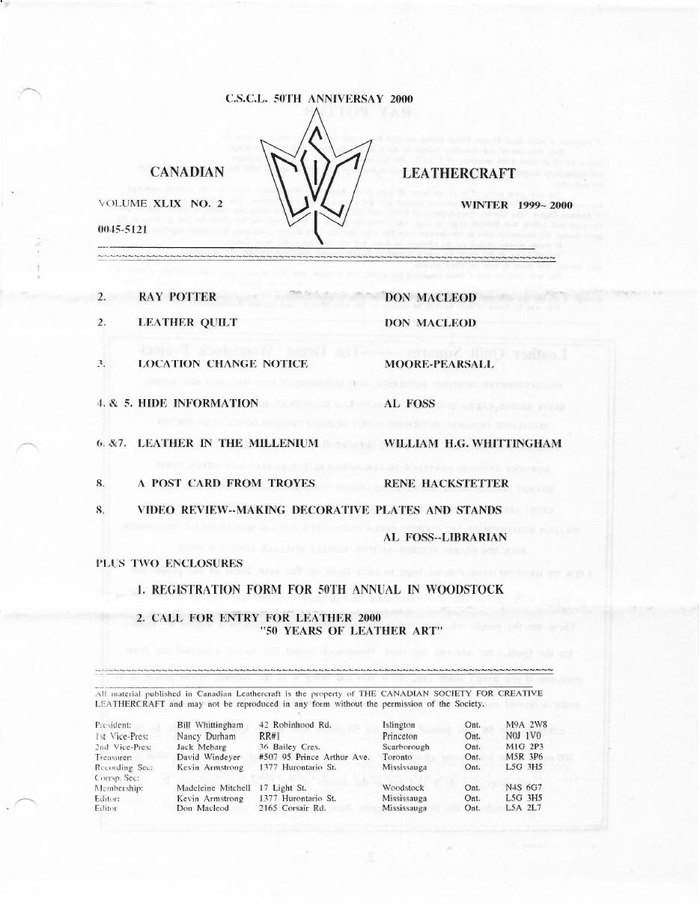
C.S.C.L. 50TH ANNIVERSARY 2000
CANADIAN LEATHERCRAFT — VOLUME XLIX NO. 2 — WINTER 1999–2000 — 0045-5121
2.       RAY POTTER                                   DON MACLEOD
2.       LEATHER QUILT                                DON MACLEOD
3.       LOCATION CHANGE NOTICE                       MOORE-PEARSALL
4. & 5.  HIDE INFORMATION                             AL FOSS
6. & 7.  LEATHER IN THE MILLENIUM                     WILLIAM H.G. WHITTINGHAM
8.       A POST CARD FROM TROYES                      RENE HACKSTETTER
8.       VIDEO REVIEW -- MAKING DECORATIVE PLATES
AND STANDS                                AL FOSS -- LIBRARIAN
PLUS TWO ENCLOSURES
1. REGISTRATION FORM FOR 50TH ANNUAL IN WOODSTOCK
2. CALL FOR ENTRY FOR LEATHER 2000 "50 YEARS OF LEATHER ART"
All material published in Canadian Leathercraft is the property of THE CANADIAN SOCIETY FOR CREATIVE LEATHERCRAFT and may not be reproduced in any form without the permission of the Society.
President:      Bill Whittingham    42 Robinhood Rd.          Islington    Ont. M9A 2W8
1st Vice-Pres:  Nancy Durham        RR #4                     Princeton    Ont. N0J 1V0
2nd Vice-Pres:  Jack Meharg         36 Bailey Cres.           Scarborough  Ont. M1G 2P3
Treasurer:      David Windeyer      #507 95 Prince Arthur Ave Toronto      Ont. M5R 3P6
Recording Sec:  Kevin Armstrong     1377 Hurontario St.       Mississauga  Ont. L5G 3H5
Corrsp. Sec:
Membership:     Madeleine Mitchell  17 Light St.              Woodstock    Ont. N4S 6G7
Editor:         Kevin Armstrong     1377 Hurontario St.       Mississauga  Ont. L5G 3H5
Editor          Don Macleod         2165 Corsair Rd.          Mississauga  Ont. L5A 2L7
[The Corresponding Secretary line is again printed blank, as in Fall 1999.]
Page 2
RAY POTTER
I received a letter from Marian Potter telling me that Ray Potter had passed away on June 19.
Ray was one of our founding fathers of the C.S.C.L. He was a Life Member longer than a lot of us have been members of C.S.C.L. He had different views on a lot of policies and particularly judging and expressed himself openly at meetings, but always agreed with the majority and that was the end of it.
The one great piece of work we have all seen is the Attendance/Registration books for the Annual meetings. Ray was approached when a new book was needed and did a fantastic job on its cover. The C.S.C.L. gave Ray a copy of Readers Digest "The Garden Encyclopedia of Plants and Flowers" for book and cover. He called me and I had to get my copy and follow him through page by page and flower by flower as he showed me the plants he had growing in his green house. We remember him at the annuals with his wife and the Fred Brown's enjoying themselves together.
It seems noone picked up the obituary in June, but we do have some more details.
We all know of his work; he was a wizard at design, carving and book binding. We will truly miss having him there to help us when needed.
His wife said he had a heart condition for about 3 or 4 years, and then about a year ago developed a form of cancer for which he had been receiving chemo therapy. He had an operation for the cancer in June, he seemed to come through it ok, but the next day June 19 his heart gave out and he passed away.
Ray was 82 years of age, he will be missed by his wife, Marian, and his two daughters.
Leather Quilt Squares ~~~~~ The Great Woodstock Project
DAVID WINDEYER -- DOROTHY McPHERSON -- LOIS MACPHERSON -- DON MACLEOD -- BEA AUSTIN
BETSY RENNIE -- LAURA BUSH -- MAY CORBETT -- KAY CLOUGHLEY -- EDITH MELCHIOR-HAWKENS
MADELEINE MITCHELL -- RUTH HAIG -- NANCY DURHAM -- JESSIE M. LITTLE -- GLEN NELSON
FRED & PHIL BROWN -- LEA LOVE -- DAVID McPHERSON -- GLADYS RIDDELL -- MURIEL McKNIGHT
DOROTHY STANTON -- GERTRUDE HILDER -- NORAH HUYCK -- LILLIAN KAY -- BRUCE WHITE
SHARON BEASLEY -- RENE HACKSTETTER -- HARRY WENDLAND -- CAL LUCAS -- JIM EDWARDS
KEVIN ARMSTRONG -- EMMA WINDATT -- BEULA REYNOLDS -- HILDA NEWITT -- VIOLA HARRIS
WILLIAM WHITTINGHAM -- ART COUSINS -- DELLA CHYNOWETH -- PHYLLIS McHALE -- HILDA CHYNOWETH
JACK SIM -- GLORIA COUSINS -- AL FOSS -- ROSELLE WALLACE -- LOREEN MANUEL
A FEW WE HAVE NO NAME FOR: we hope to clear them up this year. Some of the people are no longer with us, so this is a testimonial unit of their work for us. Lets be proud of them. These are the people who have taken the time and pride to fashion a leather 6" square for the Quilt, (the odd one has two). Woodstock would like to see a second one from everyone. If you havn't made one, do it now and bring it to the Annual. While you're at it make a second one, your own design, colouring, and finishing. Lets make the Quilt bigger to celebrate this 50 year annual. There are 50 pieces now in the Quilt, lets make to the 100 mark or at least come close. Make your piece colourful and original, thats what it is all about, but do it and get to the annual so the ladies can assemble it.
[This is the fullest roll of quilt contributors in the run, and it settles several forms: SHARON BEASLEY (against BEASLY in Summer 1998), BEULA REYNOLDS, EDITH MELCHIOR-HAWKENS, MAY CORBETT (elsewhere Mae), GLEN NELSON, and BETSY RENNIE rather than Slappendel. FRED & PHIL BROWN share one entry. Names not previously seen in this run: JESSIE M. LITTLE, DOROTHY STANTON, GERTRUDE HILDER, NORAH HUYCK, CAL LUCAS.]
Page 3
LOCATION CHANGE NOTICE
Moore-Pearsall Leathers Limited
47 Front Street East, Toronto          4281 Rue Garand, St. Laurent, PQ
Fax 416-363-8214                       Canada H4R 2B4
Tel 514-332-6800  Fax 514-332-3843
E-mail [email protected]
We're on the move! — December 9, 1999
To all our customers and friends:
After 54 years in our historic downtown Toronto location, we are relocating to much more efficient and up-to-date facilities.
Everyone will appreciate that we will now have ample parking available as well as 2 full-size truck level shipping doors.
Our new address is
100 Wingold Avenue, Unit #7
Toronto, Ontario  M6B 4K7
Phone (416) 789-3123
Fax (416) 789-0161
Our last day on Front Street will be Wednesday December 22nd and we will open at our new location on January 4th, 2000.
We look forward to welcoming all our customers to our new "Millennium" facility, which is fully Y2K compliant!
Merry Christmas, Happy Hanukkah and best New Year's greetings from all of us at Moore-Pearsall Leathers.
R. J. Pearsall
[A location map accompanies the notice, marked Highway 401, Lawrence Ave., Tycos Rd., Wingold Ave. and Eglinton Ave.]
Page 4
HIDE INFORMATION
AL FOSS picked this "HIDE" discription off the Internet. He contacted the writer Ron Ross of "Ross Saddlery" and asked permission to reproduce it. He gave his whole-hearted consent, because people don't know the facts about the leather they are trying to work with and why sometime the same application to two pieces of leather, give different results. So read it, absorb it and remember that all leathers are not the same, even from your same soarce or dealer, this could tell you why the differences.
Subject: Re: [IDLG] bickering From: Ron Ross <[email protected]>
Reference your question on hides. My answer to your question may become a little lengthy. First, as we all should know, raw hides, used for tanning different types of leather, all normally, come from skin of cattle. Now, the skins, used to make the leather we use, are coming off all kinds of cows, dairy cows, dairy breed bulls or steers, or from the skins of various beef type cattle. Many of the cattle that are butchered are grain fed, while yet, others are butchered after coming off ranges of our western ranches. Many are from our Western states, while others are from the Eastern states. What this means is that the very raw material used to make tanned leather is not uniform in its raw state, due to the growing conditions in which the cattle providing the raw hides were raised.
The skins of the Western cattle are often from grass fed animals which mature more slowly than grain fed cattle. The grain fed cattle are usually marketed at a younger age, which means that their skins have not matured, which means the denisity of the fibers in the hide are not as dense as those of older cattle. Of course, the skins of older cattle make the better finished leather, as the denisity of the fibers makes for a firmer leather, with less stretch to it.
Having been in this game for over 40 years, I have noticed, as I am sure the others of the guild, who started in the late 1950's or earlier have also noticed is that the quality of leather over the years has done nothing but gone down. The size of the skins has also decreased, also due to the marketing of the cattle before they are fully matured.
Now if you get a side of leather that is in the 22 to 24 square foot size range, it is not the norm, you will more often find the sides in the 20 to 22 square foot size. Often smaller. When you are fortunate to be able to sides that are in the 24 to 28 square foot size, you are getting the raw material, from a larger animal, often, from aged bulls. You will find that the larger sides, if not run thru a leveling machine will be thicker. This comes from maturity.
Add to this, that some of the leather being marketed is imported from other countries, some of which leave the cattle mature to a ripe old age of 3 or 4 years, before slaughtering, while the average age to slaughter cattle here in the States, is something like 18 months of age, sometimes, younger. Then, there are the differences in how the one tannery will tan the hides into leather, using one formula of bark, for veg tanned leather, which is what we use to carve and tool, from the way another tannery will tan their leather. All you have to do, to determine that is to view the handle the finished leather from different tanneries. You will also notice the difference in the leathers when they are wet or dampened so as to case, before we work them with our tools.
All of these factors come into play, and are things that the leathercrafter must consider when making up products they make for their markets. You have all heard various crafters state their preference on leather used. One will prefer the leather from one tannery, while another will prefer the leather from another. It all then becomes what the crafter prefers. Many of us will only use the leather from a certain tannery, and, in order to get that type of leather, will only buy from that particular tannery. By doing so, we can be fairly certain that the tannage of the leather will be the same, or nearly the same, at any time that we order. For those of you who buy from supply houses or distributors, that is not the case. Most supply houses, and I will not name any, will buy their leathers from many different sources, often making their purchases upon price, with quality being secondary. This of course, is good business practice, since they are in the business to make a profit. Unfortunately, it is a practice that is not what the crafter needs. For those of you who have been in this guild for some time, you have heard, in the past, the questions about the quality of leather, and how, when you ran out of a piece of leather and reordered from your supplier, the next piece was not at all close to what you had
Page 5
previously ordered. This all comes from the fact that, in most cases, the leather did not come from the same tannery. Let's face it, oak tanned leather, is not always oak tanned leather. That is another story, which you can read about in books available from some large librairies, and due to the length of this already lengthy message, I will not address.
Then, the other thing, one that you mentioned, was you were using latigo leather. When you read about how leather is tanned, you will find that there are several methods of tanning latigo leather. Those methods can be the use of chromium salts, hence, the name chrome tanned, the use of alum, hence the term, alum tanned, while others use a combination tannage, but, the latigo of the past was different leather than we can get today. Those leathers had a mellow, slightly oily feel to them, which made the leather supple and easy to handle, especially for items such as cinch billets, saddle strings, etc. Unlike the latigo of today, some of which you can actually case and carve, due to the vegetable tannage used prior to then being re-tanned into latigo. Now, on your latigo that is very hard to stamp, that hide may well have, if it was large in square footage, may well have come off of some big old bull, that a farmer or rancher could no longer use for breeding and that bull's hide would have been very mature and dense. This would make for a firm tough hide. In some of my old saddle and harness catalogs, some of the items advertised, back in the early part of the century, were referenced as being made of bull hide, meaning that it was thicker, tougher leather. Unfortunately, bull hide was not always what it was advertised to be, since, due to the density of the leather, the surface, or grain side, would frequently crack, due to the tightness of the fibers. Leather from these types of skins, when you can get them, must often be dampened in order to fold them over rings or buckles to prevent the leather from cracking. Another thing you find, in the leather that is taking the initial stamps well, is that it is softer leather. Again, that is due to what I stated above, namely, the way the cattle were raised, the age of the cattle when they were slaughtered, the way the hides were tanned into finished leather, etc.
I know I have been long winded, but, a question such as yours requires much detail, due to the complexity of the subject of tanning and the methods used by the tanneries now in business. For the more detailed education, I suggest that the tanneries out there who view our site, pick up where I left off. I am strictly a user, who has tried to gain all the knowledge I can, by conversing with those who make the leathers I have used over the years. Some of my knowledge has come from my visiting and touring different tanneries, some of which are no longer in business.
Hope this information is useful to those who read it. I apologize for being so long winded, but, when I get wound up on a subject that I enjoy, I can go on & on & on.......
Oh yes, one other thing you mentioned the leathers from England. On occassion, I will aquire some for special orders, mainly to hand make English style bridles and accessories. From my own experience, what you said about lack of wire fences (barbed wire) seem to be true. I know, from my own experience with English tanned leathers, that the hides are very clean, almost blemish free. The hides are also firmer, as, again, from information I have read, the cattle are slaughtered at a much older age. Thus, again, a more mature rawhide to start with.
I do recall that, quite a few years ago, one of the suppliers I dealt with, Schultz Brothers of North Manchester, Indiana, had a supply of imported russet harness leather from England. I bought several backs of it and it was about the nicest leather I had ever worked with for horse goods. It was the colour of saddle skirting, being very light in colour and had been thoroughly stuffed, thru the curring process, with tallow and oils, to the point that the cut edge looked like wax. All it took after edging a strap, was to wipe it with a rub rag, and all the fibers were smooth and polished. Unfortunately, my friend, Don Schutz, who was the owner of Schutz Brothers, is now deceased, and his children who now run the company have no idea of which tanneries the leather came from. Perhaps, you may have some idea tannery produced such. I, on occassion, will deal with Pearce Brothers, however, it was not from their production.
Ron Ross, (Ross Saddlery) — <[email protected]>
[The firm is printed Schultz Brothers and then Schutz Brothers in consecutive sentences.]
Page 6
Leather and the Millenium
This past October, a close friend gave me a piece of smoked deerskin unlike any that I had previously seen. The colour was very different, the texture was pretty much the last thing I had expected from deerskin and the smell of smoke was quite pungent. As I silently marveled at how very different this particular hide was from the hundreds I had seen in the past, I promised myself I would source out information to share with the guild about it's production. Don't get me wrong, I don't imagine any of you are likely to smoke a deer hide in your backyard any time in the near future, but the information is very interesting nonetheless.
A search for "smoked deerskin" produced no results whatsoever, but oddly enough the search "leather art" produced a web site called "Hide Art". Please enter the following URL on your keyboard:
www.spacestar.net/users/adikkers/hideart.htm
As many of you know, for best results the brains of the deer are used for tanning the hides, and that brain tanning process is described in full and concise detail here including the following headings: The Brain, Fleshing, Washing, Drying, Hair Removal, Storage, Braining, Softening and finally Smoking.
The advice that is given is very solid. There are tips on what NOT to do, and to make sure you don't get bored while you're taking in all that information, there are highlighted words in the text that you can click to see drawings or pictures of parts of the process, with further explanations in some cases.
At the bottom of the page, if you click "Tanning Furs" there is a brief description of that process as well. Once you've done that, look for "Judy Kavanagh's Moccasins and Mukluks" for her gallery of woodland moccasins, plains moccasins, fancy mukluks, snowshoe mukluks, mittens and bags.
The work here is gorgeous and the beading is excellent, and the best part... she's Canadian EH!
Other headings to look for are "patterns", "where to find craft supplies", "books", and "hide tanning".
For our next site we board a plane from the land surrounding our nation's capital and journey to the sunnier climes of Australia.
To visit "Leather Art" by Robert Boyd please key in:
www.qonline.com.au/~jeid/leatherart/
Robert Boyd is a pyrographer, meaning he burns impressions into the leather to create his pictures. The resulting effect is not unlike an artist's use of charcoal in sketching. This gentleman leaves most of his work in the natural leather tones which gives an overall sepia-like appearance and then the pieces of art are laced to a wooden frame to give a rustic look to the overall work of art.
Of the six pieces shown, the train station is particularly good, though the scene of the herd of sheep probably took him the longest to create and more than likely drove him bonkers in the process.
Once again, at the bottom of the page click "Links" then click the sign that says "Pyro Café" on the new page. Now click the "Enter" sign that has "640 x 480 version" written under it, then click "Gallery One" and so on to see various other examples of pyrography. Only one of these is on leather, and this one is
Page 7
colourized. All the other examples have been burned onto wood, but there are some good ideas for us to ponder using ourselves in our own work. Remember, woodburning and inverted carving are not as far apart as they might seem. Just use your imagination.
Our third site is a small one and loads very slowly, but the work certainly catches your eye.
Go to: www.imerimask.com for the work of self-taught leather artist Andrea M. Harris. These are wearable masks that have been created using free form sculpture techniques. Molds or forms have not been used, and the leather has been carved and tooled before it has been sculpted and baked for hardness. They are made from 7/8 oz vegetan leather and then coloured using a combination of spirit dyes and acrylics. Both the designs and the colouration are done with panache for a very striking finished piece. The wolf and dragon masks are especially well done in my opinion.
The fourth site is for all you history buffs. The artisan's name is Modar Nezmanich and his site focuses on the making of leather blackjacks, and discusses in detail a number of English Drinking Vessels.
Please go to: www2.kumc.edu/instruction/academicsupport/ite/staff/rknight/Jacks.htm
He very efficiently tells the history of the leather jack in the following categories: "introduction", "definition of terms", "why was leather used?", "timeline of leather vessels" and "historical side notes" and then he describes materials and the use of wooden molds in his "production of the Jack" section. There is also a section for "alternate formation" and a bibliography that list four books other than the Oliver Baker book that is photocopied in our library.
The real cream of this site is at the bottom of the page where you can click "Back to Modar's Leatherwork Page". This is an index for 17 other pages of mostly period pieces and there are also two other leather links for you to follow. Historical trivia abounds on this site and will undoubtedly fill some of the gaps in your knowledge about the roots of our craft.
Finally, some of you may have bookmarked Silva Fox's site to use as a reference tool for your own carving and colouration tutorial purposes. At this time I would like to inform you that her site has moved and can now be located at:
http://wdstudio.net/foxart
If you have been a regular visitor to her site, much has remained the same, but there is now a section called "New Art Works" which contains her most recent masterpieces.
That's all for now surfers. I look forward to seeing you all at the annual.
Respectfully submitted, William H.G. Whittingham F.C.S.C.L.
Page 8
A postcard from Troyes
1961 by Rene Hackstetter
Postcards provide the leather researcher with another source of images, wheather the view of the tannery or perhaps the interior of the ateliers with the craftsmen engaged in various tasks. Shown here is the Tannery Gate in Troyes around 1838. Troyes, the capital of Champagne, was a great industrial and commercial town whose leather productions were renowned in the 12th and 13th centuries. The "basan" — the sheepskins of Champagne — had an European reputation. In 1339 a censer counted 80 Masters and Mistresses in the Tanners Quarter, employing 400 to 500 "ouvriers" or craftsmen.
The leather production was regulated by a Jury composed of Tanners, Curriers and Shoemakers. Each of the trades had a guild hall — a "halle commune". The Tanners were dependant on "Le Grande Boucherie" — the slaughter houses — for their material and were located nearby.
In 1317 there were in Troyes 500 Cordonniers — shoemakers — employing "cinq cenz ouvriers, varlets, apprentiz du dict mestier" (500 craftsmen, varlets, apprentices employed by the masters). The curriers, accompanied by the "savetiers" — shoemaker — had the right to visit the hall of the shoemakers.
Around the 1820's the tanneries retained a relative importance, and in 1826 there are 34 Ateliers, then in 1869 we count 16 and before long the postcard (in French) says there won't be a single one left and it will be a procedure lost to other times. Its a delight to find a card of this sort, paired with accurate historical information, probably by a visitor at the turn of the century, visiting Troyes.
[The postcard itself is reproduced, captioned Troyes d'autrefois — Porte DE LA TANNERIE, supprimée ainsi que les remparts en 1833, with a long historical note in French set beneath it. The French text is a fuller version of the account paraphrased above and is printed in a small engraved face that does not resolve cleanly; it is not reproduced here. This is the only substantial block of text in the run left untranscribed, and it is a French-language restatement of the English account above rather than new content.]
Video Review — Making Decorative Plates and Stands
This is one of our newest library acquisitions and is 35 minutes in length. A previous video had the making of plates added onto another program as a more or less fill-in to finish a video, that perhaps was too short. This is only a guess on my part but it was successful and used, and I used it to make several plates that were quite well done, for gifts and sold at craft markets.
This time around the video is more polished and quite a nice selection of finished plates in various sizes and décor starts the program and certainly whets your appetite to do some of these. Some are highly decorated or stamped and some too plain even for my liking. Few tools are needed for this project and newer members should have little trouble in making quite a presentable product. Simple pictures seem to be the way to go. Some of my past efforts used pictures from my wife's stained glass books. They are truly nice. Pictures from children's colouring books are also useful.
Good luck and do try this project.
Al Foss, Librarian