An issue of the Society’s newsletter, transcribed from the original. Download as PDF.
(14 pages, 1116 KB)
Page 1
[Transcribed from the original fourteen-page issue. Paragraphs are reflowed from the two-column setting; spelling, punctuation and wording follow the original, including its own inconsistencies. Editorial notes appear in [square brackets].]
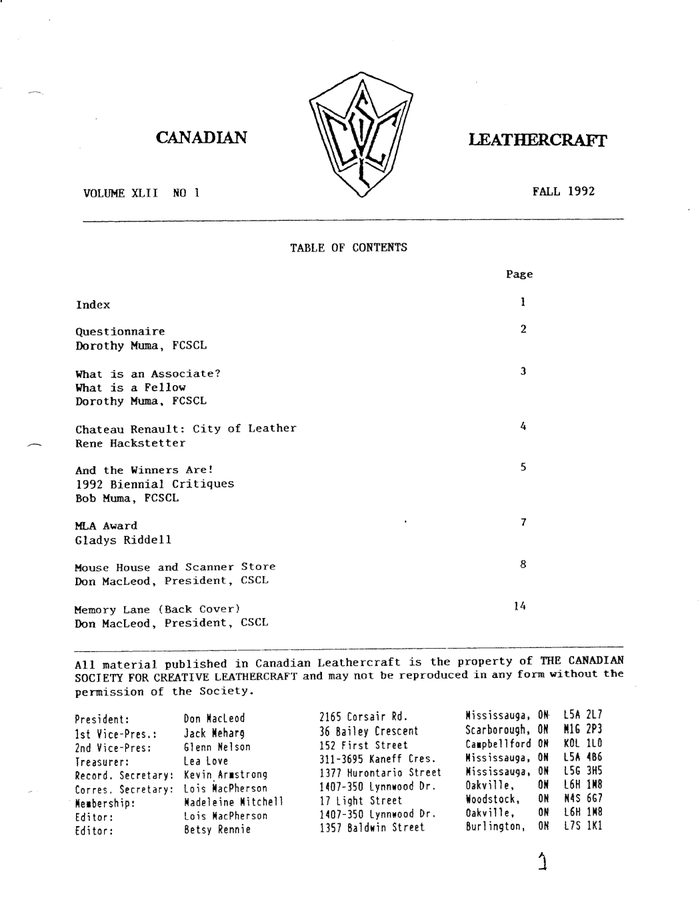
CANADIAN LEATHERCRAFT
VOLUME XLII NO 1                   FALL 1992                        0045-5121
TABLE OF CONTENTS
Page
Index                                                                     1
Questionnaire                                                             2
Dorothy Muma, FCSCL
What is an Associate?  What is a Fellow?                                  3
Dorothy Muma, FCSCL
Chateau Renault: City of Leather                                          4
René Hackstetter
And the Winners Are!  1992 Biennial Critiques                             5
Bob Muma, FCSCL
MLA Award                                                                 7
Gladys Riddell
Mouse House and Scanner Store                                             8
Don MacLeod, President, CSCL
Memory Lane (Back Cover)                                                 14
Don MacLeod, President, CSCL
All material published in Canadian Leathercraft is the property of THE CANADIAN SOCIETY FOR CREATIVE LEATHERCRAFT and may not be reproduced in any form without the permission of the Society.
EXECUTIVE
President:       Don MacLeod        2165 Corsair Rd.        Mississauga, ON   L5A 2L7
1st Vice-Pres.:  Jack Meharg        36 Bailey Crescent      Scarborough, ON   M1G 2P3
2nd Vice-Pres.:  Glenn Nelson       152 First Street        Campbellford, ON  K0L 1L0
Treasurer:       Lea Love           311-3695 Kaneff Cres.   Mississauga, ON   L5A 4B6
Record. Sec.:    Kevin Armstrong    1377 Hurontario Street  Mississauga, ON   L5G 3H5
Corresp. Sec.:   Lois MacPherson    1407-350 Lynnwood Dr.   Oakville, ON      L6H 1M8
Membership:      Madeleine Mitchell 17 Light St.            Woodstock, ON     N4S 6G7
Editor:          Lois MacPherson    1407-350 Lynnwood Dr.   Oakville, ON      L6H 1M8
Editor:          Betsy Rennie       1357 Baldwin St.        Burlington, ON    L7S 1K1
[The original prints "Jack Weharg" for Meharg. Postal codes are struck faintly and are given here as printed in the adjacent issues.]
Page 2
QUESTIONNAIRE
BY DOROTHY MUMA, FCSCL
Approximately 65 people attended the Annual Meeting this year, at which time a questionnaire was put before members. Of those present, 15 members completed the questionnaire, some at length. Answers were thoughtful and constructive, for the most part, but some did show that members were not reading available material, such as the Constitution, membership brochure, or "Canadian Leathercraft". Neither the Executive nor the Council of Fellows can remedy this; it is up to the members entirely. We can produce pages and pages of information, but if it is not read, what can we do?
Because we wondered why the number of Fellows and Associates was so small, our first question concerned that subject. Most of those responding agreed that qualifying was worthwhile, feeling that qualification is a source of pride and achievement.
Fellows might be very useful to people trying for the Associate or Fellow standings, as advisors or supervisors, or developing special techniques for such qualifying pieces. Fellows agreed with this idea of one-to-one instruction or discussion. Another idea put forward was for Associates to meet as a group with the Fellows during the Annual Meeting to discuss qualifying as Fellows.
A number of people pointed out that Branches have not been promoting qualifying for Associate as much as they should, and we hope that Branch Presidents will take this up. Several people felt that Fellows and their work should be more in evidence at the Annual Meeting. There may be special workshops open only to Associates on a more advanced level, if such is their wish.
Many ideas were noted to increase interest in C.S.C.L. We should try to promote membership, perhaps volunteering as teachers for camp, scouts, church, or other groups of a recreational nature. School Boards have little interest in holding classes in leathercraft at this time. Another idea was to have the displays at the Annual Meeting open to the public at specific times to stimulate interest in the craft, noting that this would require staffing for security reasons, but might be worth trying. Craft shops could be asked to display our membership brochures, whether or not they stock leathercraft supplies.
While all members should be encouraged to attend the Annual Meeting, it was noted that increasing costs may keep some away from a weekend meeting. Therefore, could we try a one-day Annual Meeting to encourage more people to attend?
One request was that Salon and Craftsman pieces be identified earlier, not left until the evening banquet time, with ribbons still being awarded at that time.
One outstanding and repeated request was for more workshops and demonstrations, but with no specifics given. Branches could ask their members what workshops they feel would be helpful and interesting to them. Some feedback is necessary before the Executive can make decisions about workshops.
A very useful suggestion was that members-at-large could each be linked with a member of a Branch and kept closely in touch with C.S.C.L activities in that way. This might take a bit of organizing, but would probably be very much worthwhile in stimulating interest and increasing a sense of belonging on the part of members-at-large.
Page 3
Plans are already underway to follow up on the suggestion that all new members be given a packet, including the Constitution, membership brochure with C.S.C.L information in it, information about Associate and Fellow standing, the Weston Trophy and other awards, judging and teaching standards, etc.
None of the above can be put in place without assistance from the general membership. Branch Presidents need feedback from local members who are willing to follow through on suggestions. Ask your Branch President to take your ideas to the Executive and ask for a report back from your President after the Executive meeting. More communication is needed so that the general members feel more attached to the Society as a whole. Read your "Canadian Leathercraft" all the way through, every time it appears. You will find a great deal in it that could be of help to you in leathercraft. It is one of the privileges of your membership and you can help keep it that way.
We greatly appreciate the responses from those who took time to answer the questionnaire, but we do, of course, wish that many more had done so. The C.S.C.L belongs to its members, and both the Executive and the Council of Fellows needs feedback from them. As one respondent to the Questionnaire put it, "If you are going to find fault, perhaps you should get on the Executive".
WHAT IS AN ASSOCIATE? WHAT IS A FELLOW?
BY DOROTHY MUMA, F.C.S.C.L
An ASSOCIATE is a general member who has decided to prove that his or her work is of the very top quality, by submitting four special pieces to be judged, mainly on craftsmanship and general appearance. These four pieces will demonstrate ability in a variety of techniques. While the craftsman may. have advice on the production of the articles, they must be produced by the craftsman alone, thus showing ability on a creative level.
An Associate is also one who has shown faith in C.S.C.L by being of service to the Society, helping with exhibitions, serving on local or national Executives, promoting membership, or in other ways.
From time to time, the Associate may have the opportunity of participating in special workshops or of receiving one-to-one instruction from specialists in various areas of leathercraft.
A FELLOW is an Associate who has demonstrated superior creative ability, by submitting four pieces of original design, to be judged on workmanship and originality. These four pieces will have been produced entirely by the craftsman, without any supervision or assistance during production. The Fellow assists other Fellows in selection and/or judging of articles for the Annual Meeting and biennial exhibitions, as well as for the Weston Trophy branch competition and Associate and Fellow applications. Fellows also set standards for judging and for special awards, and for teaching certificates, in order to continue the mandate of the Society to promote high standards in the craft.
A Fellow will also have shown interest in the Society by serving it in the same way as an Associate, but with the addition of submission of an article for "Canadian Leathercraft".
Page 4
CHATEAU RENAULT: CITY OF LEATHER
A TRAVELOGUE BY RENÉ HACKSTETTER
In September, 1991, Yolanta and I visited Monsieur and Madame Huteau, the director of the Leather Museum and his wife, an historian and writer from Chateau Renault, a city whose principal trade until the end of the 19th century, was leather tanning.
Monsieur Huteau, an amicable man in his seventies, met us at the TGV station and drove us to the lovely city near Tours, an hour by the rapid train from Paris.
"Les Amis du Musee du Cuir" is an association of amateurs interested in preserving the local history, relating to the tanners' arts.
Prior to our visit to Chateau Renault, we stopped in a small village where we toured an operating tannery with its oak bark piles, pits with hides soaking, drying lofts and so forth. Apparently it is one of the last of its kind in France, supplying sole leather to one of France's best shoemaking firms.
We were served a marvellous lunch which meandered delightfully through a bottle of delicious white wine, duck pate, marinated mushrooms and boeuf. Then we walked over to the Museum, located by the river in the centre of town.
There is a lovely house at the entrance to the tannery which was the master tanner's home. This contained an office and modest library of books on Chateau Renault and the processes involved in tanning. Monsieur Huteau suggested that if we visited again, the second floor had a private apartment and, sure enough, there was a lovely spot beside the river, with a canopy of trees ...... idyllic!
There is one large building which contains many of the exhibits, men working “on the beam" dehairing hides, a room devoted to the bark and its collection, distillation and use in tanning, as well as rooms showing the re-integration of oils into the tanned leather. This process, which we know as "currying", the French call "megisserie". Many of the tools used in the process are displayed.
"Les Amis du Musee du Cuir" published a bulletin, very detailed and erudite, from September 1980 until last year, one re-edition and five “opuscules"” have been published thus far, and hopefully, more will be published,
Sadly, when we returned home from France, we received news that Madame Huteau had passed away. Madame Huteau was the author of archaeological papers, a detailed local history, with R. Changeux, on Chateau Renault, and the editor of the bulletin. She will be missed.
We spent the day in Chateau Renault, with Monsieur Huteau seeing us off. We returned to Paris by a local train on a small branch line. the trip was three hours. back, instead of the one-hour on the TGV. We had a chance to read and see the countryside on the way back and to reflect on Chateau Renault and our gracious French Hosts.
[The page reproduces two illustrations from the museum's own material: a plate of traditional tanners' tools captioned "Outillage traditionnel des tanneurs de Château-Renault", with a numbered key, and the museum's opening notice — "MUSÉE DU CUIR, 105, rue de la République, CHÂTEAU-RENAULT, ouvert du 15 Mai au 15 Septembre". The French captions are set in small type and are only partly legible in the scan.]
Page 5
1992 BIENNIAL EXHIBITION
The 1992 show was a great success, with almost 50 entries, all worthy examples of the talent within C.S.C.L,
Fred Brown opened the show with an interesting talk about the Etobicoke City Hall Art Gallery and the C.S.C.L exhibit.
President Don MacLeod took over the podium to welcome members and guests and to thank everyone for their contribution to the show.
Dorothy Muma presented the awards, and each presentation was followed by a critique by Bob Muma, whose delight in the works was clearly evident.
AND THE WINNERS ARE!
CRITIQUES BY BOB MUMA, F.C.S.C.L
Bob's critiques are presented here, for your enjoyment.
C.S.C.L JUDGES SPECIAL CHOICE: Red Oval Box with Black Morocco Inlay/Onlay by Clifford McTavish
This is without a doubt, one of the most superb pieces of hand crafted leatherwork ever to come our way. To begin with, it is a pleasure to pick up and hold in the hands. The decoration on the lid is happily shaped to agree with the concept as a whole, and is done in a technique which is neither inlay nor onlay, but what seems to be a combination of each. There are people who won't buy any kind of handwork unless they can find some little flaw in the workmanship, proving it is hand done, as if perfection were something beyond the pale of human endeavour. Neither Dorothy nor I, nor the whole Selection Committee could find the slightest error in this piece. Morocco is especially difficult to work, without registering a slip of a tool. It is impossible to find any of these "skid marks" or any visible leather edges or joins in its construction, inside or out nor any visible creases to indicate how it was moulded. Furthermore, the oval lid fits perfectly either way around.
Since we found no shortcomings whatever, it becomes one of those rare masterpieces we can only admire. In the vernacular, "It is awesome, man". Clearly our SPECIAL CHOICE.
The C.S.C.L Executive Award for MOST FUNCTIONAL PIECE: Bookends by Jessie Little
Not every piece of leatherwork entered in a show like this could be considered for this award. For instance, a leather picture or other decorative wall hanging could have no other qualification for it than that it was fitted for hanging on the wall. So, we look for something which has the maximum of qualities {as well as craftsmanship) which makes it suitable for the purpose of its manufacture.
Anyone who has used bookends knows how risky it is to stand large or heavy books between light-weight supports. The books, soon tiring of standing in a rigid, vertical position, begin to slump and slide, pushing the ends apart and maybe landing disastrously on the floor.
These bookends, by their harsh, angular shape and geometric decoration, suggest strength on sight, while their structural weight {achieved by filling a wooden form with lead shot) assures the stability necessary to hold the books permanently in a standing position. Thus it seemed unquestionably the MOST FUNCTIONAL entry for this award.
Page 6
Ontario Crafts Council Award for MOST ORIGINAL DESIGN: Blue Box and Tray Set by Bruce White
Design means not only the decoration of an object, but also the shape and relationship of its various parts and their suitability to its intended use. Usually, we have to juggle several pieces mentally, before resolving a winner in any category. One by one the candidates fall short of our requirements and we are left, as in this case, with a winner which literally "sings" with all the elements of good design.
In this set of moulded leather boxes and tray we were struck by the rightness of all the aesthetic qualities, its attractive colour schemes, its simplicity of motif, its unobtrusiveness and "togetherness'' as an ensemble. In short, the sometimes mysterious thing we call design stood out here above everything else and called us to name it for the Ontario Crafts Council Award for MOST ORIGINAL DESIGN.
Moore-Pearsall Award for BEST TOOLED PIECE: Angel "Gabrielle" by Betsy Rennie
There are two basic ways of decorating leather by changing the physical nature of its surface. These are, of course, tooling and carving. Although tooling is usually considered the simplest of the two, and therefore most appropriate for beginners, it is actually the more sophisticated and difficult, requiring a craftsman with some artistic sense and an aptitude for manipulating hand tools. Tooling is essentially freehand drawing, modelling and embossing on leather with possibilities for all the subtleties of a fine art production.
We recall, with nostalgia, the Estonian and Latvian artists who enriched our C.S.C.L in the 50's and 60's with their leather masterpieces in tooling. They were university-— trained in leather art and demonstrated their skills with the single double-ended tool they used, alternately flipping it from end to end and from one hand to the other, or controlling it with both hands at once. Although they adopted Canadian motifs, their style was alien to us and we seemed to have absorbed little of their art.
Fortunately, we have the occasional pioneer who comes up with some new ideas in leather worth encouraging. Here, in this Angel Gabrielle, we have a pattern intended for paper sculpture, adapted to leather and tooled with an intricate background, carefully and effectively laid down without cutting or stamping, or otherwise despoiling the natural grain of the leather, which is what leather tooling is all about.
Moore-Pearsall Award for BEST MOULDED PIECE: Jug in Cuir Bouilli by Ruth Haig
Cuir bouilli is French for “boiled leather", which is a misnomer, since boiling leather makes it rubbery and very distorted, hard and brittle when dry, and unfit for any kind of use.
Cuir bouilli is rather a technique developed by British craftsmen around the 14th century for making helmets, armour, powder horns, fire buckets and all sorts of boxes and protective cases. Britain had no ceramics industry at the time, but they did have an abundance of cattle hides and a large and thriving Leatherworkers Guild. High import duties on ceramic ware encouraged craftsmen to create a style of drinking and liquid storage vessels of leather, called "Black Jacks, Bombards and Leather Bottels". Very little information as to the processes used in their manufacture has come down to us, but it was a process of soaking, moulding and stitching the leather, and then heating and drying it very quickly, thus setting the form in its final shape for all time. In my opinion, cuir
Page 7
bouilli is the most creative and least exploited leather technique we have, and certainly, the most durable. A whole dream world of fantasy and usefulness awaits the more fertile imaginations among us.
Although this piece by Ruth Haig is not entirely original, it does represent the finest workmanship in this technique and is worthy of the Moore Pearsall Award for the BEST MOULDED PIECE.
Michigan Leather Artisans Award, BEST IN SOFT LEATHER: Natural Deerskin Bag by Nancy Durham
Over the years, this category has given us more dilemmas to swim around in than any other. First, there is the question, "What is soft leather?" Well, it is soft-tanned leather, dyed, perhaps, but not glazed, embossed, boarded or otherwise finished with a hard artificial surface. It is preferably a top grain leather; it is glove leather; it is the leather being manufactured on such a large scale today for making leather clothing. Which immediately raises the question of whether it is more properly a leather craft or a needle craft. Now, of course, the question of whether an entry is hand stitched or machine sewn becomes of paramount importance. And any additional hand decorative features will enhance its handcraft value.
Thus, having safely negotiated another whirlpool of dilemmas, we select this beautiful, hand-tooled, soft deerskin bag by Nancy Durham for the MICHIGAN LEATHER ARTISANS AWARD.
Irva Ford Award for BEST IN SHOW: Red Oval Box by Clifford McTavish
Now we come to the real dilemma. Usually, we have two (or more) paramount pieces which are worthy of top honours and which easily shuffle into suitable categories; one for Judges Special Choice and another for Best In Show. So what do we do when the Special Choice is definitely also the Best in Show, and vice versa? The prime purpose of the award system in a show like this is to highlight excellence in leatherwork and set standards and goals for the membership in general to emulate. The challenge already exists in new ideas and techniques in every piece in this show, including the award winners. We are happy to recognize this outstanding entry by Clifford McTavish with this double citation, as an extra motivation to achievement by others. Congratulations Cliff! And congratulations to all those whose entries make this one of the better shows we have had recently.
MLA AWARD
BY GLADYS RIDDELL
The following is a short history of the MICHIGAN LEATHER ARTISANS AWARD,
The Michigan Leather Artisans originated in Dearborn, Michigan under the guidance of Paul Payne, a professor at the university, where meetings were. held.
When the Canadian/American International Assembly of Leathercraftsmen conventions began, they were held one year in Canada, the next in the U.S.
When the American guilds began closing up shop or moving to the midwest states, the Dearborn, Michigan, society donated what funds they had to the C.S.C.L, to be used for awards within the C.S.C.L.
Page 8
MOUSE HOUSE AND SCANNER STORE
BY DON MACLEOD
Everyone today either owns and operates a computer or has a friend, relation, son or daughter who does. A mouse and scanner are great to work with, but when you're not using them, they sit at the side of your computer and get things piled on them, or pushed off the desk, The mouse pad is flat and doesn't provide too much of a problem, but the mouse with its cable attached can cause a problem. If you set paper or anything on it, you could interfere with what you are processing, or even damage, crush or push them on to the floor.
A permanent home for your mouse and scanner can save them and keep the cables from getting tangled and interfering with your action.
The pattern is fairly simple and uncomplicated. The plug takes a little extra work.
PLUG
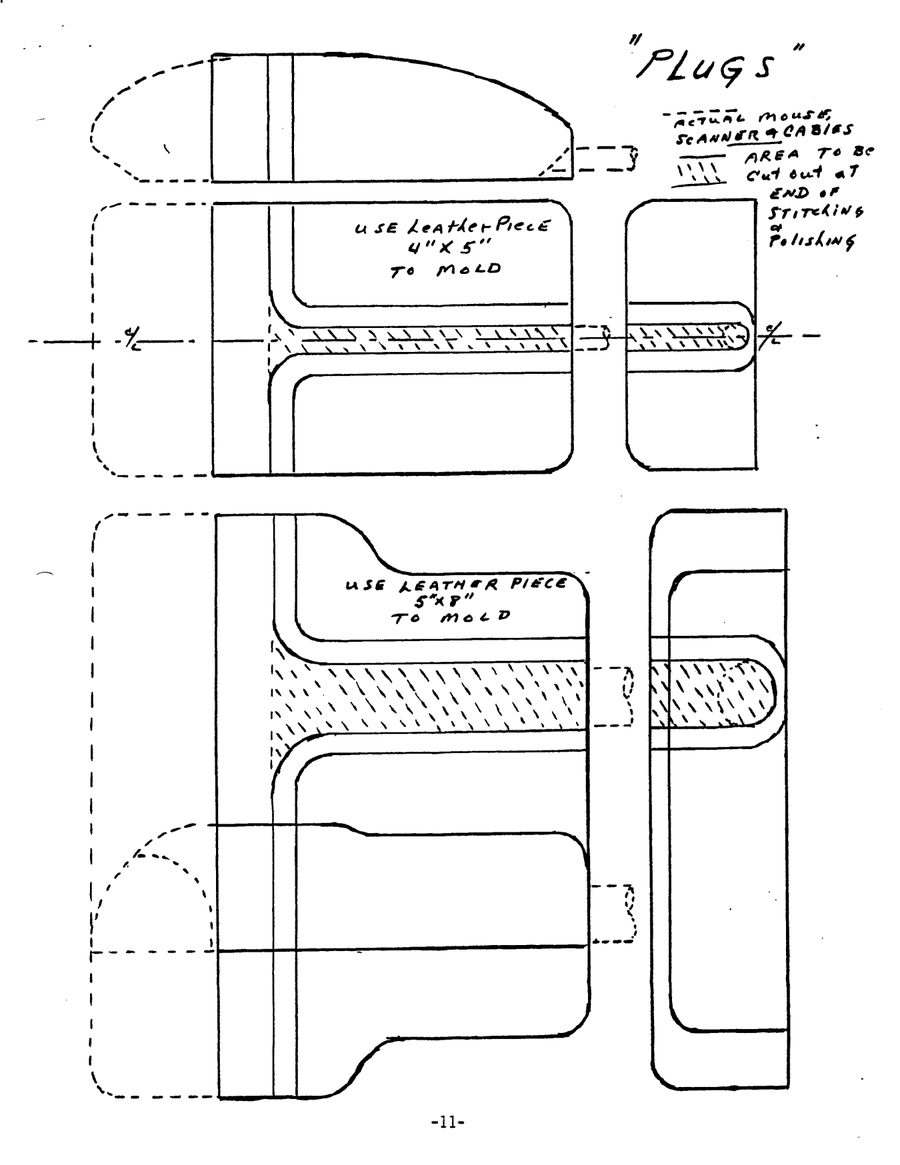
Trace the outline around the mouse and show the cable attachment location. Trace the side view, also showing the cable location. You now have to make a plug to mould your leather around. I used a piece of scrap wood 3-1/2" wide. I cut 2 pieces 2-1/2" wide, glued them together and put them in a vice for 24 hours to make sure they were dry and solid.
When dry, trace the side view on the block (forget the cable for now ) You now rough-cut some of the outline, but remember, it will be inserted, cable down, into its holder, so don't worry for now about what will be the top end, except it has to be at least equal to the maximum dimension, all the way up.
Now, if you are lucky you will have access to a sanding disc, or better, have one of your own. If you have a friend who does woodworking as a hobby, go and see him and have him do the next steps for you. You could do all the carving and sanding of the plug by hand; it's a lot of work, but it can be done,
When you get the side view cut out, trace the outline of the plan view, or top view on the bottom of your block. Follow this outline and you will end up with a plug that is the exact size as your mouse, but square edged. Remember, you are only interested in the cable end of the mouse; it will hang cable-down when you are finished, so the maximum size of your plug will be the maximum dimension of the mouse. The cable end outline has to be correct, with no taper above the maximum height. Round the edges to give you the same contours on your plug, as on your mouse or scanner. Draw the pattern outline and the centre line on your plugs - these will be your reference points as you mould your pieces.
Mount the plug on a piece of 1/2" plywood, about an 8" square. Chipboard will do, but driving a brad or nail into chipboard isn't easy.
I mounted my plug with a pair of screws, counter sinking the screw heads flush on the bottom. Because I was going to use the same base for at least two plugs - the mouse and the scanner, I built the two plugs exactly the same way and made allowances for the different cable attachments. The only thing you have to watch is that your screws don't go through the plug. With 1/2" plywood, I used 1-1/2" bevel-headed Phillips screws so that they were flush on the bottom when screwed up tight. I also used the same plywood piece and screw holes for the two plugs.
You are going to mould the piece of leather over the plug flesh side down. For the mouse, a piece of 5-6 oz, about 4" x 5", is required to allow for the depth of the plug and excess that you can nail down to dry and stay outside your pattern area, A piece of 5-6 oz, about 5" x 8" is
Page 9
needed for the scanner store.
At this point, before you do any moulding, lay out on a piece of paper a few essentials - the centre line, and the cable location. Lay out the slot for the cable, allowing about a 1/4" slot for free movement of the mouse with its cable. Put any design on the upper face that you want, at this point, but bear in mind that this mould is more than 1-1/2" thick and to get the bottom of a fixed pattern around the mould takes a good eye and a lot of luck. The only pattern I tried to put on at first was the outline for the slot. I then added a 1/8" trim mould along the top and down the sides of the cable slot, rounding: it at what will be the bottom of the slot. It should not touch the flange area of the leather that will be stitched through when the two pieces are mated together. Trace your pattern onto tracing film.
Case your leather and let it stand until dry to touch, but still moist. Trace on the pattern, keeping the centre line on the centre line of your leather and the top edge along the top edge of the leather. Cut the cable slot deep, with your swivel knife, but not through. Cut and decorate the rest of the top piece now, before you try to mould the leather around the plug. You can lose part of any decorating or carving with a 1-1/2" deep mould, so I stayed simple on the piece.
Align the centre line of your leather with the centre line on the plug. During all the moulding, keep these two centre lines as close together as you can. Start at this line and working outwards with your fingers and thumbs (no finger nails), push the leather around the plug down to the plywood base. Work the leather with the fingers to get a sharp right angle at the plywood. Holding the two flat wings down against the plywood, work the bottom of the leather until it goes flat onto the plywood. At this point, you will probably have to rework the other two wings to keep them flat on the plywood. Knead the leather with your fingers and get the three flat surfaces to become one,
Take your bone folder and sharpen this right angle, first the sides then the bottom, lastly the two corners. Remember, always keep the two centre lines aligned at all times.
Allowing for about a 3/4" flange and holding the formed leather on the plug, nail in three brads or small (1") finishing nails on each side and three more at the bottom, to hold the leather until it drys. Allow at least 24 hours before lifting the leather off the plug. Your nails will be in the leather part that will be trimmed off, so make sure you stay at least out on the flange a full 3/4" or even more,
Trim the moulded piece to allow you a 3/8" flange. Use a dime to give you the two bottom corners on the moulded piece.
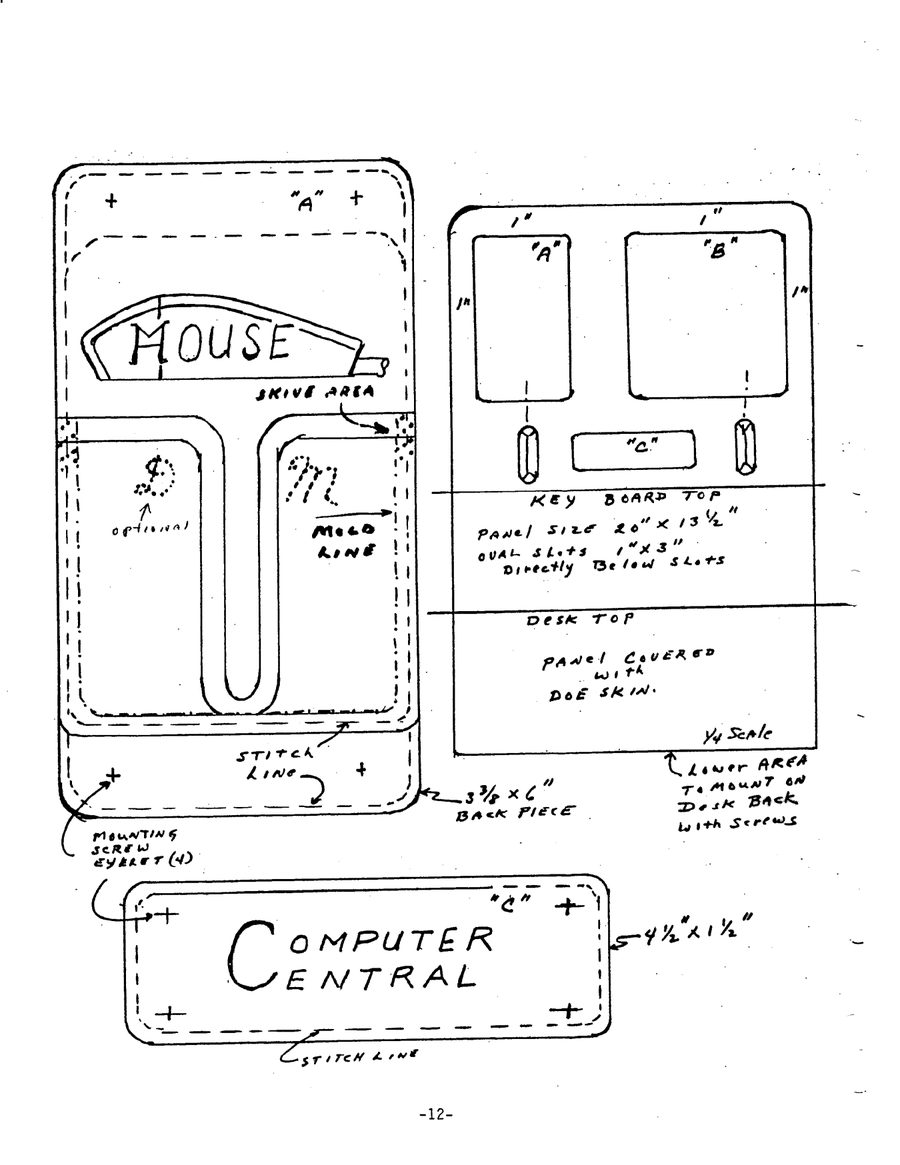
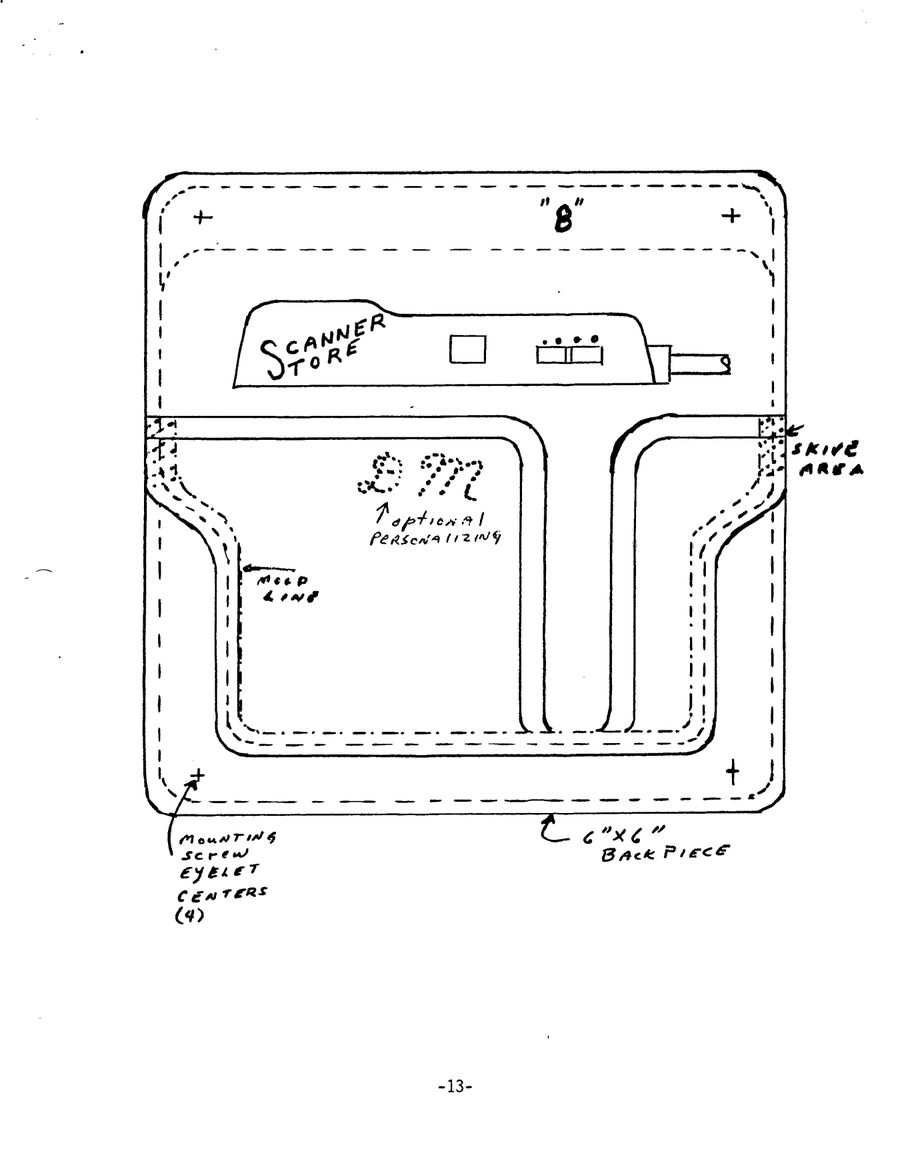
Your back piece of leather can now be cut to size. The maximum width, flange-to-flange was, in my case, 3-3/8" wide. The length of this piece is 6". Using a dime for matrix, round the four corners on the back piece. I set my edge groover at 1/8" and cut around the back piece completely, and at the same time, did the three sides of the moulded front, on the flanged area, With the stitching wheel, mark all the stitching hole locations.
I wanted some design, so I used a #5 wheel, to get a decorative wide stitch around the edge. I also doodled an outline of the side view of the Mouse (and Scanner), and traced the design on. Using the swivel knife very lightly, I followed the design. Then, using the Stylus end of my modeler, opened the cuts to show the outline and did a bit of carving to show the rounded edges of the Mouse and Scanner.
Page 10
Now, pick your colour and dye your two pieces. I used 50% Garnett Tan water based dye because it's easy to work with and easy to clean up after.
When the dye was dry, I used white acrylic, about 5 coats, very thin, and painted the Mouse design on the back piece.
When everything was dry, I used “White Rose Tacky Glue" and put the two pieces together. This type of glue lets you move your pieces around and position them properly. I used spring clamps to hold the pieces in position while they dried. This glue dries crystal clear and the excess can be wiped off as you put pressure on the joint.
The position of the moulded piece should be about 3/4" up from the bottom edge of the back piece. (The Scanner is 1/2" from the bottom).
I stitched all the way around the back piece and across the bottom of the moulded piece. The moulded piece is held up from the bottom to allow screw holes to be punched into the bottom corners, and also a pair of holes are punched in the top corners. I fixed eyelets in these holes, to finish the job, so the mounting screws won't crush the leather.
I used a #11 Scalpel to trim out the cable slot, and used the same blade to edge the slot. Then I burnished the edges of the slot with my small bone puller (it's small, about 1/2" in diameter, about 6" long and one end goes into a nice tapered end - good for holes in belts and the slots in this piece). Trim any uneven edges where the two pieces fit together, after the stitching is complete. Touch up all raw edges with your dye.
Before going any farther, I gave the piece a couple of coats of Garnett Super Sheen and polished all the edges.
Because I have an old wooden desk and a raised keyboard, the bracket I built looks a bit big, but I allowed 6" for desk mounting and 4" to clear the wooden keyboard shelf and allowed
11" to show above the shelf to hold the moulded pieces. Also, I cut a 1" x 3" oblong holes just below where the holders were to be mounted and in line with the cable slots.
I covered this 1/4" backboard with tan doe skin and rolled all edges, and around the oblong holes. I put another piece of doe skin on the back, over these openings, and slotted them to allow the cables to be fed through, once the panel is mounted on the desk. With the computer turned off, disconnect one cable at a time and thread them through the oblong slots and reconnect the amphenal plugs to the computer. When the Mouse or Scanner is used, it is lifted out of the holder and the cable runs freely in and out the hole It also lets the excess cable fall back down the hole when you put the unit back into its nest, just like an old switchboard cord.
See the pattern for the suggested sizes and design of the moulded piece and the back panel. Remember, the size and shape for either the Mouse or Scanner can and will vary with different models and manufacturers. These units were for Logitech model #PC-93-MD, Mouse, and Logitech "Scanman", Different units can have different cable connections, but the plug construction and moulding of the leather case will remain the same.
REQUIRED MATERIALS
WOOD BLOCKS
Mouse    -  4-1/2" x 2-1/2" x 1-1/4"
Scanner  -  5-1/2" x 4-3/4" x 1-1/4"
LEATHER (5-6 oz vegetan)
Mouse House:    To mould 4" x 5" min.   Back 6" x 3-3/8"
Scanner Store:  To mould 5" x 8" min.   Back 6" x 6"
MOUNTING BOARD: Approx. 20" x 14", covered with tan doeskin.
Stitching cord or waxed polyester lacing tape. Eyelets. Tools of your choice to do the job.
Pages 11–13
[Three hand-drawn pattern sheets for the project, drawn to scale with hand-lettered labels.
Page 11 gives the moulded mouse piece — leather piece, cut lines, end of stitching, and the plug outline.
Page 12 gives the scanner piece and the mounting arrangement — back panel, desk, computer, screw centres and scale.
Page 13 gives the back panel layout with eyelet and screw centres and a note to personalize the piece. There is no body text on these pages.]
Page 14
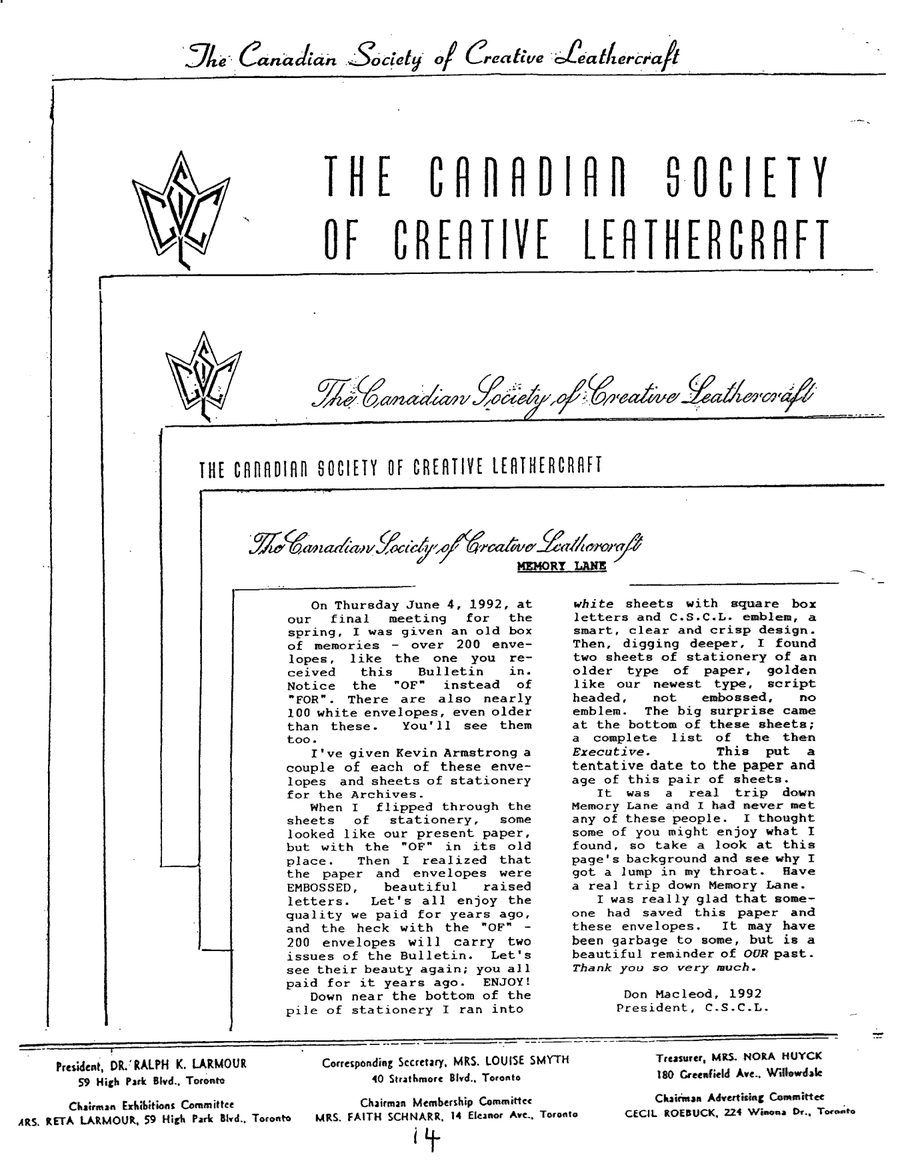
MEMORY LANE
Don MacLeod, 1992 President, C.S.C.L.
On Thursday June 4, 1992, at our final meeting for the spring, I was given an old box of memories - over 200 envelopes, like the one you received this Bulletin in.
Notice the “OF" instead of "FOR". There are also nearly 100 white envelopes, even older than these. You'll see them too.
I've given Kevin Armstrong a couple of each of these envelopes and sheets of stationery for the Archives.
When I flipped through the sheets of stationery, some looked like our present paper, but with the "OF" in its old place. Then I realized that the paper and envelopes were EMBOSSED, beautiful raised letters. Let's all enjoy the quality we paid for years ago, and the heck with the "OF" 200 envelopes will carry two issues of the Bulletin. Let's see their beauty again; you all paid for it years ago. ENJOY!
Down near the bottom of the pile of stationery I ran into President, DR. RALPH K. LARMOUR 59 High Park Blyd., Toronto white sheets with square box letters and C.S.C.L. emblem, a smart, clear and crisp design. Then, digging deeper, I found two sheets of stationery of an older type of paper, golden like our newest type, script headed, not embossed, no emblem. The big surprise came at the bottom of these sheets; a complete list of the then Executive. This put a tentative date to the paper and age of this pair of sheets.
It was a real trip down Memory Lane and I had never met any of these people. I thought some of you might enjoy what I found, so take a look at this page's background and see why I got a lump in my throat. Have a real trip down Memory Lane.
I was really glad that someone had saved this paper and these envelopes. It may have been garbage to some, but is a beautiful reminder of OUR past. Thank you so very much.
[The page is printed over a background montage of the Society's older letterheads, in several scripts, all reading "The Canadian Society OF Creative Leathercraft". At the foot, the Executive list printed on the oldest pair of sheets is legible:]
President,                        DR. RALPH K. LARMOUR
59 High Park Blvd., Toronto
Corresponding Secretary,          MRS. LOUISE SMYTH
40 Strathmore Blvd., Toronto
Treasurer,                        MRS. NORA HUYCK
180 Greenfield Ave., Willowdale
Chairman Exhibitions Committee    MRS. RETA LARMOUR
59 High Park Blvd., Toronto
Chairman Membership Committee     MRS. FAITH SCHNARR
14 Eleanor Ave., Toronto
Chairman Advertising Committee    CECIL ROEBUCK
224 Winona Dr., Toronto