
An issue of the Society’s newsletter, transcribed from the original. Download as PDF.
(7 pages, 474 KB)
Page 1
[Transcribed from the original seven-page issue. Paragraphs are reflowed from the two-column setting; spelling, punctuation and wording follow the original, including its own inconsistencies. Editorial notes appear in [square brackets]. The masthead volume is struck "XL11" for XLII. This issue runs to seven pages; the table of contents ends at page 7 and page 7 carries the editors' Christmas sign-off, so no eighth page is missing.]
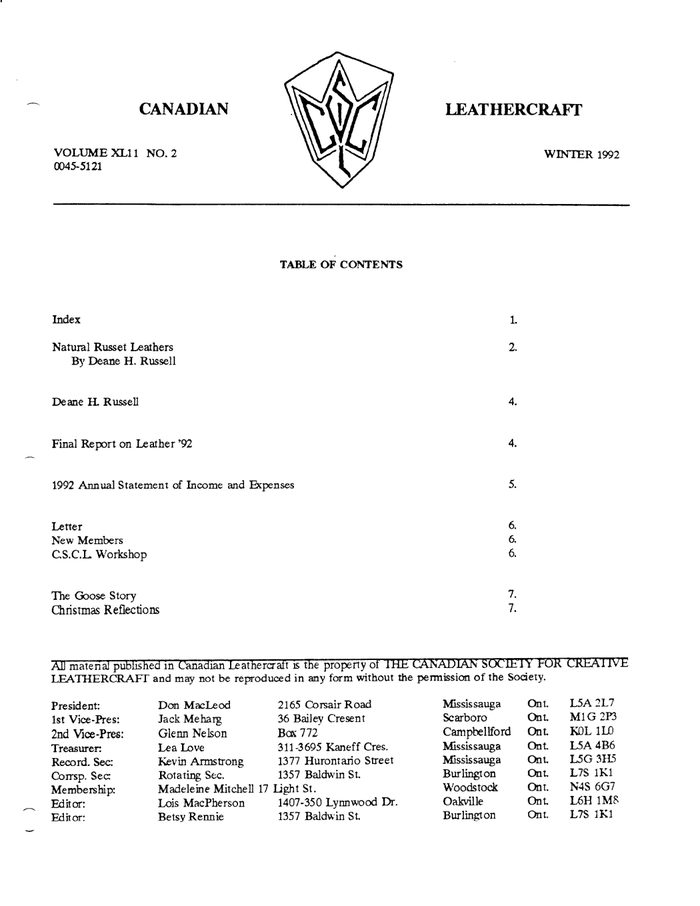
CANADIAN LEATHERCRAFT
VOLUME XL11 NO. 2                WINTER 1992                        0045-5121
TABLE OF CONTENTS
Index                                                                     1
Natural Russet Leathers                                                   2
By Deane H. Russell
Deane H. Russell                                                          4
Final Report on Leather 92                                                4
1992 Annual Statement of Income and Expenses                              5
Letter                                                                    6
New Members                                                               6
C.S.C.L. Workshop                                                         6
The Goose Story                                                           7
Christmas Reflections                                                     7
All material published in Canadian Leathercraft is the property of THE CANADIAN SOCIETY FOR CREATIVE LEATHERCRAFT and may not be reproduced in any form without the permission of the Society.
EXECUTIVE
President:       Don MacLeod        2165 Corsair Road       Mississauga   Ont.  L5A 2L7
1st Vice-Pres:   Jack Meharg        36 Bailey Cresent       Scarboro      Ont.  M1G 2P3
2nd Vice-Pres:   Glenn Nelson       Box 772                 Campbellford  Ont.  K0L 1L0
Treasurer:       Lea Love           311-3695 Kaneff Cres.   Mississauga   Ont.  L5A 4B6
Record. Sec:     Kevin Armstrong    1377 Hurontario Street  Mississauga   Ont.  L5G 3H5
Corresp. Sec:    Lois MacPherson    1407-350 Lynnwood Dr.   Oakville      Ont.  L6H 1M8
Membership:      Madeleine Mitchell 17 Light St.            Woodstock     Ont.  N4S 6G7
Editor:          Lois MacPherson    1407-350 Lynnwood Dr.   Oakville      Ont.  L6H 1M8
Editor:          Betsy Rennie       1357 Baldwin St.        Burlington    Ont.  L7S 1K1
[Glenn Nelson's address changes to a box number this issue.]
Page 2
NATURAL RUSSET LEATHERS
by Deane H. Russell
This is an article written by one of the earliest Presidents of the Society in 1952.
Fred Brown asked us if we would reprint this article.
A discussion about some important craft characteristics of russet leathers. Probably no other tannage or finish of leather is so important to the decorative leathercraftsman.
An understanding of the term “russet leather” is necessary for the student craftsman for appreciate its special craft possibilities. The term "russet" suggests different meaning to different branches of the leather industry.
"Russet" may refer to colour, or to tannage, or both. Hides and skins which are subjected to the long and involved process of "vegetable" (bark) tanning are rendered into leather of a type most suitable for ornamenting and finishing with the hand tools and materials of the decorative leathercraftsman.
When referring to colour, it should be understood that no colouring agents are added leathers during tanning. Variations from light to dark natural russet result from different vegetable extracts favoured by different tanneries for their special products. Certain very light russet leathers may, however, undergo an extra "bleaching out" process.
Skins, hides and sides which have been "vegetable tanned" but not further finished, are often referred to as being "in the crust". It is at this stage that serious grading or sorting is commenced for the many industrial, manufacturing and craft uses expected of russet leathers. By far, the greater bulk of vegetable tanned russet leathers whether calfskins, horsehides, cowhides, sheepskins, goatskins, pigskins, buffalo hides, and others, are made for industrial and manufacturing purposes, while selection for use by handcraftsman is only incidental as far as volume of pieces tanned is concerned. The natural russet finished leathers which are finally selected for fine personal leather goods and for use by decorative leathercraftsmen number well under 5% of the total of the many hundreds of thousand of pieces tanned each year.
It is well, therefore, for the leathercraft instructor and student to keep this fact constantly in mind, as beginner leathercraftsmen are generally much too prone to insist that their craft leather be "blemish free". While industrial and manufacturing users of vegetable tanned russet leathers (as well as of coloured bark tanned products) have many ways of using 2nd, 3rd, 4th, and even Sth grade leathers, they too must claim a reasonable share of the comparatively limited supply of #1 selected pieces completing the long process of making leather at the tannery. Because of the numerous factors which may cause natural and accidental markings of hides and skins during growth (see article "What is Good Leather" Bulletin No 2, 1951), the finding of really “blemish free" skins or hides is so rare among tanners as to be all but a nil factor for those who, through ignorance, try to insist on "blemish free" super sections for all orders.
It is up to the Craftsman - to discover and understand the limitations of leather as a natural product, while, at a
Page 3
challenging craft material. Experience will suggest how numerous natural markings may be included in your work without detracting, but in some cases even enhancing the final appearance of a well planned, carefully worked and finished leathercraft article.
Following are some important characteristics, problems and possibilities to explore when working with natural russet leathers:
Advantages - a good material for beginner students, as it shows in clear detail the effects of tooling upon leather. —natural russet leathers offer the best medium for modelling, incising, embossing, carving, or stamping techniques for decorating. --well planned and carefully worked, natural russet tooling and carving leathers can result in finished articles displaying the maximum of a craftsman’s "capacity" with leather.
Problems - Natural russet leathers may soil easily while "making up". However, finger and tool stain marks may often be lifted with a mild bleaching solution ( 1 tablespoon of Oxalic Acid to 1 pint of water). When using any bleaching agent, take the precaution of wiping over work with clear water dampened swab, as any concentrate of bleaching agent left in the leather may seriously affect subsequent hand colouring operations.
Oxidizing of Natural Russet Leathers - Some russet leathers "mellow" rapidly; all mellow eventually. The same oxidizing process takes place on many light-to-medium dark toned leathers particularly with aniline dyed leathers. This effect, if produced evenly, is not necessarily undesirable. In fact, it is often hoped and planned for by skilful craftsmen that their work appear more "mellow" after use over a period of weeks or months or even years.
Often, however, beginners are disappointed when they plan to "leave their work natural" and expect it to stay in the same light tone after use for a season as when articles were first completed. To learn what will happen to "natural" leather when left uncoloured or when just superficially finished, students may observe the strong oxidizing effects of sunlight (or daylight) on russet leathers, by putting a strip in the window, half covered with a close fitting brown paper sleeve. Pull the sleeve back a couple of inches every other day for a week and notice the distinct gradations of “mellowing". Multiply this effect of one week’s light exposure the "natural finished" article will receive during a whole summer of outdoor use, and the beginner may think twice about leaving his work natural.
Unless natural leathers are frequently refinished with cleaning solutions and neutral creams or waxes, they tend to absorb finger and hand marks which in time become so ingrained into the surface fibres as to permanently soil the original fresh appearance. While there are methods which students may study and practise applying clear shellacs, lacquers or waxes to natural russet articles, the more experienced craftsman prefers to treat his leathers with at least a light toning of colouring medium.
Remember - as different leathers take the same dyes differently, from piece to piece and even from area to area of the same hide, the careful craftsman will ALWAYS experiment or test on scrap leather of the type to be used in major projects.
Page 4
The more you study the craft of hand colouring and finishing natural russet leathers, the more you will enjoy leathercraft and have your work admired by others.
DEANE H. RUSSELL
Deane Russell was one of the founding members of the Society. He started leathercraft at the YMCA Golden Lake Summer Camp in 1938. For five years he was the Secretary for the Interdepartmental Committee on Canadian Hand Arts and Crafts for the Dominion Government. In 1946, Deane Russell wrote a feature column “Leathercraft Lobby" for "RA NEWS". This was a monthly newspaper for the Civil Service Recreation Association. He organized Canada’s two largest leathercraft exhibitions. The 1948 display included entries from coast to coast in Canada and from 14 Foreign Countries. He resigned from the Dominion Civil Service after 12 years to undertake full-time management of the Ottawa Valley Leathercraft Studios. In 1950, Deane Russell was appointed President of the newly formed Canadian Society of Creative Leathercraft. In 1951, he was appointed Editor of the newly formed "Canadian Leathercraft". His early work commissions were a photograph frame presented to the President of the United States; A book cover presented to the Emperor of Ethiopia; and photograph folders presented to visiting Chiefs of Staff, European Armies.
CANADIAN SOCIETY FOR CREATIVE LEATHERCRAFT
Final Report on "Leather '92", October 23, 1992
INCOME
Entry Fees                                  $ 170.00
DISBURSEMENTS
Prizes                                      $ 150.00
Judging Facilities                            100.00
Judging Honorarium                            100.00
City of Etobicoke                              30.00
Printing Costs etc.                            75.34
Return of Cases to Woodstock                   30.00
Postage                                        44.94
Total Estimated Expenditures                  530.28
Expenditures Over Income                    $ 360.28
Lea Love, Treasurer
[The balancing figure is struck faintly in the scan but legible at high magnification, and agrees with the arithmetic: 530.28 - 170.00 = 360.28.]
Page 5
CANADIAN SOCIETY FOR CREATIVE LEATHERCRAFT
1992 Annual Statement of Income and Expenses
INCOME
Registrations (56 x $15.00)                 $  840.00
Banquet Ticket Sales (54 x $25.00)            1350.00
C.S.C.L. Deposit                  $ 200.00
Deposit Returned                    200.00       0.00
Draw Table - Main Draw              322.00
- Special Draws          86.00     408.00
M.S.C.L. Coffee Break                           60.00
Bank Interest                                   15.18
TOTAL INCOME                                $ 2673.56
[The Special Draws figure and the 408.00 draw subtotal are struck faintly in the scan but legible at high magnification; 322.00 + 86.00 = 408.00, and 322.00 and 86.00 stand in the inner column with the deposit figures, the 408.00 subtotal in the income column. As printed, the income column (840.00 + 1350.00 + 0.00 + 408.00 + 60.00 + 15.18) comes to 2673.18, not the printed total of 2673.56. The 1993 Annual Statement's comparative column gives the M.S.C.L. Coffee Break as 60.38, which makes the column foot exactly; the 60.00 printed here appears to be the original's own error.]
DISBURSEMENTS
Banquet - Meals and Extra Food              $ 1125.50
Room Rental                                    600.00
Refreshments (Hospitality Room)                 31.39
Service Charges, Sales Tax & GST               391.46
Guest Speaker (Gift & Expenses)                160.00
Early Registration Prize                        15.00
Advertising                                     24.05
Entertainment                                   24.05
Money Order Expenditures                        15.25
TOTAL EXPENDITURES                            2386.85
NET INCOME OVER EXPENDITURES                   286.71
MISCELLANEOUS OTHER EXPENSES
Postage                                     $   60.41
Ribbons and Weston Trophy                      132.25
Salon Prize                                     50.00
Film & Developing                               23.00
Printing - Annual Report                        89.70
Room Allowance (Pres.)                          62.09
Judging Facilities                             150.00     567.45
TOTAL EXPENDITURES OVER INCOME              $ 280.74
[The final total is struck faintly in the scan but legible at high magnification; it equals 567.45 - 286.71 and matches the figure the 1993 Annual Statement's comparative column reports as Net Income (or Loss) on Activity, (280.74). Note also that the disbursements above sum to 2386.70 with the Guest Speaker line at 160.00, against the printed total of 2386.85; the 1993 comparative column gives that line as 160.15, which foots exactly. The 160.00 printed here appears to be the original's own error.]
Page 6
LETTER
Dear Madeleine Mitchell,
Thank you for sending me the membership card. First, I congratulate you the exhibition. The problem of sending my leather articles to Canada proved to be unsolvable for me. By the end of this year a new service branch of sending parcels by Air Mail will start functioning. So, Let’s hope that in future T’ll be able to take part in similar events.
Still, there was a very marvellous event in Germany - Grunwald near Munich, which I was able to attend. Leather 92 Conference. I received an invitation and went there with my exhibits. When the conference and the exhibition were over I took my items back home. The Germans also printed a catalogue. If you don’t have it, I can send you one Next time.
At the moment we are reorganizing our Leather Society. It has been functioning as it should, so far. It has been more like a trade union, dealing with material problems of leather artists. In spite of that I have been planning to organize a Leather Conference in Tallinn together with the Estonian Applied Art Museum. The possible dates for the event are May 4-9, 1993. You and members of your Society will certainly receive an invitation from us.
Still, I would like to know, if this conference is going to take place, how many leather artists would be interested in joining it and taking their work along?
I would appreciate if you could predict the possible participation from your Society.
Looking forward to you kind reply.
Yours Sincerely, Riina Kermik
NEW MEMBERS
Riina Kermik                      William Allen
Siili 7/9 - 11                    1457 Colborne Rd.
EE0034, Tallinn                  Sarnia, Ont.
Estonia.                         N7V 3M2
Raymond R. Clements              David J. Haas
952 Parkhill Rd. W.              5-7359 Chestnut Ridge Rd.
Peterborough, Ont.               Orchard Park, NY
K9J 6P3                          14127
IF ANYONE IN THE C.S.C.L. HAS A PATTERN FOR A LEATHER SEWING THIMBLE (STANDARD STEEL THIMBLE SHAPE) WOULD YOU PLEASE CONTACT THE EDITORS.
C.S.C.L. WORKSHOP
Making a Pattern for a Leather Vest. This pattern making workshop will include your basic vest pattern and then if there is time, we will include different styles - yolks etc.
This workshop will be taught by BETSY RENNIE, F.C.S.C.L. There is a $25.00 fee and will be taught at St. Margaret’s Anglican Church on 134 Emerson Street in Hamilton. The Workshop will be the last weekend of May 1993.
Page 7
THE GOOSE STORY
Next fall, when you see Geese heading South for the Winter...flying along in V formation you might consider what Science has discovered as to Why they fly that Way.
As each bird flaps its wings, it creates an Uplift for the bird immediately Following.
By flying in V formation the Whole Flock adds at least 71% greater Flying Range, than if each bird Flew on its Own.
People who share a common direction and sense of community can get where they are going more quickly and easily because They are travelling on the thrust of one another.
When a goose Falls out of Formation it suddenly feels the Drag and Resistance of trying to go it alone...and quickly gets back into Formation to take Advantage of the Lifting Power of the bird in front.
If we have as much sense as a goose We will stay in Formation with those Who are headed the same way we are.
When the Head Goose gets tired it rotates back in the Wing...and another goose flies Point.
It is sensible to take turns doing demanding jobs... with people or with geese flying south.
Geese honk from behind to Encourage those up Front to keep up their Speed.
What do we say when we Honk from Behind?
Finally...and this is Important..when a goose gets Sick, or is wounded by Gunshots, and falls out of Formation, two other Geese fall out with that goose and follow it down to lend Help and Protection.
They stay with the Fallen Goose until it is able to Fly or until it Dies, and only then do they launch out on their own, or with another Formation To catch up with their Group.
If we have the Sense of a Goose
We will Stand by each other like that.
Source Unknown
CHRISTMAS REFLECTIONS
A happy heart feels
the power of love
A tranquil spirit feels
the presence of peace
Wisdom will cherish these
always!
Christmas Inspires... such friendly ways the hugs and smiles that brighten our days
Christmas Inspires close feelings with all and provides fond memories we will later recall
Christmas Inspires giving gifts large or small though our gift of each other is the best gift of all
The editors of the Canadian Leathercraft would like to wish the members of the guild a "Merry Christmas" and a "Peaceful New Year" and let your hearts keep on tapping.....
From Lois and Betsy.