
An issue of the Society’s newsletter, transcribed from the original. Download as PDF.
(8 pages, 18410 KB)
Page 1
[Transcribed from the original 8-page issue. Paragraphs are reflowed from the original setting; spelling, punctuation and wording follow the original, including its own inconsistencies. Editorial notes appear in [square brackets].]
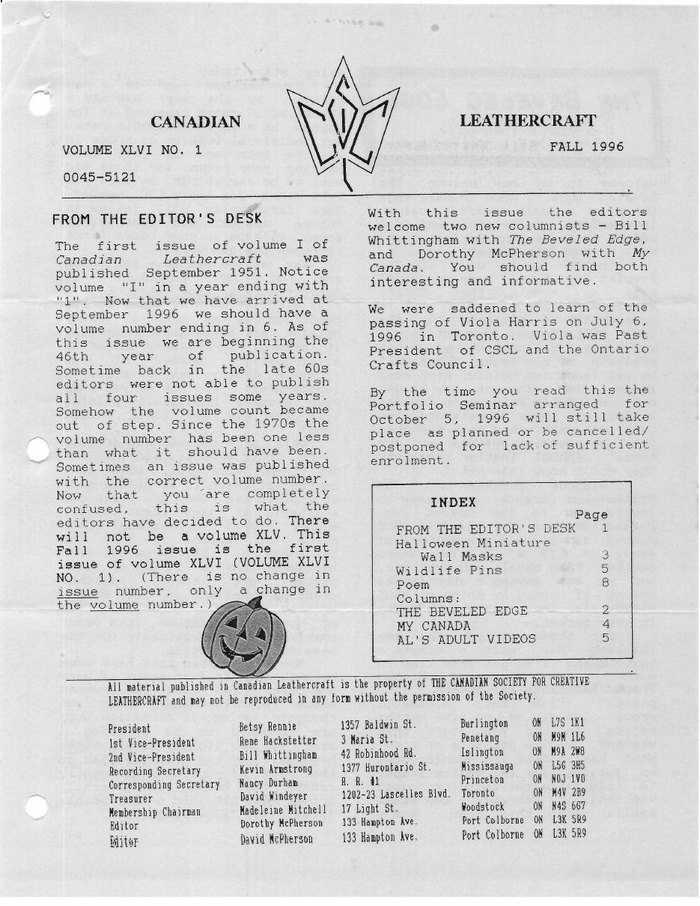
CANADIAN LEATHERCRAFT
VOLUME XLVI NO. 1 — FALL 1996 — 0045-5121
FROM THE EDITOR'S DESK
The first issue of volume I of Canadian Leathercraft was published September 1951. Notice volume "I" in a year ending with "1". Now that we have arrived at September 1996 we should have a volume number ending in 6. As of this issue we are beginning the 46th year of publication.
Sometime back in the late 60s editors were not able to publish all four issues some years. Somehow the volume count became out of step. Since the 1970s the volume number has been one less than what it should have been. Sometimes an issue was published with the correct volume number.
Now that you are completely confused, this is what the editors have decided to do. There will not be a volume XLV. This Fall 1996 issue is the first issue of volume XLVI (VOLUME XLVI NO. 1). (There is no change in issue number, only a change in the volume number.)
With this issue the editors welcome two new columnists — Bill Whittingham with The Beveled Edge, and Dorothy McPherson with My Canada. You should find both interesting and informative.
We were saddened to learn of the passing of Viola Harris on July 6, 1996 in Toronto. Viola was Past President of CSCL and the Ontario Crafts Council.
By the time you read this the Portfolio Seminar arranged for October 5, 1996 will still take place as planned or be cancelled/postponed for lack of sufficient enrolment.
INDEX
                                          Page
FROM THE EDITOR'S DESK                      1
Halloween Miniature
Wall Masks                               3
Wildlife Pins                               5
Poem                                        8
Columns:
THE BEVELED EDGE                         2
MY CANADA                                4
AL'S ADULT VIDEOS                        5
All material published in Canadian Leathercraft is the property of THE CANADIAN SOCIETY FOR CREATIVE LEATHERCRAFT and may not be reproduced in any form without the permission of the Society.
President               Betsy Rennie         4357 Baldwin St.          Burlington     ON  L7S 1K1
1st Vice-President      Rene Hackstetter     3 Maria St.               Penetang       ON  L9M 1L6
2nd Vice-President      Bill Whittingham     42 Robinhood Rd.          Islington      ON  M9A 2W8
Recording Secretary     Kevin Armstrong      1377 Hurontario St.       Mississauga    ON  L5G 3H5
Corresponding Secretary Nancy Durham         R. R. #4                  Princeton      ON  N0J 1V0
Treasurer               David Windeyer       1202-23 Lascelles Blvd.   Toronto        ON  M4V 2B9
Membership Chairman     Madeleine Mitchell   17 Light St.              Woodstock      ON  N4S 6G7
Editor                  Dorothy McPherson    133 Hampton Ave.          Port Colborne  ON  L3K 5R9
Editor                  David McPherson      133 Hampton Ave.          Port Colborne  ON  L3K 5R9
Page 2
THE BEVELED EDGE
Welcome to my new column, The Beveled Edge. I hope to make this Canadian Leathercraft column informative and helpful, and if I add a smile to your day along the way, so much the better.
In the early days of The Beveled Edge I will keep you up to date on events that CSCL's Mississauga branch (of which I am president) is planning for the 1997 CSCL Annual Convention. I will also be commenting on new products or new books. There will be at least one helpful hint each issue. I'm going to try to get some of CSCL's Fellows to divulge a few of their secrets and also tell us what they look for when they're judging pieces at the Annual. (Shhh! That's a secret. They don't know this yet.)
Without further ado, The Mississauga branch is pleased to invite you to The Beacon Inn, Jordan Station, for the 1997 CSCL Annual to be held the weekend of April 18, 19 & 20. Two weeks earlier than usual, you say? Yes, but we are saving a substantial amount of money by doing so, and ultimately that means more money in your pocket.
[The Summer 1996 issue announced this Annual as tentatively May 2-4, 1997 at the Beacon Inn, Jordan Harbour. The date and the place-name both differ here.]
For these of you who are thinking "Hey, wait a minute that means I've got less time to work on my Weston Trophy/Associate/Fellowship pieces' (Pick one, please!), wrong. I'm giving you five months notice. So, if you start this weekend, you've got lots of time.
Word has it that you should count on judging for the Weston Trophy to take place the third or fourth week-end in February -- two weeks earlier than this year. Don't delay, start today.
Don MacLeod (who is a new grandpa, by the way) has had a block of 30 rooms reserved at The Beacon at a very reasonable rate, but individual booking of rooms is up to each one of you. When booking your rooms, for those who want to be earlybirds, be sure you tell them you are a CSCL member. More information will follow in future issues and appropriate forms will be in your hands first thing in the new year.
Any of you who have sat in on any of my workshops or demonstrations know that I'm a real stickler when it comes to the condition of my brushes. In my opinion, any brush that looks like it belongs on the back end of an alley-dwelling member of the rodentia family has no place in leathercraft. So, how do you keep your brushes beautifully pointed like the day you first bought them?
Well, professional oil artists clean their brushes, and then, to dry them, will roll them in a bamboo mat which is about the size of a place mat. They are cheap and available at just about any art supply store. Why bamboo? Each piece of bamboo is only the thickness of the large end of a toothpick and a series of these pieces are strung together creating excellent air flow so the brushes dry very quickly instead of trapping moisture like paper towel would and eventually rot the base of your bristles.
Now for brushes that have seen more than their fair share of wear and tear. You know, the brushes whose bristles have their own thoughts on which direction they are supposed to be pointing. I find if you lightly dampen these brushes, lay the bristles flat in the palm of your hand and gently rotate the brush, it generally brings them all into a nice point.
(Please see "Edge"/page 7)
Page 3
HALLOWEEN MINIATURE WALL MASKS
designed by Dorothy McPherson
"Ghosts are nothing more than restless souls looking for peace and needing a little guidance in finding it," says Canada's ghostbuster and author, Najla Mady, in her book, BOO!! GHOSTS I HAVE(N'T) LOVED.
Folklore buffs tell us that some of Canada's famous restless souls inhabit an inn, a school, and a road: The Angel Inn on Regent Street, Niagara-on-the-lake, Alma College, on Moore Street, St. Thomas, and the Roman Line road, Lucan.
Leathercrafters, no matter where they reside, can capitalize on the interest in ghostly apparitions and, at the same time, have fun researching ghosts. Museum curators or local history buffs will know of local ghosts. If not, libraries will have North America's ghost stories.
Select any ghost, then condense the information about it into approximately 25 words. Handwrite, or type, the short version on a piece of paper or on the back of a business card. This becomes the product tag. Punch a hole in the tag.
Our pink ghost is Angela, that used to inhabit a school: In 1881, Alma College, Moore Street, St.Thomas, Ontario, was officially opened. From the early 1900s until early 1970s students, at this regal, Victorian-Gothic private school for girls, were aware of an invisible ghostly presence named 'Angela'.
She made her presence felt through an eerie, 10-minute silence that descended on the school dininghall - on the lower level of the main building - at the same time every day, about 12:10. Students and staff would be eating, then the silence descended, and people would look up and say:"Oh, yes, it's Angela."
In the early 1970s Angela disappeared when a new, separate dininghall was built and the old dininghall was converted into an art room. Her presence hasn't been felt since the dining facilities were moved. It would appear that she's gone for good. (MISS JANEY CANUCK, BEAVER BOOKS)
[The page passes read JANEFY; isolated re-OCR with dictionaries disabled reads JANEY, which is adopted.]
The above information was condensed: Angela. This legendary ghost's presence was felt daily in an eerie 10-minute silence that descended at noon In dininghall of Alma College, St. Thomas, 1900s-1970s.
Brave enough to go ghost hunting? If so, follow these directions and you'll encounter a Canadian ghost of your choosing.
MATERIALS:
thin leather such as levelling splits (about 6" square for FACE
and 4" square for FACE BACK)
stiffener (paper mache or modelling compound)
Weldbond white glue
cardboard
silk, leather or ribbon cord
dye
EQUIPMENT:
Easter egg decorating kit
air-brush
scissors
rotary punch
DIRECTIONS:
(1) To make ghost's FACE use a child's Easter egg decorating kit that comes with moulded plastic stencils that are the shape of half an egg. Wet 6" piece of leather and place it between two of the moulds. Weight down the leather flat around the outside edges of mask FACE. When leather is dry, remove the moulds. Using #6 rotary punch, punch two eye holes. Spread a layer of
(Please see "Mask"/page 6)
Page 4
MY CANADA
by DOROTHY McPHERSON
Did Cinderella visit here?
One afternoon this summer we parked our trailer just outside Louisbourg, Cape Breton, Nova Scotia, and headed for my long-awaited outing to Big Pond where the former home of singer/songwriter Rita MacNeil has been converted into Rita's Tea Room.
That day. upon hearing that the Tea Room was serving coconut cream pie (my favourite), I ordered a piece and then remembered that I had originally come for oatcakes. "Could I have an order of oatcakes to go?" I asked the waiter.
"I'm awfully sorry, ma'am, but we don't fill any take-out orders."
"Really? Oh, no. I've travelled 1500 miles for tea and oatcakes at Rita's," I told him in dismay.
"Well, I'll ask management," he said and shortly returned. "If you were to order oatcakes and couldn't finish them here you would probably want to take them home in your purse, wouldn't you?" he hinted.
"Uh, yes," I said catching his meaning, and shortly thereafter left with my purse bulging with two huge oatcakes wrapped in serviettes.
The next morning, despite overcast skies and a light drizzle, we toured the restored Fortress of Louisbourg National Historic Site. There, we gobbled up the oatcakes and a picnic sandwich while walking through Magazin du roi, King's Storehouse. Tourist Info had assured me that the best part to see is the king's bastion that houses the governor's quarters. So, we headed directly there where opulence and austerity elbow each other.
In the interpretive centre of the king's bastion we listened to telephone-recorded, neat facts about the old town: Founded in 1713 for its cod fishery, historic Louisbourg enjoyed three peaceful decades as a French colonial seaport. New Englanders captured the town in 1745, but watched its return to France three years later. The peace was short and in 1758, the British captured the town a second time. In 1760, Louisbourg's fortifications were destroyed and the small British garrison left eight years later.
In 1961, the Government of Canada undertook reconstruction of one quarter of historic Louisbourg to commemorate its history and to stimulate the local economy.
Undoubtedly the most amusing artifact was the governor's wooden bathtub. Splinters?!
Upon rounding one corner in the bastion I came upon a case that held a lady's single brown leather shoe. Cinderella's lost slipper, perhaps?
Could have been. It was 200 years old and found during excavations on the site. The shoe had a stacked heel and a pointy toe. The shoe was stitched together with only one seam: a centre seam ran up the front from toe to top. The upper was made from two pieces of leather — both the same shape with one and one cut reverse. Up top, at the front, the ends overlapped. No buckle, strap or lace was needed to hold them securely on. Ingenious.
Beneath a festive ballgown of shimmering, pale yellow silk stood a pair of yellow leather pattens. Apparently, when m' lady went
(Please see "Shoe"/page 7)
Page 5
WILDLIFE PINS
by Roselle Wallace
I am a lover of wildlife. I spent most of May in Northern Manitoba and it was very exciting to see species native to that area or migrating north: snow geese by the thousands, pelicans, grosbeak, magpies, mergansers, pintails, shovellers, teal, kildeer - just to mention a few. The binoculars were within easy reach all the time.
Dave Elliott was my first leather instructor in the 70s. He made "duck pins" for the Sportsman Show that year and I was very impressed with his "wildlife birds". My interest in making pins heightened.
I now enjoy making this jewellery. Ducks, wolves, bears are some of my favourites, also butterflies. After my subject is drawn or stencil-impressed on the leather it is then carved, beveled, then cut out very carefully. Before embossing I let the item dry for 2 to 5 days. After embossing I check with my nature books for painting details. Pin back is glued on and painting done. I wait a few days before I apply a coat of Leather Balm to the item, which gives my project a soft sheen.
LEATHER
L  luxurious
E  exquisite  engravable
A  adaptive  adorable  agreeable
T  touchable  tough
H  harmonizing  handcraft  handy
E  exciting
R  rich  regal  ravishing  resposible  and rugged
Other characteristics: flexible, sturdy, pliable, useful and naturally beautiful. Very exciting!
AL'S ADULT VIDEOS
The latest leather video I saw was CARVING SCENERY, a must see, by Robert Beard.
CARVING SCENERY: Special scenery carving methods revealed by this world class leather carver. Methods are included for carving rocks, landscape, water, grass, trees, foliage, mountains, sky and more. Pattern is included. 40 minutes.
This is a very detailed demonstration of this particular form of carving. There is so much in it that I believe if you are to really utilize the methods described, you would need the video right at hand while doing the work to review each area described as you are doing it. It is not for everybody but should be viewed just to appreciate the work that goes into a picture.
This is one of a series of leathercrafting videos made by Lone Star Leathercrafters, Fort Worth, Texas. CSCL has the series and any CSCL member who wishes to borrow them just needs to let me know.
BRANCH NOTICES
HAMILTON — St. Margaret's Anglican Church, 138 Emerson St., 7 p.m.
* Demonstration: one-piece wallet pattern by Ruth Haig, Oct. 4 * Mask making workshop by Madeleine Mitchell, SAT Nov. 16 (9:30-2:30) Bring lunch. Coffee/tea/donuts will be provided * Pot luck, Silent auction, Christmas ornaments by Betsy Rennie, Dec. 13, 6:30
Page 6
Mask (Continued from page 3)
[The page carries three labelled line diagrams: HALLOWEEN MINIATURE MASK (FRONT VIEW) showing the HANGING CORD; a FINISHED ACTUAL SIZE view; and a cutaway captioned LEATHER-COVERED CARDBOARD FACE BACK.]
stiffener inside the oval-shaped FACE but don't cover the eye holes. Allow to dry.
(2) Meanwhile, to make a flat FACE BACK, trace the outline of the egg mould on cardboard. Glue the cardboard egg shape on 4" piece of leather. When dry, use scissors to cut out leaving 1/2" (or more) rim of leather around the cardboard.
(3) Next, form a HANGING DEVICE by attaching cord loop. Centre loop on cardboard at top edge of cardboard so that loop extends upward approximately 1/2" beyond the cardboard.
(4) To join FACE and FACE BACK apply glue liberally on rim of leather that extends beyond the cardboard. Place FACE and FACE BACK back-to-back and press them firmly together being sure to centre the BACK correctly so that the hanging device is at the top of the mask and positioned so the mask hangs straight.
(5) When dry. lightly air-brush FACE using a suitable colour: Blue for sea captain, pink for young lady, and black for an apparition that reputedly only appears at night.
(6) Cut a narrow, flexible hanging leather cord and thread it through the loop. Add the product tag if selling or giving away the mask. Shorten the cord if mask is to hang on the wall. For wearing as a Halloween trick-or-treat necklace, cut a neck cord about 35" long.
Page 7
Edge (Continued from page 2)
Then let it air dry standing on its handle, bristles up. For really chronic cases of the "frizzies", the old brush in the mouth trick works wonders. Your saliva has a more glutinous quality that allows the bristles to adhere to one another more readily. You may have to repeat this process a few times.
One final tip concerning the use of brushes. Picture this: It's 3 a.m and you've been doing leather work for the last 14 hours. You're making leather brooches and you have to dye loon's eyes, wizard's eyebrows, and dragon's teeth, but the two pots of coffee you have consumed have really kicked in and your hand is shaking from all that caffeine. (This may not sound familiar, but I do it all the time.) What do you do? When I am doing very fine work, I do the following:
I am right-handed, so I take the small article to be dyed between the thumb and the forefinger of my left hand. I plant both elbows firmly on a table in front of me. This automatically raises my work to eye level, and gives me a solid "anchored" position to work from. Then, I rest the little finger of my right hand firmly on the knuckle of my ring finger of my left hand, once again forming a firm anchored position. This gives me ample room to wield my brush in the required manner, yet provides the support I need. Try it.
Lost the clear plastic protective collar that came with that expensive brush you bought? No problem. Pieces cut from a plastic straw will provide the same protection.
Bill Whittingham is the newest member of the Council of Fellows
Shoe (Continued from page 4)
walking she would tie the heelless shoe covers on over her shoes — the forerunner of duck shoes or rubber boots, I guess.
Although some craftsmen still make sandals, no longer is it as much of a novelty to order sandals custom-made by hand. And so, any skilled leather crafter who might decide to duplicate heritage shoes would probably find a ready market now among tourists who always appreciate something new.
Yes, those old Canadian shoes in Fortress Louisbourg look trendy and contemporary. Also, durable and beautiful like the island on which they were found:Cape Breton.
[A line diagram is captioned FORTRESS LOUISBOURG SHOE — TOE TOP VIEW.]
McPherson is a heritage writer who resides in Niagara
BRANCH NOTICES
WOODSTOCK
* Removeable book cover by Loreen Manuel and Madeleine Mitchell at Loreen's, Oct. 17 * Picture carving by Al Williams at Nancy Durham's, Nov. 21 * Christmas party, location TBA, Friday Dec. 6
The editors would like to hear from branches in Norland, Toronto, and Mississauga to be able to publish notices in the December issue.
Page 8
AUTUMN
I like to go walking through the woods
To see the leaves again,
To tread on a carpet of red and gold
Woven by the wind and rain.
Why do people say that Autumn is sad?
Nature's rest is taken this way,
And her dreams cannot be so bad
With a blanket so bright and gay.
Yes, it is Indian Summer,
And the wind is soft and low,
It sends up a musty odour
From the fallen leaves below.
Their gorgeous colours have now gone
Washed by the rain and dew,
The bright reds and the orange
Have faded to a russet hue.
Two last oak leaves hung on a tree,
High above the ground.
A breeze sprang up and set them free
Winter had truly come!
Jack Bonisteel