
An issue of the Society’s newsletter, transcribed from the original. Download as PDF.
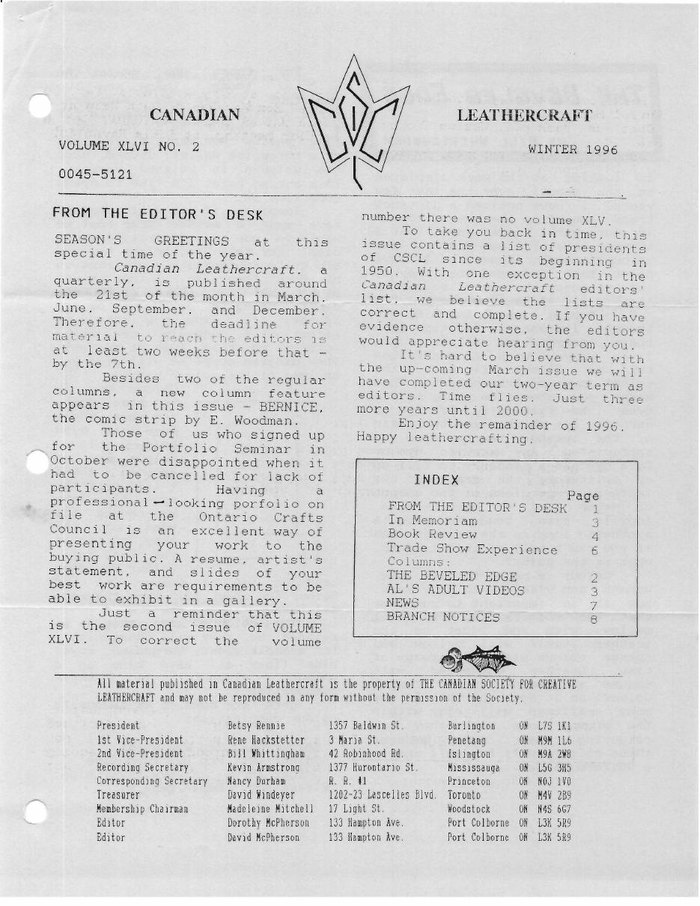
(8 pages, 17202 KB)
Page 1
[Transcribed from the original 8-page issue. Paragraphs are reflowed from the original setting; spelling, punctuation and wording follow the original, including its own inconsistencies. Editorial notes appear in [square brackets].]
CANADIAN LEATHERCRAFT
VOLUME XLVI NO. 2 — WINTER 1996 — 0045-5121
FROM THE EDITOR'S DESK
SEASON'S GREETINGS at this special time of the year.
Canadian Leathercraft. a quarterly, is published around the 21st of the month in March. June, September. and December. Therefore. the deadline for material to reach the editors is at least two weeks before that by the 7th.
Besides two of the regular columns, a new column feature appears in this issue BERNICE, the comic strip by E. Woodman.
Those of us who signed up for the Portfolio Seminar in October were disappointed when it had to be cancelled for lack of participants. Having a professional-looking porfelio on file at the Ontario Crafts Council is an excellent way of presenting your work to the buying public. A resume, artist's statement, and slides of your best work are requirements to be able to exhibit in a gallery.
Just a reminder that this is the second issue of VOLUME XLVI. To correct the volume number there was no volume XLV.
To take you back in time. this issue contains a list of presidents of CSCL since its beginning in 1950. With one exception in the Canadian Leathercraft editors' list, we believe the lists are correct and complete. If you have evidence otherwise. the editors would appreciate hearing from you.
It's hard to believe that with the up-coming March issue we will have completed our two-year term as editors. Time flies. Just three more years until 2000.
Enjoy the remainder of 1996. Happy leathercrafting.
INDEX
                                          Page
FROM THE EDITOR'S DESK                      1
In Memoriam                                 3
Book Review                                 4
Trade Show Experience                       6
Columns:
THE BEVELED EDGE                         2
AL'S ADULT VIDEOS                        3
NEWS                                     7
BRANCH NOTICES                           8
All material published in Canadian Leathercraft is the property of THE CANADIAN SOCIETY FOR CREATIVE LEATHERCRAFT and may not be reproduced in any form without the permission of the Society.
President               Betsy Rennie         4357 Baldwin St.          Burlington     ON  L7S 1K1
1st Vice-President      Rene Hackstetter     3 Maria St.               Penetang       ON  L9M 1L6
2nd Vice-President      Bill Whittingham     42 Robinhood Rd.          Islington      ON  M9A 2W8
Recording Secretary     Kevin Armstrong      1377 Hurontario St.       Mississauga    ON  L5G 3H5
Corresponding Secretary Nancy Durham         R. R. #4                  Princeton      ON  N0J 1V0
Treasurer               David Windeyer       1202-23 Lascelles Blvd.   Toronto        ON  M4V 2B9
Membership Chairman     Madeleine Mitchell   17 Light St.              Woodstock      ON  N4S 6G7
Editor                  Dorothy McPherson    133 Hampton Ave.          Port Colborne  ON  L3K 5R9
Editor                  David McPherson      133 Hampton Ave.          Port Colborne  ON  L3K 5R9
[The masthead officer block still lists Rene Hackstetter as 1st Vice-President and Bill Whittingham as 2nd. The executive minutes on page 7 of this same issue record that these offices changed effective immediately.]
Page 2
THE BEVELED EDGE
In looking at the annual over the last few years, I have noticed a distinct trend away from the use of colour in our work. I must admit that I thought the Fellows did not like coloured work. However, I have since been informed that they do indeed enjoy the use of colour in leather "if it is done properly".
Keeping this in mind, I thought I'd share a few tips from their perspective to help you liven up your work. As one Fellow told me: "Above all else, the colour must be transparent. This means you should be using spirit dyes like Fiebing's, Pro Dye or Garnett Dye which allow the grain of the leather to be seen and appreciated. Any acrylic dye or Cova dye has a tendency to fill up or obliterate the grain of the leather, regardless of the amount of water used to thin it down. Acrylic dyes tend to give a synthetic look to the leather, and if you can't tell if it's leather. what is the point?
Colour is meant to give life. warmth and vitality to your work, but it is important to remember that the colours you use will mellow with age, just as the leather itself will mellow and change colour with the passage of time. Leather. untreated. will assume a golden tan or russet colour as it ages and this is why many craftsmen will stay within the brown tones when they are colouring their work, because these colours will age well and in a uniform manner.
For those who prefer the brighter tones, there are two important things to consider. First. is the piece appropriate for a bright colour? ie.do you want a fire engine red mantelpiece clock or a turquoise wallet? Second, keep the colours in related harmony. This second point I'd like to spend some time on.
Imagine, if you will, that we have made a molded tray that we want to use as a decorative candy dish. For this use, bright colours are quite appropriate at least in my book they are. I use an air brush. but for those of you who don't. using a dry brush, or dry sponge, can give you the same effect. I usually use three colours on this type of project. The diagram supplied will give you an idea of the colour usage.
Colour One is the base coat, and the whole tray is dyed this colour. Colour Two is applied about 1 1/2" from the edge all the way around the edge of the tray, on top of the base coat. Colour Three is used on top of Colour One and Colour Two about 1/2" from the edge all the way around the tray.
The colours used should be related so they will "harmonize". for example:green, turquoise, royal blue (They all have blue as a common element - in their composition.)
Here are some of my favourite colour combinations:
Colour One:   Pro Dye green
Colour Two:   Pro Dye turquoise
Colour Three: Pro Dye royal blue
(Please see "Edge"/page 8)
Page 3
IN MEMORIAM
Viola Harris, honourary life Fellow and president of CSCL (1963-65), died on July 6, 1996 in Toronto at the age of 93. Viola was an OCC volunteer and accountant for the Canadian Guild of Crafts, the precursor to the Guild Shop. She began working at the Canadian Guild of Crafts shop, Bloor Street West, in 1965. The guild was merged with the Ontario Craft Foundation in 1976 to form the OCC. Verna Fogarty [or Fogerty; see note below], the shop's manager from 1964 to 1976, remembers her as "a very industrious person, gentle and loyal. She was quiet but had a nice sense of humour. and was very firm in her beliefs." After Viola retired in the late 70s, she continued her involvement with OCC, joining the Women's Committee and staffing the gallery on Dundas Street. She also became interested in helping customers and worked at North York General Hospital's craft shop until the age of 84, surprising many with her vigour. Her volunteer involvement wasn't curbed until she was 85, when deteriorating eyesight precluded driving. Nevertheless, she would often take the bus down to Dundas Street to help out at The Craft Gallery. "She was willing to do almost anything," recalls Fogarty. "She was a person that everyone liked." (partially exerpted from Ontario Craft, September/October 1996)
AL'S ADULT VIDEOS
by Allan Foss
Three new videos were added to our library in October: Dyeing and Finishing, How to Filigree, Making Exotic Inlay Belt Buckles.
The latter video on buckles covers the article on the same subject in the last issue of the Journal. Being an illiterate is now not an excuse for not being a leather craftsman, craftswoman, craftsperson whatever, Now since I said craftsman first, I am still probably in trouble with a capital "T" The capital "T" is also my middle initial. Sometimes you just can't win.
It is interesting that since our video library started in April 1993 there have been 84 borrowings. Many more than that have viewed them since they are normally in branch possesion for a month or two each time. and have been used for program material at some meetings.
Although they are continually in circulation, I have heard very little comment on their value to the club or individual members who have viewed them. Personally, I find some a little basic, some covering things a lot more ambitious than I am, but have completed every viewing with knowledge I did not have and ideas and worthwhile kinks to use in my own work. I have learned to skive through a video in a method that works well for me. What about you? Good or bad, what do you think about videos? Write a note to the editor today.
Page 4
BOOK REVIEW
Leathercraft by Hand by Jan Faulkner (1973, WALKER AND COMPANY NEW YORK)
The approach of winter weather is an incentive to borrow Faulkner's interesting book. In it she clearly illustrates how to hand-stitch leather garments, and finish them with leather buttons. Faulkner points out that leather is graded either 1,2,3,4, or A,B,C,D. Grades 1 and A are the best and most expensive. The grade refers to the usable portion, not to the quality of the tanning. A Grade 1 hide has a large surface area free from dye and knife marks as well as natural flaws. For a handbag, the lower grades will serve just as well as the upper grades. Sheepskin and cowhide are the most common garment leathers; and lamb and goat are the most common garment suedes. Since leather is sold by the square foot, on page 4, Faulkner shows how to convert the yardage requirements into square footage.
Lacing: Faulkner points out that lacing used for stitching can be cut from the scraps that are left after you cut your pattern. She says: "There is really no need to waste leather by cutting lacing strips the length of the hide."
To cut a piece of lacing, choose a scrap that is on the thin side with a generally uniform thickness. Trim the scrap into a rounded shape. Hold the leather in one hand, with your first and second fingers holding the leather, and begin cutting around and around, using your thumb and third finger to hold the lacing as you cut. Keep the lacing as thin as possible 1/8 inch is best. Also keep the edges free of jagged edges as these catch in the punched holes and make stitching difficult.
For lacing material, goat suede seems to be the best as it is very thin but very strong. Thick suedes are not manageable for lacing, and splits break.
She divides stitches into four categories: Edge stitches; Simple stitches; Cross stitches; and Decorative stitches. All her stitching is done through pre-punched holes with a revolving punch.
Besides garment-making the author also includes small projects such as boot-top fringe pg 181, ties for closing pg 165. leather concho pg 113, unisex cabby hats pg 157, feather concho pg 105, tassel pg 105, rolled leather button pg 91. and patchwork pot pg 211. She also deals with smocking leather pg 109, and lining a leather garment pg 85.
Conchos can be used for bookcover decoration as well as hat, vest or boot-top decoration, and as earrings or brooch.
[Three small line diagrams accompany the review, captioned: Feather concho; Approx. 1 1/2" diameter; Disk, star, etc.]
Page 5
[The page carries the tail of the book review, a diagram captioned Tassel, and the first instalment of the BERNICE comic strip.]
Learning how to make conchos can be a challenging winter project — that might produce a spring profit. Great book.
Reviewed by Dorothy McPherson
BERNICE
[A hand-lettered comic strip by E. Woodman, introduced in this issue. The lettering is drawn rather than typed and does not resolve reliably at 300 dpi; the recoverable fragments of the speech balloons read "There's no question — this ..." and "I think this oven just re-incarnated a long-lost relative ...". The strip is not transcribed further here.]
Page 6
WHOLESALING: MY TRADE SHOW EXPERIENCE
Part 1 of a 2-part series by David McPherson ACSCL
Most crafters are familiar with retail craft shows. However, in September 1996, I had the opportunity to participate in a wholesale trade show. The objective was to set up an appealing display of my work to attract, and then convince, buyers from retail stores and galleries to order my products for later delivery. I highly recommend wholesaling to anyone who makes a quality product and knows it is accepted by the public.
But let me start at the beginning. In the summer of 1995 I learned (probably from a mailing by the Ontario Crafts Council) that a part of the semi-annual Toronto Gift Show was being set aside for first-time home-based gift producers. I wondered if I should make the jump from craft shows to wholesale. One of my former high school students - a stained glass worker - did participate in that first show in September, 1995. She was pleased with the orders she received. She encouraged me to participate in the February 1996 show. I still dragged my feet. I did, however, go to the show as her guest to get a feel for the show surroundings. I had my name put on the mailing list for an application for Uniquely Ontario, the Third Ontario Creative Arts Show.
The application form arrived early in 1996.
In May. I assembled three pieces representative of my best work. a cheque for the $35.00 jurying fee, product description of all products I hoped to sell at the show, and a resume detailing experience, awards received, list of current buyers. etc. Off to Toronto went my parcel to be juried by Impact Communications Ltd., the company responsible for choosing about 125 crafters for that September show.
Jurying criteria: Design - originality/creativity. use of color and suitability of materials to design. Workmanship - technical capabilities, attention given to details such as glueing. stitching, painting, glazing. staining. etc. Saleability - consumer/mass appeal, marketability, labelling, packaging, business cards/letterhead and pricing. Include wholesale and retail pricing structure.
Off to Cape Breton we went on our holidays.
Following our arrival home near the end of July, a parcel awaited me. I had been accepted. My pieces were enclosed. The jurors considered my products "outstanding". My shortcoming in the jurying process was in the third part as my marketing information was not yet ready. Actually the deadline for confirmation that I would attend was a few days past, but with my frantic call to British Columbia (Impact Communications Ltd.) I was informed that I still had a space. I mailed them a cheque for $150 ($200 for producers residing within 100 kms of Metro Toronto) for show space — a booth 5' wide and 6' deep. They then sent to me a three-ring binder loaded with information and suggestions on how to design my display space, prepare materials such as stationery, price list, order form, business card, and product/care card. Off I went to the local copy
Page 7
shop (Davies Stationery that photocopies, punches, and staples Canadian Leathercraft) with my ideas for a logo and all. These cost me about $140 but were worth it because it helped me present a professional image.
A couple of calls to BC again for assistance in booth designing. Even though the booth was already draped. we were advised to cover them with our own background. I needed a backdrop 8' high for the 5-foot width so off I went to KMart for a dark green double sheet and to Canadian Tire for a can of fireproofing spray. The test for being fireproof is to hold a flame (lighted match) to a piece of the product for 12 seconds and then remove it. Any flame on the product must go out within two seconds. Although my idea for a set of shelves came from an Ikea catalogue I built my own (my father was a carpenter) with pine lumber, screws (for assembling and disassembling), a lot of sanding, and two coats of varnish. Then back to the lumber yard for several pieces and different sizes of sono tubing - a heavy cardboard for round concrete forms. I cut heights of 36", 42", and 48" from diameters of 6", 8", 10", 12". Actually it is smart to buy sets like 7 5/8" and 8" to slip inside each other for storage. From my pine lumber I cut square lids for the tubes. I painted the tubes green — the same colour as the sheet. A large piece of leather and two posters made from enlarged photocopies of photographs of two of my boxes completed my display.
For Uniquely Ontario contact:
Impact Communications Ltd.
2949 Ash Street
Abbotsford. B.C.  V2S 4G5
Tel: 1-800-672-0103
Fax: (604) 854-3087
NEWS NEWS NEWS
Hamilton Branch held a successful Saturday workshop on Mask Making with Madeleine Mitchell. Nine attended including two members from the Toronto Branch, a new member from Hamilton Branch, and Irva Ford's daughter, Susan Ricketts. The oven produced some very scary-looking leather faces.
Toronto Branch had a visit from a very talented Japanese leather crafter.
FROM THE EXECUTIVE MEETING MINUTES
The 1997 Annual Meeting of CSCL will take place at the Beacon Inn in Jordan Station April 18, 19 & 20. Registration cost remains at $20. Rooms will be $55 per night, and banquet will cost $30 per person.
A motion was made and passed that Bill Whittingham be asked to assume the office of First Vice-president to replace Rene Hackstetter, effective immediately, and that Nancy Durham be asked to assume the office of Second Vice-president.
A budget has been prepared by the treasurer for the balance of the fiscal year.
GOOD NEWS: no change in CSCL membership fee. It remains at $20 per year.
TIP
A large elastic band stretched over the lid of bottles that tend to stick closed, like glue bottles, makes it easier to open them.
Page 8
Edge (Continued from page 2)
Colour One:   Pro Dye red
Two:   Fiebing's oxblood
Three: Fiebing's cordovan
Colour One:   Pro Dye turquoise
Two:   Pro Dye royal blue
Three: Fiebing's purple
Colour One:   Fiebing's British tan
Two:   Fiebing's medium brown
Three: Fiebing's cordovan
Colour One:   Fiebing's purple (Cut 1 part dye to 10 parts methyl hydrate)
Two:   Pro Dye royal blue
Three: Fiebing's purple (full strength)
Experiment, have a little fun, and create your own favourites, but keep in mind that your colour combinations should have a common colour that binds them together. and this is what gives your work that special glow.
One final tip. For those who want to dye the backrounded areas of carved work, dependable inlay dyes are hard to find. I have the most success by pouring a small amount (about 1/2 an ounce) of Fiebing's cordovan dye into a small plastic cup, and allow the alcohol to evaporate for about an hour before I use it. The dye is much easier to control and bleeding is a minimal risk.
Happy crafting.
CSCL PRESIDENTS
Deanne Russell, Ottawa            1950-54
Ralph Larmour, Toronto              54-56
Jean Newton, Toronto                56-57
Fred Brown, Toronto                 57-61
Harold Wilson, Hamilton             61-63
Viola Harris, Toronto               63-65
Dorothy Muma, Toronto               65-69
Irva Ford, Hamilton                 69-72
Helen Wheaton, London               72-75
Mae Corbett, Barrie                 75-78
Beula Reynolds, Woodstock           78-80
Hope Drysdale, Hamilton             80-82
Jack Meharg, Toronto                82-85
Madeleine Mitchell, Woodstock       85-87
Ruth Haig, Hamilton                 87-90
Don MacLeod, Mississauga            90-95
Betsy Rennie, Burlington            95-
CANADIAN LEATHERCRAFT EDITORS
Deanne Russell, Ottawa            1951-54
Dorothy Muma, Toronto               54-60
Margaret McFarlane, Toronto         60-65
Gerry Mills, Weston                 65-69
69-74
Joy Hutcheson, Beachville           [74-75]
Margaret Monteith, Lambeth          75-80
Mary Patterson, Toronto             80-86
Audrey Gorton, Hamilton             86-90
Lois MacPherson, Oakville
Betsy Rennie, Burlington         90-95
Dorothy McPherson, Port Colborne
David McPherson, Port Colborne   95-
[The line for 1969-74 carries a date range in the date column with no name beside it. This is the "one exception" the editors refer to on page 1 — the name for that term was not known to them. Joy Hutcheson's own term does not resolve at any magnification; 74-75 is inferred from the surrounding sequence and is bracketed accordingly. The final two pairs share a single date range, the second name of each pair being indented under the first, indicating joint editorship.]
researched September 1996 by David McPherson
[Cross-checks against the existing archive. Three points where these lists bear on records already held:
1. Both lists print the forename Deanne Russell. The archive holds Deane H. Russell as first President (1950) and first Editor (1951). Confirmed at 10x with dictionaries both on and off — the page really does read Deanne, so this is a genuine variant, not dictionary bias, and the two records should be merged rather than one silently overwriting the other.
2. Helen Wheaton is given 72-75 here, but the 1994-96 batch recorded a Wheaton presidency in 1978. On this list 1978 falls inside Mae Corbett's term (75-78, confirmed) and at the start of Beula Reynolds' (78-80, confirmed). Wheaton's own date cell does not resolve at 14x; 72-75 is fixed by the two confirmed terms on either side of it. The 1978 attribution needs re-checking against its source.
3. Ruth Haig 87-90, immediately before Don MacLeod 90-95. This confirms the open handoff item that Haig held the presidency before MacLeod, and dates it.]
BRANCH NOTICES
HAMILTON — St. Margaret's Anglican Church, 138 Emerson St., 7 p.m.
* Desk pad making by Ruth Haig and Muriel McKnight, Jan. 11 * Continue Desk pad, Weston Trophy, Feb. 14 * Annual Meeting, reports, Buttons by Betsy Rennie. Mar. 14
WOODSTOCK
* Folding Picture Frames at Madeleine Mitchell's, Jan. 15 * Morocco Standing Picture Frames, elections, at Mary Reading's, Feb. 20 * Hinged Box Worshop by Ruth Haig at Etonia [?] United Church, SATURDAY Mar. 8 * Regular meeting, at Buela Reynolds' Mar. 20
[The church's place-name does not resolve. The page passes read Ftonia; isolated re-OCR with dictionaries disabled reads Etonia. Neither is a locality I can match near Woodstock, so it is marked [?].]
[Note on Fogarty. The In Memoriam on page 3 names the Guild Shop's manager twice. Both page-level passes read Fogarty; isolated re-OCR at 12x reads Fogerty at the first occurrence and Fogarty at the second. Fogarty is carried on the majority, but the name is not settled.]
[Note on Reynolds. This page prints the surname's forename both ways: Beula Reynolds in the CSCL Presidents list and Buela Reynolds' in the Woodstock branch notice, on the same page of the same issue. Both readings confirmed at 8× magnification. This bears directly on the open question carried from the 1991–93 batch.]