
An issue of the Society’s newsletter, transcribed from the original. Download as PDF.
(8 pages, 22904 KB)
Page 1
[Transcribed from the original eight-page issue. Paragraphs are reflowed from the original two-column setting; spelling, punctuation and wording follow the original, including its own inconsistencies. Editorial notes appear in [square brackets].]
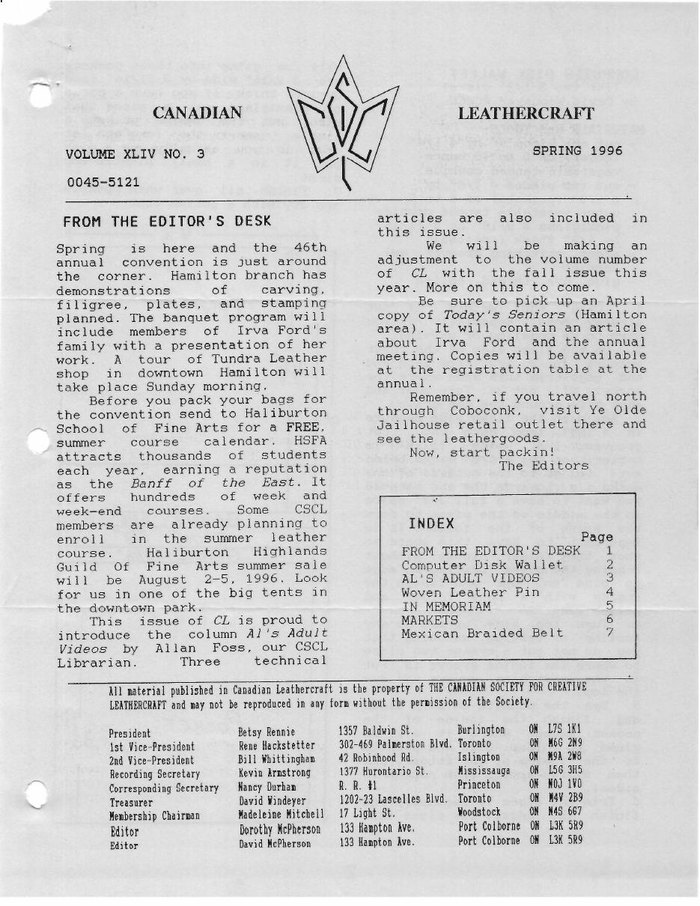
CANADIAN LEATHERCRAFT
VOLUME XLIV NO. 3                 SPRING 1996                       0045-5121
FROM THE EDITOR'S DESK
Spring is here and the 46th annual convention is just around the corner. Hamilton branch has demonstrations of carving, filigree, plates, and stamping planned. The banquet program will include members of Irva Ford's family with a presentation of her work. A tour of Tundra Leather shop in downtown Hamilton will take place Sunday morning.
Before you pack your bags for the convention send to Haliburton School of Fine Arts for a FREE summer course calendar. HSFA attracts thousands of students each year, earning a reputation as the Banff of the East. It offers hundreds of week and week-end courses. Some CSCL members are already planning to enroll in the summer leather course. Haliburton Highlands Guild Of Fine Arts summer sale will be August 2-5, 1996. Look for us in one of the big tents in the downtown park.
This issue of CL is proud to introduce the column Al's Adult Videos by Allan Foss, our CSCL Librarian. Three technical articles are also included in this issue.
We will be making an adjustment to the volume number of CL with the fall issue this year. More on this to come.
Be sure to pick up an April copy of Today's Seniors (Hamilton area). It will contain an article about Irva Ford and the annual meeting. Copies will be available at the registration table at the annual.
Remember, if you travel north through Coboconk, visit Ye Olde Jailhouse retail outlet there and see the leathergoods.
Now, start packin'! The Editors
INDEX
FROM THE EDITOR'S DESK · Computer Disk Wallet · AL'S ADULT VIDEOS · Woven Leather Pin · IN MEMORIAM · MARKETS · Mexican Braided Belt
All material published in Canadian Leathercraft is the property of THE CANADIAN SOCIETY FOR CREATIVE LEATHERCRAFT and may not be reproduced in any form without the permission of the Society.
OFFICERS
President                Betsy Rennie       1357 Baldwin St.        Burlington     ON  L7S 1K1
1st Vice-President       René Hackstetter   302-469 Palmerston Blvd. Toronto       ON  M6G 2N9
2nd Vice-President       Bill Whittingham   42 Robinhood Rd.        Islington      ON  M9A 2W8
Recording Secretary      Kevin Armstrong    1377 Hurontario St.     Mississauga    ON  L5G 3H5
Corresponding Secretary  Nancy Durham       R.R. 4                  Princeton      ON  N0J 1V0
Treasurer                David Windeyer     1202-23 Lascelles Blvd. Toronto        ON  M4V 2B9
Membership Chairman      Madeleine Mitchell 17 Light St.            Woodstock      ON  N4S 6E7
Editor                   Dorothy McPherson  133 Hampton Ave.        Port Colborne  ON  L3K 5R9
Editor                   David McPherson    133 Hampton Ave.        Port Colborne  ON  L3K 5R9
[David Windeyer's address changes to Toronto this issue.]
Page 2
COMPUTER DISK WALLET (for two 3 1/2" disks) by David Windeyer, A.C.S.C.L
MATERIALS and TOOLS: · cut one piece 9" by 4 1/4" (cover) of 8 to 10 ounce vegetable tanned cowhide · cut two pieces 4 1/4" by 3 1/2" (pockets) of 1 to 2 ounce vegetable tanned cowhide · plexiglass 3 9/16" by 3 11/16" by 1/8" thick (optional) · edger, stitching groover, awl, needles · glue, dye, thread, polish
1. Case the leather, if not already done, especially if you wish to do modeling or carving.
2. On the flesh side of the cover measure in 3 1/2" from each end and edge trim this side where the pockets will not be. Turn over and edge trim around the top grain.
3. Again on the flesh side measure in 4 1/8" from each end. Cut grooves 1/8" wide (3/16" is better) at the 4 1/8" marks being sure to go to the outside of the marks i.e. towards the end because you want to have a full 3/8" space in the middle of the piece to form the spine of the folder. It is important to have this space so that the folder closes without bending the disks. Leaving an edge to glue on, dye and finish the inside with a bone folder and polish coat.
4. Turn top side up and do any tooling or carving, watching that you do not put a crease too close to where the inside groove is. Put in the stitching groove and dye the top.
5. Dye the pockets on both sides and finish the inside of the pocket except where it will be glued to folder. Glue the pockets to the inside of the folder, and then stitch around each pocket (3 sides).
6. Trim the edges if necessary and finish the edges. The disks that will be going into these pockets are 3 9/16" wide by 3 11/16" long by 1/8" thick. If you have a piece of plexiglass cut a piece that size, wet the inside pockets a little, insert the form and let dry. If you actually use a disk put it in a small plastic bag first.
7. Finish all over when pockets are dry with a polish coat.
[A diagram labels the SPINE and the 3/8" groove.]
Page 3
AL'S ADULT VIDEOS
by Allan Foss, C.S.C.L. Librarian
Our CSCL library videos on working with animal skin, rawhide and other types of leather have been well received since our collection began. Some of our branches have used them for program material for meetings with good reports. They are available, at no cost, to branch representatives at each executive meeting, workshops and at the annual meeting. The content of three of the videos may whet your appetite.
ROLLED EDGES
This is a special technique used by bookbinders and makers of fine leathergoods to create professional rolled edges. Secrets of skiving with the French Knife are revealed. Use and care of tools is a bonus. Includes patterns for a credit card case and billfold interior. (61 min.)
FUN WITH FLOWERS
Features special Figure Carving of Flowers technique developed by Shirley over many years of practice and improvement. Also includes special acrylic dyeing techniques on leaves and flowers. First in a series, this program includes the pansy, fall maple leaves and the daisy. Patterns are included. (52 min.)
FUN WITH FLOWERS II
This is a continuation of the first outstanding Fun With Flowers by this accomplished artist. Enjoy her award-winning techniques for creating a butterfly, an oak leaf in a snow setting and other foliage. Patterns included. (47 min.)
LEATHERCRAFTING WINS WIFE'S APPROVAL
Once in a while we have a piece of good news to report about one of our members, and this is one of those times.
Will Tanahide, our oldest living charter member (43 years) has told this reporter that his wife has finally approved of his leathercrafting after all these years of constantly complaining and naggin about how he was wasting his time doing all that summer camp and boy scout stuff.
He says he recently received her positive approval when she presented him with a new piece of marble for him to use in his little shop.
His birthday is coming up in 2 weeks or so and last Thursday his wife gave him his birthday present. It was a beautiful piece of marble about 2 feet wide, 4 feet long, and about 6 inches thick, and it was polished on both sides to where a fly would break a leg just trying to stand on it. He says she even had it personalized for him. On one side is his name, the date he was born, and the date of his coming birthday. He figures the man that made it must be awful proud of his work because he put his initials (R.I.P.) right down there below the dates.
If some of you leathercrafters whose wives or husbands don't like your doing it would just let them read this, it might just help some in gettin their approval of what you are adoin.
[Don MacLeod passed on this little bit of humour from Volume 1/16 Issue 1/8 of The Little Bitty Teeny Weeny Yellow Polka Dotted Rose of Texas Leather Guild Newsletter.]
Page 4
WOVEN LEATHER PIN
by Margaret Montieth
This project will help to use your smaller leather pieces that can be cut into narrow strips.
MATERIALS: · assortment of finished leather pieces or carving pieces · resin or clear drying glue · sharp knife · 1/8" grid ruler is a great help when cutting narrow strips (found with quilting supplies) · graph paper to work on for glueing, to keep pieces straight · your favourite polish or finish coat (depending on type of leather used)
Cut 8 strips 1/4" wide by about 2" long. I used carving leather dyed four colours.
ASSEMBLY: (see numbered diagrams)
1. Glue two pieces as shown with vertical piece over horizontal — keeping pieces straight — both the same colour. Let dry a few minutes. 2. Glue two more pieces as above, of another colour. Let dry a few minutes. 3. Glue these pairs together as follows. Try to keep the centre squarish with room for two more pieces to be woven in each way. 4. Glue two more pieces the same colour as follows keeping the overlap area up further on the piece. Note: this spacing is important for the next step. Let dry a few minutes. 5. Pick up above piece and slide vertical piece under bottom cross piece and horizontal piece under vertical piece at right side. This makes bottom left corner pieces under, over, under as weaving. 6. Weave the last two pieces in each way, remember weaving over, under, over, under. It may help if leather is lightly dampened if working with carving weight. Glue ends together. 7. Outer edges can now be evened off or trimmed as you wish.
FINISHING: If your weaving needs to be a little firmed glue a narrow strip on back edges, on all four sides. Or a piece of leather can be glued on back, but it loses the openness. Glue pin back along a strip on the back. Polish coat.
Experiment. Have fun. (Please see "Pin"/page 8)
Page 5
IN MEMORIAM
Frederick Williams Brown (1912-95)
With the passing of Fred Brown we all lost a friend. Fred worked hard to maintain standards outlined by early CSCL workers he knew and admired: Dr. Ralph Larmour, Deane Russell, Robert Muma, Don MacKinnon, Edith Roscoe, Rita Larmour, Sadie Roebuck, Gladys Riddell, and many others.
Born in Toronto, Fred met his wife Phyllis at Bloor Collegiate. Avid horticulturists, they became interested in leathercrafting through his sister, a craft instructor with the Canadian Women's Army Corps.
In 1951, the then Toronto Art Gallery was encouraging the formation of local groups in the Toronto area. A handful of Etobians gathered at Browns' home to discuss the organization of a group that had a common interest in the arts. Thus The Etobicoke Art Group was born.
Fred taught leathercrafting with North York Parks and Recreation, as well as Central Technical School, senior citizens' classes and others. He also did volunteer work at Cummer House. In 1965 he accepted a position with the CNE as manager of the Arts, Crafts and Hobbies Building. In January 1976, on the occasion of TEAG's 25th anniversary, Fred (a life member) was named Etobian of the Week.
Fred's dedication was demonstrated by his service to CSCL having been president from 1957 to 1961. He also promoted leathercrafting through his position with the C.N.E. His position with the Etobicoke Arts Committee accorded CSCL an opportunity to display at City Hall with the most recent display being Leather '94. He was on hand then when The Fred Brown Award (for colour) was presented.
Fred, a sound draughtsman in his early years, was in recent years interested in line and mass. He did much to further the cause of leathercrafting in Ontario and will be missed. He leaves wife Phyllis, son Eric, grandchildren Greg, Scott, and Lisa.
(by Ray Potter and excerpts from CL v. XXIV No. 4)
George McPhail
We received notice recently that George, a longtime member of Toronto branch and Honourary Life member of CSCL, has passed away. George was a bookkeeper by occupation, assisted at many CSCL sales at the CNE, and was CSCL Treasurer 1986-91.
NOTICES
WOODSTOCK
· Demo of choice by Al Williams at Loreen Manuel's home, April 18 · Moulded masks at Madeleine Mitchell's home, May 16 · Potluck picnic, location TBA, June 7
NORLAND
· Belts at Hilda Chynoweth's home, April 15 · Conclusion/convention report at Della Howard's home, May 13 · Finale, year end party, June 21
MISSISSAUGA — Cooksville United Church · Moulded cases using a wooden form (part 2), Guild table items for annual clinic, April 14 · Surprise project Part 1, May 12 · Surprise project Part 2, June 9
HAMILTON — St. Margaret's Anglican Church, 138 Emerson St., 7 p.m. · Convention planning, April 12 · Left-over business, May 10
TIP
Use spring-coloured dyes.
Page 6
ANNUAL MEETING NOTICES
CSCL Annual Meeting May 3-5, 1996 at the Holiday Inn, Burlington. FREE REGISTRATION. Send in your registration early to be eligible to win a $20 registration refund. Forms were mailed separately.
A large HOSPITALITY ROOM will be available at the annual for those who need a place to rest and meet friends, especially those who are not taking a room at the hotel.
A special HERITAGE TABLE is planned for the annual meeting. Members of CSCL would like to see as many pieces as possible from the masters of the craft — those Fellows who are, or have been, jurors for Weston Trophy, Fellow and Associate entries, and other shows. Please bring pieces for this Heritage Table display.
WORKSHOP PARTICIPANTS: Be sure to bring your finished pieces for the WORKSHOPS display table for the workshop awards. Two $50 awards will be presented for the three workshops held since the last annual meeting — box, bottell, and wallet. These awards are for general members only. Don't miss out on this chance. Associates and Fellows are not included.
CONTRIBUTORS to Canadian Leathercraft for this issue and the previous three issues are eligible to win a $25 prize. Draw will take place at the Annual. If you have not made a contribution to Canadian Leathercraft in the past year try to prepare and send in an article for one of the upcoming issues to be eligible for next year's draw.
Branches should be planning their DISPLAYS for the Annual. Bring props, shelves, coverings, backgrounds, etc. to enhance and elevate parts of your display.
NEWS
Seven apprentices gathered in Cooksville on February 24th on a learning mission. Thanks to instructors, Betsy Rennie and Don MacLeod, it was a very good workshop session. So far it is a draw on which side learned the most. The fellowship within the group, as always, counted greatly towards the enjoyment of the occasion.
The problem this time was how to cut and fold a single piece of leather into a wallet — something like making a paper airplane — except that these ones really did fly.
Betsy's version, which raised some eyebrows, consisted of two pieces of leather plus a liner. It made a nice thin wallet for folding money and two compartments for cards. Tricky but satisfying.
Don's version came from lifting Cliff McTavish's wallet, emptying it first, and then carefully measuring all aspects in order to lift the design. He then changed everything a little, rounded out a few wrinkles, and ended up with a generic version one-piece wallet which works very nicely. Don also provided some refreshments.
Missed it? Plan now for the next one! You always take home some new knowledge that you did not bring with you to the workshop. (Report by Al Foss)
REMINDER!
Your CSCL annual fees are due April 1, 1996. It's still only $20.00 a year to be a CSCL member and receive Canadian Leathercraft quarterly. Send your cheque, payable to CSCL, to Madeleine Mitchell, Membership Chair 17 Light Street, Woodstock, ON N4S 6E7 or to your CSCL branch treasurer.
Page 7
MEXICAN BRAIDED BELT
by Nancy Durham, A.C.S.C.L
NOTE: Cut belt length 1/2" longer than you normally would.
MATERIALS and TOOLS:
· belt length of leather
· #6 spacing wheel, or #5
· gouge
· round or rectangular punch
· 7 lacing needles
· dividers
· 3/32" lacing
METHOD: Finish the edges and ends of belt, stamp if desired, and dye before marking or punching. Using dividers, start approximately 8" from billet end of belt to draw your guide lines, and stop approximately 7" from the buckle end. Do not draw dividers full length of the belt.
On a 1" belt, lines would be drawn 1/4" from each edge. On a 1 1/4" belt, lines would be drawn 3/8" from each edge.
These lines will not show later when the belt is braided, so should be made deep enough that you will not lose your guide lines when punching. Punch between guide lines and edge of belt.
Using a round punch, space holes 5 or 6 per inch. Using a rectangular punch, space holes 6 or 7 per inch.
With a spacing wheel, follow this line very carefully, being sure the starting holes on both edges are DIRECTLY OPPOSITE EACH OTHER.
With a rectangular nib punch placed crosswise in convert handle, punch crosswise of the belt, and using the line as the inside guide, punch to the outside of the lines, being careful to keep the holes equally spaced (see illustration).
Gouge along underside of belt on holes so lacing will lie in the groove later. Measure 7 pieces of lacing at least 2 1/2 to 3 times the length of the space to be laced (depends on the depth of lacing). Glue together.
PROCEED AS FOLLOWS: Skive 3/4" of each piece of lacing. Glue together 4 thongs and place 4 in the top hole, and 3 into the opposite top hole. The 4 thongs are then entered into the holes on the opposite side of the belt. The bottom, or thong next to the leather, goes into the 5th empty hole. Continue putting the next to the bottom thong into the 4th hole and the next into the 3rd, and the top into the 2nd empty hole, in this order.
The 3 thongs on the opposite side are braided by carrying the bottom thong under the first 3 thongs, and over the 4th and into the 4th opening on the opposite side. The next to bottom thong is carried under the first 2 thongs, and over the 3rd and 4th, and into the 3rd opening. Carry the top thong under the 1st thong and over the top 3 and into the 2nd open hole.
You will now have all thongs on the flesh side of the belt. Starting with the thong in the 3rd hole from the top, carry it through the empty hole above (number 2 hole), over itself, and under the remaining 3 thongs, incline it down and into the opposite bottom hole. Repeat this pattern braiding to the 2nd to the last hole. Always work from the side with 4 thongs.
Finish as started, with 3 strands in one hole and 4 in the other, skiving and tucking into the remaining hole and glueing well into the groove.
[Diagrams show rectangular and round holes, the guide lines and marking dots, and a 1" end.]
Page 8
Pin (Continued from page 4)
[The page carries the numbered assembly diagrams for the Woven Leather Pin.]
SUMMER LEATHER COURSE
LEATHER - HEAT ASSISTED FORMING (CUIR BOUILLI)
(Pending Approval)
INSTRUCTOR: Rex Lingwood
DATES: August 5 - 9
FEE: $140.13
This course will investigate the use of heat as a means of transforming leather to make hardened three dimensional forms. Using vessel forms as a point of departure and the propane torch and boiling water as the means, participants will examine a number of strategies for developing work. To begin with, the course will be quite structured to provide participants with an understanding of the effects of heat on leather as well as some ability to manipulate the various processes. Participants will then be encouraged to develop their own forms and approaches. The projects will be supplemented by demonstrations, readings and slide lectures. A materials fee of $60.00 will be payable to the instructor on the first day of the course.
REX LINGWOOD is an internationally recognized leatherworker, teacher and author. He has taught and exhibited throughout Canada, USA, Australia, New Zealand, England and Germany. In October of 1995 the German Leather Museum (the major institution in the field) opened "Rex Lingwood: Boxes & Bowls, Experiments With Functional Subjects", a major exhibition of his work. The exhibition will tour Europe until 1997 and then return to Canada. His work is in both public and private collections in all the countries mentioned. He is also the author of Leather in Three Dimensions, as well as numerous articles.
Calendars and more information are available by contacting: Haliburton School of Fine Arts PO Box 839, Haliburton, ON K0M 1S0 (705) 457-1680
MARKETS
Reed Wolfe and Judy Barnes of Prime Ostrich Products of Canada, Winnipeg would like to hear from crafters who are interested in developing a top line of products from ostrich leather. Contact Nancy Durham for further information at (519) 458-4533 or call Prime Ostrich Products of Canada direct at 1-800-340-2311.
[Printed here as Deane Russell. Both the CSCL Presidents list and the Canadian Leathercraft Editors list printed in Winter 1996 give Deanne Russell; that reading was confirmed at 10x with tesseract's dictionaries both enabled and disabled, so the two forms are a genuine variant rather than a scanning error.]