
An issue of the Society’s newsletter, transcribed from the original. Download as PDF.
(8 pages, 22348 KB)
Page 1
[Transcribed from the original eight-page issue. Paragraphs are reflowed from the original two-column setting; spelling, punctuation and wording follow the original, including its own inconsistencies. Editorial notes appear in [square brackets].]
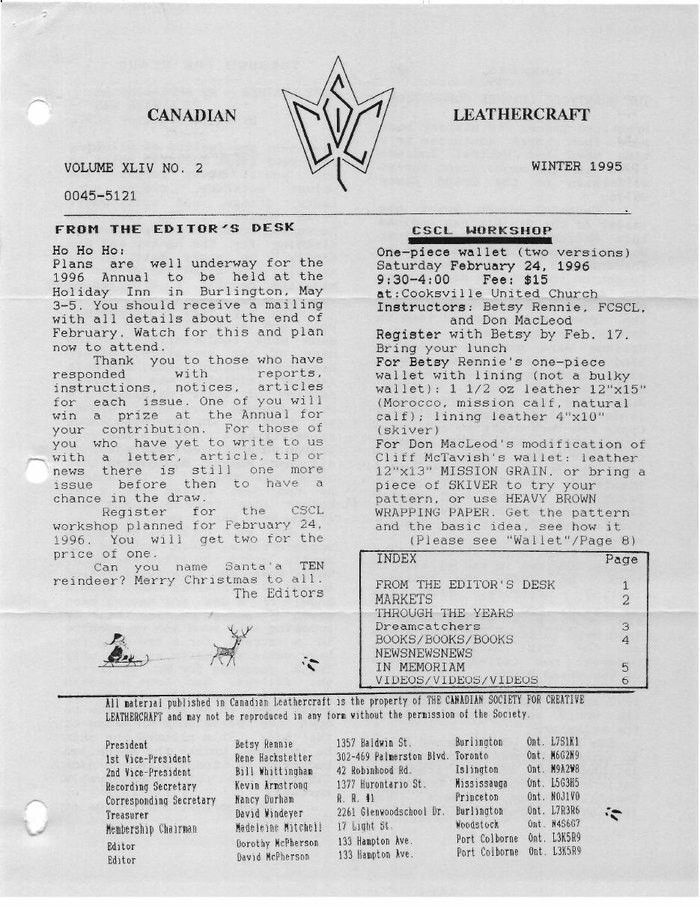
CANADIAN LEATHERCRAFT
VOLUME XLIV NO. 2                 WINTER 1995                       0045-5121
FROM THE EDITOR'S DESK
Ho Ho Ho!
Plans are well underway for the 1996 Annual to be held at the Holiday Inn in Burlington, May 3-5. You should receive a mailing with all details about the end of February. Watch for this and plan now to attend.
Thank you to those who have responded with reports, instructions, notices, articles for each issue. One of you will win a prize at the Annual for your contribution. For those of you who have yet to write to us with a letter, article, tip or news there is still one more issue before then to have a chance in the draw.
Register for the CSCL workshop planned for February 24, 1996. You will get two for the price of one.
Can you name Santa's TEN reindeer? Merry Christmas to all.
The Editors
CSCL WORKSHOP
One-piece wallet (two versions)
Saturday February 24, 1996, 9:30-4:00. Fee: $15
at: Cooksville United Church
Instructors: Betsy Rennie, FCSCL, and Don MacLeod
Register with Betsy by Feb. 17. Bring your lunch.
For Betsy Rennie's one-piece wallet with lining (not a bulky wallet): 1-1/2 oz leather 12x15" (Morocco, mission calf, natural calf); lining leather 4" x 10" (skiver).
For Don MacLeod's modification of Cliff McTavish's wallet: leather 12" x 13" MISSION GRAIN, or bring a piece of SKIVER to try your pattern, or use HEAVY BROWN WRAPPING PAPER. Get the pattern and the basic idea, see how it (Please see "Wallet"/Page 8)
INDEX
FROM THE EDITOR'S DESK · MARKETS · THROUGH THE YEARS · Dreamcatchers · BOOKS/BOOKS/BOOKS · NEWSNEWSNEWS · IN MEMORIAM · VIDEOS/VIDEOS/VIDEOS
All material published in Canadian Leathercraft is the property of THE CANADIAN SOCIETY FOR CREATIVE LEATHERCRAFT and may not be reproduced in any form without the permission of the Society.
OFFICERS
President                Betsy Rennie       1357 Baldwin St.        Burlington     Ont.  L7S 1K1
1st Vice-President       René Hackstetter   302-469 Palmerston Blvd. Toronto       Ont.  M6G 2N9
2nd Vice-President       Bill Whittingham   42 Robinhood Rd.        Islington      Ont.  M9A 2W8
Recording Secretary      Kevin Armstrong    1377 Hurontario St.     Mississauga    Ont.  L5G 3H5
Corresponding Secretary  Nancy Durham       R.R. 4                  Princeton      Ont.  N0J 1V0
Treasurer                David Windeyer     2261 Glenwoodschool Dr. Burlington     Ont.  L7R 3R6
Membership Chairman      Madeleine Mitchell 17 Light St.            Woodstock      Ont.  N4S 6G7
Editor                   Dorothy McPherson  133 Hampton Ave.        Port Colborne  Ont.  L3K 5R9
Editor                   David McPherson    133 Hampton Ave.        Port Colborne  Ont.  L3K 5R9
Page 2
MARKETS
THE BRANTFORD LEATHER CONNECTION
Brantford traces its history back more than three centuries to a time when the Neutral Indians lived in the magnificent forest wilderness of the Grand River Valley.
Captain Joseph Brant was leader of the Six Nations Indians (Six Nations of the Grand River Native Peoples) and was known as Thayendanegea to his people. He fought on the English side during the American Revolution and at war's end, chose to remain under the Crown and requested land in Canada for his people. The Six Nations were granted a tract of land six miles in depth on each side of the Grand River from its mouth to its source. In 1784, Brant led his tribes from their lands in the Mohawk valley of Upper New York State to the Grand River Basin. Where they crossed the river became known as Brant's ford which, in 1826 was named Brantford in honour of Captain Brant. Much of the land granted the Indians was never settled by the Iroquois because they did not know it was there.
The first white settler, John Stalts, arrived in the village in 1805. By 1847 the Indians, feeling pressure from the Europeans, had slowly moved to the south side of the river to land held in trust for them known as the Six Nations Indian Reserve, now called Six Nations of the Grand River.
Brantford became a city in 1877 and is recognized throughout the world as the birthplace of the telephone.
Six Nations of the Grand River is situated near Brantford, and is the home of six Iroquoian Nations: Mohawk, Onondaga, Oneida, Cayuga, Seneca, and (Please see "Brantford"/Page 7)
THROUGH THE YEARS
SOFT LEATHER - AS APPEALING AS IT ALWAYS WAS
by David Windeyer, A.C.S.C.L
"A-h-h-h! the feeling of slipping into your first buckskin shirt is one you'll never forget. The velvet softness, rugged good looks, fringe, and smoky smell evoke images of the days when harvested game provided durable clothing for the hunter and his family," so spoke Matt in an article from Primitive Archer, a magazine devoted to articles on the "good ol' days".
You may feel that cotton, wool and even polyester sound much more comfortable, but for many of our ancestors, either here or in other lands, the soft leather clothing was a great portion of their wardrobe. I'm sure someone once said, "Gronk, you have to do something about these rawhide clothes — put your brains into action"; and so Gronk did and he/she discovered that using the "brains" of the animal he had just killed was a far better idea than using his own. If you know what I mean.
And so, tired of stiff and uncomfortable hides covered in smelly stuff, buckskin was born. Well what is this stuff called buckskin? Certainly taken from a buck, or a doe, and having been given a shave of its hair by covering with wood ash or soaking in a stream for a few days the hair could be easily scraped off. Thank goodness for Mr. Gillette, eh, fellows? For true buckskin both the flesh side and the top grain had to be scraped away to open the pores on both sides of the hide. This allowed the skin to breathe unlike the so-called buckskin of today with one side finished to an impenetrable surface. (Please see "Soft"/Page 6)
Page 3
DREAMCATCHERS
by Nancy Durham, A.C.S.C.L
Materials brass ring, size of your choice artificial sinew assortment of beads or stones (pony beads or smaller) piece of deerskin feathers sharp scissors white glue (Weldbond)
Begin at a point on the ring opposite the weld on the ring by tieing a square knot, leaving a short end of sinew. Push the knot to the inside of the ring. Use your own judgment to determine the spacing you will need for the size ring you have chosen, and start looping the sinew using a half-hitch around the ring. Keep in mind, the closer the spacing, the more sinew needed and the more intricate the design. Continue on to the starting point and be sure to complete the last half-hitch to tie into the start knot.
Place the sinew to the back of the ring and start threading it through each loop. Do NOT do a half-hitch. You can start adding beads anytime now, but not too many. Your first round will bring you back to the start. Be careful that you don't miss any loops, especially near the start, as this will throw the design off. Continue in the same way around the ring. In some spots you may have to pull the sinew apart to find the proper loop to go through. You will find that the loops get smaller and tighter as you work to the centre. When you have completed as many rounds as you can, pull the sinew tight to straighten out the design. Tie a double knot in the centre. A few beads or a piece of bone pipe can be tied on to this piece of sinew and knotted to finish off.
Deerskin binding: cut a piece of deerhide, and round off any corners. Cut the lace you will need about 1/4" wide. To cover the ring, begin at the top NOT where you started. Glue start of lace and wrap around the hoop back to the starting point. Trim the lace end and secure with a spot of glue. The remaining lace is used to decorate with streamers. Cut one piece for hanging (about 10") and attach to the top of the ring using beads to decorate and tie a knot at the top. Cut three longer streamers (about 12-14") depending on the size of the ring. These will hang, one on each side and one at the bottom. Some beads are added here also and finished off with feathers.
It is believed that dreams have magical qualities. When hung over cradle boards or in lodges, the dream catcher captures the dreams as they float by: the good dreams, knowing the way, slip through the centre hole, drifting gently to the sleeper below. The evil spirits are caught and dissipate as they get lost wandering through the sinew, beads, and feathers. Any remaining bad dreams or evil spirits are burned off with the morning sun. (Dreamcatcher lore)
Page 4
BOOKS · BOOKS · BOOKS
BLACK JACKS AND LEATHER BOTTELLS by Oliver Baker (chapters 1 & 2) reviewed by David McPherson, A.C.S.C.L
Peculiar to England were strong and rigid bottles made of thick and rigid tanned ox-hide. European countries used soft leather bags which had to be frequently rubbed with grease on the outside to prevent their becoming dry and brittle.
A black jack was a jug, mug, pitcher or pot made from leather. The most common bottle shape resembled a small keg on its side with an extension at the top for the opening. Early in the 14th century each of the chief leather-working crafts had a guild of its own. One of these was the fraternity of bottle-makers. In 1373, the Court of Common Council in London decreed that each botillar (maker of bottles and pots) should affix his sign to his vessels to indicate their authenticity. Manufacturing of leather bottles declined in the 16th and 17th centuries and had nearly ceased by the end of the 18th century.
Leather containers were made in various shapes — keg, flask, horn, pistol, and some decorated in the shape of a face. Their praises were chanted in ballads. They held the red wine of kings, carried the curds and whey of the peasants, and went hunting with abbots and knights. The eventual fate of a worn bottle? A children's football.
BOTTELL WORKSHOP
Bill Whittingham conducted an excellent leather bottell workshop on Saturday, September 23, at Cooksville United Church. Beginning promptly at 10:00 am, Bill took crafters through the steps of making and cutting out a pattern for a bottell. Two pieces of 8-ounce leather (cut carefully side by side from the same piece of shoulder) were stitching-grooved and then stitched all around except the top while still flat. Only one of the nine participants got this far, but Bill demonstrated filling the bottell with sand, and provided instructions to bake and seal the container with the beeswax supplied. Bill mailed instructions to participants before the workshop and follow-up information afterward. Bill also passed on extra tips. Definitely a worthwhile workshop! Look for nine completed bottells at the Annual, all competing for the newly-announced CSCL Workshop Award. (Report by David McPherson)
INTERNATIONAL CENTRE HOBBY SHOW
Nov. 3-5, Report by Al Foss
Several good folk participated at the CSCL tables — Cal Lucas, Jim Edwards, Bruce White, Harry Wendland, David Windeyer, Al Foss, Roselle Wallace, Lillian Kay, and Betsy Rennie. Bill Whittingham packed his car to join us on Sunday. He got started Sunday morning but his car did not. Although we got along without him, his august leatherworker appearance would have given us a tremendous lift.
Sales were slow since most visitors were themselves crafters cruising for ideas. It was surprising how many former leathercrafters dropped by our tables. I believe that during our periods on the line we made progress towards new members for CSCL. Hope it works out since that was the main idea in our attending. (see "Hobby"/Page 7)
Page 5
IN MEMORIAM
Helen Wheaton, FCSCL, passed away August 28, 1995 in her 86th year. Helen, an enthusiastic and energetic worker, took over a man's job of driving a truck during the war. She was a swimming instructor at the Y for many years. Active in leathercraft since 1948, she studied under some of the leading leathercrafters of the time. She was a charter member of the London Leather Carvers Guild, a group that joined CSCL. Helen received associate standing in 1954 and fellow standing in 1965. She took a very active part in the executive of CSCL becoming president in 1978. [The CSCL Presidents list printed in Winter 1996, researched by David McPherson, gives Helen Wheaton 1972-75. On that list 1978 falls inside Mae Corbett's term (75-78) and at the start of Beula Reynolds' (78-80), both of which are legible at magnification while Wheaton's own date cell is not. The two sources disagree and this obituary's date is transcribed as printed.] Helen was an excellent teacher and very generous with her time and knowledge. She had a wonderful sense of humour and being with Helen was to enjoy the time — whether at workshop, executive meeting (even travelling to and from the meeting), a shopping expedition for leather, an annual picnic or Christmas dinner. Declining health the last few years made it impossible for her to take an active part in the craft, but she was always ready to help with advice on method or technique. Helen will be sorely missed by all who knew her. Our sincere sympathy goes out to her husband, Harold.
Submitted by Beula Reynolds, A.C.S.C.L
NOTICES
CSCL Executive motion: That the CSCL establish awards at the Annual Meeting for each CSCL workshop, open only to members who participated at that workshop, for the person who improved most as a result of that workshop. New Horizons has agreed to sponsor two awards of $50.00 each this year.
CSCL Executive motion: That the CSCL hold a draw at each Annual Meeting for all members who have contributed anything to Canadian Leathercraft, the prize to be a $25.00 gift certificate, or something similar.
The Ontario Crafts Council Guild Shop has moved from 140 to 118 Cumberland Street in Toronto. Drop by to shop or just browse. CSCL is an affiliate guild of the Ontario Crafts Council. Individual membership in OCC is $35 for affiliate members ($40 for non-affiliate members).
One of the OCC publications is Annual Craft Shows in Ontario 1996. Order from: Ontario Crafts Council, Chalmers Building, 35 McCaul Street, Toronto, Ontario, M5T 1V7 Members $9.00 + $3.00 (S&H) + $.63 (GST) = $12.63 Non-members $12.00 + $3.00 (S&H) + $.84 (GST) = $15.84
WOODSTOCK
· Patterns for animals at Nancy Durham's home, Jan. 18. · Election of officers, Weston Trophy selection, videos at Mary Reading's home, Feb. 15. · Finish projects to date at Beula Reynolds' home, Mar. 21.
HAMILTON — St. Margaret's Anglican Church, 138 Emerson St., 7 p.m. · Workshop for computer disc travel carrier, Jan. 12 · Wallet interior: Ruth Haig, Feb. 9 · Weston Trophy judging, Mar. 8
NORLAND
· Embossed valentine at Marion and Jack Sim's home, Jan. 15 · Dying at Carol Broumley's home, Feb. 19 · Filigree practice at Art and Gloria Cousins' home, Mar. 18
Page 6
Soft (Continued from Page 2)
The brains of the animal were then rubbed into the skin. If you have ever read the detail of the work involved in doing this you would understand what these women did all day. It was a heck of a job with flies buzzing all about, and the smell you can only imagine. Then, when that was all done, they had to further process it by pulling and wringing and twisting the hide until it was completely dry. Several hours later they were done. I have tried this myself and it gives new meaning to the cost of good buckskin.
Then with the hide dry and beautifully white, they needed to colour it that beautiful tan we all love. That was done by a process of smoking the hide over a very smoky fire for a period of several days. Sounds obvious. No wonder the native people weren't bothered as much by mosquitoes as we are today. Come to think of it, haven't we all sat around a campfire, and in the smoke, just to keep these pesky bugs away?
What do we make from this material? Well certainly this was the primary clothing material of the First Nations peoples, but was also picked up by the colonists. In a book from Colonial Williamsburg, the leather workers, plying their trade, advertised the production of moccasins, leggings, breeches, aprons, shirts, coats, caps, gloves, suspenders etc. Quite probably not all of these articles were made of buckskin but would have been made of a soft leather.
Has much changed in the last 200 or so years? Not much really. We still have a fashion industry that produces the leather jackets we see so many of today. But they are so expensive — must be all that braining and tugging and pulling to make it soft! There still is a love for the "feel" of leather, the smell, the durability and the sense of a second skin that makes us keep coming back to soft leather next to our skin. Now if I could just find a way to soften up the boss — maybe a little brains, some tugging and some pulling.
Soft leather. Ahhhh!!
VIDEOS · VIDEOS · VIDEOS
STRETCH EMBOSSING (by George Hurst, Lone Star Leathercrafters, Fort Worth Texas) reviewed by David McPherson, A.C.S.C.L
This group of leathercrafters has two purposes in making these videos: to teach advanced techniques and fundraising.
The demonstrator showed several finished examples of embossing, mostly pictures. One example of an Indian face was raised as much as one inch at the cheekbone. He then proceeded to very carefully demonstrate all the steps using swivel knife, bevellers, modellers, cement, and sawdust. Patterns that are large and with a minimum of background work best with this technique. Leather should be veg-tanned cowhide from the belly, neck, or shoulder, because of its ability to stretch, in weights from three to nine ounce depending upon the project.
The explanations were clear and the viewer could well see how each tool was used. The filling on the back was done with sawdust mixed with rubber cement then covered with brown paper.
The last part of the tape was about decorative leather plates making use of the same embossing technique.
If other tapes in the series are as good as this one then they are worthwhile viewing.
Page 7
Brantford (Continued from Page 2)
Tuscarora. The community is hailed as one of the largest and most progressive Native communities in Canada, while still maintaining its ancestral roots and cultural identity. Six Nations of the Grand River is also the home of famous personalities: Captain Joseph Brant, Emily Pauline Johnson, Thomas Longboat, Tonto Jay Silverheels, and Kicking Bird Graham Green.
While leather shopping in Brantford area, check out historic sites: HER MAJESTY'S ROYAL CHAPEL OF THE MOHAWKS — circa 1785, the world's only Royal Native Chapel; CHIEFSWOOD MANSION — circa 1835, home and birthplace of world-renowned Mohawk poetess Emily Pauline Johnson; WOODLAND CULTURAL CENTRE Native Museum and Art Gallery focusing on Woodland Native people; SIX NATIONS COUNCIL HOUSE circa 1863, once housed both the Traditional and Elected Councils, now the Public Library. Beautiful handmade Native crafts abound such as beadwork, carving of bone, antler, soapstone and wood, leather moccasins, clothing and more.
Heritage Crafts and Supplies, in downtown Oshweken (P.O. Box 122, Chiefswood Road, Oshweken, ON, (519) 445-4003) is a good source of Native craft supplies such as deerskin, beads, and feathers, as well as Native Navaho and Aztec material, jewellery and ready-made dream catchers, medicine wheels, sweet grass. Visitors are always welcome, the staff helpful, and you pay no tax.
(From information supplied by Nancy Durham, F.C.S.C.L)
Hobby (Continued from Page 4)
As far as demonstrations are concerned, during our periods, Harry made the table jump a bit from his end. I got four wallet backs completed except for dyeing. David had his horse with him, but didn't see him do any tricks. It was a good show.
FINALLY WE KNOW
The butterfly jewellery in the Toronto Branch Weston Trophy entry (1995) was made by Roselle Wallace.
BROOCH — Design #1
Enlarge if desired. Emboss. Paint. Cut out. Add brooch back.
Phyllis McHale · Della Howard Design #2 on Page 8
Page 8
NOTICES
MISSISSAUGA — Cooksville United Church · Embossed trillium address book, Jan. 11 · Sponge dye and dry brush colouring of address book, Feb. 9 · Moulded cases using wooden frame (part 1), Mar. 10
VIDEOS AVAILABLE
The following is a list of CSCL videos on leathercrafting as of Nov. 1995, available through branch representatives from your librarian at monthly CSCL executive meetings, workshops or annual meetings.
Figure Carving (vol. 1) · Fun with Flowers · Secrets of Belt Making · Holster making · Rope-edge Belt Making · Saddle Making · Western Floral Carving · Rolled Edges · Leather, New Frontier and Air Brushing · Carving Roses · Tippmann Aerostitch (5 1/2 min. on machine) · Stretch Embossing · Carving Western Floral Patterns · Carving Oak Leaves · Carving Scenery · Fun with Flowers (vol. 2) · Air Brushing and Colouring Leather
Wallet (Continued from Page 1)
works, then go home and make your own special piece in peace and quiet.
Tools required: (combined list)
super shears, sharp knife
00 punch, cutting board
spatula (with fine curved end tracing point)
thin cardboard (15" x 15") for pattern
pencil, eraser, 12" ruler
bone folder, square
stitching wheel or lacing punch
lacing or thread, needles
beeswax, finish, denim to polish
[An advertisement occupies the right column:]
Complete Retail & Wholesale Supplies for: Leather/LeatherCraft Material · Jewellery Making Supplies · Native Crafts · Beads, Lace, Feathers · Dream Catchers & Mandella Supplies FREE COLOUR CATALOGUE · Fast Mail Order Service Visa/Mastercard/Debit Card Accepted 3 Ontario Stores to serve you. Call Toll-Free! 120 Brock St, Barrie, ON L4M 4W4 — 1-800-450-3062 1513 Merivale Road, Ottawa, ON K2G 3J3 — 1-800-469-0646 1654 Victoria Park Ave, Scarborough, ON M1R 1P7 — 1-800-236-4651
[The advertiser's name is set in a logo block and is not legible in the scan.]
FOR SALE
Leather and tools from the estate of Helen Wheaton are available from Woodstock branch. Contact Beula Reynolds (519) 539-3251.
BROOCH — Design #2
[Santa's ten reindeer, answering the Editor's question on page 1:] Comet, Olive, Vixen, Rudolph, Prancer, Blitzen, Dancer, Donner, Dasher, Cupid
TIPS
Recycle blusher and eyeliner brushes to use for tiny glue or dye jobs.