
An issue of the Society’s newsletter, transcribed from the original. Download as PDF.
(8 pages, 19101 KB)
Page 1
[Transcribed from the original 8-page issue. Paragraphs are reflowed from the original setting; spelling, punctuation and wording follow the original, including its own inconsistencies. Editorial notes appear in [square brackets].]
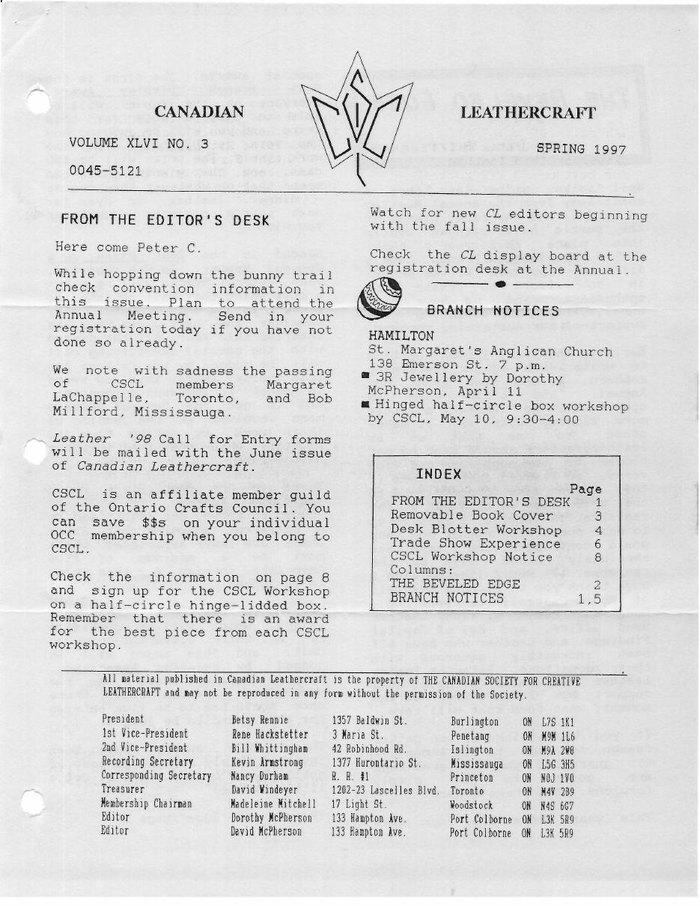
CANADIAN LEATHERCRAFT
VOLUME XLVI NO. 3 — SPRING 1997 — 0045-5121
FROM THE EDITOR'S DESK
Here come Peter C.
While hopping down the bunny trail check convention information in this issue. Plan to attend the Annual Meeting. send in your registration today if you have not done so already.
We note with sadness the passing of CSCL members Margaret LaChappelle, Toronto, and Bob Millford, Mississauga.
Leather '98 Call for Entry forms will be mailed with the June issue of Canadian Leathercraft.
CSCL is an affiliate member guild of the Ontario Crafts Council. You can save $$s on your individual OCC membership when you belong to CSCL.
Check the information on page 8 and sign up for the CSCL Workshop on a half-circle hinge-lidded box. Remember that there is an award for the best piece from each CSCL workshop.
Watch for new CL editors beginning with the fall issue.
Check the CL display board at the registration desk at the Annual.
BRANCH NOTICES
HAMILTON — St. Margaret's Anglican Church, 138 Emerson St., 7 p.m.
* 3R Jewellery by Dorothy McPherson, April 11 * Hinged half-circle box workshop by CSCL, May 10, 9:30-4:00
[The workshop notice on page 8 dates the same event Sat. May 19/97. In 1997 May 10 was the Saturday and May 19 the Monday, so the two notices disagree and only the page-1 date is consistent with "Sat."]
INDEX
                                          Page
FROM THE EDITOR'S DESK                      1
Removable Book Cover                        3
Desk Blotter Workshop                       4
Trade Show Experience                       6
CSCL Workshop Notice                        8
Columns:
THE BEVELED EDGE                         2
BRANCH NOTICES                          [?]
[The page reference against BRANCH NOTICES does not resolve at magnification. Branch notices appear on pages 1 and 5 of this issue.]
All material published in Canadian Leathercraft is the property of THE CANADIAN SOCIETY FOR CREATIVE LEATHERCRAFT and may not be reproduced in any form without the permission of the Society,
President               Betsy Rennie         4357 Baldwin St.          Burlington     ON  L7S 1K1
1st Vice-President      Rene Hackstetter     3 Maria St.               Penetang       ON  L9M 1L6
2nd Vice-President      Bill Whittingham     42 Robinhood Rd.          Islington      ON  M9A 2W8
Recording Secretary     Kevin Armstrong      1377 Hurontario St.       Mississauga    ON  L5G 3H5
Corresponding Secretary Nancy Durham         R. R. #4                  Princeton      ON  N0J 1V0
Treasurer               David Windeyer       1202-23 Lascelles Blvd.   Toronto        ON  M4V 2B9
Membership Chairman     Madeleine Mitchell   17 Light St.              Woodstock      ON  N4S 6G7
Editor                  Dorothy McPherson    133 Hampton Ave.          Port Colborne  ON  L3K 5R9
Editor                  David McPherson      133 Hampton Ave.          Port Colborne  ON  L3K 5R9
[The masthead still lists Hackstetter as 1st Vice-President and Whittingham as 2nd, although the Winter 1996 executive minutes recorded the exchange as effective immediately.]
Page 2
THE BEVELED EDGE
BY BILL WHITTINGHAM
Well folks, we're less than a month away from the Annual Meeting in Jordan, and the final pieces of the puzzle have slipped neatly into place. This year's host, CSCL's Mississauga Branch, took a different approach to the Annual in an effort to create more enthusiasm, and we have been unbelievably impressed by the support of our sustaining members.
Early in the year, I took the time to write each of our sustaining members, inform them about our Annual, and offer them an opportunity to interact a little more closely with us. It makes sense to me that we as leathercrafters should want to get closer to the suppliers and vice versa, so I asked each of them if they would like to contribute to the grab bags we hand out at the registration table. I left it up to each sustaining member how they would contribute, and I have been absolutely blown away by the response. I would like to give a huge thank you to Richard Pearsall of Moore-Pearsall Leathers Ltd., Doug and Kevin of Tandy Leather Head Office, and Kel of Capital Findings and Leather who have all been incredibly generous with their donations. Peter of Tundra Leather has also pledged some support but I don't know, at the moment, what form that will take.
If you can think of no better reason to come to the Annual, I can guarantee you the grab bags are going to be simply fabulous...but there's more.
This year there are four more special awards. The first is the Best Branch Display Award. Everyone at the Annual will be able to cast a vote for this award, and you will be judging how the work is DISPLAYED, NOT the work itself. The prize will be $50 cash, and the winning guild can spend that on whatever they choose - dinner, leather, or dyes for next year's projects - whatever you wish.
Second is the Best Piece by a General Member. As you register, each General Member will be given a chit which they will be asked to place in front of what they consider the best piece they are entering this year. All the pieces with the special identifying chit will be judged by the Fellows for this special award. This new award is meant to increase enthusiasm, and to get the General Members more involved in the judging of their work, by asking them to identify what they feel is their best effort.
Third is the Best Piece by an Associate Member. It will be judged as above, but identified by a different coloured chit. Since there are fewer Associates, there must be a minimum of five Associate entries for this award to be judged.
Fourth is the Best Piece by a Fellow, which will be identified by a third different-coloured chit, and this award will be judged by selected Associates. Since Fellows are on the endangered species list, there once again has to be five entries for this award to be judged.
These four awards have been invented solely for the purpose of getting your motors running. Get a little excited.
(Please see "Edge"/page 5)
Page 3
COVER YOUR FAVOURITE BOOK
by Loreen Manuel and Madeleine Mitchell
Your book may be soft covered or hard covered. For the outside, use morocco or lightweight cowhide. For the inside, use skiver.
1. Measure actual book. Add 1/2 to height and width (open book and measure across both covers and spine). If actual book size is 7" x 9", then adding 1/2", cut PART A from cardboard 7 1/2" x 9 1/2".
2. For outside leather, add 1" to the height and width of Part A. Cut PART B from outside leather 8 1/2" x 10 1/2". Apply design as desired. About 1/2" will be skived from all four sides, and corners rounded.
3. For front and back reinforcements, cut from X-ray film. For height, use Part A. For width, measure width of front of actual book. Do not include spine. Repeat for back cover. Cut two PART C from X-ray film 7 1/2" x 4 1/8".
4. For inner flap liners, cut two PART D from X-ray film. Use Part A height minus 1/4" for height, and a desired width from 2 1/4" to 3". In our sample 7 1/4" x 2 1/4".
5. For flap coverings, cut two PART E from outside leather adding 1/2" to width of Part D, and subtracting 1/4" from height of Part D, e.g. 7 1/4" x 2 3/4". Skive top and bottom and long side that will be turned.
6. For lining, cut PART F from skiver subtracting 1/4" from height of Part A. The lining can be up to 2" shorter than the width of Part A, e.g. 7 1/4" x 9 1/2".
ASSEMBLY
1. Using Part A as a template, centre on wrong side of Part B (outside leather). Skiving should extend to the template size on all sides.
2. Take Part C (X-ray film plates (2)) and round outside corners. Place X-ray film, one plate on each side, and glue securely to outside leather. (See Diagram #1)
3. Dampen along edges and turn and glue. TIP: Turn and glue long sides first, leaving corners open and open 4" either side of corners. When turning corner, trim excess away and make sure skiving leaves the corners very thin. Use a modeler to make small pleats around corner. Glue securely.
4. Apply Part D (X-ray film) to Part E (outside leather) to each inner flap. Round outside corners of X-ray film and leave inside corners square. On the leather pieces (Part E) skive on three sides 1/4" along top, bottom, and outside edges. On inside edge skive 1/2". Place X-ray film on inside of flap leather and glue. Turn 1/2" along inside edge and glue. The leather on the other three sides should just touch, or be slightly beyond the edge of the X-ray film. (See Diagram #2)
(Please see "Cover"/page 5)
[Diagram #1 is a labelled construction drawing showing the cardboard and X-ray film plates positioned on the wrong side of the outside leather, with the centre line marked.]
Page 4
WORKSHOP REPORT
by David McPherson, ACSCL
At the January and February Hamilton Leathercraft Guild meetings Ruth Haig and Muriel McKnight conducted an excellent two-part workshop showing how to make a practical desk blotter pad. It was interesting to make because it was new to many of us. Dorothy and I only attended the second session so had some catching up to do. I almost finished mine. Here is what we did, as best I can remember. I cut a rectangle of approximately 1/8" thick millboard. A convenient size was 12" by 19" because blotter paper comes 19" x 24". Then I rounded the four corners using a nickel coin for a pattern. Two strips of millboard 12" x 2 1/2" were cut and two corners for the ends rounded. Now, for my raised pattern, I cut two millboard strips 12" x 1 1/4". Ann Kowalchuk and Dorothy sanded all our edges of the millboard smooth and round while I cut two strips of morocco about 1 1/4" x 15", skived all four edges, and then skived the entire pieces very thin. Then I cut two strips of morocco about 4" x 14" and skived all four edges, with extra skiving at least 1" where the two rounded corners of the finished pad would be, for easier folding. I glued a narrow pattern strip of millboard on top of each wider strip of millboard off centred a little, making them match for opposite ends of the pad. Later I realized that it was best not to raise the ends too much with design or it wouldn't be flat enough for my arm to write comfortably! Dampening the two narrow strips of morocco made it easy to glue over the long sides of the millboard rectangle. By then, the two large morocco pieces were ready to glue on top of the two pieces of millboard allowing a little more for overlap at the outside edge, and using my bone folder to make the morocco fit around the pattern strip.
Later, at home, I placed each end piece on top of the rectangle at each end, and glued morocco around the three edges, leaving corners open to glue last by cutting out wedges of extra leather to make the underside as smooth as possible. I made sure no glue ran over on top of the rectangle because the blotter paper has to slip in each end. Dampening morocco made it fold more easily. I rubbed down the edges with a bone folder. To make the back look neater I cut triangles of morocco for each corner, skiving the edges and glueing over the corner folds. I polished the morocco and then cut blotter paper slightly smaller than 12" x 19" and took a triangle off each corner to make it fit under each end and lie flat. The workshop results should be ready for the annual meeting.
[A labelled construction diagram occupies the foot of the page, carrying the captions: 12" x 19" millboard; 1 1/4" x 15" morocco; fold under; 12" x 2 1/2" millboard; 12" x 1 1/4" millboard; 4" x 14" morocco; last 3 edges to fold under; fold under large rectangle.]
Page 5
Edge (Continued from page 2)
For those of you wanting to take part in the workshops we are offering this year, the following is a list of materials for which YOU are responsible.
For Glenn Nelson's Wild Rose Carved Coaster Workshop the coasters are being supplied by Tandy Leather (Thanks guys!) but you must bring your mallet, marble, sponge and water container. For a matted background you will need bevelers 701 and 936 or 801 and 836, figure carver F976. For a smooth coaster background you will need bevelers 200 or 203 and 935. and F941. You will also need pear shader 703, or 206, or 215, veiners 745, or 707, or 715, and flower centre J815 or J615. Of course, you will also need a sharp swivel knife, and you may want to bring your favourite modeler with you.
To colour that project the next day with Joyce and I, you must bring a good quality #3 or #4 brush and a container that will hold five different dyes - either half a styrofoam egg carton, or five plastic pill cups, or five baby food bottles, or whatever. Also. bring some plain brown paper or a plain paper bag to use as a working surface, and some paper towels in case of spills.
For Madeleine Mitchell's Mask Making Workshop you must bring a piece of 6 oz. cowhide cut 12" x 15", sponge, water container, 12" x 1/8" calf lace, drive punch or rotary punch, cigar tube or ball bearing tool, white glue (to use as a stiffener if you only have 5 oz. leather), cutting board, X-acto knife and shears. Optional: you can bring decorative trims like sheepskin, beads, snakeskin, etc.
None of these workshops conflict, so you can work all weekend if you wish. Truth to tell, that is the whole idea. We've done all the work to make this an excellent weekend of leather knowledge and hands-on fun, so please show your support by coming out participating.
Don't forget to scour your homes and workshops for items for the raffle table. See you April 18-20 in Jordan.
Cover (Continued from page 3)
5. Apply flexible glue to the wrong side of the skiver lining (Part F), centre on inside of the book cover and ease under inner flaps. TIP: Waxpaper may help avoid glue contacting leather. To finish, draw lines 1/16" to 1/8" apart along the spine to improve bending.
[Diagram #2 shows the inner flap assembly, labelled SKIVE 1/4", PART E, AND GLUE, PART C, EDGE, TURN.]
BRANCH NOTICES
WOODSTOCK
* Work meeting at Loreen Manuel's, April 17 * Rope-edged Belt, video and Al Williams, May 15 * Pot luck picnic, Planning meeting for new year at Madeleine Mitchell's, June 6
Page 6
WHOLESALING: MY TRADE SHOW EXPERIENCE
Part 2 of a 2-part series by David McPherson ACSCL
set-up day. I left Port Colborne on Friday, September 13. I made four trips from our loaded station wagon, up the freight elevator in the West Mezzanine of the CNE Coliseum, to my corner booth area, which was already draped and carpeted. I used my step ladder to hang my backdrop, leather, and pictures, over the drapes. I assembled shelves with a screwdriver, and arranged the tubings. I set out my boxes on display. Setting-up took a few hours.
On Saturday I attended two seminars on pricing and marketing, and a general meeting of all exhibitors for instructions. The catalogue for the Uniquely Ontario exhibitors was terrific, including colour photographs of every participant's products.
When I came back to the show on Sunday morning I could hardly believe the transformation that had taken place. No more boxes, dollies, or forklifts in the carpeted aisles. Everyone was dressed up and ready to receive orders from buyers. We stood mostly in the aisle beside our booths - no sitting unless on a high stool. Our displays did not leave much space for standing inside the booth.
For four days, Sunday to Wednesday, we talked to customers and exhibitors, passed out literature, and took a few orders. It is absolutely essential to collect a business card from everyone who comes to your booth and shows an interest in your work. You need these for a record and follow-up after the show.
Finally, at four o'clock on Wednesday, the show was over. Immediately, another transformation began. Take down, pack, say goodbye to new friends, and wait in line to load your vehicle. Everyone was trying to leave at the same time. Set-up had taken place gradually over at least three days. What a difference in leaving. I would only be hurrying into Toronto rush hour traffic so I decided to relax, wander around, and complete some bartering I had started.
After six o'clock, I still got stuck in traffic. But five days after I had left Port Colborne, I was back home again. It had been great, for that first trade show, to have a fellow leathercrafter in Toronto supply me with a spare bedroom.
With the trade show over, I had crafting to do, orders to fill and mail, follow-up information to send out to my new contacts, and more supplies to purchase. I was somewhat disappointed with the monetary value of the orders at the show. Selling about two-thirds of my display items at the end of the show was a definite plus! My sales at the show covered my show expenses.
Since then, orders keep coming in from some of those new contacts. One gallery has ordered three times in October and November. I also have some galleries taking my work on consignment — not as good as wholesale, but the next best thing.
I have already been accepted for the "Graduate" section in February 1997, this time paying full price ($350) for a booth 5' wide by 10' deep. I will be sharing a 10' by 10' booth, and paying extra for hydro which was provided the first time by the corporate sponsors of Uniquely Ontario.
Pricing: If you are in business to make money then you have to price your product accordingly. The retail buyer will add 160 percent markup to your wholsale price, i.e. if your wholesale price is $50 the retail price
Page 7
in the store will be $100. For consignment, it is usual to quote the retail price and receive 55 to 66 2/3 percent of that when the product sells — 60 percent is probably most common.
Shipping: I found Canada Post Xpresspost to be excellent with one or two day delivery. An 800 number is available to check date of delivery. For wholesaling you can require the buyer to pay for the shipping, and you can even ship COD including postage and contents. You pay the postage up front and include it in the COD amount.
All applicants for Uniquely Ontario must be an Ontario home-based business, and must be a first-time exhibitor at the Southex Toronto Gift Show. I was very impressed with the assistance provided by the show staff at Impact Communications and Tracey-Lee Hearst Design (display booth assistant) throughout the entire process. I learned a great deal about producing and selling. I now make a production schedule, cost out each piece, plan purchase of raw materials, maintain a current inventory list by size and colour, and file copies of completed and paid orders. It is necessary to be somewhat flexible and adapt to the specific needs of different clients. I keep in mind that. the business cannot expand beyond what I alone can do and still have a life outside of leathercraft. Yes, I highly recommend wholesaling. Wholesaling leaves a crafter more time at home to produce. It is a real ego booster to have a buyer call on the phone and say, "I want two of these and three of those."
There are a lot of other business terms for a wholesaler to learn such as "net 30 days", "FOB Port Colborne", and "PST exempt number". Although my very small business is expanding into wholesaling, it will remain a very small one-person business. I am still retailing and taking special orders, but wholesaling has opened up a whole new world and, along the way, I'm meeting a lot of fine folk. For me, leathercrafting remains a grand, fun pastime.
Anyone interested in this wholesale show can contact:
Southex Exhibitions
1 Concorde Gate
Suite 800
North York, ON  M3C 3N6
Tel.: (416) 385-1880   1-888-823-7469
Fax: (416) 385-1855
Since writing the above article I have attended the next trade show in February, 1997. It was another success with a possible buyer to export to Asia. I plan to exhibit again in September.
[A BERNICE panel by E. Woodman sits at the foot of the page. The hand lettering does not resolve reliably; the recoverable fragments read "Looks like ..." and "Forget to plan ahead, Bernice".]
Page 8
CSCL WORKSHOP
HALF-CIRCLE BOX WITH PIANO-HINGED LID
Instructor: David McPherson, ACSCL
Sat. May 19/97, 9:30-4:00
St. Margaret's Anglican Church, Emerson Street, Hamilton
Fee: $15.00. Register by mail, phone or at the Annual with:
David McPherson
133 Hampton Avenue
Port Colborne, ON  L3K 5R9
(905) 835-2576
A kit containing all leather and dowel may be ordered from David before May 1 for $8.00.
Procedure: make cardboard pattern, cut leather pieces, dye, assemble, polish. Measures in inches.
TOOLS: (items in brackets optional — share or borrow)
compasses, sharp pencil
cutting board, knife
scissors, ruler, square
dye applicators, sandpaper
burnishing tool, edge beveler
water sprayer/sponge
skiving knife, modeler
(strap cutter), (shears)
(#18 X-acto blade)
(3/32" U/V gouge)
MATERIALS:
cardboard for pattern
leather: rough sizes
sole    - 3 1/4" x 4 3/4"
7/8 oz. - 3 1/2" x 5 1/4"
- 2" x 14"
4/5 oz. - 4" x 4 3/4"
- 4 3/4" x 3 1/4"
skiver or thin leather for bottom - 3 1/2" x 5 1/4"
(wood dowel - 3/16" x 4")
white glue, (Barge). polish
NEW AWARDS:
Best Branch Display Award
Best General Member's Piece Award
Best Associate Member's Piece Award
Best Fellow Member's Piece Award
Ontario Crafts Council Design Award
WORKSHOPS Friday, Saturday, Sunday - bring your tools
Banquet SPEAKER: John Powers, Cambridge, on the now-popular topic of Butterflies
Viola Harris' tools and leather will be FOR SALE
HOSPITALITY ROOM will be available Fri. PM, Sat., Sun. AM
DRAW: early registration prize
DRAW: Canadian Leathercraft Contributors Prize (2nd annual)
BRING goodies for the draw table - need not be craft related
NOTICE
Annual MEMBERSHIP fee in CSCL is still only $20.00 due April 1, 1997. Register with your branch or make cheque payable to CSCL and send to Membership Chairman:
Madeleine Mitchell
17 Light Street
Woodstock, ON  N4S 6G7
Annual fee for Sustaining members is $35.00