An issue of the Society’s newsletter, transcribed from the original. Download as PDF.
(8 pages, 523 KB)
Page 1
[Transcribed from the original eight-page issue. Paragraphs are reflowed from the original setting; spelling, punctuation and wording follow the original, including its own inconsistencies. Editorial notes appear in [square brackets]. The masthead prints the volume as "XL11".]
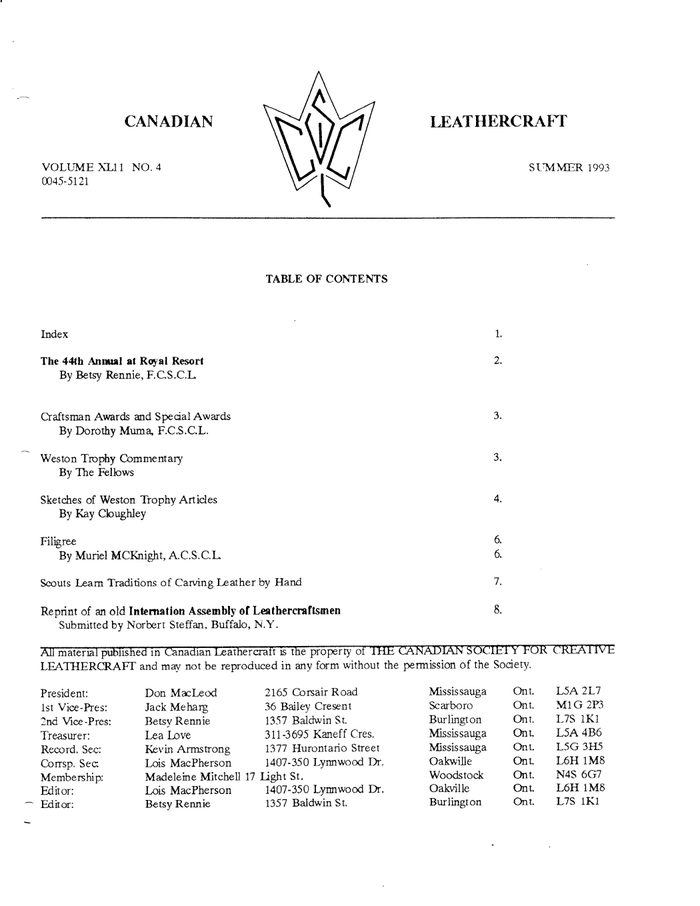
CANADIAN LEATHERCRAFT
VOLUME XL11 NO. 4                 SUMMER 1993                       0045-5121
TABLE OF CONTENTS
PAGE
Index                                                                     1
The 44th Annual at Royal Resort                                           2
By Betsy Rennie, F.C.S.C.L
Craftsman Awards and Special Awards                                       3
By Dorothy Muma, F.C.S.C.L.
Weston Trophy Commentary                                                  3
By The Fellows
Sketches of Weston Trophy Articles                                        4
By Kay Cloughley
Filigree                                                                  6
By Muriel McKnight, A.C.S.C.L
Scouts Learn Traditions of Carving Leather by Hand                        7
Reprint of an old International Assembly of Leathercraftsmen              8
Submitted by Norbert Steffan, Buffalo, N.Y.
All material published in Canadian Leathercraft is the property of THE CANADIAN SOCIETY FOR CREATIVE LEATHERCRAFT and may not be reproduced in any form without the permission of the Society.
EXECUTIVE
President:       Don MacLeod        2165 Corsair Road       Mississauga  Ont.  L5A 2L7
1st Vice-Pres:   Jack Meharg        36 Bailey Cresent       Scarboro     Ont.  M1G 2P3
2nd Vice-Pres:   Betsy Rennie       1357 Baldwin St.        Burlington   Ont.  L7S 1K1
Treasurer:       Lea Love           311-3695 Kaneff Cres.   Mississauga  Ont.  L5A 4B6
Record. Sec:     Kevin Armstrong    1377 Hurontario Street  Mississauga  Ont.  L5G 3H5
Corrsp. Sec:     Lois MacPherson    1407-350 Lynnwood Dr.   Oakville     Ont.  L6H 1M8
Membership:      Madeleine Mitchell 17 Light St.            Woodstock    Ont.  N4S 6G7
Editor:          Lois MacPherson    1407-350 Lynnwood Dr.   Oakville     Ont.  L6H 1M8
Editor:          Betsy Rennie       1357 Baldwin St.        Burlington   Ont.  L7S 1K1
[Betsy Rennie takes the 2nd Vice-Presidency this issue, in place of Glenn Nelson.]
Page 2
THE 44TH ANNUAL
CANADIAN SOCIETY FOR CREATIVE LEATHERCRAFT
by Betsy Rennie
The 44th Annual at the Royal Resort on Balsam Lake, was a great success. Late afternoon on Friday, the tables were set up, ready for the Judging done by the Fellows. Meanwhile, the rest of the people met in the hospitality room.
On Saturday morning, everyone met for the Annual Business meeting. The new slate of Officers were passed for the next year. Dorothy Muma, Chairman of the Council of Fellows, presented the Weston Trophy to the Hamilton Branch with an 85.4% average. The five pieces winning the trophy included a Magnifying Glass case by David Windeyer; a Hinged Box by Muriel McKnight, an Oval Moulded Box by David McPherson; a Desk Set by Sharon Beasley; and a 5-Strand Braided Belt by Ruth Haig. This year there were two Associates awarded, Bruce White and Bill Whittingham. The Zalitis pin was awarded to Bill Whittingham having the higher average. The critiques were read by Betsy Rennie and displayed by Madeleine Mitchell, showing us the best qualities of the pieces. The business meeting ended and Lunch was served in the Dining Room.
The Demonstrators this year were Dorothy and David McPherson showing their Leather Mache. They showed us how to mould leather splits over ordinary objects like a rock and then to make something artistic out of it. Margaret Monteith showed us how to make Buttons and Jewellery using a combination of materials. Hilda Chynoweth showed us what she called "Weed Pots" to put dried flowers in, but they are in fact dainty and a pretty wall hanging.
Draw numbers were called at break time. The same people demonstrated, so that we could watch a different one. The afternoon finished of with buying leather and supplies from guild members.
After having a delicious meal at the Banquet, the Guest speaker, an OPP Officer, Mike Maybee spoke on his early experiences on working with fur by watching the Indian people. He speaks widely to youngsters in the area about his experiences. Later Emma Windatt gave us her poem on "The Cats" and "Her Green Eyes". These poems have been written by her and she often goes to schools to recite them to the children.
Dorothy Muma awarded the Salon and Craftsman Ribbons and Prizes.
SALON AWARDS
Sharon Beasley       3 piece Desk Set
Nancy Durham         Maple Leaf Tray
Ruth Haig            Red Box, moulded with free form design
Della Howard         Large Flower Holder; small castle box
Jessie Little        Bookends
Lois MacPherson      Candleholder
Dorothy McPherson    Large maché bowl
Cliff McTavish       Card Case, pencil holder
Margaret Monteith    Earrings with red filigree
Bill Whittingham     Purse; a yoyo
Page 3
CRAFTSMAN AWARDS
Sharon Beasley       3 piece Desk Set
Nancy Durham         Blue Moulded Box
Ruth Haig            Card Case, Maple Leaf Tray, belt
Rick Fielding        Toronto Branch Logo
Della Howard         Pink Hinged box, Large maché "Flower Holder"
Jessie Little        Bookends
Don MacLeod          Black tool case
Dorothy McPherson    Large Maché Bowl, moulded box
Loreen Manuel        Royal Plaque Brass holder
Lois MacPherson      Candle Holder
Cliff McTavish       Card Case, Pencil Holder
Madeleine Mitchell   Small Red Bottle
Margaret Monteith    Pencil Holder
Betsy Rennie         Moulded Box with Star, Credit Card Case
Beula Reynolds       7 Strand Braided Belt
Bruce White          Small Spirit Drum - bear paw; Bell Bag, Tray
Bill Whittingham     yoyo, Owl Mirror, Purse
[This list prints "Dorothy MacPherson" and "Lois McPherson", reversing the spellings used elsewhere in the issue. Both were re-read at 14x and are transcribed as printed.]
SPECIAL AWARDS
Irva Ford Award   — Best moulded work, to Ruth Haig for moulded box with
black design on lid.
Bob Muma Award    — For Best tooled and/or coloured piece, to Jessie Little
for the Bookends.
Best in Show      — Cliff McTavish, for the Carved Pencil holder.
I would like to thank Kay Cloughley for drawing the sketches to go with the Weston Trophy pieces.
WESTON TROPHY COMMENTARY
by The Fellows
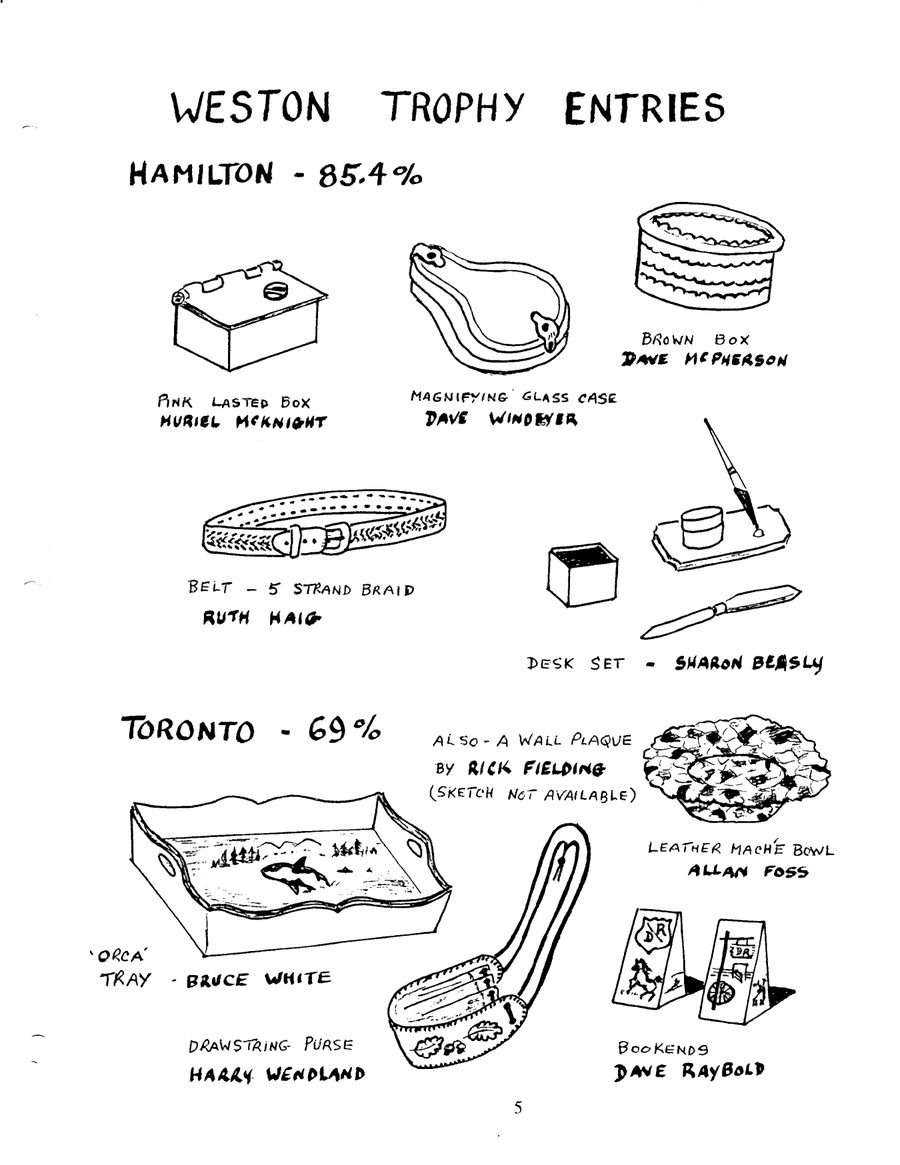
HAMILTON — 85.4%
Magnifying Glass Case: 81% The top of the case is dished in. The inside is nicely finished.
Hinged Box: 84% The box has a nice finish on it. The lid fits well but the overall design could be improved.
Oval Moulded Box: 84% There is an intriguing insert in this box. The dye job is nicely done. The join on the box is poorly done.
3 Piece Desk Set: 92% The set is nicely done, but the pen wobbles a bit. 5-Strand Braided Belt: 86% The tone braided belt is pleasing to the eye. The lacing is rough on the back and would be better if it were grooved.
TORONTO — 69%
Tray: 69% The design looks too artificial. The edges are quite lumpy.
Book Ends: 62% The basic design is quite interesting. The back should be covered in leather and the bottom of the book ends need a something sturdy.
Purse: 75% It is pleasing to the eye. The lacing is punched too deeply.
Wall Plaque: 80% The carved design is nicely done. The overall plaque is well done. Torn Leather Bowl: 59% The work has sturdy construction but it isn’t proportioned.
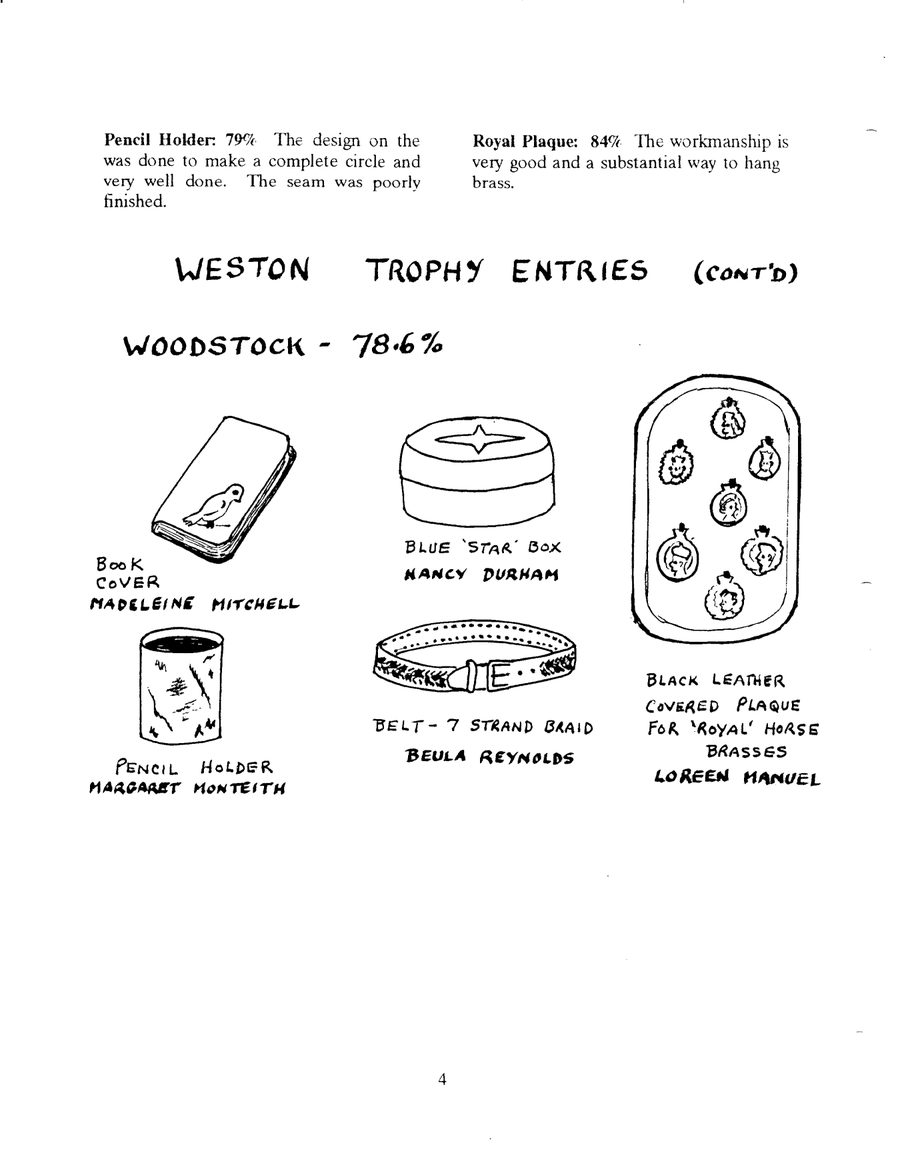
WOODSTOCK — 78.6%
Book Cover: 75% The embossing is a nice design and well done. The cover is a bit too small for the book with the glue giving away.
Blue Box: 80% Outside is pleasing. The lid fits fine but the inside could be dyed better.
Pages 4–5
[Two pages of pen sketches of the Weston Trophy entries, hand-lettered.]
PAGE 5 — WESTON TROPHY ENTRIES · HAMILTON — 85.4%
BROWN BOX — Dave McPherson PINK LASTED BOX — Muriel McKnight MAGNIFYING GLASS CASE — Dave Windeyer BELT, 8 STRAND BRAID — Ruth Haig DESK SET — Sharon Beasley [the hand lettering reads "BEBSLY"]
TORONTO — 69%
TRAY — Bruce White
DRAWSTRING PURSE — Allan Foss
BOOKENDS — [Jessie Little]
ALSO A WALL PLAQUE BY RICK FIELDING (SKETCH NOT AVAILABLE)
PAGE 4 — WESTON TROPHY ENTRIES (cont'd) · WOODSTOCK — 78.6%
BLUE 'STAR' BOX — Nancy Durham BOOK COVER — Madeleine Mitchell BLACK LEATHER COVERED PLAQUE FOR 'ROYAL' HORSE BRASSES — Loreen Manuel BELT, 7 STRAND BRAID — Beula Reynolds PENCIL HOLDER — Margaret Monteith
[The remaining Weston commentary is printed above the sketches on page 4:]
Pencil Holder: 79% The design on the Royal Plaque: 84% The workmanship is was done to make a complete circle and very good and a substantial way to hang very well done. The seam was poorly brass. finished.
Page 6
FILIGREE
by Muriel McKnight
Choose an appropriate carving pattern for the article of your choice, e.g. a barrette, key fob, wallet back, key case back, belts, earrings, bracelets, or collars. The weight of leather will vary with each project.
The pattern must have a limited amount of background that you are able cut out with many western carving patterns suitable, and of course you can create your own. Too much cutting weakens the leather article.
STEP ONE: Wet or case the leather, trace pattern onto leather with modeller, proceed to carve your leather before doing the filigree cuts, omitting the background tooling.
STEP TWO: To cut out the background use a very sharp pointed, e.g. exacto or any thin pointed knife you have. When cutting, it is important to cut straight down through the leather (not at on angle to undercut). When cutting is complete, dye top and edges, apply finish coat.
STEP THREE: Choose a contrasting colour for the underside, which shows through cut outs, cut same size as front. Apply white glue to back of filigree piece, carefully lay under piece (which is usually a skiver or thin morocco) and press until all the edges are secure.
BARRETTES: Approx. size 3 x 1, 1/4 to 3 1/2 x 1, or 1/4 inches. All different sizes and designs can be created for this project. If belting weight is used no backing is necessary, a lighter weight of leather such as 3 to 4 ounce will require backing. Used cased leather, mark design then cut using descnbed procedure.
Out side edges should be bevelled and shape the barrette with a modeller or bone folder to create a curve. Punch a hole on each side to fit a skewer or pick. Wood skewers should be dyed.
On the illustration of the filigree pattern, the outside edges of the design are bevelled. Shaded sections on pattern are cut out to form filigree, after carving is completed.
[A filigree pattern is illustrated beside the text.]
SCOUTS LEARN TRADITION OF CARVING LEATHER BY HAND — cont'd from page 7
We rivetted our patterned knife pouches at the top and pulled a thin leather thong through the stitch holes, and then doubled back all the way to the starting point.
Thanks to Carolyn and Jill, who often host Scout and Guide groups for one evening leather working courses, for a most rewarding evening. Too bad we leaders don’t qualify to earn a specialty badge!
Page 7
SCOUTS LEARN TRADITION OF CARVING LEATHER BY HAND
This article is submitted by Kay Clougley. It is a column written by Brian Baker of the Huronia Sunday.
With the boys of our 1st Churchill Scout troop working for their troop specialty badge, we spent a recent evening making leather knife pouches at the Tandy Leather store on Anne Street in Barrie.
As we industriously worked table hammering our own individual designs into the leather, under the supervision of the store manager, Carolyn Srigley and staffer Jill Kovaks, we were conscious of the nostalgia aroma of leather that reminded us of being in an Old West harness and leather shop just like they show on the movies.
Choosing from 100 or more leather stamps including designs of maple leaves, acorns, horseshoes, moons, bears, a wolf as well as letters for us to put our initials or names on with, we all felt like instant professional leather workers.
Not quite so! Before pattern working leather, you must wet the surface with a sponge. One of the boys who put too much water on did not feel so badly when leader Brian did the same! We had to blot the excess off and wait before we could start hammering on the patterns.
If you have ever admired the patterning of leather work, it is really neat and exciting to watch your own patterns and designs developing on what started out to be a plain piece of leather.
If we had thought the only leather was from cowhides, we were mistaken. Carolyn showed beautiful furred pelts from the African Springbok, phable deer leather used extensively for making leather clothing including sharp looking skirts, durable pigskins, lamb from Australia and New Zealand, rabbit from Brazil, python snakes, as well as the skins of deadly cobras which, complete with menacing heads, are popular with some people for making belts.
“Most of our cowhides come from the U.S.," Carolyn told us. ‘That is because most tanneries in Canada have gone out of business, including Barrie Tannery, which used to be next to our original downtown store. There is one government-operated tannery in Winnipeg.
“Because most of our leather comes from other countries, we still measure leather in inches and feet, not metric."
"Depending on the various leather preparations procedures used, we can produce leathers for every imaginable purpose from shoes to bomber jackets, from lady’s handbag and purses to yes, knife pouches just like you are making."
Most deer hides come from deer shot by hunters in the fall. When Carolyn showed us one deer hide exhibiting the hole made through the side, one of our boys exclaimed: “Holy Cow, Man!!”"
Chrome, caustic and salt are used in the leather curing process. Where the hair is required to remain, such as for some clothing or a calfskin rug, salt is used. Caustic removes hair. Dyes in reds, greens, blues, and yellow, and also metallic colours, are used to decorate the leather, along with tans for natural finishes.
Leather from colt hides is most commonly used to make leg pads for ice hockey goalies.
Continued on page 6
Page 8
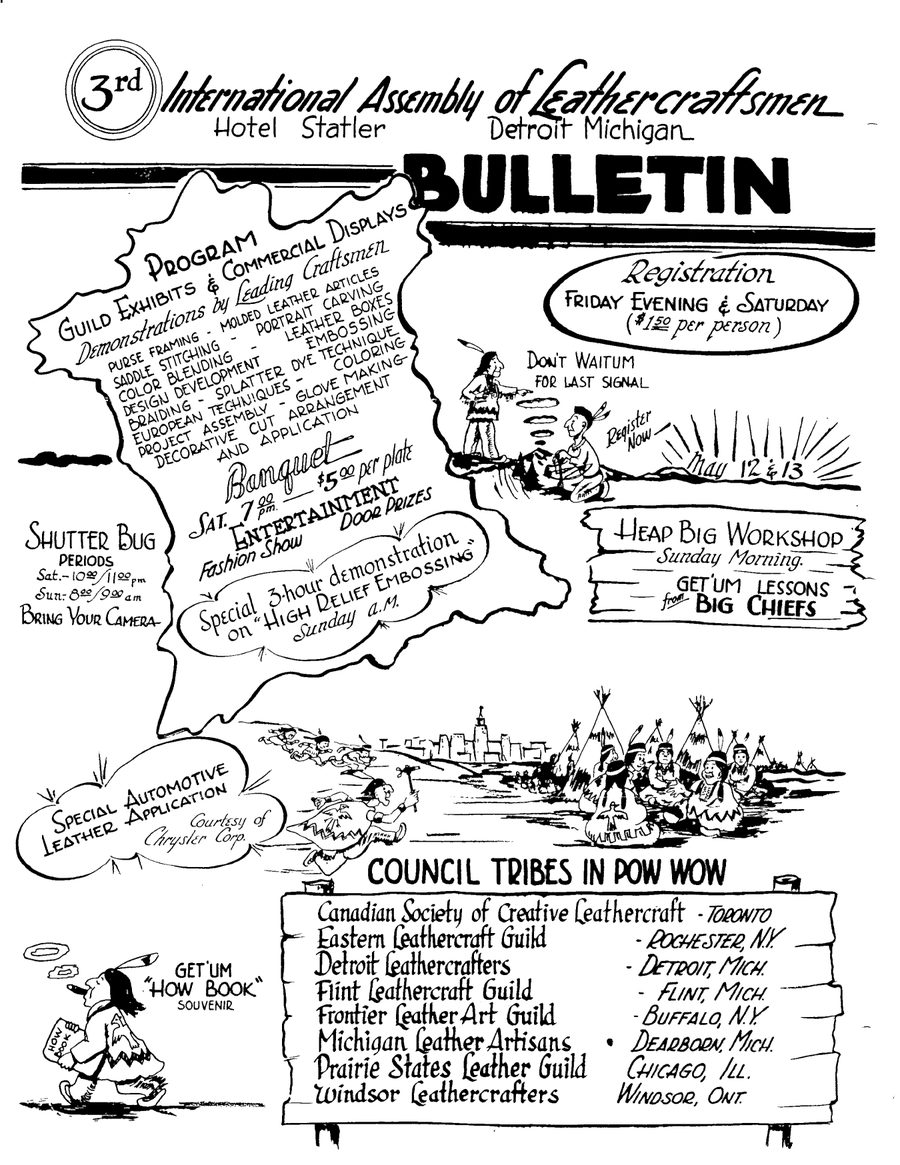
[A full-page reprint of an old hand-lettered bulletin for the International Assembly of Leathercraftsmen, submitted by Norbert Steffan of Buffalo, N.Y. The sheet is drawn in a cartoon "pow wow" style with an Indian-camp motif, and announces the Assembly at the Hotel Statler, Detroit, Michigan. Legible items include Registration, Friday Evening & Saturday, Shutter Bug Periods, Big Workshop, Saturday Morning, Lessons, "Bring Your Camera", Big Chiefs, and "Council of Tribes in Pow Wow". Most of the surrounding hand lettering is decorative and only partly legible in the scan.
At the foot, the member guilds of the Assembly are listed:]
Canadian Society of Creative Leathercraft  —  Toronto, Ont.
Eastern Leathercraft Guild                 —  Rochester, N.Y.
Detroit Leathercrafters                    —  Detroit, Mich.
Flint Leathercraft Guild                   —  Flint, Mich.
Frontier Leather Art Guild                 —  Buffalo, N.Y.
Michigan Leather Artisans                  —  Dearborn, Mich.
Prairie States Leather Guild               —  Chicago, Ill.
Windsor Leathercrafters                    —  Windsor, Ont.