
An issue of the Society’s newsletter, transcribed from the original. Download as PDF.
(8 pages, 683 KB)
Page 1
[Transcribed from the original eight-page issue. Paragraphs are reflowed from the two-column setting; spelling, punctuation and wording follow the original. Editorial notes appear in [square brackets].]
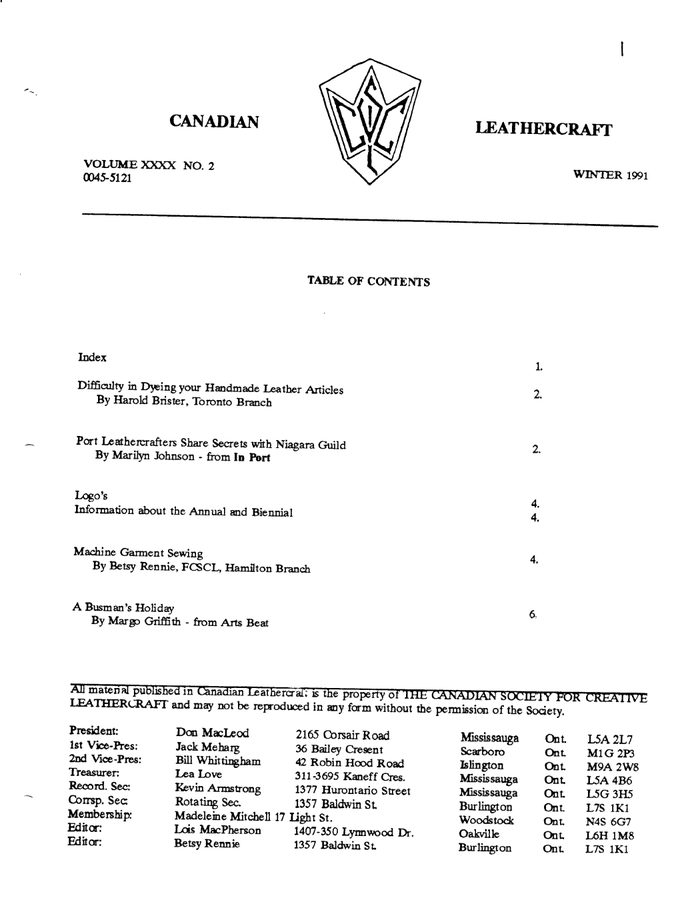
CANADIAN LEATHERCRAFT
VOLUME XXXX NO. 2                 WINTER 1991                       0045-5121
TABLE OF CONTENTS
Index                                                                     1
Difficulty in Dyeing your Handmade Leather Articles                       2
By Harold Brister, Toronto Branch
Port Leathercrafters Share Secrets with Niagara Guild                     2
By Marilyn Johnson - from In Port
Logo's                                                                    4
Information about the Annual and Biennial                                 4
Machine Garment Sewing                                                    4
By Betsy Rennie, FCSCL, Hamilton Branch
A Busman's Holiday                                                        6
By Margo Griffith - from Arts Beat
All material published in Canadian Leathercraft is the property of THE CANADIAN SOCIETY FOR CREATIVE LEATHERCRAFT and may not be reproduced in any form without the permission of the Society.
EXECUTIVE
President:       Don MacLeod        2165 Corsair Road       Mississauga  Ont.  L5A 2L7
1st Vice-Pres:   Jack Meharg        36 Bailey Cresent       Scarboro     Ont.  M1G 2P3
2nd Vice-Pres:   Bill Whittingham   42 Robin Hood Road      Islington    Ont.  M9A 2W8
Treasurer:       Lea Love           311-3695 Kaneff Cres.   Mississauga  Ont.  L5A 4B6
Record. Sec:     Kevin Armstrong    1377 Hurontario Street  Mississauga  Ont.  L5G 3H5
Corrsp. Sec:     Betsy Rennie       1357 Baldwin St.        Burlington   Ont.  L7S 1K1
Membership:      Madeleine Mitchell 17 Light St.            Woodstock    Ont.  N4S 6G7
Editor:          Lois MacPherson    1407-350 Lynnwood Dr.   Oakville     Ont.  L6H 1M8
Editor:          Betsy Rennie       1357 Baldwin St.        Burlington   Ont.  L7S 1K1
Page 2
DIFFICULTY IN DYEING YOUR HAND MADE LEATHER ARTICLES
Harold Brister, Toronto Branch
Garnett Dyes and Finishes Could be your Answer:
Teachers: Use Garnett Dyes in class, because the first project can be successfully dyed and the general appearance greatly improved.
Experienced Crafts Person: Use Garnett Dyes because of the wide colour range, the possibilities of colour blending, and the unique dye effects.
Occupational Therapists: Use Garnett Dyes because of their ease of application and absent of odour. Also, they easily clean-up by washing in water.
Beginners: They use Garnett Dyes because they are easy and safe to apply and the dyes get a good job on the first try.
For information on Garnett Dyes you can call Joyce Scruton at 416-844-9471 or Harold Brister at 416-279-0333.
Garnett Dyes are a liquid - not a paste - and penetrate deeply, leaving the background, tool impressions, and lines clean and clear. They leave the leather soft and pliable. All colours mix readily with each other, giving you an unlimited range of colour possibilities. Colours can be gradually built-up coat by coat, working from light to dark. Your brushes will conveniently wash up in water.
For the leather worker who has not used Garnett Dyes and are wondering about them: There are five Antique finishes, nine Toning dyes and there is Garnett Polish Coat. In the near future we will be bringing back the INLAY-BACKGROUND DYE as well as the EDGE DRESSING.
In a future issue I will go into the use of the colour combinations and toning effects.
Garnett Dyes and Finishes were developed especially for you as a Leather Craftsman for the use on Vegetable Tanned tooling and carving leathers. They are durable, safe and easy to apply. The dyes emphasize the craft work and decorative design, bringing out the natural grain of the leather.
PORT LEATHERCRAFTERS SHARE SECRETS WITH NIAGARA GUILD
by Marilyn Johnson
PORT COLBORNE - Leathercrafting was the topic of guest speakers David and Dorothy McPherson, who displayed their work and shared their enthusiasm for the
Page 3
craft with the 35 people assembled at Niagara Guild of Crafts’ September meeting.
In introducing the speakers, Linda Killip, program convener said: "When the Ontario Crafts’ 91 show ran in Toronto at OCC headquarters during July, a leather box - one of a total of almost 700 entries in all media - won David on [sic] of the 14 prizes awarded in that show."
"When the Canadian Society for Creative Leathercraft’s (C.S.C.L) 41st annual general meeting convened recently at Jordan Station, among articles submitted by 60 members for jurying was the work of these two Port Colborne leathercrafters."
Linda pointed out that Dorothy, a folk art doll maker, just recently joined the Hamilton Branch of C.S.C.L, whereas; David, a mathematics teacher at Port Colborne High School for the past 27 years, first took lessons in leatherwork at age 15.
"Leather never goes out of style," David said. "Traditional leather articles find contemporary uses. Today, a leather portmanteau, fashioned after a suitcase used by horseback riders of the early 19th Century becomes a shaving kit.
"Consider joining the Canadian Society for Creative Leathercraft (Hamilton Branch), then master basic techniques, make four articles which meet the C.S.C.L standards and you can receive a degree in leatherwork. This year, I was awarded my associate standing (AC.S.C.L) for these pieces displayed tonight - the belt, box, wallet, and purse. It signifies an attained level of expertise."
Displayed were Dorothy’s first leather dolls, depicting members of the Donnelly family - Johanna and James and son Will whose sombre tone garments “represent the dark decades of violence in Biddulph Township (1850-80’s) when the family, known in history books as "the Black Donnellys",farmed near Lucan outside London.
"The dolls’ creative design earned their maker a Salon ribbon at the C.S.C.L convention.
"These dolls aren’t traditional leather dolls cut from a pattern", Dorothy said. "They are artistic adaptation dolls. I experimented by constructing body, support and garment, from natural skiver, 10-ounce cowhide and cowhide levelling splits, and used wire armature bodies".
"This fall, I started doing Mallard duck decoys in cowhide levelling splits", Dorothy said, "in an effort to use up the tiniest pieces of leather left over from David’s studio projects, I started making earrings. Sometimes I end up with two lefties. I’m not a very good studio apprentice. I just enjoy it as a creative pastime,
"Two of David’s boxes were auctioned off at Ontario fine arts’ auction this summer".
"I was afraid no one would bid on them", he confided, "but they did”.
David shared with the Guild information about the Haliburton School of Fine Arts (HSFA) summer school, where he has been invited to teach a course in leather box-making in the summer of ’92.
"This year, I understand over 2,000 students registered in the informal craft courses. If my one week course runs there next year I'll be happy", he said, pointing out various features of handbound books.
David concluded his remarks by saying, "I intend to pursue book binding
Page 4
[conclusion of the Port Leathercrafters article]
because it fits in nicely with leatherwork. On Nov. 9 and Nov. 10, I'll be at PALS Show and Sale Welland.
Dorothy, in conclusion, read an excerpt from her poem "Creation", about making apple dolls, and noted that the poem will form part of the month-long exhibition "Wordcolor '91" at the Port Colborne Public Library during November.
"That doll-making poem resulted from my affiliation with Niagara Guild of Crafts", she said. "This Guild is an excellent doorway to the Ontario crafts' unity and to creativity."
The poem is by Dorothy McPherson. This article was submitted by David McPherson.
CREATION
Golden sunlight pierces windowpane
Shafting across the woman's hands.
Peeling, carving seven red apples,
In sunlight where pine table stands.
Piling, swirling on floor around her
Spirals of fragrant peelings lie.
Dropping near her faithful Shelty
Dozing on his mat nearby.
Now Toby knows just what she's doing.
He's watched her many times before -
She's making apple granny dolls
For "the big city" handcraft store.
- Dorothy McPherson
LOGO'S
Last year at the Annual, Mississauga Branch announced that all the branches were to make up a logo for their group. There will be a special table and prize for the best logo at the Annual in April. The logo should represent your area or group interest and should be worked on by several members. In future, the logo's can be placed on your branch table at the Annual, replacing the core board signs.
THE ANNUAL will be held at the Beacon Motor Inn on April 24, 25, 26, 1992. The Mississauga Branch is hosting this year's Annual. Is everybody working on their Weston Trophy Pieces?
THE BIENNIAL is in September at the Etobicoke Art Gallery. This event is to be shared with Arts of Etobicoke.
MACHINE GARMENT SEWING
Betsy Rennie, Hamilton Branch
Pattern Layout: When laying the pattern out on leather, for example suedes in particular, you need to watch the nap of the leather. If the leather has a pattern, you need to watch that it does not get turned up-side-down unless it is a pattern that is turned all ways.
When sewing leather use a leather needle in your sewing machine. These are much like the glover's needle. Use a 1/4 inch seam and the stitching should be 8 stitches to the inch, depending
Page 5
on the thickness of the leather. With a heavier leather, you should use 6 stitches to the inch. For armholes, the seams should be 3/8th of an inch.
Layering Seams: The importance of layering a seam lies in the smoothness on the outside. To layer the seam, cut 1/16th" off one piece only. It is easier to do this to the top layer. In the case of three pieces of leather, cut the centre seam 1/8th" and the top one 1/16th". Doing this to all seams, will add to the finished product.
Interfacings: Interfacings should be used on the garment to give the leather support. I suggest using the iron-on interfacing. To apply interfacing, use a clean cotton cloth and a hot dry iron, give equal amount of pressure all over the interfacing. It is sometimes suggested to use interfacing all over the bodice of a garment, a dress or jacket. Make sure you get a good meld, otherwise when the garment gets washed, the facing will become separated.
Lining: Make a completely detachable lining for the dress or pullover. The lining can be made from polyester cotton, attaching this to the neckline and shoulder seams. Sew bits of velcro in the places the lining is to be attached and also in the same places on the lining. Another suggestion is to buy or make an underarm shield of the lining material. This makes for easy laundering of the lining and also helps prevent some of the body stains on the leather.
Care of Leather Garments
Between washing the leather, you put cornmeal on the surface and leave this to soak up the body oils. If you are considering washing a garment yourself, I think that the leather should be washed before you cut the garment pieces out. There is a certain amount of shrinkage the first time the leather is washed as there is with any yard goods. This way the garment will still fit after it has been washed.
Washing: I tested small pieces of Pigsuede by hand washing them first and drawing the unwashed leather on paper. There was no a remarkable change in the size. I have been asking different people that have sewn with Pigsuede how to wash it. I finally decided to risk washing two hides of Pigsuede in the washing machine to see the results myself. Make sure that your washing machine is clean on the inside.
Wash in Cool/lukewarm water, more cool than lukewarm. Use a mild detergent, eg. wool-lite and set the washing machine on Gentle wash cycle for about 6 minutes. You should never wring the leather, this leaves creases that are almost impossible to get out. The spin cycle does an adequate job.
Drying: I put the leather in the dryer on the Air cycle and kept checking it for dryness. The air cycle has no heat. Take the leather out immediately after it is dry, this prevents wrinkles or creases from forming.
The Pigsuede I washed and dried this way came out soft looking a bit like crushed velvet and it did shrink a little bit.
Pressing: Use a warm dry iron - No steam. Iron the back of the garment using a clean cotton cloth such as a tea towel.
Pages 6–8
A BUSMAN'S HOLIDAY
by Margo Griffith
Submitted by Ruth Haig, Hamilton Branch. This article comes from Arts Beat and is put out by the Council for the Arts in Hamilton and Region.
"Hello.
Have a browse around. If you want any help, please ask. You won't mind if I carry on, will you? What am I doing? Finishing this week’s supply of brooches (tiny 2-dimensional leather Wellington boots). I do 1,000 brooches a week, every week.
Oh no, this is just part of my regular production. I also do belts, purses and bracelets. I’ve been a leatherworker almost 20 years now, not counting my training.
I love it!!
Aside from production work? Well, commissions, orders, repairs. In fact, I just finished an 8' guitar, fully carved, for a music store.
Oh no, only a few shows. Agents and shops contact me.
No, that’s not unusual.
Wholesale rate? 40%, my share that is.
Oh yes, this is my only job.
We (self, wife, 3 children) moved up here several years ago. It’s too expensive in London now.
Nice part of the world, this."
This abbreviated conversation illustrates the state of British crafts in a nutshell. The speaker is a professional leather craftsman at Whithorn, a village in Dumfries and Galloway, Scotland. We talked in renovated storefront, now a co-op gallery and shop, featuring paintings of local views, fine handwovens, greeting cards, toys, silks, leather...That’s not unusual. What was unusual was the way this group got started. They were fully funded by the local council (government) for the first year as part of a job-creation scheme. Fully funded. I was stunned.
After hearing similar stories from craftsmen from Land’s End to John O'Groats, I stopped being stunned.
Thinking was called for.
So I thought back to the conversation with the leatherworker and to others over the past five summers held with craftsmen in their studios and shops, and drew some generalizations about what I had seen and heard. These deserve some examination and have some application for those of us interested in crafts in Canada.
The warmth, enthusiasm, and pride that literally shone from the leather worker was not unique to him. I found it in crafts people all over the kingdom. These people were genuinely happy! Why? Maybe it was all the tea they drank. Or maybe one reason is that in the UK, craftsmen do not need to justify being craftsmen. They do not need a day job. It is reasonable there to expect to make a living potting, working leather, silversmithing.
British craftsmen are, after all, following in the footsteps of Wilkinson, Wedgwood, William Morris and Bernard Leach, albeit on a smaller scale. These pioneers established a tradition that allows our leatherworker to be a leatherworker, and to be happy in his work. Craft and design are integral parts of industry and manufacturing there, and are even celebrated in museums (Design Centre, London, and the Victoria and Albert:
Museum of Applied Arts are two fine examples). Fine craft schools are located throughout the kingdom. British craftsmen are very well-trained in technical and business aspects of craft. There are many ways to use their crafts: in industry, as small producers, as restorers or conversationists, as artists, agents or manufacturers. These choices exist, not just on paper. The various levels of government see crafts as viable occupations and actively encourage and fund their development.
Crafts are highly visible throughout the UK. In addition to countless shows and shops, there is a craft shop connected to every museum, no matter how small, to every castle or big House. Even tourist information centres and cathedrals have crafts included as major parts of their stock. Some Houses have craft studios in outbuildings, some have sculpture gardens, some have seasonal shows in the house or grounds. Attendance at these shows is enormous! Even the Bishop’s Palace in Wells is a venue for a major craft show. Craft shops are busy. Sales are very good.
There is a very obvious “made here" consciousness on the part of consumers and shopkeepers. No craft, art or souvenir shop can afford to ignore this "high demand" for British or locally produced work. There is also a strong local bias in shops that ensures that work is very different from shop to shop and area to area, No standardized mall shop merchandise for them. Even a minor item like the plaster English cottages are made in Britain; the cheap, poor quality work from other continents is rejected by shopkeepers and consumers alike. Tourism is big business in Britain and the tourists are demanding British-made souvenirs.
This is a very smoothly working system indeed where shops want to carry local work, customers want to buy it and people want to produce it.
The craft work itself is excellent in design and quality. Craft-conscious consumers demand it, and they get it. No quick-and-easy or boring junk here.
British crafts fall into 5 categories: reproduction; functional or traditional; current or innovative; hobby; and "art". Frequently all of the categories can be found on the same sales floor or exhibition. There is much category-crossing by craftsmen and the categories themselves peacefully co-exist. Amazingly, there is little effective elitism. There are geographic divisions as well. "Art" crafts tend to be centred in London. Production craftsmen were London-centred too until recently when soaring rents and taxes forced most out into other parts of the country where production and living costs are lower. This physical shift has been aided by the marketing system of show and agents, and the ease of movement of goods. The move has had another result too. Functional work, production pieces are enjoying a huge resurgence as public demand for functional work increases and the demand for "art" craft decreases due to the drying up of grants, patrons, and galleries. Price doesn’t enter into it, most British craft work is very affordable, as it is market priced. Many people buying many things makes for competitive pricing.
Craftsmen in Britain successfully use many methods of organizing craft production. The experience of the Industrial Revolution, the Arts and Crafts Movement, the co-operative movement, trade unionism, even village life have all contributed to this variety. Single studios, cottage industries, clusters of craftsmen in shared space, all work well. The shared space is usually a renovated or purpose-built multi-studio development and tourism marketing. There are also private developments along the same lines.
Methods of marketing are organized along similar lines. Again the most interesting are those complexes of craftsmen, each having his own studio and showroom, and sharing large gallery/shop spaces.” The group facilities are really — exciting to visit. Examples of this system in action include shops in Maws at Ironbridge, Corris in North Wales and the Cirencester Workshops. All have good restaurants too. Tenancy tends to be consistent and constant and this sharing system is well-established.
People seem to work well together here, again because experience has taught them to co-operate. Single and mixed media guild are active. Information about other craftsmen is freely given. A well-established group of producers often hold Craft Days where excess space is given to beginning craftsmen or small producers. An enamellist in the North may carry work from a Southern enamellist in his studio, and vice versa. Co-operative competition, - an interesting concept.
One key element in the success story of British crafts is the willingness of suppliers of craft materials to deal with small or unusual orders. They respond to, and work with, the craftsmen who are, as a result, not limited in growth or production by the suppliers’ restricted inventories as often happens here. There are many small producers and many small suppliers. Each is actively interested in and maintains the other. Part of the reason is the way they use computers. The computer is seen as a mere tool, not a determiner of stock or demand; that remains a human task. This alone could account for the diversity, variety, and innovativeness of British craft work.
I've painted a very rosy picture here. There are some thorns and there will be more when Britain moves fully into the European Economic Community. I believe the effect will be minimal because each country involved has a strong craft tradition to guard. They appear to have internalized "thinking globally, but acting locally’.
Finally, here’s some food for thought. In 1988-1989, the gross sales of crafts in the UK was 2,000,000,000 pounds, that’s over $4,000,000,000 (four billion) Canadian. Maybe we can learn some lessons from them.