
Leathercraft Standards and the Point System for Scoring Craft Works, April 1996
the original (PDF) · 9 pages · 1.4 MB · the full-resolution scan, 14 MB, for close research
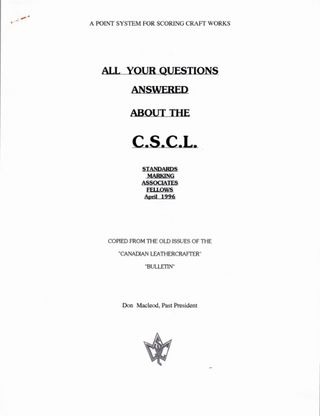
Page 1
A POINT SYSTEM FOR SCORING CRAFT WORKS
ALL YOUR QUESTIONS
ANSWERED
ABOUT THE
C.S.C.L.
STANDARDS
MARKING
ASSOCIATES
FELLOWS
April 1996
COPIED FROM THE OLD ISSUES OF THE
"CANADIAN LEATHERCRAFTER"
"BULLETIN"
Don Macleod, Past President
Page 2
April 1996
C.S.C.L.
LEATHERCRAFT STANDARDS
These are the general requirements and will be considered by the Council of Fellows in
appraising works to be accepted for Sales. There will be exceptions in the case of articles with a newly identified need,
ingenious application of material or technology, or an original aesthetic design. Exhibition and Competition articles will be
judged by highter standards. DESIGN: Function: The project must fit the purpose for which it has been designed. shape in
relation to all the other shapes in the design. Propotion and Shape: Proportion means the height in relation to the width, and
each shape in relation to all other shapes in the design. Materials and Findings: Materials must be suitable for the purpose
for which they are used, and the findings must be in keeping and good taste. Harmonious Appearance: This is the result of the
relationship of the forms or parts, bringing them into unity. WORKMANSHIP Cutting: Accurate cutting to ensure correct fit and
appearance Decoration: Tooling:- Clear cut lines; any modelling must be smooth, background stippling should be regular and any
flat backgrounding should be put down smoothly. Carving:- Lines should not be cut deeper than half the thickness of the
leather. Except in certain places, lines should not cross each other, or go beyond the outline being cut. In many cases, they
should taper out. Beveller: Must follow the cut line smoothly. Pear Shader: Rarely is the exact impression of the pear shader
correct. The tool should be moved around in the area concerned, tapering off the pressure toward the edges. Rarely should it
touch these lines. Background: However the background is treated, it must not detract from the design. Camoflauge, Verner,
Mulefoot, etc.: If used, they should not be overdone. Seeders: These are used mainly for flower centres, and how it is used
depends on what centre is being done and the effect desired.. Decorative Cuts: If used, they generally follow the contour of
the leaf or petal. They start heavy, and taper out to nothing. Embossing: The parts to be embossed must be carefully raised.
The raised portion must be well and smoothly supported. Generally, the surrounding area should be treated in such a way that
the embossing is well defined. Stamping: The impression should be regular or graduated and reasonably deep. When more than one
tool is used, the impression should create a related design Inlay: To fit accurately and show no tool marks. Onlay: Prepared so
that the edges are neat and firmly adhered. Colouring: Must show that there is a knowledge of how to handle colour to get
desired effect.
Page 3
LEATHERCRAFT STANDARDS CONTINUED
Other forms of applied decoration: not specifically mentioned, need the same care and
attention to details as those above. Skiving: Sufficient to make the parts fit well, and to reduce the edges of parts being
stitched or laced together to a suitable thickness, but not enough to weaken the leather where strength is needed. For
turn-edges, the leather must be skived enough to make a smooth, neat turnover. Fitting and assembly: Edges to be flush,
gussets and fasteners to be properly placed. Moulding: Whatever method is used, the leather must be a suitable weight for the
article. If there is more than one moulded part to the article, the moulding of the various parts must form a harmonious whole.
Finishing: Lacing and stitching to be even and uniform, suitable to the article and inconspicuously joined or finished off. Cut
Edges: Whether laced or unlaced should present a well finished appearance. Turned Edges: The edges must be skived enough to
make a smooth neat turnover. Glueing: Glue should be spread so that no lumps are formed. Any excess should be removed from the
visable parts of the article. Linings: Should be suitable for the article, neatly inserted and accurately fitted. Stacked
Leather: Must be securely glued, and sanded sufficiently to make a smooth edge. Backs: To be finished suitably for the
article whether lined, dyed, polished, or left untouched. Combinations: - If the leather is combined with other materials, the
leather must be the dominant part of the article, and the material must be compatable with the leather. Reprinted from Volume
XXXV11,No.1&2, Fall 1988/ Winter 1988/1989 Reprinted from Volume XXV11, No. 3, Spring, March 1979 Canadian Leathercraft
"Bulletin"
Page 4
C.S.C.L
April 1996
REQUIREMENTS FOR ASSOCIATE MEMBERSHIP
1. Not less than 3 years satisfactory practice of leathercraft.
2. Two years of satisfactory service to the society, e.g.,
helping with exhibitions, sales, writing for the bulletin, serving on executives (Local and National ) getting new members for
the society or working in some way toward the development of leathercraft.
3. Demonstrating ability to produce work of high
standard of craftsmanship, while. originality of design is not necessarily required for Associate standing, it will receive
favourable mention. Copied designs should bear some stamp of the individuality of the craftsman and should not be an exact
duplicate in every sense of the copied design.
4. Approval by the Board of Selection of submitted work as follows: ( I ) Handbag
or other large articles involving gusset construction. ( II ) Belt of 6 or 8 oz. leather. ( III ) Optional ( IV ) Optional NOTE:-
Numbers 3 and 4 should be chosen to show specific techniques. Articles submitted should demonstrate knowlege of materials and
various techniques and versatility in the craft, e.g. tooling, carving, colouring, construction, stiching, lacing, moulding,
etc.
5. Articles submitted for Associate standing will be marked according to the Society's point system of judging. The
minimum passing mark for each article is 75 marks. If one of the articles has failed to receive 75 marks, the candidate will
receive credit for the three qualifing articles and a condition on the fourth. The candidate may submit another article the
following year, and if it qualifies will receive his Associate standing and certificate at the next Annual Meeting when all
four articles must be displayed. A candidate may fail on only one article to receive this condition.
6. Work submitted must be
accompanied by a_ signed declaration application form that the work is solely that of the candidate. Work done in a
Leathercraft Studio may be submitted for Associate standing provided that it is done without assistance.
7. Enclose fee as set
fourth on the application to cover examination and certificate. Copied from volume XXXV11, No. 1 and 2, Fall 1988/ Winter
1988/1989 Copied from volume Canadian Leathercraft "Bulletin"
Page 5
C.S.C.L.
APRIL 1996
REQUIREMENTS FOR FELLOW MEMBERSHIP
1. At least one year as an Associate Member and three years of service to the
Society
2. Wide experience and meritorious achievement in the field of leathercraft.
3. Approval of the Board of Selection of
submitted work as follows: 4 Articals (2 Large and 2 Small) of the applicant's choice, all of different function, size and
treatment, chosen to show versatility in the craft and grasp of techniques. No piece submitted for Associates will be eligible.
4. Articles will be marked according to the Society's point system of judging. The minimum passing mark on each of the four
articles is 80 marks. All four articles must qualify.
5. All work submitted must be original in design and decoration, and
should include, if possible, new forms and uses.
6. Candidates shall submit an article, not necessarilly technical, for
publication in Canadian Leathercraft for the approval by the Board of Selection. An artical previously published may be
submitted.
7. Work submitted must be accompanied by the signed decloration on the application form that the work is solely that
of the canditate, done without supervision or assistance.
8. Acceptance by a_ two-thirds vote of the Active available Fellows.
9. Enclose fee as set forth on application to cover examination and certificate.
COPIED FROM VOLUME XXXVII, NO. 1 AND 2, FALL
1988 / WINTER 1988/1989 CANADIAN LEATHERCRAFT "BULLETIN"
Page 6
A POINT SYSTEM FOR SCORING CRAFT WORKS e April 1996
ORIGINAL BY DR. RALPH LARMOUR 1958
The judging of craft work is difficult
enough when only a relative placing is required, but when it is necessary to assign definite numerical values it becomes
arduous and controversial. I shall discuss some of the specific difficulties and suggest a more rational method that is easier
to apply and leads to more acceptable end results.
In any system of judging the average score of several judges is likely to be
more reliable than the score of a single judge. This is axiomatic. It is also accepted that various characteristics of objects
ought to merit different maximum values and herein lies one of the cardinal difficulties of the differential value scoring
system, namely, the inability to keep in mind and apply a number of different values. It is comparable to trying to measure
something with yardsticks of different length.
THE UNIFORM MEASURING STICK
In judging quality of objects, the human mind is
accustomd to using a relatively simple yardstick with only a few divisions. We see a thing and instantly appraise it as "good",
"fair", or "poor". Or we may note it is "beautiful", "ordinary", or "ugly". If we wish to be a little more specific we may
modify these three basic categories to "very good", "good", "very fair", "fair", "poor", and "bad", making six divisions. But
beyond this there is required very critical appraisal which takes time and which may not prove tool accuate. When several
judges work on the same objects, even the simplest yardstick becomes split into what may be called fractional divisions as soon
as an average value is calculated.
I propose first, then, that appraisal be limited to four categories, namely, EXCELLENT,
GOOD, FAIR, POOR. But since these are awkward to write into a scoring sheet, and moreover, cannot be averaged, it will prove
more convenient to designate them by numbers, 4, 3, 2, 1, respectively. This very simple uniform yardstick with only four divisions can be
applied to all characteristics of an object irrespective of thier relative importance. The relative importance can be adjusted
later by using a weighting factor.
The first concept then is that of a simple uniform measuring yardstick to be used for all
characteristics that need to be scored.
CHARACTERISTICS TO BE JUDGED
The next step is to decide what characteristics of the
objects need to be appraised. Here there can be considerable difference of opinion, but in general the number of
characteristics ought to be kept as small as possible. For leathercraft, C.S.C.L. has agreed to cocider only three divisions,
namely, (1) DESIGN, (2) WORKMANSHIP, (3) GENERAL APPEARANCE AND SUITABILITY OF MATERIALS. These admittedly contribute in
different degrees to the total of quality and they must therefore be weighted by some differential factors which will be
discussed presently. Before we come to that let us see what three divisions mean.
1.) DESIGN embraces shape, function and
proportion, decoration, colour and the combination of these three things. Where originality is not demanded, we expect a
certain degree of harmony in order to merit the rating "EXCELLENT".
Page 7
A POINT SYSTEM FOR SCORING CRAFT WORKS
2.) WORKMANSHIP embraces all the techniques that must be applied, namely, cutting, fitting, assembly, finishing, stamping, tooling, carving, etc.
3.) GENERAL APPEARANCE, etc. refers to over-all effect and the use of the proper materials. With these two concepts, namely, the uniform measuring stick and the pertinent characteristics, the judges are ready to go to work making the primary appraisal of the object. Let us illustrate with an example of what might happen with three judges scoring a ladies' purse. The scores would look like this if brought together:
SAMPLE 1. Ladies' Purse.
Judge Design Workmanship General Appearance
A 3.0 4.0 3.0
B 4.0 2.0 2.0
C 3.0 3.0 3.0
Average 3.3 3.0 2.7
It is readily seen that the maximum score that could be obtained if each characteristic were scored 4 (Excellent) would total 12. Most people would agree, however, that these three characteristics are not of equal importance in contributing to the total value. And furthermore, most people would prefer to have the perfect score read 100 instead of some odd figure such as 12, or 17 or 42. Both these points can easily be attended to be a little simple arithmtic, applied to the scoring of the judges.
WEIGHTING FACTORS.
If we wish to bring the maximum total score to 100 all that is necessary is to apply a factor of 25 to the three separate characteristics in accordance with their relative importance. Obviously Design and Workmanship are more important than the third; in fact for a lot of objects it would not matter greatly if the third characteristic were omitted. Hence it it reasonable to assign the least weight to the third category, namely, GENERAL APPEARANCE. Suppose we assign it a factor of 3, which would make the maximum for it equal to 12. Then under some circumstances we might consider the other two characteristics as equal, so we could weight each of them by 11 which would allow each to contribute 4 X 11 = 44 points to a maximum total of 100.
SAMPLE 11.
Design Workmanship General Appearanc
Average X 11 X 11 X 3
Primary Average 3.3 3 2.7
Weighted Average 36.3 8.1
Final weighted score for Ladies' Purse is 36.3 + 33.0 + 8.1 = 79.4
[In SAMPLE 11 the page leaves the Workmanship cell of the Weighted Average row empty; the closing line gives it as 33.0. The closing sum is as printed: 36.3, 33.0 and 8.1 add to 77.4.]
Page 8
A POINT SYSTEM FOR SCORING CRAFT WORKS
A POINT SYSTEM FOR SCORING CRAFT WORK
While we have weighted Design and Workmanship
equally in the previous example, which would be justifiable for general purposes, these weightings can be changed to meet
various special requirements. For example in qualifying tests for the C.S.C.L. Associate standing, workmanship is stressed more
highly than originality of design. Hence, while still using the uniform measuring stick as shown before, we would weight the
average scores as follows: Design X 7: Workmanship X 15; General Appearance X 3. But for Fellowship, where excellence of
workmanship is taken for granted and where stress is now on placed on originality, the weighting would be: Design X 15;
Workmanship X 7; General Appearance X 3. In all the three above mentioned weightings the maximum score for any one article
would be 100, but the final end scores would differ according to how the weighting is applied. QUALIFICATION LIMITS.
The final
step in establishing the point system is deciding the lower limits for a passing score. This, clearly, is a matter that will
require careful consideration and there ought to be full agreement on it. It is obvious that a passing score may vary depending
on the nature of the competition, i.e. whether for beginners or professionals. It may also depend on the nature of the
competition in which the craft work is entered. For example in the C.S.C.L. qualifying tests for Fellowship of the Society, it
might be set as high as 85% for individual pieces and 80% for the average of the four pieces that are required for this test.
On the other hand, for a general chapter, branch or guild display, the qualifying mark might well be set lower, say at 65 or
75% of the possible score. These are decisions that must be left to the Exhibitions Committee or the standards Board of the
group. RECAPITULATION SUMMARY.
To put the plan in a nutshell, the steps in applying this system are:
1) Set up a blank scoring
sheet, showing the characteristics to be assessed, with room for identifying the articles to be judged. Sample sheet is shown
below.
2) Appoint two or more judges who will each score all the articles independently, using the Uniform Measuring Stick.
3)
Get someone, (preferably one good at mental arithmetic) to average independently, using the Uniform Measuring Stick. 4) Apply
the designated weighting factors to all scores on the sheet of AVERAGES.
5) Total the weighted scores for each article, and
circle those that equal or exceed the passing mark.
Page 9
A POINT SYSTEM FOR SCORING CRAFT WORKS
[The page is a blank scoring sheet ruled as a table; its entry rows are left empty. The printed cells read:]
Judge............................................ · Excellent 4 · Good 3 · Fair 2 · Poor 1
Suitability of Material & General · Suitability of Material & General
Name · Description · Design · Workmans · Appearanc · Total
Reprinted from volume XXXVI No.3 SPRING 1988
Reprinted from volume VII No. 4 SUMMER 1958
Canadian Leathercraft "Bulletin"
The words above are the document’s own, as the paper prints them. Spelling and spacing are left as they stand.