
An issue of the Society’s newsletter, transcribed from the original.
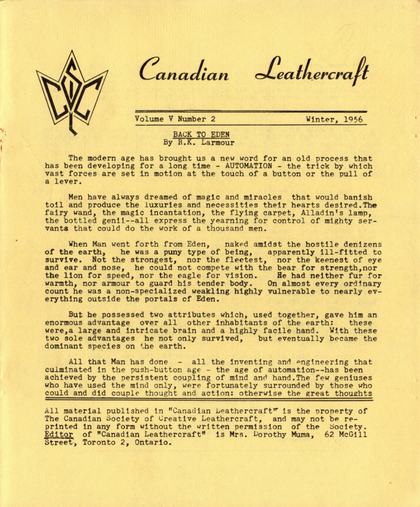
(12 pages, 2.4 MB)
the full-resolution scan, 34 MB, for close research
Page 1 — BACK TO EDEN
Canadian Leathercraft
Volume V Number 2 Winter, 1956
BACK TO EDEN
By R.K. Larmour
The modern age has brought us a new word for an old process that has been developing for a long time - AUTOMATION - the trick by which vast forces are set in motion at the touch of a button or the pull of a lever.
Men have always dreamed of magic and miracles that would banish toil and produce the luxuries and necessities their hearts desired.The fairy wand, the magic incantation, the flying carpet, Alladin's lamp, the bottled genii--all express the yearning for control of mighty servants that could do the work of a thousand men.
When Man went forth from Eden, naked amidst the hostile denizens of the earth, he was a puny type of being, apparently ill-fitted to survive. Not the strongest, nor the fleetest, nor the keenest of eye and ear and nose, he could not compete with the bear for strength,nor the lion for speed, nor the eagle for vision. He had neither fur for warmth, nor armour to guard his tender body. On almost every ordinary count he was a non-Specialized weakling highly vulnerable to nearly everything outside the portals of Eden.
But he possessed two attributes which, used together, gave him an enormous advantage over all other inhabitants of the earth: these were,a large and intricate brain and a highly facile hand. With these two sole advantages he not only survived, but eventually became the dominant species on the earth.
All that Man has done - all the inventing and engineering that culminated in the push-button age - the age of automation--has been achieved by the persistent coupling of mind and hand.The few geniuses who have used the mind only, were fortunately surrounded by those who could and did couple thought and action: otherwise the great thoughts
All material published in "Canadian Leathercraft" is the property of The Canadian Society of Creative Leathercraft, and may not be reprinted in any form without the written permission of the society. Editor of "Canadian Leathercraft" is Mrs. Dorothy Muma, 62 McGill Street, Toronto 2, Ontario.
[The masthead "Canadian Leathercraft" is printed beside the Society's maple-leaf monogram, set out here too.]
Page 2
would have proven abortive -- would never have come to fruition. Today, when we no longer eat our bread in the sweat of our face, when we can sit in leisure and by only the effort of pushing a button, control our machines, our heating, our lighting, our transportation, our communications, and even our mathematical calculations; when we labor with our automatic machines only 40 of the 168 hours each week, we seem to be edging our way rather quickly back into the long lost Garden.
The mighty problem we must face is - what shall we do when we are fully reinstated in Eden? Will we lie in air-conditioned ease beneath the tree and let manna fall into our mouths? Will we sit with folded hands and think high and noble thoughts as our sole activity?In brief, will we be content to vegetate throughout the ever-lengthening span of life that seems to be ahead. We need to find some sort of answer soon because already we have one foot over the threshold of Eden.
The great conjunction of mind and hand which in active use through untold centuries has made Man a creative being, cannot be destroyed without destroying Man as he is today. Man must remain a creator, or perish. He must forever strive to make ideas grow into things, under his hand. Thought and action are inseparably coupled and together they make modern man. Separate them and we get two other sorts of being - the mystic, the dreamer, the neurotic on the one hand, and the aimless, unthinking beast on the other hand. Already we have them -- too many who think without acting or act without thinking.
We must go on creating things - things great or small, lasting or fugitive, beautiful or homely, because into each thing that takes form and substance under the hand, there enters some quality conceived in the mind of the maker - some ethereal part of the artisan - some fragment of a dream brought to reality.
If we need shed less sweat in the sordid business of earning our daily bread, so much the better -- we can afford to sweat more over things that satisfy the deep creative urge of Man, the urge that has made us what we are today.
When the mind is busy directing the hand, the ear is deaf to the wiles of the Serpent, and perhaps we may in the end be able to dwell happily in the Garden.
HANDICRAFT LEATHERS AND SUPPLIES
Fine Assortment of Beautiful Leathers
Largest Range of Leathercraft Tools and Accessories
All inclusive Specialized Leathercraft Catalogue
Experienced Personalized Service
THE BIRT SADDLERY CO. LTD. 519 Main Street Winnipeg 2, Manitoba
[The page hyphenates "communications" across a line end, "comm-/unications", and it is set here as one word.]
Page 3 — THOUGHTS ON TEACHING LEATHERCRAFT
THOUGHTS ON TEACHING LEATHERCRAFT
By Don MacKinnon
Our last article on teaching leathercraft dealt mainly with the studio-type classes. In response to the interest shown and the evident need for more articles on teaching, the Editor interviewed Don MacKinnon, well-known leathercraft teacher, regarding the teaching of public-type classes such as community centers, etc. Comments on these articles would be welcome and helpful to other teachers.
The technique of handling public classes comes in good part by experience. Small groups, even at low rates of pay, should be taken for the experience value by anyone desiring to teach. Large groups are very difficult for beginning teachers to take care of adequately and should, therefore, be avoided at first.
In laying out a leathercraft course for public classes such as a community center, special methods must be employed. The classes are usually much larger and require quite different techniques in handling.
Another consideration which must be taken into account is the age of the students. Teachers of adult classes must know the "why" answers because this is what adults will ask. The teacher must do a great deal of between-class preparation as well as pre-course preparation. The teacher must have sufficient skill in the craft to show how it is done, emphasizing the idea that experience will improve the students! techniques. Children present the need for a completely different approach. They must have projects which will be completed in about an hour or at least in one lesson. Some adult beginners require this type of project also, but the items must be useful and bring out some special technique which will lead them further into leathercraft.
At the beginning of the course, the first lesson, for best results, should include a conference period, during which the teacher can find out what experience the members of the class have had and what projects they particularly have in mind to do. Remember that each person is an individual and should be treated as such.For most participants the leathercraft class is taken for amusement only and interest must be sustained throughout if the course is to be successful.
Long demonstrations of techniques are not necessary. A short demonstration by the teacher, with perhaps one student working along with him, will be sufficient. The other students should watch carefully and questions should be encouraged. Have those who know the techniques teach them to others in the class. Some slower students will naturally require more attention than the quicker ones, but the latter can be of great help to the former and in doing so, be of assistance to the teacher as well.
[The typescript prints "improve the students! techniques" — an exclamation mark where an apostrophe (students') is plainly meant, most likely a slipped key on the typewriter. Kept as printed.]
Page 4
Many people want to begin with projects which are much beyond their ability and knowledge. Some way must be found to put the projects off until the student has acquired the necessary skill. This can usually be done by finding another project in which they are interested and simplifying it, but including techniques which will lead up to the more difficult project.
Some parts of the course will of necessity be more hurried than others. This is especially true of the period immediately preceding Christmas. Everyone wants to make their Christmas gifts of leather. In this period,take advantage of the shortness of time by using small projects. These must be quickly made but of good appearance. At a later time, after the rush of the holiday season is over, larger projects may be taken care of.Try to get this idea across to the class, especially to those who wish to start out on large items.
Another problem with beginners is the desire to overdecorate. In these cases, lectures on design would be lost because the student is not ready for it. They have not learned the use of the tools and materials and would not understand what makes good leathercraft design. Try to lead them away from overdecoration by suggestions of slight changes in their design. Throughout the course, suggestions can be made on this subject without going too deeply into the field of design as such. Most students will eventually come to the place where they will know what good design is and will wish to produce it in their own work. Many early pieces will be a little overdecorated but if the teacher will guide the student, but not push him, he will soon turn out work which is simpler and of better design. Make sure the student learns his tools and their uses before insisting on original design.
Much attention must be given to the use of materials and tools. Give plenty of information on choice of materials,what is available, and what is good of this. The theory of leathercraft generally should be explained, giving facts on tannages, types of leather, meanings of the most common terms used, and so on. This could form part of the first lesson conference period, or it could be part of each lesson. Do not oversell them on materials and tools, especially the latter. They will buy the tools needed when they are ready for them, and to be rushed into it would merely overwhelm them. If possible, the teacher should handle all materials in order that the class will get the best for the projects they are doing. A good way to acquaint them with materials is to give them scrap leather and see what they can make from it. This will also test their ingenuity and ability at pattern making.
Insist on their making a pattern for all projects, even if a commercial pattern is available. Point out that what works in one weight leather will not necessarily work in another and all patterns should, therefore, be tested. Help them learn to allow in their patterns for differing thicknesses of materials. Have them assemble the pattern and make all adjustments in it before the leather is cut.
Page 5
To get the best work out of a class, you must also be something of a psychologist. Try to study the personalities of the students and fit the program to them. If the course suits the students, they will keep on coming. If interest is not sustained, many will drop out and this will be to the teacher's discredit.
Encouragement plays a large part in the success of any course. Beginners need plenty of encouragement. Always take the attitude that they can improve, and stress the good points in whatever work they have done so far. If they feel they are hopeless, they will lose interest.
Where the student has had previous experience, he may show poor techniques on certain projects. For the moment, instead of trying to correct all the faulty techniques at once, give him an altogether different type of project to do, later returning to the original projects as if they were entirely new ones. This method will generally succeed in correcting wrong techniques in such a way that the student will feel no adverse criticism.
To sum up, the role of the teacher must constantly be that of guide, leading the students to correct leathercraft and design techniques gradually. There will always be some who drop out midway in the course, but those who are left offer the greatest challenge to the teacher's ability and will probably prove to turn out the best work.
Our Catalogue Club
provides a valuable service for you.
FOR INFORMATION
Write to:
Clarke E Clarke leathers
| BARRIE | ONTARIO |
| BRANCHES | |
| MONTREAL | TORONTO |
| (636 Dorchester St. W.) | (523 Mt. Pleasant Rd.) |
Page 6 — LEATHERCRAFT SALE - CANADIAN HANDICRAFTS GUILD - TORONTO
LEATHERCRAFT SALE - CANADIAN HANDICRAFTS GUILD - TORONTO November 18 and 19, 1955
The Christmas shopping public was definitely interested in the C.S.C.L. sale of handmade leather articles. With very little advertising and publicity, except by word of mouth, 1,000 printed invitations and the special window display at the Guild Store on Bloor Street, it was surprising and gratifying to find the sale so well patronized. Members who assisted were convinced that the public response was sufficiently encouraging to warrant it becoming an annual event,to be held in late November or early December, an event which would be expected and planned for by Christmas shoppers.
Since this was our first venture in the selling field, except for the slight experience gained at our sales booth at the second International Hobby Show, it was difficult to estimate the response, either from the buying public or our craftsmen. It was considered an experiment, the results of which would indicate whether it should be carried on or dropped.No great effort was put into advertising and publicity, since we did not know how much we would have to sell. Nor was any pressure put on our craftsmen, since we did not know how sales would go,even With a good stock on hand. We have learned a number of valuable lessons,and we now feel we can make definite plans for next year, with more realistic suggestions to our craftsmen and more vigorous sales promotion.
From an analysis of the sales, together with requests, comments and criticisms during the sale, we have arrived at the following conclusions.
Simplicity in design and harmonious colors compatible with leather were features of the articles which sold readily. Harsh brilliant colors and overdecoration, particularly western floral motifs, were generally ignored, unless exceptionally well done. We were catering to a discriminating public, who, although they may not have had any leather background,were very conscious of good.workmanship and pleasing design.
There was a lack of variety -- too many articles of a type -- not enough imagination in the low-priced pieces. Sales would have been much higher had there been a wider selection of articles, particularly those under $5.00. Any pieces departing from the run-of-the-mill 'type were quickly snapped up. More stress should have been put on articles for men. The majority of shoppers were women, many looking for gifts for their men.
Canadian motifs in decoration were greatly in demand, particularly for overseas gifts. The maple leaf, from which we have been struggling to escape, seemed to represent "Canada" to many purchasers. We should be on the alert for designs which would be considered Canadian, particularly for the overseas trade.
Page 7
The selection in belts was poor on the whole, both in design and craftsmanship. The basket weave stamp was much overdone. Belts in natural leather had little eye appeal, and were generally avoided. Large, more expensive pieces such as handbags did not sell this year. However, in planning future sales, we should provide a selection of high grade articles. As this sale becomes more widely known, we might encourage and expect a greater demand for superior leather goods.
There were requests for comb cases, cigarette cases, wrist watch straps, glasses cases, stamp and ticket holders, simple sewing kits, and a variety of other small articles, which we could not supply. We had no boxes, utility cases, cosmetic cases, passport cases, message pads, book covers, small ring notebooks, desk accessories, etc. Two toy animals, on display in the window, were sold before the sale opened. These stuffed leather animals had.a particular appeal for durability, softness and cleanliness, and could be made quite a feature in future sales.
Of our total membership of over 300, only 21 craftsmen, approximately 7.5%, sent in articles.This response was extremely disappointing, particularly since a great number of our better craftsmen were not represented. Consequently many of the articles on sale were not of the quality in design and workmanship, which have come to be associated with C.S.C.L. standards.
The following table tells the story clearly:
| Price | Articles submitted | Articles sold | Articles returned |
|---|---|---|---|
| $1 and under | 439 | 349 | 90 |
| $1 - $5 | 140 | 58 | 82 |
| $5 - $10 | 52 | 9 | 43 |
| Over $10 | 13 | — | 13 |
| Totals | 644 | 416 | 228 |
[The table is printed in four columns, Price, Articles submitted, Articles sold, Articles returned; read down the sold and returned columns together instead of across, the two ran together and the sale's bottom line came out as "A1G 2Z8" where the page prints "416" and "228". The "Over $10" row prints a dash for Articles sold, meaning none of the 13 items over $10 sold; all 13 came back. It is set out here as four columns in the order the page prints them, and the totals check: 439+140+52+13 = 644 submitted, 349+58+9+0 = 416 sold, 90+82+43+13 = 228 returned.]
Total sales - $409.55. Friday sales $262.95; Saturday sales $146.60.
These figures show that the lower priced articles were most in demand. We would suggest that in planning your projects for the 1956 sales you watch for and experiment with new ideas in this category. Too many of the same type, even in this class, would defeat our purpose. Variety is essential to successful sales. For example, 37 wallets were submitted,10 sold; 30 keycases,13 sold; 13 changepurses, 1 sold; 27 belts, 8 sold.
The 10% commission collected on gross sales by C. S. C. L. just covered the cost of operation. As you are aware, a further 10% went to the Canadian Handicrafts Guild for the use of their facilities.
We cannot urge our members too strongly to start making use of their spare moments from now on for the 1956 sale. Even half a dozen articles from each craftsman would assure us of sufficient variety and quantity. We consider this sale a concrete and definite service to our members, which should merit their whole-hearted support.
Page 8 — ADDITION TO C.S.C.L. LIBRARY; ENTRIES FOR HIGHER MEMBERSHIP AWARDS; EXECUTIVE COUNCIL MEMBER PASSES; NOTICE REGARDING TEACHER QUALIFICATION
C.S.C.L. appreciated greatly the splendid cooperation given by the canadian Handicrafts Guild. Miss Betty Smith dressed the Guild window, Mr. S.G. Hazell turned over his office and facilities for our use, and Miss Lex Cullingham and staff helped us in every way possible, as well as publicizing the sale to their own clientele.
The Sales Committee wishes to express its sincere appreciation to those who sent in articles, and to all those who helped in arranging and conducting the sale.
information may be procured from the Secretary, Mrs. Louise Smyth, 40 Strathmore Blvd., Toronto 6, Ontario.
ADDITION TO C.S.C.L. LIBRARY
F.O. Baird has kindly sent a complimentary copy of his new book, "Design Artistry",to the C.S.C.L. Library, suitably inscribed. We greatly appreciate Mr. Baird's thoughtfulness in this.action and are sure good use will be made of this book.
At this moment, no opportunity has been available to have a review made of this book,but Don MacKinnon has promised us one for the next issue.
ENTRIES FOR HIGHER MEMBERSHIP AWARDS
With the date of the Annual Meeting fast approaching, those who wish to apply for Associate and Fellow memberships should remember that their qualifying submissions must be in the hands of the Committee by March 15th,so that judging can be completed before Annual Meeting time early in April. Application forms with full
EXECUTIVE COUNCIL MEMBER PASSES
We were sorry to hear of the passing of Mr. T.H. Kribs, who has served for the past year on our Executive Council. Mr. Kribs was an active Toronto leathercrafter and took part in most of the meetings of the Toronto Guild. He will be missed by both the C.S.C.L. Executive and the Toronto Guild.
NOTICE REGARDING TEACHER QUALIFICATION
The Committee appointed to set up qualifying standards for leathercraft teachers and establish a file of such teachers in our Society wish to inform all those who responded so well to their invitation for applications that work is being done and that a satisfactory system is well underway to completion. The work of the Committee has been seriously delayed, however, because of the necessity of doing all the work by telephone and correspondence. We hope to have a report for the Annual Meeting in April.
[The reading first published here gave the Executive Council member's initials as "T.4."; the typescript reads T.H. Kribs, the H struck over, and is corrected here; the page itself is unchanged.]
[This issue's typewriter carries several capitals struck high above the line — the "B" of "Blvd.", and "Committee", "Secretary" and others through the same paragraph — set out here as ordinary capitals, no word changed.]
Page 9 — USING HAIR CALF
USING HAIR CALF
By Don MacKinnon
One of the most decorative types of craft leather is hair calf.
This is known by various terms such as "slunk", "hair-on-calf",
"deacon", etc. These terms are sometimes used interchangeably, but actually denote different ages of the animals from which the hides came. True "slunk" is skin from a calf killed before birth, while "deacon" is calf that may be several days old. For good slunk, the hide must be taken at just the right time, otherwise spots will result which appear to be moth holes but are only places on which the hair has not yet grown. Deacon will generally have much longer hair than slunk.
Another factor in the length of hair and the fineness of the leather itself is the type of cattle from which the hide was taken. Beef cattle have tougher hides and coarser hair' than the dairy cattle. Beef cattle have developed this type of hide because of their range life,while dairy cattle lead a more sheltered existence and do not require such a coarse hide. Different breeds of cattle im each type also have different markings and weights of hair. For instance, the shorthorn hide often shows a wavy characteristic in the hair, making for a beautiful calf skin.
Slunk is most useful only as a decorative leather in combination with other leathers. A whole bag of slunk would be very difficult to make satisfactorily. Lacing presents a problem because in cutting the lacing slits the hair is cut too, sometimes to the point where it is too short to cover the edge. There 1s also difficulty in seeing the slits once they are cut. The lacing itself will often pull the hairs to the underside, leaving bare patches. Except for very thick hides, slunk cannot be skived, because this will loosen the hair, causing it to fall out. Even the thick hides should not be skived much.
The best way to make a bag using slunk is to use an overlay designed of other leather to tone with the shades of the slunk. For this type of decoration a complete picture of the finished project must be clear in your mind along with possible adaptations of it. This is necessary in order to take fullest advantage of the pattern of color on the slunk. It is best to draft a pattern out before buying the skin, then choose one which particularly suits the pattern and layout for color, areas of decoration, etc. You must be prepared to have a good deal of waste in relation to the size of the hide.
A full border of leather should cover all edges to be stitched or laced, making a frame around the slunk panels. Do not use slunk on the back of shoulder or over-arm bags because of the wear on these sections. Use plain leather for gussets and main parts of the straps. Arrange slunk in the panels so that the hair runs downwards.
Page 10 — MOULDED LEATHER TRAYS
All drawing must be done on the flesh side of the skin, as no marks will show on the hair side. Check all markings carefully before cutting and be careful to avoid any bare spots in the hair side, or place pattern so that they come on a portion to be overlaid. Stiffener must be used because of the soft nature of the leather, unless a drawstring type of bag is being made. Drawstring bags require a stiff base and are best if the sides are overlaid part of the way up.
Other uses for slunk include belts, boxes, vests, sleeveless jackets, lamp bases, cuffs and ties. Belts should have the edges bound with smooth leather and a leather tongue should be used. In covering boxes and lamp bases, great care must be taken in measurements so that the edges meet exactly, as no skiving can be done.
Sewing of slunk presents particular difficulties because the hair causes slipping against other leathers.There is no satisfactory way of gluing on to slunk and all edges must be sewed or laced. One method suggested which holds the pieces together to some extent for sewing, is the use of shoemaker's tacks. These are hammered through all thicknesses on to a hard surface, so that the points are flattened into tiny rivets.
In time, the white portions of the hide will become soiled. To clean them, use soft white bread crumbs or a soft art gum eraser.
The use of slunk presents many possibilities for the venturesome leathercraftsman, but it is one of the most difficult leathers to work with. The craftsman must be willing to take a loss on the hide; he must be prepared to do extremely careful work and make no mistakes in cutting; he must use care in selecting the skin he wishes to use. If he is prepared for all this, new adventures await him in the use of hair calf.
MOULDED LEATHER TRAYS
One of the two Canadian contributors to the current issue of McCall's Crafts Annual is the well-known leathercraftsman, Deane H. Russell. Deane Russell has long been recognized as an authority especially on the subject of moulded leather trays and his article dealing with these in this magazine is well worth obtaining. It is profusely illustrated, giving step-by-step instructions, as well as designs for shapes and decoration. The magazine sells for $1.00 and is full of many other crafts besides leather. Canadian leathercraftsmen particularly will be interested in this very good article by Deane H. Russell.
Page 11 — THE TRAVELLING EXHIBITION
THE TRAVELLING EXHIBITION
"Canadian Originals In Leather", the second Travelling Exhibition of our Society,has now been on tour since the beginning of March, 1954. It has been on display in 29 places -- Barrie, Kirkland Lake, Iroquois Falls, Timmins, Galt, London, Petrolia, Peterborough, Brockville, Oakville, Vancouver, Chatham, Brantford, Port arthur, Fort William, Atikokan, Winnipeg, Regina, Melfort, Georgetown, McMaster University, Belleville, Sackville, N.B., St.John, N.B., Kapuskasing, Marathon, Terrace Bay, R.C.A.F. Station at Roymount, Combemere.
For those of you who have not had a chance to see it, here are a few details about it. The exhibit contains 95 articles made by 36 members of our Society. The first Travelling Exhibition, called "Canadian Handmades In Leather", contained 58 pieces made by 18 members. It is to be hoped that we shall have an even greater representation of our members in the third Exhibition.
There are eight educational projects in the Second Travelling Exhibition -- Belt construction, Wallet Interiors, Handbag Interiors, Gusset Construction, Scroll Decoration, Knots and Braids, Leather Tooling Techniques, Handle Strap Tabs. Many host groups considered these projects the most valuable and instructive part of the Exhibition and have expressed the wish that such projects always be a feature of future displays. We would, therefore, greatly appreciate any suggestions that you, the members of our Society, might have for the next exhibition -- which we hope will be ready to start on tour in October of this year. 'Some groups are working without instruction of any kind. These especially, appreciate anything in the way of educational material.
Here is a comment from a letter we received:
"Thank you for making the Exhibition available to us.
I assure you it was a pleasure to us, and most instructive for our students. As you no doubt are aware, it seems to be the most artistic and best executed of any leather work in the country. I feel that your group need not be unduly modest about your achievements, for they speak for themselves." -- Prof. E.N. Roulston, Mount Allison
University, Sackville, N.B.
This is high praise indeed from the director of the School of Fine and Applied Arts, recognized as one of the best in Canada.
There are bookings still available between now and June, when 4t will be permanently broken up and the pieces returned to their owners. Bookings may be arranged through Mrs. Nora Huyck, Exhibitions Chairman, 96 Hounslow ave., Willowdale, Ontario.
Page 12
YES, It's TRUE! Ulustration (A) — a tool conjured up in our minds when asked this actual question not so long ago: "Have you a tool with a SPOON on one end and a PIN on the other ?"
Too often, beginner craft students don't bother to learn correct names for their tools. They seem content to order by catalog number alone, or by wild description, without realizing that learning of proper names for equipment is in itself an aid to better understanding of the special functions of /, a tool.
It's equally true that some of the finest decorative leathercraft in Canada today was produced with tools little better than tool "A" — tools quickly beaten from nails and crudely bound with cord or tape for handles. But such work represents exceptions — accomplished in spite of tools used, and only because of highly developed skill in tool manipulation by the craftsman.
It is our firm belief that such masters of leather modelling could increase their enjoyment of leather decorating, if not their already excellent work by becoming the proud owner of a new OVLS "Canadian Modeller-Tracer" (B) — developed after long study of over 30 different typical modellers from Europe and North America. Made of rustproof, nickel silver, individually hand finished — this one tool suffices for over 90% of all modelling needs.
A finely-designed and finished tool adds pleasure to any craft. Send for your "Canadian Modeller" today. Price $1.10 — postpaid. Groups may receive 12 for the price of 10°
Ottawa Valley Leathercraft Studios, 116 O'Connor St., Ottawa a CRAFT LEATHER DYES AND FINISHES 16 colors keyed to color originality Choose your color or create a new one SIX ANTIQUES FOR MELLOW AGED EFFECTS:
GOLDEN TAN HAVANA BROWN MAHOGANY
CHESTNUT BROWN ROUGE FOREST GREEN
TEN TONING DYES FOR FINE COLOR HARMONIES:
| YELLOW | BLUE TAN |
| ORANGE | LIGHT BLUE MIDDLE (Walnut) BROWN |
| SCARLET | GREEN BLACK DARK (Chocolate) BROWN |
POLISH COAT FOR SATIN-SMOOTH, WATER-RESISTANT FINISH
EDGE DRESSING AND INLAY BACKGROUND DYE for that final professional touch.
Ask for the GARNETT INSTRUCTION MANUAL at your hobby supply store.
Dealers write for information to:
GARNETT COMPANY
1 HANNAFORD STREET - TORONTO - Phone OXford 4587