
An issue of the Society’s newsletter, transcribed from the original.
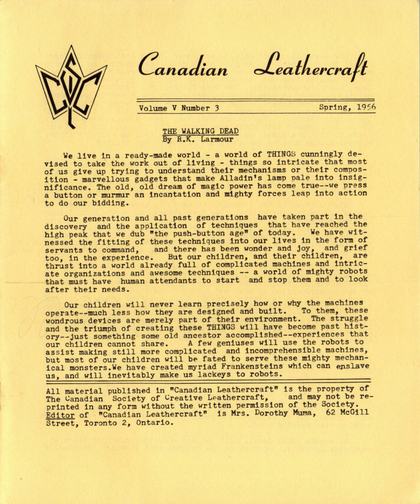
(12 pages, 2.4 MB)
the full-resolution scan, 34 MB, for close research
Page 1 — THE WALKING DEAD
Canadian Leathercraft
Volume V Number 3 Spring, 1956
THE WALKING DEAD
By R.K. Larmour
We live in a ready-made world - a world of THINGS cunningly devised to take the work out of living - things so intricate that most of us give up trying to understand their mechanisms or their composition - marvellous gadgets that make Alladin's lamp pale into insignificance. The old, old dream of magic power has come true--we press a button or murmur an incantation and mighty forces leap into action to do our bidding.
Our generation and all past generations have taken part in the discovery and the application of techniques that have reached the high peak that we dub "the push-button age" of today. We have witnessed the fitting of these techniques into our lives in the form of servants to command, and there has been wonder and joy, and grief too, in the experience. But our children, and their children, are thrust into a world already full of complicated machines and intricate organizations and awesome techniques -- a world of mighty robots that must have human attendants to start and stop them and to look after their needs.
Our children will never learn precisely how or why the machines operate--much less how they are designed and built. To them, these wondrous devices are merely part of their environment. The struggle and the triumph of creating these THINGS will have become past history--just something some old ancestor accomplished--experiences that our children cannot share. A few geniuses will use the robots to assist making still more complicated and incomprehensible machines, but most of our children will be fated to serve these mighty mechanical monsters.We have created myriad Frankensteins which can enslave us, and will inevitably make us lackeys to robots.
All material published in "Canadian Leathercraft" is the property of The Canadian Society of Creative Leathercraft, and may not be reprinted in any form without the written permission of the Society. Editor of "Canadian Leathercraft" is Mrs. Dorothy Muma, 62 McGill Street, Toronto 2, Ontario.
["wonder and joy, and erief too" reads on the page as "and grief too".]
Page 2
Nor does this apply only to machines: our social organizations travel the same road. We have built great corporations in order to make the best use of our robots; we have built great cities so that we can benefit from our techniques with electricity, heat, refrigeration, fast transportation; we have founded great states, and great nations in order to gain by collective effort the benefits made possible by our techniques. The architects of these organizations knew the joy of making dreams come true -- the satisfaction of translating ideas into actions. But to our children, these things are just part of the environment into which they happened to be born, and they must learn to fit themselves as well as they can into an existing state, without having much to say about how or why it was created.
The more mechanized, and the more organized we become, the less chance will there be for any but geniuses amongst our children to experience the joy of seeing a brainchild come to life; most of them will become mere ciphers in an intricate pattern to which they are forced to conform.
The progress of Man through the ages is marked by a series of partial triumphs over Nature. We have always had to yield to Nature in some things such as birth, death and hunger -- but in many other facets of living we have steadily tried, with considerable success, to bend Nature to our needs. Out of the raw matter of the earth we have fashioned innumerable things that are Man's and his alone --we have created things for our protection, our comfort and our pleasure.
Nature has the first and the last word, as to when we come and when we go, but while we live our allotted span we can transcend Nature--we can be creators.The awareness of this power to create things by the coupled action of mind and hand -- this transcendence over all other animate and inanimate objects, has been the greatest driving force of human history. Based on the power to create, it is best expressed in creative action. Buf if for any reason creativity is denied or thwarted, transcendence may be expressed by destructiveness. The act of destroying life or things others have created is the undesirable manifestation of transcendence that leads to violence and war.
In our Western society our laws curb the destructive urge of the individual fairly successfully and hence when neither creative nor destructive acts can be indulged in, Man becomes estranged from the material world and ends by being first frustrated, then bored. Boredom is a condition unique to Man. In boredom, the victim loses incentive - his capacity to feel joy or grief, pride or shame, declines or even disappears. He has lost the élan vital. His most precious human quality--aliveness--has died down to a flicker or less. He functions as an animal but is defunct as a human--he has joined the ranks of the zombies--the walking dead.
No wonder that nearly half of our hospital beds are taken by psychotic patients, Or that in the nations most advanced technically
Page 3
there is the highest incidence of suicide and alcoholism.Anything is better than enduring the tensions, the frustrations, the boredom of living. And it will become worse as our push-button age advances.
The handicrafts are an island of hope in a sea of despair, because in them Man can still exercise the liason of mind and hand in creating things for his own satisfaction and use. Here in the handcrafts Man asserts his mastery over things--escapes the fatal subservience to the machine -- confirms his human transcendence and avoids boredom, the fate of the walking dead.
We cannot give up the wondrous THINGS we have created and revert to a primitive state. We must learn to live with them because they are useful. But let us realize that our children must be carefully taught how to nurture the creative urge and keep alive that mighty human quality that can make life in a mechanical age endurable and happy. What seems to us now merely a pleasant recreational pursuit may become, in the near future, a stark necessity for our children. The handcrafts will be the last area of human activity in which Man can find relief from automation and preserve his transcendent creative powers,
(The above was the Retiring President's address delivered by Dr. R.K. Larmour at the Annual Meeting on April 21st.)
THE BIGGEST 50¢ VALUE IN LEATHERCRAFT
[This is a boxed advertisement, printed in large display type ("50" with a small raised "¢" for cents); set out here as running text.]
JOIN CLARKE & CLARKE LEATHERS CATALOGUE CLUB For Information, Write:
Clarke & Clarke Leathers
BARRIE — ONTARIO
TORONTO—523 MOUNT PLEASANT RD. * MONTREAL—636 DORCHESTER ST. WEST
["the liason of mind and hand" is the spelling the Society uses throughout this issue, including the Executive Council's "Canadian Handicrafts Liason" on page 8, and is left as printed. The lines below the address are a display advertisement for Clarke & Clarke Leathers, set in an ornamental type too worn to make out in full.]
Page 4 — BOOK REVIEW
BOOK REVIEW
"Design Artistry" by F.O. Baird, Reviewed by Don MacKinnon
For many years past we have been fortunate in being allowed a sort of front seat: in which to observe the amazing development of leathercraft in North America and particularly in Canada. It is a far cry to the time when we managed to secure a copy (after much heart-breaking search) of a book on leather carving designs called "Leather Art" by a man named F.O. Baird, probably one of the first copies of this work to enter Canada and one of the first books published for the benefit of the leather carver. Then the search for tools and the trouble learning to use them,not to mention the spikes ruined trying to make saddle stamps.
From time to time, as the craft of leather carving developed, many books and patterns were offered to the craftsman,many of merit, some horrible to behold and some that shouldn't happen to a dog. Through all this spattering of fire, F.O. Baird occasionally brought up the heavy stuff and let drive, when one and all sat up and took notice. He has done it again with the new work "Design Artistry", proving conclusively that all old soldiers do not fade away. Baird just matures and blooms.
In his introduction inside the front cover of "Design Artistry" the author uses becoming modesty,but there is plenty of meat in these words which could be read over and over, then carefully digested. It soon becomes apparent that this work is not so much for the copyist as for the poor soul with a craving to do his own designing and not knowing where or how to start. While there is plenty of material for those who only want to copy, the book is utterly lacking designs for "geetar cowboy" gear. Praise be.
Page 1 is devoted mainly to equipment and the laying down of ba- Sic lines. Page 2 is devoted to radiating lines and their application, while Page 3 is mainly concerned with flower designing and development. Thence to Page 4 with the suggestions for flowers and leaves which fire the imagination. Then comes an amazing page on the handling of the Acanthus,which is beyond value for inspiration and study.
From here to "THE END" will be found pages of figures, designs, suggestions, enough to suit the most discriminating student. Herein will be found ideas for the decorating of most leathercraft projects, simple or complex, AND very much in keeping with the trend in modern design. While not the beginning or the end, "Design Artistry" by F.O. Baird fills a long desired need among budding leathercraft designers. The book could provide the jumping-off place, the springboard from which to leap into the bombastic pool of "DESIGN". It undoubtedly has a place in the library of all sincere leathercrafters and well worth the effort to obtain it.
To F.O. Baird, may his shadow never grow less in the field of leathercraft. Salut.
Page 5 — CANADIAN HANDICRAFTS GUILD COMPETITION AND DISPLAY
CANADIAN HANDICRAFTS GUILD COMPETITION AND DISPLAY C.N.E., August 24th to September 8th, 1956
This important competition has added three new prizes to its list, the last three in the detailed description below. Special attention should be paid to the Canadian Handicrafts Guild (Ontario) prize, which should be interesting to many of our members. It is designed to encourage craftsmen who have never before competed in a national competition, in the hope that it will bring in many new competitors.
Most original entry... $25.00 cash — donor, Women's Committee Canadian Handicrafts Guild
1st Prize, tooled or carved work... $15.00 credit note, Clarke and Clarke Leathers, Barrie, Ont.
1st Prize, neither tooled nor carved. Use any other treatment.... $15.00 credit note, Lewis Craft Supplies Limited, Toronto.
1st Prize, best design, not more than 20% decoration.... $15.00 credit note, Ottawa Valley Leathercraft Studios, Ottawa, Ont.
1st Prize, leather gloves... $10.00 credit note, Lewis Craft Supplies Limited, Toronto.
*Any leather article of original design, but winner must never have won a prize in any national competition. Designate this on entry form:
1st Prize... $15.00 cash, donor Canadian Handicrafts Guild (Ontario)
2nd Prize... $10.00 cash, donor Canadian Handicrafts Guild (Ontario)
1st Prize, any leather article showing the best use of colouring techniques... $15.00 cash, donor, Garnett Company, Toronto.
[The prize list is printed as a two-column table with dot leaders: the class on the left, the prize and its donor on the right. Read straight across instead of column by column, the description of one class lands inside another's donor ("$15.00 credit note, Lewis Craft carved. Use any other Supplies Limited") and the words "treatment.", "ing techniques." and the whole starred Canadian Handicrafts Guild (Ontario) condition are left stranded. Set out below in the order the columns are meant to be read. Three further readings: "winner mist never have won" is "must"; "end Prize" is "2nd Prize"; and the two "toronto" in lower case are printed "Toronto".]
Entries will be accepted only from August 6th to August 11th inclusive from 9:30 a.m. to 5:30 p.m. at the Canadian Handicrafts Guild Shop, 77 Bloor Street West, Toronto. There is no entry fee.
Articles should be sent prepaid,and will be returned prepaid by the Handicrafts Guild.
Please note that this is an entirely different competition to the "Handicrafts, Women's Division, Leather Class, C.N.E." listed in the C.N.E. Prize List.
The response of our craftsmen to this competition has made it an important feature of the C.H.G. display, and it has now become the Show-window for the best in Canadian leathercraft. It is expected that with an increasingly large entry each year, and with the standards maintained and steadily improved, the prize list will be augmented
Page 6 — NEW FELLOW AND ASSOCIATES; ANNUAL REPORTS
still further. Remember that there must be a sufficient entry in each class to warrant the awarding of a prize. For our members this is an excellent opportunity to further the field of Canadian leathercraft. Prize winning entries will be shown, and as many more as space will permit. To have your work displayed will bring credit to you as a craftsman, even though do not win a prize.
Entry forms will be forwarded toward the end of May to those members whom we think most likely to compete. If you do not receive one, write either to Mrs. Reta Larmour, 59 High Park Blvd.,Toronto 3, or to the Canadian Handicrafts Guild, 77 Bloor St. West, Toronto 5.
NEW FELLOW AND ASSOCIATES
At the Annual Meeting April 21st, Mrs. Clara Cavanagh of Barrie,
Ontario, was elected a Fellow member.
The following were elected Associate members: Winifred Barratt, Toronto; Ethelwyn Carlyle, Brantford; Anne Hook, Toronto; James V. McClung, Timmins; Louisa McMichael, Lorne Park; Edith Melchior, Port Burwell; Gladys Mortimer, Peterborough; Olivia Smith, Toronto; Louise Smyth, Toronto; Kay Yasunaka, Hamilton.
It was pointed out that a number of there members could probably have attained these ratings if work had been submitted by them, and they are urged to try for qualification next year.
ANNUAL REPORTS
Membership: Although reminders were sent out to delinquent members, only a small proportion of these renewed their memberships. Consequently, there has been a decline in membership over the past year.
Exhibitions: A full report of the Travelling Exhibition has appeared in a previous issue of "Canadian Leathercraft". The next Travelling Exhibition is to be assembled about October, 1956, and all members are asked to keep this in mind for entries.
Editorial: More interest in the Bulletin by the general membership would be of great help to the Editorial Board, and members should send in any information about activities and suggestions. An Assistant Editor is to be elected to help in this.
Advertising: More advertising is needed if the Bulletin is to be self-supporting. Members should mention "Canadian Leathercraft" when buying from advertisers as this will encourage advertisers to continue in the Bulletin.
[The heading is NEW FELLOW AND ASSOCIATES; "— AN" before it is stray marks, not text. Four further readings: Louisa McMichael is of Lorne Park, not "Lorre Park"; "there most be a sufficient entry" is "must"; "even though do not win a prize" is "even though you do not win a prize"; and the Guild's address ends "77 Bloor St. West, Toronto 5." — 5 is the postal zone, not a sentence of its own. "a number of there members" is printed as it stands.]
Page 7 — TEACHING STANDARDS
TEACHING STANDARDS
Over the past year it has been difficult to get the members of the Teaching Standards Committee together and all work has had to be done by telephone and correspondence. However, a set of standards for the grading of leathercraft teachers has been set up and approved by the Annual Meeting. This is as follows:
Knowledge and Craftsmanship:
Grade "C" (Elementary): One who is proficient in basic construction and finishing methods and has some knowledge of tooling or carving.
Grade "B" (Intermediate): One with (1) a certain minimum knowledge of leathers, tools, and handling of such. (2) a certain minimum knowledge of and ability in construction and finishing and either tooling or carving, or both. Associate membership standing will automatically establish a Grade "B" rating. Credentials should specify "Teacher of Leathercraft Grade B Tooling (or Carving)".
Grade "A" (Specialists): One with (1) a wide general knowledge of leathers, tools, and handling of such. (2) a wide general knowledge and skill in tooling, carving, color and construction techniques. Fellowship rating automatically establishes applicant in Grade A category.
[The three grades are printed as a hanging-indent table — the grade and its bracketed name in a narrow left column, the definition in a wide right one. Read straight across instead of column by column, the columns run together, splitting words across them ("finish(Elementary) ing methods") and stranding the parenthesised names on lines of their own. Set out below one grade to a paragraph. Two further readings: the first grade is "C", not "Cc", and Grade B's first requirement is numbered (1), not (2) — as printed, and as the Grade A entry below it does.]
Credentials should read "Teacher of Leathercraft, Grade A", Outstanding skills may be indicated for Specialist's rating. Teaching Ability:
The CSCL shall not be responsible for guaranteeing any individual's teaching ability. This shall be vouched for by his own record of experience listed on his credentials with references which can be investigated personally by any interested party.
The applicant's rating will be established by the Board of Selection of the CSCL from representative samples of work submitted by the applicant to demonstrate the degree of excellence and range of his leathercraft skills. Associate and Fellow members whose work has already been appraised by this Committee need only submit the application form for their rating and credentials as above.
This rating is subject to review and change at request of the applicant on the basis of new experience or training, or information not supplied on the original application form, or demonstrated in his submitted work.
On the reverse side of this Set of Standards will be the Teacher's Credentials giving information as to experience both in leathercraft and teaching generally.
Further announcements regarding submission of articles will be made later as machinery is set up for this purpose.
Page 8 — NEW EXECUTIVE; NEW CONSTITUTION
NEW EXECUTIVE
The following is the new Executive appointed at the Annual Meeting:
President: Mrs. Jean Newton, Toronto.
Vice-President: Mr. Fred Brown, Toronto.
Treasurer: Miss Olivia Smith, Toronto.
Recording Secretary: Miss Viola Harris, Toronto.
Corresponding Secretary: Miss Winifred Barratt, Toronto.
Executive Council: Past President, Dr. R.K. Larmour, ex-officio.
                   Exhibitions Chairman, Mrs. Nora Huyck.
                   Membership Chairman, Miss Elizabeth Prince.
                   Editor, Mrs. Dorothy Muma; Assistant, Mrs. Jean Agnew.
                   Advertising Chairman, Mr. A.W. Jeffery.
                   Teaching Standards, Mr. Robert Muma.
                   Canadian Handicrafts Liason, Mrs. Reta Larmour.
                   Others: Mrs. Anne Hooke; Mr. Don MacKinnon,
                           alternate, Mrs. May MacKinnon; Mr. Clyde
                           Johnston; Mr. Cecil Roebuck; Mr. Harold
                           Frost; Mr. Deane Russell.
                   Presiding Officers of Local Sections, and Regional Representatives will be ex-officio members of the Executive Council.
NEW CONSTITUTION
At the time of formation of CSCL, a constitution was drawn up in a tentative form. With the growth of the Society, this draft constitution has been found to be inadequate and at times unworkable. A committee was therefore appointed to re-draft the constitution and a tentative draft has been made. This draft constitution will be in effect for one year, after which time further revisions will be made as necessary. Then copies will be circulated to the membership for comments and suggestions, the final Constitution to be adopted at the next Annual Meeting.
HANDICRAFT LEATHERS AND SUPPLIES
Fine Assortment of Beautiful Leathers
Largest Range of Leathercraft Tools and Accessories All inclusive Specialized Leathercraft Catalogue Experienced Personalized Service
THE BIRT SADDLERY CO. LTD. 519 Main Street Winnipeg 2, Manitoba
[The Executive is printed one office to a line, e.g. "Recording Secretary:" and "Corresponding Secretary:", with "Executive Council:" heading the list below them, set out here as printed. The Society prints "Mrs. Anne Hooke" here and "Anne Hook" on page 6 of this same issue, and "Mrs. May MacKinnon" where its later memorial notice reads MAE MacKINNON; both are left exactly as printed.]
Page 9 — HAND SEWING
HAND SEWING
By Don MacKinnon
Part I
It is a sad commentary that we as Canadians find such a simple thing as the so-called saddle stitching such a terrific mystery. After all, it isn't so long ago that the practice of the shoemaker, cobbler and harness-maker were common knowledge and usually an awl and a wax end were part of the household equipment. However in these days of "tin-can cooks", mass produced clothing, canned music, etc., and the pressure of regimentation, such a homely virtue as doing for yourself could be lost sight of. The sturdiness of hand sewing could be thought out of place in the modern decor.
Hand stitching has a definite place in the view of the leathercrafter when at times it can be used to add just the right touch to finish off so many projects. Sizes of stitch and thread may be selected to "just suit" and add up where lacing leaves much to be desired. For the uninitiated, the following comments are offered.
Good hand sewing calls for good equipment. As in every other phase of leathercraft,there are particular tools and materials available to help give that professional touch to hand work. In this case the equipment is simple and inexpensive but very important.
SPACING OR OVERSTITCH WHEEL: Spacing wheels come in a number of sizes, each wheel making so many stitches to the inch. They range from No.4 (4 stitches to the inch) on up. To decide the most suitable number of stitches to the inch, take into account the size of the article, the weight of the leather and the weight of the thread. Larger articles as a rule require fewer stitches per inch and heavier thread. Be careful not to make your stitching holes too close together, as this weakens the leather. If you do not have a spacing wheel, holes may be marked with an awlpoint--using a ruler for measurement between holes, or with a pair of dividers, set at so many holes to the inch.
AWLS: A sabre-bladed harness-maker's awl is best for punching your stitching holes. It makes a diamond-shaped hole, and allows the thread to lie properly, the leather to fit snugly and the hole to close up well. It comes in a variety of sizes, making holes suitable to the weight of the thread. The awl hole must always be large enough to allow the needle and thread to pass through with reasonable ease. The best awl handles may be obtained from the harness-maker's suppliers, and from some craft and shoe findings stores, or from the local harness-maker. The awl points may be gotten from some craft stores or shoe findings suppliers. Curved awls are useful to punch angled sewing edges. If the proper awl is not available, a regular awl may be used. On light weight leather, holes may be punched on a sewing maching, set for wide spacing, and hand sewn later.
Page 10
NEEDLES: Harness-makers' needles, also obtainable at Harness-makers suppliers, some craft and shoe findings stores, are essential. The points are blunt, so they do not split the threads, and the eyes are constructed for easy threading. These also come in a number of sizes to suit the weight of the thread. Select a needle of a thickness slightly larger than the thread; for example, a 3-cord thread takes a needle about the thickness of a 4-cord thread.
In the past hog bristles were used in place of needles. As a substitute a thin wire bristle has been produced,which works reasonably well. These are used when both needles are put through the awl hole at the same time, and are also convenient when a curved awl has been used.
THREAD: Threads are of two types,machine thread and hand-laid thread. There is a real art in making the hand-laid thread, but the method is too difficult to describe in words and requires a number of illustrations. The technique is easily grasped in a demonstration.
Various weights of machine-made thread are available, which are made up of a certain number of cords of fine standard thread, such as 3-cord, composed of 3 strands, 4-cord, composed of 4 strands, etc.The thread is usually twisted counterclockwise,and some of it is pre-waxed. Select a thread suitable in thickness to the project to be sewn.
WAX: There are several types of wax for thread,but the most convenient and best is purified beeswax, which comes in a pressed cake form in a natural color. Threads should be well waxed before starting to sew, and also every so often while sewing,especially where the thread goes through the needle, or any other part which begins to fray.
STITCHING HORSE: Some apparatus for holding the article to be stitched is helpful. There are different types of stitching horses. Anything which can be devised to hold the article and leave the hands free for work makes for more rapid and easier manipulation. Your own knees may be found to be the handiest device.
THREADING THE NEEDLE: Even this simple operation can be improved by certain techniques. When using machine thread, fray out the ends with a blunt tool, wax well and roll to a point which will go through the eye of the needle. This is called a wax end.(See diagrams Page 11)
The needles can then be threaded in the ordinary way, but a method used by the old-time harness-makers locks the thread in the needle. To make this lock, slightly unravel your thread about three inches from the end. Between your thumb and forefinger, left hand, make a loop or sort of inverted U with this loosened section. The short end of the thread must be to the right. Place the point of the needle through the centre of the right hand thread,continuing through the centre of the left hand thread,closing the opening of the U. Push this U toward the eye of the needle,to about ¼" from the eye. Take the short end of the thread,put it through the eye of the needle not quite as far as it will go. Then take the needle in your left hand, the thread in your right hand, and jerk lightly to the right, pulling the two threads of the U over the eye of the needle, which will end up with the short end of the thread locked twice through the standing thread. The thread at the needle eye should be kept thoroughly waxed at all times. (See illustrations below).
Page 11 — RENEW YOUR MEMBERSHIP NOW!
[Below the paragraph above, the page carries a hand-drawn nine-panel diagram of the harness-maker's double lock, hand-lettered. Its captions are set out below in the order the panels are numbered. The diagram itself is not reproduced.]
1. Thread cut square. 2. Fray end with dull knife. 3. Twist to point. 4. Left Thumb — the loop 2" to 2½". 5. Needle thru centre of threads — 4½". 6. Pointed end thru needle eye. 7. Take up slack. 8. Pull long end to Right over needle eye. 9. Double lock completed.
To make clean, even stitches, special attention must be paid to the thread as the sewing progresses. Thread has a tendency to unravel, and to keep it tightly wound, develop the habit of giving the thread a half turn on the right hand needle at each stitch, in the direction in which the thread is twisted.
(Part II of this article, dealing with actual stitching and the finishing of the edges, will appear in the next issue.)
RENEW YOUR MEMBERSHIP NOW!
Page 12
YES, it's TRUE! Illustration (A) — a tool conjured up in our minds when asked this actual question not so long ago: "Have you a tool with a SPOON on one end and a PIN on the other ?"
Too often, beginner craft students don't bother to learn correct names for their tools. They seem content to order by catalog number alone, or by wild description, without realizing that learning of proper names for equipment is in itself an aid to better understanding of the special functions of a tool.
It's equally true that some of the finest decorative leathercraft in Canada today was produced with tools little better than tool "A" — tools quickly beaten from nails and crudely bound with cord or tape for handles. But such work represents exceptions — accomplished in spite of tools used, and only because of highly developed skill in tool manipulation by the craftsman.
It is our firm belief that such masters of leather modelling could increase their enjoyment of leather decorating, if not their already excellent work by becoming the proud owner of a new OVLS "Canadian Modeller-Tracer" (B) — developed after long study of over 30 different typical modellers from Europe and North America. Made of rustproof, a nickel silver, individually hand finished — this one tool suffices for over 90% of all modelling needs.
A finely-designed and finished tool adds pleasure to any craft. Send for your "Canadian Modeller" today. Price $1.10 — postpaid. Groups may receive 12 for the price of 10!
Ottawa Valley Leathercraft Studios, 116 O'Connor St., Ottawa a CRAFT LEATHER DYES AND FINISHES 16 colors keyed to color originality Choose your color or create a new one SIX ANTIQUES FOR MELLOW AGED EFFECTS:
GOLDEN TAN HAVANA BROWN MAHOGANY
CHESTNUT BROWN ROUGE FOREST GREEN
TEN TONING DYES FOR FINE COLOR HARMONIES:
| YELLOW | BLUE TAN |
| ORANGE | LIGHT BLUE MIDDLE (Walnut) BROWN |
| SCARLET | GREEN BLACK DARK (Chocolate) BROWN |
POLISH COAT FOR SATIN-SMOOTH, WATER-RESISTANT FINISH
EDGE DRESSING AND INLAY BACKGROUND DYE for that final professional touch.
Ask for the GARNETT INSTRUCTION MANUAL at your hobby supply store.
Dealers write for information to:
GARNETT COMPANY
1 HANNAFORD STREET: TORONTO - Phone OXford 4587