
An issue of the Society’s newsletter, transcribed from the original.
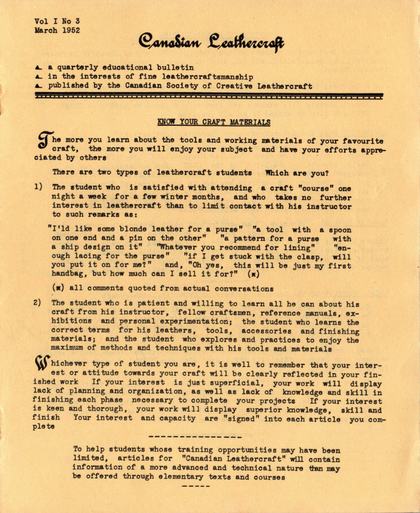
(12 pages, 2.3 MB)
the full-resolution scan, 36 MB, for close research
Page 1 — KNOW YOUR CRAFT MATERIALS
Vol I No 3
March 1952
Canadian Leathercraft
a quarterly educational bulletin
in the interests of fine leathercraftsmanship
published by the Canadian Society of Creative Leathercraft
KNOW YOUR CRAFT MATERIALS
The more you learn about the tools and working materials of your favourite craft, the more you will enjoy your subject and have your efforts appreciated by others
There are two types of leathercraft students Which are you?
1) The student who is satisfied with attending a craft "course" one night a week for a few winter months, and who takes no further interest in leathercraft than to limit contact with his instructor to such remarks as;
"I'ld like some blonde leather for a purse" "a tool with a spoon on one end and a pin on the other" "a pattern for a purse with a ship design on it" "Whatever you recommend for lining" "enough lacing for the purse" "if I get stuck with the clasp, will you put it on for me?" and, "Oh yes, this will be just my first handbag, but how much can I sell it for?" (x)
(x) all comments quoted from actual conversations
2) The student who is patient and willing to learn all he can about his craft from his instructor, fellow craftsmen, reference manuals, exhibitions and personal experimentation; the student who learns the correct terms for his leathers, tools, accessories and finishing materials; and the student who explores and practices to enjoy the maximum of methods and techniques with his tools and materials
Whichever type of student you are, it is well to remember that your interest or attitude towards your craft will be clearly reflected in your finished work If your interest is just superficial, your work will display lack of planning and organization, as well as lack of knowledge and skill in finishing each phase necessary to complete your projects If your interest is keen and thorough, your work will display superior knowledge, skill and finish Your interest and capacity are "signed" into each article you complete
To help students whose training opportunities may have been limited, articles for "Canadian Leathercraft" will contain information of a more advanced and technical nature than may be offered through elementary texts and courses
The masthead's three-line subtitle is set with a small decorative triangular bullet mark repeating at the start of each line, removed here where it does not belong in the prose ("...leathercraftsmanship a published by..."). "than" near the end of the opening article is printed in full. The masthead "Canadian Leathercraft", printed in large script above the three bulleted lines, is set out here too.
Page 2 — NOTICE OF ANNUAL MEETING; MEMBERSHIP DUES and Subscriptions to "Canadian Leathercraft" LOCAL SECTIONS of the Canadian Society of Creative Leathercraft
NOTICE OF ANNUAL MEETING
The Annual Meeting for members of the Canadian Society of Creative Leathercraft will be held FRIDAY, MAY 16, 8:00 PM, Room 2, Central YMCA, 40 College Street, Toronto
A Progress Review, New Program Planning, and a chance to meet fellow leathercraftsmen will be offered members able to attend this year's Annual Meeting All members are cordially invited to MARK YOUR CALENDAR and plan to attend if at all possible
MEMBERSHIP DUES and Subscriptions to "Canadian Leathercraft"
All membership fees become due on June 1st of each year Registered members only will receive "Canadian Leathercraft" the official quarterly educational bulletin of the CSCL New memberships may be accepted at any time throughout the year Registrations received prior to January 1st entitle members to back issues of the current volume of "CL" Members registering after January 1st will receive complimentary copies of "CL" from January to June, when their new membership-subscription term will commence
Special Notice - Because of an accident to early membership records, it is regretted that some members may not have received issues No 1 or No 2 of "CL" While every effort has been made to reconstruct original mailing lists as accurately as possible, should back issues of "CL" not yet have been received by any registered members, please report to the Secretary and your missing issues will be mailed promptly
LOCAL SECTIONS of the Canadian Society of Creative Leathercraft
The rapid growth of interest in "CSCL" affairs and services to Canadian leathercraftsmen, has prompted several major centres to consider organizing local sections in order to better co-ordinate their leathercraft interests with the activities of the national CSCL
Toronto, London and possibly Ottawa are among the centres whose leathercraftsmen may soon become officially affiliated with the "CSCL" through formation of local sections
As the Society's travelling display "Canadian Handmades in Leather" may demonstrate to other centres the unique scope of contemporary leathercraft in Canada, other centres may wish to plan for similar affiliation Inquiries regarding formation of local sections may be addressed to the Chairman, Membership Committee (address page 12)
Page 3 — Dyeing of Craft Leatherwork
Dyeing of Craft Leatherwork
R K Larmour
One of the greatest problems that confronts the amateur leathercraftsman is the final coloring and finishing of the completed object Unless he is willing to leave his work in the natural color of the leather, he must find some safe means for applying color of various shades and intensities And finally, when the color has been achieved, he must seal the surface and polish the whole project
Many of the dye preparations available have been made for the purpose of touching up or redyeing shoe and bag leathers, and as such they are intensely colored On vegetable tanned leathers, especially those in the light shades, such as are used for carving and tooling, they strike too hard, and it is most difficult to avoid streaks and splotchy end effects If applied too liberally, in an attempt to smooth out the color, a "metallic" effect, or as is sometimes called, "burning" results. What the amateur needs is a mild preparation which can be applied safely in successive coats until the correct color effect is achieved The antiques and particularly those in water medium, are by far the safest and the most satisfactory for the beginner to use
The "antiques" are differentiated from the straight pigment dyes by the fact that they are mixtures of solid and liquid: the solid part goes into the cuts and the background and even the grain of the leather, while the liquid dye colors the leather The excess solid can be wiped from the smooth parts of the work, leaving the cuts crevices and grain darkened by the solid, to yield the characteristic effect of age
The straight dyes, on the other hand, are uniform solutions of the dyestuff in various sorts of solvent These are used to yield uniform color Some differentiation can be obtained because the cuts fill up with the solution if it is applied liberally, and one can thus obtain a color darkening in various parts of the work, simply by different intensities of dyeing This effect is considered by many to be inferior to the aged appearance produced by the antiques
"a color" is printed as two words, run together here as "acolor".
Nearly all good leather dyes are "aniline" dyes They are for the most part reasonably fast to light and age They possess the great advantage of uniformity; that is to say, one specific dye will always be the same in coloring power and in shade, if supplied by a reputable manufacturer Consequently if the processor who makes the final preparation for the craftsman exercises proper precautions in formulation of the solutions or mixtures, great uniformity can be achieved
[This issue sets most paragraphs with a large decorative capital opening the first word. Three were missed here and are restored — "One" (the opening paragraph), "What" (a new paragraph starting mid-line), "The" (a third paragraph) — and "Swilling", two words run together, is given as "is willing". The byline's own space between "K" and "Larmour" was also read as an underscore; restored.]
Page 4
Dyes are put up for the craftsman in several forms, the principal being:
Type I - Aqueous (water) solutions and mixtures of solids and solutions
Type 2 - Spirit solutions
Type 3 - Oil solutions and mixtures
Type 4 - Oil-soluble dyes in various sorts of wax preparations either in pure solution or in mixtures of solution and solid
Type 5 - Water-soluble dyes in wax emulsions
Most of the popular "antiques" are of Type 4 With these the paste is rubbed over the work, allowed to stand for varying times, depending on the intensity of color required, when the excess is wiped off with a dry or a damp swab
The Type I dyes are by all odds the most satisfactory and the safest for the amateur to use, because the pieces can be scarcely irretrievable spoiled It is always possible to go over the work a number of times to improve the color effect and it is also safe to touch up various parts of the leather with other dyes to obtain unique and subtle color effects
The antiques of Type I are applied liberally with a soft brush, allowed to dry, and then the excess solid, together with some of the color, is wiped out with a damp swab, until the desired intensity of "antiquing" and of color is achieved Alternatively, the dark solid may be worked into the leather with a dry cotton swab to produce various intensities of shading Streaking, which may develop with the initial dye coat, can almost always be eliminated by wiping with a damp swab It is important that the leather be clean and free from grease, to permit the proper absorption of the dye Successive applications may be made as long as no waxing or another sort of protective finish is put on the leather
Particularly with the Type I dyes, include a scrap of the same leather to be dyed along with the main parts, so that at the end of the process this scrap can be treated with the polish coat in order to see what the final effect is going to be You might decide as a result of this test to put on another coat or two of dye Remember that once the polish coat is applied, it is no longer possible to do any further dyeing with the Type I dyes Remember also that the polish coat always clears and brightens the color It also protects the leather from damage during assembly
One of the outstanding advantages of the Type I finishes as compared with Types 4 and 5 is that they leave the background cuts and grain clean Solid or paste waxes inevitably tend to clog these areas, thus destroying much of the original contrast, from which much of the decorative effect is achieved
[Three more of this page's opening decorative capitals were missed, the same fault as the facing page, and are restored — "Most", "The", "One". Two more letters are dropped mid-word and restored: "some" and "once".]
Page 5 — NATURAL RUSSET LEATHERS
Spirit and oil dyes of Types 2 and 3 are useful, and indeed almost necessary for edging, for coloring the flesh side of the leather and for inlay work The low intensity Type I dyes do not give sufficient color for satisfactory application here. It should be pointed out that various natural russet craft leathers respond differently to aniline dyes, especially where the lighter hues are being sought and the dyeing is not carried to the ultimate end color Consequently, especially with the Type I dyes, the craftsman has at his disposal an almost infinite variety of shades and hues One of the most interesting aspects of experimenting with Type I dyes is the unusual effects which may be obtained by each individual craftsman.
ABOUT THE AUTHOR - Dr RK Larmour became interested in the problem of dyeing carved and tooled natural leathers through the activities of his wife, Reta Larmour, Secretary of the Canadian Society of Creative Leathercraft A research chemist by profession, he made extensive tests with all available dyes and with many not found on the Canadian market and he can, therefore, write with the authority of knowledge and experience
Editor's Note - Because of unexpected home moving by the author of the proposed series of articles on the subject of "Good Designing for Leathercraft" (mentioned in Bulletin No 2), the articles will commence with Bulletin No 1, Volume II (September) Other topics of interest and importance to decorative leathercraftsmen will be offered in the meantime
NATURAL RUSSET LEATHERS
A discussion about some important craft characteristics of russet leathers
PROBABLY NO OTHER TANNAGE OR FINISH OF LEATHER is so important to the decorative leathercraftsman
An understanding of the term "russet leather" is necessary for the student craftsman to appreciate its special craft possibilities The term "russet" suggests different meanings to different branches of the leather industry "Russet" may refer to color, or to tannage, or both Hides and skins which are subjected to the long and involved process of "vegetable" (bark) tanning are rendered into leather of a type most suitable for ornamenting and finishing with the hand tools and materials of the decorative leathercraftsman. When referring to color, it should be understood that no coloring agents are added to russet leathers during tanning Variations from light to dark
Three sentences on this page open with a decorative capital, as on pages 3 and 4 above: "An", "When", and "It should be pointed out" — the third of them mid-paragraph rather than at the start of one.
Page 6
natural russet result from different vegetable tanning extracts favoured by different tanneries for their special products Certain very light russet leathers may, however, undergo an extra "bleaching out" process
Skins, hides and sides which have been "vegetable tanned" but not further finished, are often referred to as being "in the crust" It is at this stage that serious grading or sorting is commenced for the many industrial, manufacturing and craft uses expected of russet leathers By far the greater bulk of vegetable tanned russet leathers whether calfskins, horsehides, cowhides, sheepskins, goatskins, pigskins, buffalo hides, seal skins and others, are made for industrial and manufacturing purposes, while selection for use by handcraftsmen is only incidental as far as volume of pieces tanned is concerned The natural russet finished leathers which are finally selected for fine personal leather goods and for use by decorative leathercraftsmen number well under 5% of the total of the many hundreds of thousands of pieces tanned each year
It is well, therefore, for the leathercraft instructor and student to keep this fact constantly in mind, as beginner leathercraftsmen are generally much too prone to insist that their craft leather be "blemish free" While industrial and manufacturing users of vegetable tanned russet leathers (as well as of colored bark tanned products) have many ways of using 2nd, 3rd, 4th, and even 5th grade leathers, they too must claim a reasonable share of the comparatively limited supply of #1 selection pieces completing the long process of making leather at the tannery Because of the numerous factors which may cause natural and accidental markings of hides and skins during growth (see article "What is Good Leather" Bulletin No 2), the finding of really "blemish free" skins or hides is so rare among tanners as to be all but a nil factor for those who, through ignorance, try to insist on "blemish free" super selections for all orders
The paper opens a new paragraph here with an ornamental drop-cap "I" ("It is well…"), read here as printed; the drop-cap is restored rather than left as the bare "t" it becomes without it.
IT IS UP TO THE CRAFTSMAN - to discover and understand the limitations of leather as a natural product, while, at the same time, recognizing the unique qualities which make leather such a challenging craft material Experience will suggest how numerous natural markings may be included in your work without detracting, but in some cases even enhancing the final appearance of a well planned, carefully worked and finished leathercraft article
Following are some important characteristics, problems and possibilities to explore when working with natural russet leathers:
Advantages - a good material for beginner students, as it shows in clear detail the effects of tooling upon leather
-- natural russet leathers offer the best medium for modelling, incising, embossing, carving, or stamping techniques for decorating
-- well planned and carefully worked, natural russet tooling and carving leathers can result in finished articles displaying the maximum of a craftsman's "capacity" with leather
A dropped decorative capital is restored: "$ kins" to "Skins".
Page 7
Problems - Natural russet leathers may soil easily while "making up" However, finger and tool stain marks may often be lifted with a mild bleaching solution (1 tablespoon of Oxalic Acid to 1 pint of water) When using any bleaching agent, take the precaution of wiping over work with clear water dampened swab, as any concentrate of bleaching agent left in the leather may seriously affect subsequent hand coloring operations
Oxidizing of Natural Russet Leathers - Some russet leathers "mellow" rapidly; all mellow eventually The same oxidizing process takes place on many light-to-medium dark toned leathers - particularly with aniline dyed leathers This effect, if produced evenly, is not necessarily undesirable In fact, it is often hoped and planned for by skillful craftsmen that their work appear more "mellow" after use over a period of weeks or months or even years
Often, however, beginners are disappointed when they plan to "leave their work natural" and expect it to stay in the same light tone after use for a season as when articles were first completed To learn what will happen to "natural" leather when left uncolored or when just superficially finished, students may observe the strong oxidizing effects of sunlight (or daylight) on russet leathers, by putting a strip in the window, half covered with a close fitting brown paper sleeve Pull the sleeve back a couple of inches every other day for a week and notice the distinct gradations of "mellowing" Multiply this effect of one week's sunning by the exposure a "natural finished" article will receive during a whole summer of outdoor use, and the beginner may think twice about leaving his work "natural"
Unless natural leathers are frequently refinished with cleaning solutions and neutral creams or waxes, they tend to absorb finger and hand marks which in time become so ingrained into the surface fibres as to permanently soil the original fresh appearance While there are methods which students may study and practise of applying clear shellacs, lacquers or waxes to natural russet articles, the more experienced craftsman prefers to treat his leathers with at least a light toning of coloring medium
EMBER - as different leathers take the same dyes differently, from piece to piece and even from area to area of the same hide, the careful craftsman will ALWAYS experiment or test on scrap leather of the type to be used in major projects
Fine leatherwork demands sufficient finishing time Therefore, remember also, that when you spend hours, days or weeks, designing, decorating, and preparing major work for assembly, you risk spoiling your work and wasting your time and materials if you rush your leathercraft finishing operations
The more you study the craft of hand coloring and finishing natural russet leathers, the more you will enjoy leathercraft and have your work admired by others
Page 8 — Travelling Exhibition of "Canadian Handmades in Leather"
Travelling Exhibition of "Canadian Handmades in Leather"
The hardworking committee of Toronto region executive members of the CSCL are beginning to feel well rewarded for their efforts in attending to the many details of organizing our first travelling display The exhibit planned to help field members study contemporary Canadian leatherwork, commenced its trial tour of Ontario centres February 20
Articles composing the display include: belts, wallets, needle case, pocket secretaries, change purses, lapel pins, chess box, jewel box, guest book and telephone book covers, writing case, book ends, blotter pads, handbags, shoulder bags A number of examples have won top awards at such major art-craft exhibitions as: Canadian National, Central Canada, Pacific National and the Toronto Art Gallery
While it was originally hoped to compose the display of examples of work from all sections of Canada, limits of time and resources available to the exhibition committee have prevented the organization of a display of more national scope and representation A revised edition of the display may be completed for the Western Canadian itinerary
The paper opens a new paragraph here with an ornamental drop-cap "W" ("While it was…"), read here as printed; the drop-cap is restored rather than left as the bare "hile" it becomes without it.
The effort in organizing "Canadian Handmades in Leather" has been entirely voluntary Articles have been contributed largely by members who have been active in the formation of the Canadian Society of Creative Leathercraft That our Society's first travelling exhibit is being well and enthusiastically received may best be demonstrated by the following extracts from reports of host groups who have already received the display --
From Mrs Margaret Jennings, President London Leather Carvers Guild "Everybody is amazed at the range of articles shown Many are interested in the creative phase of Canadian leathercraft The display will certainly give leathercraft a tremendous boost in this city and surrounding area"
From Miss Louise Colley, Executive Secretary, Simcoe County Arts and Crafts Association
"I am delighted to be able to tell you that the travelling exhibition of creative leathercraft provided for our members one of the most interesting meetings we have ever had People from nearly all over our county were present and were thrilled with the exhibition Our leathercraftsmen received a great deal of inspiration from this meeting From Cornwall - by a visiting reporter "....... The work viewed yesterday may easily give local artists urge and desire to create their own designs and has undoubtedly increased the interest in leathercraft in this city among the large crowd which visited the exhibition"
Page 9 — Let’s Try More Than Once
Garnett — Type I Aqueous Antique Dyes for Leather
Rouge, Golden Tan, Havana Brown, Chestnut Brown. Water Resistant Polish Coat.
Safe and easy to apply — ask your dealer for them. Garnett Company, 442 Spadina Avenue, Toronto.
Apple Blossom — A New Mumart Design, Matched Set No 5
A jaunty shoulder bag, billfold, keycase, and change purse — designs with complete instructions. Per sheet postpaid.... 50¢. Mumart Studios of Creative Leathercraft, 62 McGill Street, Toronto, Ontario.
Leather Goods is Our Business
Finest assortment of Beautiful Leathers, plus all leather craft tools, accessories and "Books of Instruction." Birt Saddlery Co. Ltd., 519 Main Street, Phone 923 565, Winnipeg, Man.
Studio of Leather Carving
Individual instruction in elementary and advanced leather carving. Custom designing & patterns — limited enrolment. D W MacKinnon, Studio, 6 Irwin Street, Toronto, Ontario.
Let’s Try More Than Once
From "Strictly Personal" by Sydney J Harris: "Those who still believe that creative artists sit around all day waiting for ‘inspiration’ ought to visit the British Museum and see the 75 drafts of Gray’s famous ‘Elegy Written in a Country Churchyard,’ which the poet rewrote 74 times before he was satisfied with it."
[This page carries four advertisements and a short reprinted item, none of them transcribed before. All are given here in full.]
Page 10
Quality Leather Supplies and Personalized Service.... Yours at Lewiscraft!
We are anxious to help you solve your Leathercraft needs and problems! Let us Air Mail to you, pamphlets showing the wide variety of leathers and tooling supplies we have to offer!
Write to-day to: Lewiscraft. "For Handicraft It’s Lewiscraft."
Mail Order Building, 8 Bathurst Street, Toronto, Ontario. Retail Store, 645 Yonge Street, Toronto, Ontario.
To Canadian Leathercraftsmen
You are cordially invited to write or visit our Studios to discuss your interests and needs in decorative leathercraft.
Fine craft leathers – selected leatherworking tools and accessories.
“A leathercraft service by leathercraft specialists.”
Ottawa Valley Leathercraft Studios, 116 O’Connor Street, Ottawa, Ontario. Write for catalog.
[This page carries two advertisements, not transcribed before. Both are given here in full.]
Page 11
Fine Craftsmanship Depends on Good Materials
Select your leather as carefully as you choose your design or pattern -- it is essential to your success
Horsfield's Hand Grained English Morocco is tanned, grained and finished by a craftsman of over 50 years experience Produced in bag substance or mossed back billfold -- in choice of ten colors
the paper prints "50 years" and "mossed".
Tooling and carving cowhide by Wickett & Craig, one of our finest Canadian tanners Renowned for its mellow texture and fine selection Available in sides, shoulders, bends or flanks
Genuine Russian Calf -- in bag or billfold weight, in natural russet, black and brown The perfection in tooling leather
LEATHER TOOLS - Our tools are custom made by manufacturers selected for their ability to produce fine tools
Buy with confidence, knowing that every item we sell is unconditionally guaranteed to give satisfaction
CORBEIL-HOOKE INC.
Handicraft and Artists Supplies of Quality 1218 Drummond Street
Page 12 — Mrs Margaret McFarlane, Weston, Ontario; CSCL EXECUTIVE
"Who's Who in Canadian Leathercraft"
(to acquaint field members of CSCL with the interests and achievements of fellow leathercraftsmen)
The page's own underlined heading and the parenthesis beneath it had been reduced here to "Canada eat."; restored from the printed page, the same words as `1951-december` p9.
Mrs Margaret McFarlane, Weston, Ontario
Mrs McFarlane has long been active in home and community programs, having acted as Home and School Association Vice- President; executive member of recreation councils; and instructor of crafts at summer schools Her early experiences with leathercraft include instructing for a YMCA group of leathercraft students
During the past four years, Mrs McFarlane has taught decorative leathercraft for recreation clubs of industrial firms This is her third year as President of the very active Weston Leathercraft Guild, which is affiliated with the Canadian Handicrafts Guild, Ontario Branch
At the meeting of charter members of the Canadian Society of Creative Leathercraft, Mrs McFarlane was chosen Vice-President of the Society She was re-elected to this office for a second term at the 1951 annual meeting of the Society Her interest and assistance in furthering the objectives of our Society are greatly appreciated by fellow executive members
Mrs McFarlane's wide and varied experiences in community education and welfare projects has served to convince her that most people should have a useful hobby and, while she has herself been interested in many crafts, she reports her greatest enjoyment and satisfactions have come through her practice of decorative leathercraft
[A small hand-drawn squiggle and a dashed double rule divide this profile from the Executive list below.]
CSCL EXECUTIVE
President and Editor "Canadian Leathercraft"
   Deane H Russell, 116 O'Connor Street, Ottawa
Vice-President, Mrs Margaret McFarlane, 1810 Lawrence Avenue West, Weston
Secretary, Mrs Reta Larmour, 59 High Park Boulevard, Toronto
Treasurer, Robert Muma, 62 McGill Street, Toronto
Chairman Membership Committee, Mrs Edith Roscoe, 277 King Street, Weston
Ottawa Member, Mrs Margaret Richardson, 364 Huron Avenue, Ottawa