
An issue of the Society’s newsletter, transcribed from the original.
(12 pages, 2.3 MB)
the full-resolution scan, 34 MB, for close research
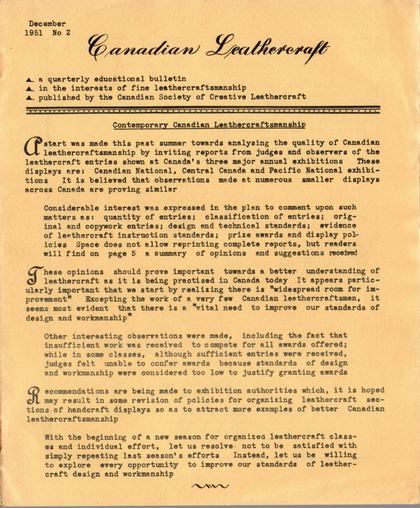
Page 1 — Contemporary Canadian Leathercraftsmanship
December 1951
No 2
Canadian Leathercraft a quarterly educational bulletin in the interests of fine leathercraftsmanship published by the Canadian Society of Creative Leathercraft
Contemporary Canadian Leathercraftsmanship
A start was made this past summer towards analysing the quality of Canadian leathercraftsmanship by inviting reports from judges and observers of the leathercraft entries shown at Canada's three major annual exhibitions These displays are: Canadian National, Central Canada and Pacific National exhibitions It is believed that observations made at numerous smaller displays across Canada are proving similar
Considerable interest was expressed in the plan to comment upon such matters as: quantity of entries; classification of entries; original and copywork entries; design and technical standards; evidence of leathercraft instruction standards; prize awards and display policies Space does not allow reprinting complete reports, but readers will find on page 5 a summary of opinions and suggestions received These opinions should prove important towards a better understanding of leathercraft as it is being practised in Canada today It appears particularly important that we start by realizing there is "widespread room for improvement" Excepting the work of a very few Canadian leathercraftsmen, it seems most evident that there is a "vital need to improve our standards of design and workmanship"
Other interesting observations were made, including the fact that insufficient work was received to compete for all awards offered; while in some classes, although sufficient entries were received, judges felt unable to confer awards because standards of design and workmanship were considered too low to justify granting awards Recommendations are being made to exhibition authorities which, it is hoped may result in some revision of policies for organizing leathercraft sections of handcraft displays so as to attract more examples of better Canadian leathercraftsmanship
With the beginning of a new season for organized leathercraft classes and individual effort, let us resolve not to be satisfied with simply repeating last season's efforts Instead, let us be willing to explore every opportunity to improve our standards of leathercraft design and workmanship
[The masthead of this issue is set with decorative rules and ornaments, which came through as stray characters, and its opening paragraph begins with a dropped capital that was lost. Both are corrected here from the page; the wording, including the Society’s early style "of Creative Leathercraft", is as printed.]
Page 2
Fine Craftsmanship Depends on Good Materials
Select your leather as carefully as you choose your design or pattern -- it is essential to your success
Horsfield's Hand Grained English Morocco is tanned, grained and finished by a craftsman of over 50 years experience Produced in bag substance or mossed back billfold -- in choice of ten colors
Tooling and carving cowhide by Wickett & Craig, one of our finest Canadian tanners Renowned for its mellow texture and fine selection Available in sides, shoulders, bends or flanks
Genuine Russian Calf -- in bag or billfold weight, in natural russet, black and brown The perfection in tooling leather
LEATHER TOOLS - Our tools are custom made by manufacturers selected for their ability to produce fine tools
Buy with confidence, knowing that every item we sell is unconditionally guaranteed to give satisfaction
CORBEIL-HOOKE INC.
Handicraft and Artists Supplies of Quality 1218 Drummond Street
Montreal 25, P Q
["mossed back" (a leather grain/finish term).]
Page 3 — WHAT is GOOD LEATHER?
WHAT is GOOD LEATHER?
In an age dominated by plastics and synthetic materials of every kind, our standards for judging traditional materials such as wood, cloth and leather can be distorted slowly but surely by the different standards of these new materials Where once ruled the craftsman's and connoisseur's eye for warmth of texture, subtlety and blending, variety of colour and live feel, the mass produced tests of characterless uniformity, brightness and smoothness swamped everything
The tanner had to be more and more apologetic for having blemishes and other natural variations on his leather His line of least resistance was to follow the fashion by making his leather as much like the synthetic materials as possible He did this by buffing off, that is sandpapering, the grain surfaces of the leather and applying a heavy coat of opaque plastic finish
But there is a better answer to synthetic dominated taste than this defeatist one Anyone who takes pride in making or working leather should also be proud of its natural qualities, including blemishes, and do his best to show the general public too that these are the things that make leather so distinctive and interesting to have around us in our clothing, furnishing and personal goods Some of these natural qualities are:
1) ROUNDNESS -- Good leather has a springy, lively full feeling when you bend it in the palm of your hand
2) MELLOWNESS -- No matter how firm leather is made, it will still have some of the stretch and flexibility which give it a mellow quality
3) GRAIN -- The hair pores which cover the grain side of unbuffed leather lend a subtle variety of texture. unique in leather 4) STRENGTH -- Natural fibres properly lubricated with leather oils will give good leather more strength after long use and age than almost any competing material
5) "SILKY" FEEL -- Gentle tanning and processing will give leather a low, even grain and hence a smooth feel even on fairly dry leather 6) Scratches from thorns and fence wire -- Some makers of excellent quality leather goods have been wise enough to capitalize on the distinctively natural pattern of healed scratches on leather This has been a good selling point in Rawhide luggage, for instance, where manufacturers of synthetic materials have tried to duplicate the scratches, with only moderate success, by special embossing plates
Page 4
7) COLOUR VARIATION -- The very best of leather, unless it is coated with artificial sealer or finish, will have colour shadings because of the varying openness of grain in different areas of every hide As long as this is a natural shading of colour, it can be used as another mark of distinction of good leather over substitutes
Many of the other blemishes common to leather, such as too-pronounced, neck and fat wrinkles, brands and a few open cuts are more common on the best plump mellow sides from a beef breed of cattle than on a poorer hide They should be regarded only as a loss in cutting area and will be so graded down in price by the tanners.
[A byline follows in the original, set in script type: "Article by — John Stewart".]
Article by — John Stewart
Assistant Superintendent
Wickett & Craig Co Ltd
"CANADIAN LEATHERCRAFT" is greatly indebted to Mr John Stewart for the above clear, concise and informative review of the special qualities which make genuine top grain leather a material for craftsmen to work with pride and for all others to appreciate in fine finished articles
The characteristics of leather, as outlined by Mr Stewart, offer important information which should be understood by all instructors of leathercraft if their students in turn are to learn how to appreciate genuine leather as a product distinct from its many "lifeless" immitations
Other articles by tannery authorities will appear in "CANADIAN LEATHERCRAFT" from time to time These articles will prove of interest and value to students, instructors and leather supply houses
HERE and THERE
(an idea exchange for CSCL Leathercraftsmen)
From Napanee, Ontario - Miss Olive Hambly, a CSCL Member of Napanee has been experimentally making ladies' billfolds with varriaged sheep skiver lining leathers (Rose Maries, Opals) We saw one of her samples recently and were surprised to learn it had been in use "every day since last spring"
Its appearance was still fresh and it showed absolutely no signs of wearing or stretching out of shape The secret -- well, Miss Hambly simply backed up her Blue-Green sheepskin skiver with thin but strong Persian Skiver of a complimentary colour For ladies who want lots of colour and flexibility with good wearing qualities in a novelty wallet, here is an idea with interesting and inexpensive possibilities,
We hope to hear from more craftsmen who will tell us about their own similarly successful experiments
["varriaged sheep skiver" is printed exactly so and is kept as printed rather than guessed at.]
Page 5 — Contemporary Canadian Leathercraft
Contemporary Canadian Leathercraft
(as displayed at the Canadian National, Central Canada and Pacific National Exhibitions of 1951)
The following reports were prepared especially for "CANADIAN LEATHERCRAFT" QUESTIONS, ANSWERS and COMMENTS --
Total number of entries?... CNE - 56 CCE - 34 PNE - 20
Suggested explanations for unusually small numbers of entries:
-- prize awards too low to encourage participation by country's more experienced craftsmen (CCE)
-- confusion resulted from classification of entries; recommend revision (CNE)
-- cost of materials; inability to complete work in time for displays; beginners afraid to compete with more experienced craftsmen (all displays)
NOTE: It is the Editor's understanding that handcraft entries in most other craft sections, excepting possibly needlework and handweaving, were similarly few at this year's major craft displays
How many entries were considered original in design?
CNE - 22 entered in original classes (1/3 considered original; remainder as copywork or adaptations from recognizable design sources)
CCE - no entry class provided for original work, but majority of entries recognized as copied or adapted
PNE - 4
What is opinion concerning standards of workmanship in either original or copywork classes?
CNE - average to poor, excepting certain 1st and 2nd prize winning pieces
CCE - average to poor, except for a few top award winning entries
PNE - average
How many entries appeared to reflect a feeling for distinctively Canadian inspired motifs as compared with entries obviously copied from traditional American or European designs?
CNE - perhaps half a dozen CCE - just several PNE - none
| Do you feel there is need for: | CNE | CCE | PNE |
|---|---|---|---|
| a) improving instruction services | yes | yes | yes |
| b) encouraging higher technical standards | yes | yes | yes |
| c) encouraging more creative leathercraft | decidedly | --- | --- |
Special Comments by Judges and Observers:
CNE -- Leathercraft section organizers are to be congratulated in adopting policy of offering separate awards for "original" and "commercial design" entries
-- the next logical step recommended by judges is to urge that prize awards for "original classes" become, in future, of greater value than awards for copywork, as it is felt that exhibitions of national scope should attract the best possible examples of Canadian designed leathercraftsmanship
Page 6 — Congratulations
Special Comments by Judges and Observers: (continued)
CNE -- a revision of entry classification terms is also recommended as a means of avoiding confusion in minds of craftsmen interested in entering "original" or "commercial design" work
CCE -- an award for "best piece in show" might be added to encourage craftsmen to submit entries on basis similar to awards of CNE and PNE
PNE -- a distinctly Canadian motif is lacking; emphasis should be placed on this phase by instructors
Congratulations
TO - Mrs Margaret Richardson, Ottawa for winning top honours at this year's Canadian National Exhibition Mrs Richardson's awards included: 6 first awards and best piece in the display Articles were: incised and tooled wallet; tooled and carved handbags; suede and snakeskin handbag; snakeskin covered box -- all original designed
TO - Mrs Reta Larmour, Toronto for winning highest honours at this year's Pacific National Exhibition Mrs Larmour's awards included: 1st in Carved Leather Class (a carved handbag in dolphin design, finished in red-wine tone); the Bedford Cup for best individual leathercraft entry
Mrs Larmour's dolphin purse was also accepted and displayed in this year's Toronto Art Gallery Exhibition of Canadian Arts and Crafts
TO - Mrs I Limberg, Toronto for winning 1st prizes in three classes at the Central Canadian Exhibition Mrs Limberg's award winning entries included: book cover; belt and box -- all worked and finished according to Esthonian techniques of modelling and finishing leather
EXHIBITION NEWS
"Canadian Handmades in Leather" -- a CSCL Travelling Exhibition will start its tour early in the New Year Original
Design and a high order of leathercraftsmanship will be stressed through articles selected for the exhibit The display will offer students and instructors of decorative leathercraft a valuable opportunity to study contemporary standards of Canadian leathercraftsmanship
PLEASE NOTE - This display will be available for travelling among interested leathercraft centres for FOUR MONTHS ONLY Responsible leather - craft groups are invited to request a copy of the circular outlining details of Exhibition Plans, by writing to the Chairman, Leathercraft Exhibition Committee, 116 O'Connor Street, Ottawa 4, Ontario Applications for the display may be received until January 31, 1952
Page 7 — BOOK REVIEW
BOOK REVIEW
"LEATHER SECRETS" - Of all books reviewed during some five years of leathercraft column writing, the complimentary (x see page 9) copy of "Leather Secrets" recently received from its author Mr F O Baird of Manitou Springs, Colorado, has proven the most unique Because of its uniqueness our appraisal of "Leather Secrets" is offered in three parts: Physical Features; Critical Observations; Complimentary Comments
Physical Features. - weight nine pounds; size 13" by 25"; though last page is numbered only 86, volume contains over 730 square feet of printing; more than 500 photographs and 403 process sketches "Leather Secrets" is not a book which may be read or studied in any ordinary chair, but must be used over a large-area table top (some pages open to 24" by 45")
Critical Observations - Many students of leather carving techniques might have preferred a manual of more compact size, at considerably less cost, and containing chiefly the considerable amount of well-illustrated technical information offered by such a recognized authority, while reserving, for a separate portfolio, the abundance of full-scale patterns and decorative motifs for those more interested in copywork.
As with so many texts dealing with craft subjects, "Leather Secrets" is no exception in confusing the term "design" with "ornamentation" Many of the decorative motifs may not properly be considered as good examples of designing for leathercraft, since they violate the principles of good designing so obviously and frequently Animal drawings also suggest lack of knowledge of anatomy of animals portrayed and represent attempts at naturalistic sketches rather than conventionalized forms more appropriate for the ornamentation of a craft medium such as leather:
Certain of the general leathercraft instruction tips seem so streamlined as to limit their instruction value, or to pre-suppose an advanced knowledge of the craft on the part of students e.g. "skive to feathered edge" is a term repeatedly used as a step in preparing project parts for assembly Real feather edging" is a difficult and special technique to be recommended for turned edge" construction rather than for edges to be laced or sewn, when more fibrous edge strength is required for the setting of thongs or threads
Complimentary Comments - "Leather Secrets" records techniques, patterns and decorative motif ideas accumulated by the author over many years of practical experience, and reflects long training and specialized interests of an enthusiast for "western motif" leathercraft As a job of planning, collating and publishing such a quantity of material into one book, the author has earned a unique place among publishers of craft texts
Page 8
Contents include: thoroughly illustrated steps for mastering use of basic carving tools; use of related leather carving equipment; leather finishing techniques; unusually important sections on leather stitching, thonging and pierced leatherwork Patterns for western-style decorated articles include: albumns, handbags, belts, billfolds, box coverings, key and coin cases, holsters, neckties Students of leather carving will appreciate the well-organized page illustrating the basic elements of acanthus leaf designing - representing perhaps the most widely used of area-filling decorative motifs for leather carvers
Altogether, techniques peculiar to the craft of incising and stamping ("leather carving") are presented in a most thorough and clear manner From a leather carving instruction value point of view, "Leather Secrets may be highly recommended to students of this fascinating craft
"Leather Secrets" will cost about $30.00 in Canada--a price which may at first seem high for any one craft text However, considered as a thorough home training course in the craft of leather carving, such an investment compares very favourably with the cost of regular courses in organized classes for leathercraft students, while "Leather Secrets" offers the additional value of a permanent reference
Craftsmen interested in obtaining "Leather Secrets" may inquire of their regular Canadian supply houses for additional information
ABOUT THE AUTHOR - While adding considerably, through the publication of "Leather Secrets" to his reputation as a leathercraft authority, Mr F O Baird has long since become internationally known and recognized for his numerous previous offerings to the leathercraft field Among his earlier important works are: "Leather Carving" "Leather Art" and the "Baird Home Study Course"
As one token of the admiration and gratitude shared among Canadian students of leathercraft for such important contributions to the advancement of knowledge in decorative leathercraft, the Executive of the Canadian Society of Creative Leathercraft, have been pleased to offer Mr Baird the Society's first Honorary Life Membership
On November 13, 1951, Mr Baird replied to the Society's offer as follows:
"I deeply appreciate the tribute in your offering me the Society's first Honorary Life Membership and I accept with the utmost gratitude and pride It will be my pleasure to collaborate in any way to further your work and objectives"
Page 9 — Who's Who in Canadian Leathercraft
On behalf of the General Membership of the Canadian Society of Creative Leathercraft, the Executive desire to express sincere pleasure and appreciation to Mr Baird for his acceptance of the Society's first Honorary Life Membership It is widely hoped that Canadian and American students of decorative leathercraft may enjoy increasing opportunities for furthering our common interests
The Executive of CSCL also acknowledge with pleasure and thanks Mr Baird recent donations to the Library of the Society --
1) "Leather Secrets"
2) his "just-off-the-press" portfolio of new handbag and belt patterns with special instruction sheets
Who's Who in Canadian Leathercraft
(to acquaint field members of CSCL with the interests and achievements of fellow leathercraftsmen)
The paper closes the parenthesis on a second line; the same words are printed at `1952-march` p12.
Until the many details of information provided upon individual membership forms may be classified and followed up across Canada, the CSCL Executive decided to introduce this series of articles with descriptions of the leathercraft experiences of members of the Executive
The task of introducing this department was made somewhat difficult when our Executive firmly insisted that the series commence with a report about the Society's President and Editor of "Canadian Leathercraft" To make this task both easier and more interesting, the Editor thought to combine a review of some of his craft experiences with a similar report concerning his wife, Mrs V Lara Russell It is hoped this plan will prove acceptable, as we have perhaps become more widely known as a husband and wife team in the field, rather than as two individuals each pursuing different programs
1938 - first tried leathercraft at YMCA Golden Lake Summer Camp
1941-45 - Secretary to Interdepartmental Committee on Canadian Hand Arts and crafts (Dominion Government)
1946 - commenced writing feature column "Leathercraft Lobby" for "RA NEWS"
(monthly newspaper for the Civil Service Recreation Association)
1948-49 - organized Canada's two largest leathercraft exhibitions -- visited and studied by students and instructors from many centres: 1948 display included entries from coast to coast in Canada and from 14 foreign countries
1948 - resigned from Dominion Civil Service after 12 years to undertake fulltime management of Ottawa Valley Leathercraft Studios
1950 - appointed President of newly formed Canadian Society of Creative
Leathercraft
1951 = appointed Editor of CSCL quarterly bulletin "CANADIAN LEATHERCRAFT"
Page 10
Mrs V Lara Russell
- Scholarship student in Decorative Designing, Chicago Art Institute - Former instructor at Winnipeg School of Art
1944 - organized and conducted craft courses for Women's Division RCAF
Rockcliffe Station
1945 - organized and conducted craft courses for members of combined
Women's Services - central Recreation Centre, Ottawa
1947-51 - Leathercraft instructor at Ottawa Valley Leathercraft Studios
Joint Interests
1943 - organizers of Arts and Crafts program for "RA" (Civil Service
Recreation Association)
1946 and 1948 ~- conducted instructor training courses in leathercraft for Ottawa Recreation Commission, Collegiate Institute Board and Carleton College - Ottawa
1946 - organized Ottawa Valley Leathercraft Studios on part-time basis 1950 - designers of Ottawa Valley LeatherTools
1951 - designers and publishers of LeatherLore Publications
Among numerous special custom designed commissions enjoyed by Mr and Mrs Russell have been:
-- photograph frame presented to President, United States -- book cover presented to Emperor of Ethiopia -- photograph folders presented to visiting Chiefs of Staff, European Armies
- APPLE BLOSSOM - LEATHER GOODS
A NEW MUMART DESIGN - Matched Set No 5
Our Business
jaunty shoulder bag, billfold, keycase, and change purse - designs with complete instructions per sheet postpaid 50¢ MUMART STUDIOS OF CREATIVE LEATHERCRAFT 62 McGill Street, Toronto, Ontario
FINEST ASSORTMENT OF Beautiful Leathers plus All LEATHER CRAFT Tools Accessories and "BOOKS, OF INSTRUCTION" Birt Saddlery Co, Ltd,
519 Main Street Phone 923 565
Winnipeg, Man.
Garnett
antique dyes for leathercraftsmen
The advertiser's script logo reads "Garnett".
rouge golden tan
havana brown chestnut brown waterproof polish topcoat safe and easy to apply ask your dealer for them
Page 11
QUALITY LEATHER SUPPLIES AND PERSONALIZED SERVICE....YOURS AT LEWISCRAFT!
We are anxious to help you solve your Leathercraft needs and problems! Let us Air Mail to you, pamphlets showing the wide variety of leathers and tooling supplies we have to offer!
WRITE TO-DAY TO:
Lewiscraft
| Mail Order Building | Retail Store |
| 8 Bathurst Street | 645 Yonge Street |
| Toronto, Ontario | Toronto, Ontario |
To Canadian Leathercraftsmen
You are cordially invited to write or visit our Studios to discuss your interests and needs in Decorative Leathercraft
Suppliers to Canadian Leathercraftsmen for fine craft leathers – selected leatherworking tools and accessories
Ottawa Valley Leathercraft Studios
116 O'Connor Street – Ottawa 4 – Ontario
write for catalogue
[The second advertisement on this page, for Ottawa Valley Leathercraft Studios, is set in a cursive script face.]
Page 12 — CSCL OBJECTIVES
STUDIO OF LEATHER CARVING
Individual Instruction in Elementary and Advanced - LEATHER CARVING -
Custom Designing & Patterns --- Limited Enrolment D. W. MacKinnon, Studio, 6 Irwin Street, Toronto, Ontario
CSCL OBJECTIVES
The two major objectives of the Canadian Society of Creative Leathercraft are:
1) to encourage originality in design
2) to establish high standards of craftsmanship
Future issues of "CANADIAN LEATHERCRAFT" will offer illustrated feature articles on these two important topics Commencing with Bulletin #3 "Canadian Leathercraft" will offer the first of a series of articles to help students understand something of the fundamentals of good designing for leathercraft
The Question "What is Good Design?" is invariably asked by the novice and very often by the experienced craftsman who, though skilled in various techniques of leatherworking, has not learned to compose or to differentiate between good and poor examples of designing for leathercraft
The December issue of Reader's Digest offers through its department
"Viewpoints" the following interesting and important opinions by C E M Broad:
Good Taste is not instinctive but acquired Good taste grows slowly through the endeavor to appreciate what we cannot yet understand It depends on our willingness to be bored with what is good in order that we may become bored with what is bad and so demand something better In short, it is born of faith, the faith that the kingdom of Beauty can neither be purchased by dollars, nor taken by storm, but must be approached by a process of trial and error, a willingness to learn, and the humility which is prepared to accept on faith and the judgment of others what it cannot yet dare to reject on its own"
CSCL EXECUTIVE
President and Editor "Canadian Leathercraft"
   Deane H Russell, 116 O'Connor Street, Ottawa
Vice-President, Mrs Margaret McFarlane, 1810 Lawrence Avenue West, Weston
Secretary, Mrs Reta Larmour, 59 High Park Boulevard, Toronto
Treasurer, Robert Muma, 62 McGill Street, Toronto
Chairman Membership Committee, Mrs Edith Roscoe, 277 King Street, Weston
Ottawa Member, Mrs Margaret Richardson, 364 Huron Avenue, Ottawa
Advertising Department, 116 O'Connor Street, Ottawa