
An issue of the Society’s newsletter, transcribed from the original.
(12 pages, 2.2 MB)
the full-resolution scan, 34 MB, for close research
Page 1 — RHYTHM AND WORK
Canadian Leathercraft
Volume XI No. 2 Winter, 1961-62
RHYTHM AND WORK by Robert Muma, F.C.S.C.L.
The other day while pasting a piece of leather for a book, I found myself falling unconsciously into a definite rhythm with my brush; "chub-chub, chub-chub-chub, chub-chub, chub-chub-chub."
I began to ask myself, "Is this. being foolish?" When I noticed that I was getting more speed and efficiency with what was persisting as a habit, my answer was "No!"
Do other craftsmen develop these same habits then? I began to look around me and to search my memory for evidence of this, to me, new aspect of craftsmanship; and I was surprised to find it in abundance.
Awhile ago I heard a radio documentary on a special kind of omelet which is world famous but made only in a little town in France. The eggs are beaten for at least five minutes by hand by men who do nothing else; and one man has been doing it for fourteen years! The beating is done in a copper pan in a rapid and constantly changing rhythm. When a second beater joined the first, it sounded for all the world like a bongo drum duet. Who can say that these omelets are not unusually delicious,at least partly, because of the music or rhythm that is beaten into them?
How well I recall as a boy the daily "clang, clang, clang,dub-dub-dub-dub-dub; clang, clang,clang, dub-dub-dub-dub," of the black smith's hammer echoing up the creek in spring from the shop by the mill pond; or out across the hot fields of summer. The staccato bounce of his hammer at the end of each interval was a momentary rest period for the relaxing of muscles and manipulation of his tools. No sustained physical activity is possible without momentary relaxation of the muscles involved. Nature developed the process of
All material published in "Canadian Leathercraft" is the property of the Canadian Society of Creative Leathercraft, and may not be reprinted in any form without written permission of the Society. Editor of "Canadian Leathercraft" is Mrs. Margaret McFarlane, 45 Summerhill Gardens, Toronto 7, Ontario.
Page 2
walking so that one leg rests while the other makes the effort of stepping forward.
Anyone who has used a hammer on a blacksmith's anvil knows how soon the bounce of metal on metal would put the hammer out of control unless it were brought to rest occasionally in a tripping staccato dance. Sometimes the smith uses this tripping phenomenon of his hammer to build up to a powerful forging blow: "Tap-tap-tap-tap, BANG." What would be an ear-splitting noise at close range is still music to me as I remember the rhythmic variations with which the blacksmith plied his skill.
What man (or woman) is not well aware of the rapid "Clip-clip-clip, snip-snip;clip-clip-clip, snip-snip" of the barber's scissors? Or the rhythmic "strop-strop, strop-strop" of his razor? Here too are natural rest intervals to relieve what might otherwise be unbearable monotony and fatigue.
Everyone knows the rhythmic hammer blows of the carpenter driving nails. They start with a gentle blow to set the nail in the wood, followed by a series building up to a final lusty "Whack."
The conductor on the train punches our tickets with a series of rhythmic "clicks" which have come to form a definite pattern.
Watch a house painter with his series of short strokes of t!. brush followed by a long one or two.
Typists report a subconscious rhythm in their work which makes it possible to detect many errors without looking at the typed shed.
Our mothers and grandmothers developed a rhythm to speed up and lighten the back-breaking drudgery of washing clothes with the old-fashioned wash board: "Rub, a-dub, a-dub, a-dub, a-dub, a-dub, SC RU B; Rub, a-dub, a-dub, a-dub, a-dub, 5S C RU B." Perhaps that rhythm had something to do with the mysterious fascination I found in watching the clothes creep up slowly with each "dub" into my mother's hands to be released into the hot suds again with each
This was a rhythm designed for maximum cleansing of each garment. It made work a form of dance, but like the blacksmith's hammer it is a hand skill that is gone now. And what have we substituted in our daily chores that takes the place of these rhythmic activities? Very little, I am afraid. Rather than performing these daily dance-like activities which children do instinctively in their hippety-hop at play, we listen to the endless dance rhythms on radio and TV far more than we perform them. But rhythm serves no purpose for mere listening. Rhythm activates; but if frustrated, it irritates and annoys subconsciously.
Page 3
We can do something about it. We can put rhythm into our work and play where it belongs. It should become a part of our recreation. Rhythm should be a part of all forms of recreation, including handicrafts.
So next time you take out. your leathercraft tools, throw away the drudgery of it and try to rise above the timid uncertainty characteristic of an amateur status. All this can be done with a rhythmic design in your work. Even in cutting the leather: Hold the pattern firmly and study its shape. Then plan your strokes; one long firm cut,pause; one short one pauses a short curved one, pause; another long cut, and so on like this — How much more interesting than a series of short uncertain strokes which leave a sloppy trail.
The same thing applies in line tooling or cutting with the swivel knife. One long sure stroke, pause, and one short one are much more professional looking even if you do get off the line,than a series of short, timid or uncertain ones which, though they follow the line in effect, look more like a baby learning to walk!
Now take your stamping tools (#104 background for instance). Set it in position. Strike firmly enough that one stroke is sufficient for each position. Move the tool quickly after each stroke to be ready for the next. "Tap-tap-tap, pause; look for the next 3 positions;tap-tap-tap, pause. How about that corner? Fit the point of the tool in position and strike and back up; tap-tap-tap, pause. Now we come to a larger space. Survey it carefully and then let go: tap-tap-tap-tap, pause; tap-tap-tap. You might even try tapping out the beat of a little tune like Jingle Bells: "Tap-tap-tap; tap-tap-tap-; tap-tap-tap-tap-tap".You will find the backgrounding done before you. know it, and you are also well on the way to greater mastery of your tools.
It would seem that whenever ANY action has to be performed with monotonous repetition some sort of rhythm develops automatically. And this rhythm plus the skill it helps to foster, add up to greater efficiency. I wonder why?
Well we know that all Nature, all life exists or revolves on a complicated fabrication of rhythmic patterns and cycles: the Ages, the years, the months, the Seasons (seed time and harvest, bird migration, mating and nesting), the weeks, the days (meal times, sleeping and waking), the hours, the minutes, the seconds. Birth into life, with all its functions and then death, repeated endlessly, endlessly, endlessly through aeons of time.
Rhythm is an integral part of our being. And we are a part of cont'd
[Where the sentence says “and so on like this” the writer has drawn the rhythm rather than described it: a long stroke, a short one, a shallow curve and another long one, ruled across the line. The drawing is described here rather than set as type; the stray mark that stood in its place has been removed.]
Page 4 — ANNUAL MEETING 1962; ASSOCIATE AND FELLOWSHIP QUALIFICATIONS; INTERNATIONAL ASSEMBLY; WORKSHOP TIP
a Greater Rhythm. If rhythm finds its way into our work then work becomes a part of us, an offspring of our Cosmic Selves.
Work songs form a great part of our folk song tradition. They are a natural expression of well-correlated group or individual physical activity. Our work too can be a song if woven out of the rhythms of life.
I believe that great skill in the use of any tool or instrument for work involves an eventual rhythm in its use. May we not then develop greater skill in the use of our tools by consciously combining rhythm with the physical movements necessary in their use? By adding music and efficiency of rhythm to our work we not only make work more tolerable but vitally expressive as well.
ANNUAL MEETING 1962
The 12th Annual Meeting of the C.S.C.L. will again be held at WoodGreen Community Centre, 835 Queen Street East, Toronto on Saturday, April 14th. Registration and setting up of displays will begin at 9 a.m. The business meeting will follow registration and will again be brief as the reports will be mimeographed. Awards will then be awarded to new Associates and Fellows and to the Branch winning the Weston Guild Trophy. A question box will be a feature. During the luncheon break there will be a meeting of Branch representatives and two hours of various demonstrations.
ASSOCIATE AND FELLOWSHIP QUALIFICATIONS
Members desiring to qualify for higher membership awards must have their articles in by March 31st. For further information re number and type of articles, etc.,write to Mrs. Nora Huyck, RR. 3, Newmarket, Ontario.
INTERNATIONAL ASSEMBLY
The 8th International Assembly will convene in the Hotel
Wolverine in Detroit on May 4, 5 and 6, 1962, under the capable chairmanship of Paul Payne. Plan now to reserve May 4, 5 and 6 for another outstanding International at Detroit.
WORKSHOP TIP
The task of cutting trays or other articles from sole leather with a knife is a heavy and arduous one, especially if the outline is scalloped, and there is always a tendency for the blade to veer from the perpendicular.
Recently I discovered that the jigsaw is the answer to the problem. The time element and results are very gratifying to say the least.
Mrs. Irva Ford.
Page 5 — INTER BRANCH COMPETITION GENERAL INFORMATION
INTER BRANCH COMPETITION GENERAL INFORMATION
An Inter Branch Competition shall be held ANNUALLY,circumstances permitting,for the Weston Trophy,in conjunction with the Annual Meeting of the Society.
The Weston Trophy was made available for Branch Competition through the generosity of the members of the Weston Leathercraft Guild. At the time their Guild disbanded, the members donated the proceeds of their treasury to C.S.C.L. for this purpose.
Each Branch Guild shall be notified, well in advance, as to where and when to send its entry for judging. The judging generally takes place two or three weeks before the Annual Meeting, to allow sufficient time for the Trophy to be engraved.
The results of the competition shall be announced at the Annual Meeting and the Trophy shall be presented at that time. The results of the competition must remain strictly confidential until announced at the meeting.
The winning Branch Guild shall hold the Weston Trophy for the ensuing year and return it to the Chairman of the Council of Fellows at the time and place announced for the judging the following year.
The winning Branch Guild shall also receive an engraved miniature Trophy to retain permanently in its possession.
RULES AND REGULATIONS
1. Each competing Branch Guild must be a full fledged member Branch of C.S.C.L. in good standing.
2. All pieces submitted must be the work of C.S.C.L. members in good standing.
3. FIVE articles of its own selection shall constitute an entry from a Branch. The final mark shall be the total of the marks obtained on each article divided by five. If a Branch so wishes it may enter less than five articles, but its total mark would be divided by five.
4. An individual member shall not be permitted to enter more than one article in the competition.
5. No article shall be accepted that has been exhibited at any previous Branch competition.
6. Articles only shall be judged. There shall be no credit given for special displays.
7. No article submitted for Associate or Fellow awards may be entered in Branch Competition in that same year.An article that has been entered in a Branch Competition may, however. be submitted when applying for Associate or Fellow membership at any time in the future and vice versa.
8. Judging is to be done by the Board of Selection using the Point
System with particular attention given to Design and Workmanship.
Page 6 — JUDGING BY THE POINT SYSTEM
JUDGING BY THE POINT SYSTEM CHARACTERISTICS TO BE JUDGED
Design - embraces shape, function, proportion,decoration, originality, colour and a harmonious blending of these combinations.
Workmanship - embraces all techniques employed in the construction and finishing of an article - cutting, fitting, assembling, finishing, tooling, carving, stamping, stitching, dyeing, etc. General Appearance and Suitability of Materials - refers to the overall effect and the use of proper materials.
AWARDING OF POINTS
Each characteristic will be placed in one of the following categories. Excellent, Very Good, Good, Fair, Poor.
On the score sheet - which must be added and divided - these categories are indicated in the following manner.
Excellent -- 5
Very Good -- 4
Good ------- 3
Fair ------- 2
Poor ------- 1
WEIGHTING FACTORS
Since it is desirable to have 100 as the top score, it becomes necessary to multiply each number by weighting factors. The number 5 - when multiplied by 20 gives the desired 100.
Each of the three characteristics is not of equal importance,nor always of the same importance.
For the Branch Competition and for general judging, design and workmanship are of equal importance and considerably more important than general appearance and suitability of material. Therefore the number given for design is multiplied by 9, the number given for workmanship is multiplied by 9, and the number for suitability is multiplied by 2.
If the article were given excellent in all three characteristics, its score would be as follows:
Design 5 x 9 - 45
Workmanship 5 x 9 - 45
Suitability 5 x 2 - 10
Total 100
The category scale above runs Excellent, Very Good, Good, Fair, Poor, worth 5 points down to 1. The design and workmanship weightings the paragraph above states (9 and 9) reach its stated total of 100 only with the worked example's three lines all present.
In judging articles submitted for Associate standing, the workmanship is far more important than design. The-weighting then is as follows - Design multiplied by 6, Workmanship multiplied by 12 and the Appearance and Suitability multiplied by 2. In judging articles submitted for Fellowship standing the design is more important than the workmanship. The weighting then is as follows - Design multiplied by 12, Workmanship multiplied by 6, and the Appearance and Suitability multiplied by 2.
Page 7
JUDGES
It is desirable to have at least three qualified people selected as judges. In the case of official C.S.C.L. judging, it is done by the Board of Selection which is the working body of the Council of Fellows. Each judge works independently of the others.
A NOTE TO THOSE WHO HAVE ALWAYS MARKED OR JUDGED IN TERMS OF 100 MARKS
Any article for which 'you would give more than 80 is considered by this system to be excellent and therefore given the number 5. If you consider the article worth 80 or less but certainly more than 60, then the category is Very Good which is indicated by 4. If the article is worth 60 or less,it becomes Good and receives 3. If it is worth 40 or less, then it is Fair and given 2. If it is worth no more than 20, then it is given 1.
It is permissible if the article deserves it, to give 0.
SCORING SHEETS
A scoring sheet has been devised which serves as an individual scoring sheet for each judge and can also serve as a master sheet for the calculation of the final score.
A copy follows with a sample judging of one entry in the branch competition - five articles and three judges.
To conserve space, only the important section of each score sheet is shown. The sheets for each of the three judges need no further explanation.The figures on the master sheet are obtained as follows: For the belt, under Design, 4.2 is the average of the number given for it by all three judges. In Branch competition, the design is multiplied by 9, which gives the figure 38.7. Under Workmanship, the figure 3.7 is the average of the number given it by all three judges. The workmanship is multiplied by 9, which gives the figure 33.3. Under General Appearance the figure 3.3 is again the average of all three judges. The General Appearance is multiplied by 2, which gives the figure 6.6. These three final figures are added to give the total 78.6 which indicated that the belt is Very Good, since Very Good falls between 80 and 61. The same is done for the other four articles. The five totals are then averaged to give the whole entry 75.08%. The whole entry from the Branch is thus considered Very Good.
Page 8 — SCORE SHEET - CANADIAN SOCIETY OF CREATIVE LEATHERCRAFT
SCORE SHEET - CANADIAN SOCIETY OF CREATIVE LEATHERCRAFT
Competition
Associate ____
Fellow ____
Branch ____
Marking System
Excellent - 100 -- 81 - 5
Very Good - 80 -- 61 - 4
Good ------ 60 -- 41 - 3
Fair ------ 40 -- 21 - 2
Poor ------ 20 -- 1
Unacceptable ---------- 0
Weighted Averages (see Can. Leathercraft, Vol. 7, No. 4, Summer 1958)
| Design | Workmanship | Gen. App. | |
|---|---|---|---|
| Associate | x 6 | x 12 | x 2 |
| (Pass mark for each article = 65; Aggregate pass mark = 300; Condition in one if aggregate = 300) | |||
| Fellow | x 12 | x 6 | x 2 |
| (Pass mark for each article = 75; Aggregate pass mark = 340; Must pass on all four articles) | |||
| Branch | x 9 | x 9 | x 2 |
The heading and, below it, the Competition and Marking System notes at the left of the page and the Weighted Averages table at the right are printed in two columns side by side. They are set out below in the order they are meant to be read, left column first.
Name Description Design Workman- Gen. Final Mark ship App. Total (Total - Judges)
| Branch | Article | Design | Workmanship | Gen. App. | Final Mark Total (Total − Judges) |
|---|---|---|---|---|---|
| Branch "A" | Belt | 5 | 3 | 4 | |
| Box | 3 | 5 | 2 | ||
| Bag | 4 | 3 | 2 | ||
| Judge 1. | Wallet | 5 | 5 | 5 | |
| Tray | 3 | 3 | 3 | ||
| Branch "A" | Belt | 3 | 5 | 2 | |
| Box | 4 | 4 | 4 | ||
| Bag | 5 | 4 | 5 | ||
| Judge 2. | Wallet | 3 | 5 | 4 | |
| Tray | 2 | 2 | 2 | ||
| Branch | Belt | 5 | 3 | 4 | |
| Box | 3 | 5 | 2 | ||
| Bag | 4 | 3 | 2 | ||
| Judge 3. | Wallet | 5 | 5 | 5 | |
| Tray | 3 | 3 | 3 | ||
| Branch "A" | Belt | 4.3–38.7 | 3.7–33.3 | 3.3–6.6 | 78.6 |
| Box | 3.3–29.7 | 4.7–39.3 | 2.7–5.4 | 74.4 | |
| Bag | 4.3–38.7 | 3.7–33.3 | 3.–6. | 78.0 — 75.08% | |
| "Master Sheet" | Wallet | 4.3–38.7 | 5.–45. | 4.7–9.4 | 93.1 |
| Tray | 2.7–24.3 | 2.7–24.3 | 2.7–5.4 | 54.0 — 375.4 |
This score sheet sets out one Branch entry's marks in four blocks, printed in overlapping columns that read confusingly straight across the page. It is set out below reading down each block in turn instead: three judges' marks, out of 5, for the Branch's five articles (Belt, Box, Bag, Wallet, Tray), each scored for Design, Workmanship and General Appearance; then a Master Sheet totalling the three judges' marks into a weighted score for each article. The Master Sheet's Bag row carries a further figure, 75.08%, which agrees with the same result given in prose on a facing page; its Tray row carries 375.4, printed the same way but not otherwise explained on this page, and is kept exactly as printed rather than interpreted.
Judge
Place Date
Page 9 — Making Steerhide Moccasins
Making Steerhide Moccasins by Edith Roscoe
Here is an interesting "Adventure-in-Doing." In our group we make moccasins for the whole family -- mother, father, children -- all to the same general pattern. This is a good way of using pieces of steerhide that are too scratched or marred for making purses and other larger projects
This type of leather is pliable and long-wearing. The pattern suggested makes use of fairly small sections of leather and can be made to fit any foot-size from a tracing made from wearer's own low-heeled shoe. Shear ling insole and cuff may be cemented lightly into place, and removed for washing. If you do not have steerhide on hand, moccasins to this plan are very attractive and wear well when made from suede splits, which are low in price and come in brilliant colors
PROCEDURE
Pattern
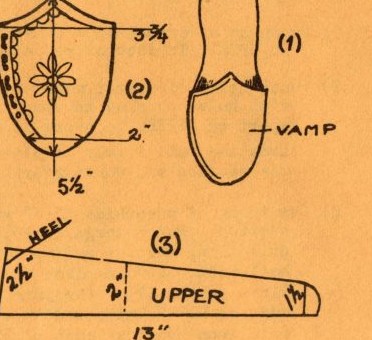
1) Make tracing on brown paper, around sole of shoe, pencil held vertically. Allow 1/4 inch all around for seams (1) 2) Cut pattern of vamp -- shield-shaped
Dimensions shown are for ladies' medium size. Children's should be smaller; men's larger. Vamp pattern should be about same size as tracing of toe of shoe (2) VAMP
3) Pattern for moccasin UPPER -- as shown (3)
| Just a long strip, tapering from 1½" at | (3) |
| toe to 2½" at heel about 13" long for | A |
| ladie's; men's longer; children's shorter | 9! UPPER |
| CONSTRUCTION | 13 |
1) Decorate vamp in any desired manner -- sections of tooling or carving cowhide may be used for these. Cement a leather lining on back of vamp after decoration. (The illustration shows carved and colored pine-cones, in two shades of brown with green pine needles)
On other moccasins we have made (in colored suede splits) we used a decorative stamp around edge (leaving 1/4" margin for lacing) -- and a central motif stamped or carved to represent Indian bead-work. This was colored with MONGOL pencil dyes in bright colors to represent the bead motifs
2) Cut out soles -- from scrap carving cowhide, or heavy steerhide. Two soles for each foot. Cement together, grain sides out.
Page 10
3) Join heel sections of UPPER - with criss-cross lacing
- with straight lacing
- with saddle-stitching
4) Form flange, or ridge, at lower edge of UPPER -- and starting in middle of heel-back, cement flange to sole (holding along edge with clamps) and bringing sections together at middle of toe, trim off FLANGE any excess length, and join at toe, as at heel. (fry this first with brown paper pattern to be sure UPPER section is plenty long enough to require trimming at toe when in place 5) Punch through flange and edge of sole together for lacing or saddle stitching 5) After stitching we dampened the UPPER leather very slightly, put moccasin on carefully over on heavy sock, and molded it into instep and a around foot for contour; slip foot out carefully and allow to dry in shape
6) Punch holes around edge of vamp, spacing evenly. (Holes may also be punched in UPPER, in decorative pattern, for ventilation with shearling insole) 7) Punch holes along top edge of UPPER (starting at join at toe) to correspond with holes punched in vamp. Holes on UPPER should be very slightly farther apart on UPPER, to bring it in place under vamp 6) Lace and pull firmly in place, starting at centre of toe section and working either way. Fasten off firmly 8) Cut thong of steerhide (3/8" wide) to go around heel section. Punch large holes, or make slits, to pull thong through and up and around foot to make heel firm. Sew in place at each end, with heavy linen thread 7) Sew this into place along top / edge of UPPER, with saddle stitching. Dampen and dS fold down over raw edge of UPPER
9) Cuff - cut cuff of steerhide about 2¼" wide, and long enough to go right around heel to yamp, to cover thong. (Cut paper pattern first) Shred lower 1¼" of cuff into equal strips, for Indian effect 7) Sew this into place along top edge of UPPER
SHEARLING LINING
Insole section - cut insole of shearling about 1/2" larger around toe section than sole - slit at 1" intervals. When pushed into moccasins, the slits allow it to extend slightly up, and around inside for softness on toes (8)
Page 11
Cuff Section - cut cuff pattern about 4 inches by 5% inches, two sections for each foot. Overcast with linen thread at heel Overcast to shearling insole around heel-section (9) Place lining inside moccasin with few dabs of leather cement on bottom of insole, and on sides, just sufficient to hold in place. May be pulled out for washing, and replaced
FINISHING
1) A section of firm cowhide was cemented inside heel of moccasin, before shearling lining was inserted - curved from UPPER edge to sole, to give extra firmness
2) Rubber heel lifts (purchased) were cemented in place for comfort - tu avoid a too-flat feeling
If necessary, for closer fit, a band of broad elastic may be sewn from side to side, under vamp, for children
3) Bow of braided lacing was stitched in place for trim
4) Antiques - moccasins were antiqued all over with Garnett Golden Tan
Antique, and finished with several coats of Polish Coat WE HOPS YOU WILL ENJOY MAKING YOUR OWN CUSTOM DESIGNED MOCCASINS We found them a lot of fun
Reprinted by special request
We are pleased to have you come in and choose from our wide selection of Quality Leathers and Accessories. If not convenient, phone or write:
284 King Street West
Toronto 2B, Canada
EMpire 3-5206
AN ALL-CANADIAN COMPANY SERVING CANADIANS SINCE 1913
Page 12 — CHRISTMAS SALE
CHRISTMAS SALE by Irva Ford, A.C.S.C.L.
The seventh annual sale of leather goods made by C.S.C.L. members was held the third week in November in the upper room of the Canadian Handicrafts Guild at 77 Bloor Street West, Toronto.
Twenty-six craftsmen sent articles for sale and display. The total receipts from the sale amounted to about $800 of which the Canadian Handicrafts Guild received 10% for the use of the room. Another 10% was used to cover the cost of insurance, invitations and other miscellaneous expenses. !
It was noted by several members of the Council of Fellows as well as a few faithful customers that the calibre of the workmanship and the variety of articles for sale had greatly improved during ! the past few years. This year all the articles received were quite acceptable for the sale. There were very few items asked for that we could not produce. There were several beautiful handbags of which four large and some smaller were sold. However, it seems that the "best sellers" were under $5.00. Two of our members sold 100% of articles sent. More leatherwork of choice quality, not necessarily for sale, was needed for the window display.
Since many of our customers send gifts overseas for Christmas, Canadian motifs in decoration were greatly in demand and requests were made for an earlier sale. Also, the sale convenor and her committee, as well as the participating craftsmen would appreciate having returns made well in advance of the Christmas season, so we have asked the Canadian Handicrafts Guild to reserve the first week in \ November, 1962 for our next Christmas Sale. C.S.C.L. members are urged to start preparing NOW for this sale. The Society provides this concrete service for its members who should give it their wholehearted support.
C.S.C.L. greatly appreciates the fine co-operation given by the Canadian Handicrafts Guild. Mr. McKell, Mr. Hazell, Mrs. Lex Hanson and staff helped us in every way possible, including publicizing the sale to their own clientele. Miss Betty Smith arranged the window display most effectively.
The Exhibition Convener wishes to express sincere thanks to those who tagged articles and set up displays; to the 21 members who formed the sales staff for four days and two evenings; to those who sent articles, thus making the sale possible; to Mr. Redman and his committee for the splendid advertising; to those who helped address invitations and to Mrs. Nora Huyck who, after several years experience as Exhibition and Sale Convenor, was able and willing to give us valuable advice and assistance.
[The printed page reads “the cost of insurance, invitations and other miscellaneous expenses”; two stray characters read into the line break are removed.]