
An issue of the Society’s newsletter, transcribed from the original.
(12 pages, 2.1 MB)
the full-resolution scan, 34 MB, for close research
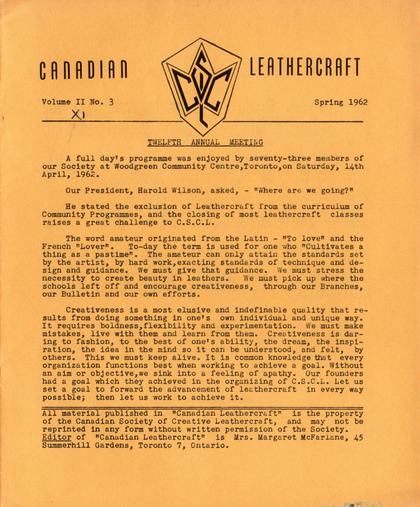
Page 1 — TWELFTH ANNUAL MEETING
CANADIAN LEATHERCRAFT
Volume II No. 3 Spring 1962
[The cover prints the volume as Volume II. The issues either side of it are printed Volume XI and Volume XII; the number is kept exactly as this cover prints it.]
TWELFTH ANNUAL MEETING
A full day's programme was enjoyed by seventy-three members of our Society at Woodgreen Community Centre,Toronto,on Saturday, 14th April, 1962.
Our President, Harold Wilson, asked, - "Where are we going?" He stated the exclusion of Leathercraft from the curriculum of Community Programmes, and the closing of most leathercraft classes raises a great challenge to C.S.C.L.
The word amateur originated from the Latin - "To love" and the French "Lover". To-day the term is used for one who "Cultivates a thing as a pastime". The amateur can only attain the standards set by the artist, by hard work,exacting standards of technique and design and guidance. We must give that guidance. We must stress the necessity to create beauty in leathers. We must pick up where the schools left off and encourage creativeness, through our Branches, our Bulletin and our own efforts.
Creativeness is a most elusive and indefinable quality that results from doing something in one's own individual and unique way. It requires boldness,flexibility and experimentation. We must make mistakes, live with them and learn from them. Creativeness is daring to fashion, to the best of one's ability, the dream, the inspiration, the idea in the mind so it can be understood, and felt, by others. This we must keep alive. It is common knowledge that every organization functions best when working to achieve a goal. Without an aim or objective,we sink into a feeling of apathy. Our founders had a goal which they achieved in the organizing of C.S.C.L. Let us set a goal to forward the advancement of leathercraft in every way possible; then let us work to achieve it.
All material published in "Canadian Leathercraft" is the property of the Canadian Society of Creative Leathercraft, and may not be reprinted in any form without written permission of the Society. Editor of "Canadian Leathercraft" is Mrs. Margaret McFarlane, 45 Summerhill Gardens, Toronto 7, Ontario.
The masthead’s decorative emblem produced a stray “A” and a line of repeated A’s above and into the opening headline; dropped, they are not text. A line-wrap in “design” had left the word split with a stray capital, “de- Sign”; rejoined.
Page 2 — WESTON TROPHY; ANNOUNCEMENTS; LUNCHEON SPEAKER; DEMONSTRATIONS
WESTON TROPHY
The Trophy this year was won by our youngest branch BARRIE.
The three branches competing all scored higher than 80% with Barrie rating 89.7%. Congratulations Barrie Branch!
ANNOUNCEMENTS
CANADIAN HANDICRAFT GUILD, CNE: Last year there were no competitions owing to the destruction by fire of the Manufacturers building. There will be competitions this year and Mr. MacKell will inform us shortly as to the number and particulars of each class. Mrs. Anne Hook will be asking for demonstrators for the Canadian Handicraft Guild's exhibit at the CNE.
CNE COMPETITIONS: While we have a duty to the Handicraft Guild, in the interests of good leathercraft this competition is also a place where we can make an impact. Mrs. Hook feels that if our society made the effort we could clear the C.N.E. Handicraft Exhibit of poor leathercraft. For entry information write to the C.N.E
Women's Division and ask for their bulletin on the C.N.E. competition. Those living in Toronto can phone for it - EM. 6-7551.
CANADIAN PACIFIC EXHIBITION: C.S.C.L. has been invited to send an exhibit to be displayed. Members are also asked to send in articles for competition.
STRATFORD FESTIVAL EXHIBIT: This exhibit will be on display June 18th to September 29th. Associates and Fellows have been sent forms requesting articles for exhibit. Please return these forms promptly advising yes or no. These articles are judged to conform to the exact setting they are trying to create, so if your article is not chosen it does not necessarily follow that your work is inferior for this prestige exhibit.
LUNCHEON SPEAKER
The luncheon speaker was Mr. J. Eilbeck, District Representative,
Community Programmes Branch, Ontario Department of Education, who gave a most informative talk stressing the need for flexibility in programme, and time and place of meetings. Members should be active and willing to serve on committees, etc., or should not criticize. Advantage should be taken of untapped resources, technical personnel and films that are available for the asking. It is up to us to make ourselves heard and ask for these things.
DEMONSTRATIONS
In the afternoon demonstrations were given by Don MacKinnon on Gussets; Fred Brown on 3 D Tooling, and Turned Edges; Clara Cavanagh on Lamp Bases; May Corbett - Notebook and Helen Wheaton on Dyes.
Page 3 — NEW FELLOWS & ASSOCIATES; HONORARY LIFE FELLOW MEMBERSHIPS PRESENTED
NEW FELLOWS & ASSOCIATES
The Board of Selection are pleased to announce that the following members have qualified as Fellows and Associates:- Fellows: Mrs. Sadie Roebuck, Toronto, Ont.
Mr. Janis Zalitis, Toronto, Ont.
Associates: Miss Helen Anderson, Longford Mills, Ont.
| Mrs. W. Barry, | Barrie, Ont. |
| Mrs. Sherle Bottrill, | Barrie, Ont. |
| Mr. Alvin Haig, | Hamilton, Ont. |
| Mrs. D. Jacombs, | Barrie, Ont. |
| Mrs. Mildred Kemp, | Stoney Creek, Ont. |
| Mrs. R.E. Tuck, | Barrie, Ont. |
Honorary Associate - Mr. Cecil Roebuck, Toronto, Ont.
While Cecil is not a craftsman, he has given many long years of service to our Society. He is a past Chairman of Toronto Branch and presently their Treasurer, and now Treasurer of C.S. C.L. He was Chairman of the Second International Assembly, held in Toronto; has served on C.S.C.L. Executive for many years. He is keenly interested in the craft, and his wife, Sadie, is one of our top Fellows. We could call Cecil a Patron of the craft. He is always ready to take on any job and see it through. Honorary Associates are awarded very sparingly and we are happy to bestow this on Cecil as a token of our appreciation of his service to us.
HONORARY LIFE FELLOW MEMBERSHIPS PRESENTED
Address by Dr. Ralph K. Larmour.
In November 1951, Mr. F.O. Baird was given the Society's first
Honorary Life membership in recognition of his important contributions to the advancement in decorative leathercraft.
An Honorary Life Fellow Membership in C.S.C.L. was presented to Mr. Deane H. Russell, in 1954, for his contribution in organizing this Society. Deane held the presidency for the first four years of its existence, and is an excellent craftsman. Eight years have gone by, and to make up for lost time, the Executive Council Selected two of our Fellows to the Honorary Life cléess. It is my great pleasure to introduce them to you to-day.
Mr. Don MacKinnon has inspired a great many in the field of leather. MacKinnon has contributed much to the Society in his own inimitable style, end has encouraged the rest of us when we thought the going tough. As a teacher, he has promoted the craft and CSCL. He has given generously of his time and energy. His style of picture carving is outstanding. It is my pleasure to inform Don he
Page 4 — SIMCOE COUNTY QUILT, RUG & CRAFTS FAIR
has been elected to be the recipient of an honorary life fellow.
Mr. Robert Muma has been a great asset to the Society since its founding. His advice is always sought, and it is usually right. His influence as a teacher and practitioner of his craft is widespread. In his own specialty, bookbinding, he has added lustre to the meaning of this Society. In his quiet way he has encouraged many faltering novices to persevere in the craft. I am sure he will grace our honorary life fellows. Mr. Robert Muma I congratulate you.
SIMCOE COUNTY QUILT, RUG & CRAFTS FAIR
This year the 12th Simcoe County Quilt, Rug & Crafts Fair will be held in the Community Centre, BEETON, Ontario - (off Highway 27, on No.1 County Road, approximately 40 miles north of Toronto and 25 south of Barrie.) ---- JULY 25th - 28th, 1962 ----
Those leathercraftsmen who visited this Fair held in Barrie in 1960 will remember the very interesting display of quilts, rugs and handcrafted articles.
These unique Fairs began in 1949, and through the untiring efforts of Miss Louise Colley, Director of Simcoe County Recreation Service and Executive-Secretary of the Simcoe County Arts and Crafts Association, and all the ladies and gentlemen participating, they have become a "must" for Simcoe County.
Thor Hansen, Art Director for the B/A Oil Company stated projects like the one in Simcoe County are very worthwhile for all Canada. "Each one will be a small step", he said, "toward a Canadian culture rooted in the everyday lives of all Canadians - not an artificially concocted elixir dispensed like a breakfast cereal by a small group of sophisticated culture brokers." He developed quilt designs for the first Fair and thus inspired artists and teachers.
A "highlight" in the history of the Fair is the quilt called "Northern Night" designed by Mrs. Ada Bruce Torrance. It is an all Canadian, home-crafted, prize-winning, contemporary quilt made by an average group of Simcoe County women fired with an un-average enthusiasm, and it now hangs in the collection of the Royal Ontario Museum.
We are stressing the showing of quilts and rugs. Some will be valued heirlooms, others will be of traditional design, and still others will use original designs developed by Simcoe County artists. One of these will be "County Fair" designed by Mary McKay of Collingwood.
There will be an Arts and Crafts for-sale booth. Also exhibits and demonstrations by County craftsmen.
Tea will be served every afternoon. Meals will be catered to by Women's Institutes and Church groups in the area. We are sure this Fair will prove worthwhile to visit in July.
Page 5 — THE WESTERN FAIR — LONDON
THE WESTERN FAIR -— LONDON by Helen Wheaton, A.C.&.C.L.
Supervisor of Women's Division
It has been brought to our attention that many Leathercrafters in Ontario and across Canada are unaware of the opportunity of competing in the open classes offered at the Great Western Fair, - held annually at London, Ontario.
The Western Fair is one of the oldest Fairs in Canada, getting a start in 1867,was incorporated in 1887,and has operated ever since with steady growth to one of the fourth ranking Fairs of today. The only exception was during World War II when the buildings were used by the Military from 1939 to 1948.
In 1949 full operation of a week-long Fair was resumed and in 1961 this was increased to an eight day operation, with two complete Grand Stand Shows, Horse Racing as well as complete coverage of agricultural and industrial exhibits and a midway second to none.
The permanent buildings, on the four square city blocks covered by the grounds,starting with the administration building,at the King St. entrance and turning right, we have the Horticultural Bldg which leads on to the Special events Building which housed the Atomic Power Exhibit in 1961. Then we cross an open space where furing the Fair, all kinds of Farm implements are displayed in the open air. Then comes the Arena where cattle, horses, sheep, goats and swine are stabled and a show ring for judging. This also houses the Horse Show, square dance competitions and during the winter becomes a hockey rink with a good seating capacity.
To the East of the arena, the midway is set up during the Fair on a paved area about a block square and has some permanent playland buildings.
On the Eastern end of the grounds is a half-mile race Track with modern grand stand and parking facilities within the oval. At the south end are stables which are used by some horses all year,so the track may be used for training purposes. Afternoon and evening shows go on every day to capacity crowds. They also hold spring and fall horse racing with para-mutuele betting beginning in 1961, and had a most successful opening year.
In the central part of the grounds is the Manufacturer's building where automobiles, boats and many, many other things are displayed. This building is in constant use end houses the Seed Fair, The Home and Garden Fair, and the Sports Fair, in February, March and April, respectively. The last two mentioned Fairs have very good craft displays, but no competitions.
Coming to the North we have the children's midway, with rides,
“Furing the Fair” is printed that way and is left as printed — evidently meant for “during”.
Page 6
etc. for tiny tots. The rest of the year this space is a park land with flowers and lovely green grass.
Then comes the Art Building,where competitions are keenly contested by local talent, individually and in groups. And lastly, on the north west corner, the Confederation Building. On the ground floor electrical and home appliances as well as musical instruments and fine china are displayed. The Upper Floor is given over to Handicrafts and Educational displays. Divided in the middle with the Theatre taking up the central north half with educational displays surrounding it.
The open space in the South half of the upper floor is used to display all classes of Handicrafts and Hobbies. The open class competitions take up two-thirds of this space, with the remainder used to display the Hospital Class,the work of the Blind,Senior Citizens over 65 years, the group competitions of the Women's Institute, and a Doll Dressing Contest where the donors receive 10 prizes of $10.00 each and the Dolls are given to the Children's Hospital, or other charity specified by the donor, at Christmas time.
Thus you can see our Western Fair is a well rounded Fair in all respects. Many of the C.S.C.L.London Branch enter the various craft competitions.
But what of Leathercraft? In the open class competition there are 117 sections of which nine are for Leathercraft, as follows:-
This section list prints three prize amounts (1st, 2nd, 3rd) after every line; a whole line, Section 93, had dropped out where it had, along with the money for Sections 91, 92 and 98. It is set out below complete, in the order printed.
Section
91.  Gloves, Leather, hand sewn                        4.00  3.00  2.00
92.  Handbag, Original Canadian Design, Tooled          6.00  5.00  4.00
93.  Handbag, Original Canadian Design, Carved          6.00  5.00  4.00
94.  Handbag, Commercial Design, Tooled                 6.00  5.00  4.00
95.  Handbag, Commercial Design, Carved                 6.00  5.00  4.00
96.  Belt, Tooled or stamped                            3.00  2.00  1.00
97.  Belt, Carved                                       3.00  2.00  1.00
98.  Miscellaneous Small Article in Leather             3.00  2.00  1.00
99.  Miscellaneous Large Article in Leather             3.00  2.00  1.00
From the above we feel we have covered the field fairly well giving opportunity for those who have a talent for real creativity in the two classes of original handbags as well as to those who are excellent craftsmen but not artists.
While the prizes are not large amounts, I feel this is a good way to get your work before the public (in 1961 attendance at the fair was 390,000 in round figures) as well as pick up some craft money, and enjoy the exhilaration of winning a competitions.
If you are interested in competing just drop a line to the Western Fair Association, +Administration Bldg., Queen's Park,London, Ont. asking that you receive a prize list of Handicrafts and Hobbies, Don't forget to send your address. Happy Leathercrafting to all!
Page 7 — MAKING A HANDBAG
MAKING A HANDBAG by Nora Huyck, F.C.S.C.L.
These are general instructions. There may have to be changes made for different bags. Read through carefully, first, then note where and when you will have to change the directions for your bag. Secondly, these instructions were written for classroom use and as a reminder of the steps to be taken when making their next bag.
PREPARATION OF LEATHER
1. Select pattern -- If a commercial pattern is not satisfactory, make one of brown paper to meet your own specifications.
2. Make accurate cardboard templates of all pattern pieces.
(a) If necessary, mark which side is to be placed up, when cutting leather.
(b) Mark if it is to be reversed for lining.
3. Design -- If applied design is to be used, prepare it on brown paper or tracing paper. (Cut it to the exact size of the template part for which it has been prepared.)
4. Cut out the required leather.
(a) Same size as the cardboard template, - if there will be no shrinkage.
(b) Slightly larger all around if there is danger of shrinkage from casing or dampening.
(c) Exception is the gusset:-always leave a bit extra on ends. (d) Don't forget the straps and strap hangers (if of leather).
5.6.7.8 - Refer to these numbers in "Making an Article of Leather" Vol.XI No.1 p.2.
9. When completely dry, cut to cardboard template shape. When cutting the gusset, don't cut off the excess length on the ends.
10. Cut out stiffener to the size of the leather parts to be stiffened.
11. Cut out lining for all parts to be lined, pockets, etc.
(a) Remember to reverse pattern if necessary.
(b) Cut lining for gussets 3/8" wider than outside leather.
(For end gussets allow 3/8" at bottom also.)
PREPARATION OF PARTS.
1. On heavier leathers, it will be necessary to gouge along lines where the leather has to make sharp turns of 90 degrees.Be careful not to gouge too deeply, half way through should be sufficient, or enough to make the leather take the required shape.
2. Skive where necessary- (a) Don't get the corners too thin.
(b) Don't skive front and back panels as thin as the gusset. This will prevent it from curling out.
(c) Skive stiffener and lining, - if and where necessary.
["PREPARATION OF PARTS." is printed as a heading on its own line, above the numbered steps, and is set out here that way. The page types "90 degrees.Be careful" with no space after the full stop, and it stands as printed.]
Page 8
3. Prepare the gusset. This is for an all-around gusset.
(a) Crimp the gusset along both sides 3/8" in from the edge. If the leather was not gouged, draw 6 pencil line 3/8" from the edge along both sides on the underside of the leather. Dampen the leather slightly on the underside. Bend along the line until the leather will stay at right angies to the main part of the gusset Bend away from the line under side of leather right side of leather
Then bend the gusset, to follow the shape of the outline of the beg -- the same shape it will be when the bag is finished. The crimped edge will have to be stretched at the corners or sharp curves in order that it will still retain its right angle across the bottom around the corners and up the sides, after it is installed.
(b) For an end gusset, the procedure is much the same. The bottom and sides must be crimped. The corners at the bottom will have to be cut out. The dotted lines indicate where the crimp will be made. Cut from the point where the dotted line intersect, but net on the continuation of the dotted lines. Make it less than a right angle as indicated by the lines in the fetch. When the gusset is fitted a bit more may have to be cut out.
N.B. - It may be better to wait for this step until the lining has been inserted, since the bottom of the gusset may have to be narrowed a bit.
(c) If the gusset is the pleated type, do that shaping now.
(d) If the strap hangers are of leather, prepare them now.
4. Straps.
(a) Short strap. 1" width is usually used. When measuring desired length, allow 2½" for turnback on either end. If strap hangers or loops are the usual ¾" width, the strap must be tapered from 1" wide at a point three inches from the end to ¾" wide at a point 2½" from the end and continue to the end just ¾" wide. Shape the end and finish the edges as for a belt. Any decoration will have been done earlier before the dye and finish coat went on.
(b) If thin leather is used, double width must be used, sides cemented to the centre line so the strap is double. This will have to be tapered too. The ends must be skived thin and pleated in when the sides are cemented to the centre line to form round ends.
(c) Over shoulder strap - ¾" width is usually used. Length depends on height of person and type of strap.
ASSEMBLY OF PARTS
1. To the lining, stitch or lace pockets and other interior accessories as desired.
2. Cement stiffener to bag parts and gussets where needed.
(On a bag with end gussets, be sure to leave 1/8" between front
The page breaks off in the middle of its own second assembly step; the sentence finishes at the head of the next page, which then carries steps 3 to 18. Those steps had been set out on this page as well as that one, so a reader met them twice; they now stand once, on the page that prints them. The step lettered (c) under the gusset, which the page does print, is restored with them.
Page 9
back and bottom parts so that the bag will take shape properly).
3. Cement linings to body of bag. (Not the gussets yet.) Start with the back, then the flap, which should be bent at about 45 degrees. This will avoid excessive wrinkling when closed. In a bag with end gussets, do the back and the flap, then the bottom and the front,holding the outer leather to the finished shape and making the lining follow that shape. There will likely be extra leather to be trimmed off.)
4. Install flap clasp fitting.
5. Inconspicuously mark centre front and centre back at the bottom of front and back panels and on the gusset.
6. With Mac's rubber cement, assemble handbag starting with centre of back panel and gusset, then front. (For an end gusset bag, start at the bottom and work up the sides.)
7. Stuff with paper. If bag doesn't stand firmly and squarely,take apart and re-assemble until it suits you. Usually the trouble is with the gusset. It has been pulled too tightly or not tightly enough. If that does not fix it, check shape with pattern.
8. If gusset is too long, trim ends now, even if you have to remove it, and re-assemble again.
9. Close the bag and mark the place for the front clasp fitting. Mark the place on the gusset for the installation of the strap hangers.
10. Take the bag apart again.
11. Install the part of the clasp for the front panel.Usually only two slits are required. Don't cut a hole in the front panel unless you are absolutely sure it is required for your type of clasp. Cut a piece of the lining leather larger than the plate of the clasp. Skive it to a feather edge, and cement over the metal on the inside of the bag. (An alternative method - don't cement the front lining in place until this part of the clasp has been installed. The disadvantage to this method isthat there is no patch to be removed if the clasp breaks. Replacement then is very difficult.)
12. Install strap hangers in the gusset.
13. Cement lining to the gusset. Make it follow the shape and the crimped edge of the gusset. Do not bend the gusset out flat to adhere the lining. Trim off any excess lining.
14. Punch and lace the ends of the gusset. The ends of the lacing will be concealed between the gusset and the body of the bag when it is finally assembled.
15. Cement front panel to gusset. Punch and lace.
16. Cement back panel to gusset. Punch and lace.
In both cases start lacing at a point where the ends can be easily hidden and the join if not too good will be inconspicuous.
17. Use the bone folder or roller to smooth the lace and polish it.
18. Fasten straps -- either by using two domes at either end or by hand stitching after the turn back has been passed through the loops.
Page 10 — BARRIE "TUESDAY-NIGHTERS" MEMBERSHIP FEES
When lacing the two front corners it is usually necessary to go through three corner holes twice. When coming to the third one on the sketch, if possible, the first time through, go through the first laced hole on the top of the gusset too. The second time through just go through the front panel. This will help keep the gusset from tearing away from the bag after considerable use. Reverse for the other corner.
When you are lacing the back, if it is possible to go through the first hole on the top of the gusset without spoiling the appearance it will greatly strengthen it.
BARRIE "TUESDAY-NIGHTERS"
In order to have a more active participation in leathercraft, four CSCL members - (May Corbett, Eleanor Coutts, Jepp Trew, Sherle Bottrill) - registered in the leathercraft class at Central Collegiate night school in the fall of 1960.
There were not enough registrations for two classes - and too many for one. A strong protest from a young European lady (who had been unable to register in the leathercraft class the previous year and might possibly be rejected from the class, which was then forming) proved to be the incentive for the four of us to withdraw and begin an informal club known as the "Tuesday-Nighters". Our Vice- President, May Corbett, very kindly offered her recreation room as our meeting place. (Monthly CSCL meetings are also held there.) We now have nine Tuesday-Nighters who work together. We have found much enjoyment and been able to produce articles, - which we probably would not have done on our own, - as a result of this association.
MEMBERSHIP FEES
MEMBERSHIP FEES WERE DUE AND PAYABLE AT THE ANNUAL MEETING APRIL 14th, 1962 Members are reminded that only paid-up members will receive bulletins and notices of special meetings etc.
Page 11 — CEMENTS
CEMENTS
TYPES OF CEMENT
White Leather Cement - all purpose cement
a) good bond.
b) since it is thicker, it also provides stiffening in an article.
c) it must be wiped off immediately if any is spilled on the outside of the leather, otherwise will leave a stain.
d) dries to an opaque colour.
e) can be thinned with warm water.
Rubber Cement
a) thin, no lumps to be rubbed out.
b) smooth surfaces must be roughened.
c) must be tacky before two surfaces are put together.
d) apt to dry out and strain will pull article apart.
e) used to hold parts together until laced.
f) good for cementing skiver to flesh side of leather.
g) good for sub-assembly of handbag.
h) used to join lacing.
Barge Cement
a) strongest bond, once down can't be undone.
b) cannot be used where fitting is necessary.
c) good for cut-edged articles where there is no lacing.
C.I.L. Household Cement
a) to cement lacing to bamboo needle.
b) to sharpen tips of lace where no needle is used.
c) to cement metal to leather - bar pins, etc.
d) not flexible, so cannot be used between leathers.
SOLVENTS FOR THINNING DYES AND CLEANING BRUSHES
Used For Methyl Hydrate - Spirit and oil dyes - India inks
| Turpentine | Artists Oils |
| Thinners | Lacquer, Enamels |
| Warm Water | Antiques, Liquid Wax, Shoe Creams, |
Garnett Toning Dyes
BULLETIN INDEX: The second section for Volume 6 - Volume 10 will be found, loose, in the centre of this issue.
Page 12
C.S.C.L. EXECUTIVE: 1962 - 1963
Past President:          Mr. Fred Brown
President:               Mr. Harold Wilson
Vice-Presidents:         Miss Viola E. Harris
                         Mrs. Nora Huyck
Corresponding
  Secretary:             Mrs. Sherle Bottrill
Recording
  Secretary:             Mrs. Lillian Neelands
Treasurer:               Mr. Cecil Roebuck
COUNCIL:                 Miss Bea Austin          Mrs. Anne Hook
                         Miss Win Coombs          Dr. R. or Reta Larmour
                         Mrs. G.H. Caswell        Mrs. Jessie Little
                         Mrs. Clara Cavanagh      Mrs. Margaret McFarlane
                         Mr. Jim Courneya         Mr. C. or Mrs. Redman
                         Mrs. Irva Ford           Mrs. Sadie Roebuck
                         Miss E.O. Henstridge     Mrs. Fred Schooley
                         Mrs. Helen Wheaton
CHAIRMEN OF BRANCHES;    Barrie:                  Mrs. Sherle Bottrill
                         Hamilton:                Mr. Frank Torry
                         London:                  Mrs. Jean Muxlow
                         Tillsonburg:             Mrs. Florence Sawyer
                         Toronto:                 Mrs. Jean Newton
Erratum: We regret the typographical error in the last bulletin which showed Irva Ford as A.C.S.C.L. instead of F.C.S.C.L. Mrs. Ford has been a Fellow since 1958.
We are pleased to have you come in and choose from our wide selection of Quality Leathers and Accessories. If not convenient, phone or write:
284 King Street West
Toronto 2B, Canada
EMpire 3-5206
AN ALL-CANADIAN COMPANY SERVING CANADIANS SINCE 1913