
An issue of the Society’s newsletter, transcribed from the original.
(12 pages, 1.9 MB)
the full-resolution scan, 33 MB, for close research
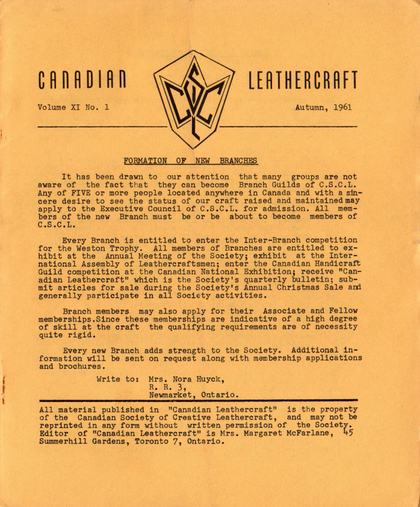
Page 1 — FORMATION OF NEW BRANCHES
Canadian Leathercraft
Volume XI No. 1 Autumn, 1961
FORMATION OF NEW BRANCHES
It has been drawn to our attention that many groups are not aware of the fact that they can become Branch Guilds of C.S.C.L. Any of FIVE or more people located anywhere in Canada and with a sincere desire to see the status of our craft raised and maintained may apply to the Executive Council of C.S.C.L. for admission. All members of the new Branch must be or be about to become members of C.S.C.L.
Every Branch is entitled to enter the Inter-Branch competition for the Weston Trophy. All members of Branches are entitled to exhibit at the Annual Meeting of the Society; exhibit at the International Assembly of Leathercraftsmen; enter the Canadian Handicraft Guild competition at the Canadian National Exhibition; receive "Canadian Leathercraft" which is the Society's quarterly bulletin; submit articles for sale during the Society's Annual Christmas Sale and generally participate in all Society activities.
Branch members may also apply for their Associate and Fellow memberships.Since these memberships are indicative of a high degree of skill at the craft the qualifying requirements are of necessity quite rigid.
Every new Branch adds strength to the Society. Additional information will be sent on request along with membership applications and brochures.
Write to: Mrs. Nora Huyck,
R.R. 3,
Newmarket, Ontario.
All material published in "Canadian Leathercraft" is the property of the Canadian Society of Creative Leathercraft, and may not be reprinted in any form without written permission of the Society: Editor of "Canadian Leathercraft" is Mrs. Margaret McFarlane, 5 Summerhill Gardens, Toronto 7, Ontario.
Page 2 — MAKING AN ARTICLE OF LEATHER
MAKING AN ARTICLE OF LEATHER by Nora Huyck, F.C.S.C.L.
Prepare pattern - (pattern refers to size and shape) Prepare design - (design refers to decoration used)
2. Make a cardboard template (bristol board is good) for each part of article. It must be exact and true.
3. Trace design from prepared design or commercial design to tracing paper. In this way the original design is preserved. Cut the traced design to the exact shape of the template. 4. Cut out desired leather with knife. a) same size as template if there will be no shrinkage. b) slightly larger all around if there is danger of shrinkage. N.B. leather is quite inconsistent regarding the amount of shrinkage to be expected. Some leathers can be preshrunk, others cannot.
5. Prepare leather to receive design.
a) up to 3½ oz. leather - moisten the grain side with a damp sponge. Then let it return almost to its natural colour.
b) heavier leathers need to be cased. Wash in lukewarm water with small amount of detergent - rinse well - stand it on side to drain, or blot off excess moisture with towel. If thinner leathers seem soiled, they can be washed in the same way. Allow leather to come back to natural colour - may take several hours; if it cannot be used right away, store in a piece of plastic. Do not leave it damp more than two or three days; it will mildew. 6. Transfer design to leather.
a) trace lightly the outline of template.
b) centre tracing paper design in this outline.
c) holding design in place with one hand, go over all lines of design with bent tracer.
d) remove design carefully starting at one corner. Trace any lines missed before the design is lifted from the leather. N.B. Never use a pencil directly on leather. If leather is too soggy, it won't hold lines; if too dry, won't take them. 7. Tool or carve the design. Moisten only as much as necessary for good work,unless the leather has dried out completely, in which case it should be recused.
Colour or finish outer leather.
a) if any parts are to be left clear, protect them with lacquer or polish coat.
b) if any smaller parts are to have colours such as red, green, etc., dye them, then protect them with lacquer or polish coat. c) if rest of leather is to be other than its natural colour do that next.
cont'd.
Page 3 — BRANCH NEWS
d) put a protective finish - polish coat - over all. e) if one or several shades of brown are to be used, start with the lightest and work to the darkest, then polish coat it.
9. If leather was cut larger than outline, cut it to its proper shape now if the leather is perfectly dry.
10. Skive - all sides of each piece where two or more thicknesses come together. When it is assembled, those edges which have two or three thicknesses of leather,should have been thinned enough so that you have left a thickness equal to the original thickness of the outside piece of leather. 11. Cement lining (if used) to leather and trim off excess lining.
1. Leather Cement - white - good adhesive qualities.
2. Rubber Cement - quality xxx - suitable for cementing linings - not as adhesive as leather cement.
12. Edge crease any parts of interior.
13. Dye any cut edges that show.
14. Cement various parts in place.
15. Punch for lacing - or mark for sewing. Editor's Note: Read, "Making Articles for Sale" - Vol. VIII,
BRANCH NEWS
The Hamilton Guild played host to the Tillsonburg Guild on Saturday, November 11th. The workshop meeting was held in our regular meeting rooms starting at 2:30 p.m. Mrs. Edith Melchior conducted the afternoon session when all present made suede poinsettias. Hamilton Guild members provided a smorgasbord supper serving almost 50 persons. In the evening Mr. Frank Torry very capably handled a work session on the making of Christmas boxes.Mrs. Melchior followed with a brief period of "How to use Scraps for Christmas". Several useful items were made by those present. Coffee and doughnuts concluded the evening.
The feeling of fellowship and relaxation at the meeting made everyone feel that it had been a very worthwhile experiment. It was the general feeling that occasional mixing of Guilds would help to increase the feeling of "togetherness" that seems to be needed in outlying smaller Guilds.
[The machine this page was typed on has no key for the digit 1; the typist struck a lower-case l for the numeral, and it is set here as the numeral.]
Page 4 — Why not make these - ideas picked up by a SHOP HOUND; BULLETIN INDEX; EDITORIAL ASSISTANT
Why not make these - ideas picked up by a SHOP HOUND
2" leather belt with unusual loop thong closing.
Peter Pan type slipper. Crushy soft glove leather - insoled with leather - innersoled with foam. Folds flat for packing.
Travel case for jewels. Make it of soft, bright coloured leather, line with suede. Make pockets for earrings, rings and bracelets.
Bottle Opener. Medallion of leather in centre - simple design on medallion if desired. Cover metal handle with leather. Nice to the touch.
BULLETIN INDEX
As planned some time ago an index for "Canadian Leathercraft" is being prepared and the first section for Volume I - Volume 5, consisting of 4 pages will be found in the centre of this issue of the bulletin, loose, so that it can be readily added to members' past issues.
A great deal of work has gone into the preparation of this index and it is hoped that it will be found useful by members when wishing to recall certain articles or items in back bulletins.
EDITORIAL ASSISTANT
We are very pleased to announce the acceptance of the position of Assistant Editor of "Canadian Leathercraft" by Miss Viola Harris. Viola Harris is well known to all leathercrafters having been on the executive for many years as Secretary and now is one of our Vice- Presidents. Welcome aboard Viola!
Page 5 — INDEX "CANADIAN LEATHERCRAFT" VOLUME I - VOLUME V
INDEX
"CANADIAN LEATHERCRAFT"
VOLUME I - VOLUME V
ANNUAL MEETINGS:
Notices - Vol.I #3 p.2; Vol.III #3 p.2; Vol.5 #3 p.6
Reports - Vol.I #4 p.6; Vol.II #4 p.1; Vol.3 #4 p.3; Vol.4 #4 p.9
ASSOCIATES & FELLOWS:
First Fellow & Associate Members named Vol.II #3 p.2.
New Associates & Fellows - Vol.3 #4 p.9; Vol.4 #4 p.9; Vol.5 #3 p.6.
Requirements for Higher Membership Awards- Vol.3 #4 p.4; Vol.4 #2 p.11; Vol.5 #1 p.2.
BOOK REVIEWS:
Color Decoration & Finishing of Leather- Vol.2 #1 p.10.
Color In Leathercraft- Vol.4 #4 p.8.
Design Artistry- Vol.5 #3 p.4.
Glovemaking for Beginners- Vol.2 #1 p.10.
Leather Goods Manufacture- Vol.3 #1 p.8.
Leather Secrets- Vol.1 #2 p.7.
Leatherworkers' Directory- Vol.5 #4 p.7.
Molded Leather Trays- Vol.5 #2 p.10.
Sunset Leathercraft Book- Vol.2 #4 p.9.
BRANCHES:
Affiliated Leathercraft Groups- Vol.1 #1 p.7
Hamilton Branch- Vol.3 #3 p.10.
Toronto Branch- Vol.2 #1 p.2.
The Lajord Leathercraft Club- Vol.2 #2 p.4.
The Leathercarvers Guild of London- Vol.1 #4 p.3.
Reports of Branches- Vol.5 #4 p.5
Weekend Workshops- Vol.4 #1 p.9.
CANADIAN LEATHERCRAFT
Back Issues- Vol.3 #1 p.12.
Publication- Vol.3 #4 p.12; Vol.5 #1 p.10; Vol.5 #3 p.6.
CSCL HISTORY:
Canadian Arts Council Admits New Member- Vol.1 #4 p.5.
Crest Design- Vol.2 #3 p.5.
New Constitution- Vol.5 #3 p.8.
A New Craft Society- Vol.1 #1 p.1.
Objectives- Vol.1 #2 p.12; Vol.3 #1 p.1.
Progress in Canadian Leathercraft 1950-1953- Vol.3 #2 p.1.
Progress Report- Vol.1 #4 p.6.
COMPETITIONS:
Canadian Handicrafts Guild Competition- Vol.4 #1 p.10; Vol.5 #1 p.9; Vol.5 #3 p.5.
Natural Grained & Marked Leather- Vol.2 #2 p.2; Vol.2 #3 p.3; Vol.2 #4 p.2; p.5; Vol.3 #1 p.12.
The first page of a topic index to Volumes I–V (1950–1961); it cites articles by volume and issue number.
Page 6
CRITICISMS:
Constructive Criticisms- Vol.3 #2 p.7.
Contemporary Canadian Leathercraft- Vol.1 #2 p.5.
Rejection Reasons- Vol.3 #2 p.5.
Through the Eyes of Others- Vol.3 #2 p.3.
DESIGNING:
Design- Vol.4 #2 p.4.
Designing for Canadian Leathercraft- Vol.2 #4 p.1.
Designing for Leathercraft- Vol.3 #1 p.3.
DYEING LEATHER:
Dyeing of Craft Leatherwork-Vol.1 #3 p.3.
Splatter Technique- Vol.3 #3 p.8.
EDITORIALS:
Back to Eden- Vol.5 #2 p.1
Exhibitions- Vol.5 #4 p.1.
If the Blind Lead the Blind- Vol.4 #1 p.1.
Kits and Crafts- Vol.5 #1 p.1.
A Matter of Approach- Vol. 3 #3 p.1.
On Being Canadian- Vol. 2 #2 p.1.
Original, Copied or Adapted- Vol.2 #1 p.1.
Stunts or Skills- Vol.2 #3 p.1.
The Walking Dead-- Vol.5 #3 p.1.
Your Money's Worth- Vol.3 #4 p.1.
EXHIBITIONS:
Canadian Arts & Crafts Display- Vol.2 #4 p.8.
Canadian Leathercraft in England- Vol.3 #2 p.2.
Canadian Originals in Leather- Vol.3 #3 p.7.
CSCL Fall Exhibition- Vol.5 #4 p.7.
Contemporary Canadian Leathercraftsmanship- Vol.1 #2 p.1; p.5.
Exhibitions and Leathercraft- Vol.4 #1 p.5.
Going Places with the T.E.- Vol.2 #2 p.6.
International Hobby Show- Vol.3 #2 p.2.
The Leather Fair- Vol.2 #1 p.2.
Prizes Won by Fellows- Vol.5 #4 p.2.
Reports- Vol.2 #3 p.7.
Second International Hobby Show- Vol.2 #4 p.7; Vol.3 #3 p.6.
Travelling Exhibition- Vol.1 #1 p.8; #2 p.6; #3 p.8; Vol.2 #2 p.2; #4 p.7; Vol.3 #1 p.2; Vol.5 #2 p.11.
Travelling Exhibition #2- Vol.3 #1 p.2; #2 p.2.
GENERAL INFORMATION:
The History of Cordovan Leather- Vol.2 #1 p.4.
A Hobby for Leathercraftsmen- Vol.3 #4 p.7
Know your Craft Materials- Vol.1 #3 p.1.
Leathercraft as Therapy- Vol.4 #3 p.8; Vol.5 #1 p.10.
A Leathercraftsman's Library- Vol.5 #4 p.11.
Leather Thicknesses- Vol.4 #3 p.5.
New Fields- Vol.1 #4 p.1.
Summer Opportunities- Vol.4 #4 p.2
What is Good Leather?- Vol.1 #2 p.3
[This page of the index to the first five volumes is printed one entry to a line, each under its own subject heading, and is set out here that way. Every entry is followed by its reference. The typewriter has no figure one, so the page sets it with a small letter l; the references are given here as numbers.]
Page 7
3
INTERNATIONAL ASSEMBLY:
American Leathercrafters Visit CSCL Exhibit- Vol.3 #3 p.10.
Canadians Return Visit of American Friends- Vol.3 #3 p.10.
Eastern Leathercraft Invades the West- Vol.4 #4 p.7.
Demonstrations at the Assembly- Vol.5 #4 p.6.
Detroit Leathercrafters- Vol.4 #3 p.11.
International Assembly- Vol.4 #1 p.3.
International Leathercraft- Vol.4 #3 p.1.
Memory Holds the Door on the Third International Assembly- Vol.5 #4 p.8.
Reflections on the Assembly- Vol.4 #4 p.1.
Second International Assembly- Vol.4 #2 p.1; p.2; #3 p.2; #4 p.5.
Third International Assembly- Vol.5 #1 p.2.
LEATHER:
Assisted Graining- Vol.2 #4 p.5.
Laminating- Vol.4 #3 p.5.
Leather Thicknesses- Vol.4 #3 p.5.
Natural Grained & Marked Leathers; Vol.2 #3 p.3; slipsheet.
Natural Russet Leathers- Vol.1 #3 p.5.
What is good Leather- Vol.1 #2 p.3.
LEATHER CARVING:
Door Plates- Vol.2 #3 p.5.
Pine Cones- Vol.2 #2 p.9
Plaque Carving- Vol.1 #4 p.8.
Shoes- Vol.4 #1 p.4.
MEMBERSHIP:
Honorary Life Membership- Vol.3 #4 p.4.
Life Membership- Vol.1 #2 p.8.
Membership Dues- Vol.1 #3 p.2; Vol.4 #1 p.10; Vol.4 #4 p.8.
Requirements for higher Membership- Vol.3 #4 p.4; Vol.5-1-2.
Sustaining Members- Vol.1 #1 p.11.
POETRY: Craftsman- Vol.1 #1 p.11.
PROJECTS:
Book Ends- Vol.5 #4 p.9.
Door Plates- Vol.2 #3 p.5.
Leather Lapel Pins- Vol.3 #4 p.10.
Making Steerhide Moccasins- Vol.3 #3 p.3.
A New Use for Old Watches- Vol.4 #1 p.7.
Rawhide Lampshades- Vol.4 #3 p.10.
Shoes- Vol.4 #1 p.4.
Upholstering Furniture in Leather- Vol.3 #4 p.5.
Want to cover a Jewel Box- Vol.4 #2 p.9.
SALES:
Fall Sale Canadian Handicrafts Guild- Vol.4 #4 p.11.
Fall Sale of Leathercraft- Vol.5 #4 p.2.
Leathercraft Sale Canadian Handicrafts Guild-Vol.5 #2 p.6.
Sell Your Work Through the Handicrafts Guild-Vol.4 #4 p.4.
A topic index to Volumes 1–5 (1950–1961), not an article of its own. “Door Plates” and “Shoes” are each listed twice, once under Leather Carving and once under Projects, as printed.
Page 8
4
TEACHING:
CSCL Approved List of Teachers- Vol.4 #4 p.8.
Notice re Teaching Qualifications- Vol.5 #2 p.8.
Organizing a Leathercraft Course- Vol.5 #1 p.3.
Teaching Standards- Vol.5 #3 p.7.
Thoughts on Teaching Leathercraft- Vol.5 #2 p.3.
TECHNIQUES:
Dyeing of Craft Leatherwork- Vol.1 #3 p.3.
An Exercise in Moulded Leatherwork- Vol.3 #1 p.7.
Hand Sewing- Vol.5 #3 p.9; #4 p.3.
Highlights of History & Decoration of Gloves- Vol.4 #3 p.3.
How to Emboss- Vol.5 #1 p.7.
Leather Finishing- Vol.1 #1 p.5.
Splatter Technique- Vol.3 #3 p.8.
Tooling Morocco- Vol.2 #2 p.3.
Upholstering Furniture in Leather- Vol.3 #4 p.5.
Using Hair Calf- Vol.5 #2 p.9.
TOOLS:
The Bonefolder and its Uses- Vol.2 #4 slipsheet.
Do You Know Your Modelling Tool?- Vol.5 #1 p.5.
WHO'S WHO:
Melba Fisher- Vol.4 #4 p.7.
Viola Harris- Vol.4 #1 p.10.
Nora Huyck- Vol.4 #2 p.11.
Stefan Kontski- Vol.2 #1 p.3.
Dr. Ralph K. Larmour- Vol.3 #4 p.9. Vol.1 #3 p.5.
Reta Larmour- Vol.1 #4 p.7.
Margaret McFarlane- Vol.1 #3 p.12.
Robert Muma- Vol.2 #1 p.12.
Edith Roscoe- Vol.2 #2 p.12.
Deane Russell- Vol.1 #2 p.9.
V. Lara Russell- Vol.1 #2 p.10.
Louise Smyth- Vol.4 #1 p.10.
WORKSHOP TIPS:
Bleaching- Vol.4 #4 p.11.
Cementing- Vol.1 #1 p.9; Vol.2 #1 p.9; #4 p.9; Vol.5 #1 p.8.
Cutting- Vol.2 #4 p.9; Vol.4 #1 p.9.
Dyeing- Vol.4 #4 p.11.
Embossing- Vol.2 #1 p.9.
Finishing- Vol.4 #1 p.8.
Gussets- Vol.2 #3 slipsheet.
Handles- Vol.3 #1 p.11.
Mallet- Vol.2 #3 slipsheet.
Mildew Vol.5 #1 p.8.
Natural leather- Vol.2 #3 slipsheet
Polishing- Vol.1 #4 p.4.
Shrinkage- Vol.2 #3 slipsheet
Skivers- Vol.1 #2 p.4
Tools- Vol.4 #1 p.9.
Another topic index to Volumes 1–5 (1950–1961), citing articles by volume and issue number.
Page 9 — LEATHERCRAFT TOOLS
LEATHERCRAFT TOOLS KNIVES
a) bevel point - an all purpose knife used for both cutting and skiving.
b) long, square end blade - especially for skiving, blade is flexible.
c) skiving (paring) knives not in common use among leathercrafters, but used in the shoemaker trade and by professional leather workers. d) carving or swivel knife,used to incise lines for the decoration of leather.
e) X-acto knife with pointed blades for filigree and inlay work.
For Sharpening Knives
a) Carborundum - #109 or larger.
b) Arkansas stone - harder for putting a fine cutting edge on knives. c) Crocus cloth - especially for putting a smooth finish on carving knife blade. d) 3-in-1 oil or pike oil for use on stones.
RULERS
a) wooden ruler with steel edge is best. Celluloid or wood alone is apt to slice off when cutting leather. b) steel square - must not be left any length of time on damp leather - it will mark the leather.
AWLS
a) scratch or stab awl - an all purpose awl, used for marking on leather and for enlarging holes for lacing.
b) bent awl or fid - hard to get,but necessary for lacing without a needle. Better than the stab awl for enlarging holes for lacing because it is flat. c) diamond shaped stab awl - for making holes for saddle stitching. MALLET a) rawhide is best. It is used for setting domes, etc.,as well as with stamping tools.
b) wood in not good - too light and will become pitted with use. c) striking stick - for use with stamping tools instead of rawhide mallet.
SLIT PUNCHES - used to make holes for lacing a) 3 prong - available in 5/64" or 3/32" - slits. pushed in by hand or tapped in with a mallet.
b) single prong same as above, used when rounding corners. c) plier slit punch - used where it is difficult to lay work flat for punching. It has a stop to keep the slits a uniform distance from the edge of the leather.
cont'd.
Page 10
TUBULAR PUNCHES
a) revolving plier - 6 tubes on a revolving wheel to punch 6 different size holes.
b) drive - same sizes as revolving punch - used where revolving punch cannot reach - they are struck with a hammer. c) slot punch - is a drive punch, but has an oblong hole ¾ or ½ inch long for punching out slots for belt buckles or hangers for handbag straps.
SETTERS
a) dome 1. three part for segma domes 2. special setter for bird cage domes.
b) rivet
c) eyelet
d) grommet
MODELLING TOOLS
a) tracer and modeller - a bent tracer is better than a straight one - it pushes down the leather as it goes along, straight one pulls the leather.
b) deerfoot and double line tool - the deerfoot is used much the same as the modeller, except that greater depth can be achieved with deerfoot. The double line tool is used for marking a line a very short distance in from the cut edge - or with the aid of a ruler will mark a double line.
c) ball point embosser - small ball on one end, larger on the other, used underneath leather to push up the area to be embossed.
EMBOSSING WHEEL
a small wheel with a pattern on it, used in a carriage to roll along and decorate the edge of work.
SPACE MARKER
a) wheel used in a carriage to mark even spaces for hand stitching. b) overstitch wheel does the same but goes over stitches afterwards to press them down.
c) stitching punch used to punch holes for stitching on light weight leathers - gloves, etc.
For smoothing lacing leather
a) wall paper roller.
b) bone folder - also polishes lacing, important for box work and turned edges.
cont'd.
["segma domes" (SETTERS, above) is printed exactly so — likely a period trade name — and is kept as printed.]
Page 11
NEEDLES
a) lacing 1. flat, two-eyed - lacing is skived, passed through both holes and cemented back on itself.
2. split-end - lacing skived, put between the split ends and a little prong holds it.
Both above are inclined to be thick and wide, available only in 3/32" width, substitutes are -
3. bamboo splits - cut a piece of bamboo 5/64" wide, 1½" long, thin it until it will go through the slit. Sharpen one end to a point and skive it slightly. Skive the other end to form a spot to cement on the skived lace. Use household cement, allow several minutes to set.
4. end of lace pointed and skived - stiffened with household cement or nail polish - holes enlarged with fid and lace passed through without use of needle. b) harness - for saddle stitching, blunt ends. c) glover's needles have three sides - used to sew on heavy gloving leathers. d) scientific needles - used for lighter weight gloving leathers. EDGE CREASER - used to mark a line along the edge of work - especially where it is not laced. Comes in sizes 1 to 5, 1 is smallest, 5 puts a line 1/8" from edge of work. EDGE BEVELLER - to take the sharp edge from finished work - especially belts - used on top and bottom of edge to give rounded effect.
SCISSORS - a) ordinary scissors may be used for cutting skiver and thin leathers where the cut edge will not show. b) shears with a serrated edge may be used to cut both light and heavier leathers. Again, do not use scissors when the cut edge will show.
SADDLE STAMPS - for making impressions on leather - struck with a mallet when leather is damp. Leather must be on a piece of marble or equally hard surface. LONG-NOSED PLIERS - useful for pulling lace through difficult places. DIVIDERS - for marking circles and lines of various widths. ROUGE BOARD - for stropping knives.
GOUGE -. to gouge out a channel to make it easier to turn a piece of heavier leather around the corner of a box, etc. Makes it easier to crimp a gusset made of heavier leather.
Page 12
We are pleased to have you come in and choose from our wide selection of Quality Leathers and Accessories. If not convenient, phone or write:
284 King Street West
Toronto 2B, Canada
EMpire 3-5206
AN ALL-CANADIAN COMPANY SERVING CANADIANS SINCE 1913
For the Leathercraftsman:
Antiques - Toning Dyes
Polish Coat
Edge Dressing
Inlay-Background Dye
Leather Cleaner & Polish Remover Leather FEU at your hobby supply store
6 and CANADIAN DISTRIBUTOR: ?
LEWISCRAFT
284 King St. West, Toronto, EM. 3-5206