
An issue of the Society’s newsletter, transcribed from the original.
(12 pages, 2.0 MB)
the full-resolution scan, 32 MB, for close research
Page 1 — WHO'S WHO IN LEATHERCRAFT - BEA AUSTIN
Canadian Leathercraft
Volume XXVIII, No.4
Summer (June) 1980
0045-5121
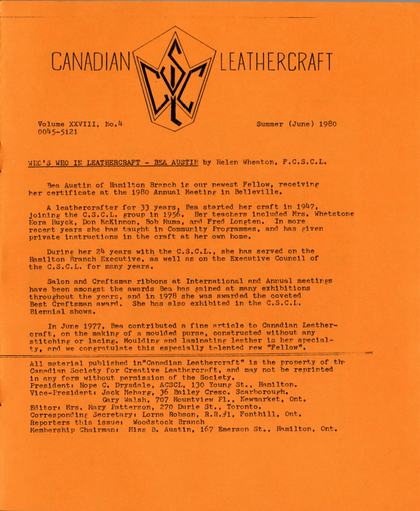
WHO'S WHO IN LEATHERCRAFT - BEA AUSTIN by Helen Wheaton, F.C.S.C.L.
Bea Austin of Hamilton Branch is our newest Fellow, receiving her certificate at the 1980 Annual Meeting in Belleville.
A leathercrafter for 33 years, Bea started her craft in 1947, joining the C.S.C.L. group in 1956. Her teachers included Mrs. Whetstone, Nora Huyck, Don McKinnon, Bob Muma, and Fred Longten. In more recent years she has taught in Community Programmes, and has given private instructions in the craft at her own home,
During her 24 years with the C.S.C.L., she has served on the Hamilton Branch Executive, as well as on the Executive Council of the C.S.C.L. for many years,
Salon and Craftsman ribbons at International and Annual meetings have been amongst the awards Bea has gained at many exhibitions throughout the years, and in 1978 she was awarded the coveted Best Craftsman award, She has also exhibited in the C.S.C.L. Biennial shows.
In June 1977, Bea contributed a fine article to Canadian Leathercraft, on the making of a moulded purse, constructed without any stitching or lacing. Moulding and laminating leather is her specialty, and we congratulate this especially talented new "Fellow",
All material published in"Canadian Leathercraft" is the property of the Canadian Society for Creative Leathercraft, and may not be reprinted in any form without permission of the Society.
President: Hope C. Drysdale, ACSCL, 130 Young St., Hamilton.
Vice-President: Jack Meharg, 36 Bailey Cresc. Scarborough,
                Gary Walsh, 707 Mountview Pl., Newmarket, Ont.
Editor: Mrs. Mary Patterson, 270 Durie St., Toronto.
Corresponding Secretary: Lorna Robson, R.R.#1, Fonthill, Ont.
Reporters this issue: Woodstock Branch
Membership
Chairman: Miss B. Austin, 167 Emerson St., Hamilton, Ont.
Page 2 — LEATHER IMPRESSIONS IN EUROPE
LEATHER IMPRESSIONS IN EUROPE - by Madeleine Mitchell
On a recent trip across Europe, I had a chance to observe some of the contemporary leather now available throughout several countries.
Portugal: In Lisbon, men,surprisingly perhaps, often carried sleek leather bags slung from the wrist. These well-constructed, compact handbags were often dark coloured, and contained numerous compartments closed by zippers and snaps.
The market stalls held some rather crude, unfinished leather items; occasionally belts, uncoloured, were made from "doughnuts" of leather strung along a thong. Amongst examples of stamped leather noted were small pouch-type shoulder baps. Otherwise, decoration was non-existant.
Spain: Rich bronze and tan coloured leathers appeared in Spanish leatherwork, combined with brightly coloured Morroco leathers and occasionally gold leaf,
Spanish handbags were superb examples of the use of soft, supple leather adapted to simple purse designs. Little ornamentation appeared on these classic, stylish handbags. Wineskins made of suede, calf, and even goatskins were popular, as well as some rather garish jewellery boxes which, although covered with leather, were dominated by brass studs and excessive decoration.
Gloves were also plentiful, and shoes were well-designed, and made of leather only.
France: The French Haute Couture uses leather in a most elegant and expensive way. Exquisitely designed leather items were richly coloured, and used a variety of finely grained leathers. Desk pieces, as well as belts, purses, wallets, etc. were available, Snake skins, and alligator, were noted in shoes and purses for women. No unfinished or uncoloured leather items were seen.
Italy: The Florence leather work is notable because of its rich colours and intricate designs, (created by embossing, stamping, or carving.) Gold leaf often was used to accentuate the design.
In Rome, leather was much like that of France - excellent and expensive. Besides the functional Pieces of leather, (bags, shoes, and belts), - moulded leather pieces were noticed in desk sets and game parts,
Up to this point in my travels in Europe, it was interesting to note that few, if any, synthetic leathers were used by European women. About 95% of the shoes, and almost all of the bags, were of leather- occasionally fabric and leather were combined. Prices were relative to the quality of workmanship and amount of leather used,
Page 3 — LET'S MAKE A PENDANT
However, in Naples, synthetic products started to appear, and although leather was still readily available, the synthetics were also available in large items such as luggage and totes.
Greece: Greek leather seemed limited to roughly made pieces, often adorned with traditional Greek designs, Shoes were often leather, but an increasing amount of synthetics were observed. Wineskins were of leather, but not in the quantities seen in Spain.
Bulgaria: This Communist country proved to have a very limited amount of leather goods. A few suede skirts, and very expensive leather bags were accessible only to tourists. However, synthetics are prevalent. Shoe stores reek of the odour of polyurethane, and handbags were either fabric, or, again, synthetic. Any leather that is produced is apparently exported, and the Bulgarian rarely, if ever, can acquire real leather pieces,
LET'S MAKE A PENDANT by Sid Taylor
Materials Needed: Enough scrap 3 or 4 oz. leather to allow three pieces approximately 3 1/8" by 2 1/8" to be cut.
A cabochon-cut stone. (Visit a "rock store" for this. A cabochon stone is one which is Opaque, usually, and domed on the top, with a flat back. An agate-type stone would be quite practical, colourful, yet inexpensive.)
Leather lacing, or round-core belting leather for either a braided leather neckpiece or solid leather necklace. Braided neckpiece looks best for this.
1. Construct your pattern pieces. You will need one basic pattern piece, (suggested pear shape), plus a pattern 1/4" smaller all round than the original, plus a small hanger-strip pattern, (see next page for pattern shapes.)
2. Lay the basic shape on your leather, mark out 1 piece on the flesh side of the leather, and cut out. (This is the back piece, mark it as such to avoid confusion). Skive edge.
3. Reverse the pattern, and cut out 2 front pieces, (same shape as back piece.) These are fronts, and should also have edges skived. 4, Cut out hanger strap from small piece (1-1/2" x 5/16") of thinner leather. Skive ends paper thin. Fold hanger in half, as marked by dotted line, and glue hanger tips together.
Page 4
| Basic | Cut out centre | Hanger |
| Shape | 1/4 " smaller | Pattern. |
| (Cut 3) | all round. This | |
| is "frame" pattern (A) | ||
| and"centre" pattern (B) |
5. The back and one of the front pieces can be dyed and when dry may be glued together, with the hanger strip inserted in appropriate position. (Remember the edges of these 3 pieces should be skived.)
6. The next piece requires a pattern that is 1/4" smaller all the way around. (We designated this the "frame" pattern above.) (A)
7. I cut this piece on an angle (from the flesh side). The inside cut of this narrow "frame" piece, (which is cut out of the remaining "front" piece of leather,) should be dressed and finished smoothly.
8. We are now left with the (B) "centre" piece. It should fit inside the "frame" piece with a clearance all round of at least 1/8".
9. Centre the cabochon stone on the flesh side of the "centre" piece, and mark as closely as possible. Cut out the cabochon shape on the inside of the mark, and cut on a good bevel, so that when the stone is properly placed, the flesh side of the leather fits snugly around it, acting as a bezel.
10.When this is accomplished, die the "frame" and centre piece, finishing the inside edge of the "frame" and the outer edge of the centre piece very well. When ready, carefully glue outer frame to the front side of the previously glued 3 pieces. With "cab" removed, place centre piece inside frame, mark outline of "cab" shape, and, on this place, place enough glue to allow for slight adjustment when setting the centre piece equidistantly inside the "frame". Press leather around base of stone, and, of course, the centre piece. All that remains is to sand, resand, and polish edge of pendant! I think that a braided leather neckpiece enhances this pendant.
[The three pattern pieces are drawn side by side with a caption under each; the captions are set out here in the same three columns. The instructions are numbered 5. to 10. and are set out one step to a paragraph, as the page prints them. Restored against the printed page: the middle caption reads "1/4 " smaller"; step 7 carries its number; and the last step reads "mark outline of "cab" shape", "sand, resand, and polish edge of pendant" and "enhances this pendant". The page types "10.When" with no space, "on this place, place enough glue", and "die" where it means "dye"; all three stand as printed.]
Page 5 — ONTARIO CRAFTS '80
5.
Finished pendant, with dotted lines indicating hanger strip placement, ce
Belows The centra piece that is left after cutting your 1/4" frame should be trimmed to allow at least 1/8" clearance all around. Centre your stone on this and figure out a pattern that will enhance the beauty of the stone. Scalloping and ribbing designs shown below.
ONTARIO CRAFTS '80
The annual provincial juried exhibition of the Ontario Crafts
Council, on display originally at the C.N.E. Arts and Crafts and Hobbies Building this year, is at present on display at Gairloch Gallery, 1306 Lakeshore Road East, Oakville, until Nov. 16,
The Canadian Society for Creative Leathercraft Award for Best Functional Design in Leather, (in the amount of $50.00), which we donate as a group, was not awarded this year as there were no entries, Paul Williams won the Tandy Leather Co. Award for Best Decorative Leather,
EDITOR'S QUERY
When I read the above in the Craft News, it suddenly brought to mind the list of entries for Leather '80 that I had just completed typing. Where are the practical leather pieces?? When I think of a show piece myself, I think of decorative leather Madeleine Mitchell's article on European leather; the first thing she checked were functional leather cases, shoes etc., as is normal in a craft such as ours, Have we forgotten how to make these more "usual" items in fine quality, or sare we sacrificing utility for "uniqueness of design" 77 I personally am guilty of this, and intend to concentrate more thought to usefulness in the future. Do I have any companions? There certainly are some practical pieces in Leather '80, but we could use even more of them in Leather '82,
PLAN AHEAD ***
FOR 1982
Page 6 — LEATHER AT THE INTERNATIONAL PLOWING MATCH * OXFORD COUNTY
LEATHER AT THE INTERNATIONAL PLOWING MATCH * OXFORD COUNTY * by Carol McLean F,C.S.C.L.
The match was held at Woodstock, Ontario, Sept, 30-Oet. 4%, 1980, and was hosted by the Oxford County Plowmans Association.
Here are a few facts about the event to familiarize you with the gigantic size of this undertaking.
It began 67 years ago in 1913 by the Ontario Plowman's Association in conjunction with many local associations and has only been hosted two previous times by Oxford County. (1921 and 1951.) The event is held annually in a different county or region of Ontario.
More than 800 acres were set aside for competitions, demonstrations, parking, and the tented city. The tented city is so large- approximately 140 acres - that it elects its own mayor, has water, hydro and telephone services, and a 24-hour security system.
There are parades at the beginning and end of the week's festivities attended by many dignitaries, including Premier William Davis, Governor General Edward Schreyer and his wife, Mp.p. Harry Parrott, to mention only a few. These parades include top bands, farm machinery and steam engines, new and antique cars, teams of both horses and oxen, floats, and much, much more... quite a gala event !
There were over 600 exhibits in farm machinery, chemicals, services, and technology information for agriculture, as well as a display of special interest exhibits.
Oxford County, being the dairy capitol of the world, had a beautiful display in its own building complex.
The attendance figure at last count had passed the 120,000 plus mark, and final results are still coming in, (It was anticipated that 200,000 people would attend this year.) It involved a mammoth job of traffic and parking management with thousands of cars.
The fun began when the rains came, as they usually do ! Out came fleets of tractors and chains to pull free the cars, wired down in axle-deep mud in the parking lots (fields!) which had turned into a sea of mud. The Provincial Police are to be congratulated for their splendid control of the situation. One officer I noticed was standing "boot-deep" in mud, a smile on his face, happily directing traffic. That takes super cool!
The Tented City alone covers 140 acres, and it was here, in a huge steel building, that I made my "home", for the week,
Page 7
Back in January I began receiving letters, (as did many Oxford County craftsmen), from the Ladies Programme Committee asking that I send in my application form to have my work juried in hopes of being chosen to represent Oxford County Craftsmen. At the time, I didn't have very much work on hand, as I had a one man show at Elmhurst Gallery in Ingersoll, so I hesitated for a while. Then I was told that the committee had seen my work at the gallery, and I need not submit further work for jurying. That was a relief, because I wanted to submit my best pieces !
After a month or so, the crafts were juried, and the letters went out -yes! - I was accepted to represent Leather. (I was asked if I could keep the bulk of mp display in the Sculptural aspect, please.) That was a challenge which worried me at first, but after sitting down and thinking for a while I decided to make my display out of free form sculpture, trays, bowls, my large chairside container, and my many masks and jewellery.
This was the first time the craft building entrants had had their work juried, but it paid dividends in the long run, with a totally co-ordinated effort, each exhibit being a single media display. This was much tidier looking than having multi-media exhibits mixed in every booth.
Sun dawned brightly for set-up day, (Monday), and spirits were high. I was fortunate to find my space allotted in an aisle with many familiar craftsmen, such as the Oxford County Weavers, and Ralph Watson with his Bas Relief Stone Sculptures. The rug hooking ladies were directly behind me, It was a 'fun' group that developed into a 'family', sharing each others triumphs and tragedys.
People were lined up from 10:00 a.m. to 6:00 p.m. every day to get through our building. It proved to be one of the highlights of the Plowing Match complex.
My family saw very little of me that week, except when Bonnie helped me "man" the exhibit. I was on the site from 7:30 a.m. until the building closed at 6 p.m., meaning that I arrived home about 7 Pp.x. I'd grab a quick supper, prepared by Bonnie and my totally supportive husband, Gus, and than back down to my workroom until midnight to attempt to keep ahead on my stock. (Impossible!) During the few hours left for sleep, I was occasionally so keyed up that sleep did not come readily, especially following the evening when I saw a man breaking into my car. (I was still a quarter of a mile away, and s0 by the time I got to my car he was driving away, but I managed to get his licence number, and as I was giving the police a description of the car, he drove by, and was apprehended !
One of the questions asked most by show visitors was "How do you get the leather to hold its shape?" As most people seemed to doubt that air-drying could accomplish what they were seeing, I added that the larger pieces were oven-baked, and that seemed to satisfy them! In retrospect, I am very pleased to look back on this event and my participation as a leathercrafter.
Page 8 — HARNESS BRASS PLAQUES
HARNESS BRASS PLAQUES by Joyce E. Poulson
A few years ago a business friend of mine brought back from England six brass face places. He had seen these mounted on leather as decorative plaques, but the mountings were cheaply done; therefore he bought six brasses and requested my assistance in mounting them on leather. Together we were able to draw up a pattern that was workable. The finished product was quite attractive.
I have since made several of these plaques in various shapes and sizes. Initially I found it difficult to obtain the brasses, but through time I have located sources of supply. Several harness suppliers stock them. Similar plaques are now sold by manufacturers, but most of them that I have seen lack the quality to be found in a handcrafted article.
[Three diagrams go with this article. Figure A is a three-brass plaque shaped like three joined circles, with a D-ring at the top. Figure B is a single-brass plaque in an octagon shape, also with a D-ring. Figure C is a side view of the mounting strap, labelled with the D-ring, the rivet, the front and back of the strap, and its cemented end. The diagrams themselves are not reproduced here.]
Items required:
3 Brass Face Pieces
1 3/4" Brass D-ring
1 Strip 3/4" x 16" 2 1/2 oz. Cowhide
1 Strip 4 1/4" x 14 1/2" 6 oz., or preferably, 8 oz. cowhide
Desired finishes (Dyes & Waxes etc.)
First prepare a pattern. Select the shape desired, and position brasses on pattern to mark holes so that brasses will hang properly centred. (Brasses vary in size - select uniform sizes if possible. )
Page 9 — LOOKING TO THE PAST
Cut the 3/4" x 16" piece of 2 1/2 oz. Cowhide. Round the ends.
This is used as the hanging and attachment strap.
Then cut the 4 1/4" x 14 1/2" piece of 8 oz. cowhide to the desired shape. Sandpapper the edges to erase irregularities. Edge bevel both back and front edges. Lightly sandpaper edges again.
Punch 3/4" slits - one for top, and one for each of the three brasses - or punch end holes and cut slit area in between.
Dampen plaque, and edge crease,
Dye plaque and strap to desired colour, I use a combination of Garnett's Havana Brown and Dark Brown (Chocolate) Toning dye.
Apply polish coat to front, and polish well.
Apply Edge Dressing to back and edges, then wipe clean. Apply
Polish Coat all over and allow to dry well.
Polish 3/4" Brass D-Ring and Brass Face pieces with Brasso polish. Everything is now ready to be assembled.
Punch one hole 3/8" from end of strap, and another 3 1/4" from the same end of the strap. Thread strap up through top hole from back of Plaque, and through D-Ring, then rivet end of strap through the two holes. Rivet (small) should now be hidden behind plaque.
Thread strap up through second top hole, through Brass Face Piece, and back through same hole. Repeat for second and third Brass pieces, carrying strap down back of plaque and pulling snug each time. (Fig.C). Glue bottom end of strap to back of plaque.
The instructions given are for a three-brass plaque. (Fig. A.) They can be made for two brasses, or for very attractive singles, as in Figure B, If you are fortunate enough to find matching left/right designs, (i.e. matching horses heads, facing opposite directions, ), you can make a most attractive pair of singles.
LOOKING TO THE PAST.... The Editor.
Since receiving ALL the issues of Canadian Leathercraft from Olivia Smith,(the collection of the late Anne Hook),I have been reading over the fine articles submitted in the past, many by members still working in our chosen craft medium. We are requesting permission from various members to reprint some of the past "gems of information".....(Bob and Dorothy Muma have already given their consent),and we feel that many of these past issues have information either useful to some of we newcomers to the art, or of a "mind-jogging" nature to some of the more experienced, We hope you will enjoy these "glimpses of the past".
MMP.
Page 10 — I.A.L.C. Leather Craft Salon Judging 1967
Reprint (edited only for space requirements) of I.A.I.C. Leather Craft Salon Judging 1967 Robert Muma F.C.S.C.L.
(We feel that this article may express some of the qualities searched for in the recent Leather '80 judging, ALSO done by Bob), aided by Dorothy!
This morning, in selecting the leather pieces for the Salon, we discharged our duties as judges. We can't expect everyone to be pleased with these results, so this evening I feel as though our roles may be somewhat reversed with my 'partner in crime' and I on trial and you the judges demanding some justification for what we have done. If I guess correctly, you want to know why we selected this, and why not that. You want to know what standards we use. What do we look for? If you were unsuccessful this year, how can you make it next year, and so on, Judging is a personal selection. Each person chooses quality in the light of his own prejudices; and these are nurtured in our individual experience and training.
We look fors the most outstanding pieces, i.e. finest craftsmanship combined with creativity in leather. Each piece must be unique. We should not have to search every piece on display to find them, They should call us in their simplicity. They should be self-evident Pieces of excellence.
Good Craftsmanship of course. It is the basis of all fine art. We take it for granted. We also look for function in leather art. It is a part of fine craftsmanship and means the article should efficiently serve the purpose for which it is made,
Craftsmanship, function and design -- but in all these combined WE LOOK FOR SIMPLICITY. Many pieces seemed intended to stagger us:
- with their size
- with intricate and all-over carving (not common in'80). - with the amount and complexity of lacing and whatever embellishments can be applied to make a SHOW PIECE which, in effect, actually destroys the character of leather itself.
WE LOOK FOR SOMETHING NEW.
(1) New Techniques-sometimes makes a classic piece of work in their own right.
(2) New Design- i.e. contemporary design, if it complies with the basic requirements of good taste.
(3) New Concepts- i.e. new ways of using leather. Here is a whole field for research and experiment.
Bob suggests further new ideas that can be explored in using leather, and, although I doubt if he is often faced with monumental-sized pieces any more, due mainly to escalating costs of materials, I am sure that these basic requirements for award winning pieces are still foremost in his mind! MPP,
Page 11 — ONTARIO CRAFTS COUNCIL Affiliates Benefits
ONTARIO CRAFTS COUNCIL
Affiliates Benefits
1. $50, Prize for Desk
A prize of $50 as an incentive towards good design is available to each affiliate to be awarded at the affiliate''s annual exhibition. The amount may be divided into three prizes at the discretion of the affiliate. The prize to be given in the name of the Ontario Crafts Council. Request for prize money must be made prior to the exhibition and within the OCC fiscal year date of Jan. 1 to Dec. 1.
2. Financial Assistance for Meetings
The Council will give $25 towards the fee of a recognized professional authority as a demonstrator or speaker for a meeting. An affiliate may ask for this assistance three times a year, or $75 once a year. Request for assistance must be made prior to the meeting with description of dates and place; of program and name of person giving workshop; and made within the OCC fiscal year dates Jan.1 to Dec. 1 coinciding with the program date.
3. Reduced fees for Individuals
A reduced fee of $10 instead of the regular $15 fee for OCC individual members belonging to an affiliate of the Council.
4, Representation on Board of Directors
(a) For affiliates operating on a regional or local basis:
Any member of a regional or local affiliate may vote at the region's annual conference for the regional representative to the OCC affiliate committee.
(b) For single-craft affiliates operating on a province-wide basiss Each single-craft affiliate designated by the Ontario Crafts Council as a province-wide organization annually elects from amongst its executive a representative to the OCC affiliate committee,
The chairman of the affiliates' committee is a member of the Council's board of directors.
5. Three Copies of the OCC Publications
Craftsman, a magazine, alternates with Craft News, a newsletter. Each year the Council devotes an issue of the magazine to the programmes of the affiliated organizations. In addition, affiliates are urged to submit material to the publications editor, for a section called Among the Affiliates which enables the affiliates to learn about each other's activities. Three copies of Craftsman and Craft News are sent to each affiliate for circulation among interested members,
Page 12
6. Opportunity to Exhibit
An affiliate may apply for an exhibition of high quality work in the OCC's Craft Gallery. The gallery is booked on an average of a year ahead. The OCC's exhibition committee holds a special meeting twice yearly to consider requests for shows. Of the commission taken by the Council, 13-1/3% is given to the affiliated organization,
7. Assistance from Craft Resource Centre
Affiliates may apply to the Craft Resource Centre for information relating to crafts activity in Ontario. The Centre's files include lists of coming exhibitions, and portfolios of craftsmen, There is a minimum fee for some of the services. Slide programs and audio tapes are available at a reduced rate,
The Craft Resource Centre also assists affiliates in finding speakers for their meetings. The Centre would appreciate receiving an evaluation of any speaker it recommends to an affiliate.
8. Communications Weekend
Each year during the winter, the Council holds a weekend conference to which a delegate from each affiliate and cooperating institution is invited. The delegates meet with the Council's board of directors, staff, and observers from government and allied arts organizations, This weekend allows affiliate members to discuss together their programs and those of the Council, and to evaluate the ongoing services of the Council,
NEWS CLIPS
For those members of the C.S.C.L. who are unable to attend the Leather'80 biennial show, a copy of the programme, with award lists may be obtained on request. Contacts M. Patterson,
270 Durie Street,
Toronto M6S 3G3.
Many of our members occasionally drop in to "The Leather Warehouse" to purchase hides, As of Nov. 10th, 1980, the new address is 11 Boulton Avenue, Toronto. (For those out-of-fawners, turn north off the Lakeshore Blvd, at Leslie Street, just east of the Don Valley Parkway, 20 north to Queen St. East, and turn west for one block to Boulton Street, which runs north off Queen East. ) Tels 465-3728.
Next issue of "CANADIAN LEATHERCRAFT" will be presenting material written by the members of the Barrie Branch, CSCL., and any news items to be included in this coming issue should reach your editor bys Dee. 5th, 1980,