
An issue of the Society’s newsletter, transcribed from the original.
(12 pages, 1.7 MB)
the full-resolution scan, 27 MB, for close research
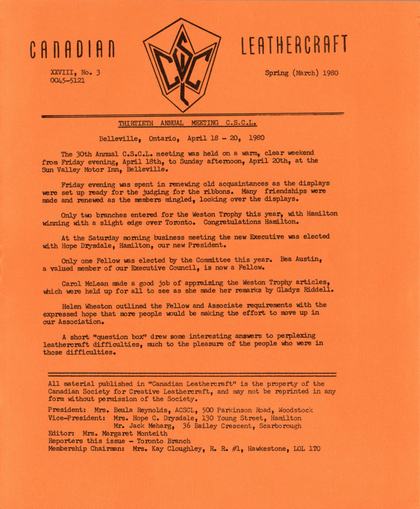
Page 1 — THIRTIETH ANNUAL MEETING C.S.C.L.
CANADIAN LEATHERCRAFT
XXVIII, No. 3
0045-5121
Spring (March) 1980
[The masthead prints the volume without the word "Volume", as "XXVIII, No. 3".]
THIRTIETH ANNUAL MEETING C.S.C.L.
Belleville, Ontario, April 18 - 20, 1980
The 30th Annual C.S.C.L. meeting was held on a warm, clear weekend from Friday evening, April 18th, to Sunday afternoon, April 20th, at the Sun Valley Motor Inn, Belleville.
Friday evening was spent in renewing old acquaintances as the displays were set up ready for the judging for the ribbons. Many friendships were made and renewed as the members mingled, looking over the displays.
Only two branches entered for the Weston Trophy this year, with Hamilton winning with a slight edge over Toronto. Congratulations Hamilton.
At the Saturday morning business meeting the new Executive was elected with Hope Drysdale, Hamilton, our new President.
Only one Fellow was elected by the Committee this year. Bea Austin, a valued member of our Executive Council, is now a Fellow.
Carol McLean made a good job of appraising the Weston Trophy articles, which were held up for all to see as she made her remarks by Gladys Riddell.
Helen Wheaton outlined the Fellow and Associate requirements with the expressed hope that more people would be making the effort to move up in our Association
A short "question box" drew some interesting answers to perplexing leathercraft difficulties, much to the pleasure of the people who were in those difficulties.
All material published in "Canadian Leathercraft" is the property of the Canadian Society for Creative Leathercraft, and may not be reprinted in any form without permission of the Society.
President: Mrs. Beula Reynolds, ACSCL, 500 Parkinson Road, Woodstock Vice-President: Mrs. Hope C. Drysdale, 130 Young Street, Hamilton
Mr. Jack Meharg, 36 Bailey Crescent, Scarborough
Editor: Mrs. Margaret Monteith
Reporters this issue — Toronto Branch
Membership
Chairman: Mrs. Kay Cloughley, R.R. #1, Hawkestone, L0L 1T0
This issue is typewritten
Page 2 — Leather Museum
The demonstrations of picture framing, carving, flower making, covered bottles, saddle stitching and book covers held the interest of attentive audiences all afternoon.
The awards presented, after the banquet dinner, did not include any salon" winners. Many of the Craftsman entrants were of as high, if not of a higher calibre, than many Salon entries. There were thirty—two ribbons given out as Craftsman awards, with several people gaining as many as six or seven awards.
The dinner was addressed by Alma Wallace, Conservationist, Taxidermist, Hunter and Photographer, who showed slides of her life in the out-of-doors, and, with examples, showed how many bird and animal antics are very human in style. Alma, who comes originally from the Belleville area, now spends most of her time in the high Arctic, where she now has a home, which she erected. Her knowledge of bird and animal traits is very extensive and provided much interesting information and many laughs.
Sunday's programme included the showing of the famous Rex Lingwood slides plus some of our own from the '78 Annual. A most interesting morning and a good way to slow down from a wonderful weekend.
We have been invited to have our next Annual in Hamilton. See you all there again.
Toronto Branch C.S.C.L.
Leather Museum
In Northampton, England is found one of the only two museums in the world devoted solely to leather. There are some 5,000 exhibits tracing man's use of leather from pre-historic times to the present.
The entrance hall displays the history of tanning using some of the more unusual skins like mouse, cat and fish skins.
The exhibits themselves are all grouped either under subjects or periods of history. The vast variety of the uses of leather can be observed. Some of the costumes of clothing date back to ancient Egypt. Each exhibit is accompanied by detailed descriptions.
The museum is due to the efforts of a half century of work by John Waterer (1892-1977) and Claude Spiers. John Waterer was also responsible for restoring completely any damaged articles so that each item is in beautiful condition.
Page 3 — Report of Delegate to the Affiliates' Meeting, February 24, 1980
Report of Delegate to the Affiliates' Meeting, February 24, 1980 Delegates to the Affiliates Meeting met on Sunday morning with President
Betty Dewar presiding.
There was some discussion re the designation of the year 1984 as "The Year of the Arts". It was reported that no government funding would be available, but that there might be some financial assistance from the Board of O.C.C. if they feel that it will make a meaningful contribution and not be too expensive.
Several new groups had made application to affiliate with O.C.C. It was recommended that the Board accept:
Elliott Lake Arts Club
Belleville Weavers' Club
North Toronto Arts and Crafts Club
Niagara Peninsula Needle Arts Guild Kingston Handloom Weavers and Spinners It was recommended that the Annual General Meeting of Communications be continued.
Stephen Dryden suggested that there should be a week-end seminar just for Affiliates Committee. This would give an opportunity for a day—long meeting, and allow for coming together twice a year.
A Search Committee consisting of Susan West and Fanny Sinclair was set up to investigate possible meeting place for next year's Communications Weekend. They would report their findings to the Board.
A complaint was registered by a Regional Director. The Regional Directors had not been receiving all of the literature that was going out to affiliates within their regions, so they had no way of knowing just what was taking place. This situation will be corrected. It was stressed that Single Media Affiliates should be encouraged to co-operate with their Regional Directors.
Financial Assistance to Affiliates (speakers etc.) has been changed to include $25.00 three times a year or $75.00 once. This will assist groups who wish to plan an extensive workshop.
A scholarship of $150.00 is available to a co-operating group for a Senior (Third Year) student. The question arose regarding courses of only two year duration. In order to qualify, the student would be expected to seek a further year of training at another source.
The Constitution Committee had also made a recommendation to the Executive Committee of the O.C.C. regarding Ontario Crafts Council Single Media Directorships. Briefly they were recommending revision to include the appointment of "up to 5 additional ex officio directors, each of whom are officers of one of five provincial single media organizations affiliated with the O.C.C. The person selected as an ex officio director must have been previously approved by the single media organization in question and also be a member of the O.C.C." The use of the words "up to" were questioned by your delegate, (who had consulted with Beula Reynolds whose place she was taking.) The burden of the complaint was that at the discretion of the Executive any number up to five could well include zero, one, two, three and four, and that the Single Media affiliates had no guarantee of representations
Page 4 — Natural Tanning of Leather
Some of the people present thought that such guarantee was implicit in the recommendation, but the point was finally taken seriously, and will be given further consideration. It was pointed out that it would not always be the same groups that had directors, since the number of Single Media Affiliates could far outnumber five, and the Directorate become unwieldy.
Betty Dewar was elected to the post of Chairman for another year. The next meeting was set for Thursday, May 8. The meeting was then adjourned.
Respectfully submitted,
Jean Hunter
(Substituting for Beula
Reynolds).
Natural Tanning of Leather Gladys Riddell
The Woodland Indians used one of the most natural methods of tanning moose and deer hides. This method was also adopted by the early settlers and can still be used by hunters today who bag their own game. No chemicals of any kind need be used.
The hides are first soaked in cold water until the hair is loosened and comes off. The flesh is also scraped off. The skins are then put into a strong warm soap solution and the scraping process is repeated. They are then put on racks to dry. In the spring, the hides would freeze overnight and the next day they would be pulled to dry them.
For the repeated scraping process, the Indians used a moose bone which had been sliced off to give it a blunt edge although any hunting knife that has been blunted can be used as effectively. An old carpenter's draw knife can also be made into a scraping tool, after the edges have been ground down to take the sharp edges off.
After the skin had been sufficiently cleaned, the Indians used vegetable oil which they rubbed into the skin although this step can be omitted. This was followed by soaking in warm soapy water. The oiling, soaking and stretching process can be repeated as often as 5 or 6 times.
The skins can be put on a rack and then pulled until dry. The more the skins are stretched, the whiter they become in appearance.
The final step in treating the skin is to give it colour. To achieve this, the skin is folded and sewn along the sides with a hole left at the top and bottom. They are then put over a fire with cob on top to make it smoke. The longer they are left over the smoke, the darker they become. When one side is done, they are then turned inside ou so that the reverse is also done.
To scrape off the hair and flesh, the skins were usually put on a block made from two pieces of a tree. The upright one was round while the slanted one had been cut in two. The bark was taken off to make it perfectly smooth.
Page 5 — Make Your Own Colour Charts
Make Your Own Colour Charts by Fred Brown
The novice who first becomes interested in colouring usually starts by using an Antique or a Toning Dye for one over-all colour effect. From this, many will wish to delve deeper into the fascinating art of mixing colours to achieve a desired shade and creating multi-colour effects etc. To those who have studied colour, the creating or varying of colours is comparatively simple, but to the craftsman not possessing this knowledge, it is quite a puzzle. How do I achieve a certain colour? What colour do I get when I mix two dyes? These, and other questions, confront the novice.
One of the first facts to learn is that colours do not necessarily need to be mixed in the bottle. Shades can also be achieved by applying one colour over the other on the leather. So, to learn what the results of this technique will produce, why not make your ow colour chart of Garnett Dyes? Each chart will require a piece of natural leather 6½ x 10" or larger if desired. (suggested size of squares—one inch) Make one chart using Antiques over Toning Dyes, then another with Toning Dyes over Antiques. (It is suggested that the number of coats be recorded.) There is a considerable difference in the colour effect when the process is reversed. The results will show a whole range of off-colours, some of which are very attractive, and some which are not at all desirable.
Carrying this chart idea further, one might be made of just Toning Dyes over Toning Dyes. The charts set out on this page are reduced in size.
Keep in mind that the leather in your colour chart will gradually darken, particularly if exposed to the light and this will also affect the coloured areas. The panel in the upper left corner of each chart is left natural and a comparison with your project leather will show the extent of darkening. Remember also that different types of leather will vary the shade of the dye. Each chart should therefore be labelled as to the type of leather used.
ONE FINAL NOTE REGARDING APPLYING ONE COLOUR OVER OTHERS
A final coat of Antique over a design which has been done in a number of Toning Dye Colours, has the effect of tying the whole colour scheme together with one common colour, and so reduces the harshness of contrasting colours. For example, over a design of red roses and green leaves an over-all coat of Golden Tan or Chestnut Brown gives them a common denominator.
[The bottom right of this page carries a second colour-mixing reference chart, "Toning Dyes over Toning Dyes" — Natural, Yellow, Orange, Scarlet, Blue, Green, Tan, Mid. Br., Dk. Br. and Black down both axes, an empty grid for the reader's own results — not reproducible as running text (same treatment as p6's "Antiques over Toning Dyes" chart). Its row/column headers are easy to weave into the prose above as stray fragments ("Yellow Orange", "Blue Green Tan Dk. Br. Black"); left out here, with the plain sentence set out as printed.]
Page 6
[This page is a colour-mixing reference chart, not prose: toning-dye colours (Yellow, Orange, Scarlet, Blue, Green, Tan, Middle Brown, Dark Brown, Black) run down the side, antique-over-toning colours (Natural, Golden Tan, Chestnut Brown, Havana Brown, Rouge, Mahogany) run across the top, with checkmarks in the grid — not reproducible as running text. No names.]
ANTIQUES OVER TONING DYES
Toning dye colours: Yellow, Orange, Scarlet, Blue, Green, Tan, Middle Brown, Dark Brown, Black.
Antique colours: Natural, Golden Tan, Chestnut Brown, Havana Brown, Rouge, Mahogany.
First put several coats of Toning Dyes on the horizontal columns, then cover with Antiques on the vertical columns, e.g. Golden Tan Antique would cover all the Toning Dyes.
Page 7
A brief resume of a lecture delivered by William Hodge, President of the Ontario Crafts Council, on February 8, 9, 1980 at Harbourfront on Colour and Design. by Ralph Whately
With 36 people on Saturday and 26 on Sunday, the members-at-large were able to participate with the regular Leathercraft members in an interesting in-depth series of seminars concerning leather design and the law of design in which all the elements of the design relate to Nature.
There are four categories of perception of design all of which are equally important no matter which category you feel applies to you viz. Infant, Child, Youth and Adult. Our perception of things changes and we may have multiple perceptions of design elements.
Some time was spent on colour and colour systems with a breakdown of some of the latest systems by Itten and Heckithier.
Leather deals mostly with the line of an article, or the lines that are put on the article, but the spaces that are created around it must also be pleasing. The rhythm of the lines and spaces and their proportions must be varied to relieve monotony.
There are many methods for planning designs, but the Golden Mean method of the Greeks is perhaps the most perfect. One needs to calculate the rightness of the size or scale of a piece and where its elements are placed.
Perhaps we need a new perception of what the leather can accomplish. Why are the flower petals so stiff and the butterfly wings so solid? In nature, they are agile enough to move.
Much was made of the multiple craft approach to leather during our own appraisal and constructive criticism session of our own leather pieces. The articles were related to other crafts which could have improved the final product.
Many suggestions were made, many provocative ideas were put forward during the sessions. Each person took away many new ideas to be worked on to improve our perception of line and space, shape and detail as well as colour techniques and purpose.
Page 8 — Craft Fairs and Exhibitions - Coming Events
Craft Fairs and Exhibitions - Coming Events Royal Canadian Legion
| May 3 | Contact: Mr. A. R. Sabre |
| Bolton, Ontario | R.R. #1, Bolton, Ontario L0P 1A0 |
| Table fee, no commission | Tel: (4:16) 5D 551 |
| Spring Antique and Craft Show | |
| May 17 19 | Contact: J. H. Patterson |
| Markdale Agricultural Society | Box 239 |
| Booth: $25.00, Table: $3.00 | Markdale, Ontario N0C 1H0 |
| Tel: (519) 986~2178 | |
| June (Date to be set) | Contact: North Toronto Arts and Craft Guild |
| Annual summer fair. | 1, Ste Clements Avenue |
| Toronto, Ontario MR 1G9 | |
| Tel: (416) 489-8502 | |
| Huronia Festival of the Arts | |
| August 2, 3, 4 | Contact: Mrs. Mamie Scholes |
| Centennial Park, Barrie | Pe Oo B0X 4H2 |
| More than 175 participants. | Barrie, Ontario L4M 4T7 |
No commission
Festival of Friends 80
| August 8, 9 10 | Contact: Wm. Powell/Conrad Furry |
| $100.00 per booth. No commission | 21 Augusta |
| All work must be pre-judged. | Hamilton, Ontario L8N 1P6 |
| Craftsmen should send in 10 slides | Tels (1,16) 525—_664h, |
| of their | |
| Autum Festival of the Arts | |
| September 5, 6, 7 | Contact: Paul Ingram |
| Carling O'Keefe plant grounds | 11 Nora Road |
| (401 at Airport Expressway) | Islington, Ontario M9A 1C8 |
| 50 craft participants | Tel: 116) 231-9016 |
| Registration fee and 20% commission | |
| Grimsby Festival of Arts and Crafts | |
| September 13 | Contact: Ernie Matton |
| No fee. No commission. | Box 277 |
| Only a donation from each entrant | Grimsby, Ontario L3M 4G3 |
| to be auctioned off the following | Tel: (416) 945-8943 |
| month. |
3rd Annual Spencersmith Park Art Market
| September 21 | Contact: Paul Beneteau |
| Spencersmith Park, Lakeshore Road and Q.E.W. | Tel: (416) 335-0707 evenings |
| Registration 10.00 for members of | 632-7796 daytime |
| Arts Burlington | Forms available from: |
| 15.00 for non-members | Burlington Cultural Centre |
| Fee includes table | 425 Brock Ave. |
Burlington, Ont. L7S 18
Tel: (416) 632=7796
Several phone numbers on this page of small-print contact listings remain uncertain — worn or faint digits — and are left as set out rather than guessed.
[Restored against the printed page: the contact is "Ernie Matton" at "Box 277", and the sentence about the donation ends "the following month." on the next line of the same entry]
Page 9 — Craftsman Awards - 33
Craftsman Awards - 33
B. Austin — Fluted Bowl
Fluted Bowl
Red Candle Sticks
Round Box
Handbag
Boy=Girl Round Box
Sandals
H. Brock = Belt Key holder
L. Busch — Book Cover = red-cross
C. Cavanagh — Rouge Jug
- Pen stand
- Book ends with cardinal
Win Comfort — Beige Bottle
Hilda Cheynoweth — Sandals
- Lamp Shade
Hope Drysdale — Deerskin Gloves
Ruth Haig -— Handbag with braid
- Belt
- Rouge Box
- Long shoe horn
Margaret Hunt — Morocco clutch wallet
Jean Hunter — Candle Holder
Irene Kirkland = Rope design bottle
Margaret Lachappelle — Gloves
Jessie Little — Photo Album
Lorene Manuel — Horse Brass Holder
Carol McLean — Wine Belt
- Free form sculpture
Art Morris — Pouch for Sportsman
Jean Pickering — Paul Bunyon Bag
Olivia Smith - Set of coasters
Itsui Yasui -— Wallet— red morocco
Helen M. Wheaton
Chairman — Council of Fellows
[This list prints “Hilda Cheynoweth”; the family name is Chynoweth everywhere else in the Society’s papers. Kept as printed.]
Page 10 — WHO'S WHO IN LEATHERCRAFT — JESSIE LITTLE
WHO'S WHO IN LEATHERCRAFT — JESSIE LITTLE
Jessie Little grew up in the Brampton area of Southern Ontario As a girl, her interests included horseback riding, baseball, canoeing and other outdoor sports. Many of her summers were spent counselling at youth camps.
After having taught for some years in the Toronto School System, Jessie left teaching, and with her husband, Neil, farmed just north of Brampton When they later moved to Snelgrove, Jessie returned to teaching, retiring from the staff of Bramalea Secondary School in 1971.
Jessie's interest in Leathercraft dates back many years. She studied under Jack MacDougall, Robert Muma and Isobel Joyce, and has since attended many related courses and workshops in design and Leathercraft sponsored by Community Colleges and Branches. She is a former member of I.A.L.C. and a long-time member of C.S.C.L. She was granted her Fellowship with C.S.C.L. in 1972, and holds a Type A Teaching Certificate with this groups Her articles on colouring, shop tips and Cuir Bouille may be found in earlier issues of The Canadian Craftsman.
Jessie has taught Leathercraft on long and short courses. She has taught from her home, and has given night school instruction at Central Peel and Bramalea Secondary Schools as well as working with the Bramalea Secondary Schools in Leathercraft. She has instructed in schools in Acton and Caledon East, and for Sheridan Community College in Brampton and at Belfountain. Many of us enjoyed her weekend workshop in colouring at Mohawk College. Other workshops have included Hamilton, Woodstock, Barrie, Toronto and King City. She is also in demand for talks and demonstrations to other groups. Added to this, Jessie finds time to participate in many sales.
The number and diversity of awards she has earned attest to Jessie's excellence in craftsmanship, and to her participation in many events and competitions in her field. Among her treasures are many Salon and Craftsman's awards from I.A.L.C. and C.S.C.L., Weston Trophy ribbons, C.N.E. prizes, a Chatelaine Award and Honourable Mention.
As Chief Librarian with the C.S.C.L. Larmour Memorial Library, Jessie has done a great job. Most of the new books that have been added to the original collection were screened personally, and she never passes a book-stall without having a look to see whether there would be something there of value to the group.
Retirement from teaching did not mean retirement from Life for Jessie. She and her husband, Neil, have enjoyed a son and daughter, and two grandchildren have been added to keep things stirred up.
The sympathy of the members of C.S.C.L. went out to Jessie upon the loss of her husband on Palm Sunday. With her usual innate courage, she is picking up the pieces and looking beyond the horizon—as she always did. As she always will.
Page 11 — Weston Trophy Pieces 1980
Weston Trophy Pieces 1980
(Description)
Hamilton
Covered Bottle: A beautiful rich shading of rust coloured tones. A jaunty nautical air was achieved using a cord as a 3-D element surrounding the "K' monogrammed
Molded Bowl: In tones of golden tan, two layers of leather laminated together.
The "4 corner feel to the fluting around the top of the bowl gave an interesting variance from the regular scalloped effect. Tt has been learned that the laminating was done AFTER the pieces had been individually shaped and dried. An interesting new technique possibility.
Soft Natural Purse: A lovely flexible soft cream coloured leather. A decorative strip of braid was used to cover the joining seam. The catch was a roll-up of leather
A very useful utilitarian article.
Gloves: A most interesting pair of gloves in a lovely cream coloured leather made of a very good choice of leather. Molded Jug or Vase: An exciting piece featuring a very rich colouring and super double stitching on the side seams. A beautiful example of molding and a lovely shape.
Toronto
Belts A very good example of the Sportsman's belt and would be appreciated by the outdoors man. A good job of carving and a tasteful restraint in the colouring. Photo Albums A very elegant piece—beautifully crafted. The cover has been molded over a hand—carved wooden form and then a filler and padding used to retain the raised shaping. A rich shading of warm leather tones from natural through red. Dark brown has been used to accentuate the 3-D effect—-a beautiful 4 strand round braid lacing has been used to assemble the album.
Cookie Bags Inspiration for this bag was from a bag given by comedian
Lucille Ball as a gift to a friend on a television show. It is a giant chocolate chip and nut cookie. A beautiful light weight bag a fun piece?
Candlestick Holder: Beautiful rich colouring in antique rouge tones. The petals have been cut in such a way to make a second layer of petals and dyed a deeper tone. A very graceful effect is achieved. Ashtray: A very functional article featuring 3-D raised work on the sides.
The leather is a lovely maroon shade of English Morocco.
Page 12 — WORKSHOP OF JACKETS
We were so disappointed that only 2 branches were able to compete this year and we'd like to encourage ALL Branches to complete next year for sure} We know two of the non—competing branches were within 1 piece of making it and hope they will add that extra piece and enter next year.
It need not be an exotic piece either—most of your members can turn out avery good basic piece of work, like a belt or wallet and key case set or book ends and these should not be forgotten when submitting pieces for the branch competition. Therefore EVERY BRANCH MEMBER should take it as a responsibility to support their branch in competition and not expect just the same 5 or 6 people to do it year after year.
The two Branches competing this year were above average which pleased the judges very mich. There were some very interesting combinations of techniques and leathers and some most exciting design concepts. Congratulations to all of you.
We again make the request of submitting a short note with your competition piece telling its "story" eg. type of leathers, dyeing or working techniques and design inspirations.
26
WORKSHOP OF JACKETS by Wally Klaffener.
Biennial Exhibition — November 14 — December 6.