
An issue of the Society’s newsletter, transcribed from the original.
(12 pages, 2.3 MB)
the full-resolution scan, 34 MB, for close research
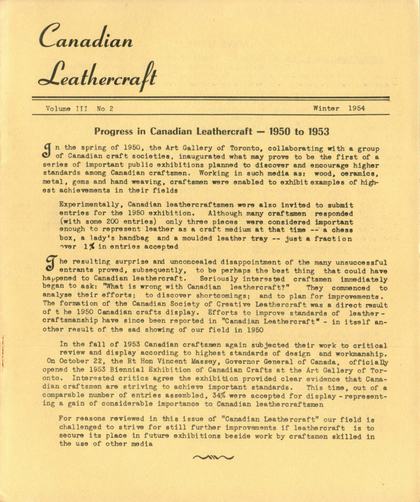
Page 1 — Progress in Canadian Leathercraft — 1950 to 1953
Canadian
Leathercraft
Volume III No 2 Winter 1954
Progress in Canadian Leathercraft — 1950 to 1953
In the spring of 1950, the Art Gallery of Toronto, collaborating with a group of Canadian craft societies, inaugurated what may prove to be the first of a series of important public exhibitions planned to discover and encourage higher standards among Canadian craftsmen. Working in such media as: wood, ceramics, metal, gems and hand weaving, craftsmen were enabled to exhibit examples of highest achievements in their fields
Experimentally, Canadian leathercraftsmen were also invited to submit entries for the 1950 exhibition. Although many craftsmen responded (with some 200 entries) only three pieces were considered important enough to represent leather as a craft medium at that time -- a chess box, a lady's handbag and a moulded leather tray -- just a fraction over 1% in entries accepted
The resulting surprise and unconcealed disappointment of the many unsuccessful entrants proved, subsequently, to be perhaps the best thing that could have happened to Canadian leathercraft. Seriously interested craftsmen immediately began to ask: "What is wrong with Canadian leathercraft?" They commenced to analyse their efforts; to discover shortcomings; and to plan for improvements. The formation of the Canadian Society of Creative Leathercraft was a direct result of the 1950 Canadian crafts display. Efforts to improve standards of leather - craftsmanship have since been reported in "Canadian Leathercraft" - in itself another result of the sad showing of our field in 1950
In the fall of 1953 Canadian craftsmen again subjected their work to critical review and display according to highest standards of design and workmanship.
On October 22, the Rt Hon Vincent Massey, Governor General of Canada, officially opened the 1953 Biennial Exhibition of Canadian Crafts at the Art Gallery of Toronto. Interested critics agree the exhibition provided clear evidence that Canadian craftsmen are striving to achieve important standards. This time, out of a comparable number of entries assembled, 34% were accepted for display - representing a gain of considerable importance to Canadian leathercraftsmen
For reasons reviewed in this issue of "Canadian Leathercraft" our field is challenged to strive for still further improvements if leathercraft is to secure its place in future exhibitions beside work by craftsmen skilled in the use of other media
Page 2 — NEWS ITEMS
NEWS ITEMS
INTERNATIONAL HOBBY SHOW - Coliseum, Toronto, February 5-12, 1954
Again CSCL has been invited to prepare a feature display of fine Canadian leathercraft. To stimulate interest among the viewing public another popular judging contest will be conducted and a lady's handbag given to the visitor whose ballot will be drawn at the conclusion of the exhibition
Craftsmen may, if desired, offer their work for sale, allowing a small commission to the Society for display and handling costs
At certain periods throughout the exhibition CSCL members will demonstrate various leatherworking techniques for the public
CSCL TRAVELLING EXHIBITION
No.2 - Because the first Travelling Display offered by our Society proved so popular during its year and a half tour of centres across Canada, a second exhibit has been planned to commence its itinerary shortly after the International Hobby Show
An important novation will be a carefully planned series of educational still-life displays, including examples of: gusset making, leather finishing, belt making operations, handbag pockets, handbag flap closing devices. Some "in-process" exhibits will be shown to help beginners understand recommended methods of construction and finishing, and the display will again be rounded out with a selection of finished articles of good design and workmanship
CANADIAN LEATHERCRAFT IN ENGLAND - At the recent International Hobby Show held at Olympia, Canadian leathercraft attracted keen attention because of its 'good designing, good crafting and good finishing." British radio and TV programs, as well as printed news services gave high praise to our Society's leathercraft display. Letters have also been received from Canadians in England and others who visited the Olympia Exhibition of hobbies and crafts, saying (we hope in all modesty) that the Canadian leathercraft display commanded top recognition among the variety of craft displays presented. Perhaps we may rightfully feel encouraged, as this loan exhibition to England actually represented our secondary efforts only, since our better examples had been reserved for the important Biennial Exhibition of Canadian Crafts, concurrently showing at the Art Gallery of Toronto
We are told that during the British International Hobby Show, an English leatherworker entertained TV audiences with a surprising demonstration of his ability to mould leather to high relief forms by a method of stretching and setting his thin leathers to the contours of animal models. If we can discover more about this craftsman's methods, we shall try to report again about his techniques. In the meantime, we might try forming masks and plaques to our own designs
Page 3 — Through the Eyes of Others
Through the Eyes of Others
If we are truly interested in practising a craft according to high standards, we must be prepared to subject our efforts to constant critical appraisal -- appraisal by ourselves and appraisal by recognized critics. Unfortunately, few craftsmen learn to review their own work critically enough to help them compare standards and to discover where important improvements may be made. The tendency is common among students to become too easily self-satisfied, and to pass over such self-satisfaction by saying or feeling: "I do my craft just for a hobby" -- thus excusing lack of interest in bettering standards of workmanship
Among craftsmen seriously concerned about good standards, certain questions come to mind when planning for competitive exhibitions --
"By what standards will my work be judged?"
"Will the jury criticise my work so severely that it won't stand a chance?" "How may I learn something about selection policies adopted for important exhibitions?" and, after trying --
"What is wrong with my work - that it could not earn a place?"
The Society wrote in British spelling here — "criticise", not "criticize" — kept as printed.
To answer these questions, our winter edition of "Canadian Leathercraft" is being devoted chiefly to a review of entries submitted for the 1953 Biennial Exhibition of Canadian Crafts. And to lend importance to the review, several critics, widely recognized for their capacity to compare art and craft standards in various fields, were invited to comment particularly upon the leathercraft section of the 1953 Biennial Crafts Exhibition. The special reports and comments offered will explain for the craftsmen such important considerations as; 1) chief reasons for offering high-standard exhibitions to the public 2) selection guiding policies adopted for choosing entries for display
3) constructively critical comments to help all entrants - whether work accepted or rejected, as well as to help all interested in developing better craft standards
Expressed variously, the exhibition objectives and policies adopted for selecting final entries for display include:
1) a major purpose of the exhibition is to promote excellence in technique and design; to discourage imitative and immature work, with a view to demonstrating the high potential of the crafts in Canada
2) to display examples of functionally well designed articles 3) to show only original efforts of Canadian craftsmen
4) to offer examples of finished craft techniques
5) to demonstrate simple, rather than ornate decorative treatments 6) to discover and display new or improved art and craft techniques 7) to display and encourage the best possible examples of creative designing among Canadian craftsmen
With such policies in mind, certain entries proved completely acceptable; some, while accepted as demonstrating our present capacities, did, nevertheless, leave improvements still to be strived for; while, as in most high-level exhibitions, the greater number of entries had to be refused - because
[The line is set with the typewriter’s own wide spacing, and a stray character read into the gap is removed. The words are the page’s own.]
Page 4
they had not demonstrated sufficient of the standards desired at displays of such importance
Let us then examine our work through the eyes of others - so that we may discover wherein we may meet the challenge to raise our standards and demonstrate progress in our craft for the next Biennial crafts display When craftsmen think of entering their work in a competitive exhibition, a common question which comes to mind is: "Will the judging standards prove so severe that my work won't be selected?" let's first think about it this way - As in competitive sports - it's not "winning" that matters as much as the importance of participation - participation to make a competition possible, and participation so that each competitor may enjoy new experiences while preparing examples for critical review
To gain experience, craftsmen may enter work in various types of competitive exhibitions - ranging from novice displays of the hobbycraft type to displays for master craftsmen who must meet the challenge to produce original work according to highest standards of design and craftsmanship. Typical exhibition services include:
1) the common local "hobbycraft" class of exhibition - where practically all entries may be accepted - regardless of standards of design or workmanship. Such local displays (community centres, end-of-term school displays) may be either competitive or non-competitive in scope
2) provincial and regional "hobbycraft" exhibitions, where organized competitive Classes offer prize awards. Judging standards are often quite elementary. 3) provincial, regional, national and international "hobbycraft" exhibitions, where somewhat higher, but still flexible standards are set - often with the idea of encouraging wide participation and popularizing certain craft subjects Some provincial exhibitions, such as held by the provinces of Quebec, Nova Scotia and New Brunswick, endeavour to encourage rather higher-than-common standards, since sponsoring services have the means to encourage more serious interests in hand craft movements
4) "Master Craftsmen" exhibitions - drawing work from provincial or national fields which have earned important status among leading craftsmen. For example, as in the Exhibition herein reviewed - which sought work from craftsmen working in: stone or wood sculpture, metal, gems, ceramics hand weaving and leather
While a chief objective of "hobbycraft" displays, seems to be to encourage as many as possible to take a beginner's interest in various crafts, and top standards are not a primary concern, exhibitions such as the Biennial Canadian Crafts Exhibition require that successful entries meet severest criticisms on points of design and workmanship
Page 5 — Rejection Reasons
Rejection Reasons
From the start, all groups co-operating to prepare the 1953 exhibition tried to invite work from their entire fields. For example, invitations for the leather - craft section were not restricted to members of any particular group of craftsmen, but were offered all craftsmen who could be reached through mailing lists available. Local groups of leathercraftsmen and supply houses also co-operated in making plans for the exhibition widely known
However, as this particular report has been prepared through the efforts of members of the Canadian Society of Creative Leathercraft, perhaps those craftsmen who are not yet members of this national-scope Society, may permit us to answer one interesting question?
"How was it that most of the accepted pieces were produced by members of the CSCL?" This is a reasonable observation and a fair question. The answers are several and each of some importance. We hope they may be understood and appreciated by non-CSCL members --
1) The CSCL has compiled perhaps the largest single mailing list of Canadian leathercraftsmen likely to be interested in participating in such important exhibitions
2) Through its quarterly educational bulletin service, the Society has encouraged participation in the exhibition
3) the special objectives of the biennial crafts displays have been repeatedly explained among CSCL membership, which may serve also to explain why certain types of entries were all but automatically regarded as unsuitable for the biennial crafts display e.g. certain examples of all-over carved bags and brief cases which displayed either completely copied decorative motifs from imported commercial patterns, or motifs so slightly modified as to suggest little important effort at imaginative or creative leatherwork. The rejects in this category were almost entirely from leatherworkers who had not previously been aware of this particular judging and selection policy
Other entries were rejected because of the following 7 common reasons:
1) entries demonstrating an obvious beginner's or novice's capacity for the craft - both in design and general workmanship
Many such entries represented merely copies of common designs of form and decoration. Other entries, while attempting to express original ideas, displayed lack of understanding regarding important design principles which may be applied to the medium of leather. Many rejects displayed immature or unpractised technical skills
2) some entries were of classifications which have not become regarded as acceptable by reason of "choice of idea" e.g. numerous entries of the lapel ornament type - representing "hobbycraft" effects in attempts to form and decorate realistic birds and animals. Such items are considered as being more appropriate when worked in other media and when more stylised in design.
The Society wrote in British spelling here — "unpractised" and "stylised", not the American forms — kept as printed.
Page 6
One rather notable exception in this category was accepted partly as a demonstration of an outstanding example of a technique for moulding, and delicate coloring of a floral composition for lapel and ear decoration
3) Choice of Materials -- showed up in some entries as displays of uncomplimentary accessories. While the use of certain "manufactured" items is in itself not regarded as an objection, and is indeed recognized as often essential (d-rings, turnlocks) the use of a plastic handle for a brief case subtracted considerably from the hand craft efforts of one entry. Brief case handles may be made of wire, paper bound, covered with leather, hand sewn, moulded to comfortable proportions and generally finished to feel and appear as more ideally suited to this particular article
4) Decoration - Generally, the selection jury was guided by the policy of preferring minimum, rather than maximum and unnecessary over-all decorative treatments. Although critics of leathercraft (outside our field) do not generally favour fully decorated pieces, judges were acquainted with the particular economic, practical usage and technical skill considerations which make this category of leatherworking desirable of recognition
Two large brief cases were rejected because they displayed a form of stereotyped and hackneyed "Western" decorating and finishing (more common and acceptable in the Southwestern United States) The category was, however, represented in the form of a paper basket of 14-ounce saddle skirting, fully cared and stamped in a variety leaf motif and finished in antique chestnut tones Several items arrived finished to the other extreme - complete absence of decorative plan. While one or two such items were included (a handsome and well crafted leather covered box in saddle tan finish, and a morocco desk note pad) both suggested articles of a kind which can be turned out as well or better, and at less final value, by methods more common among machine operators or workers in mass production leatherworking factories
Craftsmen are urged, consequently, to try for types of articles which may be recognized and appreciated as something special, original and custom-designed 5) Tool Decorating Techniques - the tooling or modelling, embossing, incising and stamping (leather carving) techniques on many articles could not be accepted for the instantly apparent reason that rejected pieces simply could not be compared with other examples displaying greater skill in tool manipulation
6) Construction of Articles - Here again, experience, care and attention to detail involved in: cutting, trimming, skiving, edging, creasing, folding, bending, cementing, stiffening and padding were common causes of acceptance or rejection - according to capacity displayed
7) Finishing of Articles - It was obvious to layman, general viewing public and critic alike that certain pieces displayed vastly superior knowledge and skill in the building up of a fine leather finish. For example, among the rejected articles were poorly-modelled and constructed blotter or desk sets, displaying quick, one-phase finishing; and handbags and wallets completely "carved" and hopefully left "natural" with just a suggestion of quick, neutral-tone finishing; while upon the accepted articles, their finish invariably showed much patience, care and skill in achieving what the public and critic alike were quick to recognize as "A very well finished piece of leatherwork"
Page 7 — Constructive Criticisms PART I
Constructive Criticisms PART I
Following are two separate critical reports of major importance to Canadian leathercraftsmen. They were prepared only after careful review of the many pieces submitted - certain of which have been described to illustrate general types of entries encountered. To give interested exhibitors some closer insight into the constructive criticisms which go into "voting by jury" at competitive craft: exhibitions the following comments are offered in verbatim style reporting -- A Belt - "Regarding this entry, I wonder why so much fine detail, which has obviously taken many hours of work to produce,was planned into an article designed ostensibly to be used as a belt. Granted, the detail is finely executed and some story may be read into the panoramic effect which might satisfy its creator and perhaps some ardent fisherman. But to me, a belt is a belt, and must serve the function of a belt. If agreed, then on the score of decoration, the detail worked into this belt is so fine it could not be appreciated when viewed during practical use. And I wonder whether the particular coloring applied would last long if this belt were to be worn as a belt could be worn? This is merely a question - the answer to which strikes me as being rather important when considering a design for a belt"
Regarding two large brief cases - "Why must craftsmen feel obliged to decorate all available areas of leather when a little, carefully planned ornamentation would suffice and make the article of more appeal for its intended function?" A Draw String Bag - "The idea and proportions, though becoming common nowadays appear interesting enough. But to me, the article has been spoiled by covering all its areas with traditional floral decoration. It could have been improved, decoratively, by planning into it some simple motif around the base and leaving the large, more flexible panels plain, as they are decorative enough in relation to the complete composition"
A Morocco Note Pad - "A very well made piece of work, but one which seems to be a direct copy of, or so similar to machine or factory produced articles of the kind as to detract from its importance as an example of hand leatherworking." A Mission Grain Steerhide Handbag (decorative motif consisting of free-hand lines bordering front through to back panel in continuous form) - "This strikes me as a good example of simplicity in decorative treatment, which, combined with pleasant gradation coloring, might well be encouraged. See how, when the flap is opened - say in a restaurant - nearby viewers could get a complete and interesting 'flash glimpse' of the whole decorative treatment"
NOTE: Craftsmen are invited to compare this example of a highly favourable comment about one entry which elsewhere (page 9) has drawn a somewhat adverse observation by another reviewer. Similarly may we compare comments about the belt with a panoramic decorative effect. We should take help from both kinds of criticisms according to varying points of view
A Ladys Brief Case - "The neat but rather different decorative treatments on either side make this piece less important as an example of good designing because it suggests doubt as to which may be the better type of designing for such an article. The side with the more simple treatment appears as the more important, and the same motif, repeated on either side, might have enhanced the effect to some greater degree
Page 8
Bookbinding and Box Covers - displaying examples of traditional European-inspired motifs - Although apparently fine illustrations of leather modelling and coloring techniques, and good general crafting of book and box covering, these pieces tend to represent more European and too little new effort in design. If the same techniques and capacity for finishing leather could be employed to achieve fresh design ideas, such effort could prove important for future exhibitions"
The paper breaks "coloring" across the line as "color-" / "ing", the r struck over the o at the right margin
A Clock Mounted in Leather Stand - "This would offer little of interest in contemporary craft fields - since the basic decorative treatment has been done so often in other materials"
A Table Crumb Tray and Brush - "The design is interesting and materials cleverly used (mission grain steerhide), but a question of practicability might arise concerning this entry. Is leather the right material for an article with such a function? And will its finish and color survive much practical use of the item?"
A Fully Carved Paper Basket - "Obviously many hours of workmanship have gone into the piece which would appear to many as very handsome and well executed. But by the same token as feeling unable to vote for the two carved brief cases, I might not include this item - being of a school of thought which tends towards less profuse decorative treatment - especially in designs which employ natural forms" (see comments regarding this entry - Page 6 - "Decoration")
An Ostrich Leather Handbag - "A delightful example of good functional designing, employing only the various leather grains of the skin and simple lines of form for balanced and appropriate decorative effect"
Two Jewel Cases - "The box with the moth motif appears as too pretty, stereotyped and naturalistic; the box with the polished stone set at the hub of a well-conceived spider web motif is much more acceptable and appropriate as a box top design"
Book Covers for Nature Books - "Decorative treatments too realistic - both in design and color treatments. Coloring employed too brilliant for appreciating on the medium of leather. Decoration of such book covers could be improved by trying for more by way of real line and color designing, rather than too much simulation of nature "
Guest Book Cover - another mission grain project in light tan finish - "Good division of space between initial letter and decorative dark banding; large plain areas show up beauty of well finished leather grain"
Lady's Belt - "The curved, carved lines and bevelled relief have been carefully planned to accent the outline and coloring of the belt, which, in all, offers a pleasing and graceful type of belt decoration"
A Photo Frame Cover (goatskin) and a Pocket Wallet (calfskin) finished in tan and natural tones - "Both decorative treatments show evidence of effort at imaginative designing (abstract), though both Suggest a tendency to overdo rather than limit separate areas composing decorative motif units"
The above comments were offered chiefly concerning articles actually accepted - some with full approval, others with reservations suggesting where improvements might be strived for. Judges also scanned entries which had gone through preliminary rejection by assembly committee. In no single case were such rejects considered as desirable of recall. For reasons, pleass note critical observations offered on pages 5-6
Page 9 — Constructive Criticisms PART II
Constructive Criticisms PART II
The following comments were especially invited concerning articles composing the final leathercraft display. They were prepared as an independent criticism after the display was opened to the general public, and represent the views of a critic whose experiences have been concerned with art-craft accomplishments of craftsmen in many European and African countries, including studies of craftsmanship as practised by both ancient and modern civilizations --
"The remarks below are confined solely to the DESIGN of pieces exhibited, as I am not competent to judge the technical aspects of leatherwork:
Brief Case - attractive and pressed trimming in excellent tradition, but the ivy leaves below the handle are in a different style and add nothing, indeed I think, detract from the attractiveness of the piece as a whole Binding in Natural Mission Grain Leather - I liked this article, with its large initial and placing of dark color banding; its arrangement and positioning of line suggest a feeling of solidity
The book ends with peacock tree designs and photograph frame with pine cones and needles, strike me as pedestrian in design. Pine cones and decorative designs similar to those of the bookends have been used far too often in naturalistic effects on cheap commercial products to be good enough for the hand worker
A selection of Esthonian techniques on albums and guest book covers suggest — ambition and interesting ideas, but I feel more attention should be paid to the size and placing of the ornament in relation to the object decorated I liked the Paper Basket. Of its kind, it is very good, with the leaves and acorns well placed in relation to the background, but as in all designs of this type the effect is rather busy
The Ostritch Skin Handbag I found excellent - well balanced and of pleasant proportions i
I liked the Man's Belt with its stylized, continuous design, produced by a Single stamp, better than the belt decorated by a variety of tools in which the pattern seemed to be rather delicate to be edged with such heavy dark edge bands
The Two Handbags (one in mission grain and the other in calfskin) were for ", both from the proportions of the bags themselves, and from the line of the decoration, rather clumsy and, though they could not be called over-decorated somehow lacked the simplicity of good style
A Belt by one of the same craftsmen, with the fish, I found very good. Of a pleasant color; the design was well spaced; the fish well drawn and the suggestion of water produced by wavy and broken bands very well done and imaginative The moulded pieces (large jewel box in natural mission grain and a small green morocco box) appealed to me as well proportioned and finished examples of such items
A Photo Frame (goatskin) and a Pocket Secretary (calf) - both in light tan to natural tones, are refreshing with contemporary design, especially in the wallet, though I feel leatherworkers should meet the challenge of true contemporary designs planned especially for their material. This was perhaps a little too like a modern picture"
Page 10
"May I say in a general way that I consider the design of most Canadian leatherworkers lacking in originality besides being sometimes singularly old-fashioned
Leathercraftsmen might do well to study antique work as models. I do not mean that these should necessarily be copied, though this might be preferable to the debased design I sometimes see, which is probably considered "new" or "modern" though most of it is now fifty years old. Antique designs should be studied by the worker and adapted by him to a personal or contemporary expression. This has been done most successfully in other crafts - notably in pottery and weaving
Perhaps it is hard for workers in small centres to obtain books, but most libraries have a few books on architecture. I feel these might be a fruitful source of inspiration. Suggestions might be taken from good photographs of the details of Classical, Medieval, Renaissance, Baroque or Rococo doorways, tombs and decoration of all kinds. Here I would suggest that the worker go for inspiration to photographs of original objects. Anyone designing handicrafts should, in my opinion, avoid books on "design motifs" since these usually reproduce a drawing and with some exception the drawings are the artist's interpretation of the design which he is copying. Many such books were published in the late Victorian era and artists or draughtsmen who drew examples, though they pretend to be copies, had no feeling for the spirit of the originals and so produced false and debased designs
I note in the fall number of "Canadian Leathercraft" that very little "moulded leatherwork" has been done in Canada. This is, I think, a pity since leather in itself is such a beautiful material it often needs no decoration. In this type of work, however, design also enters -- not the linear design of a carved piece, but attention must be paid to form, balance and proportions. May I congratulate your Society on "Canadian Leathercraft" which seems to me helpful, well written and very sound in its advice to your members. Far from 'scaring beginners' I should think that constructive criticism in design could help them
If some of the above remarks seem harsh I hope they will be accepted as sincere criticism based on a great interest in leatherwork. Leathercraft gives me a personal pleasure which I do not get from many other crafts. I should like to see Canadian work come into its own. If the improvement over the previous years, as shown in this exhibition, continues, the time should not be far away"
EDITOR'S NOTE: CSCL will wish to express appreciation for the important help offered by friendly critics. We assure you your criticisms are indeed accepted in the spirit in which they have been offered -- as a friendly contribution towards our interest in "raising the status of Canadian leathercraft"
Canadian leathercraftsmen generally will also wish to thank all craftsmen who have submitted their work for critical review -- thus demonstrating a fine spirit of sportsmanship in advancing good standards for our field
Page 11
LEWISCRAFT HAS MOVED TO.
ITS: NEW HOME - 284
We extend a cordial invitation to all our leathercraft friends to KING ST. WEST come in and see our new, spacious and comfortable showroom where
TORONTO, ONT. fine leathers and quality leather craft supplies play a major part
Remember - Our Address Is Now -
284 KING STREET WEST, TORONTO, ONT.
(One Block West of the Royal Alexandra Theatre)
To Canadian Leathercraftsmen
YOU ARE CORDIALLY INVITED TO WRITE OR VISIT OUR STUDIOS TO DISCUSS YOUR INTERESTS AND NEEDS IN DECORATIVE LEATHERCRAFT
FINE CRAFT LEATHERS — SELECTED LEATHERWORKING
TOOLS AND ACCESSORIES
"A Leathercraft Service by leathercraft specialists "
Ottawa Valley Leathercraft Studios
116 O'CONNOR STREET
OTTAWA — ONTARIO WRITE FOR CATALOG
Page 12
GARNETT LEATHER DYES
Designed specifically for craft leathers — favored by Canada's leading craftsmen — easy to apply — gentle on leather
GARNETT ANTIQUES—Golden Tan, Chestnut Brown, Havana Brown, Rouge GARNETT TONING DYES-Scarlet, Blue, Green, Yellow, Orange, Tan, Middle Brown,
Dark Brown, Light Blue
All Garnett Dyes mix with each other. Mix your own colors for unique effects NEW REVISED GARNETT INSTRUCTION MANUAL describing the dyeing method in detail is available at your hobby supply store. Ask for one
Dealers write for information to:
GARNETT COMPANY
442 SPADINA AVENUE - TORONTO
ROBERT MUMA
Announces Courses in Leathercraft as follow:
Elementary Course, Secondary Course
Advanced and Teachers' Courses
including
Theory, Tooling Techniques, Color, Construction, Finishing and an introduction to Carving
Enrol early
MUMART STUDIOS of Creative Leathercraft, 62 McGill Street, Toronto, Ont.
Handicraft Leathers and Supplies:
Fine Assortment of Beautiful Leathers Complete range of Leathercraft Tools and Accessories
Comprehensive Detailed 64 Page Catalogue with 24 Page Supplement
Experienced Personalized Service
THE BIRT SADDLERY CO. LTD. The Leather Goods House
519 Main Street - Winnipeg, Manitoba
For..Beauty..Distinction..Durability nothing can replace Genuine leather
Over 12 years of serving Canada's craftsmen with world's finest leathers
Yours for Leathercraft Success
Bedford Fine Leathers Ltd. 578 Seymour St. Vancouver, B.C.
Canadian Leathercraft
Published quarterly by the Canadian Society of Creative Leathercraft as an educational service to decorative leathercraftsmen Subscriptions to "Canadian Leathercraft'' and General Membership in Society — $2.00 annually Sustaining, Associate and Fellow Membership standing upon qualification. For information write: Chairman, Membership Committee Advertising Rates -- for information write: Chairman Advertising Committee
The Executive is printed in two columns; set out here top to bottom, left column then right.
President and Editor "Canadian Leathercraft" - Deane H Russell, 116 O'Connor St, Ottawa.
Committee Chairmen: Membership, Mrs Nora Lloyd, 15 Kelway Blvd, Toronto
Advertising, Arthur Burgess, 134 William Street, London
Exhibitions, Mrs Reta Larmour, 59 High Park Blvd, Toronto
Secretary, Mrs Edith Roscoe, 191 King Street, Weston
Treasurer, Mrs Dorothy Muma, 62 McGill Street, Toronto
CO