
An issue of the Society’s newsletter, transcribed from the original.
(12 pages, 2.2 MB)
the full-resolution scan, 32 MB, for close research
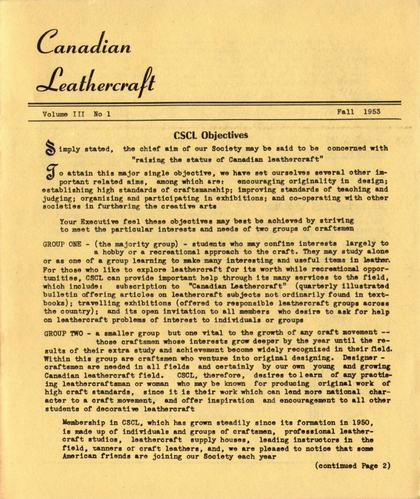
Page 1 — CSCL Objectives
Canadian
Leathercraft
Volume III Nol Fall 1953
CSCL Objectives
Simply stated, the chief aim of our Society may be said to be concerned with Cr "raising the status of Canadian leathercraft" o attain this major single objective, we have set ourselves several other important related aims, among which are: encouraging originality in design; establishing high standards of craftsmanship; improving standards of teaching and judging; organizing and participating in exhibitions; and co-operating with other societies in furthering the creative arts
Your Executive feel these objectives may best be achieved by striving to meet the particular interests and needs of two groups of craftsmen
GROUP ONE - (the majority group) - students who may confine interests largely to a hobby or a recreational approach to the craft. They may study alone or as one of a group learning to make many interesting and useful items in leather. For those who like to explore leathercraft for its worth while recreational opportunities, CSCL can provide important help through its many services to the field, which include: subscription to "Canadian Leathercraft" (quarterly illustrated bulletin offering articles on leathercraft subjects not ordinarily found in textbooks); travelling exhibitions (offered to responsible leathercraft groups across the country); and its open invitation to all members who desire to ask for help on leathercraft problems of interest to individuals or groups
GROUP TWO - a smaller group but one vital to the growth of any craft movement -- those craftsmen whose interests grow deeper by the year until the results of their extra study and achievement become widely recognized in their field. Within this group are craftsmen who venture into original designing. Designer - craftsmen are needed in all fields and certainly by our own young and growing Canadian leathercraft field. CSCL, therefore, desires to learn of any practising leathercraftsman or woman who may be known for producing original work of high craft standards, since it is their work which can lend more national character to a craft movement, and offer inspiration and encouragement to all other students of decorative leathercraft
Membership in CSCL, which has grown steadily since its formation in 1950, is made up of individuals and groups of craftsmen, professional leathercraft studios, leathercraft supply houses, leading instructors in the field, manners of craft leathers, and, we are pleased to notice that some American friends are joining our Society each year
(continued Page 2).
Page 2 — TRAVELLING EXHIBITION
To help your Membership Committee increase membership in CSCL, each individual member is invited to interest ONE NEW MEMBER in joining our Leathercraft Society during the coming year. With such additional support, new and important plans for serving our field can be put into effect. Please urge a friend to JOIN NOW by completing and mailing the ENCLOSED APPLICATION FORM to our Chairman, Membership Committee (address page 12)
REMEMBER -- all members - the hobby craftsman, professional and exploring, creative craftsman, tanners, suppliers, instructors, as well as the general leathercraft appreciator may co-operate towards -- "raising the status of Canadian leathercraft"
A decorative row of type ornaments divides the items on this page; not otherwise transcribed. The advertisement at the foot of the page sets its announcement inside a drawn signpost, in five short lines — "LEWISCRAFT HAS / MOVED TO ITS / NEW HOME - 284 / KING ST. WEST / TORONTO, ONT." — beside the advertisement's own text; the two are set out separately here rather than run together.
TRAVELLING EXHIBITION
No. 2 - originally scheduled to commence its itinerary this fall, will be prepared early in the New Year. Additional time has been required by contributing craftsmen to complete important educational exhibits. Craftsmen desiring work accepted for the 2nd TE should plan to have all entries sent to our Chairman, Exhibition Committee by January 1, 1954 énd International Hobby Show -- February 1954 - Just a REMINDER that our Society has again been invited to prepare
"an outstanding feature display of Canadian leathercraft:' Members are invited to prepare their best examples, which are expected to be seen by over 100,000 visitors. Entry forms and full details will be available in good time
LEWISCRAFT HAS MOVED TO ITS NEW HOME - 284 KING ST. WEST TORONTO, ONT.
We extend a cordial invitation to all our leathercraft friends to come in and see our new, spacious and comfortable showroom where fine leathers and quality leathercraft supplies play a major part
Remember - Our Address Is Now -
Lewiscraft
284 KING STREET WEST, TORONTO, ONT.
(One Block West of the Royal Alexandra Theatre)
Page 3 — Designing for Leathercraft
Designing for Leathercraft
by V Lara Russell
It is important to understand the meaning of the word "design" To design is to organize various elements,which include: lines, shapes, forms, colors and textures. To assist in arranging elements of design, some guiding principles ars helpful, such as: harmony, unity, proportion, emphasis, contrast, rythm and balance. Designing may be divided into two phases: 1) for utility or function of article; 2) for decoration or ornamentation
The Society wrote in its own spelling here — "rythm", not "rhythm" — kept as printed.
A common mistake of beginners when making a handbag, for example, is to assume that a "design for a handbag" concerns decoration only. Too often, when deciding to make a bag, a decorative motif is first selected and an attempt made to plan a bag around mere ornament. This invariably results in a bag which will be considered as "poorly designed" Good designing for a bag must recognize such factors as: the person carying the bag, function of bag, and materials desired in its make-up
A lady, when designing a dress does not start with buttons and then try to make her clothes around the buttons. Nor does an architect, when designing a house first choose the hardware, a door or a stair railing, and then attempt to plan the the house around such minor details - decorative though they may prove. The lady must first consider her physical characteristics, the particular functions for which she desires a dress, and her color and material preferences; while the architect must first consider the family, their means, personal needs and special features desired in their house -- any one factor may suggest necessary changes in design or plan from any preconceived original ideas
Leathercraftsmen should approach the subject of designing leather articles in similar manner. The following suggestions offer a simplified plan for approaching the subject of "designing for leathercraft." IT IS NOT NECESSARY to be "a gifted designer" or "an artist" to put this workable and simple plan into action, but interest and willingness to try are needed
Let us follow through the designing of two basic types of handbags to illustrate some fundamentals of designing. When planning a handbag, first decide who the bag is to be for and how it is to be used -- i.e. as an afternoon bag, a general utility bag, an evening bag, and follow up by consideration of materials to be used in its make-up (smooth, grained, sueded leather, and accessories). Then commence actual working plan of bag design idea by preparing a heavy brown paper pattern to exact size
1) start by drawing a perpendicular centre line (AB)
2) establish width of bag by drawing base line at right angles to centre perpendicular line (CD
3) decide on depth of bag by drawing end line across perpendicular (EF) 4) plan shaping lines of bag to add interest and grace to general lines; general shape of bag will now be GC DH (principle of proportion)
5) plan size of flap; interesting division of space is achieved by making depth of flap either 1/3 or 2/3 of front panel (thus conforming to design principle of contrast)
Page 4
The general size and proportions of the bag have now been established. Next consider attaching handles. Here it should be remembered that handles should be attached above the centre line of bag (to make bag hang in proper balance) Note suggested direction of handle lines - attached parallel to edges of bag (principle of rythm or repetition) Notice also position of handle ends in relation to tip of flap (principle of contrast)
The Society wrote in its own spelling here too — "rythm", not "rhythm" — kept as printed.
After completing this much of the bag pattern, decoration, if desired, may be considered. In example used, it will be seen that limited space is available for decoration. If bag is made in morocco, little or no decoration is actually needed
Prepare pattern from actual-size plan of bag front: decide width of base and draw lines JK parallel and below CD 2) plot depth of bag by repeating depth of front panel (block out as a rectangle first, then add tapered edge lines (LM)
3) plan width of panel across top of bag (between back panel and front flap - at least 1" to 14")
4) flap is then drawn same size and shape as previously designed on front panel GUSSET - example bag made use of a simple type of side gusset
1) draw horizontal line width of base (CJ) and centre perpendicular line,length of depth of bag (CG)
2) as a rule, top of gusset is wider than base to provide for easy opening (Fig 3) 3) shape top edge of gusset to allow for close fitting of top of gusset when bag is closed (top shaping to extend higher than depth edges of gusset)
BAG STYLE NO 2 - Procedure is similar as for Bag Style No 1. However, starting line is;
1) perpendicular (AB) 2) establish width of bag (CD) 3) plan depth of bag (EF) shape bag on one side (GH) 5) fold over and repeat curve by tracing to other side 6) plan flap - depth of example suggests 2/3 depth of bag
7) decide upon method of closing bag (turnlock, tucklock, tuckloop, snap button) 8) example suggests shoulder strap type of bag handle for carrying To prepare actual pattern --
1) repeat points GHI - lower down on perpendicular centre line 2) establish width of top of bag (above back panel - JK)
3) draw flap same as designed on front panel
4) gusset length is around G-H-I; width at base should be appropriate for use of bag and easy access to bottom; gusset may be flare-shaped at ends to make for easier opening of bag (Fig 3)
5) handles may be sewn or laced directly to bag or attached by use of D-rings and D-ring tabs (the use of rivets NOT recommended)
Page 5
Bag Style 2 may be made of cowhide suitable for tooled decoration. Decoration may be planned on original sketch of front panel. It is not necessary to cover all available space with detailed ornament. Plain areas of leather enhance finished appearance. This may be achieved by open borders and a decorative motif which leaves grain surface of leather in easy evidence
The above two suggested types of bags have now been paper-pattern-planned (in heavy brown paper) The next step is to assemble the pattern perts by taping or sewing together. Corrections or alterations may then be made if necessary. Bag should be modelled for suitability - preferably by per son planning to use the bag. This is important to discover whether general proportions and shapes have been designed to complement user of the bag, When craftsman is satisfied that pattern is completely designed, work may be commenced with leather and accessories needed for make-up of bag
Bag Style 1
Fig
Page 6
Craftsmen should remember to make allowances for differences between thicknesses of pattern papers and leathers used in making up articles - to ensure accurate fitting of parts. Experience will suggest how much extra to allow, for example, when preparing 5-oz cowhide with either two soft curves or four right-angle bends
The procedure suggested will help students who desire to actually "design" custom-made bags, and is quite different from merely adopting or "adapting" ready-made stereotyped patterns which may be used indiscriminately by many persons - regardless of personal characteristics, needs and tastes
The same procedure should be used for "designing" any type of article - varying only as each article may require more or less of the considerations and processes described
GARNETT LEATHER DYES
Designed specifically for craft leathers — favored by Canada's leading craftsmen — easy to apply — gentle on leather
GARNETT ANTIQUES—Golden Tan, Chestnut Brown, Havana Brown, Rouge GARNETT TONING DYES-Scarlet, Blue, Green, Yellow, Orange, Tan, Middle Brown,
Dark Brown, Light Blue
All Garnett Dyes mix with each other. Mix your own colors for unique effects NEW REVISED GARNETT INSTRUCTION MANUAL describing the dyeing method in detail is available at your hobby supply store. Ask for one
Dealers write for information lo:
GARNETT COMPANY
442 SPADINA AVENUE - TORONTO
To Canadian Leathercraftsmen
YOU ARE CORDIALLY !NVITED TO WRITE OR VISIT OUR STUDIOS TO DISCUSS YOUR INTERESTS AND NEEDS IN DECORATIVE LEATHERCRAFT
FINE CRAFT LEATHERS —- SELECTED LEATHERWORKING
TOOLS AND ACCESSORIES
a Leathercraft Service by leathercraft specialists "
A stray "46" paragraph before this line does not correspond to anything printed on the page; dropped.
Ottawa Valley Leathercraft Studios 116 O'CONNOR STREET
OTTAWA — ONTARIO
WRITE FOR CATALOG
Page 7 — An Exercise in Moulded Leatherwork
An Exercise in Moulded Leatherwork
by - Deane H Russell
The craft of making moulded leather goods has been practised for many generations in Europe. England, Germany and Italy have produced some of the finest examples of the craft. Many useful, long wearing and fine appearing articles can be made by moulding leather to prescribed forms. Open-end sheaths - open at both ends, such as for match box holders; or sheaths open at one end, such as for hunting knives, guns, desk knife and scissors sets, sports and field equipment; closed cases (flap or telescope closing) for cigarettes, cigars, pen and pencil sets, bottles, flasks, playing cards, camera equipment and various instruments, suggest some of the numerous articles which craftsmen may form in moulded leather
The project we tried recently was a desk stand match holder of triangular shape (Fig 1) Using the techniques as suggested in "Leather Goods Manufacture" (see page 10 for review of this important leatherworking technique manual), we varied certain finishing methods to achieve a desired effect
For craftsmen who have not yet tried moulded leatherworking, we can heartily recommend this craft as a challenging and absorbing phase of leatherworking. Condensed hereunder are the basic techniques for producing an open-end desk-stand match holder ("Leather Goods Manufacture" illustrates a variety of more advanced exercises in moulded leatherworking)
Part I
1) prepare hardwood block of form and size of intended contents of finished case (block provides foundation for moulding)
2) first cover block with blotting paper, joining overlap by }"; glue margin at edge or corner of block; tear off surplus paper to bevel edge rather than cut edge to avoid ridging. This first wrapping merely provides space between moulding and block - it is called "allowance paper" (Fig 2)
3) for lining, fancy paper may be used, gluing overlap and tearing off surplus; we used leather (Persian Skiver), which should first be cut to correct length and be skived for joining and overlap glued
- lining width should extend 4" beyond top edge and 3" beyond bottom edge for turnovers; be sure to commence lining edge on opposite side of block to first paper allowance - "in accordance with principles of moulded work, namely, to avoid lumpiness or undue thickness due to joins being arranged one over the other"
4) actual "mould" is made with piece of brown kraft, old ledger or cartridge paper, cut to roll with grain and 2" longer than needed to wrap around mould 3 times
5) cut one end of moulding paper square and apply glue evenly to whole piece
6) apply paper to partly covered block flush with edge of work
7) press down and turn block over and over for 3 layers (Fig 3)
8) sever with knife when position of starting edge is reached
9) rub bone folder over each surface to press and set glued layers (glue thus pressed into paper hardens when dry, providing case-stiffeness to project)
The Society wrote "case-stiffeness" for "case-stiffness" here; kept as printed.
10) to achieve "sharp" edges or corners - press each surface down on working marble and rub rounded end of folder against edge resting on marble (Fig 4) thus keeping mould case to same sharp form as block
Page 8
11) when dry, trim while still on block to correct length; use square on angular shapes (such trimming only when leather lining not extended for turnovers; otherwise accurate, even rolling necessary for finish without trimming) 12) turn lining over top rim of mould; glue; press with bone folder; skive to feather edge to avoid ridge in finished covering
NOTE: "Glue" used by old country craftsmen is generally of "hot glue" variety, "i.e. boiled rye or wheat flour which sets hard and stiff. For similar results, we tried "A Grade Cascoe Glue" which is water soluble and is more readily available at woodworking supply shops. DO NOT use flexible rubber cements for preparing paper moulds, which should set "case stiff" Part Il
1) to cover sheath, first remove block and discard allowance paper
2) cut leather covering with joining allowance of +" and turnover (if desired) of 4" for turning into open end of moulding
3) skive joining edges (fine-edge finishing or overlapping edge, and featheredge under edge)
4) step-skive turnover end (NOTE: skiving terms illustrated in "Leather Goods Manufacture")
5) paste covering leather, attaching finishing edge to moulding, setting edge flush with one edge of moulding
6} wrap covering tightly around moulding, then, lift up finishing edge fix down opposite end of covering leather and reset finishing edge over it; work turnovers over end of moulding, sticking them closely to interior surface; remove pleats from inner corners with point of folder (see alternate step #8)
7) when covering is nearly dry, replace block to prevent warping
8) if turned edge technique is not used, cut edges should be stained, edge dressed and burnished (for experimental match holder, lining was turned over moulding edge, but covering leather was cut flush with top of finished lining edge
9) make base of two thicknesses of heavy leather (8-9oz)
- slit at corners, lining extending beyond bottom rim and turn back and outside while setting Base into position
- Cut Base part Gl to fit snugly into bottom inside rim of match holder; roughen inside bottom lining rim to depth of base thickness; use strong rubber cement (Barge) on inside rim and base edge; reset wooden form and work base into position through bottom end (if necessary lever base into rim with knife point or rounded end of nail file); press rim until set
- bend extended 1" of lining back, down and under base; cut away overlaps, leaving tabs just sufficient to meet or hold under Base Gl; cement to bottom and skive thin
- cut Base part G2 slightly larger than outside measurement to form base of good proportions; crease, stain, edge dress and burnish outside base edge - carefully plot centre of Base part G2; roughen area to be covered and roughen bottom of base part Gl; set together with strong adhesive; use pressure on top of wooden form; set under weight until fixed
Page 9
10) if decoration desired, add before assembly; simple ornament may be added by: creasing, wheel embossing, border stamping; or elaborate decoration may be done on leather prepared before fixing outside leather to moulding and attaching base. For project described, a piece of 3-oz cowhide was chosen to display a good example of heavy natural neck graining. Top and bottom rims and finished base were creased with #3 double creaser. Top and bottom borders, as well as base rim were simply decorated with small arrowhead stamp
- coloring: Chestnut Antique dye to accent natural graining, and finish with Red Mahogany leather cream polish (before assembly)
CSCL MEMBERS NOTE: Although Moulded Leather Work is popular and highly regarded by leathercraft appreciators in Europe, it is of interest to realize that during attendance at some dozen or more of Canada's largest leather craft exhibitions, at which this reviewer has judged and observed articles totalling well over 4000 pieces, JUST ONE SINGLE EXAMPLE of Moulded Leather Work by a Canadian craftsman has been observed -- suggesting the field has, as yet, been all but untried, and is just waiting for the chance to be understood, practised and appreciated by Canadian leathercraftsmen
Fig. 2
Fig. 3
G2
Base
Page 10 — BOOKS for Your Library
BOOKS for Your Library
At this beginning of a new leathercraft season, we have already frequently been asked: "Have you anything new or good in leathercraft books?"
Well, we have continued our hobby of searching for something "new" and/or "good" which may interest leathercraftsmen. But search as we might we have yet to come across a gook which we would now like to recommend more highly to the serious leatherworker than "Leather Goods Manufacture" by GC Moseley and published by Sir Isaac Pitman and Sons, Ltd, London
"Gook" is printed exactly so, for "book", and stays.
Its 326 pages of well-organized and illustrated information make this manual, to our minds, one of the most important of references for craftsmen who are anxious to learn the fundamentals of thorough leather craftsmanship
"Leather Goods Manufacture" was prepared under the auspices of the National Leather Goods and Saddlery Manufacturers' Association. It has been endorsed as "an important guide for apprentices, improvers, craftsmen, and all students of leather goods manufacture" First published in 1939, three subsequent editions have been necessary to keep up with the demand
While especially recommended for students of the craft planning to engage in the industry of leather goods manufacture, the subject has been treated from the "craft" point of view, rather than from the angle of quantity production, since it is believed that to attain an artistic standard, important basic craft principles should be understood and applied. The author has written with a background of bench and supervisory experience in the industry, as well as in his capacity of Instructor in Fancy Leather Goods Manufacture at the Cordwainers' Technical College, London
The paper breaks "National" across the line as "Nation-" / "al", read here as one word; and the paper breaks "endorsed" across the line as "en-" / "dorsed", read here as one word. The sentence runs "It has been endorsed as "an important guide…" on the page — the word "as" is printed — and stands here as printed.
North American students of leathercraft will be well repaid by taking time off from a hobbycraft and decorative leathercraft approach to working with leather, in order to devote time and serious effort to experimenting with more of the fundamentals of good leatherworking techniques
Within the pages of "Leather Goods Manufacture" craftsmen will discover illustrated information to help him solve such important problems as: Selection of Reinforcements, Lining Materials, Adhesives and Tools. Also clearly reviewed are; Preparatory Processes, such as: Cutting, Paring (skiving), Turning Over; Creasing. And helpful chapters are devoted to such basic techniques as the making of Cut-edge and Turned-edge Articles; Moulded Gussets; Moulded Work; Builtup Work; Box Work; Handbag and Purse Work
"Feather Goods Manufacture" should certainly be in the library of every instructor of leathercraft, of every professional leatherworker, and of every student anxious to learn from the experiences of masters of tried and proven leatherworking techniques
NOTE: While our own copy came directly from a London bookseller, we have inquired of the Canadian branch of Sir Isaac Pitman & Sons, Limited, (383 Church Street, Toronto) and are happy to report that copies of "Leather Goods Manufacture" may be obtained from the above address
Page 11 — WORKSHOP TIPS
WORKSHOP TIPS
PROBLEM: How to "custom-make" leather handles for brief cases and similar projects? Instead of searching for standard-size, factory-made case handles, leathercraftsmen can make handsome handles to fit many types and proportions of cases
PROCEDURE: 1) cut length of copper wire long enough to make handle ends fit above — D-ring positions on case; bend back eyes at each end large enough to allow D-rings to pass through and swing easily (Fig 1).
2) a thickened form of comfortable handle-holding size is then achieved by wrapping brown paper (wet) around wire between end eyes (Fig 2)
3) cut-3-3½oz leather wider and longer than needed for finished handle; dampen and wrap around paper mould and over end eyes; saddle stitch close to paper and around end wire eyes; trim close to stitching (Fig 3)
4) before leather dries, roll to flatten; when almost dry, bend over rounded table edge to shape; re-roll and use handle of wooden tool to set inside curves; pierce hole with awl through leather and wire eyes for passage of D-rings (Fig 4)
5) when dry: color, edge dye, edge dress, polish and burnish
6) spread D-rings and insert through handle ends, then through D-ring tabs on case and close D's with pliers (two screw drivers inserted to hilts through D's and pried apart make good tools for this purpose)
ROBERT MUMA
Announces Fall Courses in Leathercraft as follows:
Fig 1 er a Fig.2
Elementary Course, Secondary Course Advanced and Teacher's Courses including
Theory, Tooling Techniques, Color, Construction, Finishing and an introduction to Carving
Enrol early
Write or phone for full information now MUMART STUDIOS of Creative Leathercraft 62 McGill Street, Toronto, Ont.
Fig.4
Handicraft Leathers and Supplies
Fine Assortment of Beautiful Leathers
Complete range of Leathercraft Tools and Accessories
Comprehensive Detailed 64 Page Catalogue with 24 Page Supplement
Experienced Personalized Service
THE BIRT SADDLERY CO. LTD. — The Leather Goods House
519 Main Street — Winnipeg, Manitoba
For..Beauty..Distinction..Durability — nothing can replace Genuine leather
Over 12 years of serving Canada's craftsmen with world's finest leathers
Yours for Leathercraft Success
Bedford Fine Leathers Ltd. — 578 Seymour St., Vancouver, B.C.
Page 12 — COMPETITION — in Natural Grained and Marked Leathers
COMPETITION — in Natural Grained and Marked Leathers
Submission of pieces and judging for this important competition is being postponed to coincide with commencement of our Travelling Exhibition No 2 - early in the New Year. This decision was taken when a number of leathercraft instructors asked for more time to interest their students and to search for suitable leather for the preparation of entry pieces In the meantime, we are happy to announce that yet another sponsor has volunteered to share in the co-operative offering of prize awards. Co-sponsors are now: Bedford Fine Leathers, Ltd; Corbeil-Hooke, Inc; Lewiscraft Supplies Ltd; Ottawa Valley Leathercraft Studios, and Wickett and Craig Ltd. Prize awards currently planned: 1st $12.50 2nd $10.00 3rd $7.50 4th $5.00 and 5th $5.00 CSCL members are invited to read Volume III, Bulletins 3 and 4 for full length articles discussing uses for Natural Grained and Marked Leathers, and rules for competition. Winning entries will be illustrated in the Winter issue of "CL"
All entries should be sent to: The Editor, "Canadian Leathercraft" 116 O'Connor Street, Ottawa -- NOT LATER THAN JANUARY 15TH, 1954
NOTICE BACK ISSUES of "Canadian Leathercraft" will be offered at 25¢ each issue while a limited supply lasts New members desiring to complete their files with all special leathercraft technical articles published since the first issue of "Canadian Leathercraft" are urged to send their requests along with remittances for issues desired to the Editor (address below)
NEWS ITEM - a 60-piece display of Canadian leathercraft, valued at $1300 is now appearing at an International Hobby Exhibition in Great Britain. The display was organized by our Society's Exhibition Committee Chairman, Mrs Reta Larmour. Already visitors have written from Britain to express admiration for the variety of techniques and originality of design shown by our first offering of Canadian leathercraftsmanship abroad
Canadian Leathercraft
Published quarterly by the Canadian Society of Creative Leathercraft as an educational service to decorative leathercraftsmen Subscriptions to "Canadian Leathercraft'' and General Membership in Society — $2.00 annually Sustaining, Associate and Fellow Membership standing upon qualification. For information write: Chairman, Membership Committee Advertising Rates — for information write: Chairman Advertising Committee
President and Editor "Canadian Leathercraft"    Secretary, Mrs Edith Roscoe, 191 King Street, Weston
   Deane H Russell, 116 O'Connor St, Ottawa     Treasurer, Mrs Dorothy Muma, 62 McGill Street, Toronto
Committe Chairmen: Membership, Mrs Nora Lloyd, 15 Kelway Blvd, Toronto
                    Advertising, Arthur Burgess, 134 William Street, London
                    Exhibitions, Mrs Reta Larmour, 59 High Park Blvd, Toronto