An issue of the Society’s newsletter, transcribed from the original.
(12 pages, 2.1 MB)
the full-resolution scan, 32 MB, for close research
Page 1 — INTERNATIONAL LEATHERCRAFT
Canadian
Leathercraft
Volume IV No.3 Spring, 1955
INTERNATIONAL LEATHERCRAFT
On May 7th and 8th of this year will be held the Second International Assembly of Leathercraftsmen at the Royal York Hotel,Toronto. Here is your chance to exchange ideas with visiting craftsmen from other parts of Canada and from the United States.
One aim of our Society is to encourage originality in leathercraft generally and we can do this by trying out ideas presented to us by other leathercraftsmen. Attempts to break away from "saddle-type" decoration and branch into the wider areas open to us should be commended, for such encouragement will give the creator of originals new impetus for future effort. Anyone can create original designs after he has learned the techniques which will show him for what the designs are to be used, but beginners in this field need encouragement, just as in other fields.
There is nothing to be gained by being exclusive about our craft. By taking advantage of all opportunities to share leathercraft knowledge,we are broadening our own scope as well as that of the craft in general. Exclusiveness leads to stagnation; stagnation leads to mediocrity and monotony. Ideas exchanged and put into practice can bring new horizons within our reach, turning leathercraft into an adventure worth embarking upon.
The International Assembly can prove to Americans that all Canadian leathercraft is not alike, and it can prove to Canadians that all American leathercraft is not alike. The First Assembly showed us what great variety there could be in leathercraft design and techniques and no doubt this Second Assembly will be an even greater exhibition of skill and design.
For a full weekend of your favorite topic, "Leathercraft", plan to attend all sessions of the Second International Assembly of Leathercraftsmen, May 7 and 8, 1955.
All material published in Canadian Leathercraft" is the property of The Canadian Society of Creative Leathercraft,and may not be reprinted in any form without the written permission of the Society.
[The sheet carries small marks in its margin. The words are the page’s own.]
Page 2 — SECOND INTERNATIONAL ASSEMBLY; CORRECTION
SECOND INTERNATIONAL ASSEMBLY
On May 7th and 8th, 1955, the Second International Assembly of Leathercraftsmen takes over the Tudor Room at the Royal York Hotel in Toronto for displays and demonstrations, with a banquet and evening program on May 7th in the Crystal Ballroom there. Special demonstrations have been arranged by the Detroit Leathercrafters which promise to be extremely interesting and informative.
Unusual methods of obtaining high and permanent relief in tool] - ing thin leathers will be demonstrated by Bernard Wolff, a bookbinder and bookcover designer for 25 years. Mr. Wolff creates his own designs and is a specialist and authority on heraldic design. He has produced tooled folios and bookcovers for such notable people as Pope Pius XII, President Coolidge and Paderewski.
How to make saddle stamps, swivel cutter blades and lace cutters, and proper methods of sharpening tools will be shown by Gordon Drummond and Ervin Pope. Mr. Pope will show the proper methods of sharpening and handling cutting tools, utilizing a sharpening device of his own design.
There will be a chalk talk by Frank Radke and Larry DeRosia on Basic Design for Leather Carving, with emphasis on monograms, and how to fit these into designs. Using basic types of lettering, Mr. Radke will show how these may be altered and combined to produce innumerable styles and effective monogram composition. Mr. DeRosia will demonstrate simple steps in producing your own floral designs. Both Messrs. Radke and DeRosia are accomplished artists and experts in all phases of design and composition. Here is your opportunity to learn effective methods of creating your own design even though you think you have no ability in drawing.
Bob Hartmann will demonstrate procedures in making braided bag handles and turks head knots. He will also show the use of the Duncan angle punch and soft hand cut lace, including some of the fine points on lacing picked up directly from Danny Duncan.
A few notes of interest regarding the Detroit Leathercrafters as a group will be found on Page ll.
CORRECTION
Due to a typographical error, the last issue of "Canadian Leathercraft" was numbered incorrectly. Instead of the number which appears on its title page (Volume V) the correct number should be Volume IV. Please correct this on your copy for future reference.
[The page prints "on Basic Design for Leather Carving", and "Mr. Radke will show" runs on without a paragraph break.]
Page 3 — HIGHLIGHTS OF HISTORY AND DECORATION OF GLOVES
HIGHLIGHTS OF HISTORY AND DECORATION OF GLOVES by Clarice Packham
Glovemaking has a long and honorable history. "Gloves"is a word of Teutonic origin - the Saxon "GLUF" is the Latin word used in the 7th century. There is a biblical mention of the gloves found in the book of Genesis, which recounts Rebecca put skins of the kids of goats upon the hands of her son. Gloves then were a mark of authority. Back in the early ages, the glove was a bag-like covering fashioned from animal skins. They are one of the oldest articles of dress,and were first worn by the prehistoric cave dwellers who lived more than 200,000 years ago. Linen gloves, with fingers, were found in the tomb of King Tut-ankh-amen in 1923. The finger type did not come into popular use, authorities believe, until the 11th century. I have read where "King Charles VI of France was so fond of gloves that he wore out more than 255 pairs of gloves a year." Certain tribes of Hindus in India actually worship gloves made of leather. They believe that gloves symbolize good fortune and that Leather is a sacred object. Luxury in gloves was restricted to a privileged few. The nobility in the early middle ages were not allowed to wear gloves embossed with gold or studded with precious stones and pearls. That was for kings and princes alone.
As time went on elaborately decorated gloves were worn on ceremonial occasions by the clergy and nobility. Beautiful specimens of gloves,some associated with Royalty,can be seen in museums. In Oxford, England, Henry 8th's Hawking gloves can be seen and also some of Mary Queen of Scots' gloves. Chicken skin gloves were made in the 17th century and were so thin they could be drawn through a wedding ring.These same gloves were used at night to give the hands whiteness and delicacy. A sturdier type of leather glove was in demand when women began driving automobiles.
Three countries, according to an old saying, contribute to the making of a good glove:
1) Spain to prepare the skin;
2) France to cut it:
3) England to sew it.
Now France instead of Spain, is one of the chief centres of glovemaking. The term "Fabric Gloves" is applied to gloves not made of leather or wool. About the year 1910 the great importance of a glove was its tight fit. Great care and time was necessary to put on and remove these gloves. About 1933 a riot of color came into the glove fashions more than ever before in the glove history.Colors in gloves require simple styles and so the "Classic Slip-on Glove" became a favorite for almost any occasion.Gloves of all colors in both leathers and fabrics have their place in the fashion world today.
Decoration of Gloves:
Decorative points or design lines on gloves are determined by the length of the fingers and controlled by the base of the thumb.
Page 4 — NON-MEMBERS AND THE INTERNATIONAL ASSEMBLY
The person who is original can work out a suitable decoration to distinguish the gloves from those that are factory made. In fact,there is no limit to one's creative ability, but it is always advisable to practice on small pieces of leather first. Some ways of decorating gloves are: -- French knots, beads, embroidery, applique, hand-painting, buttons, pearls, cuff-links, braid and ribbon piping.
There is nothing more attractive than well-groomed and perfectly gloved hands.
Note about the Author: Clarice Packham is a recognized authority on glovemaking, having won many awards for her leather and fabric gloves. She is an Associate member of C.S.C.L., and competent in many other phases of leathercraft in addition to glovemaking.
NON-MEMBERS AND THE INTERNATIONAL ASSEMBLY
Members have asked if they could bring non-members to the International Assembly. While there will be an opportunity for C.S.C.L. members to renew their memberships at that time, the Assembly will be open to all who are interested, regardless of membership. There is a registration fee of $1.50 for the two days and a fee of $4.50 for the Saturday evening banquet and program.
Handicraft Leathers and Supplies
Fine Assortment of Beautiful Leathers
Complete range of Leathercraft Tools and Accessories Comprehensive Detailed 64 Page Catalogue with 24 Page Supplement Experienced Personalized Service
THE BIRT SADDLERY CO. LTD. The Leather Goods House
519 Main Street Winnipeg, Manitoba
[The cursive ad heading reads "Handicraft Leathers and Supplies" — no ampersand or other character before "Leathers"; the script font's flourish is easy to misread as "£". This matches the same firm's advertisements elsewhere in the archive (1952-fall, 1953-spring).]
Page 5 — LEATHER THICKNESSES
LEATHER THICKNESSES by Deane H. Russell
We are constantly asked: What is the correct weight of leather for making a handbag (a wallet, a briefcase, and many other leather articles)?
This question puzzles all beginners and many experienced leathercraftsmen. The answer can be made quite simple. It is not necessary to consider any one weight as being correct for each type of article. As a general rule, craftsmen should choose a weight or thickness most suitable for the function of the article.
Examples: Pocket wallets should be made of leathers light enough
(1½ - 2 oz) so that 4 to 6 thicknesses will not produce a bulky article.
----Medium weight leathers(2½ - 3½ oz) is most often chosen for handbags, keycases, wallet outside panels, desk sets and similar articles.
----Medium heavy leather (4 - 6 oz) may be used for ladies' belts, briefcases, carved handbags.
----Heavy leather (7 - 8 oz) for men's belts and sturdy instrument cases.
----Extra heavy leather (10 - 14 oz) for carved wastepaper baskets, saddle skirtings.
Laminating
Skilled craftsmen may actually reverse many of the above suggested weights and follow the practice of "laminating" lightweight outside leathers to appropriate backing leathers or other materials to produce a total of weight, thickness and strength, desired for each project. This is a common practice among professional craftsmen and manufacturers of leather goods. Most people are surprised to learn that the majority of travelling bags (except full leather types -- gladstones and French welted bags) use leather of just 2½oz weight. Actually such hand luggage is laminated or mounted over plywood case frames. The laminating is further developed by backing and lining fabrics so that no wood shows in the finished product.
Handbag manufacturers often use 1½ to 2½ oz leathers, backing cloth, padding and lining materials for building up what may appear to be a product of heavier leather than appears to the eye. Mexican craftsmen are skilful at "carving" handbags with leathers as light as 1½oz. Such lightweight leather is mounted to a backing of cardboard. The incising and stamping operations are cushioned into the mounting material so as to produce maximum relief for the decoration.
Experience and availability of suitable materials will suggest dependable solutions for the craftsman's individual problems. However, certain factors may serve to guide the craftsman when deciding
[This typeface's stacked half-ounce fractions read as plain digits throughout this article — the same fault appears elsewhere in the archive (e.g. 1962-63-winter). Set out here as printed: "(1½ - 2 oz)", "(2½ - 3½ oz)", "just 2½oz weight", "1½ to 2½ oz leathers", "light as 1½oz".]
Page 6
upon leather thicknesses for special projects. Consider always whether special tensile strength is required for any part of your article. Obviously, the thicker the leather, the stronger and more resistant to wear it will prove. But extra thickness also means extra weight and bulk. In addition, thick, heavy leathers are more difficult to work. Remember too that, while the closely knitted fibres near and at grain surfaces of leather make for excellent finishing bases, these fibres have less "life" (or strength) than the flesh fibres. Very thin - 1½oz - cowhide is a poor weight to risk for hand or machine sewing, while 2½ - 3½oz leathers may be satisfactory if care is taken. It is generally easier and safer to stitch heavier leathers which allow the threads to set or anchor into the fibres and thus give maximum wear at points of strain. Lightweight "corrected grain" (buffed) leathers are not safe for stitching and certain styles of slit punching unless well backed with a material which will carry the strain of stitching and lacing.
Learning the art of "laminating" lightweight leathers for the production of sturdy appearing and wearing articles is well worth while. It considerably increases the scope and choice of materials and finishes available to the craftsman.By this technique the pliable and lightweight bag moroccos and even the softer gloving leathers such as the richly grained persians and Asians, or the soft-finished suedes may be made into firmer and heavier appearing handbags of the box or stiff panneled type of construction. Firm finished cowhide splits make an excellent backing material for such projects; or bag stiffeners well impregnated with rubber for flexibility yet firm support will give long and satisfactory wearing qualities to many fine, thin outside leathers. Sometimes two or more layers of lightweight backing materials are used in place of one layer of thicker material.
Lining Leathers
It is equally important to consider weights, thickness, tensile strengths of lining leathers when planning leathercraft projects. Special cafe should be taken when planning for lining leathers requiring zipper or pocket holding strength. If skivers are used for such purposes, they should be used doubled, hemmed or backed. Remember skivers, while perhaps most widely used as lining leathers for personal or fancy leather goods,represent chiefly the grain-split of a sheepskin and as such should not be expected to provide holding strength for stitching, zipper tapes or pocket edges, unless backed or otherwise strengthened. Certain leathers are suitable for lining without additional backing materials. Among these are: goatskins, moroccos, suedes, lightweight calf, kid, kips, splits and fleshers.
[Same half-ounce fraction fault as the page before: "1½oz" and "2½ - 3½oz" set out here as printed.]
Page 7
Measuring Leather Thicknesses
As cowhide leather provides so much of our craft needs, th following notes may prove helpful towards an understanding of selecting leather by weights er thicknesses:
Cattlehide thicknesses of leather are indicated in terms of "ounces". This practice started in England many years ago and continues there and in North America to this day --- though it has long since been found to be an unscientific method of classifying leather thicknesses. Originally, leathers so classified were intended to suggest corresponding weights for each square foot of leather. However, as the densities of leathers may vary considerably, even from area to area of the same hide, this practice of setting leather weights was abandoned and gave way to a system of calipering leather to accurately measured thicknesses.
Though the term "ounce" is still used, it now refers to thicknesses graded according to a scale of 1/64" to 1 "ounce". Therefore: 2-oz leather -- 2/64" or 1/32" in thickness.
4-0z leather -- 4/64" or 1/16" in thickness.
8-oz leather -- 8/64" or 1/8" in thickness.
YES, It's TRUE! Illustration (A) — a tool conjured up in our minds when asked this actual question not so long ago:
"Have you a tool with a SPOON on one end and a PIN on the other?"
Too often, beginner craft students don't bother to learn correct names for their tools. They seem content to order by catalog number alone, or by wild description, without realizing that learning of proper names for equipment is in itself an aid to better understanding of the special functions of a tool.
It's equally true that some of the finest decorative leathercraft in Canada today was produced with tools little better than tool "A" — tools quickly beaten from nails and crudely bound with cord or tape for handles. But such work represents exceptions — accomplished in spite of tools used, and only because of highly developed skill in tool manipulation by the craftsman. it is our firm belief that such masters of leather modelling could increase their enjoyment of leather decorating, if not their already excellent work by becoming the proud owner of a new OVLS "Canadian Modeller—Tracer" (B) — developed after long study of over 30 different typical modellers from Europe and North America. Made of rustproof, nickel silver, individually hand finished — this one tool suffices for over 90% of all modelling needs.
A finely-designed and finished tool adds pleasure to any craft. Send for your "Canadian Modeller" today. Price $1.10 — postpaid. Groups may receive 12 for the price of 10!
Ottawa Valley Leathercraft Studios, 116 O'Connor St., Ottawa
Page 8 — LEATHERCRAFT AS THERAPY
LEATHERCRAFT AS THERAPY
The following article, based on comments by three occupational therapists -- Mrs. Sheila Irvine of the Toronto Psychiatric Hospital, Miss Florence Murray of the Muskoka Hospital, and Miss Vera Carpenter of the Canadian Red Cross--tells how leathercraft is being used in three different types of institutions to help patients make good use of their time both while in hospital and after discharge. While this refers mostly to hospitalized people, the same principles could be applied to advantage by those who have people needing help under their care at home.
In psychiatric work, Mrs. Irvine tells us one real advantage in the rehabilitation of the patient is found in capturing his interest as early as possible in some work setting. Leathercraft offers 2 good medium for this because of its almost immediate appeal to most people. When patients are first admitted to hospital they are encouraged to take part in activities om the ward even while still in bed. Here again leatherwork is useful because the equipment can be simple and the craft is clean and tidy, suitable to ward routine.
The feeling of having accomplished a useful, appealing article is a tonic to the patient and encourages him to future effort. First projects are therefore simple,quickly completed and of general appeal. Also, since patients at first show poor concentration, simple articles are preferred such as keycases, changepurses, bookmarks, glasses cases, etc. Tooling is not introduced at first when patients might have difficulty in making decisions (such as which pattern to choose) or if it is going to complicate the projects. Rather, a well constructed, plain project is suggested. As patients progress both in interest and proficiency, tooling is introduced, with choice of design or initials,and more complicated construction, such as bookcovers, notepads, cigarette cases, wallets, etc. The admiration expressed by friends and relatives helps a patient develop his own interest and he soon begins making gifts for these people.
Therapists are always aiming at the community rehabilitation of the patients,and as their interest grows, they are introduced to other more complicated projects,stressing the value of a hobby when they go home. Patients are informed about the various community classes available and given suggestions for purchasing leather and tools in the community.
Leather carving has not been introduced because of the expense involved in tools and their replacement. Patients are not always ag careful as might be desired and close supervision must be given in some cases.
Page 9
In the Muskoka Hospital, Miss Murray has found that leathercraft, as well as being a hobby, must be a source of revenue for some patients and therefore in the making of an article,the question they ask is "Will it sell?" Smaller articles are favored, such as purses, wallets, keycases, belts, bookmarks, bookends, coin purses, etc. Little original work is encountered, and almost no carving is done, again mostly because of the expense of the equipment. Carving is also more Strenuous and therefore tooling is favored by t.b. patients. Here again, the question of a market for the finished article enters into the picture -- the amount of work involved in carving would call for a higher price and make the article not so saleable.
In her work with aged people,Miss Carpenter has found leathercraft not too successful as a hobby because of the fact that many old people have poor eyesight. In such cases, leathercraft must be confined to simple projects involving construction only or with minimum tooling.
The need to create things with the hands is strong in all people and especially those who are handicapped. These people cannot take an active part in other phases of life and must rely on their hands for expression. The creating of articles for gifts or sale gives the handicapped person the feeling of being useful again and interest expressed by other people increases this feeling, aiding greatly in his rehabilitation.
Our Catalogue Club
provides a valuable service for you.
FOR INFORMATION
Write to:
Clarke & Clarke Leathers
| BARRIE | ONTARIO |
| BRANCHES | |
| MONTREAL | TORONTO |
| (636 Dorchester St. W.) | (523 Mt. Pleasant Rd.) |
[Ad heading reads "Clarke & Clarke Leathers" — the ampersand is easy to misread as "E"; "Leathers" is capitalized in the original.]
Page 10 — RAWHIDE LAMPSHADES
RAWHIDE LAMPSHADES by Dorothy Muma
If you are making a leather-covered lamp base, the perfect complement for this would be a rawhide lampshade. The translucency of this material enhances leather tones and finishes. Rawhide comes in either the natural shade or a special dyed finish, tan-and-light-tan combination which is most attractive for lampshades. When the lamp is lighted under a shade of the two-tone rawhide, the colors seem to change places and the light tone becomes dark with the light showing through the darker shaded areas. This two-tone effect gives a very soft light, while more light is given off through the natural shade.
Rawhide works best on a round shade with two rings only. Changes in temperature and humidity will cause contraction and expansion in the rawhide which is not accommodated by the rigidity of a frame with vertical wires. For this reason, a square shade will be seen to be impractical.
The simplest way to make a pattern for your shade is to buy a cheap shade of the type and size desired and carefully remove the original covering. Using this covering as a guide, make a pattern of heavy paper, allowing about ¼" to ½" for overlapping the ends. Test this paper pattern on the frame before cutting leather. If a ready-made shade cannot be obtained in the size and type wanted, the accompanying diagram shows the mathematical method of obtaining a pattern, but this is quite complicated in practice and requires great accuracy.
Before cutting the leather, be sure your knife is very sharp, for rawhide is difficult to cut. Do not try to cut through the rawhide with one stroke,as this may lead to errors because of the slippery surface. Score around the pattern first with the knife, then cut through the leather along this line. The mark of the scoring will form a groove which will keep the knife on the correct line and i prevent slipping. If you own leather shears, it is easiest to mark around the pattern carefully with a pencil, then cut the leather with the shears. Mark the seamline on the leather before removing the pattern.
[The caption beside the pattern diagram is set as a single narrow column of type alongside the diagram's own hand-lettered point labels (A–G, H, J, K, L, M, N, O, P, Q, R on a curved shade outline); read as separate lines the words drop out. Restored below as a single caption, in the order it is meant to be read. The diagram itself is not reproduced.]
Draw top ring diameter AB. Mark center C. Draw vertical line depth of shade. With D as center, draw lower ring diameter EF. With D and C as centers, swing arcs from E to F, A to B. Extend line lines AE, CD and BF to meet at G. Find ¼ of arcs HB and KF by bisecting angles HCB and KDF, then bisecting new angles, obtaining distances HJ and KL. With G as center swing arcs through AB and EF and beyond. Using M as center mark off 8 times distanc HJ to right and left of M. Repeat using N as center and distance KL. (OP and QR on diagram) Draw line through OQ and PR to obtain finished size of shade. Check OP and QR to be sure they are equidistant at all points.
[The opening of this page: "Rawhide comes Neither the natural shade..." is set out here as "Rawhide comes in either the natural shade..."; "¼″ to ½″ for overlapping the ends" is restored (the same half/quarter-ounce-style fraction fault as the two pages before).]
Page 11 — DETROIT LEATHERCRAFTERS
Skive the ends of rawhide back to the seamlines. Carefully fit the leather to the frame, making sure it fits snugly. Because rawhide is so stiff, it is almost impossible to take up any excess fn lacing.This fitting of leather to frame is extremely important. After fitting, cement the two ends together, overlapping exactly on seamline, using Barge, Pliobond, or similar strong adhesive. Ordinary leather cements will not do because they depend on a certain a. oe quality in leather for adhesion and the smooth, hard surface of rawhide does not provide this.
Cut holes for lacing about 3/16" down from the edge of the leather. Florentine lacing is most effective for binding the rawhide to the frame, but ordinary 3/32" or 1/8" lacing may be used in a whip or other simple stitch. Jn any case, do not try to perforate with a slit punch as it will be almost impossible to lace through these. Use No.O round punch instead, spacing the holes about the width of the lacing apart. The metal rings should come just at the outer edge of the holes. Small bulldog-type clips are handy to keep the shade in place while lacing it to the frame. Lace carefully, making sure that the lacing overlaps if Florentine is used, covering the edge of the frame completely.
Natural rawhide is beautiful when decorated on the inside with colored India Inks, water colors, or diluted leather dyes, either before or after the shade is assembled. It is easier to plan a design before the shade is assembled. This decoration shows in pastel shades when the light is on. If dark India Ink is used, a silhouette effect is achieved.
DETROIT LEATHERCRAFTERS
As the time of the Second International Assembly draws nearer, it is of interest to have a few notes regarding the Guilds taking part. On Page 2 of this issue, will be found an outline of demonstrations planned by the Detroit Leathercrafters, which was organized in 1951 as a social, non-profit group devoted to the promotion of leathercraft as a hobby. During the first year, monthly meetings were held at members' homes, but as membership increased, these meetings were moved to the local YMCA, and membership now totals 35.Meetings consist of business, demonstrations or lectures, practice or doodle sessions and a general social period. Activities of the Guild have included visits and demonstrations to patients at Public Health Service Hospitals; designing projects and giving technical advice to Junior Achievement Camps; participation in displays at hobby shows and at meetings of other social groups; showings of the film, "The Art of Leather Carving" at various Adult Education classes. As can be seen by the above notes, the Detroit Leathercrafters will bring to the International Assembly a wealth of experience in leathercraft.
[The decorative rule above the "DETROIT LEATHERCRAFTERS" heading is a drawn ornament, not printed text, and is left out here.]
Page 12
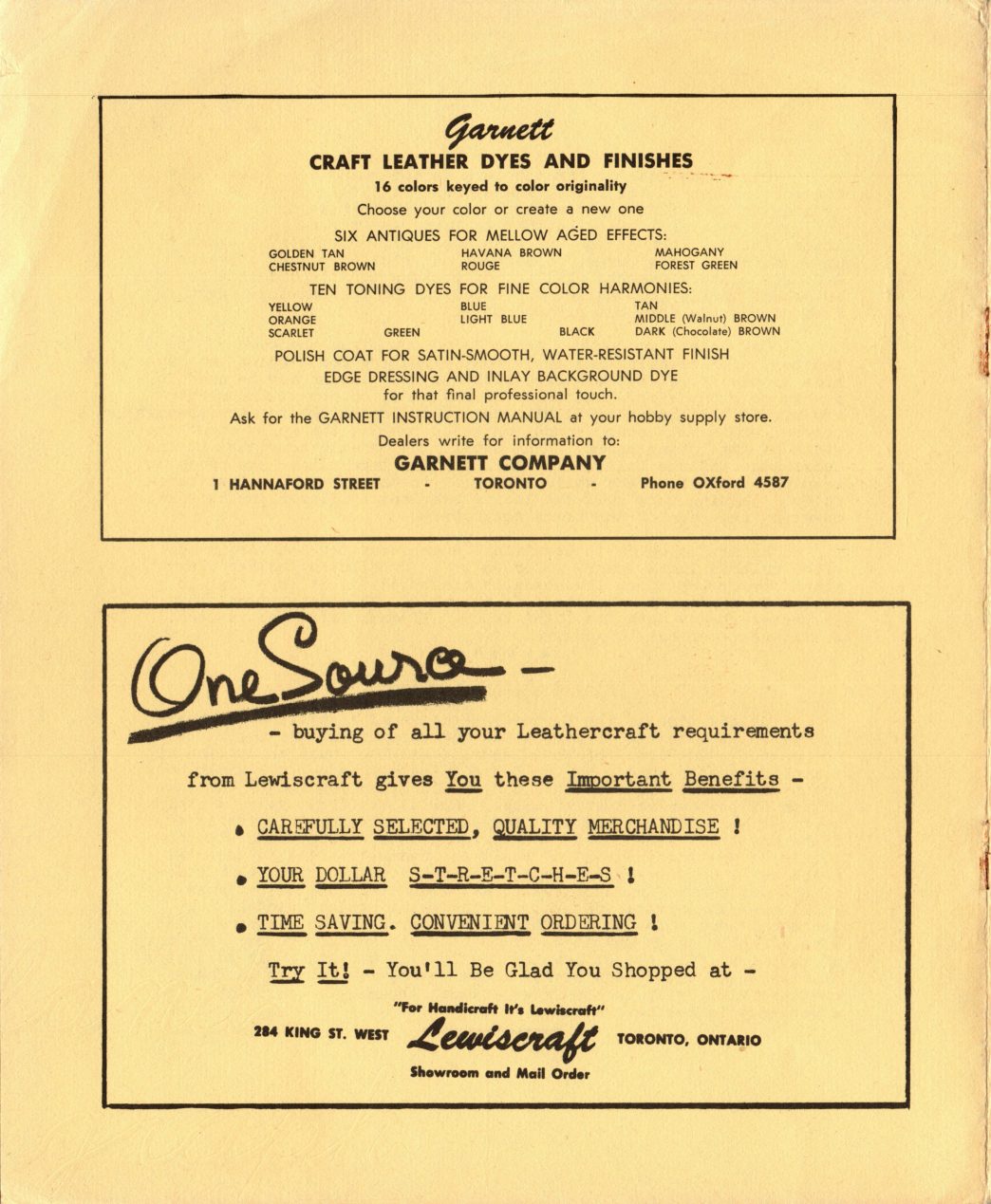
Garnett — Craft Leather Dyes and Finishes
16 colors keyed to color originality. Choose your color or create a new one.
Six antiques for mellow aged effects: Golden Tan, Havana Brown, Mahogany, Chestnut Brown, Rouge, Forest Green.
Ten toning dyes for fine color harmonies: Yellow, Blue, Tan, Orange, Light Blue, Middle (Walnut) Brown, Scarlet, Green, Black, Dark (Chocolate) Brown.
Polish coat for satin-smooth, water-resistant finish. Edge dressing and inlay background dye for that final professional touch.
Ask for the Garnett Instruction Manual at your hobby supply store. Dealers write for information to: Garnett Company, 1 Hannaford Street, Toronto, Phone OXford 4587.
Lewiscraft
One Source — buying of all your Leathercraft requirements from Lewiscraft gives you these important benefits — carefully selected, quality merchandise; your dollar s-t-r-e-t-c-h-e-s; time saving, convenient ordering. Try it! You'll be glad you shopped at — "For Handicraft It's Lewiscraft".
284 King St. West, Lewiscraft, Toronto, Ontario. Showroom and Mail Order.
[Previously marked "This page carries advertisements; not transcribed." Now set out in full: two advertisements (Garnett leather dyes, Lewiscraft). The Lewiscraft advertisement opens with a large brush-script headline, "One Source —", above a heavy swash rule; it is set out here as the first words of the advertisement. No names on this page.]