
An issue of the Society’s newsletter, transcribed from the original.
(12 pages, 2.5 MB)
the full-resolution scan, 33 MB, for close research
Page 1 — REACHING BEYOND
Canadian Leathercraft
Volume VI, Number 2 Winter, 1957
REACHING BEYOND
It is not enough to be able to say "I can do leatherwork",
Rather, we should have a goal of achievement in leathercraft; and one of the principal functions of our Society is the provision which it offers every leathercraftsman for such a goal. It is true that the bulk of our membership is made up of General members who might be just ordinary hobbyists or rank beginners in the craft, or merely interested in leathercraft without yet having used their hands creatively with leather. Yet in such membership, nourished by the inspiration of more experienced craftsmen, lies the privilege of being able to strive for recognition of their work in the attainment of a higher membership category.
Growth and achievement are a basic part of human nature. To be satisfied with what we have, or have accomplished, is to become static, in which state our interest and skills will eventually stagnate and die. The creative spirit is nourished on dreams, and dreaming, it reaches out new tendrils in experimentation or exploration of new ground. It is these efforts to reach out and beyond what we have already done that gives us perspective on our former efforts so that we are not only developing new skills but are able to see objectively and perfect those which we already have. There are always such new fields for the individual to explore and new horizons still to be reached for. Craftsmen in ages past have blazed the trails and our own contemporaries are continually opening up new avenues for us to follow and cultivate.
The Canadian Society of Creative Leathercraft in its scheme of membership rating gives us a yardstick by which to measure our progress in the craft. When we feel that our skills have reached a satisfactory state of excellence, and we have attained a reasonable knowledge of leathercraft, it is our privilege to submit examples of our work for an Associate membership award. Similarly, having
All material published in "Canadian Leathercraft" is the property of The Canadian Society of Creative Leathercraft, and may not be reprinted in any form without the written permission of the Society. Editor of "Canadian Leathercraft" is Mrs. Dorothy Muma, 118 Hazelton Avenue, Toronto 5, Ontario.
"The Canadian Society of Creative Leathercraft" — of, not for — is printed so throughout this issue.
Page 2
attained our Associate membership, if we have continued to explore new fields and add new skills, we will find that it is not too difficult if we try, to create original work and this opens the door of opportunity to try for Fellow membership.
These two classes of membership offer a challenge to all members whether they have yet qualified or not. General members have before them the opportunity of meeting the requirements for Associate membership. Associates having achieved high quality workmanship now concentrate on producing original design for Fellow membership. To have achieved Fellow standing is not the end, however. There is no final goal; for the Fellow member must not only keep up the standard of his own work in order to retain his membership rating, but must also meet the challenge of new fields and methods, exploring and inventing so that others may follow.
What is your goal? What are you doing to achieve it?
Our Catalogue Club
...provides a valuable service for you. For information write to: Clarke & Clarke Leathers, Barrie, Ontario. Branches: Montreal (636 Dorchester St. W.), Toronto (523 Mt. Pleasant Rd.).
Handicraft Leathers and Supplies
Fine Assortment of Beautiful Leathers. Largest Range of Leathercraft Tools and Accessories. All inclusive Specialized Leathercraft Catalogue. Experienced Personalized Service.
The Birt Saddlery Co. Ltd., 519 Main Street, Winnipeg 2, Manitoba.
This page had been passed over as advertisements not worth transcribing; it in fact carries the conclusion of the "Reaching Beyond" editorial begun on page 1, followed by two advertisements (Clarke & Clarke Leathers; Birt Saddlery), now set out here in full. No members are named on this page.
Page 3 — BRAIDING
BRAIDING by Anthony Genco
One of the most fascinating and simplest of all crafts, requiring a minimum of tools, is braidwork. Few crafts develop such a complete coordination of mental and manual activity, where the rewards for a small amount of work bring much satisfaction and gratifying results.
Braidwork is not new, but truly an ancient art, and once the basic principles and procedures are mastered, their applications to articles for strength, decoration, or as a supplement to another craft, offer great challenges to the ingenuity of the individual.
As we are concerned primarily with leathercraft, efforts will be concentrated on leather, although braidwork is applicable to any flexible material.
A Dictionary definition of braiding could read as follows -- to weave, to interlace, or entwine together three or more strands into one, executed by maintaining a consistently uniform tension.
Of the few tools required, a sharp knife is important. Dividers and ruler for equal measurements; a strip ease or draw gauge tool for cutting belts or thongs, the space marking wheels used mostly in the applique braids, a drive punch with various interchangeable sized tubes and preferably with a movable guide for precision type punching and slitting required in applique braidwork, lacing needles where leather lacings are used, a fid for enlarging holes, and a small home type vise as a means of anchoring your work, and the strip when being used, and thus leaving both hands free to execute the braids. As one progresses in braidwork, additional tools may be added to simplify one's work.
In this modern age of mechanization, thong cutting is reduced to a minimum for braidwork, as leather lacings are available in various widths from 1/16 to 1/2 inch in calf, goat, steerhide, and various imported leathers and in a wide range of colors, -- and thus making the basic material most economical for the beginner. This leaves the phase of thong cutting to the beginner as he slowly progresses, and invariably decides to cut his own thongs fitting his particular purposes.
By way of explanation here, a thong or strand refers to a strip of leather of a width suitable for braiding.
To classify braidwork, it may be rightly put into four categories: First, we have the flat braids that can be done from one thong to any number, either odd or even, but reaching a point of practicability. Second, we have the solid braids, as the round, square, spiral, and reverses, accomplished either with our without some form of core foundation. Third, we have the applique braids and knots, again done
Restored as printed: "principles", "applique", "braidwork", "mostly", and two stray marks dropped. The paper's own "a strip ease or draw gauge tool" and "with our without some form of core foundation" are typed exactly so, and kept as printed.
Page 4
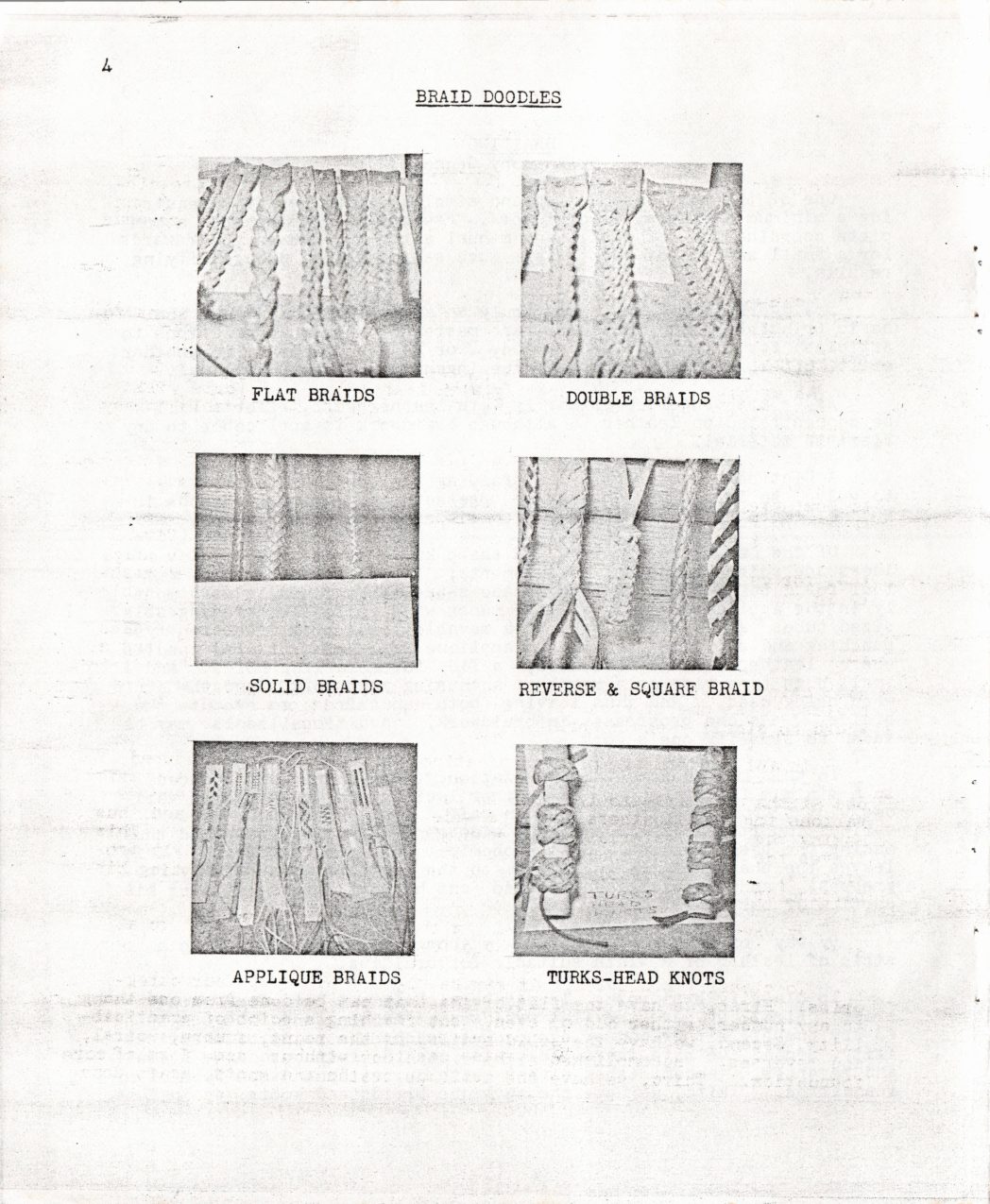
BRAID DOODLES
This page is a photo-plate of six captioned technique photographs, all six transcribed in full below the picture of the page.
FLAT BRAIDS
DOUBLE BRAIDS
SOLID BRAIDS
REVERSE & SQUARE BRAID
APPLIQUE BRAIDS
TURKS-HEAD KNOTS
Page 5
with odd or even number of strands, but here worked completely upon grain or surface side of leather with joining or decorative purpose in mind. Fourth, and last but not least, are the knots, which by their sequence form a braided ring completely symmetrical, but achieved with one continuous thong, with the simple turks head knot being the foundation for more elaborate and beautifully woven knots.
To retract on each category and generalize on procedures, the flat braiding consists of working alternately with uppermost left and right thong toward center in a sequence determined by the number of thongs used. On braiding with an odd number of thongs, the alternating procedure from each side toward center is the same,but on braiding with an even number of strands where the procedure starts with a sequence over on one side,it will start with an under sequence on the opposite. side.
As more strands are used in a braid,the sequence can be pre- - determined, thus giving variations in patterns obtainable. To cite one example, with five strands there are about ten ways the five strands can be braided, each having a procedure and definite pattern by itself and unlike the others, but still employing five strands.
From six or more thongs, the braidwork can be elaborated upon, by working what is known as double braids, accomplished by alternating procedure and sequence on each side--where your uppermost -thong is over the first time, the next pass on the same side will be under, and the same alternating procedure holds true to each side. This double braiding actually narrows a. braid,but a double thickness braid is achieved, unlike the other flat braids.
Along the flat braid lines, reference can be made here of the trick braids, where thongs are split from a single blank,but with no loose ends. These trick braids can he done with three, five, or seven thongs, or in multiples of two and three of these numbers. For example, six thongs with no loose ends can be braided as a three thong trick braid by pairing them to three thongs of two each,and likewise for the five and seven strand trick braids. The finished braid is a mystery to the beginner, but its simplified procedure is but one of the fascinations of braidwork.
A point of importance should be noted here on braiding which is that of thong shrinkage. Thongs of one length, upon braiding, will shrink back some depending on the braid and number of thongs used and the tension maintained by the individual. A foot of thong will not yield a foot of finished braid, and therefore the doodling idea is a good policy before application to a project to determine the length of thongs to finished braid.A few inches of doodling can save much time and effort, and two craftsmen, both good, have yet to produce exact duplicates of like projects.
-In solid braiding, the braidwork is achieved by alternating thongs being brought to the rear to a definite sequence instead of
Page 6 — BRAIDED BELTS
BRAIDED BELTS
This page is a plate of twelve photographs of braided leather belts, headed "Braided Belts", illustrating the braiding article that runs from page 3 to page 8. None of the twelve photographs carries a caption or a maker's name; a stray "the" belonging to the plate below is dropped.
Page 7
across as in flat braids. The solid braids can be done with four,six, eight,twelve, or sixteen thongs, and again variation can be achieved by changing sequences,or employing various colored thongs. The solid braiding is often referred to as plait round.
The square braids and their variations of spirals and twists are actually crown knots, and their procedure is building crown knot upon crown knot to the desired length and to a definite sequence to get the square, the spiral, and the twist braids.
Many beautiful examples of solid braidwork can be found in local saddle shops by way of quirts, riding crops, bull whips, dog leashes and such.
The horse gear in saddle shops such as bosals,romals, hackamores, reatas, and hobbles, are the ultimates of braidwork coupled with the intricate woven knots, and done with rawhide thongs. Rawhide braidwork is an art by itself,and though casual mention is made of it here,proud should be the too few remaining who are well versed on the mechanics of rawhide braidwork, for here is an important part of our western heritage.
Next, we have the applique braids and rightly named as they are completely formed on the surface or grain side of the leather,and perform the dual purpose of decoration and of joining together pieces of leather. Here the formation of a bed of evenly punched holes or slits on the surface of the leather is necessary,and the spacing and punching both dependent on the width and number of strands to be used. The procedure in general is working the thong or thongs through the bed formation of holes from rear to face of leather in a manner forming the various different applique braids. As the procedure is repeated from rear to the front and vice versa through the punched holes or slits, the braid forms on the surface to make what is a most pleasing and decorative braid. Variations as to patterns obtainable by changing or alternating colors and thong widths is an open field equal only to the imagination and ingenuity of the individual.
As one becomes adept at braidwork, by acquiring the basic procedures and the ability to visualize sequences,initiative in original applications of braids seems a natural course.
As to the turks-head knots and woven ring knots, their purposes are many--as sliding knots,as ornamentation,and as adjustable fastenings,and are used mostly with the plaited round braidwork,found mostly in horse gear articles and riding equipment.
As the knot is formed of one thong, a mandrel, or section of broom handle or core is needed which is rotated as a definite procedure and sequence is followed in the formation of the knot. A loose leather collar built around the mandrel or core helps greatly in the more elaborate woven knots, as the edges of the collar give an edge which holds the thong during the formation of the knot.
This page is re-transcribed in full: "eight, twelve, or" had dropped from the list of thong counts and "sequences, or" from the clause that follows; the first two paragraphs had run together; and stray marks ("i i", "Raw-_", a stray apostrophe) that are not on the paper are dropped. The paragraphs are restored to the order they are printed in.
Page 8 — HAMILTON BRANCH REPORTS
Once you are familiar with the structure of the turks-head knot and the definite relationship between the loops and parts, truly one could become a turks-head addict and have knots unlimited, and lacking time for the construction of others, with no two alike.
This completes a brief generalization of braidwork, and as time and space do not permit actual step by step procedures of the braidwork mentioned, the accompanying illustrations of braidwork doodles by the author are printed with the hopes of making the braidwork written about easier to visualize and picture.
The belts were featured at the 3rd International Assembly of Leathercraftsmen at Detroit, with the theme of braiding as applied to belt making.
This being a first venture in journalism, if my efforts will stimulate an interest in braidwork, I will feel amply rewarded, but to those who are more confused than they were before reading the article, there are books on braiding whose authors have ably put into words the procedures and methods simplifying this fascinating craft.
About the Author: Anthony Genco is an active member of the Eastern
Leathercraft Guild of Rochester, N.Y., and demonstrated braiding at the last International Assembly. Over the past few years he has been busy compiling a "Leatherworkers' Directory" containing names and addresses of craftsmen, teachers and dealers in both Canada and the United States. The first edition of this directory made its appearance at the 1956 Assembly and is now available at a cost of 50¢ from the publisher, Craftsman Supply House, Scottsville, N.Y., or Anthony Genco, 74 Fulton Ave., Rochester, N.Y.
HAMILTON BRANCH REPORTS
The Hamilton Leathercraft Guild held its first exhibition in December, 1956, with over 100 articles on display, illustrating many items it is possible to make from leather. Comments and criticisms were offered by Toronto visitors Mr. Brown, Dr. and Mrs. Larmour and Mrs. Roebuck. Two Hamilton members demonstrated 3-tone dyeing and Mexican lacing. In January, Mrs. Larmour and Mrs. Roebuck demonstrated purse framing for the Guild. At each of these meetings there was an attendance of about 40.
CAPITAL LEATHER is Moving (after March 1st)
to 578 King St. West, Toronto 2B, Ont. (Between Spadina & Bathurst)
Framed handbag supplies....... Jewellery findings for Leather
The most complete variety of leathers and supplies for all purposes
Set out here as printed: "braidwork doodles", "amply rewarded", "past few years", and the Directory's apostrophe. The Capital Leather notice's new address is printed as 578 King St. West; "Bathurst" is set out whole; and the notice's dotted leader line is set out as printed.
[The sheet carries small marks in its margin. The words are the page’s own.]
Page 9 — HIGHER MEMBERSHIP REQUIREMENTS; 1957 ANNUAL MEETING
HIGHER MEMBERSHIP REQUIREMENTS
The following are the requirements for Associate and Fellow membership ratings as listed in the revised Constitution:
ASSOCIATE: 1. Not less than three years' satisfactory practice of leathercraft.
2. Demonstrated ability to produce work of a high standard of craftsmanship; originality of design not essential but desirable; good general knowledge of materials and techniques.
3. Approval by the Board of Selection of submitted work as follows:
(a) handbag or other large article
(b) belt
(c) and (d) optional.
Articles submitted should demonstrate knowledge of materials and various techniques, and versatility in the craft. Any pieces accepted for Society exhibitions may be counted. 4. Two years' service to the Society.
FELLOW: 1. At least one year as an Associate.
2. Three years' service to the Society.
3. Wide experience in the leathercraft field.
4. Meritorious achievement in leathercraft.
5. Work accepted for three Society showings, if possible.
6. Four articles, two large, two small, of the applicant's choice, all of different function, size and treatment, chosen to show versatility in the craft and grasp of techniques, these to be approved by the Board of Selection. Any pieces accepted for Society exhibitions may be counted here. No piece submitted for Associate rating will be eligible.
7. Original design in all submitted work.
8. Acceptance by a two-thirds vote of the Fellows.
Articles to qualify for the above membership awards must be submitted by March 23rd to give the Board of Selection time for appraisal. Members wishing to try for Associate or Fellow memberships may obtain application forms from Mrs. R.K. Larmour, Apt. 307, 2649 Bloor Street West, Toronto 18, Ontario.
1957 ANNUAL MEETING
Attention is called to the next Annual Meeting of C.S.C.L., which will be held Saturday, April 6th, at the Ryerson Institute of Technology, Toronto. Notices and information regarding program, etc., will be sent to all members nearer the date and a good attendance will make the meeting of much greater value to all members.
Restored as printed: the Board of Selection's (a)-(d) labels, "appraisal", the typewriter's apostrophes in "years'", and several stray periods dropped. (Both instances of "pieces" are printed as "pieces" on the page; no such correction was made or needed.)
Page 10 — ENGLISH DRINKING VESSELS in CUIR BOUILLI
ENGLISH DRINKING VESSELS in CUIR BOUILLI
Sketches adapted from Oliver Baker.
A Typical LEATHER BOTTEL
A Typical BLACK JACK & MUG
A Silver-mounted BOMBARD
Silver-mounted heraldic CEREMONIAL JACK
Robert Muma
This page is numbered "10" and printed upside down relative to the rest of the issue. It carries four hand-lettered sketches of English leather drinking vessels, adapted from Oliver Baker (a historian of English leathercraft) and signed Robert Muma; no CSCL members are named. The mirrored, rotated lettering is transcribed here in full.
Page 11 — "CUIR BOUILLI" PART I -- HISTORICAL
"CUIR BOUILLI" by Robert Muma
PART I -- HISTORICAL
We are accustomed to thinking of leathercraft in terms of handbags, wallets, belts, desk sets and other similar items in flat leather. In so doing we are apt to overlook one of the most interesting and as yet least explored fields of leathercraft--that of moulded leather. In our everyday life we see commercial leather products such as trunk corners, bottoms for golf bags, pump cups, puttees,and various-shaped cases and protective coverings for camera lenses, etc., where a piece of wet leather is shaped with dies and hardened with heat into a permanent form.
These modern commercial articles are made by an adaptation of the ancient process known as "cuir bouilli". In simplest form, this was a method of soaking leather,moulding it to the required shape, stitching if necessary, and baking or heating it until it became very hard. It is believed that they were sometimes dipped quickly into boiling water for the setting process which may explain the term "cuir bouilli",or"boiled leather", Vegetable-tanned leather cannot actually be boiled or it becomes tough and rubbery and when dry as hard as bone and very brittle, but slow baking at a temperature of about 200° after the leather has started to dry will make it as hard and durable as wood.
This process was used in some European countries for making permanent embossed leather decorations but reached its highest stage of development in England where it was employed in the manufacture of everyday articles of utility such as armour, powder flasks, etc., and 'shaped drinking vessels. These latter were used from the 14th to the 18th century in various forms. The blackjack was a small leather mug used for drinking ale, made from one piece of leather moulded and stitched into a handle with a separate piece for the bottom. They were blackened outside with ink and waterproofed inside with pitch. Some were trimmed with silver, embossed, incised or elaborately colored. The bombard was an identical vessel much larger holding three gallons or more, which was used for storage; and the leather "bottel" was made of one piece of leather and two end "gussets", stitched together and lined with pitch. The bunghole was at the top and provision was made for a shoulder strap by which the professional ale and water-sellers carried them. The moulding of these vessels was done in heavy cowhide on wooden forms which were made in several pieces so that they could be knocked out after the hardening of the leather was completed. Then the bottom or end pieces, hardened separately, were stitched into place.
These historic leather pieces may be seen today in museums, where every opportunity should be made to study them. Part II in the next issue will outline a practical exercise in making.a simplified form for yourself.
Thanks to Mrs. Selina Lawrence of Winnipeg, for the loan of material and pictures which were the initial inspiration for this study and to Deane H. Russell of Ottawa for the loan of his copy of "Black Jacks and Leather Bottels" by Oliver Baker. For further historical study of "Cuir Bouilli", the reader is referred to "Leather and Craftsmanship" by John W. Waterer.
Page 12 — C.S.C.L. EXECUTIVE
C.S.C.L. EXECUTIVE
President: Mrs. Jean Newton, 614 Huron St., Toronto.
Vice-President: Mr. Fred Brown, Toronto.
Treasurer: Miss Olivia Smith, 32 Mountview Ave., Toronto.
Recording Secretary: Miss Viola Harris, 47 Snowden Ave., Toronto.
Corresponding Secretary: Miss Winifred Barratt, Toronto.
Executive Council: Past President, Dr. R.K. Larmour, Toronto, ex-officio.
Exhibitions Chairman, Mrs. Nora Huyck, 96 Hounslow Avenue, Willowdale, Ont.
Membership Chairman, Miss Elizabeth A. Prince,
Apt. 101, 3580 Yonge Street, Toronto.
Editor, Mrs. Dorothy Muma; Assistant, Mrs. Jean
Agnew, Weston, Ont.
Advertising Chairman, Mr. A.W. Jeffery, Toronto. Teaching Standards, Mr. Robert Muma, Toronto. Canadian Handicrafts Liaison, Mrs. Reta Larmour,
Toronto.
Others: Mrs. Anne Hook, Toronto; Mr. Don MacKinnon, alternate Mrs. May MacKinnon, Toronto; Mr. Clyde Johnson, Mimico, Ont.; Mr. Cecil
Roebuck, Toronto; Mr. Harold Frost, Wallaceburg, Ont.; Mr. Deane Russell, Ottawa, Ont.
Presiding Officers of Local Branches and Regional Representatives will be ex-officio members of the Executive Council.
Garnett
CRAFT LEATHER DYES AND FINISHES
16 colors keyed to color originality Choose your color or create a new one SIX ANTIQUES FOR MELLOW AGED EFFECTS:
GOLDEN TAN HAVANA BROWN MAHOGANY
CHESTNUT BROWN ROUGE FOREST GREEN
TEN TONING DYES FOR FINE COLOR HARMONIES:
| YELLOW | BLUE | TAN |
| ORANGE | LIGHT BLUE | MIDDLE (Walnut) BROWN |
| SCARLET GREEN | BLACK | DARK (Chocolate) BROWN |
POLISH COAT FOR SATIN-SMOOTH, WATER-RESISTANT FINISH
EDGE DRESSING AND INLAY BACKGROUND DYE for that final professional touch.
Ask for the GARNETT INSTRUCTION MANUAL at your hobby supply store.
Dealers write for information to:
GARNETT COMPANY
1 HANNAFORD STREET - TORONTO - Phone OXford 4587
The page reads "614 Huron St.", not "of.". The Garnett advertisement's toning-dye table and closing lines are set out here in three columns, in the order they are meant to be read.