
An issue of the Society’s newsletter, transcribed from the original.
(12 pages, 2.2 MB)
the full-resolution scan, 31 MB, for close research
Page 1 — A COG -- OR JUST A SQUEAK
Canadian Leathercraft
Volume VI, Number 3 Spring, 1957
A COG -- OR JUST A SQUEAK
(Retiring President's remarks, Annual Meeting) by Jean Newton, F.C.S.C.L.
Have you ever asked yourself what you are doing being a member of The Canadian Society of Creative Leathercraft? Are you a cog in the wheel which makes it go around, or are you just a squeak? Until you take an active part,you cannot realize all that the founders have done for us. I would like you to pause and think of the things that have been handed to us on a platter by the hard work of the founder members. The high prestige, and I may say fame, of the Society has been set by their standards. We are in a very proud position today, but it is up to the members themselves to keep this. We cannot expect our founders to stay with us for ever.
So I would like you to ask yourselves, are you just squeaking or turning the wheels.There is a lot to be done to keep this Society on the level it has been handed to us.When you are asked to do things, do not say "I cannot". You could if you want to. You are invited to put things in Exhibitions which is a great privilege. The people who have not entered anything are always the ones who criticize.When you try for your Associate and are accepted,that is your first stepping stone and it inspires you to greater heights to go on and do better things.
I leave these thoughts with you and during the next year whenever you are asked to do anything, whether it is exhibit work,demonstrate or work on the Executive, say "yes", The Society cannot stagnate. They must have new ideas and new blood to carry on. I do hope when you see members of executive ability in your Branch that you will recommend them to the Executive Board. A lot of people are very hesitant about doing things. But if someone asks, they are always happy to do it for you. On this our seventh birthday, rededicate yourself to be a good member of The Canadian Society of Creative Leathercraft.
All- material published in "Canadian Leathercraft" is the property of The Canadian Society of Creative Leathercraft, and may not be reprinted in any form without the written permission of the Society. Editor of "Canadian Leathercraft" is Mrs. Dorothy Muma, 118 Hazelton Avenue, Toronto 5, Ontario.
Page 2 — INCOMING PRESIDENT'S REMARKS; REVISED CONSTITUTION; MEMBERSHIP REPORT; TEACHING STANDARDS COMMITTEE REPORT
INCOMING PRESIDENT'S REMARKS by Fred Brown
Former Presidents have set a high standard and I am going to try to live up to it. As this organization grows larger, a great deal of the responsibilities are going to fall upon its Branches. They are the framework of our Society. You have heard and seen a little of what the Branches have been doing and it is most gratifying. Every Branch formed is added strength to our organization.
The one thing I would like to stress at this time is try to contribute at least one article a year to our publication, "Canadian Leathercraft." We have a capable Editor who does a marvelous job - but appreciates help. News of Branch activities should be sent in.
The Executive Council have authorized establishment of a new category of membership to be known as the "In-Patient Member" at an annual fee of $1.00. This fee is to pay the cost of our Bulletin sent to such members. These members are to be sponsored by Branches, and we expect the Branch will pay the fee. This can be quite a worthwhile project, and we will go into a full discussion of this at a meeting of Branch representatives. We feel this will give Branches added incentive helping the hospital patient interested in leathercraft.
A line of ornamental type, not words, divides the page above the next heading and is left out below. The round marks in the right margin are binder punch holes.
REVISED CONSTITUTION
Mrs. Reta Larmour, Chairman of the committee working on the revised Constitution, announced at the Annual Meeting April 6th, that with the help of our expert legal adviser in Constitutional law, Mrs. G.G. Brigden, the Constitution is being made more compact,but it was impossible to have it ready for this Annual Meeting. The Annual Meeting empowered the Executive Council to approve and adopt this Constitution and set of By-Laws and to have them printed and sent to members of the Society later.
MEMBERSHIP REPORT
Our membership has increased during the past year from 262 to 315.An Honorary Membership for one year was granted to Mr. Nicholas Hornyansky. Renewal membership fees are now due and should be sent to Miss Winnifred Barratt, 374 Brock Avenue, Toronto 4, Ont.
TEACHING STANDARDS COMMITTEE REPORT
A total of 27 teachers' certificates have been issued to members applying. These certificates are mostly temporary, as application form information was not up-to-date. Grade A and B certificates are issued only to those who have submitted work for approval by the Selection Committee. Those with the C rating who wish to apply for higher grade will be required to send representative samples of their work to be passed on for that higher rating.
Page 3 — WHICH WAY IS "FORWARD" IN LEATHERCRAFT?
WHICH WAY IS "FORWARD" IN LEATHERCRAFT?
by Edith Roscoe, F.C.S.C.L.
There seems to be much confusion in the minds of leathercrafters as to why some articles displayed in our exhibitions meet with approval and some, just as skillfully done, are not so well received.
Since C.S.C.L. has been organized,there has been much controversy and many differing ideas as to which way forward is, but gradually by applying what experience we gain each year, a better and more
Canadian type of leathercraft has emerged. Craftsmen have asked the question"If we leave behind us the traditional all-over western style carving, what do we do with our tools?"When we start to learn leather carving, we go to a well qualified instructor who starts us off with the basic tools and the traditional western style designs in order for us to learn the use of these tools. This is all very necessary in the build-up of good work. There is a certain basic technique for the use of stamping tools and this is looked for in work under inspection at exhibitions. "Then why does not the Board of Selection look with approval on a good piece of all-over western style carving that has been carefully done the way the instructor taught us?" -- Because that sort of carving has been done over and over the same way for a period of many years. We'd just be continuing to do a glorified type of copy-work and become static. We must move forward.
We must keep striving to find a "new look" in leathercraft and a fresh way to develop our "Creativeness", perhaps by representing the things we see about us that give a distinctly Canadian flavor to our work. We can still use the same tools and the good basic technique that we have learned. Leather is a beautiful substance in itself and should not be "over-decorated"; but a perfectly blank surface leaves you with the feeling that it lacks character and is not "creative". There should be a happy medium -- restrained good taste, with the finished article still looking unmistakably "leathery".
Here are just a few suggestions to start with:
1. Clever cutting can be ornamental in itself.
2. Good lines skillfully bevelled, that repeat or enhance the form, can be interesting, with contrasting areas of color, or abstract design.
3. Seeders, veiners, barkers and camouflage tools can be used to form clever geometrical designs for corners or borders, or belts.
4. A comparatively small motif of traditional carving well-placed can be very pleasing, if used to "adorn" and not "over-power" the object.The correct basic techniques will be looked for in judging. 5. We, as Canadians, should make our decorations reflect the things specific to our surroundings. It has been pointed out that the acanthus leaf of the all-over carving has nothing whatever to do with Canada, but some articles in our shows previously had the following themes:
Page 4 — WESTON TROPHY FOR ANNUAL BRANCH COMPETITION
(a) Northern lights - above pine trees and rocks,the streaks of light cleverly represented by the natural neck creases of the leather.
(b) B.C. Totem motif - typical of the Canadian West.
(c) Tower of a mining shaft - Many of these towers dominate the landscape in our northern mining towns.
(d) Plaques of figure carving showing typical early Canadian ways of life: courier de bois, Country Hoe-Down, Indian Maid, etc.
(e) Flower emblems of the Provinces, conventionalized.
(f) Pine cones and needles, native to the north, as opposed to the acanthus of the tropics.
(g) Initials or monograms cleverly worked into abstract design which repeats the outline of the article which they decorate.
(h) Wheat motifs - typical of the vast Canadian prairies.
The list runs (a) to (h) as printed, including item (b). One of the lettered labels below reads (e), not "fe".
All the above have been used to good advantage on our leathercraft and add to the Canadian flavor. With a little thought and careful work on Design, which after all,can be simplicity itself,we can go "forward"a little each year,to a New Look in Canadian leathercraft.
Let us assure you that we, the Board of Selection,to whose lot it has fallen to review the articles submitted, are not sitting in judgment on you,but rather just trying to pass on to you what we have learned from perhaps longer years of experience. We still have our own ups and downs with our work -- good results and disappointments the same as you have. We are entirely sympathetic and appreciative of the amount of thought and effort put into each article exhibited. The idea of what we hope is constructive criticism,is not to disparage the effort already made,but to try to point the way to ever newer and wider fields of endeavor for our Society as a whole. After all, leathercraft is now recognized as one of Canada's major skilled crafts and our Society as a member of the Canadian Arts Council, have much to uphold. We really must go "forward".
WESTON TROPHY FOR ANNUAL BRANCH COMPETITION
The group displays from the competing branches of CSCL at the Annual Meeting were very commendable both in new ideas and individual craftsmanship.It was difficult to choose between entries from London and Hamilton,but after much discussion and reviewing by the Board of Selection, it was felt that London had a slight edge over the others.
When the Weston Leathercraft Guild disbanded a few years ago after carrying on activities for a number of years,there was a small fund in the treasury.This fund has now been turned over to the CSCL, whose Executive decided that it should be used towards a trophy to perpetuate the name of the Weston Leathercraft Guild,the first leather craft guild in Canada under the Canadian Handicrafts Guild. As first President of the Weston Guild, Mrs.Edith Roscoe was asked to present the trophy to the London branch of CSCL. The President of the London Branch was presented with a certificate representing the actual trophy which has not yet been completed. CSCL extends its congratulations to the London Branch. See Page five for a review of submitted articles.
Page 5 — REVIEW OF ARTICLES FOR COMPETITION by CSCL BOARD OF SELECTION
REVIEW OF ARTICLES FOR COMPETITION by CSCL BOARD OF SELECTION
Annual Meeting, April, 1957
The competition between Hamilton and London was very keen, and it was indeed most difficult to decide between them. They were two beautiful displays of a great variety of work, the Hamilton exhibit topped by the little golden Hamilton "Tiger". Tillsonburg, too, offered a very creditable display, for so new a Branch of a small membership. The general feeling about the two major displays, was that Hamilton was "as an adventurer, stepping out into new fields", and that London perhaps showed a little more mature finished work. There was very little to choose between them, but after much discussion,it was felt that London had perhaps a slight edge over the others, so they were awarded the Weston Trophy.
Of the six articles from each group submitted for competition, these were our impressions:
HAMILTON
1. Mosaic Table Top -- excellent example of new technique of inlaid leather, cleverly cut and fitted. The inlaid sports plaques beautifully executed. A table evidently for use in a games room, so brilliant colors quite in keeping. The border of small sections of colored lacing quite effective and intricate.(Cement a little obvious in places,but could be removed)
2. Monkey Head Plaque -- novel idea,extremely impressive and beautifully modelled and colored; a technique where leather with its pliability is very suitable. The plaque though life-like, is still unmistakably "leathery" in finish. The mounting quite in keeping with the mask.Altogether excellent, we thought.
3. Gun Holster -- Masterful piece of excellent technique, and good figure carving, beautiful jewellery fittings, excellent saddle stitching,made of heavy leather for bearing weight. A gun holster being typically "Western Cowboy" therefore an instance where traditional western carving is quite in keeping.
4. Small Handbag of All-Over Carving -- pleasing shape and excellent workmanship. Perhaps the foregoing remarks about why we feel that western all-over carving is "static",especially as handbag decoration, may explain why it didn't quite measure up to the present ideas of "creative" leathercraft. It is still a very good piece of work, and no doubt will be much admired.
5. Figure Plaque "Barber Shop Quartet" -- good piece of figure carving (one can almost hear the "mellow" harmony!) Plaque is suitably applied to the natural wood background, and has a good effect. Perhaps the use of color tones might have relieved the monotone, and given greater perspective.
6. Handbag with Conventionalized Motif -- Pleasing and new design, where motif accents the shape of the bag flap, sufficient adornment, Leather clasp fashioned from circle in the flap is novel and clever, also matching strap hangers. (Suggest some other means of attaching handles to omit rivets.)
Page 6
It was altogether a wonderful display, incorporating many new ideas. CONGRATULATIONS, HAMILTON!
LONDON
1. Guest Book with Wheat Motif -- We felt this was an excellent example of restrained and pleasing balanced design. Delicate coloring enhanced the "leathery" look. The wheat motif, a clever play on the artist's name, Wheaton. One's first glance gets the impression "good leather, restrained good taste". Clever technique, and an excellent piece of bookbinding.
2. Desk Pad & Matching Notebook Cover -- Rugged well-executed design attractively placed on the notebook. While the motif is western style carving,there is not too much of it to obliterate the good leather.The bold design and the weight of leather well suited to the article for graceful utility with good construction.
3. Large Brief Case with Thistle Design -- Fresh type of motif -- rugged and impressive on heavy leather for utility article. (Zipper gusset might have been stretched into place a little tighter.) If gusset is made slightly shorter than opening, and the edges stretched while the leather quite damp, it gives a more professional finish.
4. Tote Bag -- Light in weight,and color,and the effect quite pleasing. Pebbled background effect interesting,and does not interfere with the "good leather" look. Handles might have been corded or slightly heavier for utility.
5. Wallet with Fern Motif -- Dainty and feminine, clever cuts only adornment.
6. Leather Animals -- Unique and amusing, coloring is in keeping -- offers suggestion for use of leather pieces.
The work altogether reflects good teaching and restrained use of design. GOOD SHOWING, LONDON! and hope you enjoy the new trophy.
TILLSONBURG
Particularly to be commended on the excellent quality of work from a new group of small membership. (Next year you should really be in the running, with a few more members!)
1. Three Legged Stool -- Outstanding design, using Canadian Totem theme.The design fits the shape it decorates and is suitable to the article, since the motif is abstract. Coloring bold and interesting. (We liked it!)
Page 7
2. Matching Articles with Wheat Motif -- shoes, wallet, etc. The design in fresh approach, and dainty coloring -- well placed and restrained design carefully executed.
3. "Boy With Dogs" Plaque -- Theme amusing and appealing, figure carving well-executed. Natural leather grain as background particularly good. (Coloring might have been more in keeping with leather if a transparent wash, or in light tones of tans and browns, but a very interesting piece of work.)
4. Large Framed Picture of Railway Switch -- As a picture the effect was excellent, one really got the feeling of the red stop-light in the dark, dominated by the tower.Our chief criticism as a piece of leathercraft, was that the coloring over-powered the substance and that the "leather" was lost.Perhaps not the most suitable use of leather, but still a very good picture.
The printed page numbers all six Tillsonburg and Toronto items in sequence, 3 and 4 above and 3 and 6 in the Toronto list below.
We were very proud of your showing as a whole, TILLSONBURG. You are a credit to CSCL. Do try again.
TORONTO
1. Colored Fruit Tray -- An excellent example of leather moulding, carefully finished. Motif suitable to article, good carving technique, soft blending of transparent colors excellent.
2. Brief Case, Plain -- Excellent example of good workmanship -- absence of motif or decorative design in this in keeping with a tailored utility article. Hand-stitching excellent.
3. Large Black Morocco Handbag -- Again plainness is smart in so large a handbag.Careful workmanship.
4. Square Box -- Simple conventional motif.Good example of splatter dye technique. Tailored item for man's desk.
5. Small Serviette Tray, with rolled handles -- good example of leather moulding, splatter dye technique, and copper-plate impression for the design.
6. Large Ash Tray -- neatly executed,but it was felt that the large gilt leather inlay was not quite in keeping with a strictly tailored utility article, and detracted somewhat from the leathery look. Perhaps here a small insert of rugged carving or tooling in the brown tones might be more interesting and could still be applied.
Page 8
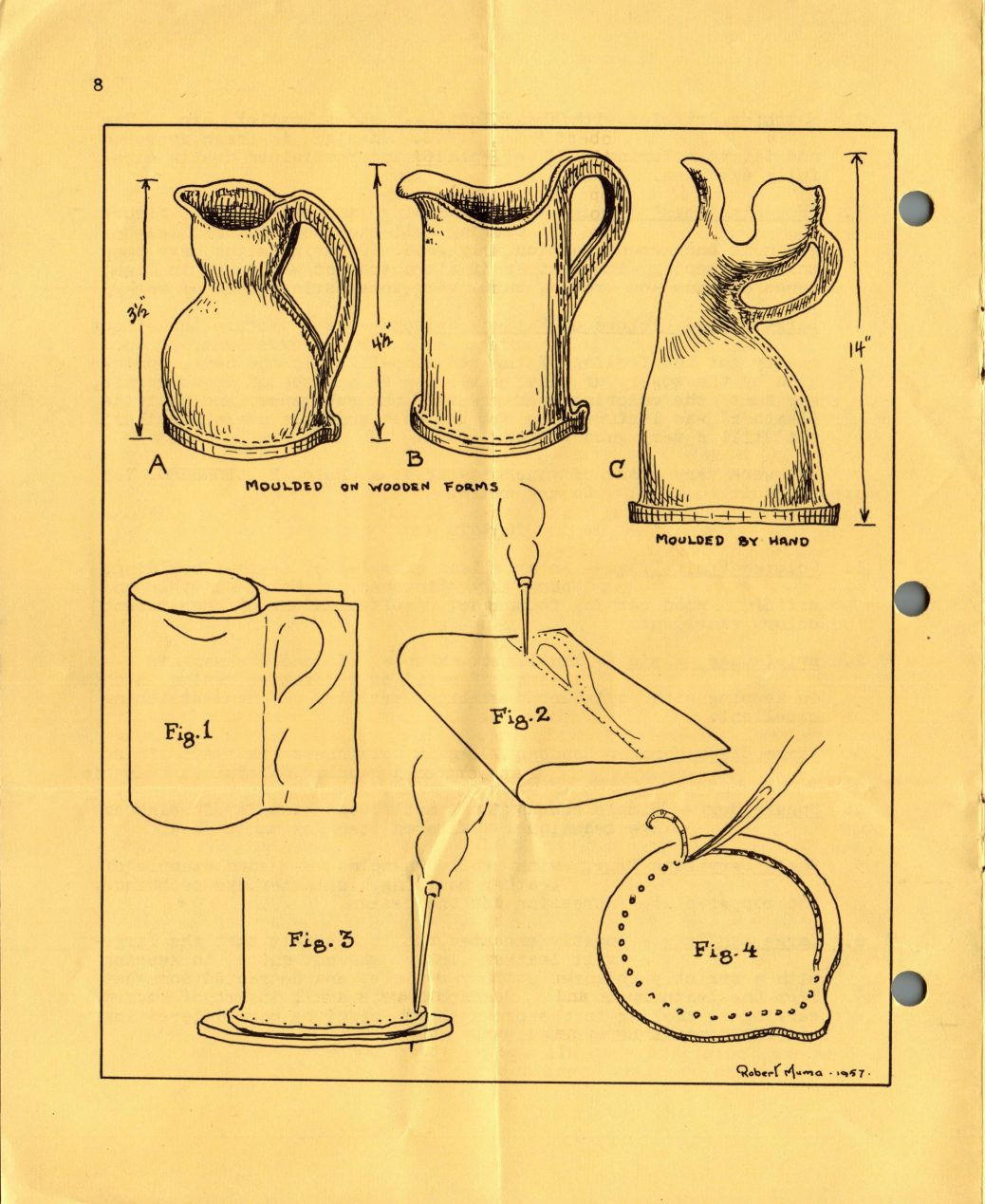
MOULDED ON WOODEN FORMS — A (3½"), B (4½").
MOULDED BY HAND — C (14").
This page is Robert Muma's diagram of moulded-leather pitchers, signed and dated in the corner. Its hand lettering, read from the printed page, is this. The three pitchers across the top are lettered A, B and C, each with its height beside it: 3 1/2", 4 1/2" and 14". Under the first two: MOULDED ON WOODEN FORMS. Under the third: MOULDED BY HAND. The four working figures below are lettered Fig. 1, Fig. 2, Fig. 3 and Fig. 4, and the signature in the corner reads Robert Muma · 1957.
Fig. 1. Fig. 2. Fig. 3. Fig. 4.
Robert Muma - 1957.
Page 9 — CUIR BOUILLI PART II -- PRACTICAL
CUIR BOUILLI by Robert Muma, F.C.S.C.L.
PART II -- PRACTICAL
At the top of the opposite page are several examples of "Cuir
Bouilli" made by the author. The miniatures at the left are projects which make unique and decorative mantel pieces.A was made on a wooden form which was removed by cutting the stitches after baking and then restitching. B is simpler and the following details of its construction will give you a good introduction to this form of leathercraft.
First you will need to procure a small wooden cylinder about 2" in diameter and 4" or 5" long. Cut a piece of 6 oz. cowhide a little wider than the length of the cylinder and long enough to wrap around the cylinder and overlap a couple of inches beyond. Soak this thoroughly in cold or lukewarm water for a few minutes and allow to drain. Stretch around the cylinder with the ends together and pinch it in against the wooden form. (See Fig.1) Mark a line at this point with a bent tracer. Remove the cylinder and lay the leather folded flat. Mark along this line with a #5 spacemarker and perforate through both thicknesses of leather using a diamond-shaped awl (Fig.2) or a #000 punch. Lightly sketch in the shape of the handle and continue the perforations around this line.
Take a piece of heavy waxed linen thread, 6-cord, and two needles and put the leather back on the wooden form. Begin saddle stitching at the bottom of the vertical line. The stitches should be drawn as tight as possible and should be close enough to the cylinder that the leather becomes stretched tightly around it.
When all the stitching has been completed,including the handle, take an Xacto knife with a #18 blade and trim off the excess leather to within about ¼" of the stitching. This includes cutting a piece out to form the handle of the jug.Also trim the top as in the sketch to form a spout and make sure that bottom is perfectly even.
The leather will be starting to dry somewhat by this time,and in just the right condition for some additional moulding by hand. Using a bonefolder, draw out the lip of the spout and curve out the top of the jug. Smooth down all the cut edges and work out about ¼" of the bottom away from the core. Place it on a piece of wood and put in an oven set at 200°. It will take anywhere from 20 minutes to half an hour or more to complete the hardening or baking process but be sure to look at it frequently to make sure that it is not "burning". If it has too much heat or too much moisture at once it will develop hard dark "pockmarks" over the surface which will become too hard and brittle.A low temperature and slow baking are essential to avoid this.
As the baking process nears completion, the leather will resume its natural color;and when all the moisture has been baked out of it, remove from the oven and knock out the wooden cylinder with a hammer.
Page 10 — REPORT OF EXHIBITIONS Chairman
Now cut a piece of leather a little larger than the bottom of the jug. Soak it in water and bake until about half done. Then place under the jug, flesh side up, and perforate with an awl for stitching through both pieces. (Fig.3) Gouge along the perforated ce ) line on the grain side so as to imbed the stitching. (Fig.4) Return: to the oven and complete baking. Stitch bottom in place, trimming if necessary afterwards.
Put edge dressing on the edges and rub down well with a bonefolder. Antique the leather if you wish and give it a good polish with liquid or paste wax. If you want to make it waterproof, apply a liberal coating to the interior of melted paraffin or some kind of plastic solution.
When you have been successful with this technique you may want to experience more freedom of moulding without a wooden form, as in C, which was done only with the hand plus imagination.
REPORT OF EXHIBITIONS Chairman
It was hoped that the Third Travelling Exhibition could be chosen from the exhibit of work held at the Ryerson Institute last October. On reviewing the situation,it seemed difficult to assemble an exhibition which would be as good as the last.Rather than allow one inferior in quality to be put before the public, the Executive decided to postpone the start of the third T.E. until the fall of 1957. We would welcome your suggestions as to the contents of the third T.E. and remember that those contents must be the work of members of the C.S.C.L. We would like as many members as possible to contribute - even one article each. It would be a great help to the Exhibitions Committee if you would keep this in mind during the summer and if you have any articles ready in September, send them to the Exhibitions Chairman, Mrs. Nora Huyck, 96 Hounslow Ave., Willowdale, Ont., for consideration by the Board of Selection.Keep in mind that the articles must be original and the size and shape should be a consideration for packing.Interest in our T.E. is extremely high and we have a long list of host groups eagerly awaiting the third Travelling Exhibition.
HANDICRAFT LEATHERS AND SUPPLIES
Fine Assortment of Beautiful Leathers
Largest Range of Leathercraft Tools and Accessories
All inclusive Specialized Leathercraft Catalogue
Experienced Personalized Service 3
THE BIRT SADDLERY CO. LTD. 519 Main Street Winnipeg 2, Manitoba
Page 11 — CANADIAN HANDICRAFTS GUILD AT CNE; NEW ASSOCIATES AND FELLOWS
CANADIAN HANDICRAFTS GUILD AT CNE
The Canadian Handicrafts Guild is now completing plans for their new demonstration and sales booth at the CNE, which will be in the new Women's Building this year. Their space will be larger than formerly and prominently placed. The Guild is therefore anxious to have the best display of crafts ever. Because of the attraction of the new building, many more people will be viewing the display this year, and it is up to the craftsmen to present a good showing. The prize list for leathercraft has not as yet been announced, and further details will be sent to interested members at a later date.
NEW ASSOCIATES AND FELLOWS
At the Annual Meeting April 6th, the following were elected
Fellows of CSCL: Miss Elizabeth Arnold, Kirkland Lake, Ont., and Mrs. Jean Newton, Toronto.
The following were elected Associates of CSCL: Mrs. Jean Agnew, Weston, Ont.; Miss Cathryn Bonis, London, Ont.; Mrs. Irva Ford, Hamilton, Ont.; Mrs. Jessie Little, Snelgrove, Ont.; Mrs. Gladys Miles, Toronto; Mrs. Loreen Myland, Toronto; Miss Anne Small,Toronto.
The Society's own membership roll gives this Associate's surname as "Bonis"; the printed page here reads "Toronto" for Mrs. Jean Newton and "Bonis" for Miss Cathryn.
Now is the time to get Your Entry Ready for Our Big 1957 C.N.E. PURSE CONTEST
WRITE FOR INFORMATION:
CLARKE and CLARKE LEATHERS
BARRIE - ONTARIO
Page 12 — NEW EXECUTIVE, 1957-58
NEW EXECUTIVE, 1957-58
President: Fred Brown, 1 Golfcrest, Toronto 18, Ont.
Vice-President: Clyde Johnson, 61 Victor Ave., Mimico, Ont.
Treasurer: Miss Olivia Smith, 32 Mountview Ave., Toronto, Ont.
Recording Secretary: Mrs. Norma Yott, 3752 St.Clair Ave. E.,Scarboro.
Corresponding Secretary: Miss Viola Harris, 47 Snowden Ave.,Toronto
Executive Council: Exhibitions: Mrs. Nora Huyck, 96 Hounslow Ave., Willowdale, Ont.
Membership: Miss Winnifred Barratt, 374 Brock Ave. Toronto, Ont.
Editor: Mrs. Dorothy Muma, 118 Hazelton Ave., Toronto 5, Ont.
Canadian Handicrafts Liaison: Mrs. Reta Larmour, Toronto, Ont.
Teaching Standards: Robert Muma, Toronto.
Past President: Mrs. Jean Newton, Toronto.
Others: Cecil Roebuck, Toronto; Deane Russell, Ottawa, Ont.;
        Dr. Ralph Larmour, Toronto; Harold Frost, Wallaceburg, Ont;
        Don MacKinnon, Toronto; Mrs. Betty Cox, Toronto.
  Presiding Officers of Branches and Regional Representatives will be ex-officio members of the Executive Council.
CRAFT LEATHER DYES AND FINISHES
16 colors keyed to color originality
Choose your color or create a new one SIX ANTIQUES FOR MELLOW AGED EFFECTS:
GOLDEN TAN HAVANA BROWN MAHOGANY
CHESTNUT BROWN ROUGE FOREST GREEN
TEN TONING DYES FOR FINE COLOR HARMONIES:
| YELLOW | BLUE TAN |
| ORANGE | LIGHT BLUE MIDDLE (Walnut) BROWN |
| SCARLET | GREEN BLACK DARK (Chocolate) BROWN |
POLISH COAT FOR SATIN-SMOOTH, WATER-RESISTANT FINISH
EDGE DRESSING AND INLAY BACKGROUND DYE for that final professional touch.
Dealers write for information to:
GARNETT COMPANY
1 HANNAFORD STREET: TORONTO: Phone OXford 4587 Ask for the GARNETT INSTRUCTION MANUAL at your hobby supply store.