
An issue of the Society’s newsletter, transcribed from the original.
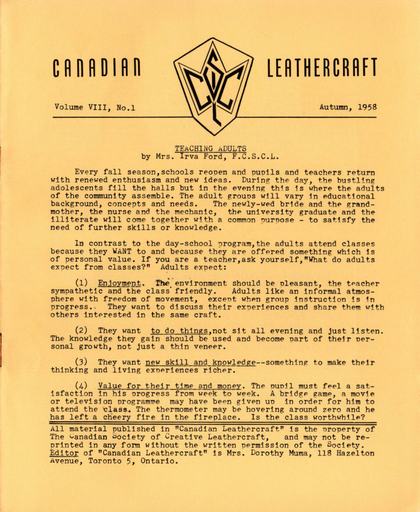
(12 pages, 2.1 MB)
the full-resolution scan, 28 MB, for close research
Page 1 — TEACHING ADULTS
CANADIAN LEATHERCRAFT Volume VIII, No.1 — Autumn, 1958
[Masthead: "CANADIAN LEATHERCRAFT" either side of the Society’s crest, with "Volume VIII, No.1" and "Autumn, 1958" on the rule below.]
TEACHING ADULTS by Mrs. Irva Ford, F.C.S.C.L.
Every fall season,schools reopen and pupils and teachers return with renewed enthusiasm and new ideas. During the day, the bustling adolescents fill the halls but in the evening this is where the adults of the community assemble. The adult groups will vary in educational background, concepts and needs. The newly-wed bride and the grandmother, the nurse and the mechanic, the university graduate and the illiterate will come together with a common purpose - to satisfy the need of further skills or knowledge.
In contrast to the day-school program,the adults attend classes because they WANT to and because they are offered something which is of personal value. If you are a teacher,ask yourself,"What do adults expect from classes?" Adults expect:
(1) Enjoyment. The environment should be pleasant, the teacher sympathetic and the class friendly. Adults like an informal atmosphere with freedom of movement, except when group instruction is in progress, They want to discuss their experiences and share them with others interested in the same craft.
(2) They want to do things,not sit all evening and just listen. The knowledge they gain should be used and become part of their personal growth, not just a thin veneer.
(3) They want new skill and knowledge--something to make their thinking and living experiences richer.
(4) Value for their time and money. The pupil must feel a satisfaction in his progress from week to week. A bridge game, a movie or television programme may have been given up in order for him to attend the class, The thermometer may be hovering around zero and he has left a cheery fire in the fireplace. Is the class worthwhile?
All material published in "Canadian Leathercraft" is the property of The Canadian Society of Creative Leathercraft, and may not be reprinted in any form without the written permission of the Society. Editor of "Canadian Leathercraft" is Mrs. Dorothy Muma, 118 Hazelton Avenue, Toronto 5, Ontario.
[Printed exactly so: "The Canadian Society of Creative Leathercraft", not the Society's later "for". Kept as printed — an early (Vol. VIII, Fall 1958) use of the name.]
Page 2
An instructor of a class does not necessarily need to be a trained teacher, though formal pedagogic training is a valuable asset. The most important requirements for the teacher are that he have a knowledge or skill which others wish to learn and that he, above all, understands and appreciates people.Adults do not accept the word of a teacher as readily as children,so the teacher must have a thorough knowledge of his subject. He must also be resourceful and tactful.
Since there is no set curriculum for adult classes in crafts such as leathercraft, a teacher of such a group is presented with many problems.A course must be planned in accordance with the time available and the experience and training of the group.Find out what they want to learn. Get to know the class, and modify the course to suit the participants. You can't use compulsion with adults -- they will learn only what appeals to them.
Begin with something interesting and productive the first night. Choose projects which lead logically to the final objective of the course. After teaching the fundamentals of leathercraft, then allow pupils some choice in activity. The members of the group will come from varying vocational and age groups. Another of the teacher's problems will be to keep within the average interest of the class.
In adult classes the methods and objectives will be as varied as the personalities of the instructors and the needs of the students. A few general principles, however, will help to guide the leader:
(i) Discipline.The rigid discipline and petty regulations used for day-schools are irksome to men and women who are accustomed to running their own affairs.
(ii) Attendance.When attendance begins to dwindle,ask yourself, "What is the matter with the objectives and practices of the class?" Use tact. A teacher who adopts a sarcastic, superior or dogmatic attitude towards adults in a class will soon note a decrease in attendance. The adult is a voluntary student and will attend only as long as the class brings him pleasure and a sense of accomplishment.
(iii) Individual interest. Encourage each pupil to express himself in this new medium. Lack of participation in class activities may be due to shyness or lack of interest;the subject matter may be too difficult,and not related to previous experiences,or the student may have little opportunity if the teacher constantly holds the "limelight".
(iv) Keeping together. While teaching the fundamentals of leathercraft try to keep the class together.Enlist the aid of the more advanced pupils to help the slower ones. This will tend to prevent the advanced pupils becoming bored and the retarded ones from becoming discouraged.
Page 3
(v) Self-criticism. One objective of adult education should be to encourage people to be honestly and objectively critical of their own effots. Ask "How does this compare with that?" The habit of self-appraisal is good for the ego and will spur the individual on to new efforts.
(vi) Variety. The same type of presentation throughout the whole course tends to become monotonous. Use a variety of techniques -- lectures, discussion, films, charts, diagrams, etc. When the instructor teaches and demonstrates a new lesson (e.g., setting a dome, how to do lacing, etc.) be sure the pupils learn it thoroughly. The following procedure in teaching will be well worth the time and effort:
(1) Arouse interest. In the case of a dome,show the difference between birdcage domes and segma domes;note the four parts;tell pupils the little hat fits on the long thin neck;the big colored hat goes on the thick shorter neck. Acquaint pupils with the parts of the dome-setter.
(2) Do the job yourself -- Tell and show.
(3) Do the job again yourself -- This time have pupils tell what to do.
(4) Have him do the job and tell you what he is doing. (5) Have him do the job again.
It is helpful for a teacher to consider the chief reasons why students forget:
(a) Because the information is only partially learned.
(b) Because the information is not put to use - use it as soon as possible.
(c) Because he considers it unimportant - the teacher must try to make each item or step appear important by stressing key points and emphasizing hazards.
Remember: "If you put it in his hand -- he'll lose it." "If you put it in his head -- he'll use it."
Note re the Author: Mrs. Irva Ford is a prominent member and one of the founders of the Hamilton Branch of C.S.C.L. She is a leathercraftsman and leathercraft teacher of long standing.
Page 4 — THE VALUE OF A HOBBY
THE VALUE OF A HOBBY by Clyde Johnson
The play spirit is an essential ingredient of recreation. The more complicated civilization becomes,and the more elaborate the machinery of living is made, the more necessary it will be to create a temporary retreat from the material obligations of everyday life.
The work we do to earn a living is activity toward an end, and play is activity as an end. At the same time, play is not aimless. Play, fun and laughter are agents of health. They give repose to the usually busy brain centres and tone up the muscles. If there were nothing else done by play, one thing justifies our indulging in it; play helps us to forget our worries and at the same time tones up our minds for a fresh attack on the cause of our worries, and variety in play is better than concentration on one form of play.
To have a hobby is to indulge in some form of play which exercises our hands as well as our brains,and to take a line that cures our despondent, worried, jittery feelings.
The machine age has tended to make our jobs routine. There are so many of us doing single parts of big jobs that we are inclined to feel individually unimportant and insignificant. When we indulge in a hobby through which we see something taking complete form under our own hands,then we gain self-confidence and self-respect. Every person should spend part of their leisure hours at some creative task in which they can submerge themselves completely. The sense of pressure under one's everyday task can be escaped.
The hobby should be something in which a person may excel and in which he takes a keen delight, There is relaxation and comfort in doing something for the sheer delight of doing it. This means,naturally, that one's hobby may change form many times in a lifetime, but even the changes are good, because every one gives us something new to think about, a new approach and a new way of seeing things. Our of achievement in a hobby comes the sense of contribution,of accomplishment.
[Printed exactly so: "Our of achievement" — almost certainly the Society's own typing slip for "Out of achievement", and kept as printed.]
A hobby should not become obsessive,either of thought or of time. It should be challenging enough to keep one interested, but not so difficult that one can't achieve something in it;it should not demand so much work that it becomes merely another job.
Some questions designed to help us select a suitable hobby are suggested, as follows: Will this activity give me fun and enjoyment? Is it within my capabilities? Can I make time for it? Will it meet my social needs? Can I make the space for it? Can I afford it?
Can it be continued indefinitely, even after my retirement?
It should be such a hobby that,instead of dreading our tomorrows,
Page 5
we will look forward to them. The choice is as wide as life itself. It is never too late to start,but on the other hand there are virtues in starting early, As much time as possible should be devoted to cultivating enduring interests. It may be necessary to try and then discard several hobbies before the right one is found.
A hobby satisfies the desire in all of us to create something. There are a thousand-and-one ways in which people satisfy their creative urge. Take the crafts -- woodworking, weaving, leatherworking, metal working, etc.,or making airplanes, boats, dollhouses. These are just some of the many ways in which you can be a maker, an originator.
In choosing a hobby, the really big question is: Will it give you fun and enjoyment? It must interest you. It must be something you do because you want to do it. But we must not allow a hobby to become master. We should be able to drop it painlessly at any time when more imperative demands are made of us. It should be willing to put up with our fits-and-starts approach to it. It should not become possessive.
A hobby can add to enjoyment of life by calming irritations and enabling the hobbyist to turn his nervous feeling into repose.
The well-rounded person knows that, having done his best, it is useless to consume energy in fretting. Far better use leisure time in relaxation and hobbies and building up reserve, so as to take up the battle with renewed vigor when the time comes.
This is far from languid contentment.No person is ever contented with life as it is; he wishes to make it better.No good housewife is ever so contented with her house-furnishings and her cookery that she ceases to seek improvement.
The first step toward better use of leisure time is to do something. There is great satisfaction to be found in being able to look at and pat with one's hand something one has created and say: "That's mine. It may not seem much to the rest of you, but I think it's grand. And I did it."
A suggestion for wise use of leisure time is to get started at once. It is largely a matter of just going ahead. Whatever your knack, however tiny it is, make it grow.Another hint is to be careful. Pleasure, even in leisure time, should never be purchased at the expense of pain, nor even at the risk of incurring it. Some hobbies may be too much for our eyesight. Every person possesses a limit beyond which he cannot go. Our satisfaction point and our saturation point are determined by our own peculiar nature.
Another suggestion is to be resonable about the spending of
[The page ends mid-sentence and carries on at the top of page 6 ("leisure time.").]
Page 6 — SHED THE SHACKLES
leisure time. When we attempt things beyond our capacity, we invite sorrow. It would not be sensible for example,for the person who has no skill of hand and eye to embark upon a clay modelling hobby.
A well-balanced hobby life will include spare-time activity designed to provide physical health,intellectual growth, contemplation, social enjoyment, creative effort, audience relaxation, and periods of solitude.
The aim and object of it all is to achieve tranquility. It comes in part from active creative hobbies, and in part from quiet, solitary intellectual pursuits. Boredom has no place in leisure. Good leisure use is not like a blazing fire, which might burn. It is rather, as so well put by Walter B. Pitkin in one of his books, like the dance of firelight upon a wall. It doesn't scorch; it has a playful touch.
That day is ill-spent in which a mature person has not done something constructive along the lines of his interest,or in which he has been too depressed to notice the brightness of the sun,the color of grass and of flowers,the mystery of the sea and the lure of moonlight on the water.
There is no readymade hobby suit into which all people will fit.
Every person makes his own pattern. By making it wisely, he may cure a present ill, fill a great want,or prevent physical and mental ailments. And, as is said by one of the philosophers: "It is disgraceful for a person to grow old in self-neglect."
**********
[Decorative printer's rule between articles — a row of joined diamond shapes, not transcribable text.]
SHED THE SHACKLES by Paul Payne
Today, many crafts are crude and banal because too many artisans furtively seek answers from the vast. Perhaps an excursion into the province of philosophy will at least provide a basis for shedding the shackles of the sacred past.
Historically speaking, man's early steps toward today's technology consisted mostly of discovering natural forces and materials as well as extensions and improvements of his own arms, legs,eyes, ears -- his senses. The resulting accumulation of observations and skills laid the foundation for the development of today's powerful tool, scientific inquiry or method. When used by man in a ceaseless quest for control, technology is one result. Perhaps an integral part was the method of invention which has been called the greatest invention of the nineteenth century. There is inherent in science of today a logic and quality of self-generation which drives the process relent-
Page 7 — LEATHERCRAFT SLIDES AND MOVIES
lessly forward regardless of its effect upon human beings. Maybe these qualities of science are potentially dangerous to human freedom.
The great systems of Western Civilizations concerned themselves with something represented as Being, Nature, the Universe, the Cosmos, Reality, the Truth. Criticism can hardly be directed at these philosophies when viewed with respect to their connection with intellectual and moral issues of their own time and place. However, their relevancy to present changed conditions is dubious to say the least. A valid philosophy of today must concern itself with the problems growing out of changes occurring with ever-increasing rapidity, over wider and wider human geographical scope, and with continually deepening intensity of penetration. Modern technology has penetrated into every nook and cranny of our lives and left us grasping, grasping for a system to deal with human processes. Dewey has stated that any inquiry into human and moral subjects must use the kind of method by which the understanding of physical nature has been brought to its present feverish pitch -- namely, the method of observation, theory as hypothesis and experimental test.
We have been looking forward to scientific advances but their rapid occurrence presents many serious and practical issues that demand attention. Consequently, we have been too busy looking at them individually to really make a generalized or intellectual observation of them. While looking ahead in science, our thoughts and desires tend to turn backward to old sources of morals, most of which have been discredited. We can, however, expedite the development of human processes by substituting faith in the activities of today instead of dread and dislike for them, and have the courage of intelligence to follow whither social and scientific changes direct us. Furthermore, Dewey has indicated that we are weak today in ideal matters because intelligence is divorced from aspiration. The bare force of circumstances compels us onward in the daily detail of our beliefs and acts, but our deeper thoughts and desires turn backward. When philosophy shall have co-operated with the course of events and the meaning of daily detail has been made clear and coherent, science and emotion will interpenetrate. Then practice and imagination will embrace. Art and religion will be the unforced flowers of life.
To further this articulation and revelation of the meanings of the current course of events is the task and problem of philosophy in the days of transition.
LEATHERCRAFT SLIDES AND MOVIES
Hamilton Leathercraft Guild now has a collection of slides and movies which are available for circulation to other Guilds. The slides are 35 mm., and the movies 8 mm. Any Guild wishing to show these pictures, which include items from the International Assembly at Detroit and the Regional Meeting at Prudhommes, contact Harold Wilson, 400 Charlton Ave. W., Hamilton, Ont.
Page 8 — LEATHERCRAFT TABLE
LEATHERCRAFT TABLE
By Bruce & Dorothy Rossetti
For many years, keeping leathercraft tools and necessities in one spot has presented quite a problem. We decided to design a table which would combine cutting surface, tooling glass, tools, etc., and it has been an outstanding success.
[A hand-drawn diagram follows in the original, not running prose: a table 71 inches wide, with a well 5 inches deep (lined with linoleum and a wood cover) sunk between a linoleum-covered cutting surface at one end and a sloped plate-glass surface at the other, each labelled on the drawing.]
We used heavy battleship linoleum for the end of table for cutting surface.(Other surfaces such as zinc,maple hardwood or masonite might also be used in preference to lineoleum). Plate glass was used at the other end for carving and stamping.This must be well supported by a solid surface underneath such as heavy plywood, or a piece of marble might be substituted.
The tool compartment is countersunk, as is the water container. The covers for these two compartments are of the battleship linoleum so that when it is necessary to cut a large skin the whole table may be used.
We made the table a bit higher than average height and we find it more convenient for work which has to be done standing up and we use a high stool for leather carving work.
We hope that other leathercraftsmen will make a similar table and get as much pleasure from it as we do.
Note re Authors: Bruce and Dorothy Rossetti teach leathercraft in Nova Scotia. Bruce is a professional engineer and has been carving leather for ten years.
Dorothy specializes in tooling and embossing. They have both exhibited in several places.
Page 9 — HOW HANDICRAFT LEATHER IS MADE
HOW HANDICRAFT LEATHER IS MADE
(An address given by Peter Stewart, great-grandson of the founder of Wickett & Craig Tannery,Toronto, at the Regional Meeting of leathercraftsmen at Vineland, Ontario, May 3rd, 1958.)
[The page reads "given by", not "given re"; the parenthetical note closes with a date, "…Vineland, Ontario, May 3rd, 1958.)"]
The art of making leather is a fascinating one. So fascinating,
I am sure we could be here until midnight. I would like, very briefly, to go through the manufacture of handicraft leather in our own tannery. Allow me a few generalizations first.
You will notice that I referred to leathermaking as an art. It is one of the few remaining manufactured products that is not made on the assembly line. Each hide has a slightly different characteristic from the next one and the tanner tries to equalize this as much as possible in his process. It takes between two and three months for a cured hide to be converted into a piece of leather ready to be tooled or carved. During that time each side has been picked up and put into a machine or truck between 40 and 50 times; been in six different solutions ranging from very alkaline to very acid and been put through a minimum of 15 different machines. The machines range in price from $3,000 to $30,000. These are a few reasons why leather cannot be sold as cheaply as a roll of plastic.
Hides, as we receive them from the various packing plants in Canada and the U.S.A., have been "cured" in salt, for a minimum of thirty days. They are covered with flesh, manure, dirt and salt.
Our first operation is to clean the hides of dirt, etc., and make them pliable for the subsequent operation. This is called soaking and is done in cool water overnight. The hides are then fleshed in a machine with a bladed cylinder similar to a lawn mower and put into a saturated solution of lime and left there for three days. At the end of this time the roots of the hair follicle have been destroyed and the hair is removed mechanically.
Bating is the next operation. This is to remove the excess of lime and remove unwanted materials from the side. Up to this point a side, if left too long in this condition, would putrefy and rot. Tanning converts this protein or gelatinous side into leather.
Most shoes are made from chrome tanned leather. This is a very rapid chemical process done with chromium salts, that takes one to two days. Most sole, harness, luggage, upholstery and handicraft leather is vegetable tanned. Vegetable tanning, using a blend of bark extracts and wood of trees such as quebracho from South America, wattle from South Africa, Valonia from Asia Minor, and chestnut, oak and hemlock from North America is a much longer process, taking from two weeks up to three months.
In our tannery the bated sides are nailed on to sticks and
Page 10 — NEWS ITEM
suspended in vats, first in a weak solution of vegetable extract. These sides are moved up regularly into stronger solutions and after three to four weeks are fully tanned.
The leather, at this point, is still the full thickness as it comes from the animal,which is from 1/8th to 1/4th of an inch thick. It is split to 6 ounces and the leather with a clean grain surface and free from grain imperfections is sorted into russet handicraft. The sides are washed to give a clear, more pleasing colour and then oils are put into the leather so that when it dries it will be soft and pliable.
The sides are "set", i.e., smoothed out on another machine and hung up to dry.
Next, they are re-wet and set by hand using metal slickers. This gives the leather a smoother grain surface than any machine could achieve.After drying again,the leather is plated on a machine which is like a huge iron. This smooths the grain again and imparts a pleasing "feel" and lustre to the leather.Some handicraft leather is sent to the finishing room for various colours to be applied, but the nicest,to my mind, has no finish on it at all and goes straight to the warehouse with the pleasing natural russet colour derived from the vegetable extract.
In the warehouse the handicraft leather is measured,sorted and re-split to whatever thickness the customer wants. The leather is then shipped out and is ready to be made into beautiful products by leathercraft enthusiasts such as yourselves.
**********
NEWS ITEM
[Decorative printer's rule between articles, not the word "Oven".]
A news item from the "Detroit Times" has been sent by Bob Dengler of Rochester because it is of interest to Canadian leathercrafters who know Larry DeRosia of the Detroit Leathercraft Guild.
Two leather albums made by Larry DeRosia have been presented to Queen Elizabeth and to the Archibishop of Canterbury. The albums of calfskin and suede, were made for the Detroit Episcopal Diocese, and were presented at the time of the Episcopal Lambeth Conference in July. The Archbishop's album bore the emblem of the Lambeth Conference, and the Queen's carried her cipher. The albums were made to contain recordings of "This is Christmas" and a Fred Waring book of new American Christmas carols. Larry DeRosia holds these two albums among his treasured memories. The covers were bright red and the interiors light green with red trimming. Special permission had to be granted to use the Queen's cipher.
["Archibishop" earlier in this paragraph is printed exactly so and is left as printed — the Society's own inconsistency, since the second mention two sentences later plainly reads "Archbishop's".]
Page 11 — CANADIAN HANDICRAFTS GUILD COMPETITION; CHRISTMAS SALE
CANADIAN HANDICRAFTS GUILD COMPETITION
Leathercraft entries in the Canadian Handicrafts Guild competition at this year's Canadian National Exhibition were disappointingly few in number. There was little outstanding original work and it was agreed that the Society in general had fallen down on the job. The following were the prizewinners with the names of the donors of the prizes:
Best In Show:
ROBERT MUMA, Plaque of Canadian Coat of Arms -- $50 cash from F. W.
Woolworth Company Ltd. Tooled or Carved Work:
1st: Miss OLIVIA SMITH, tooled shoes - $25 Credit Note from Clarke and Clarke Leathers.
2nd: Miss CLARICE PACKHAM, carved handbag -- $15 Credit Note from Clarke and Clarke Leathers.
Neither Tooled nor Carved, but any other treatment: 1st: Mrs. IRVA FORD, molded candlesticks -- $25 Credit Note from Lewiscraft.
2nd: Mrs. RETA LARMOUR, plain handbag -- $15 Credit Note from Lewiscraft.
Hand Crafted Leather with no more than 20% area of decoration:
Mrs. NORA HUYCK, Purse set — $25 Cash - Canadian Handicrafts Guild. Article of Original Design, winner never to have won prize in any previous major Canadian leather competition:
1st: FRED BROWN, Desk blotter, $25 Cash -- Canadian Handicrafts
Guild.
2nd: Mrs. GLADYS MILES, Tray with maple leaves -- $15 Cash -- Canadian Handicrafts Guild.
Best Use of Coloring Techniques:
Mrs. ANNE HOOK, Small tray, trillium design - $25 Cash - Garnett Co. Most Original Entry, new approach to leathercraft:
ENDEL RUBERG, Desk set using fish skin - $40 Cash - Anonymous.
It is to be hoped that members will "pull up their socks" a good deal next year and really give the judges a workout.
CHRISTMAS SALE
The annual CSCL Christmas Sale will be held again this year at the Canadian Handicrafts Guild shop, 77 Bloor Street West, Toronto, from November 26 to 29. Members will be receiving a special notice regarding this sale, but are urged to send in as many pieces as possible in order to make a good selection. Items for men are esepcially saleable.
[The heading’s trailing digit is the printed page number, 11, set hard against "COMPETITION" with no space.]
Page 12
Our Catalogue Club provides a valuable service for you.
FOR INFORMATION
Write to: Clarke & Clarke Leathers, Barrie, Ontario
Branches
For the Leathercraftsman: Antiques – Toning Dyes, Polish Coat, Edge Dressing, Inlay-Background Dye, Leather Cleaner & Polish Remover
Leather Dyes and Finishes at your hobby supply store
Canadian Distributor: Lewiscraft, 284 King St. West, Toronto, EM. 3-5206