
An issue of the Society’s newsletter, transcribed from the original.
(12 pages, 2.2 MB)
the full-resolution scan, 28 MB, for close research
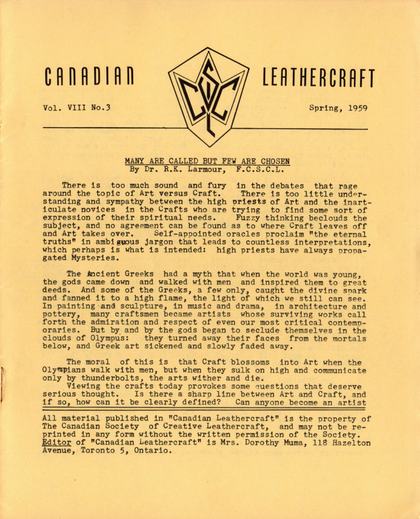
Page 1 — MANY ARE CALLED BUT FEW ARE CHOSEN
Canadian Leathercraft
Vol. VIII No.3 Spring, 1959
MANY ARE CALLED BUT FEW ARE CHOSEN
By Dr. R.K. Larmour, F.C.S.C.L.
There is too much sound and fury in the debates that rage around the topic of Art versus Craft. There is too little understanding and sympathy between the high priests of Art and the inarticulate novices in the Crafts who are trying to find some sort of expression of their spiritual needs. Fuzzy thinking beclouds the subject, and no agreement can be found as to where Craft leaves off and Art takes over. Self-appointed oracles proclaim "the eternal truths" in ambiguous jargon that leads to countless interpretations, which perhaps is what is intended: high priests have always propagated Mysteries.
The Ancient Greeks had a myth that when the world was young, the gods came down and walked with men and inspired them to great deeds. And some of the Greeks, a few only, caught the divine spark and fanned it to a high flame, the light of which we still can see. In painting -and sculpture, in music and drama, in architecture and pottery, many craftsmen became artists whose surviving works call forth the admiration and respect of even our most critical contemporaries. But by and by the gods began to seclude themselves in the clouds of Olympus: they turned away their faces from the mortals below, and Greek art sickened and slowly faded away.
The moral of this is that Craft blossoms into Art when the Olympians walk with men, but when they sulk on high and communicate only by thunderbolts, the arts wither and die.
Viewing the crafts today provokes some questions that deserve serious thought. Is there a sharp line between Art and Craft, and if so, how can it be clearly defined? Can anyone become an artist
All material published in "Canadian Leathercraft" is the property of The Canadian Society of Creative Leathercraft, and may not be reprinted in any form without the written permission of the Society. Editor of "Canadian Leathercraft" is Mrs. Dorothy Muma, 118 Hazelton Avenue, Toronto 5, Ontario.
Page 2
without mastering the craftsmanship that underlies the Art? How do we develop the means for discovering genius?
I know that some of our "moderns" contend that artistic sense and creativity are the only precursors of Art, but I can find no evidence that great sculptors, painters and musicians became great before they mastered the basic techniques. How can anyone believe that creative thinking can occur without a close and sympathetic understanding of the medium and the technique applicable to any Art? How can one translate thought to physical form without knowing what tools to use and how to use them? Perhaps the critics can manage this, since they deal only with words which in varying degree are already at hand.
I would like to know at what point a clever musician skilled in playing someone else's notes,ceases being an artisan and becomes an artist. When does a pupil leave off copying his tutor and become a master in his own right? It might be countered that the first artists had no masters to copy,but that is not so: Nature was their master, and only when they ceased reproducing an exact copy of one thing and captured a universal concept of beauty did they merit the designation, Artist. And what else but Time can decide whether or not a man's concept of beauty is indeed universal?
Since we cannot hope to define this concept of universal beauty at any point in time, despite the proclamations of the critics, how should we proceed with the task of creating an atmosphere in which potential genius may germinate and flower?The answer seems obvious: we must apply the same principles that are used in general education. We must first teach what is already known, beginning with elementary lessons, simple exercises, copying the masterpieces in order to develop skills,and all along the way applying the yardstick of critical examination to measure progress. The poor students fall out but the good ones continue, until at last there remains a handful in which there may be one who with encouragement may find the divine spark that can lead to greatness. What other way is there? We must sift a lot of earth to find one diamond, but the reward is worth the labour.
Ten thousand children practice piano for years -- one hears heavenly notes and in time becomes a great musician. Tens of thousands swat away at English for fifteen years or more--one hears the Silver tongue and becomes a great poet. Countless youngsters are coached in the elements of drawing and the use of paints - one Sees a vision of beauty and after years creates a masterpiece. Many are called but few are chosen to receive the gifts of the gods.
With the handcrafts there is some difference from general education since many of the students are adults when they begin.
Page 3 — QUESTION BOX
This leads to an error in teaching practice because, looking upon them as adult, we begin too far along the road of learning. In effect they are no different from children in respect of a skilled craft, and as we start a child from scratch in music, so should we start an adult from scratch in any craft. And like any group of beginners in school they represent all levels of intelligence, aptitude and application. Why then should we expect more from these groups of adult novices than we expect from children starting out in Grade I? Actually we ought to expect less because the adult novice has many varied interest distractions and inhibitions, and hence can never be expected to give to the task the concentrated attention common to young children. We cannot expect adults to accomplish in a dozen easy lessons what it takes receptive children a dozen years to master.
The real problem, in leathercraft particularly, is to establish correct conceptions of what constitutes a masterpiece. Once that were done, the rest would come easily, because practice could be based on clear principles and teaching could include critical study of what makes the great pieces great. Thus it would be possible to create in the minds of students the images of excellence. Then and only then, may we hope to discover those rare ones,the one-in-a-thousand, who can go forward and excel the masters. Then, we might elevate the skilled artisan to an artist.
If these ideas are right,it follows that little is to be gained by scornful censure, by Jovian thunderbolts directed toward the great mass of novice work that we see on exhibit.Good teaching takes a different course: it explains and demonstrates; it encourages the diffident and chastises the slothful; it condemns deceit and carelessness. Above all, it holds before the student an image of perfection and tries to awaken deep interest in striving toward that goal.
Is it wise then, to waste time and words on scorn and sterile criticism of the general mass of leathercraft? Would it not be more fruitful if our design critics used the equivalent effort to search out and bring to light evidences of genius--the hint of that one-in-a-thousand who might in time, properly nurtured, become one of the chosen of the gods?
QUESTION BOX
One of the features: of the Annual Meeting was a Question Box to which craftsmen were asked to submit questions. From time to time in the pages of future issues of this Bulletin, we will print some of these questions and answers.If you have any other questions to add to these, please send them in and we will endeavour to get the best practical answer to your problems.
Page 4 — C.S.C.L. ANNUAL MEETING; NEWS ITEM
C.S.C.L. ANNUAL MEETING
The Annual Meeting of C.S.C.L. this year was held Saturday,
April 18th, at WoodGreen Centre, Toronto, and this change in location with the freshness of atmosphere which it brought to the gathering, was the most unique thing about this occasion.
An experiment in streamlining the business meeting by circulating printed copies of reports and President's remarks, shortened this part of the day's program and left more time for the other activities. If you were not at the meeting and have not received a copy of these reports through the mail, write to the Secretary, Miss Viola Harris, 47 Snowdon Avenue, Toronto 12, for your copy.
No Fellow membership awards were made this year and only three members received Associate certificates.These were Miss Jean Pettit Toronto; Mrs. Nina Wilson, Hamilton; Mr. Janis Zalitis, Toronto.
The Guild competition for the Weston trophy was disappointing this year, with only three Guilds competing: Hamilton, London, and Toronto. The trophy was won by Toronto Guild, with Hamilton second. Comments on the winning pieces will be found elsewhere in this issue.
Demonstrations were given all afternoon, by a number of top craftsmen.These included: Tooling and embossing by Miss Henstridge, Hamilton; Braided handles by Mr. Fielding, Hamilton; Turtle lapel pins by Mrs. Kehoe, London; Braided belts by Winifred Coombs and Grace Smith, Toronto; Gold stamping by Robert Muma, Toronto; and Flower making by Mrs. Clara Cavanagh, Barrie. Mrs. Edith Roscoe of Weston gave a chalk talk on box covering and coloring.
The noon dinner was catered by the women of WoodGreen Church, and afterwards there was a tour of the new church building, which has pulpit and baptismal font decorated with rawhide.
NEWS ITEM
On invitation from the Lord Simcoe Hotel, Toronto, Robert Muma set up an exhibition of bookbinding in their showcase reserved for the exclusive use of professional contemporary craftsmen, for the six weeks from March 22nd to April 30th. As a result of this exhibition,he has received a commission to do the two books for the Ontario Hydro to commemorate the opening of the St. Lawrence Seaway in June. These books will contain the signatures of Queen Elizabeth and President Eisenhower, one in blue leather for the Canadian side,one in red for the American side.
Page 5 — INLAY IN LEATHER
INLAY IN LEATHER by Nora Huyck, F.C.S.C.L.
The dictionary defines inlay as the embedding of one thing in another so that their surfaces are even, or inserting a page or a cut in a space cut in a larger page. These two together explain what we mean by inlay when we are talking about inlay in leather. One smaller piece of leather is set into an identical space in a larger piece of leather. In order to insure that their surfaces are even, the two leathers used must be of approximately the same weight or thickness.
The actual process of inlaying one piece of leather into another is quite simple. The two most important things needed are a sharp, pointed knife and a steady hand. The blade of the bevel pointed knife usually used for cutting out leather is too big for anything except long straight lines. To cut around curves, a blade similar to the #11 X-acto blade is necessary. The steady hand comes with practice. A person who has mastered the skills necessary to make a wallet or a handbag should have no difficulty with inlay.
When a new technique is being tried, it is always advisable to make a few practice attempts first. Start by setting a triangular shaped piece of light colored leather into a larger piece of brown morocco. We shall also need a piece of thin skiver the same size as the brown piece.
Trace the outline of a triangle on the tan piece. Carve (or incise) this outline, or if you do not carve, deepen the lines with a fine tracer. A carved outline is much easier to follow than the broader tooled outline. Do not cut out the tan triangle. Place the brown piece on a board or other surface used for cutting. Tack the tan piece to the brown piece by using a rubber cement--one that will allow the tan leather to be pulled from the brown leather later. If possible, apply the cement on the tan piece only under the triangle, and on the brown piece only where the brown triangle will be cut out. If it does spread beyond the triangle, the rubber cement will come off the morocco or any leather which has been finished, simply by rolling it up with the fingertips. Barge cement will do the same. You are using cement here only as a temporary adhesive, therefore, do not roughen either piece of the leather and do not use white cement. It will not come off so easily later and is apt to stain the leather if it. spreads beyond the triangle area.
With a sharp, pointed knife cut out the triangle. The knife must go straight down through both pieces of morocco. It must not undercut. If it does, the tan triangle may be larger or smaller than the space in the brown morocco and will not fit exactly. It may need several strokes to get through both pieces of leather.
Page 6
Therefore, cut slowly and carefully to insure clean cut edges.
Lift out the triangle. On the underside of the tan triangle is the brown triangle. Pull it from the tan piece and discard it. Save the tan triangle. Lift the extra tan leather from the brown piece and discard it. In the brown leather there should be a space the exact size of the tan triangle.
Cement the brown piece to the thin skiver. Cement the tan piece in the space in the brown piece. Press it down well all over and especially along the edges. Use white cement here. It sets more slowly and gives you enough time to put the triangle in place carefully. With a damp cloth immediately wipe away any excess cement that oozes up. The inlay is now finished.
Before you try this form of decoration on a project, do a few more practice pieces trying more complicated outlines. You may like to use a simple design carved or tooled in cowhide and set into another piece of leather. The cowhide must be of the same thickness as the other leather used or so little thicker that with a modeller you can smooth or press the edges of the cowhide down to the level of the other leather. If you have used the white cement there will be sufficient dampness in the leather to do this quite easily. The result will be a slightly embossed effect. It is important that both pieces of leather be completely dry before attempting the inlay. If the leather is even slightly damp, there is danger of shrinkage and the inlay will not fit exactly. If the inlay shrank, there will be a little space all around the design. If the outer leather shrank, the inlay will be too big.
In doing a project, the thin skiver is replaced by whatever is used under the outer leather--on a handbag flap, it will probably be the darex stiffener, on a notebook it will be the darex or the book board used to form the front cover.
This form of decoration can be used anywhere except where a fold is involved. For example, on a wallet, the inlay should be used on the front or the back but not over the fold. If it does have to go over a fold, the cuts must run at right angles to the fold, rather than parallel with it. Otherwise, they may split open with repeated opening and closing of the article.
Inlay is used where a decoration is required on a leather which is already finished--morocco, luxon, alligator, etc.,--and therefore, cannot be decorated in the usual manner. When you want a small design left natural and the rest of the leather darkened around it, it is always difficult to keep the dark dye from seeping in around the edges of the light area. Inlay solves this problem.
Page 7 — REFLECTIONS ON THE SEMINAR
REFLECTIONS ON THE SEMINAR by A Participant
The 1959 Canadian Craft Seminar in Design took place at the Ontario College of Art, Toronto, on four successive Wednesday evenings beginning February 18th, with the co-operation of the Canadian Guild of Potters, the Metal Arts Guild, the Spinners and Weavers of Ontario, and the Canadian Society of Creative Leathercraft.
(The Oxford Universal Dictionary defines, as quoted: "SEMINAR: In German Universities (hence in certain British and American Universities),a select group of advanced students associated for advanced study and original research under the guidance of a professor).
The purpose of this Seminar was to serve as a stimulus for the existing craft groups: to establish a rapport among our craftsmen which will stimulate an interest and understanding of each other's craft problems; to emphasize the necessity for good design and good craftsmanship as the basis for better work in the crafts, for an ever-expanding market.
Two speakers were presented each evening, one local, and one from the U.S.A. One of them spoke on his own craft in particular, the other presented his point of view as it affects the crafts generally.
1. WEAVING. Mr. Harold Burnham, Assistant Curator of Textiles, Royal Ontario Museum. Mr. Burnham deplored the lack of imagination in the designs in weaving in Ontario, but did not offer a solution. The opportunity which his wife had, to study outside of Canada,sets her apart from the weavers who must learn locally. Not being a weaver, the writer failed to go away feeling that weaving excited interest sufficient to spike further investigation.
GENERAL DESIGN.
Mr. Charles McGee, B.A., M.F.S., Instructor in Design and Matrix Study, Cranbrook Academy of Arts, Bloomfield Hills, Mich., U.S.A. Mr. McGee's lack of platform experience, and the hesitant fusion of the first-night mechanics, got him away to a poor start, but this was no serious handicap. He spoke at the level at which he was invited,and those whom he transported onto Cloud Number Nine had the unique experience of stepping together, from the work-a-day world, sans sputnik, to the stars. It was deeply satisfying to find that such a man could hold his level, despite the question period attempts to break him down.
2. LEATHERCRAFT. Mr. Douglas Duncan, Bookbinder, Director of Picture Loan Society, Toronto. Mr. Duncan gave to the leathercrafters the deflating experience of which Robert Burns wrote "Oh wad some power the giftie gie us to see oursels as others see us! It wad frae money a blunder free us, and foolish notion."
Page 8
Granted,it would have been better to have inspected the current exhibit before condemning the craft en masse, but would it have made much difference? In his sixty seconds of subsequent conversation at the showcase, with the writer, he indicated one piece which he considered excellent, then turned away from one which he said gave him the shudders. If we could not select beyond criticism such a small exhibit, have we any business to protest his judgment?
GENERAL DESIGN.
Mr. Harold Brennan,Director Rochester Institute of Technology, School for American Craftsmen, Rochester, N.Y., U.S.A. Mr. Brennan's selection of color slides of hand crafts,generally,and his flawless presentation which has the polish of a precious stone,made the latter part of this evening a night to remember. What we personally remember is that it came as a shock to be told that he had spoken for 90 minutes--those hard chairs had only started to register! The interest which every craftsman should have in crafts other than his own, was driven home in the appreciation of this well-balanced and equally well-presented selection.
3. METAL CRAFTS AND JEWELLERY. Mr. Lawrence Copeland, Instructor in Metal Crafts and Jewellery,
Rochester Institute of Technology, School for American Craftsmen, Rochester, N.Y., U.S.A. This lecture appeared to be aimed at promotion of the craft market, rather than at the elevation of the level of design and workmanship in the craft itself. Knowing the metal crafters as serious workers who have set their sights high,it would seem to be desirable that the lecture stick to the point.To comment or to condemn would have given something to take away. Did they get anything?
GENERAL DESIGN.
Mrs.Dora DePedery Hunt,Hungarian-born sculptor, now living and teaching in Toronto, and recently returned from study in Europe, on a $2,000 Canada Council Grant.Mrs.Hunt's sympathetic and human understanding of the craftsman and his problems was a refreshing draught. Attention was focused on the small nucleus of creative craftsmen at the top level in each endeavour, and to the necessary recognition of this condition, without minimizing the importance of the wide field on the next level, where crafts present an outlet for activity. At this level,work should be done as well as possible, or not done at all. The writer went away with the feeling that the creative craftsman is to the craft as the soloist is to the choir.
4. CERAMICS. Mr. Daniel Rhodes, Associate Professor of Design,New
York State College of Ceramics, Alfred University, Alfred, N.Y., U.S.A. Mr. Rhodes presented color slides of pottery. old and contemporary. Pottery has come a long way in the last two decades,actually faster than those outside the craft can comprehend. Refusing to admit that there were no more fields to conquer,the potter explored the adjoining fields of sculpture and painting, took what he could utilize into his craft, and made it his own. This was an inspiring lecture, informative and well presented.
Page 9
General DESIGN. Mr. Robin Bush, A.C.1I.D., Canadian Division Manager, Herman Miller Furniture Co., Robin
Bush Associates Limited, Toronto.Nowhere was the need more forcibly shown than by Mr.Bush in his selection of color slides,for an awareness of the changing world around us,and the influence which it exerts on what we are and do. Today's boundaries and horizons are behind us tomorrow:today's dreams are tomorrow's realities;and this is fact, not fancy!Man has produced machines which in this mechanized age can reproduce themselves,complete with neurosis. When the zenith of simplicity is reached, then one simplifies simplicity.The newspaper,that cheap commodity, could be simplified out of existence by being made self-disposable. This is no longer a fantasy.It was the conclusion of the writer that the craftsman too self-contained to stay alert and in pace with the progress around him,could proudly produce a work already as obsolete on presentation as was the Avro Arrow.
N.B. The foregoing is an unsolicited summary of my reaction to the Seminar. ANNE HOOK, F.C.S.C.L.
COMPLETE SUPPLIES FOR LEATHERCRAFT
Aluminum Etching, Copper Tooling and Copper Enamelling Purse Framing — Patterns, Tools and Frames
Qualified Technician in charge
We are not a "Mail Order Catalogue" House — We sell Top Grade Materials only.
Mail & Phone Orders Given Prompt Attention Centrally Located
CAPITAL FINDINGS & LEATHER LIMITED 580 King Street West, Toronto 2B
Phone EM. 3-8563
OUR SPECIALTY:
ALL KINDS OF SPECIAL & FANCY LEATHERS
Page 10 — CRITICALLY SPEAKING
CRITICALLY SPEAKING
The following is a resume of the critical comments made by the Board of Selection on the pieces submitted for the Weston Guild Trophy competition at the Annual Meeting.
TORONTO had the highest score (557 points)and won the trophy for the second consecutive year. Their pieces included:
Purse inspired by Jack-In-The-Pulpit in well-done spatter technique with restrained design appropriate to the shape of the bag.
Telephone Memo Pad with muted, pleasing colors and carefully carved motif; high colors at sides of motif could have been subordinated.
Coasters with handcut metal disc used to press medallion decoration into leather,background pressed in with grass-linen; spatter dye technique, well-finished edges.
Small Tray with conventional trillium design impressed from etched copper plate; china dish used to shape base, edge handmoulded over heavy string, spatter dye technique.
Purse in Slunk with slunk markings arranged to give pattern; handle might have been darker brown.
Album Cover in dark brown; excellent dye job and exquisite workmanship.
HAMILTON placed second (491 points), with the following pieces: Large Morocco Bag of excellent workmanship; pocket too deep and handle might have been stronger; flap could have been somewhat larger for better visual balance.
Man's Belt perfect piece in every way,with well-finished edges and back, braided keepers and excellent stamping.
Book Cover no contrast in color; design could have been kept on front area; edges not quite straight.
Driftwood Planter Interesting but impractical; why use leather when driftwood itself is so available?
Lamp and Shade in good proportions; conventional decoration would have been more desirable on under part of base to match lower part.
Blotter Pad nicely tooled;well constructed but pad could have been half as thick to allow cover to lie flat.
Page 11
LONDON submitted the following pieces (score 482 points):
Leather Animal: Quaint leather novelty but very well executed.
Leaf Pin and Earrings well done; could have been hand-moulded to give rounded appearance.
Plaque of family crest - some lettering not well done, border not balanced; colors rather gaudy.
Wallet with Acorns: in general appearance and workmanship good but does not fold flat; design could have been centred on front rather than all over.
Black Carved Purse unfunctional although of good appearance; stiffener all in one piece making bag difficult to open; gussets too rigid; handle not well finished.
Bird Book Cover simple and in good taste; colors soft and pleasant; design sufficient and suitable to object; top grade piece of work.
From the above comments it may be seen that the judges stressed quality of workmanship, general appearance and suitability of design Originality, either of design or treatment, was not a requisite at this time.
you'll find ''everything'' in leathercraft at TANDY'S conveniently located in downtown TORONTO at 107 KING STREET EAST, at King and Church, 3 blocks from YONGE ST., 5 blocks from SIMPSON'S.
[Beside this text is a picture of the front cover of Tandy's Leathercraft Catalog #83, showing sample bag kits, pre-punched kits and baby moccasins, captioned "Always look to Tandy for leathercraft — kits, supplies and leather at low prices, plus teacher aids, movie classes." The picture itself is not reproduced here.]
WRITE FOR FREE CATALOG
TANDY LEATHER COMPANY, Est. 1919, OF CANADA LIMITED
107 King Street E., Toronto — EM. 2-4383
Page 12
For the Leathercraftsman:
Antiques - Toning Dyes
Polish Coat
Edge Dressing
Inlay-Background Dye
Leather Cleaner & Polish Remover Leather 7b at your hobby supply store
Dyes and
CANADIAN DISTRIBUTOR:
i LEWISCRAFT
284 King St. West, Toronto, EM. 3-5206
OUR 1958-59 CATALOGUE, featuring a Complete Line of Quality Leathers, Accessories and Tools — plus a Full Range of Arts and Crafts Supplies, will be sent without charge to C.S.C.L. Members upon request. Write for your catalogue today:
FOR LEATHERCRAFT IT'S LEWISCRAFT
284 King Street, West
Toronto a Canada
AN ALL-CANADIAN COMPANY SERVING CANADIANS SINCE 1913