
An issue of the Society’s newsletter, transcribed from the original.
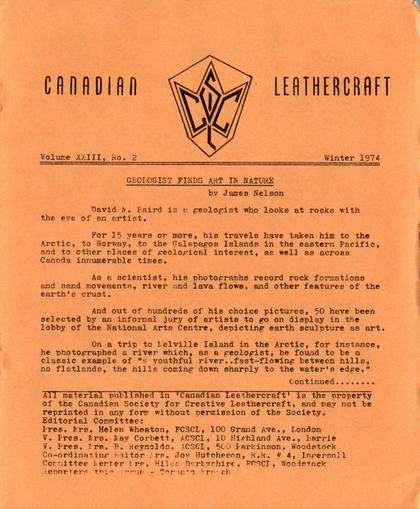
(8 pages, 1.4 MB)
the full-resolution scan, 21 MB, for close research
Page 1 — GEOLOGIST FINDS ART IN NATURE
Canadian Leathercraft
Volume XXIII, No. 2 Winter 1974
GEOLOGIST FINDS ART IN NATURE
by James Nelson
David N. Baird is a geologist who looks at rocks with the eye of an artist.
For 15 years or more, his travels have taken him to the Arctic, to Norway, to the Galapagos Islands in the eastern Pacific, and to other places of geological interest, as well as across Canada innumerable times.
As a scientist, his photographs record rock formations and sand movements, river and lava flows, and other features of the earth's crust.
And out of hundreds of his choice pictures, 50 have been selected by an informal jury of artists to go on display in the lobby of the National Arts Centre, depicting earth sculpture as art.
On a trip to Melville Island in the Arctic, for instance, he photographed a river which, as a geologist, he found to be a classic example of "a youthful river..fast-flowing between hills, no flatlands, the hills coming down sharply to the water's edge."
Continued.
All material published in 'Canadian Leathercraft' is the property of the Canadian Society for Creative Leathercraft, and may not be reprinted in any form without permission of the Society.
Editorial Committee:
Pres. Mrs. Helen Wheaton, FCSCL, 100 Grand Ave., London
V. Pres. Mrs. May Corbett, ACSCL, 10 Highland Ave., Barrie
V. Pres. Mrs. B. Reynolds, ACSCL, 500 Parkinson, Woodstock
Co-ordinating Editor Mrs. Joy Hutcheson, R.R. #4, Ingersoll
Committee Member Mrs. Hilda Darbyshire, FCSCL, Woodstock
Reporters this issue - Toronto Branch
Page 2 — BOOK REVIEW
2.
When he got back to his darkroom, he found the river picture, showing a ribbon of white water between ranges of hills, made an interesting art picture when the original and a picture printed upside down were joined together. The mirror-like duplication gave the sinuous line of the river an interesting twist.
Another example of Dr. Baird's discovery of art in nature came out of a muddy side-road ditch in Saskatchewan. He photographed the folds of erosion, and then printed the picture as a mosaic, repeating the pattern like a series of tiles.
The result is a quilt-like tapestry of black and white, in which..with a little imagination..a person can see the gnomes, smiling or sad. He calls it his Rorschach picture, after the inventor of the ink-blot psychological tests.
Dr. Baird works with a camera giving him 2¼" square negatives carrying great detail. For his purposes, he said, black and white pictures convey more vigor than colour photographs.
(the above article appeared in the London
Free Press
BOOK REVIEW by Helen Wheaton
MAKING LEATHER CLOTHES written by Kirsten T. Jorgensen
An exciting new book that shows how to make high fashion garments in both leather and suede. A short but concise section deals with the different types of skins and the equipment needed for cutting and sewing. The main part of the book consists of 29 fully illustrated designs for children's and adults' clothes, all made from leather---coats, jackets, capes, dresses and skirts, both mini and long, anoraks, boots and gloves. The reader can even make dungarees or a quilted bikini in leather. Apart from the quilting, other decorative techniques explained include applique, plaiting, piping, bead embroidery and traditional designs from Greenland. At the back of the book there is a basic pattern on squared paper for each garment, which can be copied and cut to the reader's own measurements.
This is a book that will be welcomed by dressmakers, craft teachers and anyone interested in leather and making their own clothing. (Price $8.50)
Page 3 — CANADIAN CRAFTS COUNCIL
CANADIAN CRAFTS COUNCIL
The first president of the Canadian Crafts Council is Les
Manning, Alberta potter, who was elected by the CCC board of directors at Montebello, Que., Nov. 30.
The board elected two vice-presidents: Ralph Edwards, of the Canadian Guild of Crafts (Ont) and Margo Meyer, the Newfoundland and Labrador provincial director.
Mr. Manning is head of the Banff Centre ceramics department. He was born in Provost, Alta. in 1944, and is a graduate of the Southern Alberta Institute of Technology and Arts. He has been awarded several Alberta craft scholarships and a Canada Council travel grant for pottery study in England. He has organized and operated community classes for Calgary Allied Arts Centre; was president in 1972-73 of the Alberta Potters' Association and chairman of Ceramics International '73 held in Alberta.
Mr. Edwards is a silversmith who works from a studio in his home in Toronto. He is a former group publisher of 12 Maclean- Hunter trade publications concerned with interior design, home furnishings, food, education, advertising and other fields. He studied jewellery arts at George Brown College, Toronto, with Christen Klocke and Frank Phillips. Mr. Edwards was born in Peterborough, Ont. in 1908 and grew up in Toronto where he attended North Toronto Collegiate. He is a vice-president of the Canadian Guild of Crafts (Ont.) and a member of the Metal Arts Guild. He has a special interest in handcrafts as a field for retired men.
Observations on the CCC Meeting by David Piper
President, Ontario Craft Foundation
It was interesting to see that those present realized that there had to be various bonds keeping craftsmen together and giving them a reason for belonging to a national group. Both a national magazine and people travelling across the country to motivate, help and encourage were seen as key needs.
Haliburton School of Fine Arts offers courses for adults and children from July 7 - August 15. For information and brochures write Haliburton School of Fine Arts, P.O. Box 339, Haliburton.
Page 4 — WORKSHOP TIPS
WORKSHOP TIPS by Jessie Little 1. X-ray film makes an excellent stiffener for small note books and book covers. 2. Plastic from ice cream containers and detergent bottles, etc. makes excellent pattern templates.
e.g. (a) belt tips
(b) buckle end template
(c) templates for change purses, key cases, key rings
(d) templates for leaves, flowers, small animals 3. Make the task of burnishing belt edges a little easier by putting that ¼" drill to work. Attach a lignum vitae circle edge slicker to your drill. Mount the drill on the wall or clamp it in a vise. This leaves both hands free for better control of the leather. A little saddle soap on a damp sponge rubbed along the edge of the belt helps to produce a smooth shiny edge. 4. Remove one of the beaters from a manually operated electric beater. Fasten a square of sheepskin over the beater with an elastic ban. This makes an excellent buffer. The saucer shaped egg-beater attachment is also very useful.
5- <A number 11 scalpel blade in a number three handle simplifies filigreeing and special projects requiring intricate cutting.
6. Inexpensive surgical gloves can be purchased in most drugstores. These are snug fitting and are useful when colouring. 7. <A dried-up ball point pen makes a useful stylus.
8. A French curve is a hand gadget when working out designs. (available at art stores)
9. A distributor cap provides a handy holder for your brushes. It is also a help to mark your brushes. e.g. red acrylic on the brush used for red dye.
10. File the spoon end of a modeller until it is pointed and quite thin. Polish with jewellers rouge. This is useful for such areas as animal's eyes and hard to reach corners. 11. Modellers to suit your own specific needs can be made from dental tools.
[The machine this page was typed on has no key for the digit 1; the typist struck a lower-case l for the numeral, and it is set here as the numeral.]
Page 5 — COMING EVENTS
Tips...continued
5. 12. <Antique ivory manicure sets (handles) make excellent tools for embossing. 13. Belt slicking...with a sharp knife cut a V shaped groove in & hardwood spool. Round the groove with a file and bevel it. This makes an easy to hold belt slicker.
14. If you have quantities of small articles to cope with, stack ing vegetable bins can be useful. Label each one as to the contents. The one you wish to use can be taken to your work table, then stacked away when you finish.
15. Give your belts a professional look by having a wood worker make a set of belt sticks in various widths. These are wedge shaped polished hard wood sticks. The damp leather keeper is worked up the stick. It dries and hardens on the stick.
16. Preserve your paper patterns by laminating them in plastic. VacTac is one form which may be used. Library supply companies sell rolls of plastic for laminating. There is also a machine which laminates very nicely.
COMING EVENTS
Arts & Crafts at Orangeville Annual - June 7
Agricultural Coliseum Sale & Exhibit
Guelph Artisans Association University of Guelph
Sheridan College School of Design 1460 South Sheridan Way
MISSISSAUGA, Ontario L5H 1Z7 Write for brochure/application form
The Guild Shop
140 Cumberland Street
Baker Lake Sculpture
May 13 - 30, Eskimo Gallery
Georgian College Summer
School of the Arts
401 Duckworth Street Barrie, Ontario
May - August Write for Brochure
Page 6 — MASTER PIONEER OF LEATHER CARVING
MASTER PIONEER OF LEATHER CARVING by Irva Ford
Long before the Canadian society for Creative Leathercraft came into existence in 1950, leathercraftsmen far and wide had great admiration for a brother carver in Western U.S.A., who by this time was a master craftsmen, artist and author of several books. That man was, of course, Mr. F. O. Baird.
In the early twentieth century Leather Art suffered for many years from lack of progress fostered by the very artisans who would have benefited most by keeping their art abreast of the times. Skilled leather workers were very jealous of their art. Personal instruction was the only method of learning the craft. The closely guarded secrets of leather carving were handed down from father to son. The natural result of this closed circle was stagnation of creative development.
Mr. Baird ran headlong into the reticence of the leather artisans when as a boy he spent much time watching saddle-makers ply their craft. The craftsmen showed no interest in seeing their art become more generally understood. But this boy was determined to master the art of leather carving. His first job after leaving school was in a saddle factory - washing and scrubbing leather.
- The young apprentice applied himself diligently to his tasks. One of the master leather carvers was so impressed by the young Baird's earnestness that a warm friendship developed between novice and master and the fundamentals of the craft were soon mastered by the eager student. When the master carver died some years later, he left his tools to his apprentice. So well had the tiro learned his craft that he was chosen to fill the shoes of his master. Thus was Mr. Baird started on a long and distinguished career as a creative leather artist.
The young leathercraftsman soon discovered shortcomings to his creative ability. He decided the trouble was a lack of interchange of ideas and a loss of touch with the trade. Mr. Baird packed his tools and started out in search of contempories. He found many people with ideas in Mexico where leather carving had long been popular. He decided to get more people Leathercrafting because when many people have ideas they are bound to broaden the base of their thinking and automatically catch the tempo of the times.
[This F. O. Baird, a leather-carving pioneer in the western U.S.A., is a different man from David N. Baird, the geologist in this same issue's p1-2 article.]
Continued.........
Page 7 — OBSERVATIONS OF A PAST TREASURER
To gain further experience Mr. Baird accepted a position of head leather carver with a large firm in El Paso. During the First World War he served as troop saddler in the cavalry.
Finally in 1930 he settled in Los Angeles and devoted his time to the Leather Arts problem. By teaching the secrets of the craft he did much to bring Leathercraft of age. He wrote a textbook on leather arts giving basic information with examples of completed work and several designs.
Leathercrafters everywhere have gained much from the long and distinguished career of F. 0. Baird - teacher, author, artist and practical producer in his chosen field. Students who have been inspired by his unselfish devotion to his art are scattered throughout the land. They are teaching in a way that would not have been possible had not Mr. Baird by his unceasing efforts brought the fascinating art of leather carving within the reach of the abilities of thousands of eager craftsmen.
Mr. F. O. Baird was made an Honorary Life member of C.S.C.L. in 1951.
OBSERVATIONS OF A PAST TREASURER by George McPhail
In these days of rapidly escalating costs its quite a problem to decide when you are getting full value for the money you spend. Its quite right that in your consideration you include your annual membership dues. I think you should, as I do, look upon your dues as an investment rather than an expense. For your consideration I will list some of the benefits that come your way with membership
On becoming a member of the Society you are in effect opening a window to a larger world. You have numerous opportunities to meet other leathercrafters, exchange ideas and keep abreast of changes in fashion and thinking. Membership entitles you to attend various shows, exhibitions and of course our annual meeting. At these gatherings you meet fellow crafters from different parts of the country, heer interesting speakers and discussions and store in your memory or your notebook many ideas for future projects.
Continued.
Page 8
Another benefit is the opportunity to display and sell your leather articles at the Show Window of the World, the C.N.E.. Where else could you hope to show your leathercraft to three million people. Your Society supplies you with four Bulletins each year at no additional cost although printing and postage take a considerable bite out of your fee. The Editorial Committee endeavour to present an interesting publication with news, technical articles and other information of interest to our craft. The Bulletin has not yet reached the goal of perfection but we are heading in that direction and would welcome any contributions you would care to make that would increase its interest to our members.
Our annual meeting is a special occasion when people travel considerable distance just to meet again those members they have come to consider friends and to exchange ideas and fellowship with them. The competition between the branches for the Weston Trophy inspires many members to excels their previous standards in an effort to support their branch in its effort to reach a successful conclusion in the competition. The annual changes its locale each year so that members who cannot travel out of their own community have a chance every few years of seeing it on "home" territory.
The officers and committees that serve you during the course of the year are a group of dedicated, selfless, untiring people whose aim is to serve you and spread the knowledge of our craft as widely as possible. If you are approached at any time in the future with the suggestion that you serve in some capacity don't abruptly turn aside the suggestion without at least giving it serious consideration. It's really a compliment in which someone is suggesting that they have spotted, in you, some undeveloped potential for service. Remember all your present officers were in the beginning "green horns" but they accepted the challenge and grew with the responsibilities that were placed on their shoulders.
So from my point of view I think our membership fee of $5.00 is a definite bargain and I have no hesitation in forwarding my remittance to the Society.
MOHAWK COLLEGE is planning a wide range of Mini Workshops in the crafts for their summer program. For further information contact Pam Norman, Continuing Education, Mohawk College, 135 Fennell Ave. West, Hamilton, Ontario L8N 3T2
[In the closing notice several letters print faint or broken, mostly at the line ends ("COLLEGE", "Mohawk", "contact", "135 Fennell Ave."); the words are set out as typed.]