
An issue of the Society’s newsletter, transcribed from the original.
(8 pages, 1.4 MB)
the full-resolution scan, 22 MB, for close research
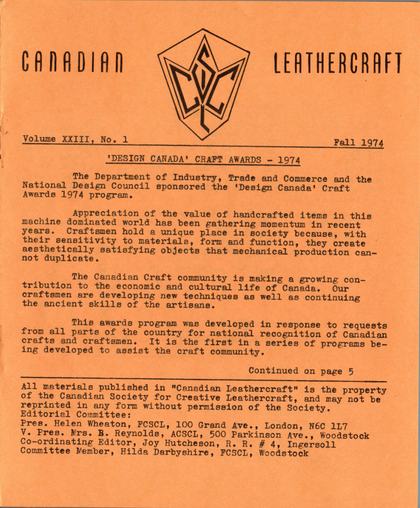
Page 1 — "DESIGN CANADA" CRAFT AWARDS - 1974
Canadian Leathercraft
Volume XXIII, No. 1 Fall 1974
"DESIGN CANADA' CRAFT AWARDS - 1974
The Department of Industry, Trade and Commerce and the National Design Council sponsored the 'Design Canada' Craft Awards 1974 program.
Appreciation of the value of handcrafted items in this machine dominated world has been gathering momentum in recent years. Craftsmen hold a unique place in society because, with their sensitivity to materials, form and function, they create aesthetically satisfying objects that mechanical production cannot duplicate.
The Canadian Craft community is making a growing contribution to the economic and cultural life of Canada. Our craftsmen are developing new techniques as well as continuing the ancient skills of the artisans.
This awards program was developed in response to requests from all parts of the country for national recognition of Canadian crafts and craftsmen. It is the first in a series of programs being developed to assist the craft community.
Continued on page 5
All materials published in "Canadian Leathercraft" is the property of the Canadian Society for Creative Leathercraft, and may not be reprinted in any form without permission of the society. Editorial Committee:
Pres. Helen Wheaton, FCSCL, 100 Grand Ave., London, N6C 1L7 V. Pres. Mrs. B. Reynolds, ACSCL, 500 Parkinson Ave., Woodstock Co-ordinating Editor, Joy Hutcheson, R. R. # 4, Ingersoll Committee Member, Hilda Darbyshire, FCSCL, Woodstock
Page 2 — HOME ARTS at WESTERN FAIR
HOME ARTS at WESTERN FAIR by Helen Wheaton
(Supervisor, Home Arts Dept.)
In 1973 Western Fair changed its whole foremat for Arts and Crafts, cutting to the bone the many, many sections, down to two in each media, one large, one small, thus providing funds to increase the prizes in the large item considerably and increase prizes pro rata to the small sections. 1974 would appear to have justified our reasoning and we who work in the Home Arts have been well pleased with the fact that the quality of articles has improved and we have been told by some of the public that the articles displayed were the best they had seen at Western Fair. We have most certainly received articles from new exhibitors in the 1973 and 1974 Fairs.
The paper prints "foremat", the Society's own slip for "format"; kept as printed.
Those winning prizes in Leather in 1974 were: Class 68, Sec. 11....Small Article
1...Mrs. Alice Howe, London $15.00 2...Mrs. Margaret Monteith, London 10.00 3...Miss Olivia Smith, Toronto 5.00
Class 68, Sec. 12....Large Article
1...Mrs. Anne Hook, Toronto $25.00
2...Mrs. Carol McLean, Woodstock 15.00 3...Mr. Roy D. Nulph, Salt Lake City10.00
"Salt Lake City10.00" is printed exactly so, with no space, and stays.
If you wish to enter articles for 1975, write for the Home Arts prize list at.
Western Fair Association
P. 0. Box 4550, Station "C"
London, ontario
N5W 5K3
Page 3 — LEATHER HANGERS
3.
LEATHER HANGERS
Irva Ford, F.C.S.C.L.
In recent years our style of living has changed. Instead of the traditional picnic basket packed with delicious food, lemonade and a thermos bottle of coffee, most people barbecue meals outdoors over an open fire on the patio or in their attractive back yard. It is customary to-day to make the surroundings attractive by hanging pots of flowers, garden bottles or candles in leather harness around the patio or porch. Candle lanterns and beer holsters are popular additions which can also be hand crafted by the leathercraftsman.
Hanging candles and plants are also popular inside the home. Emphasis lately has been on decorating the entire area of a room from ceiling to floor, which is where you will find the hanging planters advantageous. Besides freeing table surfaces or floor space for other uses, they bring the outdoors into your home and with it an illusion of continual springtime.
These exciting leather creations, sometimes called expandables appear complex but the basic techniques for making them are very simple. Besides, this is an excellent way to utilize that piece of imperfect leather, a place where you can use your imagination and "do your own thing".
Since the base of the harness is visible when hanging, a stamped or carved design on the bottom adds an unexpected decorative touch. A design might be developed from the foliage of the plant or a motif in your upholstery. The leather may also be dyed to match or complement the colour of the pot, the candle or the surroundings.
Required supplies for making leather harness;
Paper for pattern, 2 - 4 oz. leather, candle or pot, ruler, compass ( or dividers), pencil, pen, 6 way punch, square, exacto knife, latigo thonging, cutting board, scissors.
METHOD:
1. Choose a suitable pot or candle.
2. Cut a square of brown paper large enough to cover the bottom and reach about half way up the sides of the pot, 8" is the average size.
Page 4
METHOD (Continued) 3. Cut a square of leather the same size.
Dampen the leather and set it aside 4. Fold paper pattern crosswise, open pattern and fold again crosswise.
5. Open pattern and with compass, draw a circle in centre of square, this should be the same diameter as the bottom of the pot or candle.
6. Extend your compass and draw more circles the desired width, 3/8" or 1/2" or 1/4" if you want a very fine delicate hanger.
7. Now draw lines 1/2" from and parallel to the original corner to corner fold.
8. Draw lines 1/2" from and parallel to the other fold.
9. Trace over pencil lines with ink, the lines that are to be cut. Alternate the cuts on each successive row.
Note: the four corners may be left on the hanger or cut off to make a circle.
Page 5
METHOD (Continued)
10. Punch a tiny hole at the end of each ink line. This makes the pattern and leather less likely to tear at ends of cuts.
11. Place completed pattern over the slightly dampened leather on a cutting board.
12. With an exacto knife or other narrow sharp knife, cut all the ink lines through both pattern and leather.
13. Cut a small round hole (1" or 1¼") in centre of hanger as a decoration, if desired.
14. Remove pattern and stamp or carve a design on leather.
15. Punch four holes on outside edges large enough for a latigo thong.
16. Dye the leather or just antique it. Rub all edges until smooth and polished, turn harness upside down over a bowl, a bottle or bannister to dry. Polish. Bone inside if rough.
17. Knot end of thongs and pull through holes, leaving one thong longer to form a long loop at the top.
18. Tie all four thongs in a knot at desired distance from the pot. Make a loop with long thong and tie the end at the knot or thread it through the knot. Do not cut off ends. Finish them with a knot and let them dangle.
Design Awards...Continued.
Four pieces of Leathercraft were selected as follows: Mrs. Irva Ford, Cuir Bouille Jug...Honourable Mention Louise Pomminville, Decorative Leather Bird David Trotter, Leather Bracelet
Rex Lingwood, Leather Belt...Honourable Mention
Page 6 — WHO'S WHO IN LEATHERCRAFT
WHO'S WHO IN LEATHERCRAFT by Kay Cloughley
May Corbett, 1st. Vice President of C.S.C.L. resides in Barrie, Ontario. May was born and educated in Toronto and moved to Barrie with her husband Clarence. She is the mother of one son. May is presently employed at a local retail craft and hobby store.
May joined C.S.C.L. in 1958 during Barrie's first year as a Branch. She became an Associate in 1961. Just a note to indicate May's willingness to become involved —- She attended the October meeting as a visitor and her second meeting in November was asked to become the Treasurer (all this before she had actually paid her membership fee) and she accepted. For many years May's recreation room has been home base for the Barrie Branch and our collection of Weston Trophy plaques adorns the wall there. She has held most of the positions in the local branch being at present the Exhibitions Chairman for Barrie and at the same time is the 1st. Vice President on the National
Executive Council. She is unofficial transportation committee of one, and very often the attendance of the Barrie members at Executive Council meetings and other functions depend on May's busy schedule, as she is always willing to drive any distance to do her share.
May is very capable in all phases of leather, being particularily noted for the many unique and attractive bottles which she has covered in leather.
In 1959 May was appointed the Citizen of the Year for Barrie. This honour was in recognition of her devoted and tireless labours on behalf of Childrens Aid Society, Retarded Workshop, Red Cross Blood Donor's Clinic, Cancer Society, March of Dimes and C.N.I.B.. She was President of the Lady Lions, Treasurer of a Ladies Bowling League, an active member of the Barrie Horticultural Society, the P.T.A. and very active in her Church. For many years while the Redemptoristine Sisters (a cloistered community of religious Sisters who are unable to go out to attend to their own business) had a convent at Barrie, May did the banking and other necessary business for them. May is currently President of the Simcoe Adult Skating Club and finds time to go pleasure skating once or twice each week all winter.
There is probably lots more to say about May, her spacious home in it's parklike setting with well kept garden around attesting to her "Green thumb", but we'll just say Good Luck May and keep up the good work.
Page 7 — BOOK REVIEW
Te
BOOK REVIEW by Helen Wheaton
LEATHERCRAFT BY HAND - Jan Faulkner
INTRODUCTION
Hand-stitched leather garments are far from a new idea. It is probably one of man's first attempts to clothe himself. Later, Eskimos and Indians carried the idea a bit further, making the clothing decorative 'as well as functional.
This book goes one step further, refining the craft to produce garments and accessories as beautiful and well made as those from any elegant Parisian courtier. There is a wonderful luxuriousness about a hand stitched leather garment, leather right down to its buttons; the total purity and harmony, giving each item its own unique beauty. Also, by purchasing the leather and fashioning garments yourself, you will be able to have a gorgeous leather wardrobe that cannot be bought anywhere, even at twice the price.
Hand stitched leathermaking requires few tools. This book describes them and explains their uses detailing all the information you need in order to work with leather. Included are all you need to know about working with patterns, the various techniques of assembling and decorating leather, and all the stitches you will need to learn and use.
As with any book, every day brings new techniques and designs which are never covered by a press date. These unforeseen discoveries are bequeathed to you, the reader, to incorporate and refine as you desire. Use your own capacity for creativity to take what is presented here and let it grow into a craft that will bring you pleasure and beautiful leather creations.
Before moving on to teaching the craft, I would like to dispel some people's most prevalent fear about the use and care of leather.
It is a luxury fabric, but it also is a strong, durable fabric and can withstand a lot of wear. It is not difficult to care for and should be worn with comfort, without unnecessary worry about a little soilage.
Many people shy away from leather or suede garments because they fear cleaning expenses; or they treat their leather
Page 8
garments as if they are going to fall apart if worn too often. Most leather garments gather dust in closets or go out of style before they show even the least amount of age and wear. These fears are unnecessary and should be discarded for the real pleasure of enjoying one of the nicest materials man is able to put on his back and wear. A good pair of leather pants takes at least a year of wearing before it acquires the comfortable shape of your body and the soft satiny feel which comes from constant use. If left in the closet, leather garments will dry out and become stiff and unwearable. Just remember, they are meant to be worn and enjoyed !.
Leathercraft by Hand written by Jan Faulkner.
Leather garments are "in" today, and the only factor keeping them out of many wardrobes is their frequently prohibitive price tags. With this book - - the first complete guide to creating hand-stitched leather fashions - - you can produce garments and accessories at less than half their store price. And you have the added satisfaction of having created an article completely by hand.
Leathercraft by Hand shows you all you need to know to produce attractive, practical garments and accessories quickly and inexpensively without a sewing machine. Instructions are given for the basic and decorative stitches aspell as for working with patterns, assembling the garments, and using fastenings and closures.
Hundreds of line drawings plus twenty-five tips and tricks help you create professional-looking clothes and accessories. Stepby-step instructions are given for over twenty-three exciting projects and unique designs for boleros, skirts, vests, shirts, hats, backpacks, belts, and patchwork pillows.
There is a Glossary of leather vocabulary and a list of Commercially Available Hides. While the list of suppliers listed are in the United States, the same hides will no doubt be available from supply houses in Canada.
Published in 1973 in Canada by Fitzhenry & Whiteside, Ltd. Toronto: Walker Publishing Company, Inc., New York.