
An issue of the Society’s newsletter, transcribed from the original.
(8 pages, 2.8 MB)
the full-resolution scan, 3.9 MB, for close research
Page 1
The Canadian Society for Creative Leathercraft CANADIAN LEATHERCRAFT
Volume LXVIIII No. 5
0045-5121
September, October, November, December - 2022
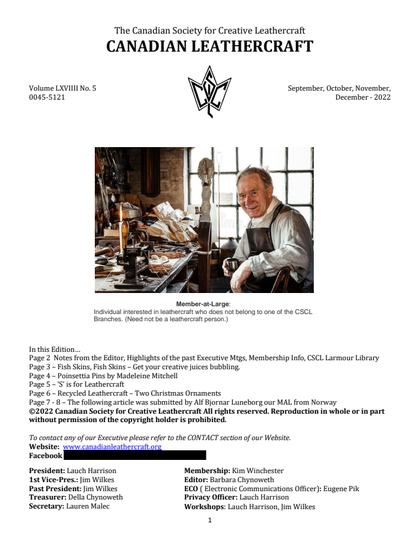
Member-at-Large:
Individual interested in leathercraft who does not belong to one of the CSCL Branches. (Need not be a leathercraft person.)
In this Edition…
Page 2 Notes from the Editor, Highlights of the past Executive Mtgs, Membership Info, CSCL Larmour Library
Page 3 – Fish Skins, Fish Skins – Get your creative juices bubbling.
Page 4 – Poinsettia Pins by Madeleine Mitchell
Page 5 – ‘S’ is for Leathercraft
Page 6 – Recycled Leathercraft – Two Christmas Ornaments
Page 7 - 8 – The following article was submitted by Alf Bjornar Luneborg our MAL from Norway ©2022 Canadian Society for Creative Leathercraft All rights reserved. Reproduction in whole or in part without permission of the copyright holder is prohibited.
To contact any of our Executive please refer to the CONTACT section of our Website.
Website: www.canadianleathercraft.org
Facebook [Facebook page removed]
President: Lauch Harrison
1st Vice-Pres.: Jim Wilkes
Past President: Jim Wilkes
Treasurer: Della Chynoweth
Secretary: Lauren Malec
Membership: Kim Winchester
Editor: Barbara Chynoweth
ECO ( Electronic Communications Officer): Eugene Pik
Privacy Officer: Lauch Harrison
Workshops: Lauch Harrison, Jim Wilkes
[The contents line on this page prints the name without the Norwegian ø; page 7 of the same issue prints it with. Both stand as the issue set them.]
Page 2 — Notes from the Editor, Highlights of the past Executive Mtgs, Membership Info, CSCL Larmour Library
Note from the Editor….
The Newsletter “Canadian Leathercraft” is your source of information about CSCL and its members. Also check out the CSCL website at www.canadianleathercraft.org and CSCL’s Facebook page.
I am always looking for articles for the Newsletter, do you have a project that you have done that you think everyone would be interested in seeing, we are looking for articles?
This edition has articles from Members-At-Large. We hope you find them informative.
Highlights from the Past Executive Council Meetings….
The CSCL Executive continues to meet on Zoom.
At the September meeting the Workshop Committee announced that they were doing a Workshop at the Norland Branch on Clutch Purses. Everyone had a very creative day.
At the October meeting Jim Wilkes did a 15 minute presentation on creating the Bible cover he did for the 2022 Annual. This was shown in one of the previous Newsletters.
At the November meeting there was discussion about Tool Sales. If you have any tools that you are interested in selling please send the information in and we will advertise it in the Newsletter OR if you are looking for a specific tool and have been unable to find it maybe someone has an extra that they would be willing to sell. Let us know.
CSCL Membership
Have you paid your membership? It’s a new Membership Year (April 1 to March 31).
- If you are joining trough a branch pay your CSCL membership to the Branch Treasurer along with your branch membership fee.
- If you are joining as a Member-at-Large or Sustaining Member send your membership payment to the CSCL Treasurer: Della Chynoweth, [address removed], Norland, Ontario [postal code removed] or you can e-transfer to [email address removed] Please be sure to include your contact information.
| General Member | General Member – Student* | Member-at-Large | Sustaining Member |
|---|---|---|---|
| Individuals interested in leathercraft who belong to one of the CSCL Branches. (Need not be a leathercraft person.) $40.00 | A registered full-time student shall pay $5.00 | Individual interested in leathercraft who does not belong to one of the CSCL Branches. (Need not be a leathercraft person.) $40.00 | Commercial Organizations interested in supporting the Society. $100.00 or material equivalent to $100.00. |
CSCL Larmour Lending Library
The CSCL lending Library of Books and Patterns can be referenced on our web site www.canadianleathercraft.org. Head to Gallery and click on CSCL Library of Books and Patterns.
Under the Pattern option there is 80 pages of patterns that may give you ideas of things to make. Under the Book section there is 13 pages of titles of Books and DVD’s about Leather crafting, design and colour.
Remember these patterns and books are there for you to borrow from the library. Select item(s) you would like to borrow and send your list to Paul Kitchener at [email address removed]
Branch Presidents will assist in pickup and delivery of the orders from branch members.
Members-at-large may order directly from Paul and arrange shipping or printing options, fees may apply.
Page 3 — Fish Skins, Fish Skins – Get your creative juices bubbling
Fish Skins, Fish Skins – Get your creative juices bubbling.
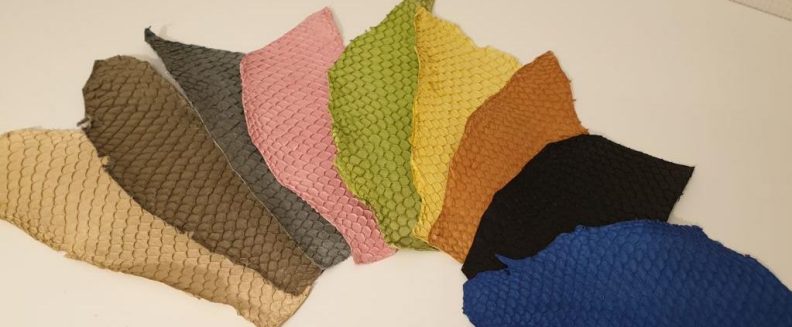
One of our Corporate Members - Stanley Major from Sea Leather Wear supplied Fish Skins to the CSCL. The skins were sent to the Branch Presidents to be distributed to branch members. The MAL were contacted by Lauren to see if any of them wanted a Fish Skin to use in making an item. Seek out your President and ask for some skins if you weren't aware of them.
At the November Meeting of the CSCL Executive, a motion was passed to introduce a onetime Award at the 2023 CSCL Convention for the best item made using Fish Skins in its construction. The nature of the award still has to be determined. So get the ideas flowing and let's see what we can do with Fish Leather.
If you have any tools that you are interested in selling please send the information in and we will advertise it in the Newsletter OR if you are looking for a specific tool and have been unable to find it maybe someone has an extra that they would be willing to sell. Let us know.
Page 4 — Poinsettia Pins by Madeleine Mitchell
Poinsettia Pins
by Madeleine Mitchell
An easy to assemble and elegant pin for the Christmas season. I've forgotten the C.S.C.L. member who first introduced me to the pattern, but I've adapted it for 2 different sized pins.(editor note: reduce the size again, for matching ear-rings, clamp or pierced type) You will need:- Cowhide- at least 3-4 oz,
Scrap of deerskin (dyed yellow) or yellow coloured cowhide 1-2 oz. Garnet Dyes:- Red and Green, and Polish Coat.
Pin ( Locking type is the best)
Contact Cement, cutting knife, Swivel knife, a round punch( at least 1/8")
NOTE:- Smaller Flower Pin:--- use #1 and #2 dyed red, and #3 dyed green.
Larger Flower Pin:--- use #2 and #3 dyed red and #4 dyed green.
METHOD:1. Trace and cut pattern pieces out of Cowhide.
2. Dampen the leather and use Swivel Knife to make decorative cuts in each petal or leaf.
While still damp, Shape the petals and leaves to add contours and demention. Note that the smaller pieces Will fit one inside the other. Align as you wish and punch the centre holes through the 2 top pieces. Do not punch a hole through the bottom (3rd.) piece, Allow to dry thoroughly.
4. Dye 2 picces red and the 3rd larger piece green.
Reshape as necessary, smooth edges and apply Polish Coat.
5. The centre of the pin is made by cutting a fringe and rolling and gluing.
Note the rolled fringe should fit snugly into the 2 centre holes of the of the 2 red pieces. Glue the centre piece and the 2 red pieces together.
Trim the centre piece flush with the bottom of the large red piece.
6. Now attach with glue the outer green leaves behind the red parts.
Open the yellow fringed centre.
7. Attach the pin to the back.
[Below the instructions, five numbered pattern pieces are drawn — three graduated poinsettia-flower shapes (1, 2, 3) and a poinsettia leaf (4), plus a small strip-and-cylinder diagram (5) for the rolled fringe centre — followed by a sketch of the assembled pin. Not further described.]
Smaller Flower use 1,2 (red), and 3(green) Larger Flower use 2,3 (red) , and 4(green)
Page 5 — ‘S’ is for Leathercraft
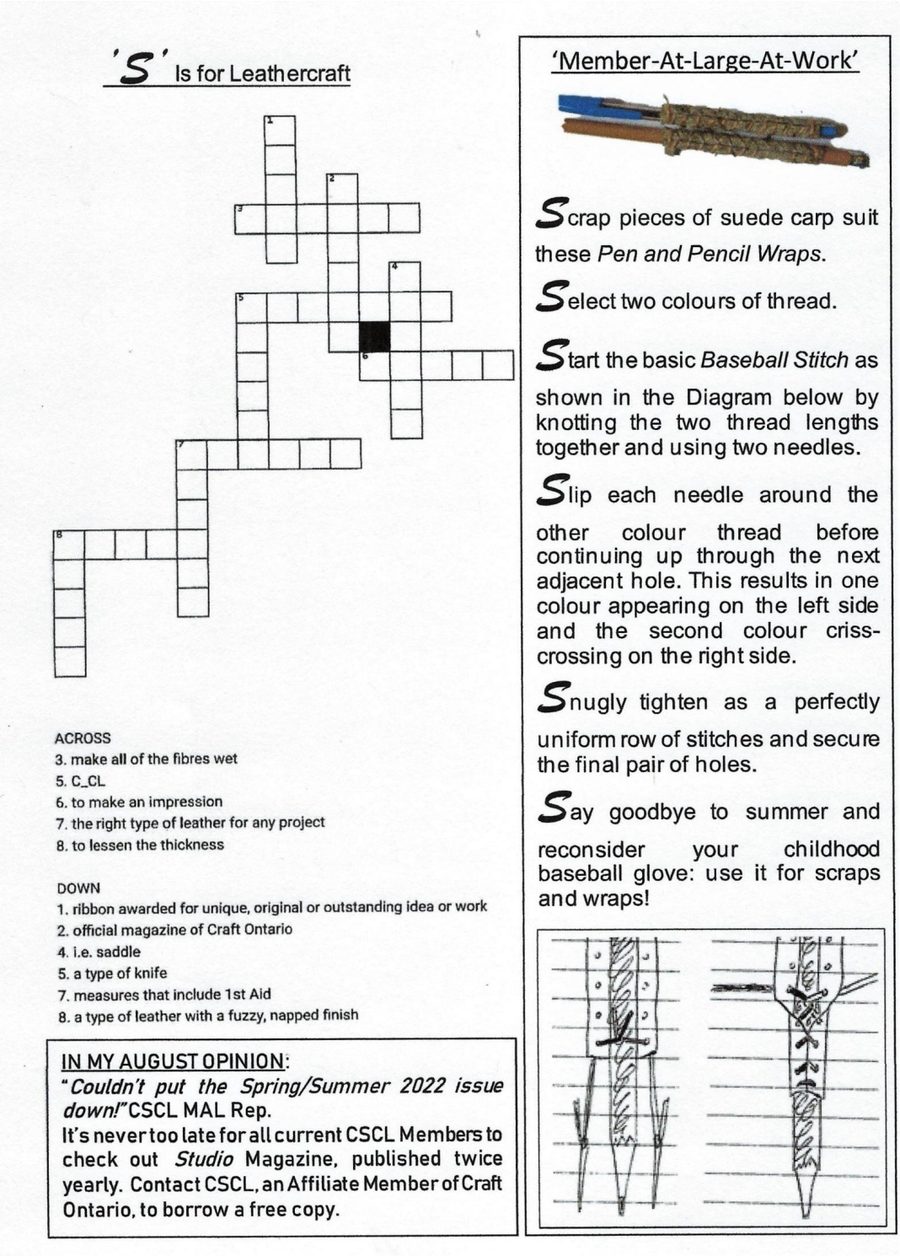
'S' Is for Leathercraft
[A crossword grid, printed with no letters filled in — the clues below are the page's own text; the grid itself is not transcribed. This page was blank in the previous edition and is filled in here for the first time.]
ACROSS
3. make all of the fibres wet
5. C_CL
6. to make an impression
7. the right type of leather for any project
8. to lessen the thickness
DOWN
1. ribbon awarded for unique, original or outstanding idea or work
2. official magazine of Craft Ontario
4. i.e. saddle
5. a type of knife
7. measures that include 1st Aid
8. a type of leather with a fuzzy, napped finish
IN MY AUGUST OPINION:
"Couldn't put the Spring/Summer 2022 issue down!" CSCL MAL Rep.
It's never too late for all current CSCL Members to check out Studio Magazine, published twice yearly. Contact CSCL, an Affiliate Member of Craft Ontario, to borrow a free copy.
'Member-At-Large-At-Work'
[A photograph of a wrapped pen and pencil heads this column; not further described.]
Scrap pieces of suede carp suit these Pen and Pencil Wraps.
Select two colours of thread.
Start the basic Baseball Stitch as shown in the Diagram below by knotting the two thread lengths together and using two needles.
Slip each needle around the other colour thread before continuing up through the next adjacent hole. This results in one colour appearing on the left side and the second colour criss-crossing on the right side.
Snugly tighten as a perfectly uniform row of stitches and secure the final pair of holes.
Say goodbye to summer and reconsider your childhood baseball glove: use it for scraps and wraps!
[Below this, a two-panel diagram shows the Baseball Stitch worked on a pencil, first with the two needles threaded and crossed, then with the stitching complete; not further described. The whole page (crossword, clues, sidebar and Baseball Stitch column) is transcribed here for the first time.]
Page 6 — Recycled Leathercraft – Two Christmas Ornaments
the page plainly prints "a gift tag to SIS when" (italicised with "gift tag", like "name tag" and "Christmas tree" earlier in the same paragraph), kept as printed. No individual is named (credited only to "CSCL Members-At-Large").
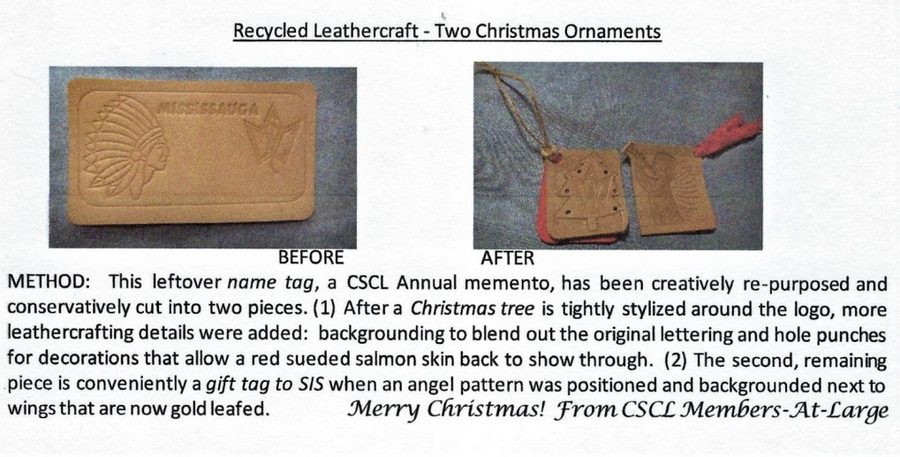
Recycled Leathercraft - Two Christmas Ornaments (Before/After)
METHOD: This leftover name tag, a CSCL Annual memento, has been creatively re-purposed and conservatively cut into two pieces. (1) After a Christmas tree is tightly stylized around the logo, more leathercrafting details were added: backgrounding to blend out the original lettering and hole punches for decorations that allow a red sueded salmon skin back to show through. (2) The second, remaining piece is conveniently a gift tag to SIS when an angel pattern was positioned and backgrounded next to wings that are now gold leafed. Merry Christmas! From CSCL Members-At-Large
CSCL is proud to be an Affiliate Member of Craft Ontario.
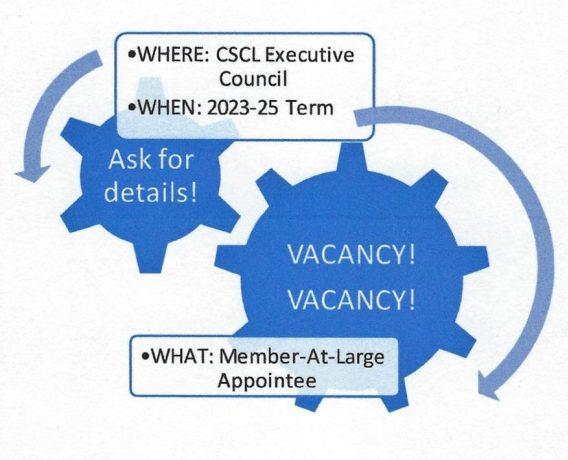
Our CSCL Nominating Committee is going to be looking for some volunteers to fill a few of the Executive positions for the 2023 – 2025 term.
We will be supplying more information in the new year on the positions and what the jobs entail.
If you are interested please watch for the coming information.
Page 7 — The following article was submitted by Alf Bjornar Luneborg our MAL from Norway
The following article was submitted by Alf Bjørnar Luneborg our MAL from Norway
Drip from the well of history, about the Pompadur bag.
Ötzi, The icemans bag.
When the truth must be told; probably exist this bag in all cultures, the form is universal but in our time can it look likes the development has led it on little different ways and given it different storys?. Example, the type bag as nowadays is called Pompadur are at least old as the iceman Ötzi, i.e. 5000 years. He had a bag as had unmistakably features with the so called Pompadur bag, made of woven cloth ! decorated with skin in the seams, and a lace closure at the top?. And in Europe is is a tangible evidence of that this bag must have followed ith in over 5000 year,- without name?,- before it for 300 years ago, in the 1700's became part of the fashion in France, and after that got the name "Pompadur" ?.
About the Pompadur bag
The name *1) "Pompadur" writes itself from a lady at the french court; Madame de Pompadur (1721-1764). On her time was the bag usually sewed of fabric, wrinkled at the top with a ribbon or string, which was used for closing the bag. When the bag became fashionable in the 1700's it was named after Madame de Pompadur, without that she really had something to do with the bag.
*2) Photo; The bag to the Iceman Ötzi
It was original her fondness for flowers as inspired to a embroidered flower pattern on her own bag, , as again was copyed of others as made the same type bags, and as startet to call them Pompadur. As said, usually these bags was made of different material, but with the rich and powerful they where sewn from silk with embroiered flower patters on. Nowadays there are pompadur's in all kind of fabrics with embroidered floral motif. And it looks like the bag have developed itself in several variants through 300 years. And one of the marked differences as the development progressed was that the pompadur got metal frames in the closure.
*3) Photo: a traditional Pompadur modern made!
Pompadur with metal frames.
The bag on the photo to left is not so different from the two first mentioned bags above on the page, but this pompadur bag have ____ developed itself with a frame in the closure, and is almost a example on how the pompadur and the fraames can have developed from beeing as silk /fabric embroidered bag with a lace/ribbon closure. This bag is norwegian owned, in that it is located to Aust Agder Museum in Norway,- but it have undoubtedly a french touch; bag material is silk, the braces is made of brass and the embroideries is in green, pink and yellow. The dating is 1882.
*4) Photo; pompadur bag with brass braces, year 1882
[The two paragraphs wrap around the *2 and *3 photograph captions. The author’s own English is left exactly as written throughout ("is is a tangible evidence", "storys", "copyed", "beeing") — this is how the Society’s newsletter printed it.]
Page 8
*5) Pompadur bag from the 1920-30's !
Modern detours.
Looking up online, seeking "Pompadur bags" then you also will find this bag on the photo to left.
It show a possible development step both in form and in use of metal frames. The bag is made of wool and embroidered and have a brass frame in the closure. And a metal chain is with, so you can hold the bag by your hands in a ifferent way form the earlyer Pompadur bags. ( from the 1920-30?)
You will also find the bag on the photo to left , by seeking online on "Pompadur bag". It's a hyper modern Czech variant of the pompadur bag made in the 2000's. It have metal frames and a metal handle and the embroideries have been replaced by flower applications. On many ways, a fantastic bag.
*6) A modern Pompadur bag from the 2000's.
Sourses to information
*1)Fact about the pompadur bag, Wikipeia, Pompadur bags
*2) Photo of Ötzi bag; The historical evolution of handbags, https://bagbirdy.com
*3)Photo of pearl embroided pompadur: Store Norske Leksikon, https://snl.no/pompadur
*4) Photo by pompaur with metal frame,; Anne Klippvåg Pettersen, Aust Agder Museum og Arkiv-Kuben
*5) Photo from net, https://rubylane.com
*6)Photo from net, www.potvor.cz
["pompaur", "Wikipeia", "ifferent" and "earlyer" are printed exactly so and are left as printed.]