
Canadian Society For Creative Leathercraft 1993 Convention
Dorothy McPherson, “Canadian Society For Creative Leathercraft 1993 Convention”, The Leather Crafters Journal, Vol. 3 No. 5, Sep/Oct 1993, p. 42. Reproduced by permission of The Leather Crafters Journal.
the original (PDF) · 1 page · 902 KB
Page 1
Canadian Society For Creative Leathercraft 1993 Convention
by Dorothy McPherson
As billows of steam rise from Ontario sugar shanties, maple syrup lovers ask, “What part of the tree makes the sugar?”
It’s maple syrup season — the signal to Canadian leathercrafters that convention time is approaching.
This year, after the last crackling hot shanty fire had been doused and the last evaporator put away, sixty members of the Canadian Society for Creative Leathercraft (CSCL) gathered for the 43rd annual convention at Royal Resort, Balsam Lake, in Ontario’s famous Kawartha Lakes District.
There they found the answer to the question, “How do you turn a stone into a leather bowl?”
Niagara area residents David and Dorothy McPherson demonstrated how it was done using wet leather mache technique. First, using only water, brush, glue, cowhide leveling splits leather and a hefty field stone, David explained how leather takes the shape of the rock after the glue dries. When the rock is removed, an irregular and interesting rock-shaped leather bowl
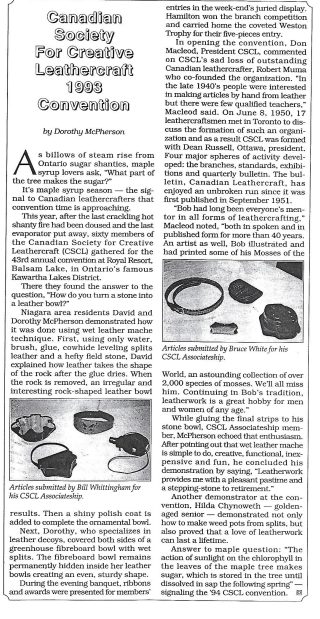
Articles submitted by Bill Whittingham for his CSCL Associateship.
results. Then a shiny polish coat is added to complete the ornamental bowl.
Next, Dorothy, who specializes in leather decoys, covered both sides of a greenhouse fibreboard bowl with wet splits. The fibreboard bowl remains permanently hidden inside her leather bowls creating an even, sturdy shape.
During the evening banquet, ribbons and awards were presented for members’ entries in the week-end’s juried display. Hamilton won the branch competition and carried home the coveted Weston Trophy for their five-pieces entry.
In opening the convention, Don Macleod, President CSCL, commented on CSCL’s sad loss of outstanding Canadian leathercrafter, Robert Muma who co-founded the organization. “In the late 1940’s people were interested in making articles by hand from leather but there were few qualified teachers,” Macleod said. On June 8, 1950, 17 leathercraftsmen met in Toronto to discuss the formation of such an organization and as a result CSCL was formed with Dean Russell, Ottawa, president. Four major spheres of activity developed: the branches, standards, exhibitions and quarterly bulletin. The bulletin, Canadian Leathercraft, has enjoyed an unbroken run since it was first published in September 1951.
“Bob had long been everyone’s mentor in all forms of leathercrafting,” Macleod noted, “both in spoken and in published form for more than 40 years. An artist as well, Bob illustrated and had printed some of his Mosses of the World, an astounding collection of over 2,000 species of mosses. We’ll all miss him. Continuing in Bob’s tradition, leatherwork is a great hobby for men and women of any age.”
Articles submitted by Bruce White for his CSCL Associateship.
While gluing the final strips to his stone bowl, CSCL Associateship member, McPherson echoed that enthusiasm. After pointing out that wet leather mache is simple to do, creative, functional, inexpensive and fun, he concluded his demonstration by saying, “Leatherwork provides me with a pleasant pastime and a stepping-stone to retirement.”
Another demonstrator at the convention, Hilda Chynoweth — golden-aged senior — demonstrated not only how to make weed pots from splits, but also proved that a love of leatherwork can last a lifetime.
Answer to maple question: “The action of sunlight on the chlorophyll in the leaves of the maple tree makes sugar, which is stored in the tree until dissolved in sap the following spring” — signaling the ’94 CSCL convention.
The words above are the document’s own, as the paper prints them. Spelling and spacing are left as they stand.