An issue of the Society’s newsletter, transcribed from the original.
(14 pages, 2.5 MB)
the full-resolution scan, 41 MB, for close research
Page 1 — ORIGINAL, COPIED or ADAPTED?
Canadian Leathercraft
Vol II No I Fall 1952
ORIGINAL, COPIED or ADAPTED?
The typewriter that set this issue is missing its full stops throughout: sentences run on with only a wider space where a period belongs, exactly as printed.
Student artists and craftsmen are often confused by the terms "original" "copy" "adaptation" This confusion as to how these terms should properly be defined or explained remains, unfortunately, in the minds of many who have practised a craft for years Perhaps the confusion is made greater by the volume of "art language" spoken and written on the subject
Discussions of the pros and cons of original or copy work are often engaged in by either of two groups: 1) a group of trained artist-craftsmen who have demonstrated their ability to speak with authority about the subject 2) a group of amateurs or laymen, who, though keenly interested in the technical phases of their craft, lack sufficient training in the subject of designing to expect much serious weight to be given their opinions
Now, while a discussion among group 1) may bring forth views at some variance with each other regarding technical excellence of design, such a discussion generally results in a really worth while exchange of ideas which at least share a common agreement regarding the importance of thinking in terms of "originality" On the other hand, a discussion of the merits of original vs copywork among group 2) generally and quickly resolves itself around the following commonly expressed points of view:
"The dividing line between original and copy work is so fine, it is difficult to recognize the difference"
"There is no longer any such thing as a completely original piece of work"
"There is no new thing under the sun" (perpetuating a quotation from Ecclesiastes)
"Cannot someone, who designs a pattern for a product, but who may adapt a decorative motif from others, claim his product as original?"
Unhappily, these are all "negative-approach" views They represent thoughts typical of those who, though they may be highly skilled in the technical requirements of their craft, lack the training needed in the fundamentals of designing to qualify them as authorities on the subject Practically all claims
(continued page 6)
a quarterly educational bulletin — in the interests of fine leathercraftmanship published by the Canadian Society of Creative Leathercraft
Page 2 — "Leathercraft Society Forms Local Group" THE LEATHER FAIR
"Leathercraft Society Forms Local Group" ('Toronto Telegram June 1952)
The Toronto local group of the Canadian Society of Creative Leathercraft was formed at a meeting at the McGill Street YWCA when JL Scobbie of the arts and crafts department of Central High School of Commerce was elected president Mr Scobbie is also chairman of the executive council of the national group
The Leathercraft Society, which has existed just three years, has been accepted into the Canadian Arts Council Thirty-two members attended the first meeting Workshop and special events are being planned for the coming season
Other officers elected are: Vice-president, Mrs Jean Newton; Secretary, A H Pearson; Treasurer, Miss Faith Symington
THE LEATHER FAIR
The Canadian Society of Creative Leathercraft has been honored by a unique invitation -- the first offered the decorative leathercraft field to appear in the Annual Fair of the Canadian Shoe and Leather Association The Leather Fair is being held this year in the Automotive Building, Canadian National Exhibition Grounds, Toronto, October 14 to 18 The general public will be admitted to the Fair on Friday evening, October 17 and throughout Saturday, October 18
Our Society's travelling exhibition: "Canadian Handmades in Leather" has been recalled from its trans-Canada tour to appear at the Leather Fair Considering the many important industrial exhibits to be shown (including: Canada's most valuable collection of historical footwear; leather fashion shows; leathergoods and leather industry accessories exhibits) a preview of our Society's travelling exhibition by Leather Fair executives encouraged them to offer one of the largest of the Fair's numerous display units for our showing of decorative leatherwork
Our Travelling Exhibition will be augmented by numerous special pieces by professional and advanced specialist craftsmen In addition, selections of antique and foreign country leathercraft will be shown We believe even the Canadian leather industry will take surprised notice of the status of Canadian decorative leatherwork
The CSCL display of the Leather Fair is in charge of our very active Toronto region Exhibition Committee, under the chairmanship of Mrs Reta Larmour CSCL members' work will be accepted for review by the Chairman, Exhibition Committee until October 7 (address page 12) All who can should see this unique display of Canadian decorative leatherwork, which promises to be by far the most important demonstration of its kind to date Bulletin #II Volume II of "Canadian
Leathercraft" will contain a special Leather Fair report for the interest of all unable to attend the Fair
Page 3 — A Modern Cordovan Leathercraft Project
A Modern Cordovan Leathercraft Project
It is with special personal pleasure that we are able to offer, as the feature article for this issue of "Canadian Leathercraft" a description of a unique and very large decorative leatherwork project just nearing completion at St Mary's Church, Montreal
We believe the project described represents the largest of its kind to have been attempted in Canada, as we are unaware of any other single decorative leathercraft project of comparable magnitude The work was designed and is being executed by Stefan Kontski -- an artist with considerable Old World training and background in large-scale interior decorative arts
Having co-operated with Mr Kontski in his long search for the special leathers required for his project, we have also enjoyed the chance to keep aware of his progress While, from the point of view of the contemporary trend in North American designing for decorative leatherwork, Mr Kontski's style of leather art may prove for many somewhat difficult to interpret, we believe, however, that the very magnitude of his current achievement, with its graphic demonstrations of a revived Old World craft will earn for its designer-craftsman a unique place in the history of "Canadian leathercraftsmanship"
About the Craftsman --
Stefan Kontski was born in Poland After matriculation he spent 5 years studying at the Academy of Fine Arts, Krakov, Poland Later, as a result of a growing professional interest in the arts of restoring old murals and other important works of art, Mr Kontski became one of the few practising craftsmen in the art of working to Cordovan leathercraft standards He studied this art in Italy for 3 years, and followed up this and allied interests in France for another 4 years
The Society writes "Krakov" for the city ordinarily spelled Kraków or Cracow in English; kept as printed.
Mr Kontski came to Canada in 1948, carrying on his leather art in Ottawa and Montreal, where at first his work appeared all but too strange for Canadians to understand and to appreciate Gradually, Mr Kontski began to enjoy more frequent and larger commissions for his special skills, until in 1950 he received his largest commission -- the designing and executing of murals in the Church of Our Lady of Czestochowa, corner Gascon and Hochelaga Streets, Montreal An important part of this large and unique church decorating commission included the working of some eleven large panels in Cordovan leather techniques With his reputation now established and spreading, it is expected that Mr Kontski will commence work on another and similar project in the United States when his present Canadian commission is completed
From Mr Kontski, we have received the following brief account of Cordovan leatherwork --
Page 4 — The History of Cordovan Leatherwork
The History of Cordovan Leatherwork
The art of designing and working Cordovan leathers began well before the XIII Century in GHADAMES, Libia
In the XIV Century the craft was introduced into Spain by the conquering Moors Cordova became the chief centre for such characteristic leather decorating and from here the products and techniques of Cordovan leatherworkers were brought to France and Italy Mention of Cordovan leather art occurs frequently in the archives of the XIV and XV Centuries
When Phillipp II, King of Spain, expelled the Moors in 1610, the big Cordovan leather industry and art began to die out Products of the craft, as so admired by travellers to Spain in the XVII Century, were no longer exported to other countries While France, Italy, Germany and Holland accepted some of the heritage of the Moors, the last Cordovan leathers were executed in the late XVII Century
The Society writes "Phillipp" for Philip here; kept as printed.
The decorative motifs of Cordovan leather art generally took the form of figurative compositions, floral ornament, architecture, landscape, birds and animals In the museum of Cluny are to be seen panels with figurative compositions from Ariostos, Orlando Furioso The panels were found in one of the houses of the XV Century in Rouen as parts of wall decoration
By the XVIII Century Cordovan leather creating techniques were forgotten
In 1952, during the restoration of the King's Castel WAWEL, some ancient Cordovan leathers were found as wall decorations behind some later superimposed decoration The study of this one-time world renown, but now forgotten leather art, was re-explored until a satisfactory restoration project could be undertaken for this important wall panelling discovery
The Society writes "Castel" for Castle here; kept as printed.
For the interest of "Canadian Leathercraft" readers, Mr Kontski has listed some of the more important phases of Cordovan leatherworking --
1) Equipment needed in working panels: silver in foils, various modelling and stamping tools, artificial gold, made from boiled resins in linseed oil, painting media - oil colors mixed with resin varnishes
2) All kinds of decorative motifs may be used for Cordovan leather art -- floral ornaments, figurative compositions, landscapes, animals, architecture, abstract designs
3) Certain tannages of calfskin are the most suitable for executing Cordovan decorated leathers The foils must bind tightly to the leather surface (we have seen Mr Kontski demonstrate this tightness by scraping a finished piece with a sharp knife blade with no ill effect)
4) Sizes of panels may be as large as the skins allow Some neck and flank sections must be cut out, as they are unsuitable for tooling and finishing
Page 5
5) Wall panel decorations are mounted on pure linen canvas, which is stretched on the wall and the skins are glued to the canvas Nowadays panels may be glued on wallboard or plywood directly
6) The durability of panels depends upon conditions under which the skins were originally decorated and subsequently preserved In museums are samples from the XIV Century As wall decorations, we may see them from the XIV to XVII Centuries, still in their places as originally fixed centuries ago The passing of time very often makes them more distinctive
7) Working time for Cordovan leather art depends largely upon richness of composition or ornament One panel with a figure of a saint, measuring 42 inches high by 8 inches in width, may take 55-60 hours of work The tooling does not require as much time as painting and gilding
In the St Mary's Church project are being executed the following Cordovan leather panels:
- the background of the crucifix - 3 feet by 12 feet
- the background of the niche (part of the high altar) 8 feet by 13 feet - eight figurative panels - 42 inches by 9 inches
- one decorative panel for the tabernacle - 16 inches by 42 inches
Canadian students and appreciators of decorative leatherwork would find a visit to St Mary's Church in Montreal well worth while if at all possible, as the several photographic illustrations (see slip-sheet enclosed) cannot do justice to the scope of Mr Kontski's unique project
The Executive and General Membership of the Canadian Society of Creative Leathercraft wish to express sincere appreciation for the helpful support and good will demonstrated by the following new Sustaining Members for the coming active season of decorative leathercraft in Canada
Bedford Fine Leathers Limited - Vancouver
The Birt Saddlery Company Ltd - Winnipeg
The Lang Tanning Company Ltd - Kitchener Ottawa Valley Leathercraft Studios - Ottawa Wickett and Craig Ltd - Toronto
NEW HANDBAG DESIGN STYLE #12
DIFFERENT
Mission grained Cowhide by Wickett & Craig ask for free 24-oz Russet per sq ft 88¢ folder or send 50¢ for PRACTICAL by Margaret Richardson pattern
HANDICRAFT & ARTISTS SUPPLIES OF QUALITY CORBEIL-HOOKE INC. 1218 Drummond Street 9 d'Aiguillon Street Montreal 25 - P Q Quebec City - P Q
Page 6
Original, Copied or Adapted? (continued from page 1) advanced to make out a case for "cribbing" and "adapting" the work of others into work we might like to claim as our own, seem to represent nothing less than excuses for not taking the trouble to study the fundamentals of designing, and thus becoming better qualified to discuss the subject logically Too many fail to realize there is quite another way to approach the subject-- if it is to be clearly understood Why not, instead of advancing simply "negative-approach" views, endeavour to think positively about the subject?
Suggestion - Group 2) could receive invaluable help if they invited representatives from Group 1) to discuss this important matter with them
There is a third and important group of craftsmen to be recognized They are the craftsmen, who having earned wide recognition for technical perfection in their craftwork, simply admit outright that they have had no training in designing; that they have not practised this phase of their craft; and that they cannot, therefore, claim to offer original designs in their work With such craftsmen we know where we stand -- we can admire their technical skills and learn much from them about this phase of their work; while, in turn, they can admire our additional interest in the phase of their craft which concerns 'originality of design"
We now propose to offer a plan for the serious consideration of all craftsmen interested in understanding the differences between "original" "copy" and "adapted" designs The plan is simple It is not new' Its principles are applied frequently in other fields - whenever issues become too obscured by generalities to help us arrive at sensible conclusions It involves simply that we forget all the art-language arguments we may have heard or read concerning original design, and make a fresh start To do this, we must be willing to analyse systematically the root meanings of all words which will help us understand the subject To help readers in such a study, we offer a few dictionary definitions of terms and expressions related to our field We suggest that the craftsman study each word and accompanying definition -- then apply such definitions to his own work If this is done, it should soon become clear whether the craftsman's work may be considered as "original" "adapted" or "copied" --
ORIGINAL - not copied, imitated or reproduced
- independent and creative in thought or action; inventive - that of which anything else is a copy or reproduction, as awaiting or an object portrayed in a work of art
ORIGINATE - to produce as new
CREATE - to bring into being; to cause to exist in original form or character
- to present a new conception in an artistic embodiement - to produce as a work of thought or imagination - especially as a work of art
AUTHOR - the creator or originator of anything
Page 7
DESIGN - to plan mentally; to scheme; to conceive; frame mental image
- to arrange details of a work of art INVENT - to fabricate mentally, create or devise in the imagination
- to discover, as by study or experiment - to produce for the first time
- to originate, frame, design, concoct - to form something new, or attain an end by means unknown before
INVENTION - a fabrication of the imagination
- a form or design originated through imaginative thought, study and experiment
COPY - an imitation or reproduction of an original work
IMITATE - to follow a pattern, model or example
- to copy or reproduce
IMITATION (strict) when original theme or form is copied in all detail
(free) when original theme or form is modified or adapted ADAPT - to adjust; make suitable for a purpose ADAPTATION - modification of a form or structure MODIFY - to partially alter
- to change somewhat the form or qualities of a product PARAPHRASE - a restatement of a text, passage or work of an author in a revised form
Creative craftsmen may liken their work to the work of a literary author -- - an author's product is original when demonstrating expressions of new thoughts, or new terms for established thoughts
- a plagarist's product intimates originality, when in reality his efforts represent simply paraphrased terms for the work of an author
The Society wrote "plagarist's" for "plagiarist's" here; kept as printed.
IMPORTANT - THINK about the above definitions carefully and seriously Apply them to your own efforts As their true and logical meanings become clear in our minds, we will realize there remains just one course left for us -- if we desire recognition for an ability to produce original work That course is to start immediately to learn something about the fundamentals of designing If we are not prepared to study and to practise these fundamentals, we should once and for all admit, as some craftsmen will frankly admit, that we have neither the inclination nor patience to work through the processes required in designing a product which other skills may produce in all but flawless techniques
With this honest approach towards understanding the subject of original-copy-adapted work, students can do much to help themselves and their fellow craftsmen "Canadian Leathercraft" will offer illustrated articles in future issues to help students commence such a study In the meantime, craftsmen may make an immediate start by: 1) inquiring about good courses in design 2) studying the subject through recommended books 3) discussing the subject with trained designers 4) subscribing to carefully selected periodicals
Page 8
Among the numerous excellent references on the subject may be recommended: "Design Approach to Crafts" by Harriet E-Knapp, Prang Company Publishers,
Sandusky, Ohio
"Creative Hands" by Doris Cox & Barbara Weisman, John Wiley & Sons, Inc
New York City
"Craft Horizons" a bi-monthly magazine of the highest calibre; contributed to by internationally recognized craftsmen, published by "Craft Horizons Inc, 40 East 49th Street New York 17
"Design" - a monthly, containing articles of interest and importance to both artists and craftsmen, published by: Design Publishing Company, 337 South High Street, Columbus, Ohio
"Canadian Art" - four times a year, offering important discussions on fine, applied and industrial design fields, published co-operatively by leading Canadian art galleries and Canadian art associations Editor: Box 384,
Ottawa, Ontario
Books and periodicals recommended above all contain bibliographic lists and book reviews describing other helpful references on the subject of design and craftsmanship
At this stage, it is of interest to report the following growing observation among leathercraft appreciators in Canada and the United States -- that, even since the formation of the Canadian Society of Creative Leathercraft, "there has been a marked improvement in the standards of designing for leathercraft in Canada" One sometimes amusing, but altogether important result of this trend is also beginning to appear -- that craftsmen who but several short years ago were content to copy imported patterns and decorative motifs, now seem committed to designing their own products And the more they display their newly-developing skills the more their efforts are becoming recognized and appreciated by serious critics
The challenge to produce "original leathercraft" in Canada has been made -- a few have accepted the challenge and are struggling to meet it successfully Encouragement will come in direct relation to our scale of efforts to understand and practise good designing Gradually we may expect Canadian leathercraft to earn for itself prestige comparable to the status of the work of craftsmen in other fields who have already gained their appreciation of good designing for their craft media
"COLOR DECORATION and FINISHING of LEATHER" by Robert Muma
A comprehensive 24-page book dealing with all forms of color decoration and featuring practical exercises in color 8½" x 11" Illustrated
From your local dealer or direct Price.. $1.50
MUMART STUDIOS of Creative Leathercraft, 62 McGill Street, Toronto, Ont
Page 9 — WORKSHOP TIPS
WORKSHOP TIPS
From far and wide we are urged to make a regular feature of offering Workshop Tips To encourage active participation by member craftsmen, "Canadian Leathercraft" will pay $2.00 in cash, or a General Membership Renewal Card for each Workshop Tip accepted from CSCL members for reprinting in "Canadian Leathercraft"
Professional Studios and experienced craftsmen are particularly invited to share their knowledge with fellow members - thus helping to increase the enjoyment of our craft by spreading useful leathercraft education Full credit will be given all contributors Send your Workshop Tips to the Editor of "Canadian Leathercraft"
Cement for Leathercraft - leathercraftsmen often wish for a "sticker cement" i.e. one that will really hold fast We reproduce hereunder a listing of a manufacturer's claims about a cement which will likely soon become available to the decorative leathercraft field It is, we are told, gaining in prestige as a superior leather cement throughout the shoe making and repair trade - a field constantly on the watch for better cements --
- solvent type cement - no nailing or stitching required - one coat application - spreads evenly - no lumps forming - perfect adhesion no press necessary - no freezing spoilage - 100% waterproof - 200% more flexibility - laboratory tested - name of product "BARGE Cement"
Fillers for Embossed Leatherwork - various texts recommend different fillers for embossed leatherwork, including - - - plastic wood, plasticine, paper, sawdust and size, cotton wool and cement Another very satisfactory material - always at hand for the leatherworker - is skived shavings or the thin slices of leather which are skived away when reducing leather thicknesses prior to assembly operations
Such skived leather slices may be laid one over the other to fill embossed cavities or depressions from the flesh side A little cement touched to either side of the slices will fix such built-up fillings securely in place, creating an all-leather embossed area which offers the strength and flexibility of leather throughout the product
This practice is highly recommended by the Mumart Studios, Toronto and by the Ottawa Valley Leathercraft Studios, Ottawa Comparing notes with Al Stohlman, designer-craftsman for Craftool Company, Los Angeles, both studios were interested to learn that Mr Stohlman goes a step further in his larger pieces -- he actually carves or sculptures leather into the form of filling desired so that areas of his large scale pieces may be embossed to desired depth, then completed with solid leather for a permanent, dependable filler
Page 10 — BOOKS for Your Library
BOOKS for Your Library
"COLOR DECORATION and FINISHING of LEATHER" by Robert Muma, 62 McGill Street, Toronto... Price $1.50
Robert Muma, a Canadian leather artist well known for his skills as a leather coloring and finishing expert, has just published a long-needed manual on coloring and finishing of leather Mr Muma's newest publication offers, in well organized chapters, the results of his many years experience in this important phase of decorative leatherworking
"Color Decoration and Finishing of Leather" will help students to understand many of the puzzling problems which arise as each new project must be finished Contents of the book offer discussions on: Color in leather; Tooling for Color; Leathers for Color Work; Equipment; Techniques; Color Materials and How to Use Them; Conditioning, Polishing, and Exercises in Color Techniques
One rather striking feature of Mr Muma's book is his readiness to discuss critically many name brands of leather colors and finishes available to North American leathercraftsmen The manual concludes with the author's own "Leather Finishing Chart," which helpfully classifies many standard leather cleaning, bleaching, staining, dyeing, varnishing and polishing products
For its economical price, craftsmen will be well repaid by adding this helpful manual to their leathercraft reference libraries Copies should by now be available through all Canadian leathercraft supply houses
"GLOVEMAKING FOR BEGINNERS" by Natalie S Woolf, McKnight & McNight Publishing Company, Bloomington, Illinois (in Canada through Moyer School Supplies Ltd, Toronto) Probably available through most major leathercraft supply houses Price...
The firm's own name is McKnight & McKnight; the Society prints it here as "McKnight & McNight", its own misprint, kept as printed.
One of the most comprehensive and profusely-illustrated books we have seen on the subject of making gloves by hand The author is a highly recognized custom glovemaker and instructor of New York City Thoroughness in attention to all details of making gloves by hand is the theme throughout Miss Woolf's manual In fact, this reviewer, with but limited experience as a maker of gloves by hand, but with fair knowledge of the abilities and capacities of the average home glove maker, might consider the technical instructions much too advanced for general adoption -- particularly the sections on dampening and stretching gloving leathers preparatory to cutting out The book, consequently, might have been given another title However, such professional knowledge and practice need not deter the home glove making student from acquiring this unusually thorough manual and using the many helpful suggestions throughout its chapters dealing with: Measuring Hands for Gloves; Cutting Gloves; Marking Stitches and Designs; Sewing; Making Evening, Combination, Fabric and Lined Gloves; How to Wash and Press Gloves Full-size patterns are offered for Ladies, Children and Men (4 each) Whether you are a beginner or a glovemaker of wide experience it is likely you can enjoy new and important chances to learn more of the interesting and practical craft of making gloves by hand
Page 11
New Garnett Leather Finishes
Garnett Toning Dyes – Red, Blue, Green, Yellow, Orange. May be used alone or to modify colors of the Garnett Antiques.
Garnett Edge Dressing – to finish belt, strap and other raw edges. Garnett Dark Brown Inlay Dye – for backgrounds, edges, etc. Free Garnett Instruction Sheets for dyeing and finishing craft leathers. Available at your dealers. Ask for one.
Dealers write for information to: Garnett Company, 442 Spadina Avenue, Toronto.
To Canadian Leathercraftsmen
You are cordially invited to write or visit our Studios to discuss your interests and needs in decorative leathercraft.
Fine craft leathers – selected leatherworking tools and accessories.
“A leathercraft service by leathercraft specialists.”
Ottawa Valley Leathercraft Studios, 116 O’Connor Street, Ottawa, Ontario. Write for catalog.
LeatherLore Publications
Ask your dealer for the new "Canadian Pocket Set" Pattern No 3 with photographic illustrations, actual-size line drawings, decoration and thorough instructions for Billfold, Pocket Secretary and Key Case. Canadian leaf decoration for standard stamping tools.
Pattern 50¢. Complete Kit $4.50. Distributors: LeatherLore Publications, 116 O’Connor Street, Ottawa, Ont.
Handicraft Leathers and Supplies
Fine assortment of Beautiful Leathers, complete range of Leathercraft Tools and Accessories, comprehensive detailed 64-page Catalogue, experienced personalized service.
The Birt Saddlery Company Ltd., The Leather Goods House, 519 Main Street, Winnipeg, Manitoba.
This page carries four advertisements, printed here in full.
Page 12 — Who's Who in Canadian Leathercraft; Executive Council
Who's Who in Canadian Leathercraft (to acquaint field members of CSCL with the interests and achievements of fellow leathercraftsmen)
ROBERT MUMA - Toronto - interested in nature, taxidermy, drawing and crafts. since childhood; illustrated university texts and nature stories; trained as a bookbinder in several of Toronto's larger binderies; has specialized in leather as a decorative art-craft for the past 7 years Bob Muma has exhibited competively at several of Canada's major craft exhibitions Received first and second prizes at 1947 CNE; first prize and bronze medal at 1948 PNE; Lewiscraft Award, 1949 CNE Has shown work also at a number of private and non-competitive displays, including the current CSCL Travelling Exhibition "Canadian Handmades in Leather' For the past three years Bob Muma has acted as consultant on tooling with Clarke and Clarke Leathers and has displayed at their annual CNE exhibitions Under the registered trade name of "MUMART" Bob has conducted his own business for 6 years offering custom bookbinding and general leathercraft products He publishes the MUMART Leathercraft Designs and his latest manual "Color Decoration and Finishing of Leather" is just off the press. Private and group lessons are conducted at his Studio.
The Society's own name is printed here as "the Canadian Society of Canadian Leathercraft" rather than its usual "Creative".
Mr Muma is a Charter Member of the Canadian Society of Canadian Leathercraft and has acted as Treasurer for the Society since its formation nearly three years ago
Canadian Leathercraft
Published quarterly by the Canadian Society of Creative Leathercraft as an educational service to decorative leathercraftsmen
Subscription and General Membership in Society — $2.00 annually Sustaining, Associate and Fellow Membership Standing upon qualification For information write: Chairman, Membership Committee
Advertising Rates — for information write: Chairman Advertising Committee CSCL Executive
President and Editor "Canadian Leathercraft" — Deane H Russell, 116 O'Connor Street, Ottawa
Vice-President — Mrs Margaret McFarlane, 1810 Lawrence Avenue West, Weston
Secretary — Mrs Edith Roscoe, 277 King Street, Weston
Treasurer — Robert Muma, 62 McGill Street, Toronto
Chairman Membership Committee — Mrs Nora Lloyd, 15 Kelway Blvd., Toronto
Chairman Advertising Committee — Arthur Burgess, 134 William Street, London
Chairman Travelling Exhibition — Mrs Reta Larmour, 59 High Park Blvd., Toronto
Executive Council
London Member — Mrs Margaret Jennings           Ottawa Member — Mrs Margaret Richardson    Regina Member — Mrs Lena M Totton
Toronto Member — James L. Scobbie (Chairman)    Toronto Member - D W MacKinnon
Page 13
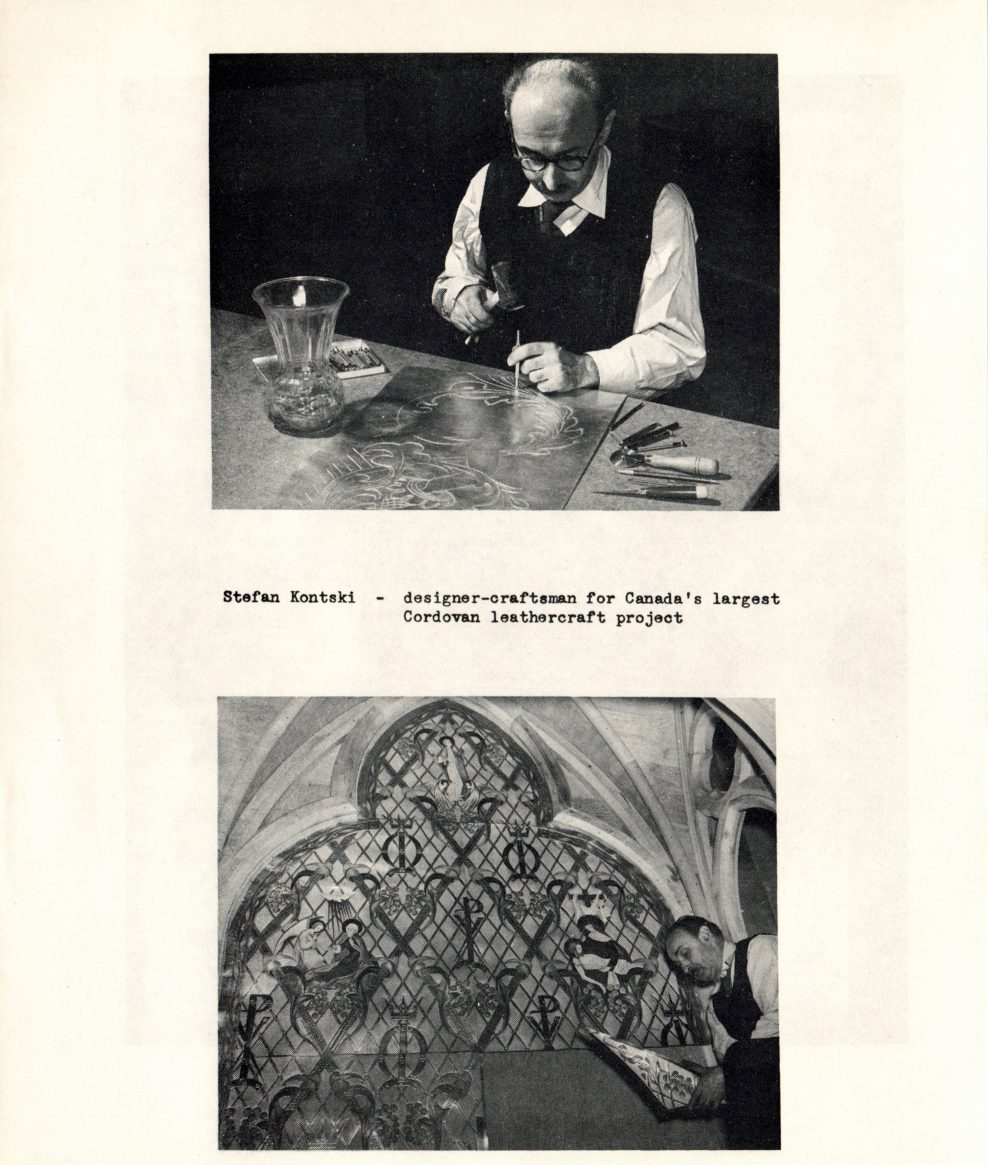
Stefan Kontski - designer-craftsman for Canada's largest Cordovan leathercraft project
[This page carries two photographs beneath the caption: the first shows Stefan Kontski at his workbench tooling a large leather panel; the second shows the finished panel, an elaborate Gothic-arched leather screen with figures and monograms, installed with a man examining it below. No CSCL affiliation is stated for Kontski on this page.]
Page 14
Slip Page - "Canadian Leathercraft" - Fall 1952 - illustrating one of a series of articles of interest to decorative leathercraftsmen For subscription rates see page 12
This slip page is a photo plate showing three stages of tooled leather scrollwork: a blank hide panel, a partly-tooled acanthus-and-bird strip, and a fully finished strip. No names appear on this page.