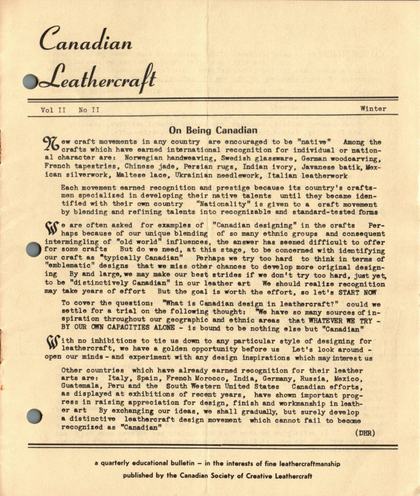
An issue of the Society’s newsletter, transcribed from the original.
(14 pages, 2.6 MB)
the full-resolution scan, 40 MB, for close research
Page 1 — On Being Canadian
Canadian
Leathercraft
Vol II No II Winter
On Being Canadian
New craft movements in any country are encouraged to be "native" Among the crafts which have earned international recognition for individual or national character are: Norwegian handweaving, Swedish glassware, German woodcarving, French tapestries, Chinese jade, Persian rugs, Indian ivory, Javanese batik, Mexican silverwork, Maltese lace, Ukrainian needlework, Italian leatherwork
Each movement earned recognition and prestige because its country's craftsmen specialized in developing their native talents until they became identified with their own country "Nationality" is given to a craft movement by blending and refining talents into recognizable and standard-tested forms
We are often asked for examples of "Canadian designing" in the crafts Perhaps because of our unique blending of so many ethnic groups and consequent intermingling of "old world" influences, the answer has seemed difficult to offer for some crafts But do we need, at this stage, to be concerned with identifying our craft as "typically Canadian" Perhaps we try too hard to think in terms of "emblematic" designs that we miss other chances to develop more original designing By and large,we may make our best strides if we don't try too hard, just yet, to be "distinctively Canadian" in our leather art We should realize recognition may take years of effort But the goal is worth the effort, so let's START NOW
To cover the question: "What is Canadian design in leathercraft?" could we settle for a trial on the following thought: "We have so many sources of inspiration throughout our geographic and ethnic areas that WHATEVER WE TRY - BY OUR OWN CAPACITIES ALONE - is bound to be nothing else but "Canadian"
With no inhibitions to tie us down to any particular style of designing for leathercraft, we have a golden opportunity before us Let's look around - open our minds- and experiment with any design inspirations which may interest us
Other countries which have already earned recognition for their leather arts are: Italy, Spain, French Morocco, India, Germany, Russia, Mexico, Guatemala, Peru and the South Western United States Canadian efforts, as displayed at exhibitions of recent years, have shown important progress in raising appreciation for design, finish and workmanship in leather art By exchanging our ideas, we shall gradually, but surely develop a distinctive leathercraft design movement which cannot fail to become recognized as "Canadian"
(DHR)
a quarterly educational bulletin — in the interests of fine leathercraftmanship published by the Canadian Society of Creative Leathercraft
[The article opens with three large decorative script drop-cap letters ("N" for "New craft movements...", "W" for "We are often asked..." and again for "With no inhibitions...") The closing initials plainly print "(DHR)" — Deane H. Russell, the Society's President and Editor per p12's masthead.]
Page 2 — COMPETITION
COMPETITION —--- many craftsmen often consider as scrap some parts of skins and hides which can offer unique decorative possibilities
All CSCL members are invited to participate in a friendly competition for the production of best examples of the use of nature] grained or marked leathers © Suggestions: 1) search for heavy neck or shoulder graining, creasing or other naturally marked leather (most tooling sides have certain areas so marked)
2) design such markings into over-all decorative effects of your articles (book covers, wallets, handbags, etc) using natural markings, coloring and finishing, rather than tools, for chief decorative effects
3) have your pieces finished for review (any number may be submitted) at the next CSCL annual spring meeting (date to be announced in Bulletin III
NOTE: Though not yet determined, prize awards will be well worth while Awards, donors and winners as well as illustrations of examples will be reported in Bulletin Number IV of Volume II
LET'S ALL TRY - We Can Learn Much From Each Other
NEWS ITEM - Art and Nila Joel, of Vista, California, had a week's intensive short course in leather during their recent visit to Toronto as guests of Ralph and Reta Larmour
Nila is a well-known Southern California artist, where she teaches adult education classes in leathercraft, copper work and textile painting Visits to the studios of Bob Muma, Don MacKinnon, Edith Roscoe, IIva Limberg-Villman, the craft rooms of James Scobbie at the Central High School of Commerce, and a tour of the British American Oil Building to see Thor Hansen's design treatment of Canadian motifs, gave the visitors a good idea of what is going on in Eastern Canada
Nila's comment was: "I was so much impressed by the originality shown in most of the Arts and Crafts that I saw By using the native beauty with which Canada is so blessed, you are developing Arts and Crafts that are full of originality, refreshing and strictly Canadian To my mind that is the way it should be"
A Special Showing of "Canadian Handmades in Leather" -- during the summer, our President, in company with G H Miller, District Representative of the Department of Education, took the Travelling Exhibition to Kingston Penitentiary for a showing to the men interested in leathercraft Over 150 men assembled to listen to a review of techniques used in pieces shown Many questions were asked, and leathercraft articles made by the men were critically appraised The program was well written up in the K P Tele-Scope (monthly magazine published by the men at Kingston) A direct result has been a request for fe a number of membership forms so that men may become subscribing-members of our Society It is satisfying to know that our Society has offered some help and encouragement to the men at Kingston who are enjoying leathercraft as their favourite recreation
[This page prints her given name as "IIva", with two capital I’s; pages 6 and 7 of this bulletin, and the Spring 1953 list that elected her, print "Iiva", with a dotted second letter. Each is set out here as its own page prints it. Whether she is the Irva Villman recorded as an Associate in 1953 is unsettled, and this archive does not join them: that name is printed with an r in the Spring 1953 article announcing it, and again in the Council of Fellows history of 1975.]
[Four small readings set out here as printed: "and hides" (not "end"), "Bulletin III" (not "ITI"), "during their recent" (not "durim"), "some help" (not "som").]
Page 3 — TOOLING MOROCCO
TOOLING MOROCCO by Robert Muma
Long famous as one of the finest of fine leathers, genuine Morocco is a vegetable-tanned goatskin easily recognized by its very fine pebbly grain which has been achieved by a rolling or a boarding process To many people the decorative quality of this grain alone is sufficient embellishment and any further attempt,.. to ornament it is regarded as superfluous How- rx ever, it is seldom that this natural beauty of Morocco is not enhanced by simple line tooling at least Just a few lines or simple border often provide sufficient contrast to emphasize its inherent luxury Straight line tooling especially adds to its dignity and charm F t is surprising how many leathercraftsmen of considerable experience are ignorant of the fact that Morocco can be tooled at all; and how few are aware of its eee: 1G "a se so. full possibilities But Morocco is one of == the easiest of leathers to tool The tiny knobs which make up the grain of the leather flatten easily under pressure of the tool and leave a glassy-smooth and shiny line This leather has a finished surface and so must be moistened entirely from the flesh or under side Learn to recognize the proper amount of moisture If too wet, the tooling will not hold nor take on the characteristic shine
The tracer, modeler and deerfoot are the three tools that can be used on Morocco The tracer should be rather course as only heavy lines will show up properly by themselves
The Hoeffer type of all-over design may become all but lost on Morocco when done in line only It should have the background pressed down smoothly with the deerfoot The shiny smooth contrast thus afforded will show up the floral motifs to excellent advantage If the leather stretches and becomes warped as a result of this method of tooling it may easily be flattened by pressing under a weight until dry.
The usual method of tooling Morocco is to bevel outside the decorative motif with the modeller This sets off the design without the use of allover backgrounding The method which I prefer, however, involves modeling within the decorative design leaving a very narrow edge around the outside of the leaf and petal as suggested in the sketch All this inside area is pressed down smooth or modeled in varying degrees to suggest contour This gives the design more reality in the sense of actually existing
[Two more paragraphs open with decorative script drop-caps — “Long famous” opening the article and “The tracer” a later one — the same pattern as on p1 and p9.]
Page 4 — The Lajord Leathercraft Club
The modeling technique just described is the basis for embossing, which is an especially effective technique for handbags On leathers such as Morocco and Mission Grain Steerhide, embossing alone is hardly sufficient By modeling first, the fibres of the leather are compressed and expanded (the leather is actually debossed) so that embossing from underneath is accomplished re quite easily with the ball point or modeler This technique also gives a contrast of texture as well as variety of form
Whatever technique of tooling you wish to use, keep in mind the decorative quality of the leather as it is, and choose a decoration that will serve to enhance rather than obliterate it
Morocco cannot be cut or stamped as these procedures would cut through the finished surface of t he leather and expose the lighter fibres beneath
The Lajord Leathercraft Club
by Beatrice Baycroft
I hope this account of our small leathercraft group will encourage others in the country, where lessons are not available, to meet together, to pool their knowledge and to have much fun and profit whilst doing their leatherwork
The seven members of our group live in Lajord (a small wheat farming hamlet 26 miles south east of Regina) or on farms nearby We meet for enjoyment, for relaxation from our routine tasks, from a genuine love of our leathercraft hobby and with an earnest desire to do better and learn more as we do more
As I have room to spare and more equipment, the meetings are held at my home I enjoy sharing with these congenial friends, interested in leathercraft, the knowledge I was fortunate to acquire from Miss Rolliffe, Mrs Larmour and Mr MacKinnon of Toronto and from a lady in England As we are just friends meeting and working together, there are no fees
We read the Bulletin, study the Doodle pages and several leathercraft books and are always on the alert for new ideas in patterns, designs, materials, or assembling One large envelope is almost full of pictures, designs, patterns, hints -- cut from papers and magazines from which we draw ideas With us, everything stops for leathercraft on Thursday at 1:30 pm -- even if a latecomer for lunch means leaving g the dishes in the sink Here is a typical afternoon -- Joan arrives, driving a truck as grown-up son is away with the car She is carrying a bag of tools and leather in one hand and a box lunch in the other - for she is a hostess today Then follows Cecile, our little French neighbor, driven by a busy husband who quickly dumps her and her load and returns to his work Marjorie, driving the car today, is right behind and with her Phyllis and Anne, the municipal Secretary-Treasurer's wife (rest of us are farmers' wives) Myrtle, the other one of our group will not attend for a few weeks until her baby is a little older
[“The modeling technique” and “Joan arrives” each open with a decorative capital; she is named plainly on p5, continuing the same account.]
Page 5
Kier greetings and brief talking, all go to the room reserved for the leather class One large table and three smaller tables arranged near the windows are soon occupied Christmas presents are uppermost now Anne is carving a belt for her husband She is having a little trouble with decorative cuts over pear shading Marjorie is thonging a red handbag for her sister from "left-overs" It is a dainty, little tooled bag, barrel shaped, made to fit the leather pieces It is lined with black and laced with red Joan is "finishing" wallets and a pocket secretary worked at home Joan is our adventurer - for she is always experimenting It was her beautifully carved and hand sewn brief case which won admiration and a well deserved "first" in Regina Exhibition this year Cecile, another Exhibition prize winner, is a great worker and does much homework She is now making a circular shoulder bag, for a niece It, too, is made with "left-overs" from a larger project The carving is well done, the flowers raised with push beveller, dyed a golden tan and emphasized with a dark brown 'background The dark brown thonging is of the weaving type Phyllis is progressing well with her first handbag, made with Autumn Beach Morocco She is thrilled with the capacious pockets and zipper pocket with gusset, and thinks the assembling is fun So everyone is busy and happy and I move around to advise and help when necessary Each develops her own technique One bevels the background area, another does not and then they compare results, and so on throughout all projects
At 4:30 or thereabouts, everything stops for tea, provided by two of the group How we enjoy that social half hour, testing new recipes or relishing old, drinking many cups of refreshing tea, often exchanging recipes or ideas or discussing the doings in the community After lunch we return to the classroom to finish something or gather tools and materials to take home
Thus passed another Thursday as have so many others during the past three years of our meetings Occasionally Mrs Webster and Mrs Totten of Regina join us for an afternoon, to work with us, to exchange patterns, ideas and techniques
During the past year, as a group, we spent a day in Regina with Mrs Totten and Mrs Webster; an evening to see the CSCL Travelling Exhibition and a Supper with a stainless steelware salesman after lesson time
We have constructed tooled and carved purses, wallets, pocket secretaries, watch straps, handbags, belts, book covers, brief cases, et cetera But more than that we have gained freedom from the daily tensions and a pleasant way of s pending leisure time (if there is such a thing on the farm) and a vital interest in life
FIRST CALL - Leathercraftsmen desiring to have their work reviewed for possible = showing in the 1953 Arts and Crafts Display to be sponsored by the Art Gallery of Toronto are urged to plan their pieces now This all-Canadian exhibition will be judged critically and to highest standards
Suggestions: 1) try for simplicity in decoration 2) try hand-sewn and turned-edge construction 3) achieve a fine "leather finish" 4) offer only work of your own original designs
Full details will be sent all CSCL members by special circular at a later date
[“Thus passed another Thursday” opens with a decorative drop-cap T, as on p1, p3, p4 and p9.]
Page 6 — Going Places with the Travelling Exhibition
Going Places with the Travelling Exhibition by Reta Larmour
Canadian Shoe and Leather Fair - Toronto - October 14-18 display of leathercraft I have ever seen" Comments of this kind underlined the public response to our Society's invitation exhibit at the recent Shoe and Leather Fair
The spacious Automotive Building of the CNE was transformed into a "Leather City", and the sight and smell of leather everywhere made it a leathercraftsman's paradise Mr Fred Payne, General Manager of the Fair, gave us ample space and all display props necessary to show our 192 articles to best advantage Against a background of pale grey walls on turquoise-draped tables, the exquisitely colored articles glowed like jewels Glass-enclosed display cases emphasised the beauty of some of the finest pieces, and our pearl-grey name cards blended inconspicuously into the general decor
The Society wrote in British spelling here — "emphasised", not "emphasized" — kept as printed.
Twenty-five top craftsmen, amateur and professional, loaned their best articles Unfortunately, except for one lone Western entry, Mrs Gwyneth R Gale of Melfort, Sask, the exhibitors were all from Ontario We hope that the next big exhibition will find all provinces represented for the Shoe and Leather Fair is truly the "Leather Show Case of Canada"
At the formal opening, the Fair members presented to their Honorary President Lieut Governor L 0 Breightaupt, a leather-bound guest book, designed and worked in the Esthonian technique by one of our members, Iiva Limberg-Villmann of Toronto Later the Lieut Governor and his party spent some time studying our display, and congratulated us on its excellence
A steady stream of Fair members visited us during the closed days The two public days (Friday night and all Saturday) brought crowds of craft visitors, 23% of whom were from outside of Toronto and its suburbs Brazil, United States, Alberta, Nova Scotia, New Brunswick, Quebec and 59 Ontario centres were represented
To present a show of such magnitude would have been impossible without the untiring work of some 44 of our members Deane Russell and Jessie Tyrell came specially from Ottawa Don MacKinnon not only gave up his whole week but put Mrs MacKinnon and daughter Eleanor to work Bob and Dorothy Muma, Edith Roscoe, Frances Rickey, Faith Symington, Larry Scobbie, Sadie Roebuck Jean Newton, LC Pearson, Clarice Packham, Nora Lloyd and many others had sore feet and aching throats - but a wonderful time Ray Potter was a real friend, and eased us through several crises
Demonstrations in tooling, carving, lacing and glovemaking invariably attracted crowds of interested spectators Joyce Watson, Jack McDougall and Robert Shaw demonstrated carving - and our stalwart, Don MacKinnon, was on hand day and night to give a private or group demonstration at a moment's notice Bob and Dorthy Muma and Jessie Tyrell wielded the modelling tool Tiva Limberg-Villman demonstrated her Esthonian technique and Edith Roscoe glove-making and lacing
The paper prints "Dorthy" here, one of two spellings the Society itself uses for Dorothy Muma on this page; kept as printed.
Page 7
Our table of antique and foreign country leather work attracted such interest that we felt another year we should make a special effort to expand this feature
Halfway through the Fair, the great variety of expressed preferences for individual articles suggested to the Committee that a public preference poll might be interesting and informative The poll got under way Friday night Each visitor was asked to answer the question - "I like Article No... best" As an added inducement, your Chairman donated a Dogwood Shoulder Bag to be drawn for from the voting slips Over 1500 people had voted by Saturday night, when "Miss Footwear" drew the winning name
The winner, Mr Bill Hurst, a Toronto pianist and a bachelor - while unable to make personal use of his prize, is deeply interested in Variety Village, a residential school for crippled boys, maintained in Toronto by people in show business Mr Hurst donated the purse to the Women's Organization of Variety Club, and it is now being raffled to raise funds for clothing the boys at the school
A count of the votes showed the top six placings in order of preference to be:
1) Large carved wine chest by Don MacKinnon, Toronto
2) Tied for second place - Oak Table Lamp with carved panels by V Lara and Deane Russell, Ottawa - "Music of the Masters" - large bound book, tooled modelled and embossed, by Robert Muma, Toronto
3) Leather Picture "Waltz Promenade" by Don MacKinnon, Toronto
4) Large Guest book, Canadian Coat-of-Arms, Esthonian technique, by Iiva Limberg-Villmann, Toronto
5) Dogwood purse - tooled and embossed, by Robert Muma, Toronto
6) Leather Picture - "New Arrivals" by Don MacKinnon, Toronto
Other pieces by these craftsmen were also very popular, and craftsmen also receiving a good percentage of votes were:
Arthur Burgess, London, Vivian Caplan, Ottawa; Margaret Jennings, London; Reta Larmour, Toronto; Jack McDougall, Toronto; Margaret Richardson, Ottawa; Edith Roscoe, Weston; Faith Symington, Toronto; Irene Surgenor, Cornwall and Helen Wheaton, London
The poll proved a great success It showed that almost everyone who paid admission came to see us It gave some indication of the kind of objects which attract the attention of the general public It was easy to see that the large pieces were naturally the eye-catchers; and that there might have been several categories - as a belt or wallet cannot compete with a lamp or a chest! Perhaps its chief value proved to be that it turned mere spectators into enthusiastic amateur judges who studied each article critically
Mr Payne and his Leather Fair Committee were greatly surprised to discover the drawing power of a leathercraft display From our point of view, we felt that the CSCL had gained greatly in stature, and that many more Canadians will now follow our future with interest
Page 8
MOUNT ALLISON UNIVERSITY - Sackville, New Brunsciwk - November 15
An urgent invitation from Mr H E Betts, Director of Recreation for the Province of New Brunswick, to send the Travelling Exhibition to Mount Allison University for November 15, meant a frantic rush to get it repacked and off in time The Maritime Association of Physical Education and Recreation was holdings its Annual Conference, with special sessions on Arts and Crafts Mount Allison School of Fine and Applied Arts, under Director E N Roulston, was putting on a display and exhibition of work for maritime recreationalists Over 100 were expected to attend the Conference - consisting of YM and YW Directors, Community Centre Directors, City Directors of Recreation, Camp Directors, Physical Directors
M'LADY FAIR EXPOSITION - Montreal - December 2, 3 and 4
We have accepted an invitation from the Montreal Women's Club to show the Travelling Exhibition in the Mount Royal Hotel at M'Lady Fair and important educational exposition under their sponsorship Over 10,000 are expected to attend This important invitation followed a visit of their representative to our display at the Shoe and Leather Fair It will be our first big showing in Quebec, and your Chairman plans to attend;
GALT and PRETROLIA - Galt YWCA is booked for the Travelling Exhibition for December 12, and Pretrolia for December 16 Miss
Helen Van Sickle of Galt, and Mrs Dorothy Draper of Pretrolia both visited our booth at the Shoe and leather Fair, and their enthusiastic reports resulted in these invitations
The Society misprints Petrolia, Ontario as "Pretrolia" here, in the heading and twice in the body; kept as printed.
Editor's Note - although some 44 members helped to put over our part in the Leather Fair week, we are sure all Society Members will want to express special thanks to our TE Exhibition Chairman, Mrs Reta Larmour, who has worked for many days and nights to keep the CSCL Travelling Exhibition active in large and small communities across Canada The benefits of such service are adding up steadily to greater recognition and prestige for Canadian Leathercraft
"COLOR DECORATION and FINISHING of LEATHER" by Robert Muma
A comprehensive 24-page book dealing with all forms of color decoration and featuring practical exercises in color 8½" x 11" Illustrated from your local dealer or direct Price.. $1.50
MUMART STUDIOS of Creative Leathercraft, 62 McGill Street, Toronto, Ont
["New Brunswick" (not "Brumsciwk"), "under Director E N Roulston" (not "mder... EN") — both set out here as printed.]
Page 9 — Carving Pine Cones
Carving Pine Cones by Edith Roscoe
Pine Cones appeal to you as much as they do to me For years I have collected them, and saved them - they are all over the place - dangling over my work table, in my jacket pockets, in every empty vase and box, all shapes and sizes - from the fragile little hemlock cones, through all shapes and varieties of pine, to the spikey fir cones I love them
Now they are breaking out like a rash all over my various leathercraft projects - on fireside bellows, on moccasin tops, on desk blotter, and photo folder So when our Editor of "Canadian Leathercraft" asked:
"How about an article on designing and carving pine cones for the bulletin" I said I would be happy to try to suggest how to go about making a pine cone design for leathercraft
First, let's find a twig of a pine tree, complete with cones and needles This is going to be your own effort, so you'll need your own model Now, with the pine cone dangling from its twig before us - the size or the kind doesn't matter, you draw your kind and I'll draw mine - first decide on an area to decorate, then sketch a life-sized outline of your project The size of the space to be decorated will decide the size of your motifs ---
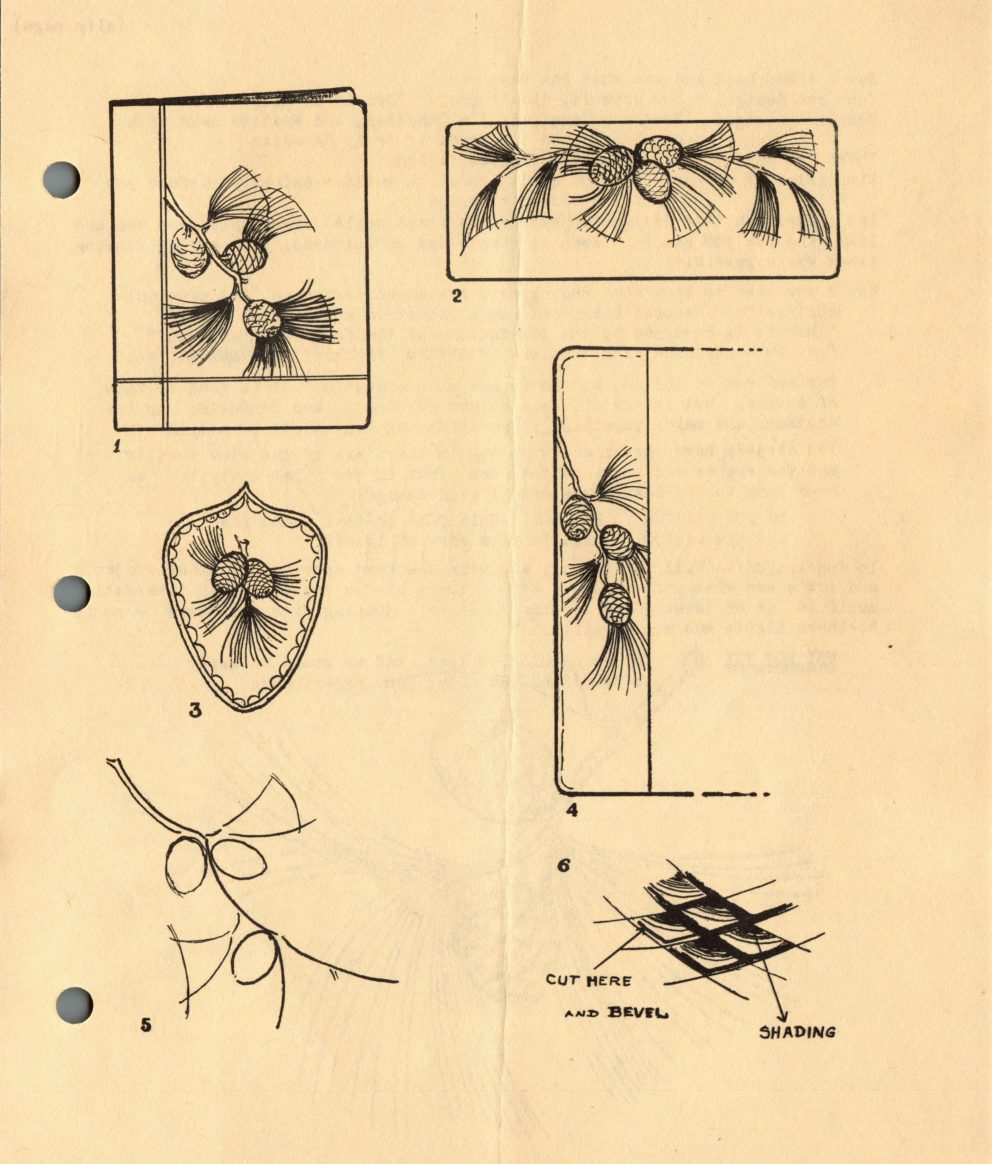
It it is a book cover or a photo folder - plate 1
2 If it is a box top - plate 2 (let your twig arrangement wander across where it looks best)
If moccasin tops - plate 3 or desk blotter - plate 4
You can see how the area to be decorated will influence your lines Now, with the area outlined, indicate lightly on your sketch sheet the twig arrangement -- just a few simple lines will do, but try to capture the particular character of your own twig -- make it bend naturally, and let it wander gracefully over the area where there's the most space to fill
At this stage "squint" at the cone, and what do you see? - just a dark egg-shape That's it, hang an egg-shape or two or three somewhere on the pine twig - again where there's space to fill (plate 5)
Then "squint" again - at the needles They'll probably look like small whisk-brooms sticking up at different angles Then hang them on the twig where they look best (as many as look right) just the brooms, no details Get your elbow up on the desk, relax, and make nice long sketchy lines that go in the general direction you want them to Sketch your 1 ines lightly; make several to form the shape and you can finally select the ones you like best later
With the design blocked in, go back and swing in the details Make the cones quite simplified at first, until you become more expert Later efforts can be more intricate
(continued on slip page)
[p9: opens with a large decorative script drop-cap "P" (matching p1's pattern)]
Page 10
Next, widen the stem; then mark off the egg-shape into simple curved lines The sections thus formed will give you the location of the individual scales (Sketch 6) The whisk-brooms easily develop into bunches of needles, but I find it easier to indicate only t he outline of these on the leather, and let the knife strokes fashion the needles Saves a lot of tracing, and gives you © more freedom with the knife The same with the cones If you trace only the outline marked off into sections you can cut each scale into its part with the knife itself
With a soft sharp pencil now go carefully over your sketch and make one clear line only, where the sketchy ones were, so that all lines will be clear-cut for carving Nothing there you can't do yet, is there?
Prepare your tracing and transfer it to the leather in the usual way Have the leather cased ahead of time and check your swivel cutter for sharpness Get your elbow on the table (keep your little finger always on the leather as a pivot) and with nice easy relaxed strokes, carve first the twig; thenthe outline of cones and finally the needles If your leather is in proper case and the knife sharp, it should slide through like cutting butter
Go back now to the cones, and with short controlled strokes cut each scale into the indicated section When you bevel around the sections it will take out the guide lines Bevel around outside of cones, using small beveller (preferrably checked) and go carefully around cone scales Then along both sides of twig - add touch of small camouflage to suggest bark If your cones are of the rugged type, small seeder may be used at © point of each scale (plate 6)
When work on cones is complete, emboss them carefully (stetch them up gently from the under side)
After the leather is completely dry, inside of cones are coated with CIL Household Cement (clear liquid) to keep them hardened and firm, and the cavity is packed with small layers of sheet-wadding, cut to size and put in place with dabs of leather cement Small piece of writing paper is cemented across back of embossing to make it flat for lining
COLORING - colors suggested here, and which have been found to be very satisfactory are the Garnett Antique Dyes and Toning Dyes Any good leather dyes that you are familiar with should do
Branch - Garnett Antique Havana Brown, two or three coats
Cones - wash of Garnett Golden Tan - let dry thoroughly before shad ing Needles - with very fine brush, follow along cuts with Garnett Green Toning
(be CAREFUL)
Cones - When Golden Tan is dry, go carefully only half-way over scales with several coats of Chestnut Brown (Sketch 5) Let dry thoroughly Now, with fine brush and touch of brown dye (dry brush technique - i.e. touch brush on paper to absorb most of liquid) touch darker brown to © tip of each scale
Finish - When all is completely dry, brush over entire design with several coats of Garnett Polish Coat (or any clear leather finish) (continued on slip page)
[p10: "and let the knife strokes" (not "a let"); "CIL Household Cement" (not "Moment") — CIL's real household adhesive product, matching "packed with... dabs of leather cement" two sentences later on the same page.]
Page 11
NEW PRACTICAL DIFFERENT ask for FREE folder or send 50c for pattern
Handbag Design Style No 12 by Margaret Richardson Mission grained Cowhide by Wickett & Craig 2½ oz Russet per sq ft 88c
HANDICRAFT & ARTISTS SUPPLIES OF QUALITY
CORBEIL-HOOKE INC. 1218 Drummond Street — Montreal 25, P Q; 9 d'Aiguillon Street — Quebec City, P Q
QUALITY LEATHERS and SUPPLIES
JACKMAN LEATHER CO. 152 LAURIER AVE. WEST, MONTREAL 14, CANADA
Handicraft Leathers and Supplies
Fine Assortment of Beautiful Leathers complete range of Leathercraft Tools and Accessories comprehensive Detailed 64-Page Catalogue experienced Personalized Service
THE BIRT SADDLERY COMPANY LTD. — The Leather Goods House
519 Main Street — Winnipeg, Manitoba
Leatherlore Publications ask your dealer for the new "Canadian Pocket Set" Pattern No 3 with: photographic illustrations, actual-size line drawings, decoration and thorough instruction for Billfold, Pocket secretary and Key Case Canadian leaf decoration for standard stamping tools Pattern 50c
Distributors—LEATHERLORE PUBLICATIONS 116 O'CONNOR ST — OTTAWA, ONT
NEW GARNETT LEATHER FINISHES GARNETT TONING DYES — RED, BLUE, GREEN, YELLOW, ORANGE,
May be used alone or to modify colors of the Garnett Antiques GARNETT EDGE DRESSING — to finish belt, strap and other raw edges © GARNETT DARK BROWN INLAY DYE — for backgrounds, edges, etc. FREE GARNETT INSTRUCTION SHEETS for dyeing and finishing craft leathers
Available at your dealers Ask for one
Dealers write for information to:
GARNETT COMPANY
442 SPADINA AVENUE - TORONTO
Page 12 — Who's Who in Canadian Leathercraft
Who's Who in Canadian Leathercraft
(to acquaint field members of CSCL with the interests and achievements of fellow leathercraftsmen )
EDITH ROSCOE - Weston 2
Early training and career as commercial artist - 4 years on studio staff of large Toronto firm Short course in Occupational Therapy in USA Taught crafts at sanatorium, then leathercraft and ceramics at YWCA One of pioneer teachers of leathercraft in Toronto district Founder and past president of Weston Leathercraft Guild, first leathercraft Guild organized in Ontario under Canadian Handicrafts Guild
Mrs Roscoe has won a number of awards at CNE and PNE over past six years in tooling, carving and glove-making, and for the past seven years has been Leathercraft Instructor at Weston Collegiate School evening classes, teaching tooling, carving, coloring and glove-making to junior and advanced classes Received diploma from Baird School of Leather Carving; some instruction from Robert Muma, and in Esthonian technique At present attend ing University extension course on "Design, Past and Present"
Charter member of CSCL; 1950-51 Chairman Membership Committee and 1952-53 Secretary of CSCL
Favourite outdoor sports - picking up pine cones, fishing, gardening NOTICE Organized leathercraft groups or craft centres, interested in es having the 2nd Travelling Exhibition visit their community should apply to the Chairman, Exhibition Committee (address below) 2nd itinerary schedule to commence about February 1, 1953
Canadian Leathercraft
Published quarterly by the Canadian Society of Creative Leathercraft as an educational service to decorative leathercraftsmen
Subscription and General Membership in Society — $2.00 annually Sustaining, Associate and Fellow Membership Standing upon qualification For information write: Chairman, Membership Committee
Advertising Rates — for information write: Chairman Advertising Committee CS CL Executive
President and Editor "Canadian Leathercraft'' — Deane H Russell, 116 O'Connor Street, Ottawa
Vice-President — Mrs Margaret McFarlane, 1810 Lawrence Avenue West, Weston
Secretary — Mrs Edith Roscoe, 277 King Street, Weston
Treasurer — Robert Muma, 62 McGill Street, Toronto
Chairman Membership Committee — Mrs Nora Lloyd, 15 Kelway Blvd., Toronto
Chairman Advertising Committee — Arthur Burgess, 134 William Street, London
Chairman Travelling Exhibition - Mrs Reta Larmour, 59 High Park Blvd., Toronto
Executive Council
London Member - Mrs Margaret Jennings           Ottawa Member — Mrs Margaret Richardson    Regina Member — Mrs Lena M Totton
Toronto Member — James L. Scobbie (Chairman)    Toronto Member — D W MacKinnon
Page 13
(slip page)
Now - stand back and see what you have ---
Your own design! You drew it, didn't you? Then it's "Original" Canadian Design! You're a Canadian; I'm Canadian, and what we make with our hearts and our hands is truly Canadian
There you have it -- Original Canadian Design
Simplified of course - but you can't expect to build a cathedral before you ) try building a garage
Let's approach this design-subject from a fresh angle Carve what you see and like, the way YOU see it Keep it simple and uncluttered, with strong flowing lines where possible
Would you like to know what the experts say about design -- "All ornament springs from natural form, and man's geometric analysis of it...." "That it is governed by the limitations of the form it enhances..." "see in accordance with the laws of RHYTHM, REGULARITY, SYMMETRY, etc" One can run on and on, and never get much concrete It is good to know, of course, but it may all seem rather nebulous, and confusing to the amateur, and makes something sound difficult that could be simple You already have rhythm and symmetry in the lines of the pine needles and the shapes and parts of the cone But in the final analysis we come back to the basic rule of all good design:
IS IT PLEASING TO BEHOLD? Hold fast to that principle and the rest will usually take care of itself
In conclusion -- Will you too try applying the same approach to other subjects and let's see what you can do? Even a lowly beetle could make an interesting motif - or an iceburg and a penguin - or a jumping fish and waves - or the Northern Lights and a mountain
"Iceburg" is the Society's own spelling and stays.
WHY NOT TRY ☞ You've nothing to lose, and we would be happy to hear from you after your experiments
The mark after "WHY NOT TRY" is a small printer's pointing-hand ornament.
Page 14
[This page is a plate of six numbered pen-and-ink figures illustrating a pine-cone motif applied to leathercraft pieces (a book cover, an edge border, a shield-shaped piece, a strap, and two studies of the cone-and-frond motif itself), continuing the "Original Canadian Design" article on the preceding slip page. Figure 6 carries the only lettered instructions: "CUT HERE AND BEVEL" and "SHADING", with an arrow.]
CUT HERE
AND BEVEL
SHADING