
An issue of the Society’s newsletter, transcribed from the original.
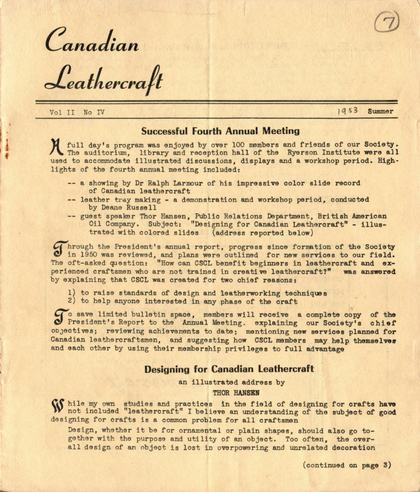
(14 pages, 2.6 MB)
the full-resolution scan, 38 MB, for close research
Page 1 — Successful Fourth Annual Meeting; Designing for Canadian Leathercraft
Canadian
Leathercraft
Vol II No IV — Summer
Successful Fourth Annual Meeting
A full day's program was enjoyed by over 100 members and friends of our Society. The auditorium, library and reception hall of the Ryerson Institute were all used to accommodate illustrated discussions, displays and a workshop period. Highlights of the fourth annual meeting included:
-- a showing by Dr Ralph Larmour of his impressive color slide record of Canadian leathercraft
-- leather tray making - a demonstration and workshop period, conducted by Deane Russell
-- guest speaker Thor Hansen, Public Relations Department, British American
Oil Company. Subject: "Designing for Canadian Leathercraft" - illustrated with colored slides (address reported below)
Through the President's annual report, progress since formation of the Society in 1950 was reviewed, and plans were outlined for new services to our field. The oft-asked question: "How can CSCL benefit beginners in leathercraft and experienced craftsmen who are not trained in creative leathercraft?" was answered by explaining that CSCL was created for two chief reasons:
1) to raise standards of design and leatherworking techniques
2) to help anyone interested in any phase of the craft
To save limited bulletin space, members will receive a complete copy of the President's Report to the Annual Meeting. explaining our Society's chief objectives; reviewing achievements to date; mentioning new services planned for Canadian leathercraftsmen, and suggesting how CSCL members may help themselves and each other by using their membership privileges to full advantage
Designing for Canadian Leathercraft
an illustrated address by THOR HANSEN
While my own studies and practices in the field of designing for crafts have not included "leathercraft" I believe an understanding of the subject of good designing for crafts is a common problem for all craftsmen
Design, whether it be for ornamental or plain shapes, should also go together with the purpose and utility of an object. Too often, the overall design of an object is lost in overpowering and unrelated decoration
(continued on page 3)
[The masthead year is inked by hand as “1953” on this copy. The issue’s two opening capitals, A and T, are decorated. The first highlight’s last line, “of Canadian leathercraft”, belongs to the sentence above it.]
Page 2 — FINAL NOTICE for -- COMPETITION in Natural Grained and Marked Leathers
FINAL NOTICE for -- COMPETITION in Natural Grained and Marked Leathers 1) Read Parts I and II (Spring and Summer issues of "CL") for reports of awards and explanation of techniques for selecting and achieving grains for leathercraft
2) Eligible for competition are pieces of leathercraft completed to display any one or combination of natural grained, natural marked, or assisted grained leathers
3) For this competition, no multiple-tool decoration will be accepted, although use of simple creasing, decorative lining, border wheel embossing or stamping will be accepted on such pieces
4) Judging - size of article submitted not important
- effort and achievement in use of natural or assisted graining to be considered more important than elaborateness of make-up, though good craftsmanship throughout may be a final determining factor 5) Results of Competition to be reported, with illustrations, in Fall issue of "CL" (Volume III No 1)
6) Send all entries (postpaid) co: The Editor, Canadian Leathercraft
116 O'Connor Street, Ottawa, Ontario
NOT LATER than September 15, 1953
LET'S ALL TRY to demonstrate to our friendly supporters that Canadian leathercraftsmen can use natural grained or marked leathers to good advantage
LEWISCRAFT HAS MOVED TO ITS NEW HOME - 284 KING ST. WEST TORONTO, ONT.
We extend a cordial invitation to all our leathercraft friends to come in and see our new, spacious and comfortable showroom where fine leathers and quality leathercraft supplies play a major part
Remember - Our Address Is Now -
Lewiscraft
284 KING STREET WEST, TORONTO, ONT.
(One Block West of the Royal Alexandra Theatre)
[The Lewiscraft notice is printed in two columns, with a “NEW HOME - 284” sign, and is set out in the order the columns are meant to be read. The paper’s own “(postpaid) co:” is typed exactly so, and kept as printed.]
Page 3
Designing for Canadian Leathercraft (continued)
Naturalistic renditions of animals and landscapes are found in places where they have no business appearing. For example, doormats are hooked with pictures of sleeping St Bernard Dogs- hardly a fit decorative subject for a foot-wiping object Our Canadian souvenir counters are filled with similarly inappropriate craft objects. Ash trays, desk set items, mugs and other "souvenir" articles are too often not made in Canada, but are imported from Japan, Czechoslovakia, Germany, or any country which can offer articles for resale cheaper than can our Canadian craftsmen. Many such articles are decorated by the simple, mass production process of covering with decal transfers, intended to suggest Canadian emblems such as: a beaver, a maple leaf, a mounted policeman, an Indian - with little or no regard for the appropriateness of such decoration for the intended uses of our souvenir articles
And its the same with leather - instead of finding the equivalent of well designed and crafted Georg Jensen silverwork, we find only electric-pencilled, or black ink-stamped pictures of Indians, mounted policemen, cowboys and some poorly drawn animals on the cheapest of leather articles. These are not true souvenirs of Canada Our problem is how to go about getting good designs. We have many craftsmen, but very few good designers. Designers should keep in mind the limitations of the craft medium for which they design. A piece of sculpture should still represent an object from a block of granite. Things made from metal should be designed so they may be milled, cast or hammered. As the nature of leather suggests something smooth, or soft, or pliable, these qualities of leather should be planned to show up to advantage in our designs for leatherworking
We should learn to express a flower in terms of leather -- not to copy flowers designed originally for expression in wood, or metal, or anything else. When I think of designing for leather, I always plead for craftsmen to "PLEASE leave a little leather showing" We see so much leather which is completely covered with decoration that we can't see and appreciate areas of natural leather at all. Let's recognize that leather may have some natural markings or flaws, and let some of these markings appear in our finished work. Leather products become much more interesting if we do this than if we keep pretending that all leather is perfect, or hide its natural markings to keep up the pretense
Designing for leathercraft should be understood as a subject dealing with more than just decoration for leathercraft. For example -- designing for a purse -- too many purses are designed and decorated before consideration is given to the accessories needed to complete the purse, and the results are purses which are not completely well designed
A word on the selection of decorating tools. Many a craftsman becomes "tool happy" That is, if he has five tools in his kit, he feels he must use all five on every piece of work. Or, if he has 150 tools, he tries to use as many as can be used on his piece of decoration. This practice does not suggest good taste in selection of tools for decorative purposes. Restraint and self-discipline have always been the hallmark of the great artists down through the ages
[The page prints: "or no regard", "from a block of granite", "has 150 tools". "And its the same with leather" is typed exactly so in the original, missing apostrophe and all.]
Page 4
Designing for Canadian Leathercraft (continued)
Now let's consider ornamental designing for leathercraft. Much of what we see on leatherwork today is derived from old forms of the acanthus leaf. This is not an expression of Canadian environment, or Canadian life. Instead, it is just a repeating of an importation from the Southwestern States. But neither is the old acanthus leaf of American origin. It came into the South West from Mexico. In turn the adaptation for its start in Mexico derived from older Spanish craft decorating practices, while Spain derived the motif from civilizations centuries older than itself
Whatever we make in Canada should be Canadian -- IF we are to develop our own creative talents and not continue to imitate ideas from the outside. In Canada we should develop original cultures. Canada is such a big country that we must first think of regions -- the vine and other food growing industries of the Niagara Peninsula might suggest one regional culture. Different cultures can be suggested in the Maritimes, Quebec, Middle West and in the West Coast fishing regions. Canada is so big we need regional cultures rather than national arts. Designers should study Canada first
If we must import ideas, then, being of the Northern Hemisphere, we might study ancient Celtic designs and try to apply this very old design system to our more modern interests and needs
But, wherever we look for influence, we should learn to "stylize" We should not use flowers and animals too naturalistically. Naturalism is outmoded and outdated. The trend is more along symbolic lines, and the conventional and abstract designs are better for ornamenting most utilitarian articles
Craftsmen, or those interested in the crafts generally experience three joys through the crafts:
1) possession of well-made craft articles - may be purchased 2) achievement through making craft articles - materials may be purchased and articles made to designs by someone else 3) designing craft articles - offering the most satisfactory of joys - that of conceiving and creating something new
After speaking to members and friends for awhile, Mr Hansen then projected a selection of colored slide films to illustrate how a Canadian theme had been designed for the decoration of the new headquarters building of the British American Oil Company, Toronto. Designed by Mr Hansen himself, interior decorative projects were carried out by Canadian craftsmen working in such craft media as: wood, linoleum, oils, hooked rugs, metalwork, hand weaving and cabinet work
Other of Mr Hansen's illustrations demonstrated graphically how flowers, animals, birds and Canadian folklore - all making up our Canadian environment by regions, can be used as sources of design inspiration for Canadian craftsmen. While most of the designs worked out by Mr Hansen during his many years of experimenting and practice represent his ideas for adaptation to craft media other than leather, Mr Hansen was able to suggest how, by considering the limitations and capacities of materials and tools used by leatherworkers, similar designs could be appropriately applied to leather
[The page prints: "Niagara", "If we", and the first of three numbered joys as "1)".]
Page 5 — COMPETITION in Natural Grained and Marked Leathers PART II
COMPETITION in Natural Grained and Marked Leathers PART II
CSCL members are invited to remember and to participate in this interesting first competition of its kind for our field. Our Canadian tanners will be interested in the results and prominent Canadian supply houses have volunteered to co-sponsor the competition and to donate the following awards: 1st $15 2nd $10 3rd $5 In the Spring issue of "Canadian Leathercraft" readers were offered descriptions of five various natural grained or marked leathers. These are; Shoulder Graining, Natural Growth Marking, Drawn Graining, Natural Veining, Healed Scar Marking. We promised to offer in this issue further details concerning "Assisted Graining" - i.e. effects which craftsmen may give certain pieces of leather in order to make them more attractive for special uses, even though they may contain one or more of the other five grainings or markings
ASSISTED GRAINING
Unfortunately this technique is seldom practised among modern decorative leathercraftsmen -- perhaps simply because of lack of suggestion and information on the subject in modern leathercraft manuals. Actually the art of achieving "assisted graining" is an old and important skill among craftsmen who have learned to get the most out of such a natural product as "genuine leather"
Most craftsmen have heard (some without realizing why) certain terms applied to leather products which suggest various types of "assisted grained leathers" Some of the most common types of assisted graining are:
Scotch Pebble Grain - often used for upper leathers of men's shoes Morocco Grain - a hand assisted graining of smooth goatskin Oat or Bag Grain - another grain popular for shoe uppers and also for luggage and other items of personal leather goods
To help craftsmen understand the possibilities of the craft of hand graining, several methods of achieving leather graining are suggested below. Cowhide, Calfskin, and Goatskin leathers take one or more such hand grained effects particularly well:
Graining leather by hand is perhaps most often done by a method known as "hand boarding" At tanneries, where hand boarding is still practised, special clamps are fitted to one edge of a side or skin of leather. Held by a handle, and braced by a strap to the forearm, the clamp is worked in such a way as to roll the leather, grain in, back over itself - using enough pressure to start new graining in the leather. Smaller pieces may be held in the hand without a clamp and worked similarly
"Boarding" thus, back and forth in one direction, produces long parallel and oval shaped grains (oat grain) By turning the leather at right angles to first ingrain rolling, and repeating the process, a criss-cross of grain will result, and the long oval grains become broken up into more evenly marked "pebbles" The process may be repeated by turning the leather into "quarter angles" as is done in the production of very fine "morocco grains"
[Set out here as printed: co-sponsor, concerning, i.e., the, be held.]
[The line is set with the typewriter’s own wide spacing, and a stray character read into the gap is removed. The words are the page’s own.]
Page 6
COMPETITION in Natural Grained and Marked Leathers (continued)
Just remember to consider the weight or thickness of leather to be grained, as the thicker the leather the bolder the grain, and the thinner the leather the finer the grain
With experience in achieving these two basic hand-boarded grains, variations may be tried by "creasing" - i.e. folding the leather at desired intervals -- each crease parallel to the last
NOTE: the depth and set of boarded or creased grains may be enhanced by sponging lightly with water over the natural grain first. leathers so treated are particularly effective when antique finished, as the full pattern and beauty of the new graining can be highly accented when polished
There are still other ways to achieve "graining" in leather which the exploring craftsman may want to try. Fine gravel or various shaped crystals spread over damp leather and pressed under flat, even weights will produce a variety of "grains" which may be useful in covering areas of leather which are considered otherwise unattractive for useful purposes
Shrinkage - When selecting a piece of leather for hand boarding into such grains as "Oat Grain Morocco Grain" or even close crease graining, be sure to allow for considerable shrinkage of the leather. This author once tried to make a piece of morocco for an Ottawa telephone book. The "morocco" was nicely successful, but the graining so shrunk the leather that the piece had to be used for a considerably smaller book!
Rememberalso - that not all areas of cowhide will "board" successfully. Some areas, no matter how firmly rolled ingrain, simply will not take on any further characteristics than a natural fine cowhide graining. Other areas -- the more loose natural grain -- will readily take on such new characteristics as the craftsman may desire to work into the leather. Similarly with goatskin, though this leather grains more readily than certain finishes of cowhide
Suggestions for completing pieces for
COMPETITION:
Try experiments on simple projects first. Select pieces of cowhide, calfskin or goatskin which may be used for wallet backs, change purses or book covers. These articles require just rectangles of leather of not too large sizes. Experience will suggest how various graining techniques or selections of natural marked leathers may be applied to more irregular shaped pieces such as may go into the making of handbags
A little practice should open up for our modern Canadian decorative leathercraftsmen, new opportunities for experimenting in an old craft - offering scope for imagination and a chance to use up quantities of leather which may otherwise be left aside for want of an idea to turn it to good purpose
(DHR)
(For COMPETITION RULES - see page 2)
[Set out here as printed: NOTE, gravel, handbags, scope, otherwise, and the closing pointer to the rules; the editor’s initials “(DHR)” stand above the pointer to the rules, as the page sets them; a few stray marks with no printed word behind them are dropped.]
Page 7 — Exhibition News for CSCL Members
Exhibition News for CSCL Members
TRAVELLING EXHIBITION No 2
It is time to start planning for the second Travelling Exhibition, which we expect to have ready for its tour this fall. The majority of TEl host groups have asked to receive TE2. We estimate that TEl travelled 14,000 miles and was seen by 150,000 people. Members will realize that considerable honor and prestige will be theirs if their work is included in TE2
TE2 will be more difficult to prepare than TE1. The element of surprise will be missing. After the high standards set by TEl even more will be expected of our next TE. So plan your projects to meet highest standards of design and craftsmanship. Such unusual articles as the jewel box, bellows, Bible cover, shoes and desk tray excited much more interest and publicity than purses, belts and wallets -- so try for the unusual and imaginative. TE2 will also offer students opportunities to see displays designed to illustrate various leather decorating, assembling and finishing operations
Last dates for submission of articles for TE2 will be announced in the next bulletin, but will probably coincide with those of the Art Gallery of Toronto display, since selection for both may take place at the same time. September 30 will be a good dateline to set
We hope this time to be able to achieve a wider representation of members' work. For your information there was no loss or damage to any article in TEl. Do not be afraid to submit your finest pieces
2nd CANADIAN INTERNATIONAL HOBBY and HOMECRAFT SHOW
We have accepted an invitation to exhibit again at the 2nd International Hobby Show, to be held February 5-13, 1954 in the Coliseum, CNE Grounds, Toronto. Our display last February was such a success that we are to be one of the featured attractions this year. We have been promised more exhibition space and wider publicity
We have several new and interesting features in mind. We will operate a sales booth for articles made by Society members. These will be sent to a Sales Committee where they will be reviewed for workmanship and fair pricing. A small commission (15%) will be deducted from the selling price and put into Society funds to help defray our part of the expenses. This is a splendid chance for us to develop a market for our articles, and we can start to work right now, so that we will have a good supply on hand
Last year many exhibition articles could have been sold right off the shelves, but we did not have prior permission of craftsmen to do so. For this show, exhibition pieces may be marked "For Sale" and your price recorded. Again a 15% commission will be deducted for Society funds. Display pieces sold will be delivered to purchasers at the conclusion of the show
Page 8
2nd International Hobby Show (continued)
In planning your pieces for exhibition, strive for originality in design and a variety in choice of articles. Articles for sale need not be of original design, but should meet reasonable standards of workmanship. Small articles such as: wallets, key cases, luggage tags, glasses cases will probably move faster than larger and more expensive pieces
More detailed information will be published in future bulletins --- BUT START NOW -- THINKING AND WORKING FOR NEXT FEBRUARY
THIRD CALL
1953 Biennial Canadian Arts and Crafts Display, Art Gallery of Toronto Leathercraftsmen desiring to have their work reviewed for possible showing in this important autumn exhibition of Canadian hand arts and crafts are urged to plan their entries now
Entries for this all-Canadian exhibition will be judged critically and to highest standards of design and craftsmanship Suggestions - try for simplicity in decoration
- be sure articles are functionally well designed - achieve a fine "leather finish"
- try hand-sewn and turned-edge construction - offer only work of your own original designs
Details of entry conditions will be sent all CSCL members by special circular later this summer
QUESTION - Why should CSCL members participate in leathercraft exhibitions, ANSWERS - some craftsmen enjoy the extra research and care required in the process of learning and practising new methods of leatherworking - others enjoy the honors and prestige of having work accepted for display at important public showings
- others enjoy the challenging task of conceiving an original design and producing their best examples of leatherworking skills
But Remember - whatever your interest - all CSCL members who participate in public exhibitions of Canadian leathercraft are helping themselves and fellow Society members to achieve one or more of our most important objectives -- among which are;
- to encourage originality in design
- to establish high standards of leathercraftsmanship - to advance education in the art
- to co-operate with other societies in furthering the creative arts - and, generally, to "improve the status of Canadian leathercraft"
["research and care required" is set out here as the page prints it.]
Page 9 — BOOKS for Your Library; WORKSHOP TIPS
BOOKS for Your Library
"Sunset Leathercraft Book" - by Doris Aller, Lane Publishing Company, Menlo Park, California (Canadian price approx.$2.00)
Doris Aller's new book comes as a refreshing change for libraries of leathercraftsmen. Her introduction to the subject should develop a wholesome and helpful appreciation of the craft. Assuming readers are beginners, the book's plan is to offer thorough introductory information and a step-by-step discussion of basic leatherworking procedures. Illustrations of leathers, tools and accessories, as well as process photographs are unusually clear and graphic. Subjects include: basic leathercraft techniques; home-use leathergoods, leather toy making, glove making, sandals and soft shoes, and a section on working metal finishing accessories for leather goods. A particularly important section illustrates and describes various edge finishing seams for hand sewing. Though illustrations of hand sewing suggest projects finished by a student unskilled in fine finishing of hand sewing, the value of the technical suggestions and illustrations more than offsets this minor observation. Perhaps the most notable feature of "Sunset Leathercraft Book" is its lack of examples of all-over decorated leather projects. Except for several illustrations of elementary modelling and stamping, all other projects have been designed in firm or pliable leathers and constructed with minimum or no tool decoration. Functionally designed and carefully chosen accessories appear quite enough for completion of the demonstration projects
"Sunset Leathercraft Book" should be available next season through Canadian suppliers
WORKSHOP TIPS
FOR SPREADING CEMENT (white rubber latex)
-- cut 1" cube strips from fine-hole synthetic sponge (photographic)
-- shape to wedge tip or round-taper point
-- sponge spreader applies cement quickly and evenly; cement will not clog spreader
-- rinse out spreader with water
Tip by Mrs Irene Surgenor, Cornwall
AN IDEAL CUTTING BOARD SURFACE
-- use sheet of neolite (reverse of finished side)
-- knife passes through leather into neolite base
-- knife cuts seal themselves tightly; surface lasts long
-- finished smooth side may be used for modelling operations
Tip by Mrs Reta Larmour, Toronto
INEXPENSIVE LEATHER CUTTING CHISELS
-- use set of gasket punches (straight and curved) -- for trimming belt tongue tips
-- for trimming wallet and coin purse corners
-- for rounding corners of heavier leather projects
-- set of 2 straight and 2 curved cost about $1.10 (available at auto accessories services)
Tip by Don W MacKinnon, Toronto
[On the page, "Tip by Mrs Reta Larmour, Toronto" is printed beside the next heading, "INEXPENSIVE LEATHER CUTTING CHISELS," rather than under the cutting-board tip it credits; it is set out here with the tip it belongs to, and the chisels tip below is Don W MacKinnon's own, signed on the page.]
Page 10 — DID YOU KNOW?
For.. Beauty.. Distinction.. Durability — nothing can replace Genuine leather
Over 12 years of serving Canada's craftsmen with world's finest leathers
Yours for Leathercraft Success
Bedford Fine Leathers Ltd.
578 Seymour St. — Vancouver, B.C.
STUDIO OF LEATHER CARVING
Elementary & Advanced Carving Taught — Limited Enrolment
Custom Designs & Patterns
Finest Carving Leather — Cut to Project Size - 2¢ square inch
D W MacKinnon, 6 Irwin Street, Toronto
Handicraft Leathers and Supplies
Fine Assortment of Beautiful Leathers
complete range of Leathercraft Tools and Accessories
comprehensive Detailed 64-Page Catalogue
experienced Personalized Service
THE BIRT SADDLERY COMPANY LTD.
The Leather Goods House
519 Main Street — Winnipeg, Manitoba
Leatherlore Publications
ask your dealer for the new "Canadian Pocket Set" Pattern No 3 with photographic illustrations, actual-size line drawings, decoration and thorough instruction for Billfold, Pocket secretary and Key Case Canadian leaf decoration for standard stamping tools
Pattern 50c
Distributors—LEATHERLORE PUBLICATIONS, 116 O'CONNOR ST — OTTAWA, ONT
ROBERT MUMA
Announces Fall Courses in Leathercraft as follows:
Elementary Course, Secondary Course, Advanced and Teacher's Courses --including Theory, Tooling Techniques, Color, Construction, Finishing and an introduction to Carving
Enrol early. Write or phone for full information now
MUMART STUDIOS of Creative Leathercraft, 62 McGill St. Toronto, Ont.
DID YOU KNOW? -- that LEATHER has been used for money in the following periods:
| Period | Country |
|---|---|
| 200BC | China |
| BC4-AD65 | Rome |
| 15-17 Centuries | Russia |
| 15th Century | Normandy |
| 16th Century (Thomas Cromwell) ? | Britain |
| 1914-18 | Germany - Austria |
| * 1933 (during 'banking holiday' chaos; tokens soon recalled by saddlery company which issued them) | United States |
[This is a page of advertisements, set out here in full: four boxed advertisements (Bedford Fine Leathers; D W MacKinnon's Studio of Leather Carving; The Birt Saddlery Company; Leatherlore Publications), the Robert Muma course notice, and the "DID YOU KNOW" leather-money table. The table's first two Period entries are 200BC and BC4-AD65.]
Page 11
NEW GARNETT LEATHER FINISHES
GARNETT TONING DYES — RED BLUE, GREEN, YELLOW, ORANGE, May be used alone or to modify colors of the Garnett Antiques
GARNETT EDGE DRESSING — to finish belt, strap and other raw edges GARNETT DARK BROWN INLAY DYE -— for backgrounds, edges, etc. FREE GARNETT INSTRUCTION SHEETS for dyeing and finishing craft leathers
Available at your dealers Ask for one
Dealers write fo information to:
GARNETT COMPANY
442 SPADINA AVENUE - TORONTO
To Canadian Leathercraftsmen
YOU ARE CORDIALLY INVITED TO WRITE OR VISIT OUR STUDIOS TO Discuss YOUR INTERESTS AND NEEDS IN DECORATIVE LEATHERCRAFT
FINE CRAFT LEATHERS — SELECTED LEATHERWORKING
TOOLS AND ACCESSORIES
A leathercraft service by leathercraft specialists "
Ottawa Valley Leathercraft Studios 116 O'CONNOR STREET
OTTAWA — ONTARIO WRITE FOR CATALOG
NEW
PRACTICAL DIFFERENT ask for FREE folder or Handbag Design Style Yo 12 by Margaret Richardson Mission grained Cowhide by Wickett Craig 214 oz Russet per sq ft 88c send 50c for HANDICRAFT & ARTISTS SUPPLIES OF QUALITY pattern
1218 Drummond Street 9 d'Aiguillon Street Montreal 25 - P Q Quebec City — PQ
Page 12 — Annual Meeting Notes
Annual Meeting Notes
Mrs Edith Roscoe, on behalf of the Society, presented Mr Thor Hansen, our guest speaker, with a leather covered cigarette box of her own original design, displaying small carved hemlock cones and Mr Hansen's initials in one corner. The paw mark of a wild mink was used in the simple decoration; and on the bottom, a name plate showed a tiny replica of the Crown to remind Mr Hansen that the box had been made for him during Coronation week
To mark the appointment of the first groups of Fellow and Associate members in CSCL, Mr Hansen presented appropriate certificates of recognition to 8 Fellows and 7 Associates. Mr Arthur Burgess, our Advertising Committee Chairman, then presented copies of the color illuminated "Craftsman's Creed" which he had specially prepared for this occasion
Officers Elected for 1953-54 - With certain changes of responsibility, elected officers agreed to continue serving the Society until the expiry of terms of office next year.
In addition to Executive Officers mentioned below, the following members were elected: Vice-President, Dr Ralph Larmour; Public Relations, J Scobbie; and Personnel Officer, Mrs Margaret McFarlane
New Regional Representatives were also appointed, and our Society is now represented in the following Canadian centres: Toronto, Don W MacKinnon; London, Mrs Margaret Jennings; Ottawa, Mrs Margaret Richardson; Regina, Mrs Lena Totten; Maritimes, Prof. Ellis Roulston; Montreal, M Ruberg; Manitoba, Mrs Lawrence; Northern Ontario, J McClung; Eastern Ontario, Mrs Irene Surgenor
CO
Canadian Leathercraft
Published quarterly by the Canadian Society of Creative Leathercraft as an educational service to decorative leathercraftsmen Subscriptions to "Canadian Leathercraft" and General Membership in Society — $2.00 annually Sustaining, Associate and Fellow Membership standing upon qualification. For information write: Chairman, Membership Committee Advertising Rates — for information write: Chairman Advertising Committee CS CL Executive
President and Editor "Canadian Leathercraft", Deane H Russell, 116 O'Connor St, Ottawa
Secretary, Mrs Edith Roscoe, 191 King Street, Weston
Treasurer, Mrs Dorothy Muma, 62 McGill Street, Toronto
Committee Chairmen: Membership, Mrs Nora Lloyd, 15 Kelway Blvd, Toronto
Advertising, Arthur Burgess, 134 William Street, London
Exhibitions, Mrs Reta Larmour, 59 High Park Blvd, Toronto
[The London representative is Mrs Margaret Jennings; the Regina representative is Mrs Lena Totten. The CSCL Executive footer is printed in two columns.]
Page 13 — The Bone Folder and Its Uses
The Bone Folder and Its Uses
In a co-operative effort to encourage wider use of the Bone Folder, two well-known Canadian leathercraft studios separately prepared the following articles for "Canadian Leathercraft" in the hope that more decorative leathercraftsmen will add this interesting and important tool to their kits
From the MUMART STUDIOS, Toronto (by Robert Muma)
The bone folder, as its name implies, is a flat bone tool about 1" wide and 9" long in standard size, with both ends rounded; or 5-6 inches long with one end round and one pointed (some common shapes Fig.1) Originally devised for folding paper smoothly and evenly, either with or against the grain, the bone folder is still used most extensively for this purpose in bookbinderies, offices and mailing rooms. During the war this tool (believed made from water buffalo ribs) was not available and substitutes were made of various plastics
Since many bookbinding uses have their counterpart in leathercraft, it is a tool which is rapidly finding a place in the hands of many leatherworkers. For those who may not yet have worked with a bone tool, a description of some of its bookbinding uses may suggest uses for leathercraftsmen
First, after sheets are folded, it is used as a light hammer to tap sheets or sections of books into proper alignment. Then it is used on the flat to rub the mull (looks like stiffened cheesecloth) into glue on rounded backs; and to rub paper into glue over the mull. It is also used to smooth down cloth or leather after gluing on cover boards; to turn up leather over edges of boards; and to draw it tight on the under side
The same principle may be used in folding a piece of leather along a straight and even line. Lay a straight edge on the flesh side, along intended fold, and press up leather from grain side against straight edge (Fig.2) Bookbinders then run the folder back and forth along the edge to make it as smooth as possible and to set square corners or smooth up round corners. Finally, it is used to set creases in cloth or leather of covers to make for easy opening. Other helpful uses are:
1) smoothing down cemented surfaces so that no air bubbles remain between.
two pieces of leather, and thus ensure perfect adhesion
2) creasing and folding leather along straight lines
3) flattening, smoothing and polishing laced edges. Lay laced edge flat on smooth hard surface and rub briskly back and forth with blunt end of folder, which flattens and burnishes at same time. (Fig.3) This method is considerably more effective for lace finishing than rolling or tapping
[The three drawings beneath the article carry no caption line of their own: each is hand-lettered beside it — "Fig. 1.", "Fig. 2." and "Fig. 3" — at three different heights.]
Page 14
The Bone Folder and Its Uses
From the Ottawa Valley Leathercraft Studios (by Deane Russell)
The bone folder, long used by old country craftsmen, is not yet fully appreciated among Canadian leathercraftsmen. The folder probably got its name from its original uses i.e. for creasing and folding papers and thin leathers used for bookbinding. Because of the variety of uses possible with bone folders, some craftsmen keep several bones -- each shaped and finished to aid in the completion of special leatherworking operations
Supply houses generally offer the bone folder in a stock form - in lengths from 6 to 9" about 1" wide and 1/8" thick, both ends rounded, or sometimes one end rounded and the other pointed
Shaping and Finishing Bone Folders
Craftsmen may, with a little effort, shape one or both ends of a bone folder by: 1) sawing or grinding the blunt stock shaped ends to any new shape desired.
-- a fine woodworker's or metal saw may be used for first rough shaping 2) bevelling new outline to desired edge thickness - use fine file or sandpaper
-- if for creasing and folding - leave one side flat and make wide bevel back from edge on other side (consider whether for right or left hand) -- if for square or round line creasing or marking - both sides may form equal parts of good wide bevel to desired edge thickness
3) pointing - pay particular attention to finishing and polishing tips or points of bone folders, as much fine line marking or decorating may be worked with well finished bone tips
Two or three bone folders may provide four to eight creasing, folding, spreading, decorating and finishing tools for the leathercraftsman (see illustrations).
The drawing above carries three hand-lettered captions of its own, in the artist's own script: "a stock bone folder", "three tip edges for bone line decoration" and "wide belt border lining". They belong to the picture, not to the sentence before them, and are set out here on their own rather than run into it.
Ten Uses for Bone Folders
1) folding paper; creasing and folding lightweight leathers such as for: bookbinding, wallet making, box covering
2) rubbing down, setting and squaring edges (for turned edge construction) 3) pressing cemented pieces together - especially lining over large surfaces 4) turning edges and pressing them smooth, straight and even
5) pressing where a fold is required, as for pleated gussets or sharp flap folds 6) burnishing leather surfaces e.g. riding boots, or any large area which may be finished slightly convex in form
7) burnishing edges of straps and bolts
8) burnishing flesh sides of straps and belts after dressing has been applied
9) rubbing down lacing (packing, flattening and burnishing)
10) marking, lining and decorating borders of vegetable tanned leathers
("Canadian Leathercraft" slip sheet Vol II No 4)
[The hand-lettered labels around the bone-folder illustrations are captions, not prose.]