
An issue of the Society’s newsletter, transcribed from the original.
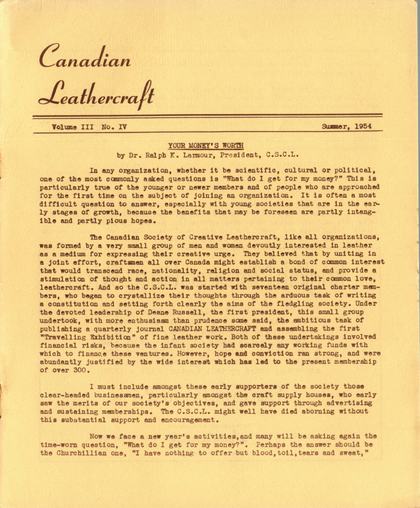
(12 pages, 2.2 MB)
the full-resolution scan, 34 MB, for close research
Page 1 — YOUR MONEY'S WORTH
Canadian
Leathercraft
Volume III No. IV Summer, 1954
YOUR MONEY'S WORTH by Dr. Ralph K. Larmour, President, C.S.C.L.
[The title prints a clean space between "YOUR" and "MONEY'S"; read here as an underscore, the same fault seen on other all-caps titles across the archive, and restored.]
In any organization, whether it be scientific, cultural or political, one of the most commonly asked questions is "What do I get for my money?" This is particularly true of the younger or newer members and of people who are approached for the first time on the subject of joining an organization. It is often a most difficult question to answer, especially with young societies that are in the early stages of growth, because the benefits that may be foreseen are partly intangible and partly pious hopes.
The Canadian Society of Creative Leathercraft, like all organizations, was formed by a very small group of men and women devoutly interested in leather as a medium for expressing their creative urge. They believed that by uniting in a joint effort, craftsmen all over Canada might establish a bond of common interest that would transcend race, nationality, religion and social status, and provide a stimulation of thought and action in all matters pertaining to their common love, leathercraft. And so the C.S.C.L. was started with seventeen original charter members, who began to crystallize their thoughts through the arduous task of writing a constitution and setting forth clearly the aims of the fledgling society. Under the devoted leadership of Deane Russell, the first president, this small group undertook, with more enthusiasm than prudence some said, the ambitious task of publishing a quarterly journal CANADIAN LEATHERCRAFT and assembling the first "Travelling Exhibition" of fine leather work. Both of these undertakings involved financial risks, because the infant society had scarcely any working funds with which to finance these ventures. However, hope and conviction ran strong, and were abundantly justified by the wide interest which has led to the present membership of over 300.
I must include amongst these early supporters of the society those clear-headed businessmen, particularly amongst the craft supply houses, who early saw the merits of our society's objectives, and gave support through advertising and sustaining memberships. The C.S.C.L. might well have died aborning without this substantial support and encouragement.
Now we face a new year's activities,and many will be asking again the time-worn question, "What do I get for my money?". Perhaps the answer should be the Churchillian one, "I have nothing to offer but blood,toil,tears and sweat,"
Page 2
and the request that we should all go forward together, firm in the belief that if we do we shall achieve our aims.
True,we expect to increase the tangible rewards of membership in the C.S.C.L. through expanded journal service, through better travelling exhibitions, and through more active local meetings. But we have many objectives yet to reach, not the least of which is elevation of our standards in workmanship,design and in teaching. We need too, more communication between members, especially those who are outside the range of local sections, and this can be facilitated either by direct contacts, or can be arranged through the medium of the journal and our corresponding secretary.
There is work to be done, for these objectives cannot be gained by sitting back and letting a few perform all the labor. Humans are queer in that they get satisfaction from working hard toward some goal,and while the doing of things for oneself is good, it is also good to work for others with others.
SO, when you are faced with the task of enumerating the benefits of the C.S.C.L. include amongst the tangible values, the inestimable privilege of being part of that company of kindred spirits that accepts the challenge of "blood, toil, tears and sweat" for the purpose of making our craft a noble medium of expressing the creative urge and the joy of beauty.
English Morocco Goat Skins
This fine leather is clean cut from flank to flank, Bag weight 6 to 8 square feet, Bill - fold weight 4 to 6 square feet. (Too small to cut in half.) Comes in Black - Brown - Tan - Red - Wine - Green or Navy Blue. Grey and Natural shades come in bag weight only. When ordering, order by this number - CSI. - 1108.
Square Foot 75¢
"For Handicraft It's Lewiscraft"
284 KING ST. WEST, TORONTO, ONTARIO
Showroom and Mail Order
Page 3 — FIFTH ANNUAL MEETING, 1954; RETIRING PRESIDENT'S REMARKS
FIFTH ANNUAL MEETING, 1954
The Annual Meeting got underway at 9:30 Saturday morning, June 12th, for a pleasant all-day session. About one hundred members and visitors attended the interesting meeting held at Ryerson Institute of Technology in Toronto. The Secretary reported the great strides that our society has made during the past year and told of the Exhibition of Canadian Leathercraft sent on invitation to London, England. Visits have been exchanged with the Eastern Leather Carvers Guild of Rochester, N.Y., and it is hoped that this exchange will continue and expand in the future. The quarterly bulletin, "Canadian Leathercraft", has been issued under the capable direction of our retiring President,Mr. Deane Russell, and this will be carried on by an Editorial Board in the next year. There has been a marked improvement in the quality of our displays and especially in the field of design. The Society has grown considerably in size, with a present membership of over three hundred.
The new Travelling Exhibition went on tour in March with about 90 pieces by 33 craftsmen included, of which eight are educational displays. Response to this new Exhibition has been very good with the many leathercraft groups who have viewed it expressing their appreciation of the high educational value of this display. A fee of $15.00 has been charged each group showing the Exhibition which takes care of transportation costs, etc. Leathercraft groups interested in showing this Exhibition may get information from the Exhibitions Chairman.
An amendment to the Constitution was passed by which the immediate Past President will be a member of the Executive for one year. It was agreed that this action would help to give continuity to our work.
The Canadian Handicrafts Guild has invited our Society to affiliate with them as a group, but the fee of 15¢ per capita was felt to be rather high in view of our membership figures. This matter is to be discussed with the Guild and when details are available a letter ballot of all members of C.S.C.L. will be taken to decide upon future action.
During the afternoon, demonstrations were given by outstanding craftsmen of glovemaking, box covering, turned edge work, lapel pins, purse framing, and saddle stitching. An interesting and informative feature was the panel discussion under the capable chairmanship of Mrs. Nora Lloyd, at which time members had a good opportunity to ask many questions and gather much useful material.
RETIRING PRESIDENT'S REMARKS
The keynote of the retiring President's remarks was that all members should concentrate on improvement in design and technique constantly, reviewing their own work with a very critical eye at all stages of its development. Work should not be judged on the basis of who did it but rather on how it is done. Efforts should be made to put out work of Associate and Fellowship standards.
Page 4 — AWARD TO RETIRING PRESIDENT; REQUIREMENTS FOR HIGHER MEMBERSHIP AWARDS
AWARD TO RETIRING PRESIDENT
At the close of the annual business meeting, a special award was made, which took the form of an Honorary Life Fellowship in the C.S.C.L. for the Retiring President,Mr. Deane H. Russell. This is the highest award our Society can give and it was agreed that Mr. Russell's contribution in helping to organize and carry on our Society merited such recognition. His work for C.S.C.L. was often carried on at a personal sacrifice and has help Canadian leathercraft to become a recognized craft to a much greater extent than it had previously been.
REQUIREMENTS FOR HIGHER MEMBERSHIP AWARDS
Our Annual Meeting agreed that requirements for the two higher membership awards, Associate and Fellow, should be published in this issue of "Canadian Leathercraft", so that all members might be aware of these requirements and work towards them.
Requirements for Associate Membership are: (1) Not less than three years' satisfactory practice of leathercraft.
(2) Demonstrated ability to produce work of a high standard of craftsmanship, originality of design not essential; good general knowledge of materials and techniques.
(3) Approval by Board of Selection of submitted work as follows: (a) handbag or other large article; (b) belt, and (c) two other optional. Any pieces accepted for C.S.C.L. Exhibitions may be counted here.
(4) Two years' service to the Society.
Requirements for Fellow Membership are: (1) At least one year as an Associate
Member.
(2) Three years' service to the Society.
(3) Wide experience in the leathercraft field.
(4) Meritorious achievement in leathercraft.
(5) Work accepted for 3 C.S.C.L. showings.
(6) Original design in all submitted work.
Service to the Society includes active participation in furthering its objectives, which include: To encourage originality of design;
To establish high standards of craftsmanship;
To advance education in the art;
To participate in exhibitions.
Members wishing to submit work to qualify for these awards should watch for submitting date to be announced in a later issue of this bulletin. All awards will be made at the time of the Annual Meeting in June.
Page 5 — UPHOLSTERING FURNITURE IN LEATHER
UPHOLSTERING FURNITURE IN LEATHER by Reta Larmour
Our old occasional chair had served its time. The back had broken away from the frame. The upholstery was completely worn out. The cost of reconditioning would have been more than the chair was worth. It was sitting in the front hall, waiting for the Salvation Army pick-up, when for the first time we looked at it critically.
On examination, we found that the back could be readily repaired by means of a couple of dowels and some glue. The upholstery on both back and seat was fitted around wooden forms, which could be removed without difficulty. Within minutes we had these forms free from the chair, and the upholstery laid out on the table. We realized that we had our patterns already prepared for us.
Being of ancient vintage, the upholstery padding was wool. A quick telephone call, and the expenditure of $2.80 brought us two squares of foam rubber 15 inches square, 3 inch thick for the back and 1 inch for the seat. These we trimmed to size, cutting them on the pitted under-side with about a 45-degree bevel, so that they would taper gradually and neatly to the edges of the wooden frame. The foam rubber was cemented to the wooden frames with Barge. We applied Barge quickly to the wood only, then placed the rubber in position immediately, while the Barge was still damp. We held it in place with weights till the Barge had set. It made a satisfactory union.
We decided to use 3½ oz. natural cowhide for the leather upholstery, to allow good depth for carving the all-over design. However, lighter weights could be used just as well, depending on the type of decoration, if any. The lighter weight would cut down the amount of skiving.
Using the old upholstery for a cutting pattern, we made a generous allowance for turning under the wooden frames and for the amount of leather liable to be taken up by the foam rubber. The decorative design was then applied. We chose an all-over carving pattern since we felt it should take care of the usual wear and tear of scratches and mars. This pattern had no fixed straight-line borders, for we could not tell exactly where our edges would be, and we felt we would have less difficulty in fitting the leather into position.
We dyed the leather with Golden Tan Antique, and let it dry thoroughly to take care of shrinkage. We applied Polish Coat Only out as far as the edges, leaving the turn-under until the leather had been fitted. It is easier to handle, and to dampen if necessary to mould into shape, without Polish Coat. When the leather was finally in place, we gave it several more Polish coats, and plan to do so at fairly frequent intervals, to keep it clean and in flexible condition.
The next step was to outline the upholstery pattern in ink on the flesh side of the leather, as a guide to skiving. We skived outside the line, taking the leather down sufficiently to allow for easy turning over the wooden frame. The corners particularly needed to be well skived, as they were the most difficult to fit.
Page 6
When we decided the skiving was satisfactory, after fitting and working over the edges,we were ready to cement the leather to the frames. Within the ink outline of the pattern, we applied Barge quickly all over the flesh side of the leather, and while still damp, placed it in position over the foam rubber, working it down and holding it in place until the bond was formed. The cement held satisfactorily. We found it necessary to do this complete cementing to hold the leather smoothly in place, otherwise it seemed there would be an uneven surface, depending on the contours of the frame and padding.
Next came the edges. Here Barge was applied to both the flesh side of the leather and the under-sides of the wooden frame,and allowed to dry a few minutes before cementing, to permit maximum adhesion. We did each of the four edges in succession,leaving the corners free and working the leather down well over the edges. We found we had to take little pie-shaped nicks out of the leather to permit it to fit comfortably on the curves. Lastly we finished the corners,using the round bookbinding corner technique,working the leather into small pleats or folds. Here again we had to take pie-shaped nicks out of the leather to overcome the extra bulk on the corners.
Once it was well cemented, the surplus leather was cut away from the wooden frame on the back, and skived down to the wood, to make for as smooth and even a surface as possible. The seat did not matter, since the underside was completely concealed. Next, the wooden back had to be covered with leather also. Here we used about 1½ oz. leather, cut to the exact edge of the frame,and skived down thinly back about half an inch. It was cemented to the wood, with the Barge On both the leather and the wood.
The framework of the back had a ledge about half an inch wide on the front side of the wood, like in a picture frame, into which the upholstered part fitted. We applied Barge to this ledge, after carefully roughening the surface with sandpaper, and also to the grain side of the leather,to a line carefully drawn with a scratch awl to the edge of the chair frame at the back. Then we simply pressed the upholstered part into the frame, and left it overnight under weights of various sorts. So far the Barge seems to be holding it firmly in place,although in time we may have to fasten it in more solidly with small nails,carefully worked through the leather in appropriate places in the design.
The seat was child's play - we simply had to refasten it to the chair frame in the original manner, namely with long screws.
A little refinishing on the wood of the frame, $2.80 of foam rubber, and less than 4 square feet of leather have given us a goodlooking chair, which should wear for years. This technique is applicable to any type of chair where the seat,or seat and back,can be removed,covered and replaced. We also covered a footstool which had a wooden frame and upholstered top. We would suggest that you look critically at odd pieces of furniture -- you too may easily get something for practically nothing, except a little hard, but interesting work.
Page 7 — A HOBBY FOR LEATHERCRAFTSMEN
A HOBBY FOR LEATHERCRAFTSMEN by Dorothy Muma
When a hobby becomes a business, what does the craftsman do for his hobby?
For Robert Muma,the answer lay in collecting different leathers,and this offers a suggestion for a fascinating hobby for other leathercraftsmen,literally endless in its scope. From the most ordinary types of leather such as cowhide, calf and sheep down to the rarer types such as whale, llama and camel,the search is exciting and educational in all its phases. The craftsman will be led to correspond with many people to extend the number of varieties and will want to spend all his free time in the hunt for different pieces to add to his collection.
Organizing A Collection
Once embarked on a collection, the craftsman will find that he must either specialise or be prepared to devote a great deal of space to it. In starting to collect leather samples,some decision must be made as to its extent,but the easiest way is to go through every available scrapbox and get as many different colors, types, grains and tannages as possible.
Many craft houses and tanners will furnish samples of their specialities on request but extensive activity along this line will probably produce many duplicates. An interesting way to use such duplicates is to have a special section for variations in grain patterns, brand marks, scratch forms, and other natural blemishes. Some of these blemished pieces might even be colored to accentuate the defects. Even the individual sections of this intriguing hobby have limitless possibilities.
The easiest divisions to make in your collection are: tooling or carving leathers, and non-tooling or carving leathers, with subdivisions of upholstery leathers,shoe leathers,printed and embossed grains,and others. Or it may be preferred to use the animal divisions, i.e.,cowhide,calf,sheep,goat,etc. Many ideas can be gathered by visiting other craftsmen, especially those who have already made a collection,and exchanging notes with them.In this way, further names of tanners and dealers will be secured and collecting possibilities enlarged. The more people who know you are collecting,the more samples of leather will come your way. A worldwide correspondence with tanners and dealers will bring forth an exciting selection of the lesser-known leathers. Make use of your friends who are going abroad also,by asking them to keep an eye open for any special samples.
Mounting
In the beginning,probably a large looseleaf notebook would be satisfactory for housing the collection,but as more samples are acquired,a more permanent form of binding should be sought. The collection will never be "complete". There will always be one or two more kinds of leather to collect as tanners continually bring out new finishes and textures. Then, too, you will continue to hear of different types of leather being used in some other part of the world and will not rest until you have some of that type. So on goes the search for new and unusual varieties. These latter will be the slowest to come to you and space must be allowed for them to be added. Do not crowd the samples, especially at first. Space them out well, properly labelled, to leave room for later additions. The perfect setting for such a collection,of course, is large leather-bound albums, perhaps one for each division of your collection, and ideally bound in the leather which the album houses.
Page 8
To make the display attractive,the samples should be cut in different shapes and mounted, Heavy bookbinders' cover paper or heavy drawing paper makes a good mounting surface. Here again is a possibility for variation in display - different colored papers to harmonize or contrast with the leather colors or different surface textures. The mounting surface should be of a size convenient to handling and storing but large enough to provide space for several variations.
Many collections are in the end worthless because of poor mounting and setting up. It is best to mount on one side of the sheet only so that the edges of the pieces do not conflict with those opposite. Be sure the pieces lie flat. Use a latex or rubber cement for mounting purposes. Samples need not be cemented down all over, but sufficiently so that they do not curl up and do stay in place. Leave One edge free for examination of the underside of the leather. Too much handling should be discouraged. Very fragile pieces should be kept carefully and in such a way that they cannot be handled.
Remember that all leather dries out in excessive heat, so keep the collection away from radiators, sunlight, or any form of direct heat. It should also be protected against dampness, as mildew is practically impossible to remove and can soon spread through the entire work. Dampness may also cause the mountings to wrinkle and generally spoil the appearance of your collection.
Leathers
You will find the easiest to collect, mount and display will be the commoner types of leather. These can usually be obtained in pieces large enough to cut to any shape desired and in a thickness which facilitates handling. The most difficult will be the reptile skins, which may vary from very thick to paper thin in weight and from a few inches to several feet in length. Alligator and crocodile skins vary in themselves as to thickness and color,some parts being very thick and others. quite thin. Snake skins generally are thinner, the smaller ones sometimes being almost fragile. Baby snake skins can usually be mounted whole and make a beautiful addition because of their delicacy of color and texture. Leathers tanned with the hair left on present further problems of thickness plus softness. These latter need to be protected from moths and should be inspected regularly for moth damage, although this danger is not so imminent after the pieces are mounted. Be prepared for many strange odors if you collect such leathers as fish skins, native-tanned deerskins, and some skins from the Far East.
These are only a few suggestions to get you started on this stimulating hobby. So acquire some leathers, mounting materials and storage space and embark on an entirely new venture.
Craftsmen interested in exchanging small samples of leather for a collection as described above are invited to do so through the Editor's office. If there is sufficient interest, a list of such samples available in this way will be published in future Bulletins.
Page 9 — New Associate Members; Membership Fees Payable; Introducing Our New Executive
New Associate Members
Awards of Associate Memberships were presented to the following at the Annual Meeting after they had met the requirements listed on page 4 for that award.
Mrs. Mabel Holman (Aurora, Ont.); Mrs. Marie Lounsbury (St. Catharines, Ont.); Mrs. Nora Huyck (Willowdale, Ont.); Mrs. Jean Newton (Toronto, Ont.); Mrs. Helen Wheaton (London, Ont.); Miss Margaret Lancaster (Toronto, Ont.); Mr. Robert Shaw (Toronto, Ont.); Miss H. Elizabeth Arnold (Kirkland Lake, Ont.); Mrs. Dorothy Muma (Toronto, Ont.); Mr. Endel Ruberg (Montreal, Que.).
Membership Fees Payable
All membership fees became due on June 1st, and those members who have not yet renewed are reminded to do so as soon as possible. New members joining between January 1st and June 1st of any year will be charged a membership fee of $1.00 for that period, and their renewal membership will become due on June 1st of that year. General membership fee is $2.00, Associate fee $3.00, Fellow membership $5.00 and Sustaining membership $10.00. Membership lists will be revised in the fall and members are urged to renew their memberships now.
Introducing Our New Executive
The President: Dr. Ralph K. Larmour, Toronto, Ont.
Dr. Larmour needs very little introduction to Canadian leathercrafters, especially those in communities which have been privileged to view his collection of colored slides depicting the best in Canadian leathercraft. His most outstanding contribution to our craft, however, is the originating of the Garnett series of Dyes and Antiques which have opened a complete field for those interested in experimenting with color on leather. A research chemist by profession, he has used his knowledge freely to help leathercraftsmen in many ways. His hobby, much to the horror of his many victims, is taking dreadfully candid snaps at odd moments and showing them as slides at any opportunity. We welcome Dr. Larmour to his arduous tasks as President of our Society.
Handicraft Leathers and Supplies
Fine Assortment of Beautiful Leathers. Complete range of Leathercraft Tools and Accessories. Comprehensive Detailed 64 Page Catalogue with 24 Page Supplement. Experienced Personalized Service.
The Birt Saddlery Co. Ltd., The Leather Goods House, 519 Main Street, Winnipeg, Manitoba.
This page carries the ten new Associate Members named at the 1954 Annual Meeting (Mabel Holman, Marie Lounsbury, Nora Huyck, Jean Newton, Helen Wheaton, Margaret Lancaster, Robert Shaw, H. Elizabeth Arnold, Dorothy Muma, Endel Ruberg), the membership fees notice, an introductory profile of new President Dr. Ralph K. Larmour, and the Birt Saddlery advertisement, all printed here in full.
Page 10 — LEATHER LAPEL PINS
10
LEATHER LAPEL PINS by Helen M. Wheaton
The making of leather lapel pins has become one of the most interesting and popular phases of leathercraft. The following are some suggestions for success in their making:
(1) Use a piece of 8 oz. cowhide or scrap from purse weight cowhide.
(2) Trace, carve and stamp design on leather. Almost any flower or part of a scroll can be adapted to pleasing pin designs, and at the right are two samples of the type of design most suitable for these pins.
(3) Cut out with No. 11 X-Acto blade. Do cutting while leather is still damp or redampen to get the best result. The correct moisture content of the leather makes for easier cutting and will give a smoother edge.
(a) The cutting may be done flat on a piece of heavy leather or any material that will allow the point of the blade to penetrate. I use a heavy rubber boot sole. If the cutting is done flat insert tip of blade at base of petal or at the "V" point of overlapping leaves and cut by repeated insertions toward the tip of petal or leaf. (See diagram a).
(b) The cutting may be done with the work held in the hand and the excess leather pared away. I use this method myself and find it a little easier and quicker, but it takes a steady hand and should be practised on scrap first. If work is held in hand, cut a rough circle around the article first, and then cut from the tip of petal or leaf toward the base or to where it may Overlap another petal. Hold top of work up and starting at the base of the blade draw the Knife down to tip of blade and forward along the line of cut; repeat, toward the base of petal or leaf; In this way you are always working toward the point of a "V", (See diagram b) ee Try to keep your cut in the "v" of the swivel cut so that the top edge is left rounded by the swivel cut. Use rouge board frequently to keep the cutting edge keen.
(4) When cutting out is finished round the edge from the back by bevelling with X-Acto knife.
(5) Where possible rub edge as you would a belt edge.
Page 11 — Workshop Tips
(6) When satisfied with edge, dip the leather in McDougall's Antique Finish and set on a rack to dry. The antique seems to give enough stiffening to this weight leather. Quick drying with heat will also add to the stiffness of the pin.
(7) Find the spot on the back of pin to give the best balance to handing of pin, scratch the back to roughen where cement is to go. At present I have been using Cats Paw Cement but have also used white latex cement successfully. Cement roughened spot and a small piece of scrap morocco and let get tacky. Put bar pin in place and cement down with the piece of morocco. Allow cement to set well before handling.
Note about author of this article: Mrs. Helen Wheaton is President of the Leather Carvers Guild of London. She has made many of these lapel pins and is considered an expert along these lines. She very ably demonstrated her methods during the afternoon session of our last Annual Meeting.
Workshop Tips
Workshop Tips are invited from craftsmen able to contribute helpful suggestions for the benefit of fellow C.S.C.L. members.
Come to "Capital"
For the Best in Standard and Specialty Leathers and Leathercraft Supplies BARGE CEMENT - - The most powerful All Purpose Cement made. HACKBARTH Handmade Saddle Stamps and Swivel Knives - - The finest Professional Tools available.
METAL HANDBAG FRAMES.- - Patterns - - Instructions - - Framing Tools - - The latest trend in handcrafted bags.
GARNETT LEATHER DYES AND FINISHES - -~ The finest for the Leather Craftsman.
The greatest assortment of Belt Buckles and Purse Clasps in Town. Expert advice and assistance on Leathercraft problems. Mail orders given prompt attention.
CAPITAL FINDINGS AND LEATHER LIMITED 132 King St. E., Toronto - EM. 3-8563
Page 12 — "Canadian Leathercraft" C.S.C.L. Executive
"Canadian Leathercraft"
Published quarterly by The Canadian Society of Creative Leathercraft as an educational service to decorative leathercraftsmen.
Subscriptions to "Canadian Leathercraft" and General Membership in Society: $2.00 annually. Sustaining, Associate and Fellow Membership standing upon qualification. For information write: Chairman, Membership Committee. For Advertising Rates write: Advertising Manager.
C.S.C.L. Executive
President: Dr. Ralph K. Larmour, 59 High Park Blvd., Toronto, Ont.
Vice-President: Robert J. Muma, 62 McGill St., Toronto, Ont.
Corresponding Secretary: Mrs. Louise Smyth, 40 Strathmore Blvd., Toronto, Ont.
Recording Secretary: Miss Viola Harris, 47 Snowden Ave., Toronto, Ont.
Treasurer: Mrs. Nora Huyck, 180 Greenfield Ave., Willowdale, Ont.
Chairmen of Committees: Advertising – Cecil Roebuck, 224 Winona Dr., Toronto; Exhibitions – Mrs. Reta Larmour, 59 High Park Blvd., Toronto; Membership – Mrs. Faith Schnarr, 14 Eleanor Ave., Toronto; Editorial – Mrs. Dorothy Muma, 62 McGill St., Toronto; Publicity – Robert Shaw, 2988 St. Clair Ave. E., Toronto.
Executive Council: Clyde Johnson; Deane Russell; Harold Frost; Fred W. Brown; Mrs. Margaret Jennings; Don MacKinnon; Miss Muff (Community Programs Branch Representative).
Robert Muma
Announces Fall Courses in Leathercraft as follows: Elementary Course, Secondary Course, Advanced and Teachers' Courses including Theory, Tooling Techniques, Color, Construction, Finishing and an introduction to Carving. Enrol early. Write or phone for full information now.
Mumart Studios of Creative Leathercraft, 62 McGill Street, Em 6-1843, Toronto.
New Garnett Leather Dyes
Mahogany Antique -- A deep reddish brown -- An all-purpose color which blends with most dress combinations.
Forest Green Antique -- Gives greater scope to antique dyeing.
Black Toning Dye -- The answer to dyeing natural leather black.
Also:
Antiques -- Golden Tan, Chestnut Brown, Havana Brown, and Rouge.
Toning Dyes -- Dark Brown, Middle Brown, Tan, Scarlet, Orange, Yellow, Green, Blue, Light Blue.
Ask your Dealer for free Garnett Instruction Manual. Dealers write for information to: Garnett Company, 1 Hannaford Street, Toronto, Ont. Ox 4587.
This page carries the year's subscription notice, the 1954 C.S.C.L. Executive roster in full (President Dr. Ralph K. Larmour; Vice-President Robert J. Muma; Corresponding Secretary Louise Smyth; Recording Secretary Viola Harris; Treasurer Nora Huyck; committee chairmen Cecil Roebuck, Reta Larmour, Faith Schnarr, Dorothy Muma and Robert Shaw; and an Executive Council of Clyde Johnson, Deane Russell, Harold Frost, Fred W. Brown, Margaret Jennings, Don MacKinnon and Miss Muff), and two advertisements (Mumart Studios' fall courses, and Garnett leather dyes). Two names easy to misread are printed clearly: "Cecil Roebuck" and "Clyde Johnson" — the same Clyde Johnson named on the 1954-fall roster.