
An issue of the Society’s newsletter, transcribed from the original.
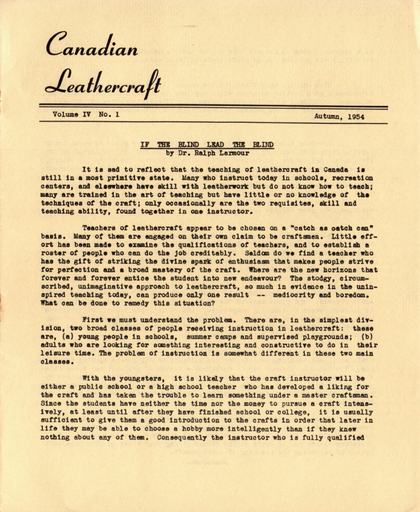
(12 pages, 2.2 MB)
the full-resolution scan, 34 MB, for close research
Page 1 — IF THE BLIND LEAD THE BLIND
Canadian Leathercraft
Volume IV No. 1 Autumn, 1954
IF THE BLIND LEAD THE BLIND by Dr. Ralph Larmour
It is sad to reflect that the teaching of leathercraft in Canada is still in a most primitive state. Many who instruct today in schools, recreation centers, and elsewhere have skill with leatherwork but do not know how to teach; many are trained in the art of teaching but have little or no knowledge of the techniques of the craft; only occasionally are the two requisites, skill and teaching ability, found together in one instructor.
Teachers of leathercraft appear to be chosen on a "catch as catch can" basis. Many of them are engaged on their own claim to be craftsmen. Little effort has been made to examine the qualifications of teachers, and to establish a roster of people who can do the job creditably. Seldom do we find a teacher who has the gift of striking the divine spark of enthusiasm that makes people strive for perfection and a broad mastery of the craft. Where are the new horizons that forever and forever entice the student into new endeavour? The stodgy, circumscribed, unimaginative approach to leathercraft, so much in evidence in the uninspired teaching today, can produce only one result -- mediocrity and boredom. What can be done to remedy this situation?
First we must understand the problem. There are, in the simplest division, two broad classes of people receiving instruction in leathercraft: these are, (a) young people in schools, summer camps and supervised playgrounds; (b) adults who are looking for something interesting and constructive to do in their leisure time. The problem of instruction is somewhat different in these two main classes.
With the youngsters, it is likely that the craft instructor will be either a public school or a high school teacher who has developed a liking for the craft and has taken the trouble to learn something under a master craftsman. Since the students have neither the time nor the money to pursue a craft intensively, at least until after they have finished school or college, it is usually sufficient to give them a good introduction to the crafts in order that later in life they may be able to choose a hobby more intelligently than if they knew nothing about any of them. Consequently the instructor who is fully qualified
[The masthead "Canadian" / "Leathercraft" is printed in large script above the volume line, set out here too.]
Page 2
as a teacher, needs to possess only a good basic knowledge of the craft in order to fulfill the purpose behind craft training in schools.
With adults, many other factors enter. Chief of these are: the need to arouse a good healthy interest which may lead to a real hobby interest; the voluntary enrollment of adults which makes it difficult to impose strict procedures of teaching; and the general intractability of the Canadian adult in respect of spare-time activities.
Moreover these adult groups are organized in a variety of ways, with varying degrees of autonomy. There are the recreation centers, supported by public funds, and subject to certain definite regulations. There are the church, club and company recreation groups,which are self-supporting and hence independent of any rules but their own. There are the hospital and sanitarium groups which are to a large extent autonomous. There are the groups,or classes,conducted by hobby dealers which usually entail payment of a fee but impose no precise limitations on what the instructor may wish to teach. Finally, there are the craftsmen who give private lessons.
Adults, if they become interested, usually purchase more tools and materials than do youngsters. Left to their own choice, they will pick a wide range of projects on which to work while learning. In general they will demand a high degree of technical skill in the instructor, and they will expect to master the craft with prodigious speed.
Since development of skill in the craft is the prime objective with adult classes, and since many of the adult groups are quite independent, there is no requirement of teaching competence, and usually the instructor is anyone with some knowledge of the craft, professed or real, who can be induced to take the job. Too often this proves to be a case of the blind leading the blind,with the result that they both fall into the ditch.
It should be possible to establish a list of people who possess both craft skill and teaching ability,for the guidance of all groups seeking instructors. The C.S.C.L. already has in operation a system of professional classification, namely the Fellows and Associates who are admitted to these categories by proof of their competence in the craft. But the question of teaching competence has not yet been taken into consideration. Perhaps the time has come to do something about this, We do not profess to know the answers to this problem. We do think, however, that amongst the members of the C.S.C.L. there are many who, having thought seriously about it, could offer sound opinions on this subject. We therefore invite you to write to the Editor giving your views on this important matter of improving the teaching of leathercraft.
Page 3 — INTERNATIONAL ASSEMBLY OF LEATHERCRAFTSMEN; "NOTHING LIKE LEATHER"
INTERNATIONAL ASSEMBLY OF LEATHERCRAFTSMEN
The First International Assembly of Leathercraftsman arose out of discussions held between Toronto and Rochester leathercraftsmen last spring. It was felt that leathercraftsmen from both Canada and the U.S.A. would derive much benefit from an opportunity to get together and discuss their favorite topic-leather. Arrangements culminated in a Leathercraft Weekend at the Hotel Statler in Buffalo, October 30 and 31. More than 150 leathercrafters attended the gathering, with Canada being represented by about 30 from London, Toronto, Welland and other centers. Displays of top workmanship were set up by the Guilds of Detroit,Buffalo and Rochester, along with representative pieces from the C.S.C.L. and some Al Stohlman originals. Continuous demonstrations of carving, stitching, coloring, box-covering and purse framing were the Saturday feature.
An organizational meeting was held Saturday afternoon with representatives from the various guilds. At this meeting it was decided that the Assembly should be an annual gathering under the guidance of an international committee. The next Assembly was scheduled for Toronto, in the spring of 1955. It was felt that spring would be a better time than fall for such a gathering. The Toronto Guild was delegated to select a Chairman for the Committee, and Cecil Roebuck was later appointed to this post. Bob Hartman of Detroit was appointed Vice- Chairman. Mrs. Louise Smyth of Toronto was elected Secretary, and Mrs. Nora Huyck of Toronto was elected Treasurer, with an Assistant Treasurer to be appointed by the Rochester Guild. Other members of the committee will include Publicity Director, Customs Directors (one American and one Canadian), and an Advertising Director.
Saturday evening leathercraftsmen enjoyed a dinner dance, at which time door prizes donated by various craft houses were drawn. Sunday morning, Dr. Ralph Larmour of Toronto showed some of his collection of leathercraft slides, commenting briefly on the different types of work shown. The movie, "The Art of Leather Carving" by Joey Smith, was also presented. The Rochester and Buffalo Guilds in particular are to be highly commended for the great effort they put forth to make this weekend the big success that it was.
Plans are under way for the Second International Assembly, to be held in Toronto, probably in May, 1955, and further information will be published in the next Bulletin.
"NOTHING LIKE LEATHER"
"Leatherwork is a craft which had its beginnings in the early civilizations. Specimens of ancient work are preserved in the museums, many having been recovered from the tombs of the early kings of Egypt. This points to the fact that articles of leather for general convenience and durability are not replaceable by articles made of other substances. No substance equals leather for the construction of articles for personal use. Its attractiveness, its flexibility, resiliency and general wear-resisting properties have earned for it the centuries old reputation -- nothing like leather."
("Leather Goods Manufacture")
Page 4 — HAND CARVED SHOES
HAND CARVED SHOES by Margaret Jennings
The shoes you sew in the Travelling Exhibition No.l were really hand carved and hand made, and in that order too; not decorated after being made, as many people believed.
Of first importance is finding someone to make up your shoes. Here fn London, as in many communities, we are fortunate in having a New Canadian shoe designer and maker, who is an artist in his trade. Enquire at your local leathercraft supply house. They will in all probability be able to direct you to someone who will do the job for you.
On my first visit, the style of shoe was chosen. Then my feet were measured and a paper pattern was drafted by the shoemaker. At home, I worked out the decorative design with pencil to fit this paper pattern and took it back for approval. The shoemaker, after checking that the design was well within the area that would be exposed, cut the leather pieces according to the pattern. The leather in this case was a lightweight Mission Grain Steerhide--a two-and-a-half ounce calf would be even more workable.
The actual carving was done, with extreme caution, especially on vamp and toe, the leather antiqued and a light polish coat applied.
Back to the shoemaker again with the decorated pieces to be made up on the last he had built from my measurements. I confess I dropped in whenever possible to watch this most fascinating procedure and would like to try it myself someday.
Most shoemakers are reluctant to attempt an all-ower decorated shoe. It is very difficult to stretch the decorated pieces around the toe; in fact, few will do it. Instead, try a pair of open heel and toe or sport sandals, or even a plain pump with a decorated removable strap -- here you can have a change. Some barefoot sandals you can make yourself. Try them; it's lots of fun.
Don't forget to design and make a bag to go with whatever shoe you produce, then you will really have something of which to be proud.
COLOR IN LEATHERCRAFT by ROBERT MUMA
This is a new, much enlarged and revised edition of Mr. Muma's book on color decoration and finishing of leather. Now being published in the U.S.A. it will soon be available for distribution in Canada. This outstanding work on color now contains almost twice as many pages with line and half-tone illustrations and a course of 12 progressive exercises in color techniques. A valuable addition to any leathercraftsman's library. Price,.« « «© «© e e $1.50
Order from your dealer or direct
MUMART STUDIOS OF CREATIVE LEATHERCRAFT 62 McGill Street, Toronto 2, Ontario
Page 5 — EXHIBITIONS AND LEATHERCRAFT
EXHIBITIONS AND LEATHERCRAFT
Pacific National Exhibition, Vancouver:
On the invitation of the Board of the Pacific National Exhibition, the current Travelling Exhibition was sent out to Vancouver as a special exhibit. The Travelling Exhibition was considered so outstanding by the judges that the C.S.C.L. was awarded the Bedford Silver Cup for the best leathercraft entry, and the P.N.E. Silver Medal for the best club entry.
Western Fair, London, Ont.:
This year at the Western Fair, The London Leathercraft Guild joined forces with the London District Weavers and the P.U.C. Recreation Department to assemble an exhibition and demonstrations of several crafts, such as weaving, pottery, woodcarving, copper tooling and leathercraft. We were fortunate in having the services of Mr. Eric Warrington, a free lance designer, and the overall picture of the exhibit was most satisfactory. A great deal of interest in the various crafts was shown by the public. While this was very satisfying to the Fair Board, it was felt by our group, that more interest and benefit to leathercraft resulted when we organized our own exhibit as in the past two years.
The materials to construct the exhibit were borrowed from one of the contracting firms of the city with the understanding that nothing was to be cut. The material consisted mainly of sheets of plywood, two-inch planks and cement blocks, any Of which could be painted but not otherwise damaged for future use. This is an interesting idea and a tip that others might use in putting on exhibitions,
Those in charge of the handicraft and hobby department of the Fair were quite disappointed in the number of articles entered for competition. It is hoped that more publicity among leathercrafters will bring forth additional entries in the future.
The work submitted was of good quality and all work submitted was put on exhibit. Anyone interested in entering articles may get a prize list from the Western Fair Association, Queen's Park, London, Ontario.
Central Canada Exhibition, Ottawa:
The Central Canada Exhibition was held at Ottawa, August 21st to 28th, Leathercraft was displayed along with other handicrafts, on the top floor of the grandstand building. Entries were displayed in glass cases and were divided into two sections, Handicraft department and Hobby Show department. All age groups were represented in the Hobby Show, with numerous entries from school children. There were also prizes for work done by hospitalized veterans and by the blind.
[The closing date is printed "August 21st to 28th,".]
Page 6
Leathercraft entries were not so numerous in the Handicraft department, so few in fact that all pieces entered in the thirteen different classes won prizes. The quality of work was fairly good, with a number of original designs winning the first prizes.
Those in charge of the Handicraft department would like to see more leathercraft at this fair next year. A prize list may be obtained from the Central Canada Exhibition Association, Lansdowne Park, Ottawa, Ont.
---- Margaret Richardson.
Canadian National Exhibition, Toronto -- Canadian Handicrafts Guild Section
The Canadian Handicrafts Guild leathercraft competition at the C.N.E. this year furnished a concrete example of the progress made in this craft since the formation of our Society, with its emphasis on original design and fine craftsmanship. With one exception, all articles accepted and displayed were the work of Society members.
An enlarged prize list this year helped to make the competition more interesting. Winners were:
1st Prize, Best Original Entry (Women's Committee, C.H.G., Ont.) --- Endel Ruberg, Montreal.
1st Prize, Tooled or Carved (Clarke and Clarke Leathers, Barrie) --- Elmar Kalnavarns, Montreal.
1st Prize, Work neither tooled nor carved (Lewis Craft Supplies Ltd., Toronto)--- Margaret Lancaster, Toronto.
1st Prize, Original Design with minimum decoration (Ottawa Valley Leathercraft Studios, Ottawa) --- Edith Roscoe, Weston.
1st Prize, Leather Gloves (Lewis Craft Supplies Ltd., Toronto) --- Clarice Packham, Weston.
Other members whose work was exhibited were: Anne Hooke, Toronto; Olivia Smith, Toronto; Reta Larmour, Toronto; Don MacKinnon, Toronto; John Opariek, Montreal. Final judging was done by Miss Marie Huper, Professor of Art, Agnes Scott College, Georgia.
Pearl McCarthy, art critic for the Globe and Mail, in commenting on the C.H.G. show, said: "We have worried because women's handwork had gone down in quality. Poor taste set in. The C.N.E. can help by showing good taste. At this point, one must recognize the influence of the C.H.G. With some exceptions, the prize-winning pieces in the Guild's section are much better taste than those in the general C.N.E. section. The Guild's leather section should be especially noted by workers in this craft,as it cuts away from the overly ornate fancy work. The box by Edith Roscoe of Weston and a purse by Reta Larmour are very good."
Members should begin now to plan interesting projects for next year's display, in order that we may take a share in making this competition the showcase of the best in Canadian leathercraft, and of comparable quality to the fine articles displayed by the other crafts.
---- Reta Larmour
[The paper plainly types Huper — Marie Huper, Professor of Art at Agnes Scott College, Georgia. Set out here as printed.]
Page 7 — A NEW USE FOR OLD WATCHES
A NEW USE FOR OLD WATCHES by Robert D. Shaw
It is possible that many of our members may have an old wrist-watch or pocket-watch that has been discarded in favour of a more modern one. The old watch still has its uses providing it will still keep reasonable time and, given some "support", it can become an attractive timepiece for one's desk, dressing table or mantel.
Pocket watches and round-faced wrist watches are ideal for this purpose, while wrist watches of other shapes may also be used.
The first step is to choose a piece of 6 - 8 oz. cowhide for the mount and decide on an outline shape for your desk clock. A few outlines are illustrated as suggestions.
Having chosen the desired outline for your clock, proceed with the decoration of your choice.
A case to contain the watch must now be constructed, leaving provision for removing the watch for winding. The case is built up of several thicknesses of 4-6 oz. leather, the centres of which must be removed to provide space for the watch. Cement these pieces together and try the watch for a snug fit, as illustrated. Cut out a facepiece from 4 oz. leather to similar dimensions as that for the case; cut a hole in the centre so that the face of the watch may be exposed. Cement the facepiece to the case, trim and finish the edges. The case is now complete.
End View Front View Final Facing Piece
Cut sufficient to enclose watch and Decoration optional cement together
The next step after decorating and finishing is to cement the case te the decorated leather mount. This will normally be the centre of the mount and the watch should slide in and out comfortably.
Finally a leather support is attached to the back of the mount so that the clock will stand upright with just a slight backward tilt. This support should be of 8 oz. leather or two thicknesses of 4 oz. leather : cemented together, grain side out, and edge finished.
Page 8 — WORKSHOP TIP
«Hunt Attach support by separating the two pieces for about —Case, 2 inch and spreading apart, cementing each edge flat to «—~—Suppoart back of mount. If 8 oz. leather is used, split the edge to make two flaps.
Many other and more complicated applications of the decorated leather clock case may be worked out, the details of which will in all probability differ greatly from those given here. Therein, however, lies an inexhaustible source of ideas both for decoration and construction.
WORKSHOP TIP
To prevent Mac's Antique Leather Finish from lifting Garnett dyes: Before applying Mac's Antique Leather Finish, apply a light coat of Garnett Polish Coat. Let dry, and polish.
Tip by Mrs. Louise Smyth, Toronto.
English Morocco GoatSkins
This fine leather is clean cut from flank to flank, Bag weight 6 to 8 square feet, Bill - fold weight 4 to 6 square feet. (Too small to cut in half.) Comes in Black - Brown - Tan - Red - Wine - Green or Navy Blue. Grey and Natural shades come in bag weight only. When ordering, order by this number
SQuare Foot 75¢
"For Handicraft It's Lewiscraft"'
284 KING ST. WEST ZL TORONTO, ONTARIO
Showroom and Mail Order
Page 9 — WEEKEND WORKSHOPS; WORKSHOP TIPS
WEEKEND WORKSHOPS
Four weekend workshops have been conducted this fall by C.S.C.L. members. Groups of from sixteen to twenty have had concentrated instruction in phases of leathercraft in which they are particularly interested,with the entire weekend devoted to workshop study.
The Simcoe County Arts and Crafts Association spent their weekend learning the intricacies of making gloves and glove patterns to their own measurements, instructed by Edith Roscoe.
The Kirkland Lake group concentrated on designing for leathercraft, under the expert guidance of V. Lara Russell.
The Timmins group, which included craftsmen from Iroquois Falls and South Porcupine,had instruction from Don MacKinnon in general and figure carving and construction, fran Ralph Larmour in dyeing and finishing, from Reta Larmour in purse framing, and from May MacKinnon in glove making. Help was also given with many other problems which had been concerning these craftsmen.
Margaret Jennings spent three weekends at Chatham,with the first weekend devoted to carving, the second to leather tools, hardware and construction, and the third to design, decoration, coloring and finishing.
The workshop weekend is a partial answer to the problem of providing further training to craftsmen in communities where advanced instruction is not available. If the pupils cannot go to the teacher, the next best thing is to bring the teacher to the pupils. The C.S.C.L. is providing a valuable service, and in so doing is working actively toward fulfilling its avowed aims and objectives, to advance education in the craft by improving standards of craftsmanship and design.
WORKSHOP TIPS
Wrap a heavy rubber band around both handles of the plier slit punch so that it will not open too wide -- this will prevent straining the wrist or tiring the hand.
Tip by Arthur Burgess, London.
Maximum pressure ani control may be exerted, while avoiding finger soreness during prolonged cutting sessions, when a leather pad is cemented ower back of knife blade. First apply adhesive tape to blade; then cement leather to tape. Or just wrap tape over pad and around blade. Lightweight leather may be cut with little effort, while severing 7 - 8 oz. leathers becomes easy instead of a repeat-stroke chore.
w--~- Tip by Deane H. Russell, Ottawa.
Page 10 — LAST CALL FOR RENEWALS; INTRODUCING OUR NEW EXECUTIVE; NEW MEMBERSHIP CHAIRMAN
LAST CALL FOR RENEWALS
Enclosed in this Bulletin will be found a special notice regarding renewal of memberships. All memberships became due on June 1st and those members whose cards are dated 1954 are urged to renew as soon as possible. This will be the last Bulletin sent out to members who do not renew. Membership fees are as follows: Fellow Member $5.00; Associate Member $3.00; General Member $2.00; Sustaining Member $10.00. Check your membership card for date, and if not dated 1955, renew now, so that you will not miss news of important leathercraft events and forthcoming articles of leathercraft importance.
Do you have a specialty in the leathercraft field? Is there some article or technique which you feel you are well qualified in? If so, you are invited to write an article about it for a future issue of the Bulletin. All articles submitted will be given careful consideration by the Editorial Committee. Remember the more writers who contribute, the more interesting is "Canadian Leathercraft". Share your ideas with other members, even if only in the form of a Workshop Tip or group news item. What may seem like second nature to you may be something altogether new to some other leathercraftsman. Help to make this Bulletin the real voice of C.S.C.L. by giving the views of the widest selection of members possible. Send articles or items to the Editor, Mrs. Dorothy Muma, 62 McGill Street, Toronto,
INTRODUCING OUR NEW EXECUTIVE
The Secretaries: Miss Viola Harris and Mrs. Louise Smyth
Our Recording Secretary, Miss Viola Harris, has been doing leathercraft for a number of years, turning out work of high standard, carefully executed. Her hobby aside fran leathercraft is flower growing, and she has often used flowers as her design motif in leather and bookbinding, at which she is also adept.
While not of such long experience in the field of leathercraft, our Corresponding Secretary, Mrs. Louise Smyth, has turned out many beautiful leather articles, among them a carved briefcase of excellent craftsmanship. Mother of four small children, she still finds time to attend leathercraft classes and the local Toronto Guild, as well as doing much custom work. It is said of Mrs. Smyth that neither husband, children, nor the fall of night can deter her from the accomplishment of her leathercraft project.
NEW MEMBERSHIP CHAIRMAN
Due to the pressure of other activities,the Membership Chairman appointed at our Annual Meeting, Mrs. Faith Schnarr, has had to give up that post. The office of Membership Chairman has now been taken over by Miss Elizabeth A. Prince, with the approval of other Executive members. All memberships should be sent to Miss Prince at 153 Close Avenue, Toronto 3, Ontario.
Page 11
YES, It's TRUE! Illustration (A) — a tool conjured up in our minds when asked this actual question not so long ago:
"Have you a tool with a SPOON on one end and a PIN on the other ?"
Too often, beginner craft students don't bother to learn correct names for their tools. They seem content to order by catalog number alone, or by wild description, without realizing that learning of proper names for equipment is in itself an aid to better understanding of the special functions of / a tool.
It's equally true that some of the finest decorative leathercraft in Canada today was produced with tools little better than tool "A" — tools quickly beaten from nails and crudely bound with cord or tape for handles. But such work represents exceptions — accomplished in spite of tools used, and only because of highly developed skill in tool manipulation by the craftsman.
It is our firm belief that such masters of leather modelling could increase their enjoyment of leather decorating, if not their already excellent work by becoming the proud owner of a new OVLS "Canadian Modeller-Tracer" (B) — developed after long study of over 30 different typical modellers from Europe and North America. Made of rustproof, nickel silver, individually hand finished — this one tool suffices for over 90% of all modelling needs.
A finely-designed and finished tool adds pleasure to any craft. Send for your "Canadian Modeller" today. Price $1.10 — postpaid. Groups may receive 12 for the price of 10°
Ottawa Valley Leathercraft Studios, 116 O'Connor St., Ottawa fo
Our Catalogue Club
provides a valuable service for you.
FOR INFORMATION
Write to:
Clarke E Clarke leathers
| BARRIE | ONTARIO |
| BRANCHES | |
| MONTREAL | TORONTO |
| (636 Dorchester St. W.) | (523 Mt. Pleasant Rd.) |
Page 12 — Officers of C.S.C.L.
Officers of C.S.C.L.
President: Dr. Ralph K. Larmour, Toronto. Vice-President: Mr. Robert Muma, Toronto.
Corresponding Secretary: Mrs. Louise Smyth, Toronto. Recording Secretary: Miss Viola Harris, Toronto. Treasurer: Mrs. Nora Huyck, Willowdale.
Chairmen of Committees: Advertising - Mr. Cecil Roebuck; Exhibitions - Mrs. Reta Larmour; Membership - Miss Elizabeth Prince; Editorial - Mrs. Dorothy Muma; Publicity - Mr. Robert Shaw.
Executive Council: Mr. Clyde Johnson, Toronto; Mr. Deane H. Russell, Ottawa; Mr. Harold Frost, Wallaceburg; Mr. Fred W. Brown, Toronto; Mrs. Margaret Jennings, London; Mr. Don MacKinnon, Toronto; Miss Muff, Toronto (Community Programs Branch Representative).
Handicraft Leathers and Supplies
Fine Assortment of Beautiful Leathers. Complete range of Leathercraft Tools and Accessories. Comprehensive Detailed 64 Page Catalogue with 24 Page Supplement. Experienced Personalized Service.
The Birt Saddlery Co. Ltd., The Leather Goods House, 519 Main Street, Winnipeg, Manitoba.
Garnett — Craft Leather Dyes and Finishes
16 colors keyed to color originality. Choose your color or create a new one.
Six antiques for mellow aged effects: Golden Tan, Havana Brown, Mahogany, Chestnut Brown, Rouge, Forest Green.
Ten toning dyes for fine color harmonies: Yellow, Blue, Tan, Orange, Light Blue, Middle (Walnut) Brown, Scarlet, Green, Black, Dark (Chocolate) Brown.
Polish coat for satin-smooth, water-resistant finish. Edge dressing and inlay background dye for that final professional touch.
Ask for the Garnett Instruction Manual at your hobby supply store. Dealers write for information to: Garnett Company, 1 Hannaford Street - Toronto - Phone OXford 4587.
[This page carries the CSCL’s 1954 officer roster — named here in full: President Dr. Ralph K. Larmour, Vice-President Robert Muma, Corresponding Secretary Louise Smyth, Recording Secretary Viola Harris, Treasurer Nora Huyck, committee chairmen Cecil Roebuck, Reta Larmour, Elizabeth Prince, Dorothy Muma and Robert Shaw, and an Executive Council of Clyde Johnson, Deane H. Russell, Harold Frost, Fred W. Brown, Margaret Jennings, Don MacKinnon and Miss Muff — followed by two advertisements. Previously not transcribed; all now transcribed in full.]