An issue of the Society’s newsletter, transcribed from the original.
(12 pages, 2.3 MB)
the full-resolution scan, 29 MB, for close research
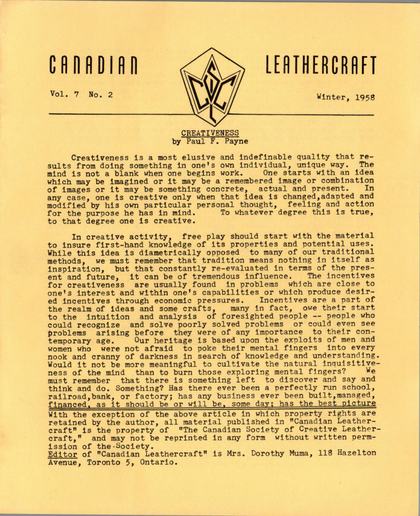
Page 1 — CREATIVENESS
Canadian Leathercraft
Vol. 7 No. 2 Winter, 1958
CREATIVENESS by Paul F. Payne
Creativeness is a most elusive and indefinable quality that results from doing something in one's own individual, unique way. The mind is not a blank when one begins work. One starts with an idea which may be imagined or it may be a remembered image or combination of images or it may be something concrete, actual and present. In any case, one is creative only when that idea is changed,adapted and modified by his own particular personal thought, feeling and action for the purpose he has in mind. To whatever degree this is true, to that degree one is creative.
In creative activity, free play should start with the material to insure first-hand knowledge of its properties and potential uses. While this idea is diametrically opposed to many of our traditional methods, we must remember that tradition means nothing in itself as inspiration, but that constantly re-evaluated in terms of the present and future, it can be of tremendous influence. The incentives for creativeness are usually found in problems which are close to one's interest and within one's capabilities or which produce desired incentives through economic pressures. Incentives are a part of the realm of ideas and some crafts, many in fact, owe their start to the intuition and analysis of foresighted people -- people who could recognize and solve poorly solved problems or could even see problems arising before they were of any importance to their contemporary age. Our heritage is based upon the exploits of men and women who were not afraid to poke their mental fingers into every nook and cranny of darkness in search of knowledge and understanding. Would it not be more meaningful to cultivate the natural inquisitiveness of the mind than to burn those exploring mental fingers? We must remember that there is something left to discover and say and think and do. Something? Has there ever been a perfectly run school, railroad,bank, or factory; has any business ever been built,managed, financed, as it should be or will be, some day; has the best picture
[The article runs on past the Society's notice below: "has the best picture" continues at the top of page 2, "been painted; has the greatest novel been written…"]
With the exception of the above article in which property rights are retained by the author, all material published in "Canadian Leathercraft" is the property of "The Canadian Society of Creative Leathercraft," and may not be reprinted in any form without written permission of the-Society.
Editor of "Canadian Leathercraft" is Mrs. Dorothy Muma, 118 Hazelton Avenue, Toronto 5, Ontario.
Page 2 — "OFF-YEAR MEETING"
been painted; has the greatest novel been written; has the most ethereal music been conceived? There is everything to take over. Even in science, probably ninety-nine percent of the knowable has to be discovered, Our recent progress in atomic research has proven that even physics and chemistry are still little more than a mass of questions. In view of these unequivocal facts, we must realize that nothing is done finally and right; that nothing is known, positively and completely. Finally, we must design; we must redesign; we must evaluate; we must ever re-evaluate everything that is done in terms of the present and future so that in a world which is all unknown and undone, or half done, or wrongly done, we can find real life goals and purpose to our studies, to our play, to our work, to our love.
Creative courage is daring--daring to bring to realization, to tangible physical shape, the inspiration, the idea in the mind; the fashioning, to the very best of one's ability, of the dream, so it can be understood and felt, so it will stir the beholder. The daring is in not minding whether the realization turns out to be good or bad, but whether it is perfect -- perfectly good or perfectly imperfect. Perfection is of the essence. Perfection requires that all of one's being go into the realization--nothing can be spared. The effort has been wholly sincere. Any missing perfection will not be in the physical realization, but rather in oneself. Perhaps limited technical abilities or limited cultural horizons-perhaps just limited horizons.
Creative courage demands self-analysis as well as daring and self-analysis gives one courage to dare whenever the inspiration comes.
For those who, like myself, chase the phantom of perfection, whether or not it has any practical value when caught,creative leatherwork may satisfy far beyond the added time and money expended.
Note Paul F. Payne is a Special Instructor in the Department of Industrial Education at Wayne State University in Detroit. He is a member of the Dearborn Leather Guild, and was one of the special demonstrators on Design at the last International Assembly.
"OFF-YEAR MEETING"
As most members know, it was the decision of the last International Assembly to hold meetings only every two years, with regional get-togethers of an informal nature in the year between. The next International will probably be held at Flint, Mich., in 1959, but in the meantime, the Eastern groups are planning a meeting for Saturday, May 3, 1958, at Prudhommes, near Grimsby, Ontario. Details of the meeting have been sent to all Branches, but if you are not affiliated with any Branch, write to Mr. Harold Wilson at 400 Charlton Ave. West, Hamilton, Ont. Registration is planned for 9 o'clock on the Saturday morning for an all-day session, with demonstrations and displays. If you plan to attend, contact Mr. Harold Wilson at the above address, also naming any demonstrations you would like to see.
Page 3 — PHOTOGRAPHERS' GADGET BAG
PHOTOGRAPHERS' GADGET BAG by Dr. R.K. Larmour, F.C.S.C.L.
Editor's Note: This is the first of several articles dealing with the design and construction of those versatile objects known as "Gadget Bags", which all serious photographers crave to possess, and eventually purchase, usually at great cost.
The Gadget Bag, about which we are going to write is not to be confused with the Camera Case. The latter is the small leather case that fits snugly over the camera itself for continuous protection: it is nearly always purchased with the camera, and is seldom removed entirely from the camera.
The bags that we are concerned with are the larger cases designed for carrying the camera, or cameras, and all the accessories usually accumulated by the ardent photographer, namely, light meter, flash gun, flash bulbs, small tripod, extra lenses, filters, sunshades, etc. A reasonably complete set of accessories is mich too bulky, and usually too valuable to be carried loose in coat pockets or on the back seat of the car. Moreover, all of these things require protection from dust, rain, and risk of breakage.
There are many sizes and shapes, in leather, plastic and imitation leather available in photographic stores,with prices to suit almost every pocket.But the photographer who is proud of his equipment will rarely be satisfied until finally he acquires a bag made of genuine leather because that material alone is worthy of association with his precious gadgets. No gift could be more appreciated by a photographer, than a well-designed, sturdy bag of genuine cowhide.
Let it be clearly understood at the outset that only the best material and workmanship need be considered for these bags. Many amateur photographers will normally carry equipment ranging in value from $250 to $1500 and that means that the bag goes wherever they go when they travel: It is seldom out of hand; it is never checked as baggage, even on airplanes; it goes into the dining room, the washroom and the bar-room. It must be handy to carry, handsome in a practical functional way, and rugged enough to stand up under the weight and the wear to which it will be subjected. If such a bag cannot be afforded immediately,your photographer will usually acquire a low-priced "temporary" bag to be discarded as soon as he can purchase, or make, a decent bag.
Most men will not want any tooling or carving on a high-grade photo bag. Probably by the time they have reached the advanced stage that requires such a bag, they have developed considerable artistic sense and feel that the utility bag is no fit medium for leather decoration. Furthermore, I believe that most men will prefer a sewn bag to a laced one. And sewing lends itself to use of overlapping which is one of the best ways to achieve the needed rigidity, especially in bags of medium to large sizes.
Page 4
One more general comment before we proceed to consider types of bags. The lids of these bags must be close fitting and the catches or locks must be of the best quality. The handles and shoulder straps must be designed with at least a 100% safety factor.We stress these points because failure of any of them will inevitably lead to loss, or damage by shock, or actual breakage, and these risks must be minimized on account of the value of the contents of the bag. The bag can get rough usage when the photographer starts climbing around rugged country in search of suitable subjects for "shooting". Imagine crawling up a mountainside with 30 pounds of equipment in a bag with a broken shoulder strap, or a lid that won't stay shut.
Types of Bags
There are two general types of construction,namely, (1)flexible, with rounded corners, and zippered lid; (2) semi-rigid or rigid with leather-hinged lid, square corners, and carrying handles as well as shoulder strap. Each have their advantages and disadvantages.
(1) The Zipper-topped bag is usually smaller and is fitted only with the shoulder strap. It can be readily fitted with an outside pocket which is very convenient for things that need to be quickly available, such as light meter, sense hood, etc. The lid is secure when closed. The disadvantages are: possibility of damaging the zipper thus making the lid useless; necessity for rounded corners making the construction a little more tricky; difficulty of stiffening the walls of the bag.
(2) The Leather-hinged lid permits a wide range of size and the easy installation of almost any degree of stiffening. Since square corners can be used,it is easy to strengthen the bag by overlapping all but the top edges. The lid, on the whole is less liable to damage, and even if the lock does go, the bag can be securely closed by tape or cord. The disadvantage of this bag is that it is usually more awkward to carry by the shoulder strap since it is more rigid than the zipper bag. On the whole, we prefer the square, leather-hinged bag both in use and in construction.
Bag (2) is preferable for the beginner to plan and construct because it is so easy to make any size from relatively simple directions. We shall accordingly describe in considerable detail in the next issue of "Canadian Leathercraft", how to proceed with designing, cutting, and assembling a bag of this type to suit your specific requirements.
Page 5 — Letters to the Editor
Letters to the Editor
The letter from O.B. Servor in this column in our last issue appears to have stirred up some controversy in our Society. Below are just two of the replies received to date. What is your opinion?
Editor, "Canadian Leathercraft"
118 Hazelton Ave., Toronto, Ont.
Dear Madam:
Having been keenly interested in the arts and crafts for a considerable number of years, I was somewhat irked, to put it mildly, by the letter published in the last issue of "Canadian Leathercraft", If Mr. O.B. Servor reads this letter I sincerely hope that he will accept my deepest sympathy He is indeed a man to be pitied.
My first impression, while my hair was still standing up on end, was that this person must be a most uninteresting, unimaginative, short-sighted, cynical individual. However, after the third reading of this rather stupid array of words, I did realise that we were dealing with a man who, although apparently he didn't realise it himself, has a fine trace of creative ability which of course is a basis for all arts and crafts. No person who is completely lacking in creativeness and intelligence could possibly sit down and write such a lengthy missile and show such a fine command of the English language. Let us therefore suppose that Mr. 0. B. Servor is a gentleman with a reasonable amount of intelligence,an average education, a degree of creativeness, and an alarming display of narrow-mindedness.
Mr. Servor refers to the ability of modern machinery to turn out finer products than those produced by craftsmen. May I point out,Mr. Servor,that the machine itself was a product of man's mind and hand, as was the original model of the article produced by the machine.
Possibly the best-known example of this is in the field of art.
Before a machine can do a reproduction of a painting, there must be an original created by a talented artist, and please, Mr. O.B. Servor, don't try to tell me that you prefer the lithographed copy to the original. That would be utter nonsense.Take for instance a commonplace article such as a man's suit. No gentleman could possibly. be satisfied with a production-made, ill-fitting garment as he would be with its handsome, hand-tailored, carefully-fitted, counterpart,for which he is quite prepared to bear the additional cost. Could our poor, misguided friend feel the same pride of possession with cheap carnival-type plaster castings as he would with fine pieces of Dresden or with a table set for an important dinner party with plastic dishes in place of fine china? Would his wife (if he has one,and we must admit that he does sound more like a frustrated bachelor) utter the same little screams of joy upon receiving a piece of jewellery consisting of a chunk of colored glass plunked in the middle of a stamped-out chrome-plated setting as she would with a fine piece of jewellery carefully wrought from silver or gold and set with an exquisite precious or semiprecious gem skilfully cut by a
Printed here as "such a lengthy missile" — the sense plainly wants "missive," a letter; kept as printed.
Page 6
master craftsman after many hours of concentrated study and planning required to produce the maximum beauty of fine gems. Examples of this type are everywhere for you to see, Mr. Servor, merely for the effort of opening your eyes and looking about you.
Possibly the greatest motivation for a craftsman or an artist to continue in his work is a great sense of satisfaction on having created something worthy of admiration. This, apparently, is something you have never experienced, Mr. Servor,and I do feel sorry for you. May I suggest that instead of criticizing your very worthwhile friends who must find you to be a very dull sort of a fellow, that you acquire a piece of fine leather from them. Feel it, smell it, admire it, and then with their assistance, which I can assure you will be willingly given, see what you can make of it. Your first effort may be a sad sight for experienced eyes, but believe me, I am quite sure that you will be as proud as Punch and drunk with your own accomplishment. Try this,Mr. O.B. Servor, and then go a little further.Doodle a few designs, and experiment with innumerable effects acquired with dyes and finishes. You will soon be just as involved as the rest of us and for the first time in your life you will be living and enjoying it. And then,Mr. Servor,please write another letter jon a subject with which you will be better acquainted.
One more word of advice, Mr. Servor, please don't confuse articles made in grandpappy's time with today's objects of art. The crafts today can be as modern and functional as tomorrow.
Sincerely, A. SKYFER
Dear Editor:
I like what O.B. Servor writes. (I assume he is a man because no woman could take such a keenly analytical view of the subject.)
He hits the arty-crafty nail squarely on its silly head. I hope he writes more, and particularly I would like to hear what constructive suggestions he may have to offer to the misty-eyed acolytes of leathercraft. I feel sure that one who can apply the lancet so skilfully must also be able to prescribe a cure.
When I look around and see the junky leather articles that pass for "hand-crafted", I become positively nauseated. How can these self-styled leathercraftsmen have the gall to think that after a few indifferent lessons by wholly incompetent instructors,they can buy a piece of leather and a few standard tools and then set up in business to make leather things to compete with those made by skilled craftsmen working in factories with all the available modern equipment needed for doing the job right?
I can only conclude that these "leathercraftsmen" are suffering from a common malady, namely, the desire to get something with the least amount of work and study.Let us become realistic and admit that until these people are ready to put some genuine "blood,toil,tears and sweat" behind their work, our best bargain will be the factory-made article. A. YOUNGBODY
Page 7 — ASSOCIATE & FELLOWSHIP REQUIREMENTS REVISED
ASSOCIATE & FELLOWSHIP REQUIREMENTS REVISED
Some slight revisions have been made in the list of requirements for Associate and Fellow membership, mostly for the sake of clarification, and the following are the present requirements.Members wishing to try for these higher membership awards are advised that qualifying entries must be ready by the middle of March, so get busy.
ASSOCIATE:
1. Not less than three years' satisfactory practice of leathercraft.
2. Demonstrated ability to produce work of a high standard of craftsmanship; while originality of design is not required, it will receive favorable consideration. Copied designs should bear some stamp of the individuality of the craftsman, and should not be an exact duplicate in every sense of the design copied.
3. Approval by the Board of Selection of submitted work as follows:
(1) Handbag or other large article
(2) Belt
(3) Optional
(4) Optional
(3) and (4) should be chosen to show specific techniques. Articles submitted should demonstrate knowledge of materials and various techniques, and versatility in the craft, e.g.,tooling,carving, coloring, construction, etc.Any pieces accepted by the Board of Selection for recognized Society exhibitions may be counted.
4. Work submitted must be accompanied by a written declaration that the work is solely that of the candidate. Work done in a leathercraft studio under supervision may be accepted, provided it is done without manual assistance.
5. Two years' service to the Society,e.g.,helping with exhibitions,sales, writing for the Bulletin,serving on Executives (local,national,or International), interesting new members,or working in some way towards the development of leathercraft in your community.
FELLOW:
1. At least one year as an Associate.
2. Three years' service to the Society.
3. Wide experience in the leathercraft field.
4. Meritorious achievement in leathercraft.
5. Approval by the Board of Selection of submitted work as follows: Four articles, two large,two small,of the applicant's choice, all of different function,size and treatment,chosen to show versatility in the craft and grasp of technique. Any pieces accepted for Society exhibitions may be counted here. No piece submitted for Associate rating will be eligible.
6. Work accepted for three Society showings,if such are available.
7. Original design in all submitted work. (Original design could constitute new shapes,forms, or treatments of leather. Simplicity of decorative design is most acceptable.)
Page 8 — CSCL EXECUTIVE
8. Work submitted must be accompanied by a written declaration that the work is solely that of the candidate,done without supervision or assistance.
9. Candidate shall have had accepted for publication in "Canadian Leathercraft"material for one article,not necessarily technical, of general interest to leathercraft. Candidates need not feel diffident about their writing ability,as such material will be edited if necessary.Any article published previous to this application for Fellowship will fulfill this requirement.
10. Acceptance by a two-thirds vote of the active Fellows.
CSCL EXECUTIVE
President: Fred Brown, 1 Golfcrest Rd., Toronto 18.
Vice-President: Clyde Johnson, 61 Victor Ave., Mimico, Ont.
Treasurer: Miss Olivia Smith, 32 Mountview Ave., Toronto.
Recording Secretary:Mrs. Norma Yott,3752 St.Clair Ave.E., Toronto
Corresponding Secretary:Miss Viola Harris, 47 Snowden Ave., Toronto
Executive Council:
 Exhibitions: Mrs. Nora Huyck, 96 Hounslow Ave., Willowdale, Ont.
 Membership: Miss Winnifred Barratt, 374 Brock Ave., Toronto.
 Editorial: Mrs. Dorothy Muma, 118 Hazelton Ave., Toronto.
 Canadian Handicrafts Liaison:Mrs. Reta Larmour,2649 Bloor W.Toronto
 Teaching Standards: Robert Muma, 118 Hazelton Ave., Toronto.
 Past President: Mrs. Jean Newton, Toronto.
 Others: Cecil Roebuck, Toronto; Deane Russell, Ottawa, Ont.;
         Dr. Ralph Larmour, Toronto; Harold Frost, Wallaceburg, Ont.;
         Don MacKinnon, Toronto; Mrs. Betty Cox, Toronto.
   Presiding Officers of Branches and Regional Representatives will be ex-officio members of the Executive Council.
Page 9 — LEATHER MASKS
LEATHER MASKS by Harold Wilson
The methods of creating leather masks are many and varied.Mexican wall masks are cut and shaped from 4½ oz.cowhide and carved or decorated as desired. There are also suede or chamois masks used in some of the plays at the Stratford Shakespearian Festival and in many early plays.
The type of mask I will describe in this article is done by means of a papier maché base. The making of this mask involves not only the hobby of leathercraft, but also sculpturing, molding, and papier mache work.
Materials required for this project: Board to work on.
For clay mold:
Powdered grey clay (obtainable from hobby and art supply stores)
Wooden modellers
Vaseline
For plaster mold:
Plaster of paris or dental plaster
For papier maché mask:
Newspapers
Walpaper paste
Shellac
For leather mask:
2 - 3 oz. calf
OR
2½ - 3½ oz. mission-grain steerhide
Modellers (preferably stainless steel)
Antiques or dyes to suit project
Polish or finish coat.
Beside this list are three captioned diagrams, not reproduced here: Fig.1, a board with a flattened oval clay form built up on it; Fig.2, a clay shape with its undercuts marked, showing the plains a mold must avoid locking against; and Fig.3, a mask outline with arrows pointing to small rolls of clay laid for the eyes, nose and mouth.
Before work can commence it is necessary to choose a suitable subject. When the subject has been decided upon obtain pictures of the object shown from various angles.This makes depth and uniformity easier to achieve. Undercuts must be avoided as they will lock the clay mold on to the sculptured form.
With our project in mind and the pictures handy,we are ready to commence sculpturing.Mix the clay powder and water to a workable consistency.Using a board several inches larger than the finished mask is to be,draw a rough outline the size and shape of the project to be made. Keep a bowl of water handy to smooth the figure as it takes shape. Roll a large lump of clay into a ball and and place in the centre of the outline;flatten this into an oval form the size of the outline. (see fig.1) All plains must be made in such a way that when plaster is applied it will not prevent removal when hardened, by interlocking. (see fig.2)
Page 10
If a face is to be made, mark off the oval about one-third the distance from the top for the eyes, two-thirds from the top for the bottom of the nose. By making small rolls of clay and placing them on the mask where the eyebrows, nose and lips would be, you will obtain the extra clay for the raised areas. (see fig.3) Gouge out or add as required using the fingers dipped in water to smoothe out the surface. The wooden modellers can now be used to give details to features. All markings and lines must be deeply exaggerated so they will not be lost in the final steps.
If it is necessary to take several sittings to complete the form, cover it with a damp cloth before leaving. This will keep your clay pliable at all times. If your clay should dry out after a period of several days,it can be brought back by adding water with your fingers.
- Having made a sculptured form that seems pleasing to the worker, the next step is to make a plaster mold from this.After the clay has dried until the surface is firm, a coat of vaseline is applied over the entire surface, including the board.
Mix the plaster until it is the consistency of thick cream.Pour over the form and allow to harden for a couple of days. If the form has been well greased and has had no undercuts it should be easily removed. Tap firmly on the plaster and lift from the clay mold.You now have a reverse mold of the original.
Fill in any air holes that may have formed and smooth out all rough spots. You are now ready for the next step. I have not found papier maché paste to be satisfactory,but prefer strip papier maché. Tear newspapers into strips about 1" wide and dip in wallpaper paste. Start filling in the hollow form of the plaster mold alternating the direction of the layers as they are pasted in.Smooth them firmly into place to eliminate air pockets, and use plenty of paste. Build up to approximately 1/8" in thickness.Allow this to dry thoroughly for several days, then remove and coat with shellac.This is your working mold for the leather.
I originally used 2-3 oz. calf, but have since found 2½-3 oz. mission-grain steerhide easier to work with.Either leather will give you a good finished product.The leather must be washed several times in clear warm water to remove the tanning filler and allow the leather to shrink. Stainless steel modellers are almost a necessity as other metals will blacken the leather when used.Place the damp leather over the papier maché mold.. Starting at the highest point, with wet hands stretch the leather down and over this area from all directions. Use the modellers to stretch the damp leather wherever a great amount of resistance is met, and to work the leather into all depressed areas or cuts in the features of the mask.Much time and patience is required for this final step to stretch the leather gently but firmly into the desired shape without losing detail in so doing.There will always
Page 11 — DECEMBER HAMILTON GUILD MEETING
be an excess of leather at the base or chin of the mold. This must be carefully fitted and cut so that there is no overlap or bulk. Do not cut out the wedges until the leather is dry as it will shrink back in drying and leave space between the joins. Barge cement may be used to adhese the leather under the chin.
The choice of dyes will depend on the subject chosen. Garnett toning dyes are very good for overall dyeing, as light to dark colours may be easily blended by working them with your index finger while the dyes are wet. Antiques applied after toning dyes give depth to cuts and depressions by leaving a residue in the low areas. Touches of colour may be blended where desired, e.g., red on lips, etc. When using colours over a toning dye it helps to subdue the colour and give a more blended effect.
NOTE ABOUT THE AUTHOR: Harold Wilson is a member of the Hamilton
Branch of CSCL. He won an Honorable Mention for his leather masks at the Canadian National Exhibition last year in the "Most Original Leathercraft Entry" class.
DECEMBER HAMILTON GUILD MEETING
In December, a carload of leathercrafters from Toronto attended the meeting of the Hamilton Leathercraft Guild. At that time, Dr. R.K. Larmour gave a demonstration of dyeing for the group.
BUSINESS DIRECTORY
[This page prints a three-column Business Directory table — SUPPLIERS, CONSULTANTS, INSURANCE — with an ad-rate notice spanning the last two columns beside the final two suppliers. Read straight across instead of column by column, the notice had been served in slices between the lines of an address, splitting words like "available" and "approximately" across the line break. Set out below in the order the columns are meant to be read, with the line-break hyphens rejoined. The picture of the page above is the original, untouched.]
| SUPPLIERS | CONSULTANTS | INSURANCE |
|---|---|---|
| Don MacKINNON, 6 Irwin Ave., Toronto WA 2-7977 | C. J. ROEBUCK, 224 Winona Drive, Toronto LE 5-6469 | |
| CLARKE AND CLARKE LEATHERS, Barrie, Ont. | ||
| GARNETT COMPANY, 1 Hannaford St., Toronto OX 9-4587 | The remainder of this page will be available to anyone wishing to be listed in the Directory. Spaces will measure approximately one-half inch in depth as above ads. | |
| LEWISCRAFT, 284 King St. West, Toronto EM 3-5206 | Cost will be $5.00 per year (4 issues). No advertising matter may be included in the Directory listing. | |
[The Society printed "adhese the leather" here; it is kept as printed.]
Page 12
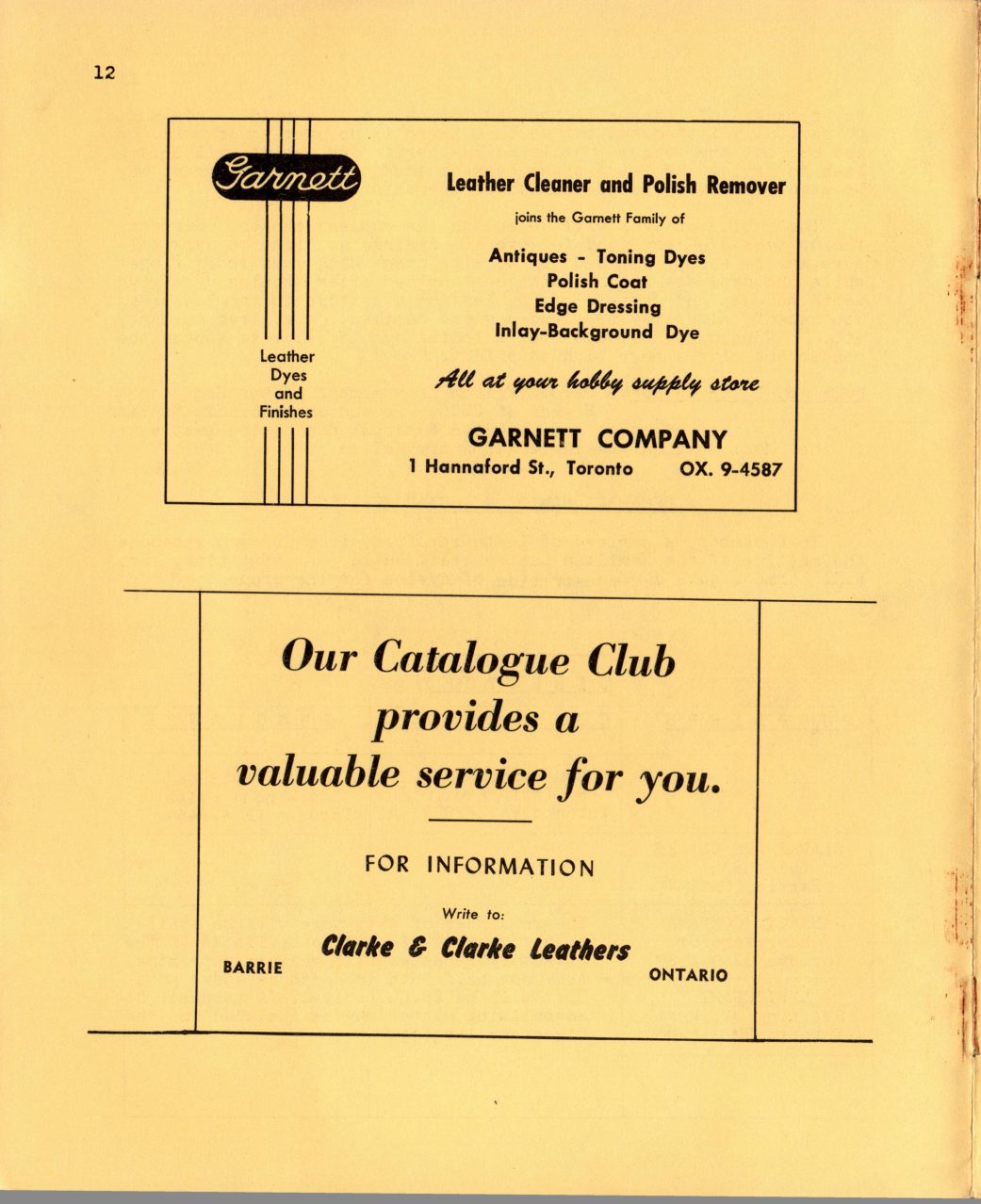
Garnett
Leather Cleaner and Polish Remover joins the Garnett Family of Antiques, Toning Dyes, Polish Coat, Edge Dressing, Inlay-Background Dye Leather Dyes and Finishes — all at your hobby supply store.
Garnett Company, 1 Hannaford St., Toronto. OX. 9-4587.
Our Catalogue Club
...provides a valuable service for you. For information write to: Clarke & Clarke Leathers, Barrie, Ontario.
[Previously marked "This page carries advertisements; not transcribed." Now set out in full: two advertisements (Garnett leather dyes and finishes; Clarke & Clarke Leathers). No names on this page.]