
An issue of the Society’s newsletter, transcribed from the original.
(12 pages, 2.2 MB)
the full-resolution scan, 31 MB, for close research
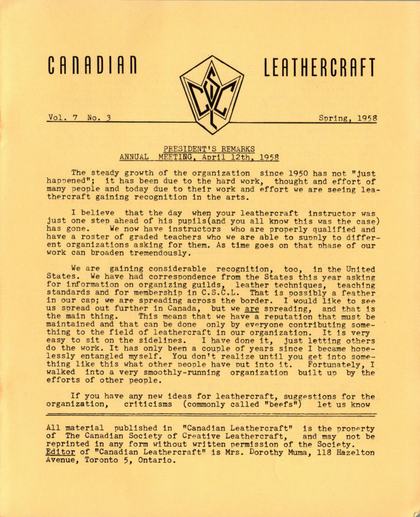
Page 1 — PRESIDENT'S REMARKS
Canadian Leathercraft
Vol. 7 No. 3 Spring, 1958
PRESIDENT'S REMARKS
ANNUAL Meeting, April 12th, 1958
The steady growth of the organization since 1950 has not "just happened"; it has been due to the hard work, thought and effort of many people and today due to their work and effort we are seeing leathercraft gaining recognition in the arts.
I believe that the day when your leathercraft instructor was just one step ahead of his pupils(and you all know this was the case) has gone. We now have instructors who are properly qualified and have a roster of graded teachers who we are able to supply to different organizations asking for them. As time goes on that phase of our work can broaden tremendously.
We are gaining considerable recognition, too, in the United States. We have had correspondence from the States this year asking for information on organizing guilds, leather techniques, teaching standards and for membership in C.S.C.L. That is possibly a feather in our cap; we are spreading across the border. I would like to see us spread out further in Canada, but we are spreading, and that is the main thing. This means that we have a reputation that must be maintained and that can be done only by everyone contributing something to the field of leathercraft in our organization. It is very easy to sit on the sidelines. I have done it, just letting others do the work. It has only been a couple of years since I became hopelessly entangled myself. You don't realize until you get into something like this what other people have put into it. Fortunately, I walked into a very smoothly-running organization built up by the efforts of other people.
If you have any new ideas for leathercraft, suggestions for the organization, criticisms (commonly called "beefs" let us know
All material published in "Canadian Leathercraft" is the property of The Canadian Society of Creative Leathercraft, and may not be reprinted in any form without written permission of the Society.
Editor of "Canadian Leathercraft" is Mrs. Dorothy Muma, 118 Hazelton Avenue, Toronto 5, Ontario.
Page 2 — HIGHER MEMBERSHIP AWARDS
about it. We have a medium for that in our bulletin,"Canadian Leathercraft". The Editor does an excellent job, but she needs our help and appreciates getting letters, whether nice letters, informative letters, or nasty letters. She likes to get letters and thus know what is being done and how the bulletin is being received by people. Often with these ideas of which I am speaking, people hesitate to pass them along. They feel that it might be a worthless idea, or that someone else has thought of it previously, but don't let that happen. If you have an idea, pass it along and let someone else judge whether it is good or not. If you sat in on one of our Executive meetings you would find that a lot of worthwhile material comes forth through exchange of ideas.
Speaking of the Executive, I would like to say that this last year I have had a real team to work with. I have had all the cooperation that I could ask for and I would like to thank every one of them for their support this past year. I certainly needed that, as I mentioned a year ago today when I said that I would need their help, and, believe me, I got it. I thank you.
HIGHER MEMBERSHIP AWARDS
This year a new system of judging was set up, and Dr. Larmour explained how it would work. He spoke of the pride in achievement and the satisfaction in having your work and long striving finally reach a point where you have achieved something. Associates should not remain content but, having discovered hidden resources, will immediately put them to work to carry forward to the ultimate achievement that this Society offers, the Fellowship.
The new system of judging uses a point system based on these three characteristics: design, workmanship,suitability. Emphasis is different for Fellowship and Associate, with the most points for design in the former, and most for workmanship in the latter. This system is to be used for judging entries in the branch competitions also.
The following members were awarded Associate rating: Mrs. Edythe Niblett, Peterboro, Ont.; Clarence Redman, Hamilton, Ont.; Mrs. May Wheatley, Guelph, Ont.; Harold Wilson, Hamilton, Ont.
The following were elected Fellows: Mrs. Irva Ford, Hamilton, Ont.; Mrs. Anne Hook, Toronto, Ont.; Mrs. Edith Melchior, Port Burwell, Ont.; Miss Olivia Smith, Toronto, Ont.
Page 3 — ANNUAL Reports
ANNUAL Reports
On April 12th, 1958, for the 7th consecutive year, members of C.S.C.L. gathered for the Annual Meeting,again held at Ryerson Institute of Technology in Toronto. Attendance was very good, with representatives from most of the branches and some unaffiliated members. Competition for the Weston Guild Trophy was keen this year, with very good entries submitted by four branches.
Reports were given by the Chairmen of the Standing Committees: Exhibitions: Several exhibitions were participated in during the past year. No Travelling Exhibition had been assembled mostly due to a lack of articles of appropriate shape and size for packing.
Editorial: The Chairman requested more cooperation from the general membership and branches in the form of reports and articles.
Publicity: At the Handyman Show, C.S.C.L. was publicized on television and other exhibitions and sales have had publicity in newspapers. C.S.C.L. is to be written up in a special booklet being prepared on the arts in Canada.
Reports were given from the Branches as follows: Barrie: A new branch was formed in March of this year and is now under the Chairmanship of Miss Kay Yasunaka. Hamilton branch was organized in 1956. It now has 45 members with an average attendance at business-demonstration meetings of 38. Publicity for the branch meetings has been given over the radio and through newspaper advertising.
London: An average of 12 members attend monthly business-demonstration meetings. Displays have been organized for the London and Western Fairs and the Sports Fair. '
Peterboro branch reported a successful, active year with outstanding craftsmen demonstrating at meetings and a display booth at the Peterboro Exhibition.
Tillsonburg has 19 members and organized a display at Tillsonburg and Aylmer Fall Fairs.
Toronto reported that all members of the branch are now members of C.S.C.L. and it is planned to continue this policy in order to have members who are truly interested in the craft. Demonstration-business meetings are well attended.
Chatham members reported that they are waiting until the fall season to plan the formation of a branch.
Guelph members are now joining the Hamilton branch.
The branches were congratulated on their good jobs of the past season. They are the framework of the organization and its future strength. They will play a bigger part in the future of the Society and several members of the branches are to be on the new slate of officers.
Page 4
After the business sessions of the Annual Meeting,a meeting was held at which the branch representatives could air their problems and exchange ideas.Among the ideas brought forth was the suggestion that inmates of the penitentiaries might be interested in a sponsored membership such as that open to hospital patients, whereby the branch supports such members with a reduced fee, and this is to be investigated.
Branches were asked to send in reports of their meetings to the Bulletin from time to time along with lists of their officers so that members will have an idea what the different branches are doing. There was some discussion as to whether or not Associates and Fellows Should compete in the same category as the general members and the Executive Council was asked to discuss this further. (At a later meeting, the Executive decided that this situation should remain as is for another year.)
The Branches agreed that the point system of judging was very fair and gave a vote of thanks to Dr. Larmour for instituting this system. At the request of the London Branch at this meeting, the Executive Council later appointed a sub-committee to investigate the possibilities of compiling a directory listing persons who would be willing to demonstrate or speak at Branch meetings. The appointment of a Public Relations Chairman to contact craft groups to promote the branches was suggested and the Executive Council later appointed Cecil Roebuck to this department.
The following are the current officers of the Branches and their meeting places:
Barrie: President, Miss Kay Yasunaka.
Hamilton: Chairman, Harold Wilson; Vice-Chairman,Mrs. R.H. Tomlinson;
Treasurer, Mrs. W.H. Jones; Secretary,Mrs. D.C. O'Rourke; Meeting place Wesley Community Centre, John and Rebecca Streets, second Thursday of each month.
London: President, Mrs. Carl Gerster; Vice-President, Miss Doris
Howey; Secretary, Miss Hilda Vaile; Treasurer, Mrs. George Porter. Monthly meetings at 100 Grand Avenue the first Friday of the month.
Tillsonburg: Meets second Thursday of each month except July, August and September. For place and particulars, contact Mrs. Glen Whitesell, Concession St.E., Tillsonburg, Phone VIctor 2-4098 Toronto: President,Russell MacMillan;Vice-President,Richard Sirman;
Secretary,Miss Ella Teasdale; Treasurer,Mrs. Gladys Miles. Meets third Friday of the month at the YWCA, McGill St., October to May. To close the season this year, a tour of Clarke & Clarke Tannery at Barrie is planned May 24th.
Page 5 — ROLLED RIM COASTERS; Splatter DYE DECORATION
ROLLED RIM COASTERS
Splatter DYE DECORATION by Olivia Smith, F.C.S.C.L.
If you prepare your own coasters, use about 6½ oz. leather and cut a circle approximately 3" in diameter. Coasters may be bought at some of the craft stores ready cut. Soak each coaster in turn until saturated, but no longer. Mop excess moisture with towel. Lay face up on a flat surface and place inverted fruit juice glass (which is at least 1/2" smaller in diameter than coaster) exactly centred on coaster,and hold firmly with one hand while drawing up the edge with modelling tool until it is vertical. This must be done carefully or the wet leather will stretch unevenly, and will have to be trimmed later. Remove the glass and turning coaster on edge, work out the crinkles in the edge with the modelling tool.Leave to dry overnight.
If a cutout design is to be used, lay this, correctly centred, one on each coaster, and hold in place with a tiny dab of rubber cement, if it is not firm enough to lie flat. Good colors to start with are yellow or orange and red, which are leather colors. Pour dye into a small container and dip toothbrush into this. Draw gently at first across wire screening, so that it will not blob. For best results, it should be a fine spray. Use yellow or orange first, spending about five minutes to each coaster. Do all coasters simultaneously, to keep the color uniform. Having put the same amount of yellow on each coaster, proceed to do the same with the red. A little green in the last Spraying helps to give variation.
When the splatter work is done, leave the coasters undisturbed until the leather has time to absorb the dye, or the design will smear. The cutout can then be lifted off safely, and the coasters set aside at least overnight. Buff gently with a soft cloth, until glossy, and if the outline looks hard, spray the whole coaster lightly with Golden Tan or brown antique. When this is dry, buff again, and give the whole coaster a coat of Golden Tan.
The edges may have to be trimmed if the coaster did not stretch evenly when rolled. When this is done, dampen enough to use the edge creaser, then dye the edge, and, if desired, the leather, to the depth of the edge crease.
Apply polish coat or shellac. Tie down any rough edges with edge dressing. Cut out felt bases and glue them to coaster bases.
Page 6 — C.S.C.L. EXECUTIVE 1958-59; TALK BY FATHER O'BRIEN
C.S.C.L. EXECUTIVE 1958-59
President: Fred Brown, 144 Lloyd Manor Rd., Toronto 18, Ont.
Vice-President: Harold Wilson, 400 Charlton W., Hamilton, Ont.
Treasurer: Miss Olivia Smith, 32 Mountview Ave., Toronto, Ont.
Corresponding Secretary: Miss Viola Harris, 46 Snowden Ave., Toronto.
Recording Secretary: Mrs. Norma Yott, 3752 St.Clair Ave.F., Toronto.
Executive Council: Publicity: Mrs. Anne Hook, 32 Mountview Ave., Toronto.
                   Membership: Miss Winifred Coombs, 73 Coady Ave., Toronto.
                   Editorial: Mrs. Dorothy Muma, 118 Hazelton Ave., Toronto.
                   Canadian Handicrafts Guild Liaison: Mrs. Reta Larmour, 2649 Bloor 5t.W., Toronto
                   Teaching Standards: Robert Muma, 118 Hazelton Ave., Toronto.
                   Past President: Mrs. Jean Newton, Toronto.
                   Others: Cecil Roebuck, Toronto; Dr. Ralph Larmour, Toronto; Mrs. Betty Cox, Toronto;
                           Mrs. Jessie Little, Snelgrove, Ont.;Russell MacMillan, Toronto;
                           Mrs. Margaret McFarlane, Toronto; Mrs. Irva Ford, Hamilton, Ont.;
                           Harold Frost, Wallaceburg, Ont.; Don MacKinnon, Toronto; Mrs. Mae MacKinnon, Toronto;
                           Clyde Johnson, Mimico, Ont.; Miss Anne Small, Toronto; Mrs. Grace Jones, Hamilton, Ont.
TALK BY FATHER O'BRIEN
An interesting talk was given by Father O'Brien about his trip to the leathercraft school in Florence, Italy. This was illustrated with colored slides and proved very informative to those attending the Annual Meeting. The school is in buildings attached to the Church of the Holy Cross and trains boys for several years in the various phases of leathercraft. All work is devoted entirely to the tourist trade, with no time for creation of new techniques, etc. The leather used comes from calves raised especially for their leather and not allowed to come into contact with barbed wire, etc., during grazing. This results in almost perfect hides of a velvety softness.
Florentine leatherwork is distinguished by the use of coats of arms of Florentine families and minimum decoration. No incising of the leather is done and swivel knives are unknown.
It was later announced that the slides used by Father O'Brien with his talk were being given by him to C.S.C.L. to use in whatever manner was thought most valuable to leathercraftsmen.
[The article ends with a centred row of three drawn diamonds — a printer's ornament, not printed text — easy to misread as a stray line, and left out here.]
Page 7 — PURSE POCKETS
PURSE POCKETS by Edith Melchior, F.C.S.C.L.
Many times during my teaching career in leathercraft I have been asked by those in my class "What about some pockets on the inside of this purse? Having given it due consideration, I came uv with the idea of making the various types in cloth, which I use for demonstration.
The simplest form of pocket is one used mainly for a mirror. Ascertain the approximate size pocket you require, and add enough to allow easy access to the inside, plus about ¼" for stitching. Put this measurement down on paper.
Next add a half-inch to the depth of your pocket which will be turned under to form a finished edge for the top.Extend the top line of your diagram 4" on either side, and join it to the bottom. This will be your cutting line. (See a) If the lining you are using has very little body to it, it may be necessary to reinforce the entire pocket with gummed reinforcing cloth. This 5 is put on with a warm iron to the under side of your pocket. (Do not use a steam iron.) As there is usually very little strain to this pocket, I; reinforce only where the top corners of the pocket (a) are stitched to the main lining of the purse. (See b).In cementing this pocket to the main lining,cement the bottom edge and then place the sides in a perpendicular manner, cement, and machine stitch, using a fairly large stitch. This type of rocket can be used in various sizes, allowing enough extension at the top to compensate for the depth, to allow access to the bottom.
Another very popular type of pocket is the zippered vouch. Ascertain the width of your purse, and the depth less half an inch. In the all around gusset type purse, the front panel of the purse may be used as a pattern minus half an inch at the ton of the panel.
Cut two pieces of skiver the size of your pattern and reinforce with gummed reinforcing cloth. Select a zipper 1" less in length that the width of your pattern. At this point I may add that if you cannot purchase the correct length zipper, get the one which is slightly longer. With the zipper closed, remove the bar at the end of the zipper with a pair of pinchers, straighten the prongs and place it at the desired length, push the prongs through, and bend into place. Open the excess part of the zipper, and grasp the teeth with the pinchers,
A diagram beside this passage illustrates the zipper-end step, labelled "Right Side" and, further on, "Stitch".
Page 8
remove them one by one. Now lay your zipper on a flat surface and place the top edges of your pocket pieces right side up on either side. Centre the zipper and cement in place, allowing enough space on either side to permit free movement of your zipper pull. Stitch by machine 1/8" from the edge. (See c). Cut 2 pieces of 3½ oz. leather 1"x2", turn your pocket right sides together, and insert one of the above pieces on either side of your pocket in line with the zipper. (See d). Lightly cement the edges, and stitch ¼" from the edge all the way around. Turn your pocket right side out, and you will have a pouch with two tabs, one on either side protruding out. Place the pocket in the purse with tabs between the gusset and the back of the purse, and about ½" below the top edge of the gusset. Cement in place, and punch the edge, trimming off the excess part of the tab sticking out. (See e) Lace in the usual manner. The advantage of this type of pocket is that if the zipper should become damaged, and have to be replaced, it is only a matter of taking out about an inch and a half of lacing on either side of the purse, and removing the entire pocket, which can be repaired without damage to the rest of the purse.
The drawing beside this paragraph, showing the pocket inserted in a round-bottomed purse and labelled accordingly, is not reproduced here; its handwritten caption is omitted rather than read into the instructions as prose.
"ON PAROLE"
If any members wondered where Robert Muma was during the Annual Meeting they will be interested to know that he was "On Parole" in the United States. A planned weekend workshop which he was invited to conduct in Flint, Mich.,almost did not happen because of an oversight on the part of the Flint Guild in not sending the required papers to the Immigration Department.Bob was not allowed to proceed far beyond London and spent the night at his sister's home near there. Early next morning after several phone calls and discussions with the authorities, the Flint people picked him up and took him across the border on papers stamped "Paroled at Port Huron". The Flint Guild had much entertainment out of this fact. Bob instructed 40 extremely enthusiastic leathercrafters in embossing, bookbinding and color techniques in a weekend of four sessions.
SUMMER CLASSES
FIVE-DAY COURSES
TWO LESSONS DAILY
THROUGH JUNE AND JULY
Write for Particulars to:
MUMART STUDIOS OF CREATIVE LEATHERCRAFT
118 Hazelton Ave., Toronto 5, Ont.
The page sets a boxed advertisement to the left of the last part of this article, in a narrower column; Reset here as the two separate texts the page carries: the article's own ending, then the advertisement.
[The heading of the piece below is printed “ON PAROLE”, in quotation marks and underlined]
Page 9 — WESTON GUILD TROPHY AWARDS; WORKSHOP TIP BONUS
WESTON GUILD TROPHY AWARDS
The Weston Guild Trophy consists of a large shield to be held by the winning branch during the following season, and a smaller shield Which is the property of that branch.
In awarding the Trophy, Dr. Larmour explained that a total of 168 points was possible for each branch on their six pieces entered, and the scoring resulted in the following figures: Hamilton, 144.6; London, 116; Tillsonburg, 109.8; Toronto, 151.6. The Trophy was, therefore,awarded to Toronto branch and presented by Mrs. Edith Roscoe, first President of the original Weston Guild. Members whose work was chosen to represent Toronto in the winning showing were: Fred Brown (guestbook); Mrs. Margaret Hazzard (jeweled box); Mrs. Anne Hook and Miss Olivia Smith (joint workmanship on coaster set); Mrs. Gladys Miles, (round tray); Robert Muma (Canadian coat of arms) Miss Ella Teasdale (covered bottle).
Due to the fact that the Trophy was not ready for presentation at the last Annual Meeting, London Guild, last year's winner, received their small shield this year. Toronto branch agreed that London branch should hold the large shield for a part of the coming year. Criticism of Entries
One criticism of those pieces which did not rate high points was that they lacked effective coloring, either being too bright or too monotonous. In contrast to this, high-ranking pieces were harmoniously and suitably colored. Suitability of findings was also criticized in some belts. Most of the workmanship was very good but some lacked finish. Some pieces were over-decorated and the effect of good leather was thus lost. In general it would seem that in submitting pieces for competition, great care should be taken that the articles come up to specifications in all phases such as finishing (edges and lacing extremely neat and as inconspicuous as possible); simple designs showing the leather off to best advantage: muted color tones with just sufficient contrast to be interesting. General workmanship and execution of design should of course be of very high standard.
WORKSHOP TIP BONUS
In the early days of C.S.C.L., we paid $2.00 for each Workshop
Tip accepted for publication. It has been decided to reinstate this policy, so if anyone has any Workshop Tips, send them along. If they have not been published in "Canadian Leathercraft" before, they are probably usable now, and you will receive $2.00 for each of them published.
Tips could include new uses for old tools,tricks you have found helpful, different good techniques, improvements on tools, or any other idea which may have helped you. So dig out your notebook.
Page 10 — Letters to the Editor
Letters to the Editor
Dear Editor:
The letter by O. B. Servor in the last number of "C.L." makes me sick to my stomach. He (it must be a man because no woman would talk such nonsense) is likely a salesman type since all he thinks about is cost.He likely spends his spare time "entertaining" customers in smoky hotel rooms and thinks that is the only life. A modern man! Phui!
We do leatherwork because we like it,not for what profit we can get out of it. We want to do something that we can use with pleasure and pride. Instead of crawling around cocktail lounges,or haunting movies, or squatting in front of the TV night after night, we want to do something that exercises our brains and our hands together, and will give us the pleasure of making a thing of our own.
Women are far more industrious than men. We like doing things better than sitting on our cushions watching someone else working. And we don't count our time so valuable that we have to reckon our wages especially when we are doing things we like to do--when we are keeping our hands and our minds busy with something like knitting, or smocking, or leatherwork. It's a good thing too, else a lot of things wouldn't get done if we had to leave them to men. They would sit on their seats figuring the cost of their precious time and end up deciding that it wouldn't pay -- then they go and turn on the TV and waste the evening staring at the fights or the wrestling. That doesn't pay either but we women are always more practical--we do something useful even if it doesn't pay us $1.86 per hour.
Well, I can't waste any more time talking about the silly ideas of Mr. Servor.I have work to do, I'll just put that stupid letter out of my mind, now that I have said my say, and will get out my leather tools and make a wallet for my husband who is half asleep in his easy chair in front of the TV.
With kindest regards and best wishes for greater success in Canadian Leathercraft in 1958,
I am Sincerely yours,
ARDEN T. POUNDER (Mrs.)
Madam Editor:
It is clear that O.B. Servor knows very little about leathercraft. Indeed it would appear doubtful that he has ever actually engaged in the craft. He (or she) writes like one who has scant acquaintance with the subject,and that only as an unsympathetic onlooker.
Heaping scorn on the work of the old master craftsmen, and extolling the shoddy, unimaginative products of modern times, O.B.S. has the crowning impertinence to ask, "Why must we revere all things made in the old way," I'll answer that question.
Our forefathers made honest goods. They bent their energies to fashioning things that were beautiful in their simplicity, and functional, and above all, things that were durable. They had not learned about obsolescence that built-in feature of modern things, which assures that they will fall apart within a year or two, so that more material and
[Several small misreadings on this page are corrected against the print: "aman" as "a man"; "K modern man!" as "A modern man! Phui!" (the paper's own exclamation, dropped); "1'1ll" as "I'll"; "jextolling" and "imnert- Jinence" as "extolling" and "impertinence" (a stray column rule read as a letter in each). The two columns of "Letters to the Editor" meet at the foot of the first letter and the top of the second: a line belonging to the first letter ("practical--we do something useful even") had been carried into the second letter instead, and the first letter closed with a run of misread letters ("vracif it doesn't vay us" for "practical...if it doesn't pay us") and was missing its closing "the TV." and "in 1958,", now restored with the paragraph break the letter's close actually has. The four spaced hyphens dividing the two letters had been misread as the word "Se" and are simply removed, as this site does not otherwise mark such printed rules. "Our forefathers made honest goods" is given the new paragraph the paper starts there. The page's boxed heading, "Letters to the Editor", had picked up a stray "=" from its own border, now dropped.]
Page 11 — DO YOU UNDERSTAND ANILINE LEATHER?
more labor can be used to make replacements in order that more people may reap more profit from the poor gullible consumers.
The old Craftsmen put a bit of themselves into their work. There was pride, and joy, and the satisfaction of creating something of value. And because they gave themselves to their work, they wanted it to be used with enjoyment and to be cherished as a valued possession. Thus could the work of a man's creative mind project the craftsman's influence into future generations, long after the skilled hand had moldered to dust. And some of them became "Immortals".
Why revere the past? Because therein lies the source of what we are today,and what we may become tomorrow. Were we to pay more attention to achievements of the past, we might escape some of the trash we must endure today.
R.K. LARMOUR
DO YOU UNDERSTAND ANILINE LEATHER?
Leather is a product of Nature.Nature creates, never duplicates. Each calfskin has been a living thing, each as individual as a fingerprint. Like other products of Nature-wood,ivory, flower petals, it has Nature's signature in growth marks, vein etchings, and grain lines.
Aniline calfskin is made by dyeing, then waxing and glazing to achieve a high brilliance. The great beauty of aniline is that you can see into the heart of the leather.... its color variations and light reflections. Aniline does not have the monotonous regularity of plastic or heavily pigmented leathers.
Look for the irregularities that enhance leather in the same way as a burl gives beauty to walnut,the shadings to tortoise shell.
-- from a Davis Leather pamphlet
BUSINESS DIRECTORY
[A ruled banner box above a ruled box across the foot of the sheet, in three columns; three headings in all.]
S U P P L I E R S                                I N S U R A N C E

CLARKE AND CLARKE       GARNETT COMPANY         C.J. ROEBUCK
LEATHERS                1 Hannaford St.         224 Winona Drive
Barrie, Ont.            Toronto OX 9-4587       Toronto LE 5-6469
Page 12
Garnett — Leather Cleaner and Polish Remover
Joins the Garnett family of Antiques – Toning Dyes, Polish Coat, Edge Dressing, Inlay-Background Dye. All at your hobby supply store.
Garnett Company, 1 Hannaford St., Toronto, OX. 9-4587.
Our Catalogue Club provides a valuable service for you
For information write to: Clarke & Clarke Leathers, Barrie, Ontario. Branches.
This page carries two advertisements. The Garnett company’s cursive nameplate at the top had long been set out here as "Saumott"; it is corrected above to Garnett, matching the company name given in the text below it.