
An issue of the Society’s newsletter, transcribed from the original.
(8 pages, 1.3 MB)
the full-resolution scan, 21 MB, for close research
Page 1 — 6th INTERNATIONAL ASSEMBLY
Canadian Leathercraft
Volume IX No. Summer, 1960
6th INTERNATIONAL ASSEMBLY
Displays
There were noticeably fewer articles on display this year at the 6th International Assembly in Buffalo, perhaps reflecting the drop in membership experienced by several guilds. There was no very great improvement in general quality although a few pieces were outstanding.
Michigan Leather Artisans display was marked for its similarity of content, mostly articles of one type of construction with little decoration. Detroit Guild display was very small, but of good workmanship. Flint display contained some of the worst and some of the best pieces in the showing. Noticeably bad was a highly coloured binder with decoration poorly set out. Of the good pieces, the one most outstanding was a book by Ruthmary Koegler on "Nature Notes," in tones of brown with milkweed decoration, very well executed. One interesting handbag combined leather with patterned cloth in a filigree technique. Eastern
Leathercraft Guild of Rochester featured braiding techniques and was a good display with the exception of two matching pieces which combined black carved leather with a highly coloured flower motif. The display showed anew technique by Tony Genco using a gouge to remove the surface colour of the leather in fine lines, leaving the natural under colour to form the design. Another outstanding piece was a plain black morocco missal cover. Frontier Leather Arts of Buffalo displayed a wide variety of items, none of which was unusually outstanding. C.S.C.L. displayed a large variety of good pieces and as usual the Canadian display stood out among the run-of-the-mill work shown by some.
All material published in "Canadian Leathercraft" is the property of The Canadian Society of Creative Leathercraft, and may not be reprinted in any form without written permission of the Society. Editor of "Canadian Leathercraft" is Mrs. Margaret McFarlane, 45 Summerhill Gardens, Toronto 7, Ontario.
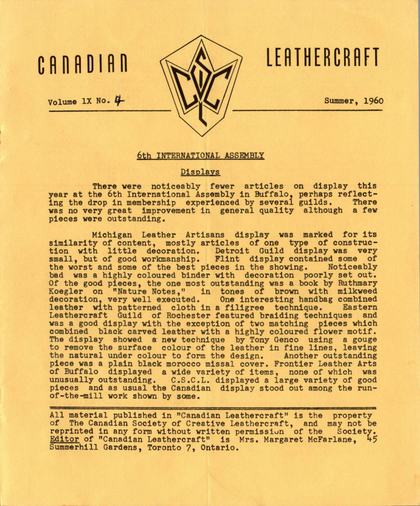
[The issue number is hand-written in ink over the printed masthead — "Volume IX No. 4".]
Page 2
SALON
A new method was used for the Salon this year. The judges viewed the entire display and selected pieces for the Salon display. There were no honor awards given. Of the 34 pieces selected by the judges, 10 were from the C.S.C.L. display, again showing the high quality of Canadian craftsmanship. Pieces were chosen on quality of craftmanship and originality of design and the result was that some people had several pieces chosen. Pieces varied from a lamp down through various types of handbags, boxes, books and wall hanging, to small flowers.
DEMONSTRATIONS
A unique feature of this year's Assembly demonstrations was having pupils work through a project while the demonstrator explained the steps. The audience liked this method because it allowed the demonstrator to give his full attention to their questions while the pupil carried out his instructions on the project. The demonstrators also approved as it meant that they could get more points across in less time.
"AESTHETICS AND LEATHERCRAFT"
During the 6th International Assembly, Paul Payne gave a lecture on this subject, and below are a few notes of this talk.
Art can be divided into four phases: the idea, technical skills, achievement of the object, criticism.
The ideas come first, but without technical skills, they do not mean anything. If you cannot do what you want to do, you cannot. express your idea. Criticism may come from anyone who views the object and all viewers are critics. If the judge does not understand what you were trying to do, he cannot judge it adequately.
Leathercraft does not have to be an art; it can be just a hobby to work off energy and develop skills. There is no real value in training people to try to make marketable items because there is no actual living in this field. The artist is his own critic and if he is a good critic will realise what part of his work is weak in the expression of his ideas. There is no creativity without great. skill. Some ideas should just remain ideas and should not be put into practice.
After the discussion, Paul Payne showed coloured slides of leatherwork to illustrate his points.
BANQUET
The banquet on Saturday evening in the spacious Terrace Room of the Statler Hotel, Buffalo, was. attended by approximately 125.
Page 3 — AFTER DINNER TALK
Mr. Fred N. Fischer, Master of Ceremonies, welcomed the leathercrafters and friends.
After a delicious dinner we were entertained by a group of dancers from the International Institute under the direction of Miss DeGrille.
The first folk dance, a rousing Hungarian number, was followed by a fast stepping Macedonian dance, then a South American number.
During the presentation of Salon Ribbons it was gratifying to see 10 awards come to members of the C. S. C. L.
Dr. D. Kenneth Winebrenner's presentation of the Jury's Comments on the articles exhibited left us with ideas for future work.
Many are already looking forward to the 7th International Assembly in 1961 to be hosted by C. S. C. L. and held at Prudhommes in Vineland, Ontario.
AFTER DINNER TALK
The after dinner talk "Design and the Craftsman" by Mr. Victor
Papenek was most topical and certainly made us think. He told us there are 215 types of leather available today but that most houses selling leather carry only approximately 50. kinds.
Jurors look for originality, technique and usability. Leather is the oldest medium used by man.
Craftsmen should explore more ways of using leather and use better fastenings and hardware. Commercial firms should also come up to date. Out of 160,000,000 leather handbags or pocketbooks manufactured annually, there are only around 800 models and 5 to 8 colours.
More emphasis should be placed on contemporary designs, they should be more typical of today. Old designs are not for the jet age. Why not experiment; be bold; give leather the place it deserves in the crafts renaissance of today.
Design is first, never accidental but intentional, must be intentional and it is also organization and must be functional. It must reflect, delight to look at. Aesthetic and function should be unity. Design is a conscious effort to impose order. In design the most important thing is to be creative.
Grateful acknowledgment to Betty Heacock, Clarice Packham and Dorothy Muma for their assistance in covering the 6th International Assembly.
Page 4 — LEATHER SPRAY COLOURING
LEATHER SPRAY COLOURING
By Janis Zalitis, A. C. S. C. L.
Some time ago, watching the demonstrations of the brush and screen spatter work, I just started to think, that the same results might be obtained with the atomizer much more quickly and easily. 1. Atomizers.
I have tried many small atomizers which are used for perfumes and in medicine, but usually the spray is not fine enough to do the most satisfactory work.
Very often the spray comes out in small drops, which does not make for even colouring or some fine shadings.
Some shoemaker's atomizers are good enough for covering larger areas in full tones and they might be adjusted for finer spray, using smaller tubes or adding a special nozzle, the main thing is to find an atomizer with a very fine spray. 2. Dyes.
Different colours thinned with water or Methyl Hydrate alcohol could be used, only it is much handier with alcohol dyes which penetrate and dry more quickly.
I have tried Garnett. Leather Craftsmen's Dyes, antiques and colour toning, which may be used alone or mixed to form new colours. also Omega Leather Dyes (alcohol), mostly mixed and thinned colours would be better to start with and always with light ones building up to darker ones. On many occasions the light tones leave much to see Of the beautiful leather material itself.
There is a wide field for each craftsman doing fine leather colouring and most of the skill necessary can be developed with practice. Amazing effects could be achieved using only brown colour in different strengths.
Artistic sense is helpful in mixing and matching colours but each person has some degree of artistic sense. 3. Preparing project for dyeing.
The leather must be dry and clean. The special designs coloured with a brush could be covered first with a polish coat, lacquer, or better still with special cut out covers of blotting paper or some absorbent thicker paper which easily takes in colours and doesn't leave lines along the edges.
Page 5 — BRANCH NEWS
It is easy to cut out covering parts with the help of the pattern put over the paper and trace the necessary parts. Very handy to hold the covers in place are heavy coins, nuts or other small metal things, but be careful with iron which leaves dark marks when wet.
4. Spraying.
To get even colouring and cover larger areas, it is better to keep the atomizer in movement, sideways or on circular motion, and to hold it about 8 - 12 inches from the project.
Always try the spray on a piece of paper (newspaper), before going over your project, even if you have stopped spraying for only a short time.
5. Finishing.
It takes about 2 hours with alcohol dyes and more with water dyes before you can start finishing. Anyway it would be quite safe to leave the projects for drying over night.
There are many different commercial liquids for finishing leather, such as liquid waxes, leather lacquers, etc. My best results are achieved with Garnett Polish Coat. Apply with soaked cotton swab, at first touching slightly the design and special coloured parts. Let them dry for a while and then go over the whole project.
BRANCH NEWS
Hamilton Branch are planning to hold Workshop Sessions between regular meetings by forming a so-called "Associate Club," in an effort to raise standards of work and enjoy fellowship while striving towards a goal. This group hope to commence meetings in the Fall.
Other branches might be interested in exploring this same idea as it may also help members to acquire their Associate or Fellow memberships.
Page 6 — SEMINARS
SEMINARS
Last year Mr. Douglas Duncan addressed the Seminar on leathercraft and from his remarks it was felt he was not fully cognizant of what our Society was doing. To allow him to examine pieces made by the Follows and Associates, they were invited, on March 5th, to his Studio at 2 Charles Street East - and sixteen attended.
Mr. Duncan studied book-binding in Paris for eight summers out of eleven between 1928 and 1939, and he stated his whole career was based on rectangles, not having had much experience with odd shapes, handbags and that sort. He has a very keen interest in seeing our craft developed to the line of other crafts. To achieve this he felt it almost requires that a separate organization be set up of the people who do the best work and are most interested - and sharply cut off from those who only work at it as a hobby.
In looking over the pieces each member brought, it was very evident a lot of skill was involved in some of them, but felt there was not enough design-wise. From his own experience he knows the difficulty in procuring materials, both leather and fittings. As a great deal of skill and time goes into making an article, the best leather should be used. Design-wise nice colour combinations could be used, but he found it very difficult to get good colours, and particularly those that will withstand sunlight.
In decorative design he dislikes mass carving. He feels strongly that what hinders the craftsman is the lack of interesting leathers and attachments that are available. On an excellent piece, the clasp, hinge or fastener looks as if it has come out of Woolworths. He felt it surely would not be below the notice of some of the metal workers to design metal parts, or a simple buckle for a belt which would enhance the leather and make it just five times as nice.
Mr. Duncan showed us some of his very handsome volumes he had bound. The designs are imprinted with hot tools. The straight lines and circles are accurate, without the look of free-hand drawing, as is the result of the tools we use.
Generally speaking, his criticism of our work was, that we are not as exact as we should be. A greater perfection in the assembly and finishing of the article, such as finely turned corners, could be achieved by practicing to skive thinly in order to get a very smooth thin corner.
Mr. Duncan thought probably we were cheating on him a little in bringing these particularly nice pieces. The discussion was lively - and so interesting, that five members stayed on sipping coffee and chatting until "it was early."
By Viola Harris.
Page 7 — LEATHER COVERED SHOEHORNS; MEMBERSHIP FEES; QUESTIONS AND ANSWERS
LEATHER COVERED SHOEHORNS
By Jean Newton, F. C. S. C. L.
Any metal shoehorn can be made a thing of beauty and a joy to use, by simply covering with pieces of leather.
Use 34% oz. leather, and allow a very good margin for easy stitching.
Wet the pieces of leather and allow to partially dry then mold over the metal shoehorn back and front and leave to dry.
Use a good leather cement and press both pieces of leather to the metal well over the edges and leave to set, then dye and polish.
Use space marker #6 as close to the edge of metal as possible and then punch holes with diamond awl or fine stitch punch for saddle stitching.
Complete stitching then cut off surplus leather close to the stitching, use edge dressing and polish edges, dye the edges and polish again.
The hole for the loop will be seen if the leather was firmly pressed on the metal, use a drive punch, or revolving punch to make the hole.
With four strands of 5/64 lacing make a round braided loop 7" long place one end through the hole and join the two ends with small turks head, trim ends of lacing.
MEMBERSHIP FEES
MEMBERSHIP FEES WERE DUE AND PAYABLE AT THE ANNUAL MEETING APRIL 9th, 1960. Membership
Membership - $3. annually
Members are reminded that only paid-up members will receive bulletins and notices of special meetings etc.
QUESTIONS AND ANSWERS
Question: What do you dilute dyes with? Answer: Garnett-water; Brazilian oil-alcohol; Omega-alcohol.
Page 8
We are pleased to have you come in and choose from our wide selection of Quality Leathers and Accessories. If not convenient, phone or write:
284 King Street West
Toronto 2B, Canada
EMpire 3-5206
AN ALL-CANADIAN COMPANY SERVING CANADIANS SINCE 1913
For the Leathercraftsman:
Antiques - Toning Dyes
Polish Coat
Edge Dressing
Inlay-Background Dye
Leather Cleaner & Polish Remover
Leather FU at your hobby supply store and
CANADIAN DISTRIBUTOR:
LEWISCRAFT
284 King St. West, Toronto, EM. 3-5206